The life cycle process model of efficient
construction manager
Kaklauskas, A, Amaratunga, RDG and Lill, I
Title
The life cycle process model of efficient construction manager
Authors
Kaklauskas, A, Amaratunga, RDG and Lill, I
Type
Conference or Workshop Item
URL
This version is available at: http://usir.salford.ac.uk/9697/
Published Date
2010
USIR is a digital collection of the research output of the University of Salford. Where copyright
permits, full text material held in the repository is made freely available online and can be read,
downloaded and copied for noncommercial private study or research purposes. Please check the
manuscript for any further copyright restrictions.
The Life Cycle Process Model for Efficient Construction
Manager: Conceptual Modelling at the level of Personality and at
Micro, Meso and Macro Levels
Prof. PhD. DrSc. Artūras Kaklauskas, Chairman of the Department of Construction Economics and Property Management,
Vilnius Gediminas Technical University, Sauletekio al. 11, LT-10223 Vilnius, Lithuania, e-mail: [email protected]
Prof. Dilanthi Amaratunga, Director of International Development Centre for Disaster Resilience, School of the Built Environment, Maxwell Building - Room 435,
The University of Salford, Salford M5 4WT, UK, e-mail: [email protected]
Prof. Irene Lill, Chair of Department of Building Production,
Tallinn University of Technology, Ehitajate tee 5, 19086 Tallinn, Estonia, e-mail: [email protected]
Abstract. The problem is how to define the life cycle of an efficient construction manager when a lot
of various stakeholders are involved in his activities, when alternative versions of construction
management come to hundreds of thousands and when the efficiency changes with the alterations in
the personality traits, the micro, meso and macro conditions and the constituent parts of the process in
question. Formalized presentation of the research shows how changes in the personality traits, micro,
meso and macro environment and the extent to which the goals pursued by various stakeholders are
satisfied cause corresponding changes in the value and utility degree of a construction manager life
cycle. For that purpose, we need to analyse versions of a construction manager life cycle, because such
analysis helps to find an optimal combination of factors related to the personality and micro, meso and
macro environment. The more alternative versions are investigated before making a final decision, the
greater is the possibility of a more rational end result. Using the available information it is possible to
perform the multiple criteria analysis of the components of a construction manager life cycle and to
select the most efficient versions. Afterwards, the resulting compatible and rational components are
combined into the alternatives of a construction manager life cycle. Following the multiple criteria
analysis of the alternatives obtained in this way, the most efficient alternatives can be selected.
Strengths and weaknesses of investigated alternatives are also analysed. The facts determining why
and to what extent one version is better than the other are also established. All analyses are based on
conceptual and quantitative information.
Keywords: construction manager life cycle; personality traits; micro, meso and macro factors; alternatives;
multiple criteria analysis; model.
Many countries around the world (USA, Japan, UK, Finland, Australia, Sweden, Netherlands, Estonia,
Lithuania, Spain, Argentina, Chile, Colombia, etc.) take up market-oriented higher education reforms.
Econometric, status-attainment, combined and other models are developed to justify such reforms. The
University of Salford, Tallinn University of Technology and Vilnius Gediminas Technical University took
part in the project “Lifelong University: Modernising Built Environment Higher Education Programmes
through Responsiveness” (BELL CURVE) and developed the Life Cycle Process Model of a
Market-oriented Higher Education and the Life Cycle Process Model for Efficient Construction Manager.
Universities operating in the UK, Estonia and Lithuania have lots of programmes and specialisations
related to built environment. Various countries of the world use catalogues of national qualifications
and higher national units. Such catalogues include numerous qualifications and higher national units
covering the area of built environment. It is a rather complicated task to compare the knowledge
provided by all such programmes and specialisations to the built environment requirements applicable
to professionals. Therefore, we shall limit this research to analysis, as an example, of the requirements
applicable to the life cycle of construction project management professionals at various levels. There
are plenty of diverse project management leader models developed worldwide. Obviously, project
managers must satisfy increasingly higher requirements with each step in their careers. The authors of
thi paper developed the Life Cycle Process Model for Efficient Construction Manager.
The Life Cycle Process Model for Efficient Construction Manager suggested in this research is based on
a presumption that the efficiency of a construction manager depends on many variables at the personality
level and at micro, meso and macro level. The presence of specific personality traits and micro, meso
and macro level variable factors right away imposes objective limitations on efficient activities of
construction project management professionals of various levels. A construction manager, in presence of
these objective limitations, tries to perform his/her functions with utmost efficiency within their bounds.
Advanced managers, basing themselves on this assertion, are trying to create for themselves rational
working environmental and operating conditions in order to achieve the best satisfaction of stakeholders’
and own needs. The research aimed to come up with the Life Cycle Process Model for Efficient
Construction Manager with the help of the complex analysis of personality traits and micro, meso and
macro environment variables affecting the life cycle. Another aim was to give recommendations helping
to increase the competitive ability. The research was performed by studying the best global practice and
by adapting it to UK, Estonia and Lithuania taking into account their specific history, their level of
Construction managers cannot correct or alter the micro, meso and macro level variables, but they can
go into the essence of their effect and take them into account when realizing various projects. When
construction managers know the personality traits and micro, meso and macro level factors that affect
their current projects, they can organize their present and future activities more successfully.
This paper is structured as follows: Section 2 analyses the leader models for project management;
Section 3 describes the efficient construction manager—conceptual modelling at the level of
personality and at micro, meso and macro levels; Section 4 analyses the core competencies; Section 5
describes the five factor model, IQ, emotional intelligence and work performance; Section 6 presents
the ability to predict job performance and personnel assessment tools; and the paper ends with some
concluding remarks.
2. Leader Models for Project Management
Founded in 1953, FMI provides management consulting and investment banking for the worldwide
construction industry. FMI performed project management survey in 2006 (FMI, 2006). In the survey,
construction industry executives were asked about the performance of their project managers and their
practices in four main areas: technology use, personnel, operations and project coordination.
The results of the FMI Project Management Survey suggest that companies can take steps in their
hiring process to improve their chances of getting the right person for the job. The survey results also
suggest that part of the problem of finding the right project managers rests in how a company defines
the role and, more importantly, how a company defines its project management processes. Companies
like to be able to say in their proposals and marketing literature that they deliver on time and within
budget. Our research with owners confirms that these are the top two characteristics that owners look
for when choosing a contractor. They also look for communication and collaboration skills, integrity,
and planning and scheduling abilities. Construction executives, when asked about project management
challenges, often highlight these skills. Nonetheless, one inalienable truth about the construction
process is that there will be problems during project construction. The following comments from
industry executives might sound familiar (FMI, 2006).
For all responses, experience (38%) and communication skills (30%) rated as the most important skills
needed by project managers. Companies with over $200M revenue placed a higher value on
communication skills (46% vs. 26%) compared to smaller companies (<$200M). Overall, respondents
rated financial management as the skill that new candidates lack most when entering the workforce
Larger companies more often said that communication skills were most lacking in new candidates
(42%) with financial management skills the next concern on the list (35%). Larger organizations place
a greater emphasis on communication skills than on financial management skills, or experience. This
reflects the need to communicate with more people and departments in a larger company internally.
Other resources available in larger companies fill the gap for lack of financial management skills,
technical competency, and experience. Generally, the weakness in skills of new project management
candidates reflects a disconnect between universities and contractors. If contractors make it known
that they are mostly concerned with technical skills, universities are more likely to turn out graduates
strong in technical skills. Universities may respond by adding financial management and
communications course materials to the curriculum; however, additional coursework adds time and
expense to the attainment of a qualified degree. The alternative for most is to get the training once they
enter the workforce through mentoring, on-the-job training, or third-party training programs. The most
expensive of these choices is most often the on-the-job method, especially if it means the student has
to make several costly errors before he or she learns the right way to go about it (FMI, 2006).
According to the FMI Project Management Survey the top five weakest skill sets noted by all
respondents were (FMI, 2006):
• Cost to complete and profit projections (21% of responses);
• Time management (12%);
• Closeout skills (11%);
• Communication (written) (10%);
• Change order management (10%).
The top five strongest skill sets noted by all respondents were (FMI, 2006):
• Client/customer relations (35%);
• Understanding the building process (27%);
• Change order management (8%);
• Cost to complete and profit projections (6%);
• Communication (written) (5%).
The good news when it comes to skill sets is that project managers are best at client/customer relation
skills, and they understand the building process. These skills are in line with the two traits that
contractors place the most emphasis on when hiring project managers—experience and communication
skills. At the same time, communication skills and experience are among the top causes for concern for
construction executives with their project managers. There is no single area that all project managers are
weak or strong in, but most have sufficient building experience to understand the process. If the goal is
over the course of a career, the project managers that become true project leaders increasingly focus on
improving their “soft skills,” which includes management and leadership skills.
When we examine the ideal project leader model, it appears we are really thinking about three
different people with three different skill sets. Companies look most often for project experience when
evaluating new project managers, followed by communication skills. Technical skills are assumed for
most project managers entering the job market, especially when the requirement is a four-year
construction management degree. Little, if any, emphasis is placed on financial management skills, yet
that is the area reported as lacking most often when new project managers enter the workforce. In the
FMI Project Leader Model, possessing just one skill is not enough, nor it is enough to have skills in all
three areas, if one is operating in a vacuum. To be most effective, the true project leader applies all of
these skills collaboratively, and mission-critical processes are designed with this in mind (FMI, 2006).
The companies reporting the highest rate of on time/on budget performance place the highest emphasis
on communication skills, yet only about 16% of companies overall said that a four-year, non-technical
degree was a minimum requirement. That degree likely would produce candidates stronger in the two
areas that concern companies the most—communication skills and financial management. It is typical
for a company in an industry as technical as the construction industry is to emphasize project
experience for new candidates. Project mistakes can be dangerous and costly. It seems that,
historically, the general belief has been that a construction firm needs to hire experience and technical
skills, and the other, softer, skills will be learned on the job. Often this approach has produced
unsatisfactory results, especially if a firm hasn't identified their project management best practices and
haven't reinforced the project managers as planner, communicator, and businessperson (FMI, 2006).
It may be noticed that the researchers from various countries engaged in the analysis of leader models
for project management did not consider the research object being analysed by the authors of the
present investigation. The latter may be described as follows: a life cycle of a construction manager,
the parties involved in his construction activities as well as his personality traits, micro, meso and
macro environment having a particular impact on it making an integral whole. A complex analysis of
the research object formulated was made with the help of new methods for multiple criteria project
analysis specially developed for this purpose.
3. Efficient Construction Manager: Conceptual Modelling at the Level of Personality Traits, Micro, Meso and Macro Environment
the help of a complex analysis of personality traits and micro, meso and macrolevel factors affecting
the manager. Another aim was to give recommendations helping to increase the competitive ability.
The research included analysis of the best global research and practice, and its adaptation to the
countries participating in the BELL CURVE project considering their specific history, their level of
development, their needs and traditions. A simulation was done to gain insight into creating an
effective environment for the project manager by interdependent harmonization of personality traits,
micro, meso and macrolevel factors.
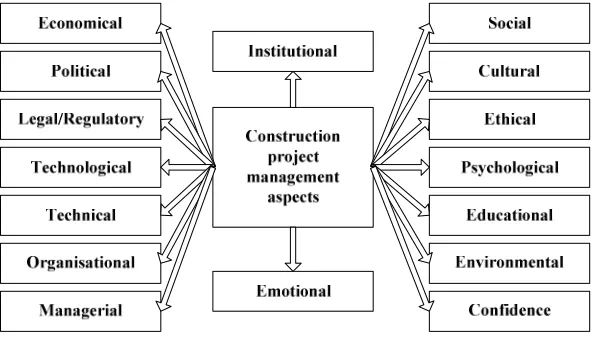
The new original Life Cycle Process Model for Efficient Construction Manager proposed by the authors
of the present investigation considers economical, political, legal/regulatory, technological, technical,
organisational, managerial, institutional, social, cultural, ethical, psychological, educational,
environmental, emotional and confidence factors (see Figure 1). It also covers personality traits, the
[image:7.595.72.371.400.569.2]conditions of micro, meso and macro environment, and analyses the construction manager life cycle.
Figure 1: Aspects of the construction project management
The level of a project manager’s efficiency depends on numerous personality traits and micro, meso
and macro level variable factors; all these variable factors can be optimised. The main objective of the
present Model is to analyse the best experiences in the field, to compare them and to present particular
recommendations eventually.
Project managers usually cannot correct or alter their personalities and micro, meso and macro level
managers, aware of their own personality and the environment affecting their projects, can organize
their present and future activities more successfully.
This research included the following six stages (using the case of Lithuania).
Stage I. Comparative description of universal advanced project managers and Lithuanian project
managers (involves analysis of the best global research and practice):
• A system of criteria characterizing project manager’s efficiency was determined with the help
of relevant literature and experts methods;
• Based on the system of criteria, the present state of universal advanced project managers and
Lithuanian project managers is described in conceptual (textual, graphical, numerical, etc.)
and quantitative forms.
Stage II. Comparison and contrast of universal advanced project managers and Lithuanian project
managers:
• Identifying the global development trends (general regularities) related to project managers;
• Identifying the differences between universal advanced project managers and Lithuanian
project managers;
• Determining the pluses and minuses of these differences in case of Lithuania;
• Determining the best practice for Lithuanian project managers based on the actual conditions.
• Estimating the deviation between construction managers’ knowledge about the best global
practice and their practice-in-use.
Stage III. Development of some of general recommendations helping construction managers to
improve their efficiency levels.
Stage IV. Formulation of particular recommendations for construction managers. Each of the general
recommendations proposed in Stage III has several particular alternatives.
Stage V. This stage included multiple criteria analysis of the components comprising a project
manager’s life cycle and selection of the most efficient versions. The compatible and rational
components obtained after this stage are combined to make a complete life cycle of a project manager.
• Construction managers become aware of and conceptualise their practice-in-use;
• Construction managers become aware of and conceptualise their knowledge of best global
practice;
• Construction managers estimate the deviation between their knowledge about the best global
practice and their practice-in-use;
• Best practice learning;
• Best practice actions (understanding what the recurring motives caused the initial behaviour
of a manager; redesigning the core patterns of managers’ thought and behaviour);
• Transformational learning (acquiring new manners of technological, social, ethical and other
behaviour, better understanding of how to interact with micro and macro environment) and
redesigning of the behaviour.
In order to throw more light on the Life Cycle Process Model for Efficient Construction Manager, we
proceed with a more detailed description of some aforementioned aspects of the analysis (core
competencies, the five factor model, IQ, emotional intelligence and work performance, ability to
predict job performance and personnel assessment tools).
4. Core Competencies
In the global market, modern organizations face high levels of competition. In the wake of
increasingly competitive world market the future survival of most companies depends mostly on the
dedication of their personnel to companies. Employee or personnel performances such as capability,
knowledge, skill, and other abilities play an important role in the success of an organization (Güngör
et al., 2009).
Selection of qualified human resources is a key success factor for an organization. The complexity and
importance of the problem call for analytical methods rather than intuitive decisions (Kelemenis and
Askounis, 2009).
Competencies in organizations can be broadly classified as employee-level and organizational-level.
Since organizational-level competencies are embedded in employee-level competencies, the
identification of the latter is important for organizations interested in using competencies to achieve
competitive advantage (Cardy and Selvarajan, 2006). In addition to the traditional frameworks, which
are more suitable for organizations functioning in a static environment, Cardy and Selvarajan (2006)
offer two alternative frameworks that can be useful in identifying competencies in a dynamic
A core competency is a specific factor that a business sees as being central to the way it, or its
employees, works. It fulfils three key criteria: it provides consumer benefits; it is not easy for
competitors to imitate; it can be leveraged widely to many products and markets. A core competency can
take various forms, including technical/subject matter know-how, a reliable process and/or close
relationships with customers and suppliers. It may also include product development or culture, such as
employee dedication (Wikipedia, 2010). Core competencies are the source of competitive advantage and
enable the firm to introduce an array of new products and services. Core competencies lead to the
development of core products (QuickBMA, 2010). Also the core competencies can be defined as
(Wikispaces, 2010) a set of integrated and harmonized abilities that distinguish a firm in the market
place.
Competencies could be very diverse. For example, Goleman (2010) has developed the following
model of competencies:
• Personal competence: these competencies determine how we manage ourselves:
o Self-awareness: knowing one’s internal states, preferences, resources and intuitions.
o Emotional self-awareness: recognising one’s emotions and their effects.
o Accurate self-assessment: knowing one’s strengths and limits.
o Self-confidence: a strong sense of one’s self-worth and capabilities.
o Self-management: managing one’s internal states, impulses and resources.
o Self-control: keeping disruptive emotions and impulses in check.
o Trustworthiness: maintaining standards of honesty and integrity.
o Conscientiousness: taking responsibility for personal performance.
o Adaptability: flexibility in handling change.
o Achievement-orientation: striving to improve or meeting a standard of excellence.
o Initiative: readiness to act on opportunities.
• Social competence: these competencies determine how we handle relationships:
o Social awareness: awareness of others’ feelings, needs and concerns.
o Empathy: sensing others’ feelings and perspectives, and taking an active interest in their
concerns.
o Organisational awareness: reading a group’s emotional currents and power
relationships.
o Service orientation: anticipating, recognising and meeting customers’ needs.
o Social skills: adeptness at inducing desirable responses in others.
o Developing others: sensing others’ developmental needs and bolstering their abilities.
o Influence: wielding effective tactics for persuasion.
o Communication: listening openly and sending convincing messages.
o Change catalyst: initiating or managing change.
o Conflict management: negotiating and resolving disagreements.
o Building bonds: nurturing instrumental relationships.
o Teamwork and collaboration: working with others toward shared goals. Creating group
synergy in pursuing collective goals.
Project mangers plan, organize, staff, direct, and control the project while being the direct link to the
customer. Ultimately, it is the responsibility of project managers to make appropriate trade-offs for time,
cost, and performance requirements of the project. They must introduce the right people into the project
at the right time to satisfy the project goals and the customer’s objectives, etc. (De Korvin et al., 2002).
There is a growing awareness of the relationship between achieving project success and construction
project managers’ competences. However, the key behavioural competencies involved in the
performance domain are dynamic and difficult to identify (Cheng et al., 2005). Many project-based
organisations within the construction industry are becoming keenly interested in identifying the
appropriate behavioural competencies of the key managerial staff (Dainty et al., 2005).
Crawford (2005) proposed three competency classifications:
• Input competencies refer to the knowledge and skills that a person brings to a job.
• Personal competencies are the core attributes underlying a person’s capability to execute a job.
• Output competencies relate to the “demonstratable” performance that a person exhibits at the
job place.
According to Ahadzie et al. (2008) construction project managers’ performance measures have been
conceptualised based on the iron triangle of time, cost and quality and key traits such as leadership,
ambitious, aggressiveness. Thus, superior managers do not simply require the knowledge of the
requisite behavioural actions but are conscious of how their management style reflects on their actions,
and in so doing they learn and develop themselves (Ahadzie et al., 2008).
Interpersonal skills may include leadership skills, verbal and non-verbal communication skills,
decision-making, dealing with emotions and stress, conflict management, trust building, negotiating,
demonstrating sensitivity to diversity issues, and modelling of the desired behaviour. The application
of interpersonal skills may be influenced by the phase of the project life cycle.
Much has been written regarding project success, and one of the factors contributing to project success
is the role of the project managers. Since project success can be enhanced by selecting the most
appropriate project managers, Bedingfield and Thal (2008) investigated the role of the Big Five
personality traits on project success by surveying project managers. The findings indicate that
Conscientiousness and Openness were both good predictors of successful project managers. The
results may be useful as one consideration when hiring and selecting project managers. Although the
literature is replete with studies regarding project success, there appears to be little information
regarding the effect of the project manager’s personality, specifically as determined by peer
assessments. Therefore, (Bedingfield and Thal, 2008) report the results of an exploratory study to
investigate the influence of project manger personality traits, as determined by the Five Factor Model
(FFM), on project managers success. Perceptions of both personality and project managers success
were analysed using Student's t-test, a correlation matrix, and hierarchical generalised linear modelling
(HGLM). The results indicated that two of the FFM personality traits, Conscientiousness and
Openness, seemed to positively correlate with project managers success. Emotional Stability, another
personality trait, was found to be significant with the difference of means test but not the HGLM
effort. Finally, the remaining FFM traits, Extraversion and Agreeableness, did not appear to correlate
with project managers success (Bedingfield and Thal, 2008).
According to Gottfredson (1997) personnel selection research provides much evidence that
intelligence (g) is an important predictor of performance in training and on the job, especially in
higher level work. Gottfredson (1997) provides evidence that g has pervasive utility in work settings
because it is essentially the ability to deal with cognitive complexity, in particular, with complex
information processing. The more complex a work task, the greater the advantages that higher g
confers in performing it well. Everyday tasks, like job duties, also differ in their level of complexity.
The importance of intelligence therefore differs systematically across different arenas of social life as
well as economic endeavor. Data from the National Adult Literacy Survey are used to show how
higher levels of cognitive ability systematically improve individual’s odds of dealing successfully with
the ordinary demands of modern life (such as banking, using maps and transportation schedules,
reading and understanding forms, interpreting news articles). These and other data are summarized to
illustrate how the advantages of higher g, even when they are small, cumulate to affect the overall life
chances of individuals at different ranges of the IQ bell curve. Gottfredson (1997) concludes by
suggesting ways to reduce the risks for low-IQ individuals of being left behind by an increasingly
According to Whitman et al. (2009) EI positively predicts performance for high emotional labor jobs
and negatively predicts performance for low emotional labor jobs).
The Five Factor Model (FFM) or “Big Five” approach has emerged as the dominant taxonomic approach
in the realm of personality research. The increased focus that has been seen with respect to using
personality traits for employee selection and promotion purposes has led to a concomitant increase in the
need for researchers and practitioners to evaluate the quality and measurement precision of the
personality instruments they use to estimate the FFM dimensions (Trippe and Harvey, 2003).
Have you ever wondered why, within your workplace, two individuals holding similar positions, and
with similar education, training, and experience, achieve different levels of success? Why, in
situations of high stress, one employee soars while another derails? Or why, when you promoted your
top performer in one department into another, his performance faltered? It’s likely that, in all these
situations, emotional intelligence played a large part. Emotional intelligence (EI) refers to the ability to
perceive and understand our own emotions, to control them and utilize them positively, as well as to
perceive, understand, and respond appropriately to the emotions of others. Put simply, it is the way in
which we cope within our surroundings. Within the workplace, EI has proven itself more valuable and
more predictive of success than cognitive intelligence, or IQ (Rieschi, 2008).
As human beings, our initial reaction to any stimulus is emotional, followed closely by logic and
reason as tempering influences. This doesn’t change appreciably when we enter the workplace. One EI
theorist described EI as our tactical, in-the-moment response style, while IQ reflects a more reflective
or strategic way of thinking and acting. EI theory has effectively put structure and substance around
those very essential but somewhat nebulous work traits generally referred to as “soft skills.” One
highly regarded EI inventory, the BarOn EQi (emotional quotient inventory) breaks EI into fifteen
subscales: emotional self-awareness, assertiveness, independence, self-regard, self-actualization,
empathy, social responsibility, interpersonal relationship, stress tolerance, impulse control, reality
testing, flexibility, problem-solving, optimism, happiness (Rieschi, 2008).
The EI subscales, alone and in combination, impact work performance to greater or lesser degrees,
based upon the nature of the job. A salesperson, for example, would benefit from a high degree of
interpersonal skill and assertiveness, but may be impeded if he is highly empathetic or socially
conscious — these traits may hamper his ability to close the sale, since they may cause him to focus
on other factors such as concern for the purchaser’s financial circumstance, or true need for the
not recognize the risks facing his company, and may make unsound decisions too quickly, with too
little supporting data. A police officer requires a high degree of assertiveness, but this skill in
combination with low stress tolerance and impulse control could be a disaster waiting to happen. The
manager who is high in interpersonal skills yet low in optimism may not be able to motivate his staff
to achieve their targets. These examples, although simplistic, illustrate the importance of EI in the
workplace, as well as the correlation of certain EI profiles to success in specific career fields (Rieschi,
2008).
Recent and ongoing research by Multi-Health Systems suggests that EI can account for as much as 45
per cent of work success. Preliminary research has now been published which aims to identify optimum
EI profiles for various career fields. Armed with this knowledge, it makes abundant sense to incorporate
EI as a recruitment tool and as a factor in determining promotions or transfers. Fortunately, unlike IQ,
each of us has the ability to improve our EI at will. This means that EI assessments can help to
formulate performance-improvement and/or career-progression plans (Rieschi, 2008).
As with any new recruitment or organizational-development strategy the essential starting point is to
understand your particular work environment and the EI skills that, on a general level, will predict
success. The second step involves assessing the various occupations and career fields within the
organization to identify corresponding EI profiles. You can start by identifying and benchmarking
your star players. There are a number of well-researched and evidence-based instruments, such as the
BarOn EQi, from which to choose. You will then be well positioned to use EI inventories as a
component of both employee-selection and employee-promotion procedures. Work scenarios designed
to allow you to observe the candidates’ EI skills in action can also provide great insight. While EI
inventories should never be used as a stand-alone decision-making tool, and should always be
interpreted by a trained administrator, they can be counted upon to provide additional, very valuable
data for determining — and improving — both person-organization and person-job fit (Rieschi, 2008).
6. Ability to Predict Job Performance and Personnel Assessment Tools
Rothstein and Goffin (2006) analyse the ability of personality to predict job performance, including
the Five Factor Model of personality versus narrow personality measures, meta-analyses of
personality–criterion relationships, moderator effects, mediator effects, and incremental validity of
personality over other selection testing methods. By the 1990s, however, methodological innovations
in meta-analysis and the emergence of a widely accepted taxonomy of personality characteristics, the
“five factor model” or FFM (i.e., Extraversion, Agreeableness, Emotional Stability,
provided a much more optimistic view of the ability of personality measures to predict job
performance (Rothstein and Goffin, 2006).
The conventional personnel selection approaches that are developed on the basis of static job
characteristics will no longer suffice (Lievens et al., 2002).
Any test or procedure used to measure an individual’s employment or career-related qualifications and
interests can be considered a personnel assessment tool. There are many types of personnel assessment
tools in human resource management to help organizations make better personnel selection decisions
(Personnel Assessment, 2010). These include interviews, job knowledge tests, work sample tests,
cognitive tests, and personality tests, Big Five traits, IQ and aptitude testing, group exercises,
personality testing and in-tray exercises.
Personnel assessment tools differ in: what they are designed to measure, e.g., abilities, skills, work
styles, work values, or vocational interests; what they are designed to predict, e.g., job performance,
managerial potential, career success, job satisfaction, or tenure. Tests, inventories, and procedures are
assessment tools that may be used to measure an individual’s abilities, values, and personality traits.
They are components of the assessment process (Personnel Assessment, 2010):
• observations
• resume evaluations
• application blanks/questionnaires
• biodata inventories
• interviews
• work samples/performance tests
• achievement tests
• general ability tests
• specific ability tests
• physical ability tests
• personality inventories
• honesty/integrity inventories
• interest inventories
• work values inventories
• assessment centers.
All assessment tools used to make employment decisions, regardless of their format, level of
evaluation of a resume and the use of a highly standardized achievement test must comply with
applicable laws. Assessment tools used solely for career exploration or counselling are usually not
held to the same legal standards.
Employees and applicants vary widely in their knowledge, skills, abilities, interests, work styles, and
other characteristics. These differences systematically affect the way people perform or behave on the
job. These differences in characteristics are not necessarily apparent by simply observing the
employee or job applicant. Employment tests can be used to gather accurate information about
job-relevant characteristics (Personnel Assessment, 2010).
Some tests can be used to predict employee and applicant job performance. In testing terms, whatever
the test is designed to predict is called the criterion. A criterion can be any measure of work behaviour
or any outcome that can be used as the standard for successful job performance. Some commonly used
criteria are productivity, supervisory ratings of job performance, success in training, tenure, and
absenteeism. Assessment strategies should be developed with a clear understanding of the knowledge,
skills, abilities, characteristics, or personal traits you want to measure. It is also essential to have a
clear idea of what each assessment tool you are considering using is designed to measure. Using a
single test or procedure will provide you with a limited view of a person’s employment or
career-related qualifications. Moreover, you may reach a mistaken conclusion by giving too much weight to a
single test result. On the other hand, using a variety of assessment tools enables you to get a more
complete picture of the individual. The practice of using a variety of tests and procedures to more fully
assess people is referred to as the whole-person approach to personnel assessment. This will help
reduce the number of selection errors made and will boost the effectiveness of your decision-making.
This leads to an important principle of assessment (Personnel Assessment, 2010).
Concluding Remarks
The original contribution of this article is as follows:
• The new original Life Cycle Process Model for Efficient Construction Manager proposed by
the authors of the present investigation considers economical, political, legal/regulatory,
technological, technical, organisational, managerial, institutional, social, cultural, ethical,
psychological, educational, environmental, emotional and confidence factors. It also covers
personality traits and the conditions of micro, meso and macro environment, and presents the
analysis of the construction manager’s life cycle.
• In order to increase the efficiency of a construction manager life cycle the Life Cycle Process
development of construction manager was developed enabling the users to achieve better
practical results in designing more effective life of construction manager. The Model allows
developing tens of thousands of alternative variants for an efficient construction manager life
cycle and to select the most rational of them.
• Formalized presentation of the research shows how changes at the level of personality and at
micro, meso and macro levels and the extent to which the goals pursued by various interested
parties are satisfied cause corresponding changes in the value and utility degree of a
construction manager life cycle. With this in mind, it is possible to solve the problem of
optimization concerning satisfaction of the needs at reasonable expenditures. This requires the
analysis of construction manager cycle versions allowing to find an optimal combination of
goals pursued and finances available.
• Based on the analysis of existing neural networks, knowledge, expert and decision support
systems and in order to determine most efficient versions of construction manager life cycle a
Decision Support System for Construction Manager Life Cycle Analysis consisting of a
database, database management system, model-base, model-base management system and
user interface is under development.
Literature
Ahadzie, D. K., Proverbs, D. G. and Olomolaiye, P. (2008) Towards developing competency-based
measures for construction project managers: Should contextual behaviours be distinguished from task
behaviours? International Journal of Project Management.
Bedingfield, J. D. and Thal, A. E., Jr. (2008) Project Manager Personality as a Factor for Success. In
Proceedings of 2008 Portland International Conference on Management of Engineering and
Technology: Technology and Innovation Management.
Cardy, R. L. and Selvarajan, T. T. (2006) Competencies: Alternative frameworks for competitive
advantage. Business Horizons.
Cheng, M. I., Dainty, A. R. J. and Moore, D. R. (2005) What makes a good project manager? Human
Resource Management Journal.
Crawford, L. (2005) Senior management perceptions of project management competence.
Dainty, A. R. J., Cheng, M. I. And Moore, D. R. (2005) Competency-based model for predicting
construction project managers’ performance. Journal of Management in Engineering, ASCE.
De Korvin, A., Shipley, M. F. and Kleyle, R. (2002) Utilizing fuzzy compatibility of skill sets for team
selection in multi-phase projects. Journal of Engineering and Technology Management.
FMI Corporation. (2006) Project Management Survey,
http://www.build-project-management-competency.com/wp-content/uploads/2009/12/FMI-06-Project-Management-Surveyfin.pdf.
Goleman, D. (2010) Emotional Intelligence,
http://www.cipd.co.uk/subjects/lrnanddev/selfdev/emotintel.htm.
Gottfredson, L. S. (1997) Why g matters: The complexity of everyday life. Intelligence 24 1 SPEC.ISS.
Güngör, Z., Serhadlıoğlu, G. and Kesen, S. E. (2009) A fuzzy AHP approach to personnel selection problem. Applied Soft Computing.
Kelemenis, A. and Askounis, D. (2009) A new TOPSIS-based multi-criteria approach to personnel
selection. Expert Systems with Applications, In Press, Corrected Proof.
Lievens, F., Van Dam, K. and Anderson, N. (2002) Recent trends and challenges in personnel
selection. Personnel Review.
Personell Assessment. (2010) Personell Assessment. http://www.hr-guide.com/data/G360.htm
QuickMBA. (2010) Strategic management. Core Competencies,
http://www.quickmba.com/strategy/core-competencies/.
Rieschi, G. (2008) Personnel selection and development — the emotionally intelligent way,
Rothstein, M. G. and Goffin, R. D. (2006) The use of personality measures in personnel selection:
What does current research support? Human Resource Management Review.
Trippe, D. M. and Harvey, R. J. (2003) Item Response Theory Analysis of the IPIP Big-Five Scales.
http://harvey.psyc.vt.edu/Documents/TrippeHarveySIOP2003.pdf.
Whitman, D. S., van Rooy, D. L., Viswesvaran, C. and Kraus, E. (2009) Testing the second-order
factor structure and measurement equivalence of the Wong and Law emotional intelligence scale
across gender and ethnicity. Educational and Psychological Measurement.
Wikipedia. (2010) Core competency, http://en.wikipedia.org/wiki/Core_competencies.