International Journal of Emerging Technology and Advanced Engineering
Website: www.ijetae.com (ISSN 2250-2459,ISO 9001:2008 Certified Journal, Volume 4, Issue 5, May 2014)
Comparison of Different Scheduling Algorithm for LTE
Ronak D. Trivedi
1, M. C. Patel
2Abstract— In this paper we evaluate the performance of Packet Scheduling (PS) for different packet scheduling algorithms of 3GPP UTRAN Long Term Evolution (LTE) Downlink. Packet scheduling is importance in 3G LTE, because different types of traffic with different Quality of Service requirements are competing of the resources. In this paper, packet scheduler for LTE downlink is described. Comparison of three basic packet scheduling algorithm with their simulation result with different amount of fairness is explained. This paper shows that by dividing the packet scheduler into a time domain, frequency domain and also utilizing those using different algorithms, the throughput fairness between users can be effectively controlled.
Keywords—LTE, round robin, proportional fair, best CQI,scheduling.
I. INTRODUCTION
Recently the increase of mobile data usage and appearance of new application like mobile TV, Web2.0 and other streaming contents forced the 3rd Generation Partnership Project (3GPP) to develop the Long-Term Evolution (LTE). Long term evolution (LTE) is a latest radio access technology planned by the 3GPP in order to provide a smooth journey towards fourth generation (4G) wireless systems.
In the 3GPP LTE radio network architecture, there is only one node between the user and the core network known as eNodeB which is used to operate all radio resource management (RRM) functions. Packet scheduling is function of the RRM. Because of its smart selections of users and transmission of their packets, the radio resources are utilized efficiently and QoS (quality of service) is also maintained.
Packet scheduling for wireless communications has been an active research area in recent years, because there has been rapidly increasing demands on data services with the likely to explode progress of traffic such as Internet, Email, multimedia. To support these packet data services, the scare and limited wireless resource must be used in best way to increase capacity and security QoS. Providing priority or fairness is also an open issue in wireless system. However, it is not simple to meet all of these requirements.
The throughput of a UE depends on the different factor like scheduling algorithms, distance from eNodeB, multipath environment, multiple antenna techniques and UE speed. In this paper, we consider the effect of scheduling algorithm with throughput performance. We apply proportional fair (PF) scheduler, round robin and best CQI for LTE in order to find best scheduler which provides high-quality cell throughput and improved fairness. The scheduler has to serve multiple users and also tries to meet individual user requirements on bit rates and delays. The fairness of the scheduler is a way to couple the scheduler and it help to the weakest users is proposed.
II. BACKGROUND OF THE INVENTION
LTE aims at ambitious goals such as e.g. [2], [3], [4] • LTE has goal about Peak data rate is 100 Mbps in
downlink and 50 Mbps in uplink • Increased cell edge throughput
• Significantly improved spectral efficiency e.g. 2-4 times better than in 3GPP Release 6
• User plane latency below 5 ms with 5 MHz or higher spectrum allocation
• Significantly reduced control plane latency e.g. transition time of less than 100 ms from a camped-state to an active camped-state
International Journal of Emerging Technology and Advanced Engineering
Website: www.ijetae.com (ISSN 2250-2459,ISO 9001:2008 Certified Journal, Volume 4, Issue 5, May 2014)
Both time (TDD) and frequency division duplex (FDD) modes can be used in LTE. In downlink the time is separated into 1 ms Transmission Time Intervals (TTI) and in frequency 180 kHz Physical Resource Blocks (PRB). LTE is optimized for packet data transfer and the core network is purely packet switched. In [5] the authors study the spectral efficiency of LTE DL with different UE receiver structures and with advanced SIMO receivers they achieved about 1.25 bits/s/Hz. In [6] the authors show about 1.56 bits/s/Hz spectral efficiency.
The time domain (TD) packet scheduler choose a subset of all users linked to the base station (called evolved Node-B (eNNode-B) in LTE ) and the FD scheduler does the real frequency allocation for the users. This division is suitable for two reasons: using different schedulers in both scheduling domains provides scheduling flexibility, since both domains can be independently configured.
The scheduling in both the TD and FD is through algorithm-specific scheduling priority metrics. A priority metric generally provide the function of obtaining a certain general characteristic of the scheduling algorithm. These characteristics can be e.g. certainty of regular scheduling, fairness among users or highest possible spectral efficiency. Most scheduling metrics can be used for both TD and FD scheduling and they can be also a grouping of different metrics.
Packet scheduler cooperates with CQI manager, link adaptation and throughput measurement (TPM). CQI calculation gives us PRB dependent channel quality information for the use of PS metrics and link adaptation [7]. Inner loop LA (ILLA) selects the best MCS for the user depending on the effective CQI of the allocated RBs and amount of data for the UE in question in Evolved Node-B (i.e. base station) buffer. ILLA provide instantaneous throughput estimates for PF metrics. Outer loop LA (OLLA) aims at controlling the user average BLER for the first transmissions in order to fix the HARQ operating point to optimal value. Throughput measurement calculate the past user throughput by using a recursive averaging filter [8].
A. Time domain packet scheduling
The purpose of time domain packet scheduling is sharing out of all users requesting frequency resources. The choice is done based on calculated priority metrics, based on e.g. L2 buffering delay, throughput or current channel conditions. Note that in TD-PS we require to utilize average full band CQI, since TD- PS does not consider actual PRB allocations. The users with the higher priority metric are appended, it’s called Scheduling Candidate Set (SCS), which is then passed to the FD packet scheduler.
A maximum scheduled user’s stricture defines the maximum amount of users that can be scheduled in each TTI. TD-PS schedule both the new transmissions and pending HARQ retransmissions. HARQ retransmissions can be prioritized in two ways. Either all users with awaiting HARQ retransmissions are automatically chosen for the SCS (i.e. before the TD scheduling) or the HARQ retransmissions are prioritized for TD scheduled users (i.e. after the scheduling).
B. Frequency domain packet scheduling
The purpose of the frequency domain packet scheduler is to allocate PRBs for the users in the SCS provided by TD- PS. However, it should be distinguished that users in the SCS are consider only candidates, since FD-PS does not necessarily guarantee that all users are being allocated frequency resources. A user may be given any number of PRBs, and the PRBs do not need to be consecutive. The algorithm’s particular priority metrics are taken into account in PRB selection.
III. DOWNLINK RESOURCE ALLOCATION
OFDMA is used for downlink transmission in LTE. Data is allocated to the UEs in terms of Resource Blocks (RB). In time, the length is 0.5 ms of a RB is one slot in frame. With 15 kHz sub-carrier spacing, in normal cyclic prefix the number of symbols in one slot is 6 and for extended cyclic prefix 7. The length of a RB is 180 kHz, in terms of frequency. The number of sub-carriers in the 180 kHz span is 12 for 15 kHz sub-carrier spacing.
The eNodeB allocate different RBs to an exacting UE in either localized or distributed way. The eNodeB uses DCI format 1, 1A, 1B, 1C, 1D, 2, 2A or 2B on PDCCH to transmit the resource allocations on PDSCH for the downlink transmission.
The scheduler at eNodeB attempts for appropriate allotment of the resources among UEs. The UE reports CQI (Channel Quality Indicator) which helps eNodeB to approximate the downlink channel quality. By the use of CQI report about the whole downlink bandwidth or about information about sub-band, the eNodeB can organize. CQI reporting for different sub-bands needs more uplink resources.
International Journal of Emerging Technology and Advanced Engineering
Website: www.ijetae.com (ISSN 2250-2459,ISO 9001:2008 Certified Journal, Volume 4, Issue 5, May 2014)
Different scheduling methods are shown below in order to address this trade off.
1. Round Robin (RR): The scheduler provides resources cyclically to the users without considering channel conditions into account. It’s a simple procedure giving the best fairness. But it would propose poor performance in terms of cell throughput. RR meets the fairness by providing an equal share of packet transmission time to each user. In Round Robin (RR) scheduling the terminals are assigned the resource blocks in turn (one after another) without considering CQI. Thus the terminals are equally scheduled. However, throughput performance degrades significantly as the algorithm does not rely on the reported instantaneous downlink SNR values when determining the number of bits to be transmitted.
2. Proportional fair (PF): Main purpose of Proportional Fair algorithm is to balance between throughput and fairness [8] among all the UEs. It tries to maximize total [wired/wireless network] throughput while at the same time it provides all users at least a minimal level of service. PF was originally developed to maintain NRT service in code division multiple access high data rate (CDMA-HDR) system. The scheduler can affect Proportional Fair (PF) scheduling by allocating more resources to a user, comparatively with better channel quality. This is done by giving each data flow a scheduling priority that is inversely proportional to its anticipated resource consumption. This gives high cell throughput as well as fairness satisfactorily. Thus, Proportional Fair (PF) scheduling may be the best option.
3. Best CQI: This scheduling algorithm is used for strategy to assign resource blocks to the user with the best radio link conditions. The resource blocks assigned by the Best CQI to the user will have the highest CQI on that RB. The MS must feedback the Channel Quality Indication (CQI) to the BS to perform the Best CQI. In order to perform scheduling, terminals send Channel Quality Indicator (CQI) to the base station (BS). Basically in the downlink, the BS transmits reference signal (downlink pilot) to terminals. These reference signals are used by UEs for the calculation of the CQI. A higher CQI value means better channel condition.
IV. SIMULATION
5 UEs are placed randomly in three sector of three eNodeB.
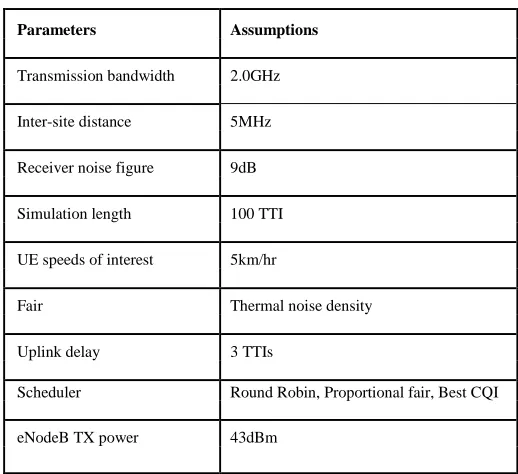
The main simulation parameters utilized are determined by the 3GPP simulation cases and Performance with round robin, proportional fair and best CQI scheduling. It has been observed for five UEs at various distances from the eNodeB and mapping of UEs and eNodeB is depicted in Table I.
[image:3.612.326.582.224.409.2]A. Mapping of UE and eNodeB within the Cell
Figure 1: The comparative distance between eNodeB and UE. Red dot represents eNodeB and black dot represents UE.
TABLE 1
SIMULATION PARAMETERS
Parameters Assumptions
Transmission bandwidth 2.0GHz
Inter-site distance 5MHz
Receiver noise figure 9dB
Simulation length 100 TTI
UE speeds of interest 5km/hr
Fair Thermal noise density
Uplink delay 3 TTIs
Scheduler Round Robin, Proportional fair, Best CQI
[image:3.612.322.581.462.699.2]International Journal of Emerging Technology and Advanced Engineering
Website: www.ijetae.com (ISSN 2250-2459,ISO 9001:2008 Certified Journal, Volume 4, Issue 5, May 2014)
V. RESULTS
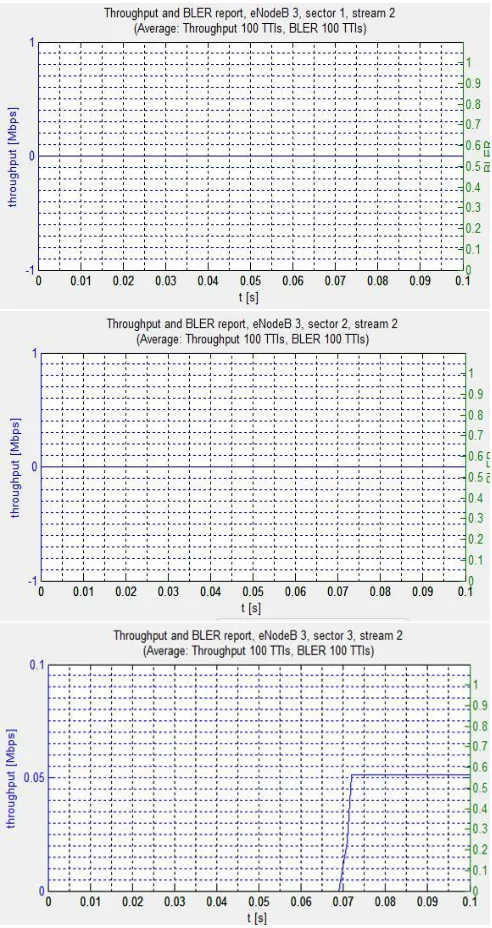
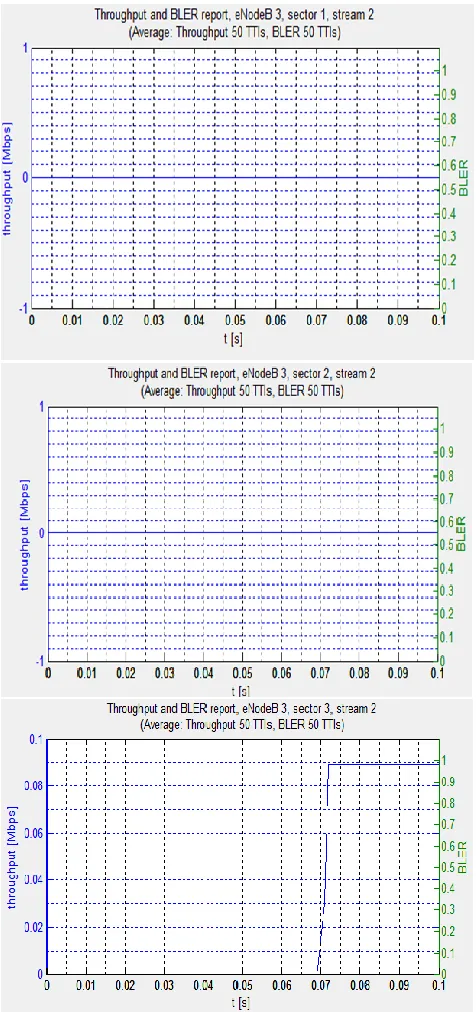
[image:4.612.334.584.168.687.2]Results of three different algorithms for LTE of LTE simulator are described in figure 2, 3 and 4, which shows throughput of third eNodeB for stream 2 for all three algorithms.
Figure 2: Simulation Results for Throughput (Mbps) vs TTI (sec) for RR (eNodeB 3, Stream 2).
Figure 2 shows simulation for Round Robin algorithm. Here throughput of sector 1 and 2 is 0.55Mbps where sector 3 is 0.56Mbps.
[image:4.612.60.306.203.667.2]International Journal of Emerging Technology and Advanced Engineering
Website: www.ijetae.com (ISSN 2250-2459,ISO 9001:2008 Certified Journal, Volume 4, Issue 5, May 2014)
Figure 3 shows simulation for Proportional Fair algorithm. Here throughput of sector 1 and 2 is 0.55Mbps where sector 3 is 1.01 Mbps. The throughput of sector 3 of proportional fair algorithm is batter then round robin algorithm.
Figure 4: Simulation Results for Throughput (Mbps) vs TTI (sec) for Best CQI (eNodeB 3, Stream 2).
Figure 4 shows simulation for Best CQI algorithm. Here throughput of sector 1 and 2 is 0.55Mbps where sector 3 is 0.98 Mbps. Throughput of sector 3 in Best CQI is greater than Round Robin but lover then Proportional Fair. In the same way, throughput of other eNodeB for different sector, streams are shown in table 2.
[image:5.612.50.288.196.702.2]Table 2 shows the throughput of different eNodeB by using different sector using Round Robin (RR), Proportional Fair (PF), and Best CQI scheduling algorithms. Position of different UEs is shown in Fig 1.
TABLE 2
Simulation Results for Throughput (Mbps).
eNodeB Stream Sector Throughput in Mbps no
RR PF Best CQI
1 1 1 0.92 0.55 0.55
2 1.07 1.2 0.72
3 0.55 0.55 0.55
2 1 0.98 0.55 0.55
2 1.08 1.2 0.71
3 0.55 0.55 0.55
2 1 1 1.08 1.05 0.79
2 0.91 0.99 0.96
3 1.1 0.79 0.82
2 1 0.78 1.1 0.77
2 0.91 0.98 1
3 1.09 0.79 0.82
3 1 1 0.55 0.55 0.55
2 0.55 0.55 0.55
3 0.56 1.01 0.99
2 1 0.55 0.55 0.55
2 0.55 0.55 0.55
3 0.56 1.01 0.98
Table 2 gives information of throughput of different eNodB for different algorithm. Average throughput is given in table 3.
TABLE3
AVERAGE THROUGHPUT (MBPS).
eNodeB Average throughput
RR PF Best CQI
1 0.8584 0.7667 0.605
2 0.9784 0.95 0.86
[image:5.612.320.569.277.550.2] [image:5.612.317.571.605.684.2]International Journal of Emerging Technology and Advanced Engineering
Website: www.ijetae.com (ISSN 2250-2459,ISO 9001:2008 Certified Journal, Volume 4, Issue 5, May 2014)
Table 3 used to find average throughput, for RR is 0.79 and Best CQI is 0.72, where PF’s average throughput is 0.8067.
The above figures and table represent the comparative throughput performances for three scheduling algorithms. In RR average throughput of eNodeB 1 and 2 is good but eNodeB 3 is very less, same in Best CQI where in proportional fair, overall throughput is good. Proportional fair provides the UEs close to the eNodeB with higher throughput. The data rate is will fairly high in most cases for proportional fair and the overall cell throughput is also expected to be better with proportional fair.
VI. CONCLUSION
We analyzed the performances of round robin, proportional fair and Best CQI scheduling methods for downlink transmission modes in LTE from this paper. It is found that proportional fair will give very good data rate in most cases. Round robin provides the UE with good fairness but proportional fair maintain a balance between fairness and throughput and so, proportional fair may still be a better choice. Also results shows that proportional fair provide good result than Beat CQI and Round Robin.
REFERENCES
[1] H. Holma and A. ToskalaI, ―LTE for UMTS - OFDMA and SC-FDMA Based Radio Access,‖ John Wiley and Sons, Ltd. 2009. [2] ―Physical Layer Aspects for Evolved UTRA,‖ 3GPP Technical
Report 25.814, version 7.1.0, September 2006.
[3] A. Toskala, H. Holma, K. Pajukoski, and E. Tiirola, ―UTRAN Long term Evolution in 3GPP,‖ in Proceedings of IEEE Personal Indoor and Mobile Radio Communications Conference (PIMRC’06), September 2006.
[4] H. Ekström, A. Furuskär, J. Karlsson, M. Meyer, S. Parkvall, J.Torsner, and M. Wahlqvist, ―Technical Solutions for the 3G Long Term Evolution,‖ IEEE Communications Magazine, vol. 44, pp. 38– 45, March 2006.
[5] N. Wei, A. Pokhariyal, C. Rom, B. E. Priyanto, F. Fredriksen, C. Rosa, T. B. Sorensen, T. E. Kolding, and P. E. Mogensen, ―Baseline E-UTRA Downlink Spectral Efficiency Evaluation,‖ in Proceedings of the IEEE Vehicular Technology Conference (VTC’F06), September 2006.
[6] K. Higuchi, T. Kawamura, Y. Kishiyama, Y. Ofuji, and M. Sawahashi, ―System-Level Throughput Evaluations in EvolvedUTRA,‖ in Proceedings of the International Conference on Communication Systems, October 2006.
[7] T. Kolding, F. Frederiksen, and A. Pokhariyal, ―Low-Bandwidth Channel Quality Indication for OFDMA Frequency Domain Packet Scheduling,‖ in Proceedings of the International Symposium on Wireless Communication Systems (ISWCS’06), September 2006. [8] A. Jalali, R. Padovani, and R. Pankaj, "Data Throughput of