Towards a Formal Method for
Distributed Object-Oriented Systems
Malcolm Tyrrell
A thesis submitted to
the University of Dublin
for the degree of
Doctor in Philosophy.
2003
Declaration
This thesis has not been submitted as an exercise for a degree at any other University. Except where otherwise stated, the work described herein has been carried out by the author alone. This thesis may be borrowed or copied upon request with the permission of the Librarian, University of Dublin, Trinity College. The copyright belongs jointly to the University of Dublin and Malcolm Tyrrell.
Acknowledgements
I would first like to express my gratitude to Andrew Butterfield, my super-visor, for his advice and support. I am grateful for the guidance given to me by Alexis Donnelly during the early stages of my research. Arthur Hughes also devoted time and effort to reading my work and I would like to thank him here.
I am grateful to Enterprise Ireland for their generous funding.
I would like to thank my colleges in the Foundations and Methods Group for many interesting discussions about almost everything (including, occa-sionally, foundations and methods).
Summary
We present two components of a special purpose formal method intended to support the modelling and development of distributed object-oriented sys-tems. The first component is a language, called Oompa, in which designs for these systems can be expressed. The second is a behavioural specification language called sequential process specifications.
Oompa is a strongly-typed class-based object-oriented language. Its ob-jects have private state and support multiple concurrent invocations. The primitive operations of its methods support both object-based and channel-based behaviour. We provide two operational semantics for Oompa; a re-duction relation, which is intuitive, and a labelled transition system, which is superior for reasoning. We define a type system for Oompa which is stat-ically checkable. We also give thorough consideration to issues of naming in Oompa.
Contents
1 Introduction 14
1.1 Distributed Object-Oriented Systems . . . 16
1.1.1 CORBA . . . 17
1.1.2 The CORBA Object Model . . . 19
1.1.3 Our Use of the CORBA Object Model . . . 20
1.2 Our Method . . . 22
1.2.1 The Formalism: Oompa . . . 22
1.2.2 The Specification Language: Sequential Process Spec-ifications . . . 25
1.2.3 The Approach . . . 26
1.3 Contributions . . . 26
1.4 How to Read this Thesis . . . 27
1.5 Synopsis . . . 28
2 The State of the Art 30 2.1 State-Based Approaches to Concurrency . . . 31
2.1.1 The Rely/Guarantee Approach . . . 32
2.1.2 The Refinement Calculus and Action Systems . . . 33
2.2 Process Calculi . . . 35
CONTENTS
2.2.2 CSP . . . 36
2.2.3 π-Calculus . . . 37
2.2.4 Pict . . . 39
2.2.5 Join Calculus . . . 39
2.3 Concurrent Object-Oriented Approaches . . . 41
2.3.1 POOL . . . 42
2.3.2 πoβλ . . . 43
2.3.3 TyCO . . . 44
2.3.4 concς . . . 45
2.3.5 OC . . . 47
2.3.6 BOOM and ODAL . . . 47
2.4 Evaluating the Methods . . . 48
2.4.1 State-Based Methods . . . 48
2.4.2 Process Calculi . . . 49
2.4.3 Concurrent Object-Oriented Approaches . . . 50
2.5 Our Work in Context . . . 51
2.6 Summary . . . 52
3 Static Oompa 54 3.1 Syntax . . . 54
3.1.1 The Syntax of the π-Calculus . . . 55
3.1.2 Names . . . 56
3.1.3 Code . . . 57
3.1.4 Definitions . . . 59
3.1.5 Types . . . 60
3.1.6 Example of Oompa’s syntax . . . 62
3.2 Issues in the design of Oompa . . . 63
CONTENTS
3.4 Renaming . . . 66
3.4.1 Permutations of N . . . 68
3.4.2 How to Pick New Names . . . 69
3.4.3 Shoves . . . 70
3.4.4 The Action of a Renaming on Code . . . 70
3.4.5 The Definition of Substitution on Code . . . 73
3.5 α-Equivalence for Code . . . 74
3.6 Summary . . . 78
4 Dynamic Oompa 79 4.1 Agent-Based Dynamic System . . . 80
4.1.1 Syntax . . . 80
4.1.2 Renaming . . . 84
4.1.3 Equivalence . . . 86
4.1.4 Semantics . . . 89
4.2 Configuration-Based Dynamic System . . . 95
4.2.1 Syntax . . . 96
4.2.2 Renaming . . . 99
4.2.3 Equivalence . . . 102
4.2.4 Semantics . . . 106
4.2.5 Weak Bisimulation . . . 114
4.3 Relationship . . . 115
4.3.1 The Flatten Algorithm . . . 115
4.3.2 Properties of Flatten and the Relationship Theorem . . 118
4.4 Summary . . . 120
CONTENTS
5.1.1 The Typing System . . . 125
5.1.2 Type Violations . . . 126
5.1.3 Type Safety . . . 127
5.2 Oompa Type Trees . . . 130
5.2.1 Trees and Subtrees . . . 130
5.2.2 Interpreting Types as Trees . . . 132
5.2.3 Expanding Definitions . . . 135
5.3 Subtyping . . . 136
5.3.1 Tree Simulation . . . 138
5.3.2 The Subtyping Algorithm . . . 139
5.4 Soundness of the Type Safety System . . . 142
5.4.1 Dynamic Type Safety . . . 143
5.4.2 Preservation of Dynamic Type Safety . . . 145
5.4.3 Configurations and the Type System . . . 145
5.5 Comparison w ith Other Work on Type Systems . . . 147
5.6 Summary . . . 149
6 Sequential Process Specifications 150 6.1 Expressing Abstract Behaviour . . . 151
6.2 CCS . . . 153
6.2.1 Nondeterminism in CCS . . . 157
6.3 Some Theory of Sequential Process Expressions . . . 161
6.4 Sequential Process Specifications . . . 164
6.4.1 Structural Equivalence . . . 166
6.4.2 Satisfaction . . . 167
6.4.3 Semantics . . . 173
6.5 Refinement . . . 175
CONTENTS
6.5.2 Refining Simulation . . . 178
6.6 Example: A Scheduler . . . 182
6.6.1 Informal Requirements . . . 182
6.6.2 Model . . . 182
6.6.3 Specification . . . 183
6.6.4 Further Requirements . . . 185
6.6.5 Respecifying the Scheduler . . . 186
6.7 Using Sequential Process Specifications w ith Oompa . . . 187
6.8 Related Work . . . 189
6.9 Summary . . . 191
7 A Development in Oompa 193 7.1 Behavioural Requirements of a Concurrent Dictionary . . . 194
7.1.1 Abstract Data Type for a Dictionary . . . 194
7.1.2 Sequential Object-Oriented Dictionary . . . 195
7.1.3 Concurrent Object-Oriented Dictionary . . . 198
7.2 Behavioural Specification for a Concurrent Dictionary . . . 200
7.2.1 Specification . . . 200
7.2.2 Alternative Specification . . . 207
7.3 Designs for a Concurrent Dictionary . . . 210
7.3.1 A Standard Design . . . 211
7.3.2 Justifying the Standard Design . . . 212
7.3.3 An Alternative Design . . . 218
7.3.4 Justifying the Alternative Design . . . 220
7.3.5 Further Development . . . 225
CONTENTS
8 Conclusions and Future Work 228
8.1 Overview . . . 228
8.2 Future Work . . . 230
A Isolated Sum 234 A.1 Definition . . . 234
A.2 Some Properties of Isolated Sum . . . 236
A.3 n-Ary Isolated Sum . . . 239
B Technical Results for Oompa 242 B.1 Results about Code . . . 242
B.2 Results about Agents . . . 251
B.3 Results about Configurations . . . 253
B.3.1 Configuration Renaming . . . 254
B.3.2 α-Equivalence for Configurations . . . 257
B.3.3 Structural Equivalence for Configurations . . . 265
B.3.4 Labelled Transition System . . . 278
B.4 Flatten and the Relationship . . . 282
C Technical Results for the Type System 315 C.1 Type Tress . . . 315
C.2 The Subtyping System . . . 322
C.2.1 Termination . . . 323
C.2.2 Completeness . . . 325
C.2.3 Soundness . . . 327
C.3 Soundness of the Type Safety System . . . 330
C.3.1 Preservation of Dynamic Type Safety . . . 332
CONTENTS
D Simulations 347
D.1 Refining Simulations for the Scheduler Example . . . 347 D.2 Satisfying Simulations for the Scheduler Example . . . 350 D.3 Refining Simulations for Chapter 7 . . . 355
List of Tables
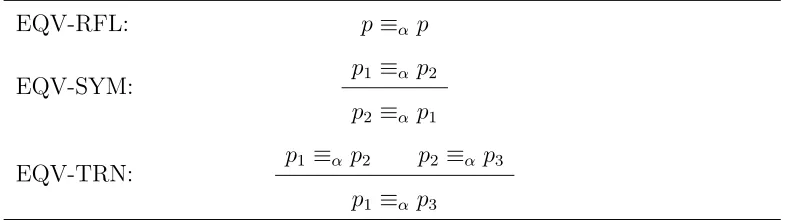
3.1 Equivalence Rules for Code α-Equivalence . . . 75
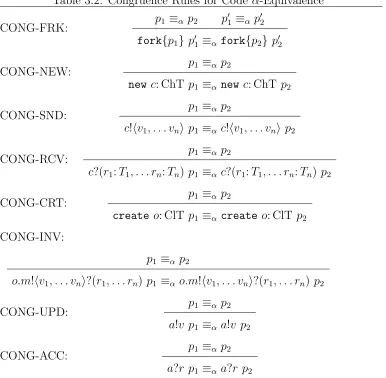
3.2 Congruence Rules for Code α-Equivalence . . . 76
3.3 Change of Bound Name Rules for Code α-Equivalence . . . . 77
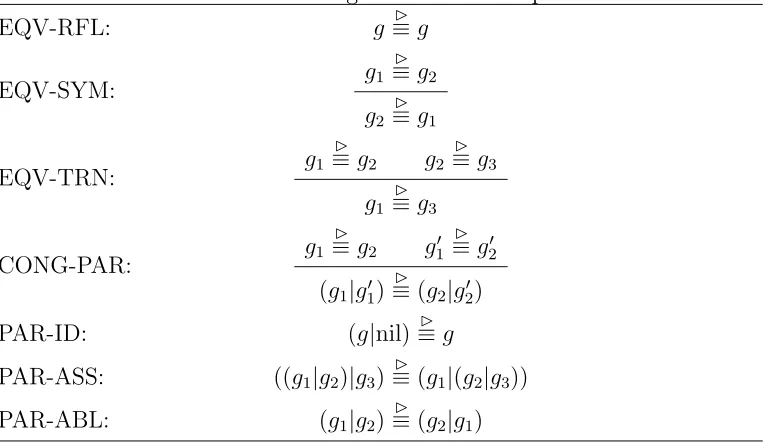
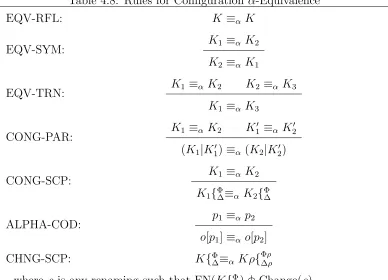
4.1 Rules for Agent Structural Equivalence . . . 87
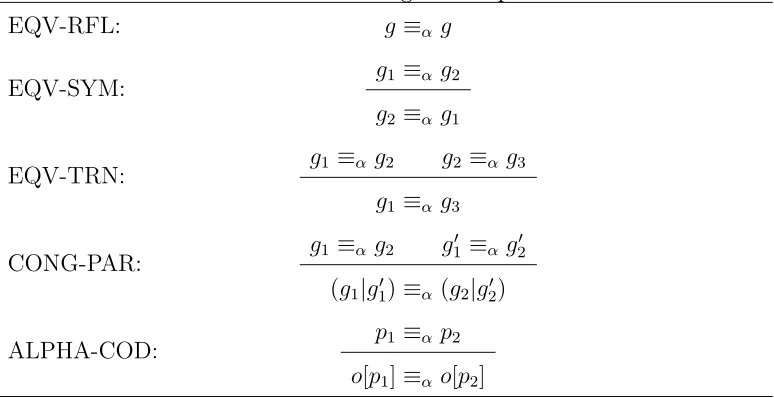
4.2 Rules for Agent α-Equivalence . . . 88
4.3 Rules for Agent α-/Structural Equivalence . . . 89
4.4 General Rules for the Agent-Based Operational Semantics . . 92
4.5 Channel Rules for the Agent-Based Operational Semantics . . 92
4.6 Object Rules for the Agent-Based Operational Semantics . . . 93
4.7 Reflexive Transitive Closure of the Operational Semantics . . . 95
4.8 Rules for Configuration α-Equivalence . . . 103
4.9 Rules for Configuration Structural Equivalence . . . 105
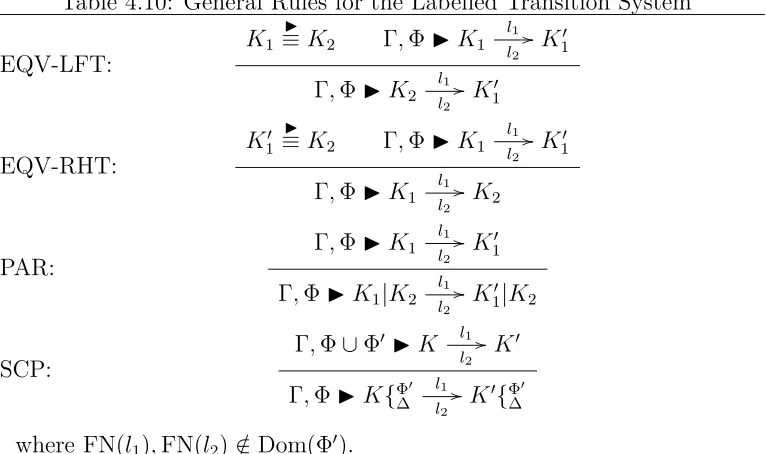
4.10 General Rules for the Labelled Transition System . . . 109
4.11 Local Rules for the Labelled Transition System . . . 109
4.12 Labelled Rules for the Labelled Transition System . . . 110
4.13 Interaction Rules for the Labelled Transition System . . . 110
4.14 Rules for Experiments . . . 113
5.1 Rules of the Typing System . . . 125
LIST OF TABLES
Chapter 1
Introduction
The ultimate aim of this research is to provide a formal method to support the modelling and development of distributed object-oriented systems.
Individual formal methods can be identified as either general purpose or special purpose. A general purpose formal method seeks to be applicable to the modelling and development of diverse systems. It will be semantically neutral, so it will not be focused on any particular type of system, and should avoid implementation bias, so it will promote development that is strictly defined by the problem. Perhaps the most significant advantage to a general formal method is a practical one: familiarity for users. Good examples of general formal methods are VDM [Jon90] and Z [Spi92].
CHAPTER 1. INTRODUCTION
often developing the same solutions. This repetition of work is exacerbated in the case where there is a wide semantic gap between the method and systems being developed1.
Aspecial purpose formal method [Sch94] seeks to tackle a specific type of system only and, by doing so, can be much semantically closer to a target system than a general purpose formal method can. Assumptions about the target systems can be built into the method, bridging the semantic gap, so the user can start modelling and developing at the level at which the target system is most suitably considered. The main disadvantage of using special purpose formal methods is that a newmethod must be learnt for each problem domain. Another disadvantage is that a special purpose formal method is likely to have a smaller community of developers and users than a general purpose formal method.
An analogy is the field of programming languages where a distinction be-tween general purpose languages and special purpose languages can also be drawn [LR88]. There exist many programming languages touted as general purpose (such as C++ [Str91]), i.e. suitable for developing any type of soft-ware. While the obvious advantage is that users only need to become familiar with a single language, there can be little doubt that work is frequently dupli-cated within and between these languages2. An example of a special purpose
programming language would be the database query language SQL [vdL89]. 1This problem can be somewhat mitigated by techniques which promote reuse. For
example, Object-Z [Smi99] uses object concepts as a structuring mechanism primarily to
improve reuse between specifications.
2As with formal methods, techniques for reuse can help, for example the development
of user libraries for certain problem domains. However, given the complexity of some
libraries (e.g. Microsoft Foundation Classes [SWM96]) we might argue that learning a
CHAPTER 1. INTRODUCTION
In general, developers have a choice between using a suitable language for each problem or forcing a single language to cope with all problems.
We are considering distributed object-oriented systems, so our problem domain is fixed. We have decided to provide a special purpose formal method to provide support for developing and modelling these systems. This thesis presents the two components of such a method: a language for expressing designs, called Oompa, and a behavioural specification language, called se-quential process specifications. Our first task will be to classify the problem domain.
1.1
Distributed Object-Oriented Systems
Adistributed system is a computational system consisting of several interact-ing components residinteract-ing at separate locations. Actual distributed systems may differ dramatically: in particular, the concept of a location and the mechanisms supporting interactions may be quite different. Nevertheless, we can delimit them with a broad definition, as above.
Unfortunately, object-oriented systems are not so easy to classify. There is no real agreement over what exactly constitutes object-orientation [III97]. Most would agree that it structures code into uniquely identifiedobjects and, within objects, intomethods; the act of causing the computation described in a method to be performed is almost always referred to asinvocation. Beyond these necessary properties, insufficient to classify even the broadest definition in use, there is little common ground.
CHAPTER 1. INTRODUCTION
be described. An example of this approach is [ ¨Ove00]. Naturally, a semantic gap will remain when we try to discuss actual systems. The second option is to choose a single interpretation and target our formal method at it. This is in line with our decision to provide a special purpose formal method and we followthis second path. However, when choosing our single interpretation of “object-orientation”, we will deliberately choose a general one.
A typical approach describes howto build an object-oriented system from the bottom up using a specific definition of object. An example is [Mey97]. An alternative and more general approach is to fit object concepts onto exist-ing systems as unobtrusively as possible. This is the approach of the CORBA object model [OMG98]3, from which we take inspiration.
1.1.1
CORBA
Modern distributed systems can have astounding complexity, the Internet being the prime example. There are substantial difficulties involved in de-signing software which avails of the facilities these systems provide yet oper-ates correctly and efficiently under the conditions to which these systems are subject. To help make the complexity manageable, software known as mid-dleware was introduced. Middleware, at the very minimum, provides a high-level protocol for participating in distributed communications. The purpose of the high-level protocol is to hide the complexity of the underlying system-level protocols. Some examples of middleware are Remote Procedure Call (RPC) [BN83], Remote Method Invocation (RMI) [WRW96], Enterprise Java Beans (EJB) [MH99], Distributed Component Object Model (DCOM) [EE98] 3Since its introduction in 1991 [OMG91], CORBA has undergone continual refinement
and expansion. To discuss CORBA consistently, we need a single slice through its
CHAPTER 1. INTRODUCTION
and Common Object Request Broker Architecture (CORBA) [OMG98]. All of these enable a distributed communication to be performed in a fashion similar to that of a language level function call or method invocation.
A feature of RPC, RMI and EJB is that their implementations tend to support a single programming language; a feature of DCOM is that it primarily supports a single operating platform. However, to benefit most from the power of distributed systems, multi-language and multi-platform development must be supported. As well the obvious argument that certain programming languages are better suited to certain software, which obvi-ously suggests such multi-language development, another force which acts on distributed software development is due to legacy software [BS95]. Large distributed software systems are not always built from scratch and often in-volve the reuse of older software, possibly by wrapping it with distribution-aware code. This saves on the expense of redeveloping and retesting the software, migrating data to newer formats and retraining staff. A conse-quence of bringing this legacy software into the distributed environment is that we cannot assume that the components of our distributed system are written in any particular language or run on any particular platform. The middleware protocols should therefore be supported across the various lan-guages and platforms typically used.
CHAPTER 1. INTRODUCTION
are mapped onto each programming language and CORBA uses method invocation to expose its middleware protocol.
1.1.2
The CORBA Object Model
For software entities to act as objects, or issue method invocations, there must be a common notion of what these concepts are — a shared ontol-ogy. According to the OMG (Object Management Group, the industry body which provides the CORBA standards), an object model “provides an or-ganised presentation of object concepts and terminology” [OMG98]. The
CORBA Object Model establishes the shared viewof object-orientation el-ements of the system must have to interact effectively. We present a brief (and mildly simplified) description of that model here.
The object model takes a very abstract viewof a distributed system. The parts that make up the system are identified as belonging to one of the fol-lowing categories: data, code and execution engines. Many different forms of computation may actually be taking place in the system but, for the pur-poses of the object model, we can ignore the details beyond the interaction of these three kinds of entity. As usual, code is a description of some com-putations to perform and data is some state component of the system or the real world. The work is done by the execution engines which interpret the code and perform the computations, possibly altering some of the data. It is not required that all code be meaningful to all execution engines but, rather, that each piece of code is meaningful to some execution engine.
CHAPTER 1. INTRODUCTION
requests that specific services be performed. Code which provides a service is called amethod and, unsurprisingly, the notion of communication allows val-ues to be exchanged, so a method may requireparametersand producereturn values. Method activation is the term used when a method is performed.
Next, we associate methods which share some relationship, such as the ability to alter a specific piece of data, into an entity called an object. The significance of an object is that it has a unique identifier, a value called an
object reference, and that it provides access to its services in a standard way: in a syntactic form called an interface. An interface lists the object’s methods, providing their name and their signatures. An object may have several interfaces associated with it, each exporting different sets of services. In fact, the CORBA object model does not insist that all the computational entities in the system belong to objects; a client is any computational entity which is capable of requesting that an object performs one of its services.
1.1.3
Our Use of the CORBA Object Model
A fundamental design goal behind CORBA was to facilitate distributed com-puting. A fundamental design goal behind the CORBA object model was to allowdiverse systems, whether implemented in an object-oriented language or not, to participate in object-oriented systems. It seems that the CORBA object model is an ideal way to establish a general definition of “distributed object-oriented systems”.
We nowhave a classification of our problem domain but find that, for our work, it allows too general a class of systems. There are many facilities within such a system that could make our goal extremely difficult. Consequently, we make some simplifying assumptions.
CHAPTER 1. INTRODUCTION
and that all running code in the system belongs to a method of some object. Under this assumption, we can still discuss systems where state and code can exist separate from objects: we view them as belonging to some trivial wrapper objects which need have no structural significance.
Secondly, we assume that all state is private to some object. This assump-tion also seems reasonable since, if we really want to expose an object’s state, we can provide the object with unrestricted update and access methods.
Thirdly, we choose a single approach to dealing with concurrent invoca-tions. If an invocation arrives when there are processes already running at the object, a choice must be made between making the invocation wait or creating a new process to deal with it. CORBA allows this choice, called an activation policy, to be made in an object dependent way. The default policy is to create a newprocess4 and we choose to follow this since it is
the most general and other policies can be modelled within it. For example, single-threaded objects could be built using locking.
Fourthly, we consider systems to be class based. This might seem a strong assumption but it really just clarifies an aspect of system we have not yet discussed: howcode is described and the way in which objects are introduced into the system.
Lastly, we prohibit two features which give rise to richer, but far more complex, systems: we exclude function passing and code mobility. The earlier assumptions do not significantly affect the class of systems under discussion although, were we to model an actual CORBA system, they might induce a mild semantic gap. This last assumption does impact the class of systems 4Using the terminology of [Nie93], which presents a partial categorisation of concurrent
object systems, we can say that synchronisation is “orthogonal to encapsulation” and
CHAPTER 1. INTRODUCTION
we can discuss but we defend it on two grounds: these features are quite rare in real systems and they could make our goal infeasible.
1.2
Our Method
What does a special purpose formal method for distributed object-oriented systems look like? All formal methods will consist of at least the following two things: a language in which concepts can be expressed and a system for reasoning about expressions in the language. A formal method focused on distributed object-oriented systems should also provide ready-made ob-ject concepts and support behaviour consistent with a distributed computing environment.
Although our formal method is in an early stage of development, our re-search has lead to the development of two components, Oompa and sequential process specifications. Oompa is a language in which designs for distributed object-oriented systems can be expressed. Sequential process specifications allowabstract descriptions of behaviour to be specified and refined.
1.2.1
The Formalism: Oompa
CHAPTER 1. INTRODUCTION
object-oriented process algebra.
Oompa’s syntax is based upon theπ-calculus [Mil99], a computationally powerful process calculus which can describe systems of parallel processes engaged in highly dynamic channel-based communication. In Oompa, we extend the language of the π-calculus with primitives for creating objects, invoking methods and accessing and updating state. This gives a syntax for code which we embed in a syntax for methods, attributes, interfaces and classes. We use this syntax for statically defining Oompa programs.
Before discussing Oompa’s semantics, we need to draw an important dis-tinction between two aspects of certain types of formalisms. For many formal languages where an operational semantics is given, the semantics applies to a term in that language and describes the reduction of that term, perhaps in some context. This is true of the λ-calculus and theπ-calculus, for example. However, in languages where structures are defined in advance there is an important difference: here the operational semantics do not apply to the terms of the syntax of definitions but, rather, to the terms of some other syntax. For example, in a class-based object-oriented language, a program is defined in classes which do not themselves have behaviour — it is the objects created during the execution of the program which have the behaviour.
For this second type of language, we group the syntax of definitions and their associated theory under the heading “static systems”. Those parts which participate in the operational semantics, we group under the slightly more awkward heading “dynamic systems”5.
We provide Oompa with two operational semantics and, hence, Oompa 5The distinction can be also seen in CORBA, where a construction model describes
how objects are implemented in code whereas anexecution model describes the parts of
CHAPTER 1. INTRODUCTION
has two dynamic systems. Each consists of a syntax for the “running” sys-tems, some associated theory of equivalences and an operational semantics. Each offers a different way of modelling the behaviour of an Oompa program. The first of Oompa’s dynamic systems we call the agent-based dynamic system. This views a distributed object-oriented system as consisting of four parts: the static definitions of classes and interfaces, a global dictionary of type information, a global dictionary of state information and a set of running processes. We might call this a flat model of a distributed object-oriented system, as it ignores any structure due to distribution. The semantics of this dynamic system is a reduction relation that describes howthe global structure evolves. The role of this dynamic system is to provide a simple and intuitive model of running Oompa programs. Unfortunately, the semantics is non-compositional in the sense that it only applies to complete closed systems. This makes reasoning awkward.
The second of Oompa’s dynamic systems we call the configuration-based dynamic system. This models a distributed object-oriented system as a hi-erarchy of subsystems. As before, some information can be global but, this time, type and state information can also be local to subsystems. The seman-tics of this dynamic system is a labelled transition relation which can apply to subsystems as well as to the complete system. The labels on the transitions allowus to describe howa subsystem interacts with its environment. We can compose such descriptions of behaviour to describe the behaviour of a set of parallel subsystems and, hence, the semantics is compositional. Because of this, it will be our primary semantics for reasoning. Its disadvantage, when contrasted with the agent-based dynamic system, is its relative complexity.
CHAPTER 1. INTRODUCTION
purpose of a type system is to avoid a set of undesirable behaviours that occur when a value is used in an inappropriate context. The exclusion of these errors gives us confidence in the meaningfulness of our programs. For Oompa we give a statically checkable type system. This means we can check Oompa’s class and interface definitions for type safety. We prove, for both dynamic systems, that a running system derived from checked definitions will never give rise to type errors.
1.2.2
The Specification Language: Sequential Process
Specifications
Oompa is a language for expressing actual designs of distributed object-oriented systems. To talk about whether such designs are, in some sense, “correct” we will need a way to reason about their behaviour. The labelled transition relation of the configuration-based dynamic system provides a very simple language for describing the behaviour of Oompa programs. Unfortu-nately, its expressions are limited to statements of the form “configuration
A can perform action a and become configurationB”.
To allowus to express more sophisticated statements of behaviour, we provide another language called sequential process specifications. We base this on a very simple language called sequential process expression, which forms the core of CCS [Mil80], and extend it with a non-deterministic choice operator similar to internal choice in CSP [Hoa84].
config-CHAPTER 1. INTRODUCTION
urations.
1.2.3
The Approach
Our current approach to system development operates as follows, although it should be noted that our formal method is still a work in progress. After re-quirements capture, a stepwise refinement in sequential process specifications is used specify the abstract behaviour we require of our system. The next development stage is reached with an “invent and verify” step, whereby an Oompa class (or classes) is proposed as giving rise to the specified behaviour. This claim is then formally verified using our implementation relation.
Although it was one of our stated goals, we have not yet evaluated the usefulness of our method for modelling distributed object-oriented systems.
1.3
Contributions
In this section, we briefly describe the key contributions of the thesis. The formalism Oompa, which combines class-based object-orientation with concurrency, is our main contribution. It differs from other compa-rable languages in either the level of its object-orientation or its approach to concurrency. We discuss these differences further in Chapter 2.
Oompa’s type system can be considered a minimal type system for lan-guages with channels and objects since we use recursive types to handle both features. Our work on the type system also led to the development of an approach to making types independent of the definition set, called the ex-pansion function. However, a similar function can be found in [AC91].
CHAPTER 1. INTRODUCTION
represent an alternative to both CCS and CSP.
One further contribution is found in Appendix A. Our naming system requires a way to apply two renamings (kinds of permutation) simultaneously and without interference. We have devised a technique, called isolated sum, which allows this to be done.
1.4
How to Read this Thesis
This thesis is structured as eight chapters and four appendices. The chapters constitute the body of the thesis and their role is to introduce the material in an accessible manner. The role of the appendices is to accommodate the more technical work we have done which, if placed within the body, might unnecessarily encumber the presentation. In particular, many of the proofs of results we present are deferred until the appendices.
Given that many results in the thesis appear twice, once in the body and once, coupled with a proof, in the appendices, we need an approach to numbering that handles this duplication sensibly. Our approach is to give each occurrence of such a result a separate number so as to preserve the numbering sequences in both body and appendices. When a result is proved in an appendix, a small box in the margin will contain a reference to the like
this
CHAPTER 1. INTRODUCTION
should flowsmoothly and the more technical material will be deferred until the end. Alternatively, the body and the appendices can be read concurrently. This means that the justification for a result will be available when the result is stated.
1.5
Synopsis
After this introduction, Chapter 2 considers existing formal approaches to the problem. We discuss various methods, from traditional general purpose formal methods to special purpose object calculi.
Chapters 3, 4 and 5 present our formalism, Oompa. In Chapter 3 we define Oompa’s static system. This involves the definition of its syntax and some discussion of the properties of that syntax, such as renaming issues. Chapter 4 defines Oompa’s two dynamic systems: the agent-based dynamic system and the configuration-based dynamic system. Each dynamic system has a syntax, some theory and an operational semantics. Chapter 5 gives the definition of Oompa’s type system.
We introduce our simple specification language in Chapter 6. We provide its syntax, a semantics based on a notion of satisfaction and a refinement relation between specifications. Chapter 7 indicates how we might use our formal method by showing the development a simple system. We provide our conclusions and speculate on future work in Chapter 8.
CHAPTER 1. INTRODUCTION
Chapter 2
The State of the Art
In order to clarify the contribution offered by our system, we need to place it in context. In this chapter, we present a survey of those formal methods with which one might tackle our problem. Such a survey cannot hope to be complete but we will attempt to touch on the key approaches available. An alternative but similarly motivated survey can be found in [BD01].
We divide the methods into three categories: state-based approaches, process calculi and concurrent object-oriented approaches1. The methods
of the first category model a system in terms of howit transforms state. We consider two methods here: the Rely/Guarantee approach and action 1There are two other categories of methods which we might have included: “sequential
object-oriented approaches” and “approaches for mobility”. There are several methods
of both kinds that would provide useful context for our work but would not be suitable
approaches for tackling our problem (for example, the object calculi of [AC96] or the
ambient calculus [CG98]). While object-orientation is something that could, arguably,
be added as a sugaring to existing formalisms, the same cannot be done for concurrency.
This means that sequential approaches would not offer a suitable way of tackling our
target systems. On the other hand, given that we have excluded mobility from our target
CHAPTER 2. THE STATE OF THE ART
systems. The second category groups a set of special purpose formal methods, called process calculi, which focus on the communication events that occur in concurrent systems rather than on state change. Here we consider CCS, CSP, the π-calculus, Pict and the join calculus. The methods of the third category are concurrent approaches which are intrinsically object-oriented. We consider the following methods in this section: POOL, πoβλ, TyCO, concς, OC and ODAL.
Once the methods have been described, we will have an opportunity to discuss their suitability for our problem. We separate their presentation from their evaluation since, irrespective of their suitability for our problem, these methods provide the context within which our method lies.
The chapter is structured as follows. We consider state-based approaches in Section 2.1, process calculi in Section 2.2 and concurrent object-oriented approaches in Section 2.3. In Section 2.4, we evaluate how these methods offer an approach to our problem. Section 2.5 identifies the role we wish our formalism to play and contrasts it with the methods of the survey. We summarise the chapter in Section 2.6.
2.1
State-Based Approaches to Concurrency
CHAPTER 2. THE STATE OF THE ART
2.1.1
The Rely/Guarantee Approach
In VDM2 [Jon90], an operation is described in terms of howit transforms the system state. More precisely, an operation ensures that the system state will satisfy a predicate, the post-condition, as long as it is performed w hen the system state satisfies another predicate, the pre-condition. There are two particularly important advantages to this approach. Firstly, it is compo-sitional. So the specifications of two operations can be naturally combined to give the specification of their sequential composition. Secondly, it sup-ports refinement. So abstract descriptions of operations and data can be replaced by more concrete descriptions. This method successfully supports the development of sequential programs.
Operations performed in parallel can potentiallyinterferewith each other. Unfortunately, in the presence of interference, this method fails to be fully compositional and refinement becomes problematic. There is no general way of combining the specifications of operations, defined in terms of pre- and post-conditions, to give the specification of the operations’ concurrent com-position. Consequently, the method is no longer fully compositional. Re-finement also encounters difficulties: an operation refined into several se-quentially or concurrently composed operations may not satisfy its original specification in a concurrent context.
An extension to this approach [Jon81, XdRH97] allows it to take account of interference by augmenting specifications with two more predicates. A
rely-condition describes the assumptions an operation needs to make about 2The description of VDM we give approximately fits two other well-known state-based
methods: Z [Spi92] and the B method [Abr96]. In fact, the extension we describe,
al-though defined specifically for the VDM, should be applicable to any system which defines
CHAPTER 2. THE STATE OF THE ART
its concurrently executing environment. A guarantee-condition describes as-sumptions that the environment can make about the effect of the operation on concurrent operations. Using this technique, the method can function as before but with a significantly higher burden on the development — a set of coexistence proof obligations must be discharged. Some relief can be obtained by delimiting the dependencies and effect of an operation with syn-tactic markings such as “read-only” and “private” [CJ95].
2.1.2
The Refinement Calculus and Action Systems
Another formal method concerned with how an operation transforms system state is the refinement calculus [BvW98]. Operations, both program and specification statements, are modelled by predicate transformers, w hich are functions from sets of terminating states to sets of initial states3. When a predicate transformer models an operation, the initial states it returns are just those in which the operation must start in order for it to reach one of the given terminating states. The justification for using predicate transformers comes from viewing programs as contracts: “Very simple contracts with no choices (deterministic programs) can be modelled as functions from states to states. More complicated contracts may be modelled as relations on states, provided that all choices are made by only one agent. General contracts, where choices can be made by two or more agents, are modelled as predicate transformers” [BvW98]. As above, the key methodology is refinement from abstract specifications to concrete programs.
The refinement calculus manages concurrency via action systems [Bac90]. Anaction system consists of a set of atomic operations, calledactions, w hich 3When thought of as predicates, the sets of terminating and initial states correspond
CHAPTER 2. THE STATE OF THE ART
can be run in parallel and can access global state. The behaviour of an action is described using a predicate transformer behind a boolean guard. Actions need not always be enabled but, when enabled, they can be executed arbitrarily with a single restriction: only those actions which access disjoint parts of the system state are allowed to run concurrently.
The most significant assumption is that the effect of an action is atomic. If input-output behaviour is the only concern, it means that an action system is equivalent to a sequential system where actions are non-deterministically interleaved. We can model these in the sequential refinement calculus using an iterated choice statement. For action systems where reactive behaviour is also important, the refinement calculus must be extended. Simulation refinement [Bac90] andtrace refinement [Bac92] are two relations which can establish refinement between action systems in these cases.
CHAPTER 2. THE STATE OF THE ART
notion of atomicity refinement is introduced by allowing early returns.
2.2
Process Calculi
Process calculi are formalisms which focus on the behaviour of a system in terms of the communications that occur rather than on state change. The decision of what to view as a communication is not clear cut and, conse-quently, many process calculi have emerged. Typically, a process calculus will have a syntax of processes which describe behaviour entirely in terms of abstract communication events called actions. An intuitive viewof their semantics is as “an unstructured collection of autonomous agents communi-cating in arbitrary patterns over channels” [PT95] — a concept sometimes called process soup.
Process calculi are often referred to as process algebras. Milner [Mil89] suggests that the former term might be preferred (in his case for CCS but it applies to most) as it suggests the use of mathematical tools beyond algebra.
2.2.1
CCS
CHAPTER 2. THE STATE OF THE ART
framework” [Mil89]. The primary semantics is a labelled transition system over which a notion of equivalence called bisimulation is defined.
Bisimulation is a coinductive reasoning technique which distinguishes two processes when a third process communicating with them could find some difference in howthey behave. Two particularly important bisimulations are given for CCS: strong and weak bisimulation (the latter is also called
observational equivalence). As well as these semantic views of equivalence, a system of equational reasoning is defined over processes which can establish bisimulation and is complete on finite-state processes. Milner also defines a formal logic, PL (process logic), whose formulae can be used to express properties of processes. This allows an incremental method of specification but can guarantee only partial correctness.
2.2.2
CSP
Hoare’s CSP (Communicating Sequential Processes) [Hoa84, Ros98] is a pro-cess calculus whose actions are indivisible and synchronous but, unlike CCS, may involve many participants. Furthermore, CSP’s syntax is richer than that of CCS and has constructs which allow processes to be specifications of behaviour — for example, the synchronous parallel operator and internal choice. The primary semantics of CSP is not an operational semantics (al-though it has one) but three denotational semantics in terms of sets: the
traces model, the failures model and the failures and divergences model. As well as these, the algebra for equational reasoning in CSP can be viewed as an axiomatic semantics.
em-CHAPTER 2. THE STATE OF THE ART
phasises “process-based specification”, i.e. refining from a non-deterministic process expression. Several industrial strength tools exist which can model check [For00a] and animate [For00b] CSP specifications.
2.2.3
π
-Calculus
CCS and CSP share the property that the systems they describe have a largely static communication network4. This can become a problem when modelling or developing modern systems which can dynamically change their communication network. The π-calculus [Mil99, SW01] overcomes this lim-itation by allowing processes to generate new names which can be sent as values and then used as communication channels5. With a very spartan syn-tax, it succeeds in being both elegant and computationally complete — a
π-calculus encoding of the λ-calculus is given in [MPW89a].
The π-calculus is a descendent of CCS and inherits much of its semantic theory. The primary semantics for the π-calculus are operational: a reduc-tion relareduc-tion and a labelled transireduc-tion system [MPW89b]. The noreduc-tion of 4In fact, in both CCS and CSP, the communication network can change in a limited
respect. Connections can be lost and processes can split into two newly communicating
parts. However, for a truly dynamic network, it must be possible for new connections to
arise between previously separate subsystems. In CCS, this cannot happen since channel
names cannot be communicated. In CSP, the model of communication does not allownew
names to be received.
5The facility for new communication possibilities to arise during execution has been
called mobility but it is arguable whether theπ-calculus is suitable for modelling mobile
systems. An toy example of a mobile phone system is given in [Mil91], where a mobile
phone switches base as it travels into a different region. However, since theπ-calculus has
no concept of location or domain, the regions are completely outside the model. Examples
of languages with a true notion of mobility would be the ambient calculus [CG98] or the
CHAPTER 2. THE STATE OF THE ART
equivalence used for the reduction relation is barbed bisimulation which uses a predicate (called a barb) to detect whether communication is possible on a given channel name. For the labelled transition system, strong and weak bisimulation are defined, as in CCS. Several other notions of equivalence be-tweenπ-calculus terms are considered in [SW01] and an algebraic theory has also been developed [PS95].
The π-calculus is a name-passing calculus and names are a primary fea-ture of object-orientation. For this reason, and others, the π-calculus has been used several times as a model of object-orientation [Mil99, SW01, Wal95, San96, KS98]. The π-calculus has also been used to give concur-rent object-oriented language a semantics in [Jon93b] and [ ¨Ove00]. More-over, encodings of concurrent objects have been given in extensions of the
π-calculus, for example the form calculus [SL00] and Pict [PT95, SL96] (see the next section).
CHAPTER 2. THE STATE OF THE ART
2.2.4
Pict
Pict [PT98] is a formally defined programming language which rests upon the
π-calculus much in the way a functional language rests upon the λ-calculus. Specifically, its core language is asynchronous π-calculus without summation but augmented with records and pattern matching. Upon this small core language more sophisticated programming constructs are built as encodings. “The goal in Pict is to identify and support idioms that arise naturally when [π-calculus] primitives are used to build working programs — idioms such as basic data structures, protocols for returning results, higher-order program-ming, selective communication and concurrent objects” [Pie98]. So the focus in Pict is support for programming over support for reasoning. Nevertheless, it is likely that much of the theory of the π-calculus carries over to Pict.
Pict has been used as an “experimental testbed” to explore different ways of modelling objects: various options are considered in [PT95] and [SL96]. Typically, an object will be encoded as a record of channels — each channel provides access to a process managing a single service. Although π-calculus’ summation (i.e. choice) is not present in the core language, it can be in-troduced as a sugaring and is available to users as a library module. Using choice, Pict could also support the object encodings for the π-calculus that we mentioned in the previous section.
2.2.5
Join Calculus
CHAPTER 2. THE STATE OF THE ART
passing. The intention is to provide a language which models distributed programming6.
The processes of the join calculus are hierarchically structured into sites (locations) and communication is by asynchronous channel-based message passing. Contrasted with more typical process calculi, there are two inter-esting features of the join calculus communication model. Firstly, channels are “defined” at a single site; all messages sent on that channel get deliv-ered to that one site. Consequently, all processes waiting to receive on the same channel must reside at the same site. Secondly, processes can consume several messages atomically. This is expressed, syntactically, with ajoin pat-tern. Until all the messages a process wishes to receive have arrived, and that process consumes them, those messages remain available for other processes. From the perspective of modelling and implementation, the significant con-sequence of this is that any contention between processes can be resolved locally.
The join pattern is sufficiently expressive to allowmany standard pro-gramming idioms to be naturally encoded. “The join calculus gives us a general language for writing synchronisation devices; devices are just com-mon idioms in that language. This makes it much easier to turn from one type of device to another, to use several kind of devices, or even combine devices” [FG02]. Encodings of asynchronous and synchronous π-calculus channels, actors, objects and Ada rendez-vous are given. Although the con-sideration of object encodings is brief, several different styles of concurrent 6It is also worth mentioning the distributed join calculus [FGL+96] which extends the
join calculus with an explicit notion of location and a primitive for process migration. The
intention here is to provide a model and basis for mobile programming. An extension of
the Objective CAML programming language, JoCAML [FFMS01], embodies this model
CHAPTER 2. THE STATE OF THE ART
objects are considered.
The join calculus is given a semantics in terms of a computational model called the Reflective Chemical Abstract Machine. It defines an operational se-mantics based on three relations between processes: reduction steps, heating steps and cooling steps. This model relies on the metaphor of computational systems as chemical solutions, as in the Chemical Abstract Machine [BB90]. The join calculus is intended to be the basis of a programming language so an important advantage of this computation model is that it can be refined into an efficient implementation. A labelled semantics is defined with the Open Reflective Chemical Abstract Machine which allows us to consider the interactions a process may have with its environment. A simple and intuitive semantics, based on an equivalence and a reduction relation, is also defined. For reasoning about the join calculus, no one notion of program equiv-alence will satisfy all requirements: “finding the ‘right’ equivequiv-alence for con-current programs is a tall order” [FG02]. Consequently, a hierarchy of five equivalences is defined7, each striking a different balance between precision
and the richness of the generated identities. In increasing order of precision, they are: may testing, fair testing, coupled-similarity equivalence, bisimilar-ity equivalence and labelled bisimilarities.
2.3
Concurrent Object-Oriented Approaches
We nowconsider some concurrent formalisms which are intrinsically object-oriented. The richer of these formalisms are full object-oriented languages; the others are object calculi.
7In fact, the equivalences and techniques of the hierarchy are not restricted to the join
calculus. “In principle, they can be applied to any calculus with a small-step
CHAPTER 2. THE STATE OF THE ART
2.3.1
POOL
The first we consider is the POOL (Parallel Object-Oriented Language) fam-ily of programming languages due to Pierre America [Ame87, AdBKR89, Ame89, Ame91]. This family includes POOL, POOL-I, POOL-S, POOL-T, POOL2 and a sequential version called SPOOL. For brevity, we will con-sider this collection of languages as if it was a single language so some of the comments need not be thought to apply to all of them. POOL “aims at the systematic construction of reliable and maintainable software” [Ame87]. America views object-orientation primarily as a protection mechanism; he “considers [the] principle of protection of objects against each other as the basic and essential characteristic of object-oriented programming” [Ame91]. Consequently, state is private to an object and can only be accessed by the object’s methods.
One novel feature of POOL is the way in which concurrency is achieved. POOL is class based and each class defines for its objects a section of code called a body. At object creation, the code in the body is started in parallel with the code already running in the system. The object is allowed only a single process so the body must, at some time, execute ananswer statement in order to service requests on the object. This answer statement can choose to service certain requests only; those requests which are not serviced are queued.
An important contribution of POOL is the complete separation of in-heritance from subtyping8. Most object-oriented languages conflate the two
8In fact, subtyping in POOL is more than just interface conformance — methods and
classes have an attached property which asserts that the tagged entity satisfies a
cer-tain specification. Unsurprisingly, the checking of code against its specification is not
automated but, if the tags are believed to be correct, then it can be used to make the
CHAPTER 2. THE STATE OF THE ART
ideas, which can be useful since they often coincide. On the other hand, by insisting that they occur together, desirable inheritance relationships can be frustrated and undesirable subtyping relationships established [Ame87]. POOL decouples the two concepts and, along with its subtyping interface, a class can export an interface specifically to let other classes inherit from it.
Several semantics have been provided for POOL but the two signifi-cant ones are a denotational semantics in terms of complete metric spaces [AdBKR89] and an operational semantics in terms of an unlabelled transition relation [Ame89]. Walker [Wal95] gives a translation into theπ-calculus and, in doing so, gives POOL a newoperational semantics in terms of a labelled transition relation.
2.3.2
πoβλ
In [Jon93a], Jones came to see “language restrictions as a way of taming in-terference”. πoβλ [Jon92] is not intended to be a full programming language but rather as a design notation which can be used for the development of con-current programs in an actual implementation language. It has class-based object-orientation and is “heavily influenced” by POOL. One similarity be-tween POOL andπoβλ is the restriction that only one method can be active in each object at any one time9. One difference is howparallelism arises in
a πoβλ program. Rather than POOL’s bodies, πoβλ has synchronous
invo-Bag, Queue and Stack would be interchangeable since they all satisfy the same simple
container interface. In POOL, Queue and Stack fail to be subtypes of each other because
Queue has the property FIFO (first in, first out) but Stack has the property LIFO (last
in, first out). Since Bag doesn’t specify an ordering policy, both Stack and Queue can
subtype from it.
9πoβλ does have a parallel statement but it is not made clear whether it can be used
CHAPTER 2. THE STATE OF THE ART
cations whose receiver may issue a reply, yet continue working (a technique called early returns).
The development method associated with πoβλ proposes sequential de-velopment followed by the introduction of concurrency using rules which can commute code statements under certain conditions. These rules are justified by arguments in the semantics [Jon94]. Reasoning requires a mixture of pre-conditions, post-conditions and invariants together with assumptions about the interference of the environment using a version of rely-condition. In the development of certain programs, arguments about the object graph (which records the interconnection of object references) can be used to make the reasoning easier. Another aid is marking state variables in terms of whether they can be read or written by the environment [Jon93c].
Although πoβλ is a design notation, it still needs a semantics to fix the meaning of its terms. The primary semantics is a mapping into the
π-calculus [Jon93b]: “It would be possible to argue that this semantics is [. . .] giving too fine a level of granularity”. So the behaviour of an encoded
πoβλ construct may take several steps to accomplish what might be thought to be an atomic πoβλ operation and, moreover, this stuttering may lead to two parallel operations overlapping or enclosing each other. However, “the
π-calculus has an algebra which makes it easy to reason about equivalence of processes”.
2.3.3
TyCO
con-CHAPTER 2. THE STATE OF THE ART
current programming languages” [Vas94b]. The name TyCO is used both for a calculus and a programming language [VB98] built on top of the calculus, using sugarings. TyCO was originally presented as an object calculus10 but later it was described as “a form of the asynchronous π-calculus featuring first class objects, asynchronous messages and template definitions” [LSV99]. Objects in TyCO are, in general, ephemeral, i.e. invocation acts like a destructor11of the object. We can create persistent objects by using recursion but we can also create objects which change behaviour and even change interface. So, although class-like definitions can be introduced as a sugaring, the system allows for much more flexible object behaviour than a class based language would typically allow.
Aside from its work on the foundations of object-orientation, TyCO is be-ing put to one other interestbe-ing use: at the University of Lisbon, students are using TyCO as training in concurrent object-oriented programming [Vas01].
2.3.4
conc
ς
In [AC96], Abadi and Cardelli present several sequential object calculi which are “at the same level of abstraction as the λ-calculus”. Instead of function application, their computational power comes from method invocation and method update. An object is a labelled record of methods and a method 10This change in presentation is associated with an improved syntax that makes the
relationship with theπ-calculus clearer. First, augment theπ-calculus’ send primitive with
a label, e.g. l in x!l[˜e], and its receive primitive with a labelled record, as inx?{l1( ˜e1) =
P1, . . . lk( ˜ek) =Pk}. Then, with an appropriate rule in the operational semantics, we do
indeed get object-like behaviour.
11Bydestructorwe mean in the sense of constructed data types, not to be confused with
a distinguished method that manages object deletion in certain object-oriented
CHAPTER 2. THE STATE OF THE ART
can contain a value which, upon invocation, is substituted by the containing object (by value or reference depending on the object calculus). The presence of method update make their calculi somewhat unusual since few object-oriented languages support this behaviour. Nevertheless, method update is simple to formalise and it allows them to illustrate various forms of reuse.
The most primitive language they present is the ς-calculus, a tiny func-tional object-based language. This is already sophisticated enough to encode the λ-calculus. Other languages considered include impς, a similarly founda-tional imperative object calculus, and three programming languages, called O-1, O-2 and O-3. Although predominantly object-based, class structures for some of their languages are given. The main contribution of the study is the development of type systems for various object-oriented features.
Gordon and Hankin have taken the imperative object calculus impς and given it a concurrent form concς [GH98]. As in its parent object calcu-lus, objects in concς are labelled records which support method update and invocation, where self-substitution is by reference. Here, however, object references can have local scope and in this regard concς resembles TyCO.
Concurrency is achieved by adding parallel composition and a particu-larly interesting feature of this system is that this operator has has a non-symmetric form, (a b), which can evaluate to a result. The operational semantics of concς is an unlabelled transition relation which describes how objects and processes invoking, updating methods or cloning interact.
CHAPTER 2. THE STATE OF THE ART
2.3.5
OC
In [Nie92], Nierstrasz proposes OC, an object calculus which is “a merge of the π and λ calculi” extended with a prioritised choice operator and pattern matching12. Communication has two forms: local communication, which resembles function application, and remote communication, similar to that of a typical process calculus. Interestingly, the function composition that is available enables a kind of inheritance where an object can be built out of more primitive objects. Two features of OC’s object orientation are that multiple requests on an object can be serviced simultaneously and objects need not have a fixed set of requests which they are willing to service.
In fact, OC’s object-orientation has a problem: the pattern matching can violate strict object encapsulation. This has lead Threet, Hale and Shenoi to develop a modified version of the calculus called Robust Object Calculus, or ROC [THS96]. In ROC, values can be marked as unbindable. A wild card in a pattern cannot match an unbindable value and, used appropriately, this guarantees full object encapsulation.
2.3.6
BOOM and ODAL
The BOOM framework [ ¨Ove00] is a meta-modelling approach whose aim is to provide object-oriented modelling languages, in particular UML [OMG01], with precise definition. Because the intended users will be familiar with ob-ject technology, the framework itself uses a concurrent obob-ject-oriented lan-guage, called ODAL, as its specification language. Our work is not a meta-modelling exercise so we consider ODAL, rather than the BOOM framework, to be of interest here.
12Unfortunately, the name OC has also been used to refer to Abadi and Cardelli’s object
CHAPTER 2. THE STATE OF THE ART
ODAL is a relatively rich language when compared to some other object-oriented formalisms. It has classes with inheritance, assertions, invariants, dynamic type support and a strong static type system. It is given a semantics primarily by a translation into theπ-calculus which, given the richness of the language, is predictably complex. Of course, the primary purpose of BOOM and ODAL is to give concepts a standard meaning, not to reason about their behaviour, so the complexity of this semantics is not a particular problem for their work. Fortunately, a simpler operational semantics in terms of a labelled transition system is also given.
2.4
Evaluating the Methods
Our intention is to provide a special-purpose formal method to support the modelling and development of distributed object-oriented systems. In this section, we discuss how the approaches we have considered could be used to this end.
2.4.1
State-Based Methods
In the first category, we considered state-based methods:
CHAPTER 2. THE STATE OF THE ART
we experience them by communicating with them, not by inspecting their current and possibly distributed state.
Other aspects of our target systems suggest that a state-based approach is not a good fit. We would, for example, need to provide data structures to explicitly encode the life-cycle of objects and the network of object references. Although these notions can be added, this represents a clear semantic gap.
Considering the Rely/Guarantee approach first, we can identify two ways in which it is unsuitable. Firstly, there is a lack of object concepts, necessitat-ing an encodnecessitat-ing. Secondly, the rely/guarantee approach can generate huge proof obligations in a system where there is a lot of concurrency. In theory, every possible combination of concurrently executing operations must have its predicates checked to ensure that those operations can execute together safely.
In the Refinement Calculus we are provided with a model of concurrent objects. Unfortunately, we find that its computational model is not appropri-ate for our target systems. Within this model, the methods of an object ex-ecute atomically. However, the methods of the objects of our target systems are not just atomic transitions between states but involve communication events and take time.
2.4.2
Process Calculi
The process calculi we considered are designed specifically to tackle concur-rent systems. They emphasise behaviour over state and we believe that this is appropriate for the systems of our problem domain. The general drawback of these methods, given our stated objective, is the lack of object concepts.
CHAPTER 2. THE STATE OF THE ART
would exist only algorithmically in the encoding. Another possible issue with encodings is that an object-level operation might be encoded as a sequence of several lower-level actions. This allows the possibility of behaviours, such as strange interleavings, which are not appropriate in the object model. To discount such behaviours requires extra reasoning.
Considering CCS and CSP, we find that their static communication net-works are too limiting. The interconnections in our target systems are likely to change significantly over time and CCS and CSP cannot accurately model this kind of system. Although aspects of high-level application logic or low-level system protocols might be usefully modelled using these methods, we do not believe they offer a general approach to our problem.
In contrast, the π-calculus, PICT and the join calculus all support dy-namic communication networks. Moreover, their rich communication actions could offer interesting ways of modelling our target system. The only fac-tor that counts against their use is that object-orientation is available only indirectly.
2.4.3
Concurrent Object-Oriented Approaches
Those methods of the third category seem close to our intended aim. They are formally defined, support concurrency and all possess a set of object concepts. Given that we are proposing an alternate formalism, we must respond to the important question of whether it is needed: are none of the formalisms and languages of the third category suitable for our purposes? There are two ways these methods can be a bad fit for our target systems: The first way is that their model of concurrency can be inappropriate. The second way is that their object model can be a poor match to ours.
CHAPTER 2. THE STATE OF THE ART
Unfortunately, their model of concurrency is not quite right. In both these languages, only one of an object’s methods can be active at one time13. Given
this restriction, there would be no way to model our target systems’ objects at the right granularity.
TyCO, concς and OC, on the other hand, all support objects with arbi-trary concurrency. Unfortunately, we feel that they are a little too founda-tional for our purposes. They are intended to be minimal models of object-oriented computation and have very economical syntaxes. We believe, how-ever, that such foundational languages are more suited to experimentation than a practical formal method. As is often the case, it would be possible to build suitable high-level constructs in these languages via encodings.
ODAL allows concurrency within objects and is richer than TyCO, concς
and OC. The problem with using ODAL for our purposes is the fact that its semantics is based on an encoding. Reasoning with such a semantics is likely to be highly complex.
2.5
Our Work in Context
Our approach seeks to provide a special-purpose formal method to support the modelling and development of distributed object-oriented systems. We intend there to be a narrowsemantic gap between our method and these target systems. In this light, our decision to use a formally-defined concurrent object-oriented language becomes clear. So our formalism, Oompa, belongs to the third category.
The significant difference between Oompa and other methods we have 13An object with this style of concurrency can be called a monitor or a synchronised
CHAPTER 2. THE STATE OF THE ART
discussed is that Oompa has been designed to be a close fit to the target systems we are considering. Firstly, the model of concurrency matches that of the target systems: there is no limit on the number of concurrent processes running at an object. Restrictions can be built within Oompa but none are imposed by Oompa. Secondly, Oompa’s objects operate at the right level to model the target systems. Invocations can send and receive several values and the language of code is relatively rich: the methods of an Oompa object can participate in channel based communication as well as object style behaviour. There is one other aspect of Oompa’s design which, we believe, make it especially suited to our work. Oompa’s semantics are operational semantics which directly embody our intuitions about object behaviour. They do not depend on encodings or sugarings which means that we can develop intu-itions about behaviours and create idioms that are appropriate to our target systems. In doing so, we need not worry about avoiding behaviours which are expressible in the language but meaningless as real systems.
2.6
Summary
This chapter set out to examine various methods that exist in the literature and establish a useful context for our work.
CHAPTER 2. THE STATE OF THE ART
object-oriented approaches. These have concurrency, modelled in terms of communications, and are intrinsically object-oriented. With regard to tack-ling our problem, these methods had either an inappropriate concurrency model, an inappropriate object model or an overly complex semantics.