Trust, Security and Privacy
in Global Computing
A thesis submitted to the University of Dublin, Trinity College, in fulfilment of the requirements for the degree of
Doctor of Philosophy (Computer Science)
2005
D
ECLARATION
I, the undersigned, declare that this work has not previously been submitted as an exercise for a degree at this or any other University, and that, unless otherwise stated, it is entirely my own work.
________________________________ Jean-Marc Seigneur,
P
ERMISSION TO
L
END AND
/
OR
C
OPY
I, the undersigned, agree that the Trinity College Library may lend and/or copy this thesis upon request.
________________________________ Jean-Marc Seigneur,
A
CKNOWLEDGEMENTS
First and foremost, I would like to thank my whole family, especially my parents, for their love and constant support. A special thought to my friends from my village and from the world.
I also express my gratitude to my supervisor, Dr. Christian Damsgaard Jensen of the Technical University of Denmark.
A few colleagues of Trinity College Dublin (TCD) have to be acknowledged for the fruitful collaborations we have had: Dr. Joerg Abendroth, Mr. Alan Gray, Dr. Fergal Shevlin, Dr. Donal Lafferty, Mr. Pierpaolo Dondio, Mr. Daniel Solis, Mr. Stephen Farrell, Mr. Yong Chen, Mr. Colin Harris, Mr. Patroklos Argyroudis, Mr. David O’Callaghan, Dr. Gregory Biegel, Ms. Elizabeth Gray, Dr. Tilman Schaëfer, Prof. Vinny Cahill, Dr. Jim Dowling, Mr. Peter Barron, Mr. Alexis Donnelly, Mr. Anselm Lambert and Dr. Margaret Woods.
My appreciation to the members of DSG, the TCD Security Interest Group (TCDSIG), http://www.trustcomp.org and the EU SECURE project, especially Prof. Ciarán Bryce and the members of the OSG of the University of Geneva, Dr. Waleed Wagealla and the members of the Smartlab of the University of Strathclyde, Mr. Nathan Dimmock of the Opera Group of the University of Cambridge, and last but not least the members of BRICS of the University of Aarhus for their formal view on computational trust.
“WE SHALL NOT CEASE FROM EXPLORATION,
AND THE END OF ALL OUR EXPLORING
WILL BE TO ARRIVE WHERE WE STARTED
AND KNOW THE PLACE FOR THE FIRST TIME.”
A
BSTRACT
During the past thirty years, the world of computing has evolved from large centralised computing centres to an increasingly distributed computing environment, where computation and communication capabilities are being embedded in artefacts of everyday life. Billions of computational entities will interact in systems with ever changing configurations determined by local and global context, for example, the location of the user. In such dynamic environments, users would be overwhelmed if involved in computing-related decisions every time the context changes. Due to the number of decisions required to sustain continuous service, most decisions will have to be made by the computing entities themselves. Moreover, due to the global scale of the environment and the potential risk of disconnected operations, the computing entities may have to make these decisions autonomously, without relying on a given fixed infrastructure. Knowledge, especially about the context of the interaction, is vital for the accuracy of these decisions. However, keeping information on a global scale is unfeasible for resource-constrained entities, so some degree of uncertainty must be assumed. This peer-to-peer type of interaction in an uncertain world where interactions are needed to go forward resembles what occurs in human social networks. The notion of trust has emerged in human society to allow humans to make decisions under such circumstances. It has been proposed that computing entities can make decisions based on a computational model of trust. The trust engine run by each entity distributes and gathers pieces of evidence, that is, knowledge about the interacting entities: direct observations, recommendations or reputation. Since the trust engines collaborate and malicious collaborating entities exist, security through collaboration must be considered. As the real world does not have a unique legitimate authority, computing entities are owned by multiple authorities and operated from multiple jurisdictions. As in real life, no administrator can be perpetually present to manage the interactions. The trust engine can adapt security in a peer-to-peer way.
draws another parallel with human social networks, namely the notion of entity recognition (ER). When someone is introduced by a trustworthy recommender, the identity card of the recommended person is not used and it is sufficient to recognise this person. It provides dynamic enrolment and, in doing so, ad-hoc interactions are possible. It also underlines that the full curriculum vitae of the recommender is not required, which translates to a privacy improvement over trust engines that link all interactions to a real-world identity. The entification framework follows an ER approach: the virtual identities are, by default, pseudonyms – recognised, but without link to the real-world identities. It is sufficient to recognise a virtual identity in order to build trust based on the above list of pieces of evidence. The link to the real-world identity may be considered to be useful for security decisions and our framework does not forbid the use of this link. However, in global computing, the possibility to sue the real-world identities behind the virtual identities is not guaranteed since the jurisdictions of the interacting entities may be contradictory. In addition, most authentication schemes linking a real-world identity with a virtual identity do not achieve dynamic enrolment and their usability compromises security.
Still, our framework takes into account the attacks at the level of virtual identity. Instead of authentication, a novel ER process is carried out. The outcome of ER is associated with a level of confidence in recognition rather than a binary authentication outcome: in doing so, weaker recognition schemes can be used. Recognition is a basis for trust computation, which starts the end-to-end trust, which emphasises that the trust in the technical infrastructure must be taken into account when the trust in the virtual identity is computed. In addition, trust transfer is introduced to encourage self-recommendations without attacks based on the creation and use of a large number of virtual identities owned by the same real-world identity. Since privacy expectations vary, a privacy-trust trade model is introduced for real-world identities to disclose explicit links between their virtual identities. Once these links are unveiled, fusionym is carried out to compute an overall trust value.
P
UBLICATIONS RELATED TO THIS
P
H
.D.
Journal/Magazine papers:
1. "The Claim Tool Kit for Ad-hoc Recognition of Peer Entities", J.-M. Seigneur and C. D. Jensen, in the Journal of Science of Computer Programming, Elsevier, 2004. 2. "Using Trust for Secure Collaboration in Uncertain Environments", V. Cahill, E. Gray,
J.-M. Seigneur, C. Jensen, Y. Chen, B. Shand, N. Dimmock, A. Twigg, J. Bacon, C. English, W. Wagealla, S. Terzis, P. Nixon, G. d. M. Serugendo, C. Bryce, M. Carbone, K. Krukow, and M. Nielsen, in Pervasive Computing Mobile and Ubiquitous Computing, vol. 2(3), July-September, IEEE, 2003.
3. "Fostering Sustainability via Trust Engines", J.-M. Seigneur, in Technology and Society, vol. 24(1), IEEE, 2005.
4. "Privacy Recovery with Disposable Email Addresses", J.-M. Seigneur and C. D. Jensen, in Security&Privacy, special issue on Understanding Privacy, November-December, IEEE, 2003.
5. "Security in Exotic Wireless Networks", S. Farrell, J-M. Seigneur and C. D. Jensen, NATO Computer and Systems Sciences Series III, vol.193 "Security and Privacy in Advanced Networking Technologies", ISBN 1 58603 430 8, ISSN, 1 387-6694, IOS Press, 2004.
Conference papers:
1. "Trust Transfer: Encouraging Self-Recommendations without Sybil Attack", J.-M. Seigneur, A. Gray and C. D. Jensen, LNCS, in Proceedings of iTrust'05 the Third International Conference on Trust Management, Springer-Verlag, 2005.
2. "Towards An Evaluation Methodology for Computational Trust Systems", C. Bryce, J.-M. Seigneur, N. Dimmock, W. Wagealla, K. Krukow and V. Cahill, in Proceedings of iTrust'05 the Third International Conference on Trust Management, LNCS, Springer-Verlag, 2005.
3. "A Case Study Implementation of a Trust Engine", C. Bryce, P. Couderc, J.-M. Seigneur, and V. Cahill, in Proceedings of iTrust'05 the Third International Conference on Trust Management, LNCS, Springer-Verlag, 2005.
4. "Combating Spam with TEA (Trustworthy Email Addresses)", J.-M. Seigneur, N. Dimmock, C. Bryce and C. D. Jensen, in Proceedings of the 2nd Conference on
Privacy, Security and Trust, Canada, 2004.
6. "Trading Privacy for Trust", J.-M. Seigneur and C. D. Jensen, in Proceedings of iTrust'04 the Second International Conference on Trust Management, LNCS, Springer-Verlag, 2004.
7. "Interaction with Trust in Ambient Intelligence", J.-M. Seigneur, in Proceedings of UbiMob, Nice, France, ACM, 2004.
8. "Ambient Intelligence through Image Retrieval", J.-M. Seigneur, D. Solis and F. Shevlin, in Proceedings of the 3rd International Conference on Image and Video
Retrieval, LNCS, Springer-Verlag, 2004.
9. "Trust Enhanced Ubiquitous Payment without Too Much Privacy Loss", J.-M. Seigneur and C. D. Jensen, in Proceedings of the 19th Symposium on Applied
Computing, Nicosia, Cyprus, ACM, 2004.
10. "Towards Security Auto-Configuration for Smart Appliances", J.-M. Seigneur, C. D. Jensen, S. Farrell, E. Gray, and Y. Chen, in Proceedings of the Smart Objects Conference, Grenoble, France, 2003.
11. "End-to-end Trust Starts with Recognition", J.-M. Seigneur, S. Farrell, C. D. Jensen, E. Gray, and Y. Chen, in Proceedings of the First International Conference on Security in Pervasive Computing, Boppard, Germany, LNCS, Springer-Verlag, 2003.
12. "P2P with JXTA-Java Pipes", J.-M. Seigneur, G. Biegel, C. D. Jensen, in Proceedings of the 2nd International Conference on the Principles and Practice of Programming in Java, ACM, 2003.
13. "Trust Propagation in Small Worlds", E. Gray, J.-M. Seigneur, Y. Chen, and C. D. Jensen, in Proceedings of the First International Conference on Trust Management, LNCS, Springer-Verlag, 2003.
Workshop papers:
1. "The REL Project: Mobile-based Reliable Relations", J.-M. Seigneur, P. G. Argyroudis, D. O'Callaghan, and J. Abendroth, in Proceedings of the 1st Workshop on Friend of a Friend, Social Networking and the Semantic Web, W3C, 2004.
2. "Towards Trustworthy Eco Computing", J.-M. Seigneur, in Proceedings of the Sustainable Pervasive Computing Workshop of the Second International Conference on Pervasive Computing, 2004.
3. "The Role of Identity in Pervasive Computational Trust", J.-M. Seigneur and C. D. Jensen, in Proceedings of the Security and Privacy in Pervasive Computing Workshop of the Second International Conference on Pervasive Computing, Kluwer, 2004. 4. "Risk Probability Estimating Based on Clustering", Y. Chen, C. D. Jensen, E. Gray and
J.-M. Seigneur, in Proceedings of the 4th Annual IEEE Information Assurance Workshop, 2003.
5. "Bank Accounting and Ubiquitous Brokering of Trustos", J.-M. Seigneur, J. Abendroth, C. D. Jensen, in 7th CaberNet Radicals Workshop, Bertinoro, Italy, 2002. 6. "Secure Ubiquitous Computing Based on Entity Recognition", J.-M. Seigneur, S.
C
ONTENTS
CHAPTER 1: INTRODUCTION... 1
1.1 TOWARDS GLOBAL COMPUTING SYSTEMS... 2
1.2 SECURITY IN GLOBAL COMPUTING SYSTEMS... 2
1.3 TRUST ENGINES FOR SECURITY IN GLOBAL COMPUTING... 4
1.4 AIMS AND OBJECTIVES... 6
1.5 CONTRIBUTION OF THIS THESIS... 6
1.6 ORGANISATION OF THIS THESIS... 8
CHAPTER 2: TOWARDS TRUST ENGINES FOR SECURITY IN GLOBAL COMPUTING ... 9
2.1 COMPUTER SECURITY... 9
2.2 LEGACY SECURITY IS CHALLENGED BY GLOBAL COMPUTING... 11
2.3 SOLVING SECURITY VIA TRUST ENGINES IN GLOBAL COMPUTING... 14
2.3.1 Inadequacy of Implicit Trust and Credential-based Trust ... 14
2.3.2 Collaborative Trust Computation to Bootstrap Trust in Strangers... 15
2.4 SUMMARY... 17
CHAPTER 3: THE SECURE TRUST ENGINE ... 18
3.1 HIGH-LEVEL VIEW OF THE SECURETRUST ENGINE... 18
3.2 HIGH-LEVEL ACTIVITIES OF THE SECURETRUST ENGINE... 20
3.3 SUMMARY... 21
CHAPTER 4: THE IDENTITY GAP IN PREVIOUS TRUST ENGINES ... 22
4.1 FLAWED TRUST ENGINES DUE TO SIMPLE IDENTITY APPROACH... 22
4.1.1 Trust Metrics under Identity Usurpation and Multiplicity Attacks ... 22
4.1.2 The Sybil Attack ... 24
4.2 REMAINING ASUPISSUES DUE TO AUTHENTICATION... 25
4.2.1 Naming Issues in Distributed and Collaborative Settings ... 25
4.2.2 Usability and Administrative Tasks at the Authentication Level ... 27
4.2.3 Adaptability of Authentication ... 29
4.3 OTHER REMAINING ISSUES RELATING TO PRIVACY... 33
4.3.2 Adaptability to Privacy Changes and their Usability Issues... 35
4.4 IDENTITY TERMINOLOGY... 36
4.5 IDENTITY AND TRUST FRAMEWORKS COMPARISON... 38
4.5.1 From Proven Related Legacy Frameworks to Pervasive Ones... 38
4.5.2 Evidence-based Frameworks ... 40
4.5.3 Real-World Social Networks-based Frameworks ... 43
4.5.4 Peer-to-peer Frameworks... 45
4.5.5 ASUP Qualitative Frameworks Comparison ... 47
4.6 SUMMARY... 52
CHAPTER 5: THE ENTIFICATION FRAMEWORK ... 53
5.1 RECOGNITION RATHER THAN AUTHENTICATION... 53
5.2 THE END-TO-END TRUST... 55
5.3 MEANS FOR RECOGNITION ADAPTATION... 59
5.3.1 Pluggable Recognition Module: Recognised Virtual Identities Set ... 59
5.3.2 A Tuneable/Talkative ER Module ... 61
5.4 ENCOURAGING PRIVACY AND STILL SUPPORTING TRUST... 63
5.4.1 Encouraging the Use of Multiple Pseudonyms for Privacy’s Sake... 63
5.4.2 Trading Privacy for Trust ... 66
5.5 ACCURACY AND ATTACK-RESISTANCE OF THE TRUST VALUES... 73
5.5.1 Issues Surrounding Accurate Trustworthiness Assessment... 74
5.5.2 Safe Fusionym... 75
5.5.3 Trust Transfer to Mitigate Identity Multiplicity ... 76
5.6 SUMMARY... 81
CHAPTER 6: ENTIFICATION/ASUP TEST BED ... 84
6.1 APPROXIMATED GLOBAL COMPUTING FOR ASUPTESTING... 84
6.2 PURE ERSCHEME EXPERIMENT... 85
6.3 JAVA-BASED CLAIM TOOL KIT (CTK)EXPERIMENT... 87
6.4 CTK/SECUREEMAIL ANTI-SPAM EXPERIMENT... 97
6.4.1 The CTK/SECURE Email Proxy ... 97
6.4.2 Trust value-based Email Prioritisation... 98
6.4.3 A Real Social Network of Email Users ... 99
6.4.4 New Decentralised Anti-spoofing ... 101
6.5 CONTEXT-AWARE PRIVACY/TRUST TRADE EXPERIMENT... 106
6.6 VISION-BASED ENTITY RECOGNITION (VER)EXPERIMENT... 111
CHAPTER 7: ENTIFICATION/ASUP EVALUATION... 120
7.1 EVALUATION GOALS,METHODOLOGY AND HYPOTHESES... 120
7.2 SCALABILITY OF THE USE OF RECOGNITION CLUES... 122
7.3 DEMONSTRATION OF STATIC AND DYNAMIC TECHNICAL TRUST... 123
7.3.1 AAS Technical Trust ... 123
7.3.2 Empirical Assessment of VER Technical Trust... 124
7.3.3 Dynamic ER Technical Trust ... 125
7.4 ERPERFORMANCE FOR SECURITY COST/BENEFIT ANALYSIS... 126
7.4.1 Ad-hoc Peer-to-Peer Performance/Security Trade-off Evaluation... 126
7.4.2 CTK Performance and Cost/Benefit in Email Anti-spam... 131
7.5 VIABILITY OF PURE ERSCHEMES VIA THREAT ANALYSIS... 133
7.5.1 Adaptability, Security, Usability and Privacy Discussion ... 134
7.5.2 Defeating Profitable Attacks... 136
7.5.3 Unprofitable Security Breach Attacks (SBA) ... 137
7.6 MITIGATION OF IDENTITY MULTIPLICITY ATTACKS... 139
7.6.1 Behaviour Under Attack of A Real-Network of Email Users ... 139
7.6.2 Proof-of-Friends (PoF) and Trust Transfer... 146
7.7 ASUPQUALITATIVE EVALUATION... 150
7.8 SUMMARY... 153
CHAPTER 8: CONCLUSIONS AND FUTURE WORK ... 155
8.1 ACHIEVEMENTS... 155
8.2 OPEN RESEARCH ISSUES... 159
L
IST OF
T
ABLES
TABLE 1.ASUPCOMPARISON OF PREVIOUS FRAMEWORKS... 51
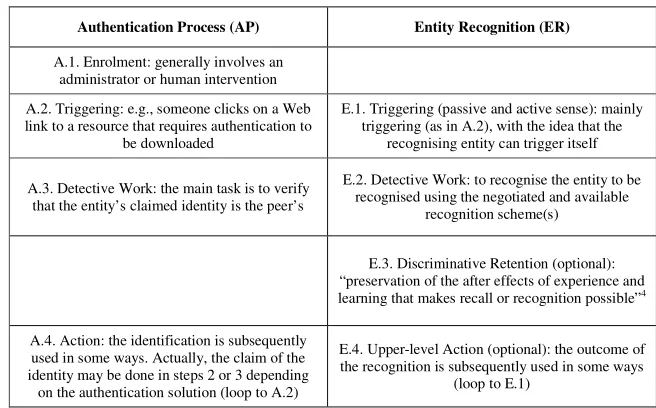
TABLE 2.AUTHENTICATION AND ENTITY RECOGNITION SIDE-BY-SIDE... 54
TABLE 3.APERCLAIM FORMAT... 86
TABLE 4.ACRCCARD EXAMPLE... 89
TABLE 5.RTT(STRINGSIZE)LINEAR FUNCTIONS... 130
L
IST OF FIGURES
FIGURE 1.SECURITY ADMINISTRATION BURDEN OF LEGACY MECHANISMS IN GLOBAL COMPUTING... 12
FIGURE 2.SHORTCOMING OF LEGACY SECURITY APPROACH IN GLOBAL COMPUTING... 13
FIGURE 3.HIGH-LEVEL VIEW OF THE SECURETRUST ENGINE... 18
FIGURE 4.HIGH-LEVEL ACTIVITIES OF THE SECURETRUST ENGINE... 20
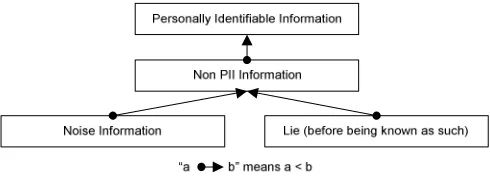
FIGURE 5.IDENTITY TERMS CATEGORISATION... 37
FIGURE 6.IDENTITY AND TRUST FRAMEWORKS POINTS OF COMPARISON... 51
FIGURE 7.REVISED IDENTITY TERMS CATEGORISATION... 57
FIGURE 8.THE ERAUTONOMIC FUNCTIONAL UNIT... 62
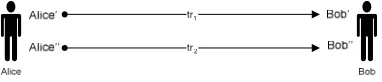
FIGURE 9:LINKABILITY OF TRANSACTIONS... 64
FIGURE 10:PRIVACY ASSET ORDER EXAMPLE... 68
FIGURE 11:TRUSTWORTHINESS ASSESSMENT IMPACT ORDER EXAMPLE... 68
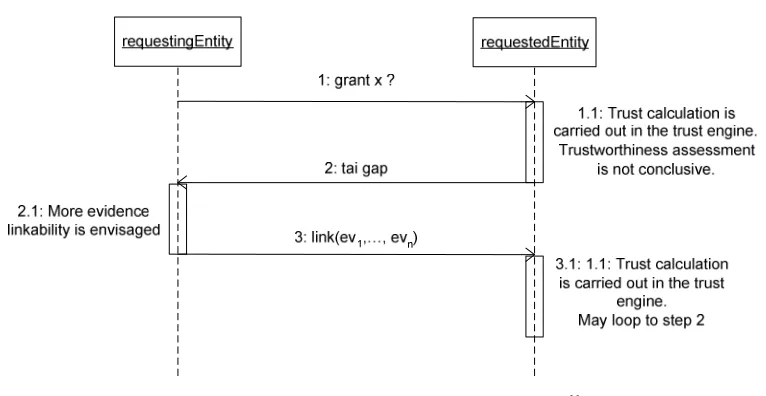
FIGURE 12:PRIVACY/TRUST TRADE SEQUENCE DIAGRAM... 70
FIGURE 13:UTILITY ORDER EXAMPLE... 71
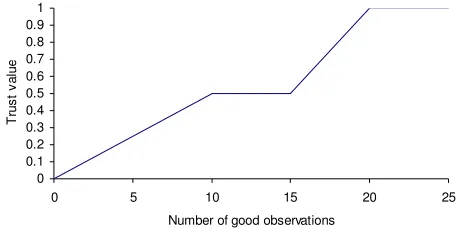
FIGURE 14:EXAMPLE RELATION BETWEEN OBSERVATIONS AND TRUST VALUES... 74
FIGURE 15.TRUST TRANSFER PROCESS... 79
FIGURE 16.TRUST TRANSFER PROCESS EXAMPLE... 80
FIGURE 17.THE CTKFUNCTIONAL UNIT... 88
FIGURE 18.CTK/TSFEMAIL PROXY... 98
FIGURE 19.THE REAL-WORLD NETWORK OF EMAIL USERS AND ZOOMED AREA POSITION... 100
FIGURE 20.ZOOMED NETWORK VIEW... 100
FIGURE 21.TYPICAL NEWCOMER BOOTSTRAPPING SEQUENCE... 102
FIGURE 22.EXTENDED NEWCOMER BOOTSTRAPPING SEQUENCE... 105
FIGURE 23.PRIVACY MAP... 107
FIGURE 24.TRUST MAP... 107
FIGURE 25:ALICE’S SMART WORLD... 109
FIGURE 26.VERENVIRONMENT AND SEGMENTED FEATURES... 112
FIGURE 27.VERSOFTWARE GUI ... 113
FIGURE 28.VERPROCESS DIAGRAM... 114
FIGURE 29. LCR EVENT STRUCTURE EXAMPLE... 125
FIGURE 30.DATA THROUGHPUT... 130
FIGURE 32.SBATYPE 2–USER’S LOCAL MACHINE IS COMPROMISED BUT WITH THE PROXY HOSTED
EXTERNALLY... 137
FIGURE 33.SBATYPE 3–MAIL SERVER COMPROMISED... 138
FIGURE 34.SBATYPE 4–A RELAYING MAIL SERVER BETWEEN SENDER AND RECEIVER IS COMPROMISED... 139
FIGURE 35.SPAMMER COST... 144
FIGURE 36.COLLABORATION EMAILS OVERHEAD DUE TO ATTACKS... 146
FIGURE 37.PROOF OF FRIENDS TRUST TRANSFER... 148
CHAPTER 1:
INTRODUCTION
During the past three decades, the computing environment has changed from centralised stationary computers to distributed and mobile computing. This evolution has profound implications for the security models, policies and mechanisms needed to protect users’ information and resources in an increasingly globally interconnected computing infrastructure. In centralised stationary computer systems, security is typically based on the authenticated identity of other parties. Strong authentication mechanisms, such as Kerberos [106] or Public Key Infrastructures (PKIs) [80], have allowed this model to be extended to distributed systems within a single administrative domain or within a few closely collaborating domains. However, small mobile devices are increasingly being equipped with wireless network capabilities that allow ubiquitous access to corporate resources and allow users with similar devices to collaborate while on the move. Traditional, identity-based security mechanism cannot authorise an operation without authenticating the claiming entity. This means that no interaction can take place unless both parties are known to each others’ authentication framework. Spontaneous interactions would therefore require that a single, or a few trusted Certificate Authorities (CAs) emerge, which, based on the inability of a PKI to emerge over the past decade, seems highly unlikely in the foreseeable future. In the current environment, a user who wishes to partake in spontaneous collaboration with another party has the choice between enabling security and thereby disabling spontaneous collaboration or disabling security and thereby enabling spontaneous collaboration. The state-of-the-art is clearly unsatisfactory, instead, mobile users and devices need the ability to autonomously authenticate and authorise other parties that they encounter on their way, without relying on a common authentication infrastructure.
global computing environments. Finally, we summarise the aims, objectives and contribution of this thesis and present its organisation.
1.1
Towards Global Computing Systems
A decade ago, Weiser [187] envisioned computing capabilities to be woven into the fabric of every day life, indistinguishable from it – global computing is the next evolution of computing environments. The scale of the proliferation of computing entities can therefore be expected to be huge. Consequently, scalability issues appear for this increasing base of computing devices, especially the tiny ones, which are resource-constrained in many aspects, for example, memory, power or communication range. In addition, even powerful servers may be challenged to deal with worldwide data and to serve a worldwide base of clients. Decentralisation is also needed due to the potential failures of these servers.
According to Weiser’s principle of “calm technology” [188], it is a great challenge not to overload humans with pervasive computing tasks. Ideally, it should go beyond usability, up to transparency. Global computing must be considered from a user acceptance and technology adoption point of view.
Another user aspect to take into account is that global computing functionalities experienced in the user’s home environment will be expected anywhere anytime. The user’s mobility implies that resources left in the home environment must be accessed via interconnected third-parties. When the user moves to a foreign place for the first time, it is highly probable that the third-parties of this place are a priori unknown, strangers. However, to interact with these strangers is still necessary, for example, to access his/her remote home environment.
1.2
Security in Global Computing Systems
Legacy security models and mechanisms rely on the assumption of closed computing environments, where it is possible to identify and fortify a security perimeter, which protects against potentially malicious entities. However, in these models, there is no room for anytime anywhere mobility. Moreover, it is supposed that inside the security perimeter, there is a common security infrastructure, a common security policy or a common jurisdiction where the notion of identity is globally meaningful. The absence of this assumption creates unaddressed issues in four surfacing dimensions, which intermingle and overlap, Adaptability, Security, Usability and Privacy (ASUP):
Adaptability: There is a risk of scalability issues, for example, the memory of a tiny device cannot store the information about all its peers. Some information cannot be retrieved fast enough, for example, due to computationally expensive security operations so the window of opportunity is missed. An application must be able to adapt to an entity’s capabilities and to the capabilities offered by the environmental context, for example, as the user roams. Ideally, it must be adaptable to all environments without requiring the availability of known parties in a decentralised peer-to-peer (P2P) way.
Security: When known third-parties are unreachable, which is even more often the case in mobile ad-hoc networks than in traditional fixed networks, security mechanisms requiring access to these third-parties cannot be applied. In this case, security must be created from scratch with reachable unknown entities. A fundamental requirement for global computing environments is to allow for potential interaction and collaboration with unknown entities because they are interdependent. Usability: Due to the potentially large number of previously unknown entities and simple economic reasons, it makes no sense to assume the presence of a human administrator who configures and maintains the security framework. This means that individual entities must decide about each of these potential interactions themselves. It applies to security decisions too, for example, concerning the enrolment of a large number of unknown entities.
computing entities are willing to respect privacy, the burden of countless privacy decisions to be made as the context changes goes against usability.
Therefore, traditional security approaches are challenged in global computing and means are needed to address issues in four dimensions, the ASUP dimensions.
1.3
Trust Engines for Security in Global Computing
There is an inherent element of risk whenever a computing entity ventures into collaboration with a previously unknown party. One way to manage that risk is to develop models, policies and mechanisms that allow the local entity to assess the risk of the proposed collaboration and to explicitly reason about the trustworthiness of the other party in order to determine if the other party is trustworthy enough to mitigate the risk of collaboration. Formation of trust may be based on previous experience, recommendations from reachable peers or the perceived reputation of the other party. Reputation, for example, could be obtained through a reputation system such as the one used on eBay.
Explicit trust management has additional advantages: it allows an entity to select the service provider that is most likely to provide the required service whenever it is faced with a number of previously unknown service providers. We therefore believe that a general trust management middleware will provide the enabling technology for secure and reliable collaboration in highly dynamic (mobile) computing environments.
entity, the actions of the granted entity are monitored and the outcomes, positive or negative, are used to refine the trust value.
Another source for trust in human networks consists of real-world recourse mechanisms, such as insurance or legal actions. Traditionally, it is assumed that if the actions made by a computing entity are bound to a real-world identity, the owner of the faulty computing entity can be brought to court and reparations are possible. In open environment with no unique authority, such as in global computing, the feasibility of this approach is questionable. An example where prosecution is ineffective occurs when email spammers do not mind to move operations abroad (at the time of writing Brazil and China [137]) to escape any risk of prosecution. It is a fact that there are multiple different jurisdictions in global computing. Therefore, security based on the authenticated identity may be superfluous. Furthermore, in the first place, there is the question of which authority is in charge of certifying the binding with the real-world identity, since there are no unique global authorities. “Who, after all, can authenticate US citizens abroad? The UN? Or thousands of pair wise national cross-certifications?” [101].
1.4
Aims and Objectives
The general objective of this thesis is to study the role of identity in pervasive computational trust and develop novel mechanisms for managing and authenticating identities in a trust-based security framework. The previous section has already introduced the notion of entity recognition, which seems to be sufficient to make trusting decisions based on trust engines. This thesis must demonstrate how this new computing paradigm, extracted from a parallel with human social networks, can be effectively used within trust engines.
In order to do so, first, a computational process based on this notion of entity recognition must be designed and implemented. Then, this process must be integrated into a trust engine. Therefore, a framework integrating both entity recognition and computational trust is needed. Then, it must be validated that recognition can effectively be used. Since there are a number of attacks that can happen at the level of identity and challenge the use of trust engines, the framework must be discussed from a security point of view. A threat analysis is required to evaluate the use of entity recognition in trust engines. Although concrete global computing environments do not exist yet, tests in related existing environments are needed.
In addition to the security dimension, the framework must be discussed according to the other ASUP dimensions of global computing environments: to what extent the framework improves adaptability, security, usability and privacy.
1.5
Contribution of this Thesis
Within the context of this thesis we have designed, implemented and evaluated the first framework that combines the human notion of entity recognition and computational trust. This framework is called the entification framework. It fills the gap between identities and their level of trust, which is one of the eight “major issues” [43] in developing identity management for the next generation of distributed applications.
The contributions are to the ASUP dimensions in the following way.
Firstly, the entification framework improves the adaptability dimension thanks to:
the management of the large number of recognition clues based on context to cope with scalability; tested with vision-based recognition, which indeed generates a lot of recognition clues;
the possibility to plug and use a number of different ER schemes depending on the application domain and the context.
Secondly, the entification framework also contributes to the security dimension by:
the identification of layers of trust, technical trust and trust in the entity, which are explicitly taken into account in the framework; trust in the entity, which is normally formed and maintained by the trust engine; static and dynamic evidence-based means to compute the level of technical trust, when it is abstracted to ER schemes; technical trust, which is useful to mitigate identity usurpation attacks, especially in message-based applications; new anti-spoofing techniques, peer-reviewed in the email domain to fight spam; and a generic tool kit for message-based recognition implemented in Java;
the use of ER performance results in cost/benefit security analysis and decision-making, which is especially important for the risk analysis component of the SECURE trust engine (the SECURE project was the work context of the thesis); a computational model of entity recognition as a replacement of the authentication process, which can work without centralised authentication trusted-third-parties; the mitigation of attacks due to the control of many virtual identities by the same real-world identity when the level of trust is based on counts of interaction outcomes; it has shed light on novel networked engineered attacks using a priori knowledge about the network to select and attack the most well-connected entities.
Thirdly, the contributions to the usability dimension are made thanks to:
the support in the tool kit of the automatic selection of the most appropriate virtual identity depending on the current context, including the threat level.
Finally, contributions to the privacy dimension correspond to:
the identification of the inherent conflict between privacy and trust: the impact that computational trust, based on knowledge about the trustee, has on privacy;
the possibility to encourage privacy protection by the use of pure ER schemes and the support of multiple pseudonyms per person in the message-based tool kit;
the new functionality to negotiate privacy for trust between the interacting entities. Therefore, this thesis contributes to the four ASUP dimensions.
1.6
Organisation of this Thesis
CHAPTER 2:
TOWARDS TRUST ENGINES FOR
SECURITY IN GLOBAL COMPUTING
This chapter begins by presenting a survey of legacy computer security and how it is challenged in global computing. Then, trust management is surveyed, which leads to an examination of computational trust engines and how they can be used to address security in global computing.
2.1
Computer Security
Although computer security influenced many early computing systems, the discipline really started to be studied in the early 1970s. The traditional goal of computer security is to ensure the Confidentiality, Integrity and Availability (these are often referred to as the CIA properties) of information and resources in the system [72]:
Confidentiality: the goal is that only authorised persons have the access to information and resources;
Integrity: the goal is that the information cannot be tampered with, neither during communication nor in its fixed storage;
Availability: the goal is that both information and resources are available when the authorised persons need them.
Model [33], imaginary walls are built as entities access objects in conflict-of-interest domains.
In this thesis, we focus on the access control method to computer security. In the access control model, confidentiality and integrity of stored data is ensured by restricting access to information and resources to entities who are trusted (this fails in global computing where traditional implicit trust relationships do not exist). The method is to decide whether or not a requesting entity is allowed to access a resource or execute an action. There are two main approaches:
identity-based access control: in order to make this decision, the identification of the requesting entity is followed by authentication, which consists of verifying that the requesting entity has the identity it claims to have; then, once authentication is successfully passed, further access control operations are carried out in order to reject/grant authorisations and privileges: “authentication is one problem and access control is a completely different one” [168];
credential-based access control: in this case, instead of relying on the identity of the requester, the requester exhibits credentials different than identity; however, the credentials must still be obtained and certified in the first place.
The authorisation work is usually done by a component called the reference monitor. Abendroth [7] presents the various access control mechanisms of distributed systems in a unified view. When an access matrix model [110] is used, an object may be associated with an Access Control List (ACL [72]), which lists the access right of the entities. A second implementation may be that the access rights are given to the entities in the form of capabilities. An extension of the second implementation may be that instead of a system protected capability, certificates with a standard format are issued [7]. In Role-Based Access Control (RBAC) [58], roles are given to entities, they can choose to play/use one or more of these roles. Usually a role combines all permissions necessary to perform a duty in the application environment.
ciphers (DES, AES, IDEA, Blowfish, CAST…) and stream ciphers (RC4, SEAL…). With asymmetric cryptography, there is no need for shared secrets (e.g., previously exchanged during an a priori secure session) since a public key (Pub) can be publicly distributed while a private key (Pri) is kept local to sign or decrypt. The encryption is done with the public key of the entity who is supposed to decrypt. It is also possible to verify a signature made with a private key using the corresponding public key. Asymmetric cryptography is based on hard mathematical problems, for example, RSA [143] uses large enough prime numbers to make the trial-and-error factoring attacks too difficult to be practical. Another example is the Digital Signature Standard (DSS [52]), which uses another hard problem other than factorisation, which is the discrete algorithm problem. Challenge/Responses (C/Rs) consist of sending a challenge to be encrypted with the private key and verified using the public key. Public key certificates (or credentials) are used to bind/link attributes to public keys. There are certificate standards to improve their interoperability: for example, globally unique X.509 distinguished names [83].
2.2
Legacy Security is Challenged by Global Computing
Gollman [72] emphasises that “decisions about technical security matters cannot be made without reference to the context they are applied in”. In this section, the evolving landscape of computer security is presented from traditional managed computing environments to global computing environments. At the time of the writing of this thesis, security has moved from “easy” [72] computer security in a single centralised security enforcing system to a collection of computers linked via some network, that is, distributed systems. Security for systems connected to the Internet – the World Wide Web – is considered even more difficult, because it spans a plethora of independent (possibly conflicting) authorities. Global computing goes even further because collaboration becomes open to any of the potential interacting computing entities.
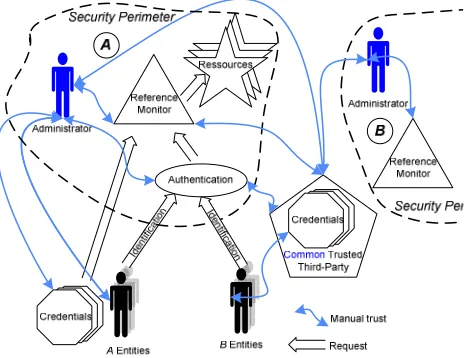
required to set some sort of trust relation, a blue arrow is drawn. The blue colour is also used to indicate that the administrators must be highly trusted. Figure 1 focuses on the domain A, which has a security perimeter administered by an administrator. The basic scenario is when an entity identifies itself as a known local entity of A’s domain. After this identification, authentication is used to make sure that the entity really possesses the identity it claims to have. This is usually possible because the trusted administrator of A’s domain will have created an account (or related authentication material) for this entity, which usually involves manual tasks to enable this permission. Then, the reference monitor is consulted to find out whether the authenticated entity is allowed to access the specific resource. Again, it usually involved that the administrator decided that the entity is allowed access and carried out manual tasks. A variant is when credentials are used directly instead of identity. In this case, identity authentication is not done. However, the credentials, which authorise access, still have to be manually configured at some stage and the validity of these credentials must be verified anyway. To summarise the access inside the security perimeter is restricted thanks to some manual trust set up by the administrator.
Figure 1. Security Administration Burden of Legacy Mechanisms in Global Computing
constantly needed would most likely overwhelm the people playing the role of administrators. In fact, it may even be the case that there is no administrator available, who is knowledgeable about security related issues, because it is too expensive to pay a dedicated administrator. For example, the home environment is different than the corporate environment because most households cannot employ an administrator. This is a real problem because it is expected that intelligent appliances and home networks will become standard home assets. In the email domain, the cost of involving humans in security decisions concerning spam has underlined that even quick security decisions made by humans are very costly when they have to be made in a great number [98].
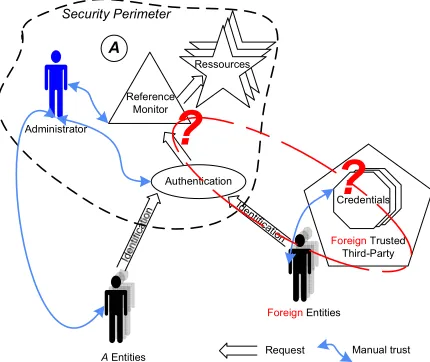
[image:28.612.209.424.410.591.2]Due to the global scale of the environment, as depicted in Figure 2, a foreign entity may have credentials from a trusted-third-party but they are useless because this trusted-third-party means nothing to the domain under consideration (that is, the domain A in our example). The authentication may be certified by the foreign trusted-third-party but the reference monitor cannot take this information into account: it is represented by the red circle and question marks. Global authentication would require a single or few commonly trusted CAs to emerge, which, based on the inability of a global PKI to emerge over the past decade, seems very unlikely in the foreseeable future.
2.3
Solving Security via Trust Engines in Global Computing
We start with an explanation of why implicit and credential-based trust approaches are inadequate in global computing. Then, we present collaborative computational trust engines.
2.3.1
Inadequacy of Implicit Trust and Credential-based Trust
The terms trust/trusted/trustworthy, which appear in the traditional computer science literature, are not grounded on social science and often correspond to an implicit element of trust. For example, we have already mentioned above the use of trusted-third-parties, called CAs, which are common in PKI infrastructures. Another example is the Trusted Computed Platform Alliance (TCPA) [174], which makes it clear that we can speak of trust in technical components. Its goal is to create enhanced hardware – by using cost effective security hardware (more or less comparable to a smart card chip) that acts as the “root of trust”. They are trusted means that they are assumed to make use of some (strong) security protection mechanisms. Therefore they can/must implicitly be blindly trusted and cannot fail. This cannot address security when it is not known who or whether or not to blindly trust.
relationships are formed” [177]. Automated Trust Negotiation (ATN) is argued to improve trust management systems such as Keynote, which all “support delegation of authority, but are not helpful for establishing trust between strangers using general-purpose credentials” [190]. However, ATN “does not address the client’s need for trust before it requests service” [189]. Furthermore, because it is required to show credentials in order to start the collaboration, this type of system may have a bootstrapping problem when no credential is already obtained, or cannot be discovered, which may often be the case in global computing settings [177]. It also does not help if no third-party is accepted as a common credential provider by both parties. There is a need for trust formation mechanisms from scratch between the two strangers. Credentials may be exchanged or accepted after this trust formation phase but not before it is achieved.
2.3.2
Collaborative Trust Computation to Bootstrap Trust in Strangers
The use of an explicit notion of trust based on the human notion of trust has yielded to a new class of trust management system, called evidence-based trust management where the level of trust is explicitly computed by a trust engine. There are many definitions of trust in a wide range of domains (please refer to [120, 139, 140, 177]). In this thesis, the human notion of trust is Romano’s one [145]:
"Trust is a subjective assessment of another’s influence in terms of the extent of one’s perceptions about the quality and significance of another’s impact over one’s outcomes in a given situation, such that one’s expectation of, openness to, and inclination toward such influence provide a sense of control over the potential outcomes of the situation." [145]
outcome, or when the legal system acts as a credible deterrent against undesirable behaviour, it means that the level of system trust is high and the level of risk is negligible – therefore the levels of interpersonal and dispositional trust are less important. It is usually assumed that by knowing the link to the real-world identity, there is insurance against harm that may be done by this entity: in essence, this is security based on authenticated identity and legal recourse. In this case, the level of system trust seems to be high but one may argue that in practice the legal system does not provide a credible deterrent against undesirable behaviour, e.g., it makes no sense to sue someone for a single spam email, as the effort expended to gain redress outweighs the benefit. We have already strengthened that due to multiple jurisdictions in global computing, legal recourse is questionable.
An interesting case might be to consider the real-world recourse mechanism as an entity and the level of trust is explicitly computed based on the number of times the real-world recourse has successfully played its role (which is indeed evidence-based computation of the level of trust). Of course, scenarios where the level of system trust is low make interpersonal trust more important. The level of dispositional trust may be set due to two main facts. First, the user manually sets a general level of trust, which is used in the application to get the level of trust in entities, independently of the entities. Secondly, the current balance of gains and losses is very positive and the risk policy allows any new interactions as long as the balance is kept positive. Marsh uses the term “basic trust” [122] for dispositional trust; it may also be called self-trust.
Interpersonal trust is represented as a computed trust value. Thus, in this thesis:
a trust value, that is the digital representation of the trustworthiness or level of trust in the entity under consideration, is seen as a non-enforceable estimate of the entity’s future behaviour in a given context based on past evidence.
contact is whitelisted even if the email address is spoofed from time to time or banned due to the same reason), it must be considered as manual trust values. Manual trust values are difficult to be integrated in trust engines if not converted in an equivalent of event outcomes. For example, if the user gives a value of 18 positive outcomes and 2 negative ones, it seems fine, if he/she gives a value of 0.75 on a [0,1] scale, it does not seem compatible.
Based on the trust value, security decisions can be made according to trust policies. For example, the resource is granted to any entities who are associated with a greater trust value than a threshold. The bootstrapping with unknown entities, strangers beyond the security perimeter, can now be carried out without a priori knowledge. The trust value can be formed after an interaction and can be further refined during subsequent interactions. Previous direct interactions may not be obligatory if trustworthy recommenders recommend the newcomer.
2.4
Summary
This chapters presented challenges to legacy approaches for computer security introduced by global computing. The challenges arise because the assumptions of the availability of a dedicated technologically-aware administrator and mutually trusted-third-parties may not be viable.
CHAPTER 3:
THE SECURE TRUST ENGINE
This chapter presents an overview of the SECURE trust engine and highlights the work context of the thesis with regard to computational trust.
3.1
High-level View of the SECURE Trust Engine
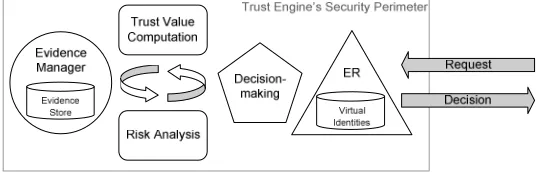
[image:33.612.182.453.380.467.2]Figure 3 depicts the high-level view of the SECURE trust engine. The goal of the SECURE project [27, 151, 154] was to achieve an advanced trust engine formally grounded and usable. A pentagonal decision-making component is called when a requested entity has to decide what action should be taken due to a request made by another entity, the requesting entity.
Figure 3. High-level View of the SECURE Trust Engine
In order to take this decision, two sub-components are used:
• one that can dynamically compute the trust value, that is, the trustworthiness of the requesting entity based on pieces of evidence (for example, direct observations1 or
recommendations [183]);
• a risk module that can dynamically evaluate the risk involved in the interaction [47, 48]; risk evidence is also needed.
1 By direct observations, we mean that the entity has directly interacted with the requesting entity and
The chosen action should maintain the appropriate cost/benefit ratio [47, 48]. Depending on dispositional trust and system trust, the weight of the trust value in the final decision may be small. In the background, another component is in charge of gathering evidence: recommendations, comparisons between expected outcomes of the chosen actions and real outcomes… This evidence is used to update risk and trust information. Thus, trust and risk follow a managed life-cycle [177]. A trust engine may be called Trust/risk-based Security Framework (TSF) due to the presence of this risk element.
The Entity Recognition (ER [160]) module deals with digital virtual identities and is in charge of dynamically recognising them. This thesis motivated and permitted the integration of this crucial module into the SECURE trust engine: in fact, this module fills the gap between the notion of identities and trust. Without this ER module (i.e., without this thesis), the SECURE trust engine would not address any identity or privacy attacks. The ER module is also supposed (within the consortium view of the SECURE trust engine) to participate in the population of risk data to be used by the risk analysis component. Information of interest corresponds to: on one hand, performance and overhead of ER schemes; on the other hand, an estimation of the security strength and threat context at the ER level. ER may also be used when evidence is received.
outcome count is represented as a (s,i,c)-triple, where s is the number of events that supports the outcome, i is the number of events that have no information or are inconclusive about the outcome and c is the number of events that contradict the expected outcome. This format takes into account the element of uncertainty via i.
3.2
High-level Activities of the SECURE Trust Engine
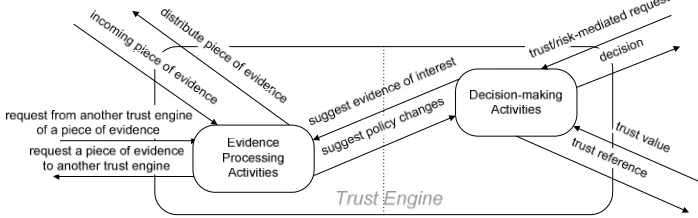
[image:35.612.141.490.473.582.2]There are two high-level processes (as depicted in Figure 4), which are run in parallel: the decision-making process and evidence processing. The directed black arrows represent messages sent from one process to another. When the arrows point outside the rounded rectangle representing the local trust engine, it means that they point to the processes of other trust engines. Activities related to these processes occur because a virtual identity can be: a requester (of an action), a decision-maker, an observer (of first-hand pieces of evidence, e.g., on its own interactions or captured from its own sensors), a receiver (of indirect pieces of evidence; it highlights issues of overcounting due to second-hand pieces of evidence), the subject (of a piece of evidence) or a recommender (of a piece of evidence). Full delegation, that occurs when the local trust engine leaves the decision to an external trust engine, is still possible. However, this is not fully in line with a scenario composed of autonomous entities. A trust reference request may also be used to obtain the trust value that a specific entity has in another entity.
Figure 4. High-level Activities of the SECURE Trust Engine
process. In email settings, the evaluation work (please refer to Chapter 7) has shown that it could be used to some extent to increase the cost on the sender side, and that it makes more sense to put that cost on the sender side than the receiver. The decision-maker may return a decision. In the case of negative decisions, the decision may suggest authorisation hints to be specified in subsequent requests. The different request/decision exchanges form the trust negotiation. The decision-making process might be faster. Further optimisation may consist of attaching the recommendations themselves in authorisation hints. However, care should be taken when including authorisation hints given by the requester because it creates opportunities for attacks on the decision-making process (for example, if authorisation hints consist of a list of recommenders and a restricted number of recommenders are queried during trust formation [177], the requester can force the decision-maker to query only colluding recommenders).
The decision-making process should be able to suggest what kind of evidence is of interest to improve scalability, performance and context adaptation (for example, authorisation hints specify evidence of interest to the evidence manager). In return, the evidence process should be able to suggest changes in the policies driving the decision-making process. The ER module developed in this thesis can indeed be tuned and contributes to the update of the environmental context. Context plays an important role in both processes. Context should affect the way in which the trust engines behave. There are different granularities of context: environmental context concerns the context in which the decision-maker seems to be (e.g., under-attack) and is built from various pieces of evidence; an action request inherently carries further context. The action context, that is, the trust context, allows the trust value to be contextualised to the dimension of trustworthiness of interest. For example, if the request is about the access of privacy information, the trustworthiness of the requesting entity in respecting privacy expectation is of greater importance than the trustworthiness in paying money in time.
3.3
Summary
CHAPTER 4:
THE IDENTITY GAP IN PREVIOUS
TRUST ENGINES
This chapter emphasises that the current approach to identity in trust engines is too simplistic and cannot achieve security in global computing. First attacks due to identity on trust engines are surveyed. Then, remaining issues of the current state-of-the-art due to authentication with regard to the ASUP requirements are presented. The terminology used for identity in this thesis is introduced in Section 4.4. Finally, related work on identity and trust frameworks is discussed, compared and contrasted according to the ASUP dimensions.
4.1
Flawed Trust Engines due to Simple Identity Approach
This section starts by describing the general attacks that are possible on trust engines due to weak identity approach. Then, the well-known Sybil attack [50] is detailed.
4.1.1
Trust Metrics under Identity Usurpation and Multiplicity Attacks
different computations and communications which are carried out by the trustor (and his/her network) to compute a trust value in the trustee. According to Twigg and Dimmock [180], a trust metric is -resistant if more than nodes must be compromised for the attacker to successfully drive the trust value. For example, the trust metrics used in Rahman’s explicit computational trust framework (compared in Section 4.5) is not -resistant for >1 (i.e., a successful attack needs only one victim).
Indeed, there are a number of specific attacks due to collaboration, for example, in order to compromise a majority vote. We do not consider real-world identities, which form an alliance, and use their vote to undermine other entities. On one hand, this may be seen as collusion. On the other hand, one may argue that real-world identities are free to vote as they wish. Instead, we focus on attacks based on vulnerabilities in the identity approach and subsequent use of these vulnerabilities. The vulnerabilities may have different origins, for example, technical weaknesses or topological ones (for example, we evaluate novel topologically engineered attacks in Section 7.6.1). However, these attacks commonly rely on the possibility of identity multiplicity: meaning that a real-world identity uses many virtual identities.
4.1.2
The Sybil Attack
A very well-known identity multiplicity attack in the field of computational trust due to collaboration is Douceur’s Sybil attack [50]. Douceur argues that in large scale networks where a centralised identity authority cannot be used to control the creation of virtual identities, a powerful real-world entity may create as many virtual identities as it wishes and in doing so challenge the use of a majority vote and flaw trust metrics. This is especially important in scenarios where the possibility to use many pseudonyms is facilitated and provided by the trust engine. In fact, a sole real-world entity can create many pseudonyms who blindly recommend one of these pseudonyms in order to fool the trust engine. The level of trust in the latter virtual identity increases and eventually passes above a threshold which makes the decision to trust (the semantics of this depend on the application).
In his draft PhD thesis [117], Levien says that a trust metric is attack resistant if the number of faked virtual identities, owned by the same real-world identity, that can be introduced is bounded. Levien argues that to mitigate the problem of Sybil-like attacks it is required to compute “a trust value for all the nodes in the graph at once, rather than calculating independently the trust value independently for each node”. Another approach proposed to protect against the Sybil attack is the use of mandatory “entry fees” associated with the creation of each pseudonym [3, 62]. This approach raises some issues about its feasibility in a fully decentralised way and the choice of the minimal fee that guarantees protection. Also, “more generally, the optimal fee will often exclude some players yet still be insufficient to deter the wealthiest players from defecting” [62]. An alternative to entry fees may be the use of once in a lifetime (1L [62]) pseudonyms, a.k.a. pseudonym commitment, where an elected party per “arena” of application is responsible to certify only 1L to any real-world entity, which possesses a key pair bound to this entity’s real-world identity. The technique of blind signature [30] is used to keep the link between the real-world identity and its chosen pseudonym in the arena unknown to the elected party. However, there are still three unresolved questions about this approach: how the elected party is chosen; what happens if the elected party becomes unreachable; and how much the users would agree to pay for this approach. More importantly, a Sybil attack is possible during the voting phase, so the concept of electing a trusted entity to stop Sybil attacks does not seem practical.
modules (e.g., TCPA [174], which is discussed in Section 2.3.1) to counter the Sybil attack. This may overcome the Sybil attack, but at the same time it may exclude poor users as said above according to [62]. Similarly, Kinateder et al.’s workarounds [102] are two-fold. Firstly, some of the risks of pseudonymity are alleviated via TCPA trusted hardware including a trusted CA that would certify the pseudonym without disclosing the real-world identity until legal bodies want to retrieve the link. Secondly, the trust engine should be combined with electronic payment systems, which allow the creation of an originality statement during the payment process which can be included in a recommendation. However, relying on real money turns the trust mechanism into a type of system trust, which is high enough to make the use of interpersonal trust (that is, the trust value) almost superfluous. In the real world, tax authorities are likely to require traceability of money transfers, which would completely break privacy in a money-based system. In this thesis, another solution is adopted (and described in Section 5.5).
A real-world application where the Sybil attack occurs is the email system. The success of spammers has proven it is still cheap enough to create (or spoof) text email addresses, which act as pseudonyms in order to carry out profitable, large-scale spam attacks. It is for this reason that we evaluate our solution in the email and anti-spam domain.
4.2
Remaining ASUP Issues due to Authentication
One of the foundations of security is authentication. Stajano [171] emphasises that without being sure with whom an entity interacts, the CIA security properties can be trivially violated. It underlines the importance of authentication from the security point of view of the ASUP dimensions. Creese et al. [37] agree with Stajano’s view [171]: authentication is at the core of security issues in pervasive computing. In this section, we first explain the impacts of naming in distributed collaborative settings and authentication with regard to the usability dimension. It is followed by a discussion on the adaptability of authentication mechanisms.
4.2.1
Naming Issues in Distributed and Collaborative Settings
entities is more complicated, especially when there is no central naming authority. At any rate, collaboration may be required in global computing environments, thus the entities should be able to refer to other entities.
The deployment and management costs of global name/identifier hierarchies, such as X509 [83] distinguished names, are not always viable. Consequently, the first issue related to naming is that it is often required for two different parts of the distributed system to understand that they speak about the same entity: if the two parts have generated local identifiers for the entity under scrutiny, it is very likely that the two local identifiers are different and they fail to realise that they talk about the same entity. Simple Distributed Security Infrastructure (SDSI) [2, 118, 142] and Simple Public Key Infrastructure (SPKI) [54, 118] solve the latter issue through the use of linked local name spaces. “Each principal has its own name space” [118], and can introduce names of its own and issue certificates to define local names. “Name resolution is the process of mapping a principal expression to a global identifier” [2]. Roughly, in SDSI, pi may be a global identifier, a local name or a
compound name. For example, a compound name represented in Abadi’s logic [2] is (Self:p1…pn), which intuitively means p1’s…’s pn (there are other representations, e.g., [118]).
A second issue related to naming is when the same identifier is picked in two different parts of the system for two different entities. A mathematically random generation of identifiers may decrease this kind of naming collision. For example, public keys may be considered as global identifiers [2] because they are assumed to be chosen with a very high degree of randomness and collisions are highly improbable.
undermined by a cost in terms of usability due to the increase of complexity in managing many identities in many contexts.
4.2.2
Usability and Administrative Tasks at the Authentication Level
Generally, authentication schemes start with enrolment of entities. This task is often time consuming and requires explicit human intervention, such as setting up an account by a system administrator. Enrolling new users may involve considerable work and resources: a random initial secret may be sealed in an envelope and sent to the new user; it can be even more expensive with smart tokens, which can involve two separate activities – token programming and user management [168]. There are already six steps needed for token programming. In the biometrics layer model [124], the enrolment, that is, the first measurement of the biometric characteristics, is crucial and “should be guided by a professional who explains the use of the biometric reader” in order to decrease the number of “fail to enrol” users. The biometric samples are often processed and features templates are extracted. Then, further authentication is usually fully automated.
In fact, once enrolment is complete, authentication often consists of two steps: the requester claims an identity (a.k.a., identification) and the claimed identity is verified (a.k.a, verification). As Smith chose for the title of his book on authentication, authentication techniques have evolved from “passwords to public keys” [168]. There are three main authentication factors: something that you know, e.g., a password; something that you have, e.g., a smart card token; and something that you are, e.g., biometrics. It may also be based on other factors, for example, where you are. Thanks to the context-awareness available in global computing, the “where you are” authentication factor is easier than ever to obtain (for example, based on satellites localisation such as GPS or Galileo).
computers available and usable than they are about password cracking”. A real challenge concerning the ease of authentication is to facilitate authentication across multiple and different authority domains: this may be achieved by single sign-on or federated identity management [81, 119, 173], where a trusted-third-party is in charge of managing identity information and ensuring authentication.
The protection by passwords (something that you know) has evolved a lot. However, there are two main categories: cultural history (the rest of the world is unlikely to know but it is not necessarily secret) and random secrets. The usability of Personal Information Numbers (PINs) and passwords undermines their security: on one hand, they need to be changed from time to time and users are asked to use complex passwords; on the other hand, it is difficult for humans to achieve that.
There are protection cost issues in the deployment of authentication tokens (what you have): expensive tokens may be lost or there are difficulties to span different sites with different authorities.
Biometrics (what you are) techniques measure the behaviour or physical traits to authenticate people. In real applications, the False Rejection Rate (FRR) is often greater than 10%, which is a usability issue for legitimate users [124]. “Sometimes biometric authentication systems replace traditional authentication systems not because of higher security but because of higher comfort and ease of use” [124].
The usability issue of managing and using public keys on a large scale has already shown the limits of approaches based on the exchange of keys that must be bound to real-world identities [64]. For example, in the email domain, previous attempts based on asymmetric encryption and binding of public keys to the identity of the owner of the private key have failed to gain large acceptance and to solve the spam problem. Authentication systems that are designed to run on top of the legacy email system suffer from many usability issues in deployment, use and management. In web of trust style systems [67, 195], the users should carefully check (ideally using an out-of-band channel such as a phone call or attending a key-signing party) that the public key received is really the one sent by the sender due to potential Man-In-the-Middle (MIM2) attacks. This is the first example of an identity usurpation attack.
2 In this thesis, any attack where an attacker can act between the two legitimate entities is called a MIM