INFLUENCE OF CERAMIC SLUDGE WASTE AS PARTIAL
REPLACEMENT OF CEMENT ON STRENGTH AND
DURABILITY PROPERTIES OF CONCRETE
Ankit J Patel
1,2and V.M.Patel
31
School of Technology, R.K. University, Rajkot, Gujarat, India 2
Government Engineering College, Modasa, Gujarat, India
3
Adani Institute of Infrastructure Engineering, Ahmedabad, Gujarat, India E-Mail: [email protected]
ABSTRACT
Concrete is very commonly used construction material. It is second largest material after water that is consumed on the planet. This popularity is due to the fact that it can be made by common materials and that are easily available. As consumption of concrete is very high, consumption of cement is also very high. Production of cement produces high amount of CO2. To save environment we have to find alternate solution for making concrete and partial replacement is one of the solution to reduce production of CO2.In this study, effects of waste material as partial replacement of cement on the Chloride permeability and compressive strength of concretes were experimentally investigated. The main parameter investigated in this study was M20 grade concrete with partial replacement of cement by waste material (CSW-Ceramic Sludge Waste). The percentage of replacement at the levels of 0%, 10%, 20%, 30% and 40% was examined. In this research a detailed experimental study on compressive strength and chloride permeability were carried out at an age of 7, 14 and 28 days. This investigation shows that ceramic sludge waste can be utilized as partial replacement of cement up to 20% without any loss of strength and durability of concrete.
Keywords: ceramic sludge waste, durability and compressive strength of concrete.
INTRODUCTION AND REVIEW OF PAST WORK
For human beings creating durable Structures is very important. Be it for residential purpose or other purposes. Structures are must be strong and durable for healthy environment for its desire service. There are many different materials available for construction like concrete, brick, stone, and glass, steel etc. They must have some properties like strength, workability, durability and they need to be molded to any shape. Concrete is one of the materials which fulfills all the requirement for easy construction of any structure.
Concrete is a family of different material like fine aggregate, coarse aggregate, binding material (cement), water and different admixture. Concrete is second largest material after water used by human beings. Cement is the main ingredient used as binding material in concrete. From the statistic portal, India is second largest country after China in production of cement. India reached 290 million metric tons in cement production in the year of 2018[1]. Production of cement creates hazard for earth by large emission of green house gases viz. CO2 to the atmosphere. One ton of cement is estimated to release 0.9 tons of CO2 [2, 3] and that pollutes atmosphere. To reduce carbon footprint t is inevitable to find replacement of cement. Ample research has been carried out for replacement of cement with different waste materials like GGBFS, fly ash, rice husk ash, silica fume, sludge waste etc…related literature for above mentioned supplementary cementitious material(SCM) are listed in references.
In review of other research paper it is established that large quantity of cement kiln dust (CKD) which is produced during the manufacture of cement clinker by the dry process, contains a mixture of raw feed as well as
calcined materials with some volatile salts. The ultimate compressive as well as tensile strengths will decrease for OPC concrete samples a slight increase in strength were observed for BFSC. The maximum limit for substitution is not more than 30% for SRC, and 20% for BFSC, and 10% for OPC [4]. They have observed higher amount of hydration due to lowest mean distribution radius for OPC with silica fume [4]. Dispersion coefficient is high so better packing characteristics observed due secondary pozzolonic reaction between silica fume and OPC [4].effect of glass powder (GP) and ground granulated blast furnace slag (GGBS) as a partial replacement in cement on the properties of concrete was carried out and the combined mix (cement + GP + GGBS) as 50:15:35 and 50:20:30 increased the compressive strength by 44.20% and 43.08% respectively. Addition of GP and GGBS reduced the sorptivity rate and water absorption rate. GP and GGBS can be successfully utilized as an effective mineral admixture in cement concrete with 15% and 35%respectively as a optimal replacement of cement in [5].
granite dust (RGD) showed good fresh properties. Better early age strength was encountered for concrete with 30% RGD than similar PFA-based concrete. Up to 50% replacement of cement with RGD mechanical properties of concrete remained acceptable [16]. Up to 30 % advantageously cement replaced with rice husk ash consists of 87% of silica and has an average specific surface area of 36.47 m2/g[17]. The concrete specimens containing 10% diatomite, 5% WPM and 5% WPM +10% diatomite replacement by weight for cement had the best compressive and flexural strength [18]. From above past research partial replacement of cement with different supplementary cementitious material gives good properties to the concrete without its side effect and we can also reduce the dumping of waste material so we can reduce pollution to the land and air by utilizing the waste in construction industries. The present research is for utilization of ceramic sludge waste generated from ceramic industries.
EXPERIMENTAL PROGRAMME
Materials
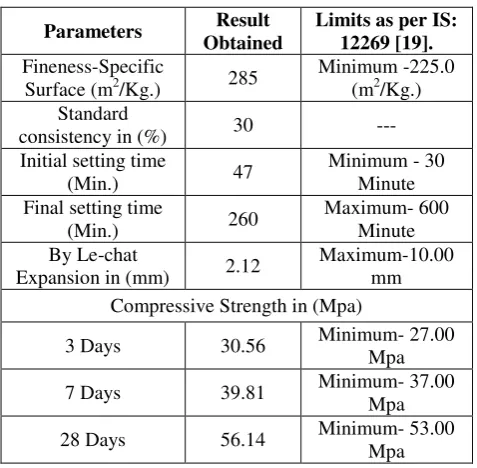
[image:2.595.308.546.108.230.2](A) Cement: Cement used for our research work was ordinary Portland cement (OPC) 53 grade conforming to IS12269 [19] the physical properties like specific gravity, surface area, initial setting time and final setting time was carried out and results were tabulated in Table-1.
Table-1. Properties of OPC 53 grade cement.
Parameters Result
Obtained
Limits as per IS: 12269 [19].
Fineness-Specific
Surface (m2/Kg.) 285
Minimum -225.0 (m2/Kg.) Standard
consistency in (%) 30 --- Initial setting time
(Min.) 47
Minimum - 30 Minute Final setting time
(Min.) 260
Maximum- 600 Minute By Le-chat
Expansion in (mm) 2.12
Maximum-10.00 mm Compressive Strength in (Mpa)
3 Days 30.56 Minimum- 27.00 Mpa
7 Days 39.81 Minimum- 37.00 Mpa
28 Days 56.14 Minimum- 53.00 Mpa
(B) Fine aggregate: River sand was used for our research work having specific gravity 2.67. Rounded aggregate provided good packing characteristics so we have used natural river sand. Grading of fine aggregate conforming IS 383-1970 [20]. Other properties are tabulated in Table-2.
Table-2. Properties of fine aggregate.
Parameters Observation Limits
Sand Falls in Zone II --
Finess Modulus of
sand 3.0 ---
Water Absorption (%) 1.1 Max - 2 %
Sp. Gravity of Sand 2.67 2.6 - 2.7 Silt Content (finer than
75 mic. (%)) 2.2 max.- 3 %
[image:2.595.50.289.442.676.2](C) Coarse aggregate Maximum size of aggregate was 20 mm used for this research work. Grading of coarse aggregate conforming IS 383-1970 specific gravity found out for coarse aggregate was 2.81 [20]. Other properties of coarse aggregates tabulated in Table-3
Table 3. Properties of coarse aggregate.
Parameters Observation Limits
Water Absorption in
(%) 0.97 Max. - 2.0 % Sp.Gravity 2.81 2.6 - 2.9 Elongation Index in
(%) 12.34 --
Flakiness Index in
(%) 10.70 --
Aggregate Impact
value (%) 14.35 Max.-45.0 % Aggregate Crushing
Value (%) 17.37 Max.-45.0 % Aggregate Abrasion
Value (%) 17.40 Max.-45.0 %
[image:2.595.50.289.443.676.2]Table-4. Chemical composition of selected material.
Types of test Result obtained
Sio2 72.41
Al2O3 20.6
Fe2O3 0.10
CaO 3.97
SO3 0.11
Loss of ignition 1.44 Fineness-Specific
surface(m2/kg) 728 Particle retained on 45µ
sieve 9.20
Specific Gravity 2.47 Lime reactivity avg
compressive strength(N/mm2)
9.20
Compressive strength at
28 days(%) 85.19%
Water used for this work for mixing and curing was good quality and having Ph value within permissible limits (IS 456: 2007) [21].
Mix design and methodology of work
M20 grade of concrete was used in this investigation and the detailed quantity of each material is mentioned in Table-5. Ceramic sludge waste was used as partial replacement of cement in varying percentage of 0% (CM-control mix), 10% (CW10 mix), 20 (CW20 mix), 30% (CW30 mix) and 40% (CW40 mix).
The main parameter for this investigation was effect of CW on mechanical properties of concrete. Specimen of size 150mm *150mm*150mm cube ware casted for compressive strength identification for different mix. For split tensile strength, 150 mm diameter and 300 mm height cylindrical specimens were casted for specified mix proportion. For durability test, 100 mm diameter and 50 mm height cylinder specimens were cast for RCPT test. Water cement ratio was 0.5 and slump value was varying from 50 to 70 mm.
Table-5. Mix design of M20 Concrete.
Mix design
Replacement %
Cement (Kg)
Water
(lit.) CA (Kg) FA (Kg) W/C CW (Kg)
M20
0 18.17 9.09 60.6 36.00 0.5 0
10 16.36 9.09 60.6 36.00 0.5 1.82
20 14.54 9.09 60.6 36.00 0.5 3.63
30 12.72 9.09 60.6 36.00 0.5 5.45
40 10.90 9.09 60.6 36.00 0.5 7.27
RESULTS AND DISCUSSIONS
Compressive strength: Compressive strength of concrete using ceramic waste as partial replacement of cement was carried out as per IS 516:1956[22] and results were tabulated in Table 6. The test set up for compressive strength test was as per Figure-1. Final strength was average of three numbers of specimen were prepared for each day strength. The test was carried out after 7, 14, 28, days of curing. The average value of compressive strength of CM mix at 7 days was found higher compare to other mix. It has also been recorded that the average compressive strength of mix with 30% (CW30) and 40% (CW40) replacement of cement was found to be less by 22.95% and 45.92% respectively. The compressive strength of (10 % replacement) CW10 mix and (20% replacement) CW20 mix at 7 days curing was not much affected by partial replacement of cement with ceramic sludge waste. The percentage reduction in compressive strength of CW30 and CW40 was found 22.96% and 38.06% respectively after 14 days curing. At 14 days curing the strength of mix CW10 and mix CW20 was not affected by replacement of cement with ceramic sludge waste. Similarly the reduction of compressive strength CW30 mix and CW40 mix was 28.26% and 42.95%. with this research it has been found that the upper limit for
replacement of cement partially by ceramic sludge waste was 20%. Compressive strength of
Table-6. Compressive strength.
MIX DESIGN
COMPRESSIVE STREGTH AT DIFFERENT AGE
7 DAYS 14 DAYS 28 DAYS
CM 14.81 22.96 25.19
CW10 13.19 23.85 25.48
CW20 14.81 23.85 25.33
CW30 11.41 17.63 18.07
Figure-1. Compressive strength test setup.
Concrete at any age with partial replacement of cement with ceramic sludge waste was very nearer to design strength of controlled concrete mix. Hydration process is depends on the amount of cement. As percentage of cement replacement is increase the required amount of cement available for hydration is less and the extra waste material is left as inert material so it will reduce the strength of concrete.
Split tensile strength of concrete
This test for measuring tensile strength of concrete was carried out on the cylindrical specimen of size 150 mm diameter and 300 mm length. This test was carried out for 7 and 28 days curing. IS 5816-1999[23] Indian standard was followed to calculate split tensile strength of concrete. Compression testing machine of 1000 kN capacity was used to apply load gradually on the cylinder till the specimen split. Arrangement of split tensile strength test was as per Figure-2.
Figure-2. Split tensile strength test setup.
The splitting tensile strength was found out by relationship given in IS 5816-1999[23]. The results are tabulated in Table-7 as per result tensile strength of concrete is poor.
Table-7. Spit tensile strength.
MIX DESIGN
SPLIT TENSILE STREGTH AT DIFFERENT AGE
7 DAYS 28 DAYS
CM 2.46 3.84
CW10 2.41 3.40
CW20 2.41 3.10
CW30 1.69 2.09
CW40 1.30 1.94
The split tensile strength of concrete with 30% ceramic sludge waste (CW30 mix) and 40% ceramic sludge waste (CW40 mix) was found very poor compare to other mix. The reduction in the split tensile strength of CW10 mix and CW20 mix at 7 days were not much affected it was only 1 to 2% reduction in split tensile strength of concrete but as amount of % of replacement of cement increased the split tensile strength of concrete is reduced. The reduction in split tensile strength of mix CW30 and CW40 were 31.03%, 47.85%, 45.52% and 49.32 at 7days and 28 days respectively. The reduction of split tensile strength of concrete is due to excess amount of ceramic sludge waste which becomes an inert material and reduced the quantities of cement for hydration process.
Rapid chloride permeability test
Chloride permeability of concrete with ceramic sludge waste as partial replacement of cement was carried out as per ASTM C1202. According to ASTM C1202 cylindrical sample for various concrete mixes CM, CW10, CW20, CW30 and CW40 of diameter 100 mm and 50 mm thickness were prepared for measuring chloride permeability. According to ASTM C1202 test, specimen is subjected to a 60 v DC voltage for 6 hours. Arrangement of RCPT test was as per Figure-3.
Figure-3. RCPT test setup.
tabulated in Table 9[24]. It was observed that as % of ceramic sludge waste increases chloride permeability of mix decreases. According to ASTM C1202 control mix CM concrete chloride penetration is at moderate level.
It was recorded that chloride permeability of mix CW10 and CW20 is also at moderate level. Chloride permeability of CW30 and CW40 mix was found at low level. With addition of ceramic sludge waste chloride permeability of mix CW30 and CW40 reduced by 39.9% and 56.04 % of control mix (CM) for 28 days.
Table-8. RCPT test results.
MIX DESIGN
RCPT (CHARGE PASSED IN COULOMBS)
28 DAYS
CM 3399
CW10 2740
CW20 2332
CW30 2042
CW40 1494
Table-9. RCPT Ratings as per ASTM C1202 [24].
CHARGE PASSED IN COULOMBS
CHLORIDE ION PERMEABILITY
>4000 High
2000-4000 Moderate
1000-2000 Low
100-1000 Very low
<100 Negligible
CONCLUSIONS
The effect of ceramic sludge waste on the different properties of concrete was carried out by performing of various test and with the help of different tests detailed conclusion were presented as follows.
As partial replacement of cement with ceramic sludge waste increase compressive strength, split tensile strength is decreased. Up to 20 % replacement of cement with ceramic sludge waste gives good compressive strength and split tensile strength. Higher amount of replacement of cement with ceramic sludge waste reduces the compressive strength and split tensile strength of concrete because of extra amount of ceramic sludge waste is work as inert material and reduces the amount of cement for hydration process. In this research we found optimum percentage of replacement of cement with ceramic sludge waste was 20%.
The concrete mix with ceramic sludge waste shows less chloride permeability of concrete compare to controlled mix. This phenomenon was attributed to the alkali binding and low interconnecting voids due to higher amount of ceramic sludge waste. With addition of ceramic sludge waste chloride permeability of mix CW10, CW20,
CW30 and CW40 reduced by 19.39%, 31.37%,39.9% and 56.04 % of control mix (CM) for 28 days.
ACKNOWLEDGEMENT
I take this opportunity to express my gratitude to GUJCOST for funding this project. I also feel a deep sense of obligation towards all the researchers in the field of concrete who had a vital role in inspiring me to pursue the work incessantly inspite of many hurdles that were encountered during research. I am extremely thankful to my guide Dr. V.M. Patel for being constant support and inspiration in my research work.
REFERENCES
[1] https://www.statista.com/statistics
[2] EPA (Environmental Protection Agency), Available and Emerging Technologies for reducing greenhouse gas emission from the Portland cement industry, Washington D.C., 2010.
[3] USGS (US Geological Survey), Background Facts and Issues Concerning Cement and Cement Data, Reston, VA, 2005.
[4] M.M. Shoaiba, M.M. Balahab, A.G. Abdel-Rahmanb. 2000. Influence of cement kiln dust substitution on the mechanical properties of concrete. Cement and Concrete Research. 30: 371-377.
[5] B. kondraivendhan, B. Sabet Divsholi, Susanto Teng. 2013. Estimation of strength, permeability and hydraulic diffusivity of pozzolana blended concrete through pore size distribution, journal of advanced concrete technology. 11: 230-237.
[6] K. Ramkrishnan, G. Pugazhmani, R. Sripragadeesh, D. Muthu, C. Venkatasubramanian. 2017. Experimental study on the mechanical and durability properties of concrete with waste glass powder and ground granulated blast furnace slag as supplementary cementitious materials, Construction and Building Materials. 156: 739-749.
[7] Dunstan M.R.H. 1986. Fly ash as the fourth ingredient in concrete mixtures, fly ash, silica fume, slag and natural pozzolanics in concrete, ACI SP-91, Detroit. pp. 171-197.
Proceedings Fourth International Conference, Istanbul, Turkey, 3-8, May, pp. 1-20.
[9] B. Craig, P. Steven, R.V. De Cruz. 1998. Potential for using waste glass in Portland cement concrete, J. Mater. Civil Eng. 10: 210-219.
[10]S.M.H. Shafaatian, A. Akhavan, H. Maraghechi, F. Rajabipour. 2013. How does fly ash mitigate alkali-silica reaction (ASR) in accelerated mortar bar test (ASTM C1567), Cem. Concr. Compos. 37: 143-153.
[11]I.B. Topçu, A.R. Bog˘a, T. Bilir. 2008. Alkali-silica reactions of mortars produced by using waste glass as fine aggregate and admixtures such as fly ash and Li2CO3, Waste Manage. 28: 878-884.
[12]M. Thomas. 2011. The effect of supplementary cementing materials on alkali-silica reaction: a review, Cem. Concr. Res. 41: 1224-1231.
[13]H. Chen, J.A. Soles, V.M. Malhotra. 1993. Investigations of supplementary cementing materials for reducing alkali-aggregate reactions, Cem. Concr. Compos. 15: 75-84.
[14]Poon C.S., Lam L., Wong Y.L. 2000. A study on high strength concrete prepared with large volumes of low calcium fly ash. Cem. Concr. Res. 30, 447-455.
[15]Mukherjee S., Mandal S., Adhikari U.B. 2013. Comparative study on physical and mechanical properties of high slump and zero slump high volume fly ash concrete (HVFAC). Global NEST J. 15(4): 578-584.
[16]S.A. Abukersh, C.A. Fairfield. 2011. Recycled aggregate concrete produced with red granite dust as partial cement replacement. Construction and Building Materials. 25: 4088-4094.
[17]K. Ganesan, K. Rajagopal, K. Thangavel. 2008. Rice husk ash blended cement: Assessment of optimal level of replacement for strength and permeability properties of concrete. Construction and Building Materials. 22: 1675-1683.
[18]Ali Ergun. 2011. Effects of the usage of diatomite and waste marble powder as partial replacement of cement on the mechanical properties of concrete. Construction and Building Materials. 25: 806-812.
[19]IS 12269:2013, Indian standard ordinary Portland cement 53 grade specification.
[20]IS 383 1970, specification of coarse and fine aggregate from natural source for concrete.
[21]IS 456:2000 Indian standard for Plain and reinforced concrete code of practice?
[22]IS 516:1956Indian standard for methods of tests for strength of concrete.
[23]IS 5816-1999 Indian standard splitting tensile strength of concrete method of test?