Scholarly Research Journal for Interdisciplinary Studies,
Online ISSN 2278-8808, SJIF 2016 = 6.17, www.srjis.com UGC Approved Sr. No.49366, NOV-DEC 2017, VOL- 4/37
Copyright © 2017, Scholarly Research Journal for Interdisciplinary Studies
GREEN APPROCH FOR ONE POT ORGANIC SYNTHESIS USING BIOCATALYST
Jagdish B. Thakur, Ph.D.
M.T.E.S. Doshi Vakil Arts College and G.C.U.B. Science and Commerce College Goregaon – Raigad (MS).
A series of Dihydropyrimidinone (DHPM) derivatives were synthesized by Biginelli reaction employing urea, ethyl acetoacetate with a series of different derivatives of benzaldehyde. A green, cost-effective, ecofriendly, simple and efficient method has been developed for performing this Biginelli reaction at room temperature using some common fruit juices as reaction medium. The fruit juices have played the role of solvent cum catalyst for this Biginelli reaction. Our recent approach of doing Biginelli reaction in fruit juice medium has given a new direction in green chemistry.
INTRODUCTON
Dihydropyrimidinone (DHPM) which is an N- contained heterocycle has attracted much attention from the researchers for last few decades. Thanks to a wide range of promising biological activities of this Dihydropyrimidinone derivatives as anticancer, anti-inflammatory, antibacterial, antifungal, anthelmintics, and antitopoisomerase agent. Thus, synthesis of this heterocyclic nucleus is of much importance and the most convenient and popular reaction which gives easy access to this N- contained heterocycle is the multi component condensation employing urea, ethyl acetoacetate and aromatic aldehydes via Biginelli reaction [Scheme 1].Investigation on this reaction was mainly focused on the exploration
of catalyst and solvents. Earlier a large numbers of Lewis acids such as BF3, FeCl3, InCl3, BiCl3, LaCl3, LiClO4, Mn (OAc) 3, CAN have been successfully employed as catalysts for Biginelli reaction. Mainly EtOH, CH3CN, CH2Cl2 and THF were used as solvent for this reaction. However these catalysts are not completely safe for the environment. It cannot be ignored that the toxicity and volatile nature of many organic solvents posed a serious threat to the environment too. So considering our growing concern for the environment, the researchers got the urge to develop a green and eco-friendly procedure for carrying out Biginelli reaction.
Dr. Jagdish B. Thakur
(Pg. 9224-9232) 9225
Copyright © 2017, Scholarly Research Journal for Interdisciplinary Studies
Scheme 1: Conventional route for the Synthesis of DHPM via Biginelli reaction.
As a green and eco-friendly procedure, a solvent-free and catalyst-free condition has been reported for carrying out the Biginelli reaction. But in the solvent-free and catalyst-free condition, the mixture of the reactants need to be stirred at 100-105 0C for approximately one hour to get the desired DHPMs. As the use of high temperature is also against the basic principle of green chemistry, the need to develop a procedure to perform the Biginelli reaction at room temperature is still there. To fulfill the urge of developing a green methodology for Biginelli reaction, a large number of literatures have reported the synthesis DHPMs via Biginelli reaction using microwave irradiation and ultrasonic irradiation, however different types of toxic Lewis acids have been used as catalysts to carry out the Biginelli reaction in presence of microwave and ultrasonic irradiation and the usage of such toxic catalysts is not desirable from the green chemistry point of view. So still there is a large scope to develop a green protocol to perform this Biginelli reaction at room temperature without using any non eco-friendly, artificial catalyst and without using any toxic organic solvent.
The feasibility of this Biginelli reaction in weak acid medium have made us think to use some common fruit juices which are weak acidic in nature, as a green medium for this reaction. The bio-degradability, easily availability, non-toxicity, eco-friendly nature of the fruit juice and the natural acids present in the fruit juices have opened the door of opportunity to use it
Dr. Jagdish B. Thakur
(Pg. 9224-9232) 9226
Copyright © 2017, Scholarly Research Journal for Interdisciplinary Studies
MATERIALS AND METHODS
All the fruit juices were directly extracted from naturally obtained fruits. No foreign chemicals have been added as additives to any of these fruit juices. So all these fruit juices used are considered to be 100% natural.
General Procedure for Synthesis of DHPM
The equimolar quantities of ethyl acetoacetate (10 mmol), urea (10 mmol) and the corresponding aromatic aldehydes (10 mmol) were stirred together in 1 ml of desired fruit juice at room temperature (Scheme 2) with continuously monitoring by TLC. After completion of reaction, the solid product was precipitated out of the reaction medium. Upon filtration of the reaction mixture, the crude solid product was collected and crude product was recrystallized from hot ethanol to get the pure compound as yellowish to white solid. The obtained DHPMs were characterized by melting point, IR and NMR spectroscopy. The
melting point, IR and NMR spectra of the synthesized compounds were identical to those of reported ones.
Scheme 2: Three component synthesis of Dihydropyrimidinone catalyzed by fruit juice (Kiwi and Karvand)
PREPARATION OF CATALYST Fruit juice of kiwi
The kiwifruit, native to northern China, first arrived in New Zealand at the turn of the 20th century; it was then known as the Chinese gooseberry.
When the time came to export the fruit, to avoid the high duties charged on berries, the name
Dr. Jagdish B. Thakur
(Pg. 9224-9232) 9227
Copyright © 2017, Scholarly Research Journal for Interdisciplinary Studies
Composition of kiwi fruit
Per medium fruit, the kiwifruit contains:
calories - 42 protein - 0.8 grams total fat - 0.4 grams fiber - 2.1 grams
vitamin C - 64 milligrams
vitamin A - 3 micrograms
iron - 0.2 milligrams
potassium - 252 milligrams
folate-17 micrograms
The fuzzy little kiwi also packs in the vital nutrients vitamin E, copper, vitamin K, choline,
magnesium, and phosphorus. The kiwifruit is higher in vitamin C per ounce than most other fruits.
General Procedure for Extraction of Kiwi juice
Dr. Jagdish B. Thakur
(Pg. 9224-9232) 9228
Copyright © 2017, Scholarly Research Journal for Interdisciplinary Studies
Fruit juice of Karvand
Karvand is a plant found all over India in the temperate climate. The plant produces berry sized fruits which are green when unripe and turns into reddish black when ripe. The ripe fruit exudes white latex when severed from the branch.
Karvand- Carissa Carandas is an Ayurvedic plant used for the treatment of acidity, indigestion, fresh and infected wounds, skin diseases, urinary disorders and diabetic ulcer.
Composition of karvand fruit
Energy - 42 Ecals
Moisture – 91 gm
Protein – 1 gm
Fat – 3 gm
Mineral -1 gm
Fiber – 1 gm
Carbohydrates – 3 gm
Calcium – 21 mg
Phosphorous – 28 mg
Vitamin A – 1619U
Ascorbic acid – 9 – 11 mg
General Procedure for Extraction of Karvand juice
Dr. Jagdish B. Thakur
(Pg. 9224-9232) 9229
Copyright © 2017, Scholarly Research Journal for Interdisciplinary Studies
Mechanism:
EXPERIMENTAL Characterizations
Ethyl 6-methyl-2-oxo-4-phenyl-1, 2, 3, 4-tetrahydropyrimidine-5-carboxylate (Compound a)
Melting point: 210 0C (Reported [22]: 209-210 0C)
IR (neat): 3242, 3113, 1724, 2958, 1703, 1487, 1321 cm-1;
1H-NMR (400 MHz, DMSO–d6): δ 1.17 (t, 3H), 2.27 (s, 3H), 4.02 (q, 2H), 5.20 (d, 1H), 7.19–7.31 (m, 5H), 7.63 (m, 1H), 9.09 (s, 1H)
Ethyl 4- (4-methoxyphenyl)-6-methyl-2-oxo-1, 2, 3, 4-tetrahydropyrimidine-5- carboxylate (Compound b)
IR (neat): 3242, 3113, 1724, 2958, 1703, 1487, 1321 cm-1 Melting point: 203 0C (Reported [16]: 199-201 0C)
Dr. Jagdish B. Thakur
(Pg. 9224-9232) 9230
Copyright © 2017, Scholarly Research Journal for Interdisciplinary Studies
Ethyl 6-methyl-4-(3-nitrophenyl)-2-oxo-1, 2, 3, 4-tetrahydropyrimidine-5-carboxylate (Compound c)
Melting point: 212 0C
IR (neat) 3244, 3117, 2983, 1720, 1649, 1539, 1489, 1375 cm-1
1H-NMR (400 MHz, DMSO–d6): δ 1.07 (t, 3H), 2.27 (s, 3H), 4.02 (q, 2H), 5.18 (d, 1H), 7.46–8.17 (m, 5H), 9.18 (s, 1H)
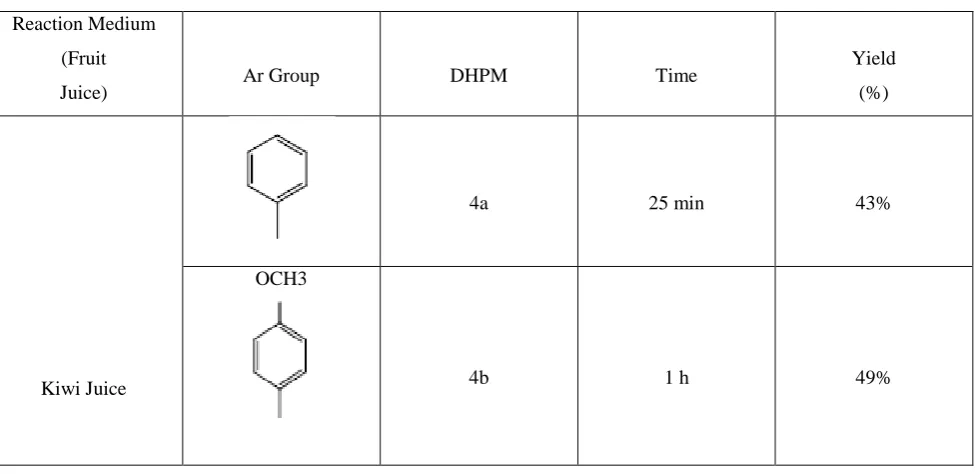
RESULTS AND DISCUSSION: The Benzaldehyde, 4- methoxy Benzaldehyde and 3- Nitro Benzaldehyde were employed individually for one-pot multi component condensation reaction with urea and ethyl acetoacetate at room temperature. The two common fruit juices namely kiwi juice, karvand juice were individually used as the reaction medium for performing these multi component condensation reactions (Biginelli reaction). It was observed that all the reactions were successfully completed at room temperature. After
completion of the reactions which was monitored by TLC, the solid products (Dihydropyrimidinone derivatives) were precipitated out of the reaction mixture. The crude
[image:7.595.58.546.455.692.2]solid products were collected by filtering the reaction mixture and the crude products were recrystallized from ethanol to get the pure compounds as yellowish to white solid with reasonable yield.
Table 1: Biginelli reaction with different aldehydes in different fruit juice. Reaction Medium
(Fruit
Juice) Ar Group DHPM Time
Yield
(%)
Kiwi Juice
4a 25 min 43%
OCH3
Dr. Jagdish B. Thakur
(Pg. 9224-9232) 9231
Copyright © 2017, Scholarly Research Journal for Interdisciplinary Studies
4c 45 min 56%
Karvand Juice
4a 30 min 41%
OCH3
4b 1 h 10 min
51%
4c 50 min 55%
The results obtained are summarized in table-1. It is interesting to note that the reaction gives better yield with electron deficient aromatic aldehydes (3-nitro benzaldehyde) and electron
rich aromatic aldehydes (4-methoxy benzaldehyde) compared to normal benzaldehyde. Biginelli reaction with different aromatic aldehydes in fruit juice medium.
CONCLUSION: Here in we report the synthesis of DHPM derivatives via one-pot multi component cyclocondensation namely Biginelli reaction in fruit juice medium at room temperature. The kiwi juice and karvand juice which all are easily available common fruit juice in all over the world were used as the green medium for Biginelli reaction. All these
Dr. Jagdish B. Thakur
(Pg. 9224-9232) 9232
Copyright © 2017, Scholarly Research Journal for Interdisciplinary Studies
inexpensive, non toxic and safe, so they posed no threat to the environment. So an eco-friendly, efficient, green and economic method has been successfully developed for synthesis of DHPM at room temperature with good yield. So our current work has given a new direction for the researcher in the field of green chemistry to use common fruit juice as green medium for carrying out Biginelli and other such one-pot multi component condensation reaction at room temperature.
REFERENCES
Department of Chemistry, Faculty of Technology and Sciences, School of Civil Engineering, Lovely Professional University, Phagwara, P.O.Box 144411, India.
Department of Chemistry, Faculty of Technology and Sciences, School of Science, Lovely Professional University, Phagwara, P.O.Box 144411, India.
www.wikipedia.in www.google.com
Department of Chemistry, Faculty of Technology and Sciences, Lovely Professional University, Phagwara, P.O.Box 144411, India
Department of Chemistry, Acharya Jagadish Chandra Bose College, 1/1B, A. J. C. Bose Road, Kolkata 700 020, India
Kappe CO. Acc Chem Res 2000; 33: 879−888.
Ramesh B, Bhalgat CM. Eur. J Med Chem 2011; 46: 1882− 1891.
Zhu L, Cheng P, Lei N, Yao J, Sheng C, Zhuang C, Guo W, Liu W, Zhang Y, Dong G, Wang S, Miao Z, Zhang W. Arch Pharm Chem Life Sci 2011; 344: 726−734.