Profiling student smokers:a behavioral
approach
Theofanides, Faidon and Makri, Vasiliki and Mavroeidis,
Vasileios and Iliopoulos, Dimitrios
University of Patras, Department of Business Administration,
University of Patras, Department of Business Administration,
University of Patras, Department of Business Administration,
University of Patras, Department of Business Administration
September 2011
MIBES Transactions, Vol 5, Issue 2, Autumn 2011 136
Profiling Student Smokers:
A Behavioral Approach
Dr. Theofanides Faidon1
Lecturer, Department of Business Administration University of Patras
Makri Vasiliki
MBA, Department of Business Administration University of Patras
Mayroeidis Vasileios
MBA, Department of Business Administration University of Patras
Iliopoulos Dimitrios
MBA, Department of Business Administration University of Patras
Abstract
The aim of the present study is to construct a coherent profile of student smokers in Greece, based on their behavioral and demographic characteristics. In this context, we collected data by administrating an anonymous self-completed questionnaire, which was answered by students of University and Technological Educational Institute (T.E.I.) of Patras. The final sample consists of 1,190 student smokers. For the purposes of the present study, principal component analysis was utilized to explore and detect the demographic and behavioral profiles of Greek student smokers. The factor solution identified 5 demographic factors and 14 behavioral factors. All factors were labeled, interpreted and discussed in the light of existing knowledge in order to understand better the consumer behavior of student smokers.
Keywords: Student Smoking, factor analysis, consumer behavior.
JEL Classification Codes: M31, I18, C3
Introduction
It is widely known that smoking is one of the most harmful habits. For that reason, the European Union has made the fight against smoking one of its key priorities in public health. According to the World Health Organization (2008), one third of the world's adult population (1.1 billion people) is smokers and tobacco is responsible for the death of 3.5 million people annually worldwide. In particular, this number is
1
MIBES Transactions, Vol 5, Issue 2, Autumn 2011 137 equivalent to 10,000 deaths per day, a number which is greater than the sum of deaths from guns, drugs, suicide, AIDS and road accidents.
It has been found that for people who start smoking by the age of 15, life expectancy is reduced by 8 years and for those who start by the age of 25 is declined by 4 years in average. Furthermore, it is argued that for a 25-year-old person, the daily consumption of one pack of cigarettes reduces his life expectancy by 4.6 years and that of two packages by 8.3 (US DHHS, 1989).
Greece is a leading tobacco-producer country within European Union. This is concordant to the fact that Greece records the highest per capita consumption of cigarettes in Western Europe. Specifically, after the year 2000 the average annual per capita number of cigarettes in Greece is 2,953 while in Germany, France, United Kingdom and Norway is limited to 1,553, 1,303, 1,123 and 578 respectively.
In Europe, smoking seems to reach approximately 30% among young people. Andersson et al. (2007) using data from the ESPAD project were focused on students between 17 to 18 years old in seven European countries. Regarding Greece, the results showed that the percentage of smokers reached 50% for men and 47% for women. On the contrary, the study of World Health Organization (2008) examining data from students from 17 to 30 years old in 2001, recorded that the rate of smokers was 44% for males and 42% for females. Moreover, in accordance with Eurostat and ESPAD project, a great amount of smokers in Greece, appear to start smoking after the age of 15 years.
This study, attempts a behavioral approach in constructing a coherent profile of the student smokers in Greece, by using principal component factor analysis.
Literature Review
In recent years, smoking behavior seems to be in the spotlight of researches. In this context, Boyle et al. (2000) examined a sample of 10,295 adult smokers from many European countries (Austria, Belgium, Denmark, Finland, France, Germany, Greece, Ireland, Italy, Luxembourg, Netherlands, Portugal, Spain, Sweden, United Kingdom, Russia and Poland) using a semi-structured questionnaire. The researchers used a pooled analysis and created four groups of smokers determined by their desire to stop smoking and their level of addiction to nicotine. The results show that the majority of European smokers wanted to stop smoking, despite the fact they had made various unsuccessful efforts in the past. According to Boyle et al. (2000), the most influential factors that may lead smokers to stop smoking behavior are their concerns about exposing their family and friends to tobacco smoke, a professional advice from a doctor to quit smoking and ultimately their fear of being a bad example for their children. However, the authors also underlined the need of organized strategies and policies by national governments in order countries to succeed in controlling tobacco use.
MIBES Transactions, Vol 5, Issue 2, Autumn 2011 138 Blitstein et al. (2003), Flint et al. (1998) and Guo et al.(2000) However, both at international and domestic level, there are not many studies, which investigate factors that can be associated with the starting and the cessation of smoking among adolescents and university students.
One of them was the analysis of Kyrlesi et al. (2007). Specifically, they examined the smoking prevalence among 6,378 Greek middle-school students coming from 100 schools in Athens, Thessalonica, Greek mainland and Islands. It should be mentioned that their study examined the issues of the prevalence of tobacco use, the exposure to secondhand smoke, the relationship of tobacco with media exposure and advertising campaigns, the students’ cessation experience and finally the access to tobacco products. Their study did not proceed to exploring the determinants of smoking behavior. They found that there is not any distinction between genders, since both sexes seem to smoke cigarettes and use other forms of tobacco at the same level. Finally, Kyrlesi et al. (2007) concluded that smoking rate among students between 13 and 15 years old is extremely high, given that 33% have already tried a cigarette, 16% are active smokers and 25% have started smoking before the age of 10.
Contrary to Kyrlesi et al. (2007), Rachiotis et al. (2008) explored the factors associated with smoking behavior among 6,141 Greek adolescents, via the implementation of logistic regression analysis. They found that students above the age of 13, male students, the presence of smoking parents, the lower parental education status, and a high amount of pocket money (>16 Euros per week) at the adolescent's disposal, were positively associated with being a current smoker.
Generally, it could be safely argued that the starting reasons of smoking could be grouped into social, psychological and emotional reasons. In accordance with Garisson et al. (2003), the beginning of smoking is associated with various socioeconomic factors, peer pressure and family and social behavioral examples. However, the study of Εfthimiou and Sofianopoulou (2007) underlined that the pretence of smoking behavior can be associated with both biological (withdrawal symptoms) and psychological factors (linkage of smoking with relaxation and enjoyment, but also with destructive beliefs in case of smoking cessation). Furthermore, the studies of Ng (2000), Sarason et al. (1992) and Zoller and Maymon (1983), recorded that curiosity and persistent offer for cigarette, were the most popular reasons for trying a cigarette. Finally, Bauman et al. (1984), found that teenagers start smoking due to the influence of their parents and that of their friends.
MIBES Transactions, Vol 5, Issue 2, Autumn 2011 139 significant role on their smoking behavior. On the contrary, female students are influenced by sister’s and friend’s smoking habits. Their empirical results show that for both genders peer pressure and social gatherings, usually of the same sex, influencing smoking behavior of students. Finally, Mandil et al. (2010) underline the need of comprehensive tobacco control programs for all community focusing on schools and universities.
Furthermore, Haddad and Malak (2002) investigated the smoking habits and attitudes among 650 university students of Jordan University of Science and Technology. Their study revealed that the total prevalence of smoking was 28.6% and students made their first smoking attempt after the 15 years old, due to the influence of their friends. They also underlined that the most often starting reasons are pleasure, stress and curiosity. Regarding the place of smoking, males prefer smoking in the cafeteria while females in the bathroom. Finally, Haddad and Malak (2002) reported that two-thirds of student smokers expressed their intention to quit smoking. This fact is related to the respondents’ fear of the harmful effects of smoking upon their health or reduce money spending on cigars.
Similarly, Maziak et al. (2004) explored the smoking and quitting behavior characteristics of students at the Aleppo University in Syria. In this survey, 587 students participated and the results revealed that age, gender, economic status and peer pressure show a strong correlation with smoking and quitting behavior of students. In this empirical survey, smoking status among university students differed between genders given that 30.9% of males and only 7.4% of females are smokers. Furthermore, they found that male gender, older students and students from a poor social background are related to increased interest in quitting. On the other hand, peer pressure is positively correlated with current smoking behavior and negatively with their willingness to quit. Maziak et al. (2004) also underlined the urgent need for cessation support to young people in Syria due to the fact that the majority of students had unsuccessfully tried to quit smoking.
Like the fore mentioned studies, Steptoe et al. (2002) investigated the prevalence of tobacco smoking, the beliefs about the health benefits of not smoking and the awareness of health risks in 19,298 students from 23 countries in Europe, Asia, Africa and America. Via the implementation of a model, which was formulated by the World Health Organization regarding the worldwide tobacco epidemic, the researchers found large variations in prevalence across countries and gender, although males seem to smoke more than females. The results also indicated that more than half of the smokers in all countries are willing to reduce smoking. Additionally, they reported that countries with stronger beliefs about the importance of smoking regarding health issues record a lower smoking prevalence. Finally, the results of Steptoe et al. (2002) designated that smokers are aware of the association between smoking and various diseases (e.g. lung cancer and heart diseases).
MIBES Transactions, Vol 5, Issue 2, Autumn 2011 140 Faculties of Education, Arts, Engineering and Medicine. The logistic regression analysis recorded that male students from the Faculty of Arts and Education, who are in their final year of their studies, live with their friends, drink alcohol and have at least two family members as smokers, can be related to smoking behavior. The results of Metintas et al. (1998) also revealed that smoking in Turkey is one of the major public health problems, which is linked to socioeconomic and cultural factors and high political tension.
In Greece, Alexopoulos et al. (2010) investigated the smoking habits of students in order to explore the most important factors associated with smoking. The researchers processed the answers of 1,205 medical and non-medical students from the University of Patras. Through Logistic regression analysis, they tried to confirm the relation between smoking and the different demographic and health risk behavioral characteristics. In particular, they found that the most important factors associated with smoking prevalence are age, maternal smoking and friendship with smokers. Alexopoulos et al. (2010) confirmed that the awareness of the harmful effects of smoking is strongly associated with nonsmoking behavior.
The research of Kamenidou et al. (2004), as Alexopoulos et al. (2010), explored the reasons that students smoke in Greece. Specifically, via the methodology of factor analysis, they examined the answers of 819 students in two universities of Northern Greece (Demokritos University of Thrace and Aristotle University of Thessaloniki). Their data collection method was mall intercept personal interview with the usage of self-administrated questionnaire. Their results revealed four factors that affect students’ smoking behavior which called “smoking for relaxation”, “smoking due to peer pressure”, “smoking for the spirit and the body” and “smoking for habit and pleasure”.
Sotiropoulos et al. (2007) investigated the smoking habits and associated risk factors among 1,284 physicians in Greece. In particular, they explored whether the smoking status of physicians could be linked to the smoking behavior of their parents. Sotiropoulos et al. (2007) presented results, which confirmed the above relationship. Additionally, Sotiropoulos et al. (2007) found that the majority of physicians seem to start their smoking behavior before the age of 25 years i.e. during their undergraduate medical courses. Finally, they designated that gender appears to play a significant role in the physicians’ smoking status, as male gender increased the likelihood of smoking.
MIBES Transactions, Vol 5, Issue 2, Autumn 2011 141
Sample
Patras is the third largest urban area of Greece and the regional capital of Western Greece, located in northern Peloponnese, 215 kilometers west of Athens. According to the most recent available data (2004), Patras metropolitan area has 222.460 citizens. Moreover, the city of Patras has two public universities (University of Patras and Hellenic Open University) and one Technological Educational Institute (T.E.I. of Patras), hosting a large student population (coming from all over Greece) which makes Patras a major scientific centre with a field of excellence in technological education. It is worthwhile to mention that until 2010 the registered number of students reached approximately 24,300 and 12,000 for University and T.E.I. respectively.
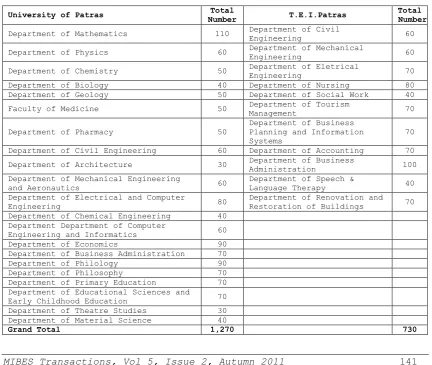
[image:7.595.82.515.399.764.2]Our research is focusing exclusively on students of University of Patras and T.E.I. of Patras. We collected our sample through quota approach based on the number of students that was announced from the Greek Ministry of Education, Lifelong Learning and Religion, regarding the above educational institutes for the academic year 2010-2011. In this context, we managed to gather 2,000 questionnaires and their distribution is presented on Table 1. From the above 2,000 students who participated in our research, 810 students (40.5%) stated that they are non smokers. The remaining 1,190 students (59.5%) were smokers and their answers will be examined in the present study.
Table 1: Distribution of Questionnaires.
University of Patras Total
Number T.E.I.Patras
Total Number
Department of Mathematics 110 Department of Civil
Engineering 60
Department of Physics 60 Department of Mechanical
Engineering 60
Department of Chemistry 50 Department of Eletrical
Engineering 70
Department of Biology 40 Department of Nursing 80 Department of Geology 50 Department of Social Work 40
Faculty of Medicine 50 Department of Tourism
Management 70
Department of Pharmacy 50
Department of Business Planning and Information Systems
70
Department of Civil Engineering 60 Department of Accounting 70
Department of Architecture 30 Department of Business
Administration 100 Department of Mechanical Engineering
and Aeronautics 60
Department of Speech &
Language Therapy 40 Department of Electrical and Computer
Engineering 80
Department of Renovation and Restoration of Buildings 70 Department of Chemical Engineering 40 Department Department of Computer
Engineering and Informatics 60
Department of Economics 90
Department of Business Administration 70
Department of Philology 90
Department of Philosophy 70
Department of Primary Education 70
Department of Educational Sciences and
Early Childhood Education 70
Department of Theatre Studies 30
Department of Material Science 40
MIBES Transactions, Vol 5, Issue 2, Autumn 2011 142 Consequently, the final sample of our study consists of 1,190 smokers students, where the 770 (64.7%) came from University and the remaining 420 (35.3%) from T.E.I. The questionnaires were collected via personal interviews, which took place on campus area of University and T.E.I. In this study, the sample included more males (58%) than females (42%). Respondents’ age ranged from 18 to 30 years, with a mean age of 21.49 years (median 21.00 years and SD 2.178 years). The vast majority of students (83.2%) are unemployed.
[image:8.595.78.525.244.760.2]Research Context
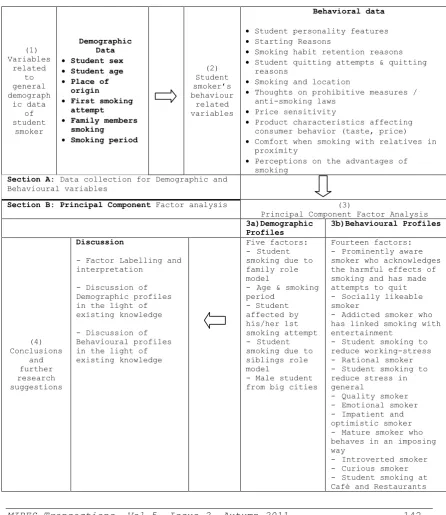
Figure 1 shows the research context of the present study.
(1) Variables related to general demograph ic data of student smoker Demographic Data
Student sex
Student age
Place of origin
First smoking attempt
Family members smoking
Smoking period
(2) Student smoker’s behaviour related variables Behavioral data
Student personality features
Starting Reasons
Smoking habit retention reasons
Student quitting attempts & quitting reasons
Smoking and location
Thoughts on prohibitive measures / anti-smoking laws
Price sensitivity
Product characteristics affecting consumer behavior (taste, price)
Comfort when smoking with relatives in proximity
Perceptions on the advantages of smoking
Section A: Data collection for Demographic and Behavioural variables
Section B: Principal Component Factor analysis (3)
Principal Component Factor Analysis 3a)Demographic Profiles 3b)Behavioural Profiles (4) Conclusions and further research suggestions Discussion
- Factor Labelling and interpretation
- Discussion of Demographic profiles in the light of existing knowledge
- Discussion of Behavioural profiles in the light of existing knowledge
Five factors: - Student smoking due to family role model
- Age & smoking period - Student affected by his/her 1st smoking attempt - Student smoking due to siblings role model
- Male student from big cities
Fourteen factors: - Prominently aware smoker who acknowledges the harmful effects of smoking and has made attempts to quit - Socially likeable smoker
- Addicted smoker who has linked smoking with entertainment
- Student smoking to reduce working-stress - Rational smoker - Student smoking to reduce stress in general
- Quality smoker - Emotional smoker - Impatient and optimistic smoker - Mature smoker who behaves in an imposing way
- Introverted smoker - Curious smoker - Student smoking at
MIBES Transactions, Vol 5, Issue 2, Autumn 2011 143
[image:9.595.77.526.83.106.2]- Impulsive smoker
Figure 1: the research context of the study for student smokers
In the following section we briefly describe the stages of principal component factor analysis undertaken, as well as the variables used in our study, separated into two groups. The first group concerns variables of the sample’s demographic and the other the behaviour-related ones. As indicated by our Research Context (Figure 1), the analysis was initiated through collecting demographic data and behavioural data (Section A). The next stage (Section B) concerns principal component factor analysis of the demographic and the behavioural data.
Regarding the demographic data the corresponding variables are presented as follows. Variable “Sex” indicates the gender of the student, “Student’s age” refers to the current age of the student smoker and “1st smoking attempt” indicates the age in which the student tried his/her first cigar.
We also investigate the smoking status of the student’s close family members with variables “father”, “mother”, “sister/brother” and “no -one”. To conclude with, variable “place of origin” refers to the place (village, town, city, big city), where the student was living before the entrance at the University or TEI. The variable’s values ranged from 1 to 4, where “1” stated the selection of value “village”, “2” stated “town”, “3” stated the value “city” of the variable and finally “4” indicated the value “big city”. Lastly, variable “number of cigars” relates to the students’ daily consumption of cigarettes.
Regarding the behavioural approach, variables “optimistic”, “impatient”, “active”, “social”, “emotional”, “Impulsive”, “oppressed”, “mature”, “imposing” were used in order to indicate how the Student evaluates his/her own basic personality traits. Then, we used variables “curiosity”, “anxiety”, “friends” and “Role-model” to identify the reasons for which a student starts smoking. Afterwards, variables “enjoyment”, “habit”, “dependency”, “confidence”, “anxiolytic”, “attracting opposite sex” and “social inclusion” refer to the reasons that students maintain the smoking habit.
Furthermore, we used the variable “change brand” in order to find how often student smokers change their brand. Via variables “health reasons”, “reduce cost”, “bad smell”, “prohibition of smoking”, it was investigated why smokers usually quit smoking. In addition, variable “influence of prohibition of smoking” was included in our research model in order to investigate whether the smoking prohibition measures, actually, affect smokers in reducing the level of smoking.
MIBES Transactions, Vol 5, Issue 2, Autumn 2011 144 Regarding product characteristics, which are widely accepted to be strongly behavior-related and basically determine the choice of brand, are variables “taste good” and “economical” and they were included to the analysis. Ultimately, the inclusion of variable “comfort when smoking with relatives in proximity“ was necessary in order to discover the feelings of the Student when smoking in front of family members.
Empirical Results
Applying Principal Component Factor Analysis Methodology requires an orderly structured questionnaire. We segregated our questionnaire’s structure into two independent groups, using the type of data derived. These groups are:
1 Demographic Data 2 Behavioral Data
Demographic Data
For the demographic data analysis, we used variables that indicate both the general demographic environment of the student and his/her immediate home surroundings.
Primarily, we assessed the overall significance of the correlation matrix with the Kaiser-Meyer-Olkin measure of sampling adequacy and Bartlett's Test of Sphericity (table 2).
Table 2: Demographic data KMO and Bartlett's Test of Sphericity
KMO and Bartlett's Test
Kaiser-Meyer-Olkin Measure of Sampling Adequacy. .444 Bartlett's Test of Sphericity Approx. Chi-Square 1639.119
df 36
Sig. .000
The KMO measures the sample adequacy. Value 0.444 represents a
fair partial correlation among variables although not very high
normally KMO measure should be greater than 0.5 for a
satisfactory factor analysis to proceed (Hair et al., 2010), yet
acceptable for the purposes of our demographic data analysis.
Likewise, Bartlett’s test of Sphericity, which indicates the
presence of nonzero correlations, is significant. The associated
probability is less than 0.05.
[image:10.595.89.512.668.765.2]Furthermore, we proceed in checking for any variables in the group that are not adequately accounted for by the factor solution. For that purpose, we examine each variable’s communality representing the amount of variance accounted for by the solution for each variable.
Table 3: Demographic data Communalities
Communalities
Initial Extraction
Sex 1.000 .619
Student age 1.000 .871
Place of origin 1.000 .774
1st smoking attempt 1.000 .870
MIBES Transactions, Vol 5, Issue 2, Autumn 2011 145
Father 1.000 .669
Mother 1.000 .716
Brother/Sister 1.000 .825
No_one 1.000 .804
Extraction Method: Principal Component Analysis
Table 3 shows that all variables in our analysis are adequately intercorrelated. The lowest communality belongs to variable “Sex” and the highest to variable “Student age”. Specifically, communalities show the amount of variance in a variable that is accounted for by the factors taken together. The size of the communality is a useful index for assessing how much variance in a particular variable is accounted for by the factor solution. Although no statistical guidelines exactly indicate the “threshold” value for communalities, practical considerations dictate a lower level of 0.50 (
(Hair et al., 2010)
). Regarding our demographic data, all correspondent variables fall in the acceptable range. Initial communalities for all variables are 1.000, because we initially make the consideration that the factors are as many as the variables. [image:11.595.88.512.84.134.2]In continuation to our analysis, we employ the latent root (eigenvalue) criterion for determining the number of factors to be retained for interpretation. To apply the latent root criterion, means retaining factors with eigenvalues greater than 1.0.
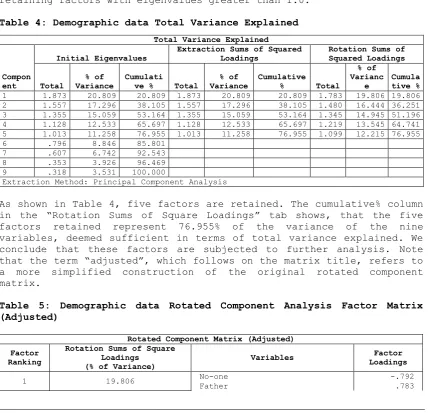
Table 4: Demographic data Total Variance Explained
As shown in Table 4, five factors are retained. The cumulative% column in the “Rotation Sums of Square Loadings” tab shows, that the five factors retained represent 76.955% of the variance of the nine variables, deemed sufficient in terms of total variance explained. We conclude that these factors are subjected to further analysis. Note that the term “adjusted”, which follows on the matrix title, refers to a more simplified construction of the original rotated component matrix.
Table 5: Demographic data Rotated Component Analysis Factor Matrix (Adjusted)
Rotated Component Matrix (Adjusted)
Factor Ranking
Rotation Sums of Square Loadings (% of Variance)
Variables Factor
Loadings
1 19.806 No-one -.792
Father .783
Total Variance Explained
Compon ent
Initial Eigenvalues
Extraction Sums of Squared Loadings
Rotation Sums of Squared Loadings
Total
% of Variance
Cumulati
ve % Total
% of Variance
Cumulative
% Total
% of Varianc
e
Cumula tive % 1 1.873 20.809 20.809 1.873 20.809 20.809 1.783 19.806 19.806 2 1.557 17.296 38.105 1.557 17.296 38.105 1.480 16.444 36.251 3 1.355 15.059 53.164 1.355 15.059 53.164 1.345 14.945 51.196 4 1.128 12.533 65.697 1.128 12.533 65.697 1.219 13.545 64.741 5 1.013 11.258 76.955 1.013 11.258 76.955 1.099 12.215 76.955 6 .796 8.846 85.801
7 .607 6.742 92.543 8 .353 3.926 96.469 9 .318 3.531 100.000
[image:11.595.86.515.344.757.2]MIBES Transactions, Vol 5, Issue 2, Autumn 2011 146
Mother .721
2 16.444 Student age .864
Smoking period .721
3 14.945 1st smoking attempt 922
4 13.545 Brother/sister .892
5 12.215 Place of origin .848
Sex .596
The 1st Demographic Factor, according to table 4, explains 19.806 % of the variance on the rotated solution. Table 5 shows the factor loadings of all demographic variables. The first factor consists of 3 variables. Variables “father” and “mother” have considerably high positive loadings, 0.783 and 0.721 respectively, while variable “No -one” has a high negative factor loading that equals -0.792. We label this factor “Student smoking due to family role model”.
Similarly, the 2nd Demographic Factor accounts for 16.444 % of total variance and it consists of two variables. These variables are “Student age” with a loading of 0.864 and “Smoking period” with a 0.721 factor loading. This factor could be labeled “Age & smoking period”.
Proceeding with the 3rd Demographic Factor, it explains 14.945% of the variance and consists of a single variable. This variable is “1st smoking attempt” and has a very high loading of 0.922. We label the factor “Student affected by his/her 1st smoking attempt”.
The 4th Demographic Factor explains 13.545% of the total variance and it consists of a single variable as well, called “brother/sister”. The variable’s factor loading is high and equals to 0.892. We can label this factor “Student smoking due to siblings role model”.
The last Demographic Factor accounts for the 12.215% of the total variance. Two variables are included to this factor. These variables are “place of origin” with a factor loading 0.848 and “Sex” with a lower loading equal to 0.596. The label of the fifth factor is “Male student from big cities”.
Behavioral Approach
[image:12.595.90.511.83.153.2]Working similarly, we proceeded with a factor analysis of the main data group of our study; behavior-related variables. In this context, KMO Measure and Bartlett’s Test of Sphericity (Table 6) provided an adequate basis for proceeding with factor analysis.
Table 6: Behavioral data KMO and Bartlett's Test of Sphericity
KMO and Bartlett's Test
Kaiser-Meyer-Olkin Measure of Sampling Adequacy. .565 Bartlett's Test of Sphericity Approx. Chi-Square 1491.579
df 666
Sig. .000
A value of 0.565 combined with the results of Bartlett’s Test of Sphericity, indicate that we can proceed to a satisfactory factor analysis.
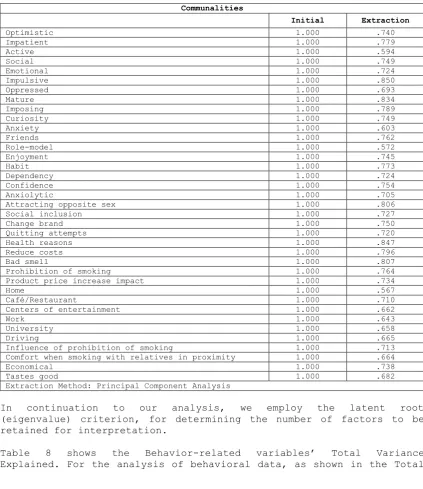
MIBES Transactions, Vol 5, Issue 2, Autumn 2011 147 examine each variable’s communality. Again, we have utilized value 0.05 as a threshold for determining, whether a variable is sufficiently significant to our analysis or not. We should remind that all communalities with a value of less than 0.50 do not meet sufficient explanation. Regarding the behavioral data, all correspondent variables will be retained for the factor analysis on the next stage (Table 7).
It is important to underline that communalities show the amount of variance within a variable that is accounted for by the factors taken together. The size of the communality is a useful index for assessing how much variance in a particular variable is accounted for by the factor solution.
Table 7: Behavior-related variables’ Communalities
Communalities
Initial Extraction
Optimistic 1.000 .740
Impatient 1.000 .779
Active 1.000 .594
Social 1.000 .749
Emotional 1.000 .724
Impulsive 1.000 .850
Oppressed 1.000 .693
Mature 1.000 .834
Imposing 1.000 .789
Curiosity 1.000 .749
Anxiety 1.000 .603
Friends 1.000 .762
Role-model 1.000 .572
Enjoyment 1.000 .745
Habit 1.000 .773
Dependency 1.000 .724
Confidence 1.000 .754
Anxiolytic 1.000 .705
Attracting opposite sex 1.000 .806
Social inclusion 1.000 .727
Change brand 1.000 .750
Quitting attempts 1.000 .720
Health reasons 1.000 .847
Reduce costs 1.000 .796
Bad smell 1.000 .807
Prohibition of smoking 1.000 .764
Product price increase impact 1.000 .734
Home 1.000 .567
Café/Restaurant 1.000 .710
Centers of entertainment 1.000 .662
Work 1.000 .643
University 1.000 .658
Driving 1.000 .665
Influence of prohibition of smoking 1.000 .713 Comfort when smoking with relatives in proximity 1.000 .664
Economical 1.000 .738
Tastes good 1.000 .682
Extraction Method: Principal Component Analysis
In continuation to our analysis, we employ the latent root (eigenvalue) criterion, for determining the number of factors to be retained for interpretation.
[image:13.595.85.509.263.753.2]MIBES Transactions, Vol 5, Issue 2, Autumn 2011 148 Variance Explained Table, fourteen factors are retained. The “cumulative %” column in the “Rotation Sums of Square Loadings” Tab indicates that these fourteen factors represent 72.410% of the variance, which deemed acceptable in terms of total variance of the model explained.
We must emphasize the importance of the above mentioned fourteen factors, as they represent the core element of our analysis and thus, will be further examined. Hence, it is crucial to efficiently interpret those factors, as their interpretation will result in extracting the student smokers profiles.
[image:14.595.84.519.387.768.2]Attempting a first approach on the matrix’s results we observe a rather equivalent allocation of total variance. Judging from the nature of the behavior-related variables analyzed, we take into consideration that they are accounted as mathematically independent. Concordantly, we select the VARIMAX orthogonal rotation method. It can be observed, that total variance extracted remains the same for both rotated and unrotated solutions (72.410%). However, each behavior-related variable’s factor loading is redistributed. The largest change is observed on the second factor, decreasing from 10.092% in the unrotated solution to 7.473% in the rotated solution. This decrease resulted in improving the explanatory power of most of the following variables.
Table 8: Behavior-related variables’ Total Variance Explained
Total Variance Explained Compone
nt Initial Eigenvalues
Extraction Sums of Squared Loadings
Rotation Sums of Squared Loadings
Total
% of Variance
Cumulat
ive % Total
% of Variance
Cumulat
ive % Total
% of Variance
Cumulati ve % 1 4.235 11.445 11.445 4.235 11.445 11.445 3.884 10.498 10.498 2 3.734 10.092 21.537 3.734 10.092 21.537 2.765 7.473 17.972 3 2.616 7.071 28.608 2.616 7.071 28.608 2.430 6.566 24.538 4 2.341 6.328 34.936 2.341 6.328 34.936 2.365 6.392 30.930 5 2.017 5.452 40.388 2.017 5.452 40.388 1.807 4.885 35.815 6 1.804 4.876 45.264 1.804 4.876 45.264 1.681 4.544 40.359 7 1.577 4.261 49.525 1.577 4.261 49.525 1.659 4.484 44.843 8 1.497 4.047 53.572 1.497 4.047 53.572 1.634 4.417 49.260 9 1.349 3.645 57.217 1.349 3.645 57.217 1.570 4.243 53.503 10 1.307 3.533 60.751 1.307 3.533 60.751 1.477 3.992 57.496 11 1.195 3.229 63.980 1.195 3.229 63.980 1.425 3.850 61.346 12 1.073 2.900 66.880 1.073 2.900 66.880 1.379 3.727 65.073 13 1.041 2.812 69.692 1.041 2.812 69.692 1.360 3.674 68.747 14 1.006 2.718 72.410 1.006 2.718 72.410 1.355 3.662 72.410 15 .883 2.387 74.797
MIBES Transactions, Vol 5, Issue 2, Autumn 2011 149
32 .230 .623 97.825 33 .212 .573 98.398 34 .188 .509 98.907 35 .175 .472 99.379 36 .129 .348 99.727 37 .101 .273 100.000
Extraction Method: Principal Component Analysis.
The next step of our analysis refers to generating the Rotated Factor Matrix. This matrix includes all variables that belong to a factor and also their factor loadings respectively. Again we use the term “adjusted”, to declare the more simplified construction of the original rotated component matrix.
The first Behavioral Factor, according to table 9, accounts for 10.498 % of the variance on the rotated solution and consists of five variables. The first variable is “Health reasons”. It is the dominant variable and has factor loading 0.909. The second one is “Bad smell”, which also has a high loading of 0.860. The variable that follows is “Reduce costs”, whose factor loading is almost equal to the previous variable 0.856. Another variable is “Prohibition of smoking” whose factor loading is 0.803. The last variable is “Quitting attempts” and has loading 0.761, which is lower in comparison to the above variables. The label of this factor is “Prominently aware smoker who acknowledges the harmful effects of smoking and has made attempts to quit”.
Table 9: Behavior-related variables’ Rotated Component Matrix (Adjusted)
Rotated Component Matrix (Adjusted)
Factor Ranking
Rotation Sums of Square Loadings
(% of Variance)
Variables Factor Loadings
1 10.498
Health reasons .909
Bad smell .860
Reduce costs .856
Prohibition of smoking .803 Quitting attempts .761
2 7.473
Opposite sex .845
Confidence .833
Social acceptance .814
Role-model .534
3 6.566
Habit .824
Pleasure .649
Centers of entertainment .641
Addition .567
4 6.392
Work .747
University .705
Driving .675
Home .501
5 4.885 Product price increase impact .800 Prohibition measures impact .746
6 4.544
Oppressed .709
Anxiety .690
Anxiolytic .404
7 4.484 Tastes Good .787
Economical -.761
8 4.417 Emotional .793
Social .441
9 4.243 Impatient .821
Optimistic .512
[image:15.595.86.518.86.154.2]MIBES Transactions, Vol 5, Issue 2, Autumn 2011 150
Imposing .597
11 3.850 Friends .805
Social -.493
12 3.727 Change Brand .810
Curious .509
13 3.674 Café / Restaurant .764
14 3.662 Impulsive .891
The second Behavioral Factor accounts for 7.473% of the variance and consists of four variables. Variable “Attracting opposite sex” has the highest factor loading: 0.845. Variable “Confidence” follows also with a high loading that equals to 0.833. The third variable is “Social acceptance” with high factor loading as well, which reaches: 0.814. Variable “Role-model” has a significantly lower factor loading, which equals to 0.534. Ultimately, this factor could be labeled “Socially likeable smoker”.
Continuing to the third Behavioral Factor, it accounts for 6.566 % of the variance on the rotated solution and consists of four variables. These variables are “Habit”, with the highest factor loading being 0.824, “Enjoyment” and “Centers of entertainment”, with lower factor loadings, being 0.649 and 0.641 respectively. The last variable of the factor· “Dependency”, has the lowest, yet acceptable positive loading equal to 0.567. We can label this factor “Addicted smoker who has linked smoking with entertainment”.
Proceeding to the fourth Behavioral Factor, it accounts for 6.392 % of the total variance explained. Four variables take part to this factor. These variables are “Work”, “University” and “Driving”, with high factor loadings 0.747, 0.705 and 0.675 respectively. Variable “Home” with 0.501 demonstrates the lowest loading of all variables mentioned before. The label of this factor is “Student smoking to reduce working-stress”.
The fifth Behavioral Factor of our analysis accounts for 4.885 % of the variance on the rotated solution and it consists of two variables. These variables are “product price increase impact” and “prohibition measures impact” with high positive factor loadings 0.800 and 0.746 respectively. The label of this factor is “Rational smoker”.
Moving on to the sixth Behavioral Factor, it accounts for 4.544 % of the variance on the rotated solution. The sixth factor consists of three variables. These variables are “Oppressed”, “Anxiety” which have positive loadings equal to 0.709 and 0.690 and variable “Anxiolytic” which has low positive, but marginally acceptable loading of 0.404. We can label this factor “Student smoking to reduce stress in general”.
The seventh Behavioral Factor accounts for 4.484 % of the variance on the rotated solution and it consists of two variables. These variables are “Tastes good” which has high positive loading up to 0.787 and variable “Economical” which has high negative loading up to -0.761. The label of this factor is “Quality smoker”.
MIBES Transactions, Vol 5, Issue 2, Autumn 2011 151 The ninth Behavioral Factor explains 4.243 % of the variance and consists of 2 variables. These variables are “Impatient” which has high positive loading up to 0.821 and variable “Optimistic” which has a low positive factor loading equal to 0.512. The label of this factor can be “Impatient and optimistic smoker”.
The tenth factor Behavioral Factor explains 3.992 % of the variance on the rotated solution. The variables, which are included at the tenth factor, are “Mature” and “Imposing” with factor loadings 0.808 and 0.597 respectively. This type could be the “Mature smoker who behaves in an imposing way”.
The 3.850% of the variance is explained by the eleventh Behavioral Factor, and it consists of two variables. These variables are “Friends” with 0.805 factor loading; a relatively high positive loading, and “Social” with a low negative loading of -0.493. The factor could be labeled as “Introverted smoker”.
The twelfth Behavioral Factor accounts for 3.727% of the variance on the rotated solution. The twelfth factor consists of 2 variables, which are “Change brand” which has high positive loading 0.810 and variable “Curiosity” which has a low positive loading which is 0.509. This factor is labeled as “Curious smoker”.
The thirteenth Behavioral Factor explains 3.674% of the variance on the rotated solution. The thirteenth factor consists of a single variable. That variable is “Café/Restaurant” with which has 0.764 factor loading, a high positive one. This factor can be simply the profile of the “Student smoking at Café and Restaurants”.
The last Behavioral Factor of the behavioral approach accounts for 3.662% of the variance on the rotated solution and it consists of one variable. Variable “Impulsive” has a very high positive loading equal to 0.891. We label this factor “Impulsive smoker”.
Discussion
Now that all factors have been extracted from both demographic and behavioral data, as explained above, we can proceed in adequately interpreting our findings. It is worth mentioning, that the interpretation of the demographical data group, will result in more efficiently clarifying the student-smoker’s true profile analysis. That is because there has been an attempt to perceive the demographic factors’ interpretation as elements that outline a general demographic profile and ultimately affect student behavior.
MIBES Transactions, Vol 5, Issue 2, Autumn 2011 152 effect” is illustrated by the factor’s ranking compared with the other factors and indicates that the Student creates role models of his family environment. This result is also supported by the empirical investigation of Bauman et al. (1984) and Metintas et al. (1998), who found significant influence of family members to teenagers and students, respectively.
The second Demographic Factor was labeled “Age & smoking period”. This factor rationally indicates, that on one hand student age is a critical element that affects smoking behavior, and on the other the smoking period does as well. We can support that the second factor is a variation of the eminent and generally accepted “time-effect”. We also found that more than 74% percent of smokers had their first smoking attempt before entering both University and T.E.I. at 16.32 years in average, revealing that smoking among youngsters is still a major problem. The early smoking initiation is also confirmed by the literature, as similar findings were recorded in the studies of Young et al.(1989), Blitstein et al. (2003), Flint et al. (1998) and Guo et al.(2000).
Moving on to the third Demographic Factor, it illustrates the experience of first smoking attempt. It labeled “Student affected by his/her 1st smoking attempt”. It is widely acknowledged that first smoking attempt affects the individual towards smoking behavior. It could be supported that it is the “messenger” of the smoking habit. The third Demographic Factor conceptually encloses all student smokers who are at most affected by their 1st smoking attempt and it is basically confirming this effect.
The fourth Demographic Factor labeled as “Student smoking due to siblings role model”. It is generally accepted that brothers or sisters play a major role on a child’s behavior. In this context, Mandil et al. (2010) reported that female students were influenced significantly by their sisters regarding smoking behavior. The variable’s factor loading is very high (0.892) and it demonstrates the importance of this effect. Taking into consideration the fore mentioned “Student smoking due to family role model” factor, it can be supported that this one works complementally. However, the magnitude of siblings’ effect has resulted in formulating a separate factor.
Finally, regarding the fifth Demographic Factor, as explained in “Research Context”, the “place of origin” variable consists of four values. Assessing the variable’s factor loading (0.848) we are directed in interpreting this value, as it neighbors with values between “city” and “big city” of the variable. Furthermore, the positive value of variable “Sex” (0.596) represents that this effect is present mostly on male students. Ultimately, the interpretation of the fifth Demographic Factor indicated the factor’s label; “Male student from big cities”.
MIBES Transactions, Vol 5, Issue 2, Autumn 2011 153 Starting the analysis of the first Behavioral Factor, our dominant variable is “Health reasons”. Taking into consideration the very high factor loading of variable “Health Reasons” (0.909) we can safely support, that it depicts a rather significant finding. This finding responds to the prominent awareness of young people about smoking habit. The factor also implies students’ realization of the harmful effects of smoking. All the other variables of the factor also strengthen this interpretation. The quitting attempts can be linked with all the above mentioned awareness. This is the reason why we labeled this factor “Prominently aware smoker who acknowledges the harmful effects of smoking and has made attempts to quit. Indeed, the empirical studies of Steptoe et al. (2002), Alexopoulos et al. (2010), Boyle et al. (2000) and Haddad and Malak (2002), revealed the awareness of smokers regarding the harmful effects of smoking and their intention to reduce or quit smoking.
Proceeding to the next Behavioral Factor, it can be said that smokers are influenced by a number of factors, when they first start smoking. The attraction of the opposite sex is the dominant variable. Secondly, the element of confidence is undoubtedly perceived by the people of this factor as very important, targeting again individuals of the opposite sex. To sum up, a smoker described in this factor exhibits high levels of self-confidence and social acceptance. This factor dictates that student smokers use smoking as a mean for boosting their confidence and improving their self-image in order to attract the opposite sex. We label this factor “Socially likeable smoker”. This finding is also underlined by the studies of Garisson et al. (2003), Mandil et al. (2010), Kamenidou et al (2004), Maziak et al. (2004), Alexopoulos et al. (2010) and Kedebe (2002) that confirmed the impact of social surroundings to students’ smoking behavior.
The third Behavioral Factor implies that student smokers of this category acknowledge the habitual nature of smoking as the main reason for them for continuing smoking. The factor dictates that student smokers are generally highly addicted. Variable “habit” has the highest factor loading (0.824) and represents their undue addiction. We labeled this factor “Addicted smoker who has linked smoking with entertainment”, because the factor’s remaining variables show that this addiction is expressed mostly in joyful environments, centers of entertainment etc.
Behavioral Factor number four shows that the dominant variable is the working place. This factor basically implies that smokers use cigarette as a means of quick relaxation. It becomes rather obvious that the fourth factor includes students, that due to the fact that they are working very hard, the use smoking habit as a relaxing, alleviating break. Smoking is perceived by this type of student smokers as a “Relief from working stress”. Lastly, we interpret the variable “home” as follows. Even when students return from their busy day home, they have not fully casted out their stress, so they need a few more cigarettes to relax. We label this factor “Student smoking to reduce working-stress”.
MIBES Transactions, Vol 5, Issue 2, Autumn 2011 154 money, as showed by the factor loading of variable “Product price increase impact” (0.800). All the above mentioned characteristics outline the “Rational smoker”
The sixth Behavioral Factor indicates that smokers express their need of a cigarette, when they are in bad mood (oppressed, anxious), in order to help them feel better. Confirming the above, the factor shows that smoking acts as a resolution against anxiety (anxiolytic). Dominant features of this factor are anxiety, oppression and generally a vague expression of stress. It could be said, that we have been expecting the occurrence of this factor as it is complementary to the fourth factor, “Student smoking to reduce working-stress”. We label the factor “Student smoking to reduce stress in general”. Smoking as a means of stress deterioration and relaxation, is also corroborated by the finding of Kedebe (2002), Haddad and Malak (2002) and Εfthimiou and Sofianopoulou (2007).
Next is the seventh factor. The high positive loading on variable “Tastes Good” represents that for smokers of this category, the cigarettes taste plays the most important role. Ergo, the negative loading on variable “Economical” indicates that smokers of this category are not interested in the price and therefore they are not affected by it. The label of this factor is “Quality smoker”.
Continuing to the eighth factor, we find all student smokers who have linked smoking habit to various emotionally special situations. A rather rational factor, if we take into account an individual’s life in student years. We labeled this factor “Emotional smoker”.
Further in our analysis, the ninth factor includes all the people that are optimistic, set goals and they are impatient about accomplishing them. This factor can be greatly applied to the genera psychological status of a student. We label this factor “Impatient and optimistic smoker”.
The type outlined in the tenth factor is the “Mature smoker who behaves in an imposing way”, because it includes all student smokers, who use smoking as means of social imposition and demonstration of maturity, independence, sovereignty. This is a rather classical factor and objectively it can better describe male students, who are sometimes trying to demonstrate their manliness, by using their smoking habit.
Reaching the eleventh factor, we observe smokers who are not considered to be social and have no hobbies or other social activities (-0.493). Thus, their close friends seem to be the only people they get social with (0.805) and from who they are strongly and mainly affected. It could be argued, that they are being treated as «victims». This factor can be related with the previews factor (Mature smoker who behaves in an imposing way), as cause and effect. This type of an individual is rather a common phenomenon of every society model, including educational institutes. We labeled the factor “Introverted smokers”.
MIBES Transactions, Vol 5, Issue 2, Autumn 2011 155 trying different flavors. Moreover, curiosity is also seems to be one of the most popular smoking starting reasons as found by the studies of Ng (2000), Sarason et al. (1992), Zoller and Maymon (1983) and Haddad and Malak (2002).
The thirteenth factor depicts an important smoking habit, especially for Greek students. Café and restaurants are places where students spend their free time before or after university courses. We label this factor “Student who likes to smoke at Café and Restaurants”. This result also supported by the study of Haddad and Malak (2002), which found that male students prefer smoking in cafeterias.
Finally, the fourteenth factor is labeled after the correspondent variable; “Impulsive smoker”. This group outlines the people who act without thinking things through. The factor implies that this general impulsiveness includes smoking behavior.
Conclusions and Further Research
The aim of our empirical research is to construct a coherent profile of student smokers in Greece, based on behavioral and demographic characteristics. As fore mentioned, the research took place in the city of Patras (Greece) and specifically focused on students of University and T.E.I. of Patras, through an anonymous self-completed questionnaire. We collected answers from 1,190 smoker students and applied the methodology of principal component factor analysis. The results regarding the demographic data, recorded that there are five factors that impact on smoker’s behavior. In particular, the factors “family effect”, “Age & smoking period”, “Student affected by his/her 1st smoking attempt effect”, “Siblings”, “Social background” seem to be significantly related to students smoking behavior.
Concerning the behavioral approach, we created fourteen smoker profiles. According to our results, the profiles that describe the smoking behavior of students are “Prominently aware smoker who acknowledges the harmful effects of smoking and has made attempts to quit”, “Socially likeable smoker”, “Addicted smoker who has linked smoking with entertainment”, “Workaholic smoker”, “Rational smoker”, “Student smoking to reduce stress in general”, “Quality smoker”, “Emotional smoker”, “Impatient and optimistic smoker”, “Mature smoker who behaves in an imposing way”, “Introverted smoker”, “Curious smoker”, “Student who likes to smoke at Café and Restaurants” and “Impulsive smoker”. In addition, it must be noticed that our findings largely confirm the existing literature.
As further research, the study could be expanded by including students from other universities in our sample in order to compare the students’ smoking behavior among different cities in Greece or abroad. Another possible issue that may need further investigation is the examination of smoking behavior of other social groups like unemployed.
References
MIBES Transactions, Vol 5, Issue 2, Autumn 2011 156 between medical and other students”, Environmental Health Preventive Medicine,(15), 115–120.
Andersson, B., Hibell, B. and F. Beck, 2007, “Alcohol and Drug Use Among European 17–18 Year Old Students Data from the ESPAD Project”, Stockholm.
Bauman, K.E., Fisher, L.A., Bryan E.S. and R.L. Chenoweth, 1984, “Antecedents, subjective expected utility, and behavior: A panel study of adolescent cigarette smoking, Addictive Behaviors, 9 (2),121–136.
Blitstein J.L., Robinson, L.A., Murray, D.M., Klesges, R.C. and S.M. Zbikowski, 2003, “Rapid progression to regular cigarette smoking among nonsmoking adolescents: interactions with gender and ethnicity”, Preventive Medicine, 36, 455–463.
Boyle,P., S., Gandini, C. Robertson, W.,Zatonski, k. fagerstrom, k. slama, M. Kunze, N. Gray and the International smokers survey group, 2000, “Characteristics of smokers' attitudes towards stopping”,
European journal of public health, 3, 5-14.
Εfthimiou, K. and Α. Sofianopoulou, 2007, “Quitting Smoking”, Archipelafos Editions, Αthens.
Flint, A.J., Yamada, E.G. and T.E. Novotny, 1998, “Black-white differences in cigarette smoking uptake: progression from adolescent experimentation to regular use”, Preventive Medicine, 27, 358–364. Garrison, M., Christakis, M., Ebel, B., Wiehe, S. and F. Rivara,
2003,“Smoking Cessation Interventions for Adolescents: a systematic review, American Journal of Preventive Medicine, 25 (4), 363-367. Guo, J., Collins, L.M., Hill, K.G. and J.D. Hawkins,2000,
“Developmental pathways to alcohol abuse and dependence in young adulthood”, Journal of Studies on Alcohol, 61, 799–808.
Haddad, L. G. and M. Z. Malak, 2002, “Smoking habits and attitudes towards smoking among university students in Jordan”, International Journal of Nursing Studies, 39, 793–802.
Hair, J.F., W.C. Black, B.J. Babin and R.E. Anderson, 2010,
Multivariate Data Analysis (7th ed.), Pearson Prentice Hall.
Kamenidou, E., Priporas, K.B. and K. Galanopoulos,
2004,
“
Why students smoke? Implementation of Factor analysis”, Proceedings of 17th Panhellenic Conference of Statistics, Lefkada.Kyrlesi, A., Soteriades, ES., Warren, C.W., Kremastinou J., Papastergiou, P., Jones N.R. and C. Hadjichristodolou, 2007, “Tobacco use among students aged 13–15 years in Greece: the GYTS project”, BMC Public Health, 7 (3).
Mandil, A., BinSaeed, A., Ahmad, S., Al-Dabbagh, R., Alsaadi, M. and M. Khan, 2010, “Smoking among university students: A gender analysis”, Journal of Infection and Public Health, 3, 179—187.
Maziak, W., Hammal, F., Rastam, S., Asfar, T., Eissenberg, T., Bachir, M.E., Fouad, M.F., and K.D. Ward, 2004, “Characteristics of cigarette smoking and quitting among university students in Syria”,
Preventive Medicine, 39,330– 336.
Metintas, S., M.A. Sabiroyaci, S.Nuhoglu, M.Metintas, C. Kalyoncu, S.Etiz, N. Odemir and C. Aktas, 1998, “Smoking patterns of university students in Eskisehir, Turkey”, Public Health, 112, 261-264.
Ng, J. , 2000, “A comparison of States to determine the impact of the social environment on adolescent cigarette smoking”, Research PAPER no.2010, Undergraduate Research Fellow, Regional Research Institute West Virginia University.
MIBES Transactions, Vol 5, Issue 2, Autumn 2011 157 associated with adolescent cigarette smoking in Greece:Results from a cross sectional study (GYTS Study)”, BMC Public Health 8, (313). Sarason, I.G., Mankowski, E.S., Peterson, A.V., and K.T.Jr., Dinh,
1992, “Adolescents’ reasons for smoking”, The Journal of School Health, 62 (5), 185-190.
Sotiropoulos, A., Gikas, A., Spanou, E., Dimitrelos, D., Karakostas, F., Skliros, E., Apostolou, O., Politakis, P. and S. Pappas, 2007,”Smoking habits and associated factors among Greek physicians”,Public Health, 121, 333–340.
Steptoe, A., Wardle, J., Cui, W., Baban, A., Glass, K., Pelzer, K., Tsuda, A. and J. Vinck,2002, “An international comparison of tobacco smoking, beliefs and risk awareness in university students from 23 countries”, Addiction, 97(12), 1561– 71.
US Department of Health and Human Services, 1989, ”Reducing the health consequences of smoking: 25 years of progress: A report of the Surgeon General”, Washington, Department of Health and Human Services.
World Health Organisation (WHO), (2008) “National Expenditures on Health” ,Available at http://www.who.int/nha/en/).
World Health Organisation (WHO), 2008, Health for all database.
Young, D., Swan, A. and J.Melia, 1989, “Cigarette advertising and the youth market”, Health Education Journal 48 (3).