Munich Personal RePEc Archive
Multiple Equilibria in Tullock Contests
Chowdhury, Subhasish and Sheremeta, Roman
2011
Online at
https://mpra.ub.uni-muenchen.de/52104/
1
Multiple Equilibria in Tullock Contests
*
Subhasish M. Chowdhury
aand Roman M. Sheremeta
baSchool of Economics, Centre for Behavioral and Experimental Social Science, and ESRC
Centre for Competition Policy, University of East Anglia, Norwich NR4 7TJ, UK.
bArgyros School of Business and Economics, Chapman University,
One University Drive, Orange, CA 92866, U.S.A.
March 29, 2011
Abstract
We find the sufficient conditions for the existence of multiple equilibria in Tullock-type contests, and show that asymmetric equilibria arise even under symmetric prize and cost structures. We then present existing contests where multiple equilibria exist under reasonably weak conditions.
JEL Classifications: C62, C72, D72, D74
Keywords: rent-seeking, contest, asymmetric equilibrium, multiple equilibria
1
1. Introduction
Contests are a type of games in which players expend costly efforts (resources) in order
to win prize(s). The effort expenditures by players determine their respective probabilities of
winning a prize. The function that maps efforts into probabilities of winning is called a contest
success function (CSF). One of the most frequently used CSFs in the contest literature is a lottery
CSF of Tullock (1980); in which the probability of winning equals the ratio of a player’s effort to
the sum of all players’ efforts.1
In this paper we consider a Tullock-type contest in which players’ outcome-contingent
payoffs are linear functions of prizes, own effort, and the effort of the rival. Under this structure
we find the sufficient conditions for the existence of multiple equilibria in this contest. We show
that asymmetric equilibria may arise even under symmetric prize and cost structures. We also
identify several contests in which multiple equilibria may arise under very general conditions.
The existing literature documents that asymmetry in prize valuation (Nti, 1999), cost
structure (Paul and Wilhite, 1990), and effectiveness in influencing the CSF (Gradstein, 1995)
can result in asymmetric equilibrium. In this paper, however, we show that even under
symmetric set up one may obtain asymmetric equilibria in Tullock-type contests.
Szidarovszky and Okuguchi (1997) prove the existence and uniqueness of the symmetric
equilibrium for a simple Tullock contest. Cornes and Hartley (2005) extend the analysis and
argue that multiple equilibria may exist in contests with increasing returns CSFs. Yamazaki
(2008) reaffirms this result for contests in which players are asymmetric in terms of value,
effectiveness and budget constraints. In this paper we show that the uniqueness of equilibrium
1 Tullock’s lottery CSF is widely employed because a number of studies have provided axiomatic justification for it
2
crucially depends on the specification of the cost and spillover parameters in the payoff function.
Under very general restrictions, even under a standard lottery CSF multiple equilibria may exist
in symmetric Tullock contests.
The finding that multiple equilibria may arise in simple Tullock-type contests is
important for a number of reasons. First, in multi-stage or repeated games the existence of
multiple non-payoff equivalent equilibria means that one can condition equilibrium selection in
the subgame based on past behavior. This allows for a wide range of payoffs to be supported as
subgame perfect equilibria. Second, in the presence of multiple equilibria, comparative statics
have to be conditioned on a particular equilibrium since different equilibria may lead to different
comparative statics results. Finally, the existence of multiple equilibria is important for designing
both static and dynamic contests. A contest designer needs to account for the full profile of
equilibria and corresponding comparative statics in order to achieve a given objective.
2. Contest Model and Equilibria
We consider a Tullock-type contest involving two risk-neutral players and two prizes.
The players, denoted by 𝑖 and 𝑗, value the winning prize as 𝑊 > 0 and the losing prize as 𝐿 ∈ ℝ,
with 𝑊 > 𝐿. Players simultaneously expend efforts 𝑥𝑖 ≥ 0 and 𝑥𝑗 ≥ 0. The probability that
player 𝑖 is the winner is decided by a lottery CSF:
𝑝𝑖(𝑥𝑖, 𝑥𝑗) = {1/2 if 𝑥𝑥𝑖/(𝑥𝑖+ 𝑥𝑗) if 𝑥𝑖+ 𝑥𝑗 ≠ 0
𝑖 = 𝑥𝑗 = 0 (1)
The outcome contingent payoff for player 𝑖 is a linear function of prizes, own effort, and
the effort of the rival:
𝜋𝑖(𝑥𝑖, 𝑥𝑗) = {𝐿 + 𝛼𝑊 + 𝛼1𝑥𝑖 + 𝛽1𝑥𝑗 with probability 𝑝𝑖(𝑥𝑖, 𝑥𝑗)
3
where 𝛼1, 𝛼2 are cost and 𝛽1, 𝛽2 are spillover parameters with restrictions 𝛼1 < 0 and 𝛼2 ≤ 0.
Define the contest described by (1) and (2) as Γ(𝑖, 𝑗, Ω), where Ω = {𝑊, 𝐿, 𝛼1, 𝛼2, 𝛽1, 𝛽2}
is a set of parameters. Under complete information the expected payoff for player 𝑖 is:
𝐸(𝜋𝑖(𝑥𝑖, 𝑥𝑗)) =𝑥𝑖𝑥+𝑥𝑖 𝑗(𝑊 + 𝛼1𝑥𝑖 + 𝛽1𝑥𝑗) +𝑥𝑖𝑥+𝑥𝑗 𝑗(𝐿 + 𝛼2𝑥𝑖+ 𝛽2𝑥𝑗) (3)
where (𝑥𝑖, 𝑥𝑗) ≠ (0,0). For 𝑥𝑖 = 𝑥𝑗 = 0, the expected payoff is 𝐸(𝜋𝑖(𝑥𝑖, 𝑥𝑗)) = (𝑊 + 𝐿)/2.
By taking first order condition in (3), player 𝑖’s best response function (BRF) is
𝑥𝑖𝐵𝑅𝐹 = −𝑥𝑗 + √{(𝛼1−𝛼2)−(𝛽1−𝛽2)}𝑥𝑗
2−{𝑊−𝐿}𝑥 𝑗
𝛼1 (4)
if 𝑥𝑗 ≤ (𝑊 − 𝐿)/(−𝛼2− 𝛽1+ 𝛽2), and otherwise, 𝑥𝑖𝐵𝑅𝐹 = 0. And the corresponding unique
symmetric equilibrium is:2
𝑥𝑖∗ = 𝑥𝑗∗= 𝑥 =−(3𝛼1+𝛼(𝑊−𝐿)2)−(𝛽1−𝛽2) (5)
The slope of the BRF is derived as:
𝜕𝑥𝑖𝐵𝑅𝐹
𝜕𝑥𝑗 = −1 +
2{(𝛼1−𝛼2)−(𝛽1−𝛽2)}𝑥𝑗−{𝑊−𝐿}
2√𝛼1[{(𝛼1−𝛼2)−(𝛽1−𝛽2)}𝑥𝑗2−{𝑊−𝐿}𝑥𝑗]
(6)
It is clear that the slope, as well as, the curvature of the BRF is different for different values of
the cost and spillover parameters. The BRF is a parabola, and if the curvatures of the two BRFs
are large enough, then the two parabolas may intersect in multiple points, generating multiple
equilibria. Therefore, in addition to the symmetric equilibrium (5), the contest Γ(𝑖, 𝑗, Ω) can
generate two asymmetric equilibria (see Figures 1 and 2). The additional restriction (5𝛼1−
𝛼2) − (𝛽1− 𝛽2) > 0 guarantees a large enough curvature of the BRF to generate asymmetric
equilibria {𝑥𝑖∗ = 𝑥; 𝑥𝑗∗ = 𝑥} and {𝑥𝑖∗ = 𝑥; 𝑥𝑗∗ = 𝑥}, where
2 This particular equilibrium is derived in Chowdhury and Sheremeta (forthcoming), who show that the needed
4
𝑥 =12(𝛼 (𝑊−𝐿)
1−𝛼2)−(𝛽1−𝛽2)[1 + √
(5𝛼1−𝛼2)−(𝛽1−𝛽2)
(𝛼1−𝛼2)−(𝛽1−𝛽2)] (7)
𝑥 =12(𝛼 (𝑊−𝐿)
1−𝛼2)−(𝛽1−𝛽2)[1 − √
(5𝛼1−𝛼2)−(𝛽1−𝛽2)
(𝛼1−𝛼2)−(𝛽1−𝛽2)] (8)
By imposing further incentive compatibility restriction √(5𝛼1−𝛼2)−(𝛽1−𝛽2)
(𝛼1−𝛼2)−(𝛽1−𝛽2) ≥
(4𝛼1−𝛼2)−(𝛽1−2𝛽2)
(2𝛼1−𝛼2)−𝛽1 we ensure that the players are willing to expend equilibria efforts, i.e.,
𝐸(𝜋𝑖(𝑥𝑖∗ = 𝑥, 𝑥𝑗∗ = 𝑥)) ≥ 𝐿 and 𝐸(𝜋𝑗(𝑥𝑖∗ = 𝑥, 𝑥𝑗∗ = 𝑥)) ≥ 𝐿. These results are summarized in
the following Proposition.3
Proposition: In contest Γ(𝑖, 𝑗, Ω), if −(3𝛼1+ 𝛼2) − (𝛽1− 𝛽2) > 0 and 𝛽2− 𝛼1 ≥ 0 then
there exists a symmetric equilibrium defined by (5). Furthermore, if (5𝛼1− 𝛼2) − (𝛽1− 𝛽2) >
0 and √(5𝛼1−𝛼2)−(𝛽1−𝛽2)
(𝛼1−𝛼2)−(𝛽1−𝛽2) ≥
(4𝛼1−𝛼2)−(𝛽1−2𝛽2)
(2𝛼1−𝛼2)−𝛽1 then in addition there exist two asymmetric
equilibria defined by (7) and (8).
3. Examples of Multiple Equilibria
Next we consider several contests in which multiple equilibria may exist. In the ‘lazy
winner’ contest of Chowdhury and Sheremeta (forthcoming) the winner faces lower marginal
cost than the loser, i.e., Γ(𝑖, 𝑗, {𝑊, 0, 𝛼1, 𝛼2, 0,0}) with |𝛼1| < |𝛼2|. The payoff function for
player 𝑖 is:
𝜋𝑖(𝑥𝑖, 𝑥𝑗) = {𝑊 + 𝛼𝛼 1𝑥𝑖 with probability 𝑝𝑖(𝑥𝑖, 𝑥𝑗)
2𝑥𝑖 with probability 1 − 𝑝𝑖(𝑥𝑖, 𝑥𝑗) (9)
3
This type of equilibria is informally described by Schelling (1971) in the context of racial segregation. The
5
Under symmetric equilibrium, according to the proposition, both players expend equal efforts
𝑥𝑖∗ = 𝑥
𝑗∗= 𝑊/(−3𝛼1− 𝛼2). However, this contest can also generate multiple equilibria if the
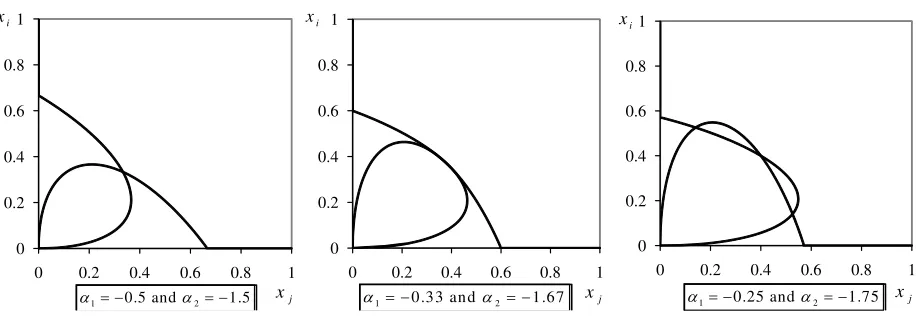
difference between the cost parameters is sufficiently high, i.e., 5𝛼1 > 𝛼2.4 In Figure 1 we plot
the BRFs for different values of marginal costs. When 𝛼1 = −0.25 and 𝛼2 = −1.75, the BRFs
intersect three times, indicating one symmetric and two asymmetric equilibria. This result comes
from the perceptive behavior of the players. One player gives more weight to the fact that the
loser has a higher marginal cost and thus expends a low effort in equilibrium. On the other hand,
[image:7.612.81.539.322.480.2]the other player envisions a lower marginal cost of winning and expends a higher effort.
Figure 1: BRFs and Equilibria in ‘Lazy Winner’ Contest (W = 1)
Multiple equilibria can also arise in contests with spillovers (Chung, 1996; Chowdhury
and Sheremeta, forthcoming). Consider, for example, a general ‘input spillover’ contest, where
the effort expended by player 𝑗 partially benefits player 𝑖 and vice versa. Such a contest can be
written as Γ(𝑖, 𝑗, {𝑊, 0, −1, −1, 𝛽1, 𝛽2}), where 𝛽1 ≥ 0, 𝛽2 ≥ 0, and 𝛽1− 𝛽2 < 4. The payoff
function of ‘input spillover’ contest takes the form:
𝜋𝑖(𝑥𝑖, 𝑥𝑗) = { − 𝑥𝑊 − 𝑥𝑖 + 𝛽1𝑥𝑗 with probability 𝑝𝑖(𝑥𝑖, 𝑥𝑗)
𝑖 + 𝛽2𝑥𝑗 with probability 1 − 𝑝𝑖(𝑥𝑖, 𝑥𝑗) (10)
4 The incentive compatibility restriction also holds. The two asymmetric equilibria, defined by the proposition, are
given by {𝑥𝑖∗= 𝑥; 𝑥𝑗∗= 𝑥} and {𝑥𝑖∗= 𝑥; 𝑥𝑗∗= 𝑥}, where 𝑥 =1
2
√𝛼1−𝛼2+√5𝛼1−𝛼2
√(𝛼1−𝛼2)3 𝑊 and 𝑥 =
1 2
√𝛼1−𝛼2−√5𝛼1−𝛼2
√(𝛼1−𝛼2)3 𝑊.
0 0.2 0.4 0.6 0.8 1
0 0.2 0.4 0.6 0.8 1
i x
j
x
1 0.33 and 2 1.67
0 0.2 0.4 0.6 0.8 1
0 0.2 0.4 0.6 0.8 1
i x
j
x
1 0.25 and 2 1.75
0 0.2 0.4 0.6 0.8 1
0 0.2 0.4 0.6 0.8 1
i x
j
x
1 0.5 and 2 1.5
6
Under symmetric equilibrium, both players expend equal efforts 𝑥𝑖∗= 𝑥𝑗∗ = 𝑊/(4 − 𝛽1+ 𝛽2).
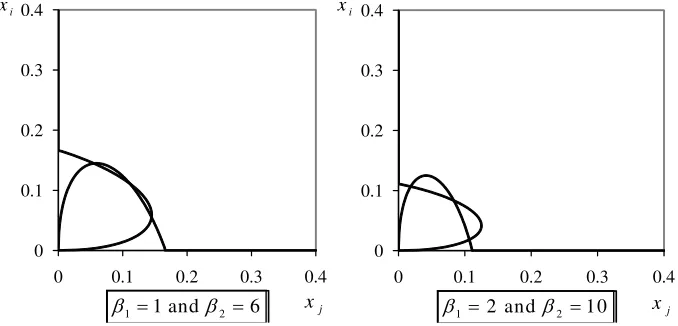
Figure 2 displays the BRFs and the resulting equilibria for different values of 𝛽1 and 𝛽2. When
spillover gain of the loser is sufficiently higher than the spillover gain of the winner, we arrive at
the case of multiple equilibria. In particular, any combination of 𝛽1 and 𝛽2, such that 𝛽1 − 𝛽2 <
−4, will generate one symmetric and two asymmetric equilibria. In any asymmetric equilibrium,
one player expends very high effort, increasing the chance of winning, while the other player
expends very low effort, ensuring a significant spillover benefit from losing. This scenario
resembles R&D contests in countries where property rights are not protected by the government
and the spillover in case of losing is very high. Therefore, there is a strong incentive to free ride
[image:8.612.139.478.384.547.2]on the effort of the others.
Figure 2: BRFs and Equilibria in ‘Input Spillover’ Contest (W = 1)
One can apply our analysis to show that multiple equilibria can also arise in contests of
Amegashie (1999), Glazer and Konrad (1999), and Matros and Armanios (2009). For example,
Glazer and Konrad (1999) study a contest Γ(𝑖, 𝑗, {(1 − 𝑡)𝑊, 0, −(1 − 𝑡), −1,0,0}) in which the
non-negative profit of a rent-seeker is taxed by a tax rate 𝑡 ∈ (0,1). It is easy to show that when
the tax rate is excessively high (i.e., more than 80%) then, besides the symmetric equilibrium,
multiple equilibria exist. In the endogenous prize value contest by Amegashie (1999), the
0 0.1 0.2 0.3 0.4
0 0.1 0.2 0.3 0.4
i
x
j
x 1 2 and 2 10
0 0.1 0.2 0.3 0.4
0 0.1 0.2 0.3 0.4
i
x
j
x 1 1 and 2 6
7
winner’s prize value is a linear function of own effort expended, i.e., Γ(𝑖, 𝑗, {𝑊, 0, −(1 −
𝑚), −1,0,0}) where 𝑚 ∈ (0,1) shows the impact of own effort on prize value. If this impact is
high enough, then following the aforementioned logic this contest induces multiple equilibria.
Finally, Matros and Armanios (2009) examine a contest where either the winner or the loser or
both can be reimbursed. A two-payer version of the contest can be written as Γ(𝑖, 𝑗, {𝑊, 0, (𝛼 −
1), (𝛾 − 1), 0,0}) where 𝛼 ∈ (0,1) and 𝛾 ∈ (0,1) are the reimbursement parameters. Using our
proposition, it is straightforward to show that when 5𝛼 − 4 > 𝛾 then, in addition to the
symmetric equilibrium, two asymmetric equilibria exist.5
There are other contest settings that can produce multiple equilibria. For example, Baye
et al. (2005) use an all-pay auction to analyze several litigation systems in which the winner or
the loser compensates a part of the rival’s legal expenditure. By modeling such litigation contests
as Tullock-type contests, one can show that certain legal systems, such as the ‘Continental
system of litigation,’ can produce multiple equilibria.
4. Conclusion
In this paper, we construct a two-player Tullock contest under complete information and
find the sufficient conditions for the existence of multiple equilibria in this setting. We show that
asymmetric equilibria may arise even under symmetric prize and cost structures. We also
identify several contests in which multiple equilibria may arise under very general conditions.
The findings of this paper can be applied to areas of contest design, R&D spillovers, litigations
and repeated games, where multiple equilibria may arise. One can also extend the analysis in the
5
8
current study in terms of incomplete information, the number of players, risk aversion, and
non-linear CSFs. We leave these questions for future research.
Acknowledgements
We have benefitted from the helpful comments of Kyung Hwan Baik, Tim Cason, Dan Kovenock, Sanghack Lee, Stephen Martin, Robert Sugden, seminar participants at Indian Statistical Institute Calcutta, Kookmin University, Purdue University, University of East Anglia, and participants at the Fall 2008 Midwest Economic Theory Meetings. Any remaining errors are ours.
References
Amegashie, J.A., 1999. The number of rent-seekers and aggregate rent-seeking expenditures: an unpleasant result. Public Choice 99, 57–62.
Baye, M., Kovenock, D., de-Vries, C.G., 2005. Comparative analysis of litigation systems: an auction-theoretic approach. Economic Journal 115, 583-601.
Baye, M.R., Hoppe H.C., 2003. The strategic equivalence of rent-seeking, innovation, and patent-race games. Games and Economic Behavior 44, 217-226.
Chung, T.Y., 1996. Rent-seeking contest when the prize increases with aggregate efforts. Public Choice 87, 55-66.
Chowdhury, S.M., Sheremeta, R., (forthcoming). A generalized Tullock contest. Public Choice. DOI: 10.1007/s11127-010-9636-3
Clark, D.J., Riis, C., 1998. Contest success functions: an extension. Economic Theory 11, 201-204.
Cohen, C., Sela, A., 2005. Manipulations in contests. Economics Letters 86, 135-139
Cornes, R., Hartley, R., 2005. Asymmetric contests with general technologies. Economic Theory 26, 923-946.
Glazer, A., Konrad, K., 1999. Taxation of rent-seeking activities. Journal of Public Economics 72, 61-72.
Gradstein, M., 1995. Intensity of competition, entry and entry deterrence in rent seeking contests. Economics and Politics 7, 79–91.
Matros, A., 2009. Sad-loser lottery, University of Pittsburg, Working Paper.
Matros, A., Armanios, D., 2009. Tullock’s contest with reimbursements. Public Choice 141, 49– 63.
Nti, K. O., 1999. Rent-seeking with asymmetric valuations, Public Choice 98, 415–430.
Paul, C., Wilhite, A., 1990. Efficient rent seeking under varying cost structures. Public Choice 64, 279–290.
Schelling, T.C., 1971. Dynamic models of segregation. Journal of Mathematical Sociology 1, 143-186.
9
Szidarovszky, F., Okuguchi, K., 1997. On the existence and uniqueness of pure Nash equilibrium in rent-Seeking games. Games and Economic Behavior 18, 135-140.
Tullock, G., 1980. Efficient rent-seeking. In: Buchanan, J.M., Tollison, R.D., Tullock, G. (Eds.), Toward a Theory of Rent- Seeking Society. Texas AM University Press, College Station. Yamazaki, T., 2008. On the existence and uniqueness of pure-strategy Nash equilibrium in