http://www.scirp.org/journal/jfrm ISSN Online: 2167-9541
ISSN Print: 2167-9533
Handling Corporate Crises Based on the Correct
Analysis of Its Causes
Drago Dubrovski
Department of Management, International School for Social and Business Studies, Celje, and Faculty of Management, Koper, Slovenia
Abstract
The extent of a crisis is simultaneously reflected in several areas, making it a complex or multidimensional phenomenon affecting the economic, social, traditional, psy-chological and legal aspects of an organization. An analysis of the real causes of a cri-sis or serious problems in a company’s operations, which should not be confused with the symptoms or consequences of a crisis, is extremely important, as it can be used to identify the areas whose effects need to be limited or eliminated. Despite the fact that in business practice there are often suggestions and pressures in the recov-ery procedure not to deal with the analysis of the causes that brought on the crisis, claiming that it is all in the past and solutions have to be found for the future, the analysis of the real causes for the preparation of a recovery plan of a company is as important as the preparation of the measures to achieve the desired changes. To re-solve a crisis, its real causes need to be eliminated or minimised, while working on the wrong causes is just a further waste of time, money and effort, which only makes the crisis situation worse. In the empirical part of the article, using a sample of 164 Slovenian companies in difficulty, the causes, as were listed by the management of these companies, were studied, while two stances were adopted regarding the two set hypotheses.
Keywords
Crisis, Syptoms, Causes, Crisis Management
1. Introduction: The Various Dimensions of a Crisis
A crisis can have many various dimensions. From an economic standpoint, there are global financial or economic crises, crises of related economies or regions, national economic crises, industry crises and corporate (organizational) crises. All crises create a distressing, uncertain and worrisome situation, which endangers property as well as
How to cite this paper: Dubrovski, D. (2016). Handling Corporate Crises Based on the Correct Analysis of Its Causes. Journal of Financial Risk Management, 5, 264-280.
http://dx.doi.org/10.4236/jfrm.2016.54024 Received: April 28, 2016
Accepted: December 13, 2016 Published: December 16, 2016 Copyright © 2016 by author and Scientific Research Publishing Inc. This work is licensed under the Creative Commons Attribution International License (CC BY 4.0).
people, and influences established business and life flows, which is why we want to re-solve this situation as soon as possible. Crises in the wider socio-economic environment directly or indirectly affect the position of individual companies or other organizations which may be more or less connected with the broader scope of the crisis. A crisis in one sector may have a significant negative impact on the companies from completely different sectors. A crisis can impact any company (Crandall & Mensah, 2008) even if at a certain time the company is efficient in a fast-growing and, according to all criteria, a high-potential industry, as the crisis can be caused by reasons which are not directly connected to the same industry.
The extent of the crisis is simultaneously reflected in several areas, making it a com-plex or multidimensional phenomenon. From the economic aspects the crisis can en-danger property as well as people and influence established business and life flows, re-distribute the positions of market participants, or change the principles of success and increase the threshold requirements for survival. The crisis will change the behaviour of the participants in the crisis, redistribute the positions of individuals and certain groups in society, and increase the proportion of individuals below the threshold of economic and social risks (the social aspect). The traditional aspect means that the crisis brings a break with previous practices (i.e. business models, structures, processes, systems, strategies and culture) and starts a new business life cycle of the organization; new foundations for the construction of the core capabilities of the organization and com-petition factors are required, and it brings new management ideologies and approaches. From the psychological aspect the crisis promotes a state of tension and conflicts be-tween the participants of the organization, worry, stress and uncertainty, and promotes the culmination of problems of the organization with only two possible solutions—the ruin or survival, resulting in a change in the “psychological profile” of the organization and its members. And finally, the legal aspect will be stressed as the crisis requires a greater consideration of additional specialized laws and implemented policies, primari-ly of obligation, equity and insolvency law, a more strict compensation and social re-sponsibility of the management, and draws the functioning of the organization closer to the edge of legality and legitimacy. When dealing with crises it would be highly rec-ommended to take these aspects into consideration.
crises than private institutions.
A crisis is a short-term undesired, unfavourable and critical situation in a company (organization), directly endangering the existence and further development of this or-ganization and is caused by an intertwined and simultaneous action of both external and internal sources (Dubrovski, 2004; Dubrovski, 2011: p. 31; cf. also Barnett & Pratt, 2000; Barton, 1993; Crone, 2007; Fearn-Banks, 2011: p. 2;Fink, 1986; Grünert, 2007: p. 9; Heath, 1998; Hermann, 2008: p. 211; Homel, Knecht, & Wohlenberg, 2006: p. 33; James & Wooten, 2010: p. 17; Kraus & Becker-Kolle, 2004; Lalonde, 2008: p. 24; Ler-binger, 1997; Neubauer, 1999: p. 8; Roux-Dufort, 2003: p. 51; Slatter, 1987).
2. Symptoms of a Crisis
Symptoms are signals (signs) that can indicate a possible crisis in a company or foresee one. Detecting them in time by implementing the proper preventive actions and timely curative activities can mitigate the effects of the already existing crisis or even prevent its occurrence. This is why it is of the utmost importance that signals such as these are not overlooked, disregarded or underestimated, although these should not be confused with the actual causes of a crisis. This is because there are various possible reasons for the symptoms; they signalise a crisis without also simultaneously being the cause of its occurrence. Symptoms therefore only warn of an illness. If the cause of an illness is not identified and treatment is not applied at the source, the patient, despite treatment, can still die. Symptoms indicate a specific illness, but it is the causes that must be treated. However, it is true that crises sometimes occur even without warning symptoms.
In spite of the many lists of possible crisis symptoms that exist in the expert litera-ture, and even more could be determined using a case study, it is advisable to classify these according to the sector of business, as this makes it possible to more easily estab-lish a foundation to carry out an analysis of signalised events and their causes. Based on the results of empirical research carried out by British companies, Slatter (1987, 1990)
appearance of informal parallel organization, obsolete organizational procedures etc.), and in the area of external environment (cancellation of bank credit lines, negative comments in media, additional guarantees are required by business partners etc.).
In some cases, individual symptoms can manifest themselves in the role of the causes of the crisis, when they are so influential that they can directly effect the success of the company. When treating a crisis that is based on the elimination of causes and not simply the symptoms, the key question is whether a specific event or situation occurs in the role of a symptom or even the cause of a crisis. The reasons for a crisis need to be distinguished from its symptoms, which signal the beginning of a crisis but are not the cause of its development (Lymbersky, 2014: p. 47).
The symptoms arise in various areas, whereby they often manifest in a combination of forms and in connection with others. It is very important to take into account the fact that there is a time delay between a symptom’s occurrence and the possible event (process, phenomenon) that it warns of, as well as the time period and circumstances in which they occur. This makes it even more risky if the company does not notice the warning signs or ignores them, as, as a rule, there is always a series of early warning signs that occur before a crisis. When the symptoms have been identified, they need to be analysed and interpreted as to determine the causes behind the events that they sig-nalise, and eliminate or minimise the causes using suitable measures and approaches. The symptoms of a crisis are even more difficult to determine, when there is an eco-nomic boom, as the general increase in demand masks many weaknesses of a company. However, in a recession the situation is reversed—all issues that had been previously unnoticed or had been swept under the carpet come out into the open.
3. Causes as the Real Culprits of the Crisis
In comparison with symptoms which simply indicate or predict a crisis situation, caus-es are the real culprits for the situation created. When discussing crisis rcaus-esolution, it is the causes that must be analysed and eliminated, and focus should not be placed on the symptoms.
Despite there being quite a few classifications of the causes of a crisis in the literature, these definitions of the causes are quite similar among each other, only differentiating in their terminology, the period they were created, the place they refer to, and the pre-dominant type of business. There is basically no general theory that would explain the causes behind the crises and natural disasters, while researchers only agree on the opi-nion that “total prevention of these is impossible” (Boin, 2008: p. xxiii). Some of the sources are: Bellinger (1962: p. 58), Bibeault (1999: p. 28), Boeckenfoerde (1993),
Crandall, Parnell, & Spillan (2014: pp. 55-65), Crone (2007: p. 9), Harz, Hub & Schlarb (2006: pp. 45-46), Kraus & Becker-Kolle (2004: pp. 15-16), Lymbersky (2013), Mitroff, Pauchant & Shrivastava (2006: p. 51), Müller (1986), Pate (1999: p. 55), Pümpin & Prange (1995: p. 201), Richardson (1994), Slatter (1987: pp. 25-55, 1990), Schellberg (2008: p. 57), Wildemann (2004: p. 193).
level from which they influence a company position and where they appear (inside or outside the company):
• direct and indirect causes, • external and internal causes.
Direct causes are those that are the most inextricably linked to the crisis, and their impact on the occurrence of a crisis situation is definitive (direct level). The indirect causes do not impact crises directly, but rather affect other (indirect) causes by streng-thening them and therefore push them closer to a crisis (the subsequent levels). A drop in market share can be a direct cause of a crisis (direct level), but other, indirect level 1 causes (e.g. issues with quality) have an effect on them beforehand, and level 2 direct causes affected them before that (e.g. outdated technology cannot provide high-quality production), and level 3 causes affected them (e.g. unsuitable maintenance of key hardware), and so on in a chain reaction. The direct causes can be easily identified (de-crease in market share in percentage), however, the subsequent (indirect) causes can be in many cases found out only by a deep and careful analysis.
External causes of crises are usually those that formed in the company environment and on which the company did not have much influence. This is why they are often called objective and exogenous causes. Internal causes are those that formed within the company, which is why they are also known as subjective and endogenous causes.
External causes of crises (influencing a company position outside the company) can be:
• changes in the market (stronger and more numerous competition, a general fall in
prices or demand, changed consumer behaviour, tight supply market conditions, increasing requirements for environmental and consumer protection, government regulations, etc.);
• changes in the industry (concentration in the industry, hostile and failed takeovers,
industry crisis, trade union requirements, deterioration of structure, suspended re-production and distribution chains, changed relationships between related or affi-liated industries, etc.);
• changes on the basis of general and technological progress (the extinction of the
need for specific materials, products or services, and the emergence of new ones, change in technology, new ways of offering products or services, etc.);
• a general economic crisis (a decline in investments, austerity measures, a decline in
economic activity or a recession, a negative rate of economic growth, credit crunch, etc.);
• social changes;
• political changes (the state’s bilateral and multilateral treaties, integrations and
dis-integrations, wars and tensions, sanctions, protectionism, legislative changes, etc.);
• macroeconomic measures (the price of financing resources, foreign exchange rates,
• natural disasters (cases of force majeure in the company and environment,
insur-ance claims, etc.);
• sociopathological phenomena (kidnapping, extortion, sabotage, terrorism, scheming
with products, etc.).
In addition to the aforementioned external causes, there are also others that can be classified as special causes, as they do not occur very frequently, but can play a key role in the emergence of a corporate crisis. Slatter (1990) and Argenti (1976: p. 134), for example, mention taking on large projects and business that are more than the compa-ny can manage, which then, due to not enough available funds for their execution, lead to a crisis situation that often ends in bankruptcy. In a study that is mentioned by Ro-venpor (2008: p. 109), in which are included 100 large organizational crises, it was found that the companies often suffer from the so-called premature aging syndrome or burnout syndrome.
Even state aid can be classified among the external causes of crises, despite the fact that the budgetary resources were supposed to be allocated to the resolution or preven-tion of crises, but due to the outside funds being obtained, the company’s management does not prepare nor adopt the required measures, but is simply satisfied with making cosmetic fixes, which only postpones the emergence of a crisis. State aid is therefore of-ten used a crutch for management, who take advantage of this so they do not have to take any action.
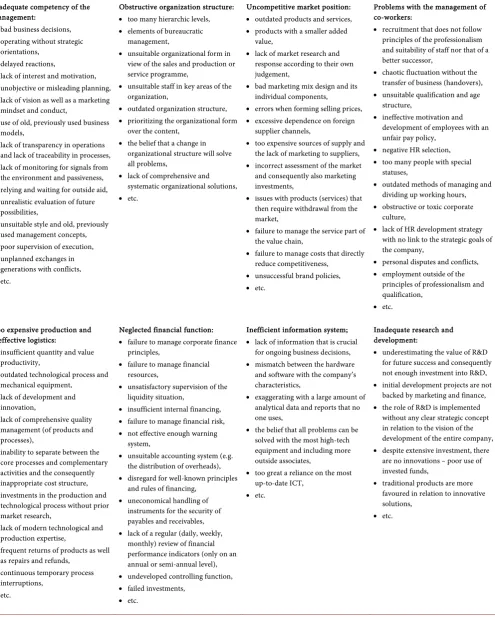
In the following Table 1, examples of internal causes of crises in manufacturing companies are shown. These are based on several empirical studies, the author’s own strategic management and restructuring consultancy experience in several companies from various industries in Slovenia in the period of 1994-2015, also working as a crisis management and insolvency practitioner:
Of course, there are also other lists of different causes which can be used in a con-crete research. For example, The Turnaround Management Society survey highlights the internal and external causes that 405 corporate restructuring specialists have wit-nessed in their assignment over the last five years (Lymbersky, 2013).
The listed potential causes should be treated as a tool in the analysis of the company’s position, as it needs to be taken into account that every company, with its models, processes, structures, systems, products, history and people, is its own special business model that should be studied as such.
Despite the fact that in business practice there are often suggestions and pressures in the recovery procedure not to deal with the analysis of the causes that brought on the crisis, claiming that it is all in the past and solutions have to be found for the future, the analysis of real causes for the preparation of a recovery plan of a company is as impor-tant as the preparation of measures to achieve the desired changes. Crises are treated by resolving or minimising its real causes, making the analysis of the causes of the situa-tion that was created an essential and integral part of crisis management.
4. The Importance of the Analysis of Real Causes
Table 1. Examples of internal causes of crises.
Inadequate competency of the management:
• bad business decisions,
• operating without strategic orientations,
• delayed reactions,
• lack of interest and motivation,
• unobjective or misleading planning,
• lack of vision as well as a marketing mindset and conduct,
• use of old, previously used business models,
• lack of transparency in operations and lack of traceability in processes,
• lack of monitoring for signals from the environment and passiveness,
• relying and waiting for outside aid,
• unrealistic evaluation of future possibilities,
• unsuitable style and old, previously used management concepts,
• poor supervision of execution,
• unplanned exchanges in generations with conflicts,
• etc.
Obstructive organization structure:
• too many hierarchic levels,
• elements of bureaucratic management,
• unsuitable organizational form in view of the sales and production or service programme,
• unsuitable staff in key areas of the organization,
• outdated organization structure,
• prioritizing the organizational form over the content,
• the belief that a change in organizational structure will solve all problems,
• lack of comprehensive and systematic organizational solutions,
• etc.
Uncompetitive market position:
• outdated products and services,
• products with a smaller added value,
• lack of market research and response according to their own judgement,
• bad marketing mix design and its individual components,
• errors when forming selling prices,
• excessive dependence on foreign supplier channels,
• too expensive sources of supply and the lack of marketing to suppliers,
• incorrect assessment of the market and consequently also marketing investments,
• issues with products (services) that then require withdrawal from the market,
• failure to manage the service part of the value chain,
• failure to manage costs that directly reduce competitiveness,
• unsuccessful brand policies,
• etc.
Problems with the management of co-workers:
• recruitment that does not follow principles of the professionalism and suitability of staff nor that of a better successor,
• chaotic fluctuation without the transfer of business (handovers),
• unsuitable qualification and age structure,
• ineffective motivation and development of employees with an unfair pay policy,
• negative HR selection,
• too many people with special statuses,
• outdated methods of managing and dividing up working hours,
• obstructive or toxic corporate culture,
• lack of HR development strategy with no link to the strategic goals of the company,
• personal disputes and conflicts,
• employment outside of the principles of professionalism and qualification,
• etc. Too expensive production and
ineffective logistics:
• insufficient quantity and value productivity,
• outdated technological process and mechanical equipment,
• lack of development and innovation,
• lack of comprehensive quality management (of products and processes),
• inability to separate between the core processes and complementary activities and the consequently inappropriate cost structure,
• investments in the production and technological process without prior market research,
• lack of modern technological and production expertise,
• frequent returns of products as well as repairs and refunds,
• continuous temporary process interruptions,
• etc.
Neglected financial function:
• failure to manage corporate finance principles,
• failure to manage financial resources,
• unsatisfactory supervision of the liquidity situation,
• insufficient internal financing,
• failure to manage financial risk,
• not effective enough warning system,
• unsuitable accounting system (e.g. the distribution of overheads),
• disregard for well-known principles and rules of financing,
• uneconomical handling of instruments for the security of payables and receivables,
• lack of a regular (daily, weekly, monthly) review of financial performance indicators (only on an annual or semi-annual level),
• undeveloped controlling function,
• failed investments,
• etc.
Inefficient information system;
• lack of information that is crucial for ongoing business decisions,
• mismatch between the hardware and software with the company’s characteristics,
• exaggerating with a large amount of analytical data and reports that no one uses,
• the belief that all problems can be solved with the most high-tech equipment and including more outside associates,
• too great a reliance on the most up-to-date ICT,
• etc.
Inadequate research and development:
• underestimating the value of R&D for future success and consequently not enough investment into R&D,
• initial development projects are not backed by marketing and finance,
• the role of R&D is implemented without any clear strategic concept in relation to the vision of the development of the entire company,
• despite extensive investment, there are no innovations – poor use of invested funds,
• traditional products are more favoured in relation to innovative solutions,
is a combination of internal and external causes that, as a rule, lead to a crisis situation (i.e. the multicausality of a crisis). When management itself analyses the causes, they overestimate external causes almost without exception, and underestimate internal ones, which is understandable as the latter are a direct criticism of the previous man-agement. This means that, in the case of a detailed analysis of the causes, an objective and, from the perspective of the operator, neutral overview of the causes should defi-nitely be drawn up, which can be carried out most effectively by qualified consultants, owners, creditors, industry experts and others.
An analysis of the real causes behind a particular situation is extremely important, as it can identify those areas (processes, phenomena, events) whose effects need to be li-mited or eliminated. Working on the wrong reasons is just a waste of time, money and effort, which only makes the crisis situation worse. Lymbersky (2014: p. 47) has stressed that knowledge of what exactly leads to a crisis and an analysis of these factors are es-sential in order to recognize a crisis at an early stage and serve as a foundation for han-dling it.
Often, the problem is that the symptoms, causes, reasons and effects are identical (e.g. key employees leaving, delays in payment, employees dissatisfaction, etc.). This is why crises are often “a multi-level constellation of causes and effects in which events that were recognized as causes on the level of crisis causes then become effects on another level that follows the first” (Boeckenfoerde, 1993). In a risky social environ-ment, crises often do not have a clearly defined origin or cause.
Studying the causes of crises can be based on:
• quantitative data and analyses, • qualitative data and analyses,
• data and analyses of theoretical models.
While the first type studies the connections between effects and causes that can be expressed quantitatively (market share, financial comparisons, comparison with the competition or similar companies or industries, etc.), the second type of research ap-plies to the so-called soft elements of business that usually give experts (consultants, industry experts) a better insight into operations than just statistical comparisons. Al-though there is some sense in preferring qualitative studies, the best results are achieved if these findings are supported by quantitative analyses (e.g. levels of performance monitoring). The use of theoretical models is suitable in the event that the presupposi-tions of a model are as close as possible to the characteristics of the particular company and its environment.
The following possibilities must be considered when analysing and interpreting causes:
• the multi-causality of crises (the combined effects of several causes);
• the causes being identical to the symptoms, effects and consequences (the same
event can have various roles and therefore requires several different measures);
• the spontaneous multiplying of causes (indirect causes of various levels affect the
• acceleration of causes (mutual strengthening as a negative effect of synergy).
5. Crisis Management and Helping a Company Recover
The occurrence of a manageable crisis when there are at least slim possibilities of keep-ing or revivkeep-ing the business, brkeep-ingkeep-ing negative trends to a stop or even beginnkeep-ing a new development cycle, can be referred to as the beginning of the recovery or rehabilitation of the company with the goal to fully eliminate the crisis. The etymological origin of the word “rehabilitation” or “to rehabilitate” is Latin (sanare = recovery, sanum facere = successful recovery) and in general denotes the improvement, the resolution or preven-tion of any aggravapreven-tion of the improved situapreven-tion (to rehabilitate − to rectify, improve the characteristics or re-establish the previous condition; whereas, from the entrepre-neurial perspective this is a notion that includes all business and political, managerial and technical, organizational, financial and other measures that will enable the compa-ny to continue to exist and later to operate profitably (e.g. Andersch & Schneider, 2006: p. 305; Grünert, 2007: p. 24; Harz, Hub & Schlarb, 2006: p. 8; Hommel, Knecht, & Wohlenberg, 2006: p. 34).
The rehabilitation of a company denotes a process of recovery of a company in crisis with the goal to eliminate the existing unfavourable condition, which poses a threat to the future, to prevent further worsening within the management and to re-establish the conditions that will enable the company to continue to exist and develop. The man-agement of the rehabilitation process by planning and implementing measures which ultimately lead to business recovery is called crisis management (a particular area of strategic management). The rehabilitation process of the existing situation to re-estab- lish normal operations and ultimately the further existence of the company is closely related to the existing crisis, therefore it must be separated from other projects, such as reconstruction, reformation, reorganization, redirection, restructuring, etc. which are not necessarily the result of an acute crisis, but are primarily aimed at preventing the crisis from emerging by establishing the further development of the company.
the existence of a crisis and its intensity level are determined. If it is a latent crisis, the measures taken will be different from those taken if it is an acute crisis. Establishing the presence of a crisis is most commonly initiated by external parties (owners, creditors, supervisory bodies, auditors, industry experts, the interested public, etc.) and less fre-quently by upper management, as they are unwilling to admit the presence of acute problems. When there is clearly a crisis already present in the company, it is necessary to identify the underlying causes of its occurrence, whereby the statements from the ex-isting management should not be relied on as they usually overestimate the external causes and underestimate the internal causes. It is advisable that the causes of the crisis are analysed in cooperation with outside experts. The purpose of this type of situation analysis is to determine the possibilities to eliminate the causes and in doing so treat the crisis situation.
6. Research Questions, Hypotheses and Their Verification
In previous studies we have studied the causes behind the corporate crisis in real busi-ness practice. In one of these (Dubrovski, 2009) a more or less typical pattern of pre-dominant errors in management was identified as the most important cause of a crisis in the individual periods of the Slovenian economic and social transition. In another study (Dubrovski, 2010), among other things (in connection with the area dealt with here) it was determined from a sample of 107 companies in difficulty that, according to the management’s opinion in the majority of these companies, that the key cause of their problems was the global financial and economic crisis as well as changes in the market, with both factors together representing as much as 74.6% of all causes of the crisis. All the internal causes represented only 18.5% of causes.
The findings from the theoretical discussions here and prior studies have been veri-fied with new empirical research in 2015 through studying a sample of 164 companies in an acute crisis in Slovenia during 2008-mid-2014 that attempted to solve the crisis with an insolvency procedure of a compulsory arrangement (in-court restructuring, debtor in possession proceedings), and started on their proposal by the authorized court (the list is available at www.ajpes.si/eobjave/). If bankruptcy is a method of solv-ing an out of control crisis, then a compulsory arrangement is a method of recovery, where the creditors play the key role. The creditors will not accept the proposal of a distress company, worsening the status of their claims if they cannot see radical changes in business practice of the debtor. Therefore, it would be expected that new strategies, structures, processes and systems are presented in the distress company in the frame of the new business model that should replace previous ineffective business practices that led to the acute crisis.
meas-ures to eliminate the causes of insolvency (Article 145 of the Slovenian Financial Oper-ations, Insolvency Proceedings and Compulsory Dissolution Act). The plans have been made public. For it to be possible to carry out a comparison with the study from 2010, the causes of the crisis, taken from these plans, were grouped into the same groups (Table 2). The comparison, although not including the same sample of companies, was also made possible in a simplified way due to the fact that the management also deter-mined the causes of the formation of the crisis.
[image:11.595.191.552.356.705.2]The Table 2 indicates that the management of the companies in difficulty that were in compulsory composition proceedings also state in the 2015 study (several causes were listed in every case) that the key reasons behind the crisis in their company origi-nate from the external environment on which they have no influence (in 7.1% cases, it was not possible to classify the cause stated according to the groups used), and only a small section stated that the crisis formed due to internal causes, and, of that, the ma-jority were regarding the management of employees, primarily referring to there being too many employees, therefore layoffs were foreseen. On the one hand, this result is in accordance with the findings in theoretical discussions and other studies which state that when the management itself evaluates the causes of the crisis, they greatly overes-
Table 2. Causes of the crisis according to the management of the companies in crisis.
Written Cause of Crises Type of Cause Study 2010 (N = 107) Study 2015 (N = 164)
Percentage % Number statements Percentage % global financial and economic crisis external 42.3 92 28.4
macroeconomic measures external 4.4 5 1.5 changes in the market external 31.3 34 10.5
political changes external 0.6 4 1.2 changes due to general progress external 1.2 27 8.3 unresponsiveness in bank lending external n.d.a. 76 23.5
Total 79.8 238 73.5
uncompetitive market position internal 6 14 4.3 cost ineffectiveness internal 5.5 11 3.4 bad decisions or the inadequacy
of management in the past internal 2.7 6 1.9 bad decisions or inadequacy
of management in the present internal 0 0 0.0 problems in human resources—
management of employees internal 3.3 32 9.9
Total 17.5 63 19.4
timate the external causes while hardly even mentioning the internal causes (e.g. none of the companies evaluated that it was due to poor decisions or a lack of management that caused the issue, despite this being the most common cause of crises in compa-nies). On the other hand, these results confirm the aforementioned need for an analysis of the real causes of a crisis. If the wrong causes are identified, the approach to rehabi-litating the crisis or serious problems will be incorrect. If every industry faces the same consequences of a crisis, but the success level of the individual companies within the industry is very varied (some companies even increased their success during a crisis), then some other causes (predominantly internal ones) must have been left out.
In relation to the findings from the theoretical discussions and presented study, the following statements (hypotheses) were set in advance:
• H1: External causes by themselves cannot affect the formation of a corporate crisis. • H2: When the management analyses the causes of the formation of a crisis itself, it
overestimates the external causes and underestimates the internal ones, which leads to a crisis being dealt with in the wrong way.
Internal and external causes (events, phenomena and processes) have a combined ef-fect on the formation of a crisis situation or serious issues within a company. There are very few crisis situations that are the result of only one cause or other. If it were to be believed that a crisis could arise solely due to external causes—a claim that many exam-ples of management would confirm without hesitation (our study showed that in the opinion of the management of the companies we surveyed, 73.5% blamed external causes for the problems that arose)—then the entire industry that felt the impact of the same external causes would be experiencing similar issues. But the fact is that even within the same industry at the same time and under the same circumstances, examples of companies with both above-average success and failure can be found. If a company carries out an activity where there is a typically above-average growth rate, then errors or issues than would otherwise incur a severe crisis situation in a problematic industry should not have a fatal impact on this company. This means that the subjective decision (internal cause) was directly connected to the goings on in the environment (external cause). Internal causes in favourable marketing or economic conditions should there-fore not be fatal to a company. However, in other (external) conditions, the same causes could be the downfall of the company. This is why it is worth emphasizing the com-bined functioning of both external and internal causes.
(H1) was therefore confirmed (despite the limits of the study), taking into account pre-vious studies.
Management gets trapped in their cognitive preconceptions that tint their view of the world when it comes to assessing symptoms and causes of a crisis. These preconcep-tions can influence whether decision-makers arrive at conflicting conclusions. Some types of cognitive preconceptions: subjective interpretation of causes, the effect of the experience and personality, incorrect framing of the problem. A study (Barker, 2005)
posed the new management that had joined a company with the task of transforming it and the previous (dismissed) management (in an interview with 20 managers) the question, to what extent did senior managers affect the worsening success of the com-pany’s operations. The previous management stated that their decisions and work did not have a significant effect on the decreasing success of the company, while the new management stated that their influence was decisive. It is necessary to be aware of the dangers of various perceptions of a crisis as traps of noncritical subjective judgement. When management itself analyses the causes, they overestimate external causes almost without exception, and underestimate internal ones, which is understandable as the latter are a direct criticism of the previous management. This means that, as part of a detailed analysis of the causes, an objective and, from the perspective of the operator, neutral overview of the causes should definitely be drawn up, which can be carried out the most effectively by qualified consultants, owners, creditors, industry experts and others. The second hypothesis (H2) was, in this way, confirmed (taking into account the limits of the study).
We recognize the limitations of the research and that the financial restructuring plans, from which were obtained the information, as the central documents in the composition proceedings which are replacing the rehabilitation programme, are not necessarily the actual strategic business plans, since the primary purpose of the finan-cial restructuring plan is to convince the creditors to a positive vote in the proposed settlement (review optimistic outcomes), and therefore may not include all the meas-ures envisaged, however, the creditors will decide on the financial write-off for the in-solvent company on the basis of these substantive measures.
A well prepared and executed compulsory arrangement is often a necessary, yet in-sufficient condition for achieving a drastic change and ensuring re-development in a company. An insolvency procedure is a process, not a solution (Miller, 2008: p. 202), which gives a company time and access to new ways of financing for the recovery and renewal. A compulsory arrangement is thus only one of the steps in saving a company, which, however, does not ensure its successful future business, but is vital for the im-plementation of further steps to solve the crisis (threat of bankruptcy).
This research, other previously mentioned empirical researches and author’s own many years’ strategic management and restructuring consultancy practice have shown that such companies:
• they do not focus enough attention on the proper (objective) identification of the
consequences of the crisis and not its causes, making the number of companies that survive a crisis lower that what could actually be attained, as the real causes that are to blame for the situation are still (unfavourably) at work;
• in most cases attempt to solve the acute crisis with various forms of financial
re-structuring, meaning that they are actually dealing with the consequences rather than the causes of the crisis, which have brought on the need for financial disbur-dening;
• approach crisis problems with short-term financial methods, burdening their
credi-tors and causing a crisis chain reaction reaching their suppliers;
• pay surprisingly little attention to the changes of their ineffective business models
(that led to the acute crisis) and introducing new strategies, structures, processes and systems, even though in this case this is the most important area of renewal, which will ensure further existence and development;
• will apparently even after financial disburdening continue to burden their creditors
by continuing to rely on existing unsuccessful business models, thereby exposing the company to another imminent acute crisis;
• are mainly only dealing with short-term and superficial measures, although the
ex-tent of the crisis is very deep and encroaching upon several areas, among the pre-pared measures there is particularly exposed the legal aspect (which is expected with regard of the type of the sample) and financial perspective, as part of the broader economic perspective; meanwhile unexpectedly little attention is paid to other as-pects, especially the traditional—as a break with previous practice and start a new business life cycle of the organization, the formation of new foundations to build the core capabilities of the organization and competitiveness factors, and the introduc-tion of a new managerial ideology and approaches—which in this case were studied with a radical change or the introduction of new business models.
7. Conclusion
However, this research has shown that companies in crisis pay surprisingly little at-tention to the changes of their ineffective previous business models, usually dealing on-ly with short-term and superficial measures, although the extent of the crisis is very deep and encroaching upon several areas.
A study of 164 Slovenian companies that attempted to solve the acute crisis during 2008-mid-2014 with insolvency procedures of a compulsory arrangement showed that, regarding the perception of causes of the crisis from the management’s perspective, ex-ternal causes heavily dominated (73.5%), which then direct towards the wrong meas-ures being taken to treat the companies. The two hypotheses that were studied and adopted were that solely external causes cannot affect the occurrence of a crisis and that when management analyzes the causes of the formation of a crisis itself, it overesti-mates the external causes and underestioveresti-mates the internal ones,directing towards the wrong selection of measures to resolve the crisis.
References
Andersch, T., & Schneider, K. J. (2006). Erstellung und Testierung von Sanierungskonzepten. In: U. Hommel, Th. C. Knecht, & H. Wohlenberg, (Eds.), Handbuch Unternehmensrestrukturie-rung. Wiesbaden: Verlag Dr. Th. Gabler/GWV.
http://dx.doi.org/10.1007/978-3-8349-9149-2_11
Argenti, J. (1976). Corporate Collapse. London: McGraw-Hill.
Barker, V. L. (2005). Traps in Diagnosing Organization Failure. Journal of Business Strategy, 26, 44-50. http://dx.doi.org/10.1108/02756660510586337
Barnett, C. K., & Pratt, M. G. (2000). From Threat-Rigidity to Flexibility: Toward a Learning Model of Autogenic Crisis in Organizations. Journal of Organizational Change Management, 13, 74-88. http://dx.doi.org/10.1108/09534810010310258
Barton, L. (1993). Crisis in Organizations. Cincinnati: South-Western.
Bellinger, B. (1962). Unternehmungskrisen und ihre Ursachen. In Handelsbetreib und Mark-tordnung, Wiesbaden: Gabler. http://dx.doi.org/10.1007/978-3-663-04256-3_3
Bibeault, D. B. (1999). Corporate Turnaround: How Managers Turn Losers into Winners. Washington: Beard Books.
Boeckenfoerde, B. (1993). Kriza podjetja. Pristop, 2, 33-40.
Boin, A. (2008). Fundamentals of Crisis Development & Crisis Management: An Introduction to Critical Crisis Readings. In A. Boin, (Ed.), Crisis Management, Volume 1. Los Angeles: Sage. Crandall, W. R., & Mensah, E. C. (2008). Crisis Management & Sustainable Development: A
Framework & Proposed Research Agenda. International Journal of Sustainable Strategic Man-agement, 1, 16-24. http://dx.doi.org/10.1007/978-3-663-04256-3_3
Crandall, W. R., Parnell, J. A., & Spillan J. E. (2014). Crisis Management. Los Angeles: Sage. Crone, A. (2007). Die Unternehmenskrise. In A. Crone, & H. Werner (Eds.), Handbuch
mod-ernes Sanierungsmanagement. München: Franz Vahlen.
Dubrovski, D. (2009). Management Mistakes as Causes of Corporate Crisis. Total Quality Man-agement & Business Excellence, 20, 39-59. http://dx.doi.org/10.1080/14783360802614281
Dubrovski, D. (2004). Peculiarities of Managing a Company in Crisis. Total Quality Management & Business Excellence, 15, 1199-1207. http://dx.doi.org/10.1080/1478336042000255578
Management, 5, 37-52.
Dubrovski, D. (2011). Razsežnosti kriznega management. Celje: Mednarodna fakulteta za družbene in poslovne študije.
Faulhaber, P., & Landwehr, N. (2005). Turnaround-Management in der Praxis. Frankfurt: Cam-pus.
Fearn-Banks, K. (2011). Crisis Communications. New York: Routledge. Fink, S. (1986). Crisis Management. New York: Amacom.
Grünert, T. (2007). Mergers & Acquisitions in Unternehmungskrisen. Wiesbaden: Deutscher Universitäts-Verlag.
Haarmeyer, H., & Stoll, C. (2004). Guter Rat bei Insolvenz. München: Deutscher Taschenbuch Verlag.
Harz, M., Hub, H.-G., & Schlarb, M. (2006). Sanierungs-Management. Stuttgart: Wirtchaft und Finanzen.
Heath, R. (1998). Crisis Management for Managers & Executives. London: Financial Times, Pit-man Publishing.
Hermann, C. F. (2008). Some Consequences of Crisis Which Limit the Viability of Organizations. In A. Boin (Ed.), Crisis Management (Vol. 2). Los Angeles: Sage.
Hommel, U., Knecht, T. C., & Wohlenberg, H. (2006). Sanierung der betrieblichen Unterneh-menskrise. In U. Homel, T. C. Knecht, & H. Wohlenberg (Eds.), Handbuch Unternehmensre-strukturierung (pp. 27-60). Wiesbaden: Dr. Th. Gabler/GWV.
http://dx.doi.org/10.1007/978-3-8349-9149-2_1
James, E. H., & Wooten, L. P. (2010). Leading Under Pressure. New York: Routledge. Kraus, G., & Becker-Kolle, C. (2004). Führen in Krisenzeiten. Wiesbaden: Gabler.
http://dx.doi.org/10.1007/978-3-322-84535-1
Kraus, K.-J., & Gless, S.-E. (2004). Unternehmensrestrukturierung/-sanierung und strategische Neuausrichtung. In A. K. Buth, & M. Hermanns (Eds.), Restrukturierung, Sanierung, Insol-venz (pp. 109-132). München: Verlag C. H. Beck.
Lalonde, C. (2008). Organiser la réponse a la crise. Paris: L’Harmattan.
Lerbinger, O. (1997). The Crisis Manager. Mahwah, NJ: Lawrence Erlbaum Associates.
Lymbersky, C. (2013). Why Do Companies Fail? 2014 Survey Results. Tournaround Management Journal, 2, 41-49.
Lymbersky, C. (2014). The International Turnaround Management Standard. Version 1.5. Ham-burg: Turnaround Management Society.
Miller, S. (2008). The Turnaround Kid. New York: HarperCollins.
Mitroff, I., Pauchant, T. C., & Shrivastava, P. (2006). The Structure of Man-Made Organizational Crises: Conceptual & Empirical Issues in the Development of a General Theory of Crisis Man-agement. In D. Smith, & D. Elliot (Eds.), Key Readings in Crisis Management (pp. 47-74). London: Routledge.
Müller, R. (1986). Krisenmanagement in der Unternehmung. Frankfurt am Main: Peter Lang, Neubauer, M. (1999). Krisenmanagement in Projekten. Berlin: Springer.
http://dx.doi.org/10.1007/978-3-662-08223-2
Parnell, J. A., Koseoglu, M. A., & Spillan, J. E. (2010). Crisis Readiness in Turkey & the United States. Journal of Contingencies & Crisis Management, 18, 108-116.
Pate, C. R. (1999). Business Regeneration: Early Detection-Early Intervention. In D. DiNapoli (Ed.), Workouts & Turnarounds 2: Global Restructuring Strategies for the Next Century (pp. 54-73). New York: John Wiley & Sons.
Pümpin, C., & Prange, J. (1995). Usmerjanje razvoja podjetja. Ljubljana: Gospodarski vestnik. Richardson, B. (1994). Crisis Management & Management Strategy: Time to “Loop the Loop”?
Disaster Prevention & Management, 3, 59-80. http://dx.doi.org/10.1108/09653569410795632
Roux-Dufort, C. (2003). Gérer et décider en situation de crise. Paris: Dunod.
Rovenpor, J. L. (2008). Organizational Crisis Management in the Post-9/11 Business Epoch. In C. Wankel (Ed.), 21st Century Management: A Reference Handbook (Part 1, pp. 106-115). Los Angeles, CA: Sage.
Schellberg, B. (2008). Sanierungsmanagement. Berlin: Erich Schmidt Verlag. Seefelder, G. (2007). Unternehmenssanierung. Stuttgart: Schäffer-Poeschel.
Slatter, S. (1987). Corporate Recovery. A Guide to Turnaround Management. London: Penguin Books.
Slatter, S. (1990). Je vaše podjetje zdravo? Podjetnik, 3, 29-33.
Spillan, J. E. (2003). An Explanatory Model for Evaluating Crisis Events & Managers’ Concerns in Not-Profit Organisations. Journal of Contingencies & Crisis Management, 11, 160-169.
http://dx.doi.org/10.1111/j.0966-0879.2003.01104002.x
Wildemann, H. (2004). Sanierungsstrategien. München: TCW Transfer-Centrum.
Wilden, P. (2004). Praxisorientierte Verfahren zur Früherkennung von Unternehmenskrisen und Insolvenzgefahren. In A. K. Buth, & M. Hermanns (Eds.), Restrukturierung, Sanierung, Insol-venz (pp. 12-44). München: Verlag C. H. Beck.
Submit or recommend next manuscript to SCIRP and we will provide best service for you:
Accepting pre-submission inquiries through Email, Facebook, LinkedIn, Twitter, etc. A wide selection of journals (inclusive of 9 subjects, more than 200 journals)
Providing 24-hour high-quality service User-friendly online submission system Fair and swift peer-review system
Efficient typesetting and proofreading procedure
Display of the result of downloads and visits, as well as the number of cited articles Maximum dissemination of your research work