Minioptical Navigation System for CT-Guided
Percutaneous Liver Procedures
David A. Valenti1, Louis-Martin Boucher1, Giovanni Artho1, Christopher von Jako2, Tatiana Cabrera1
1Department of Medical Imaging, McGill University, Montreal, Canada 2ActiViews, Inc., Wakefield, USA
Email: [email protected]
Received May 3,2013; revised June 7, 2013; accepted July 2, 2013
Copyright © 2013 David A. Valenti et al. This is an open access article distributed under the Creative Commons Attribution License, which permits unrestricted use, distribution, and reproduction in any medium, provided the original work is properly cited.
ABSTRACT
Purpose: To evaluate a new miniature optical navigation system for CT-guided liver interventions. Material and Methods: A two-center, prospective study was performed with four interventional radiologists. A total of 20 patients
had CT-guided liver biopsy or ablation interventions utilizing the CT-Guide® navigation system (ActiViews Inc., Wakefield, MA) between July 2011 and December 2011. The navigation system consists of a self-adhesive patient- sticker printed with coincident colored and radio-opaque reference markers, a miniature disposable video camera that clips on and off an interventional instrument, and software loaded on a computer to display the navigation information. The primary end point was the frequency of a satisfactory instrument position for the intended intervention. Results:
The cohort consisted of 13 males and 7 females with an average age of 63.1 years (range of 38 to 80). Most of the pa- tients, 70%, underwent CT-guided liver biopsy while the remainder had CT-guided ablation therapy. The average lesion size was 3.1 cm (range of 1.1 - 6.9 cm). All of the interventions, regardless of lesion size, met the primary end point of satisfactory instrument positioning. There were no device-related or unexpected adverse events recorded. Only one pa- tient had a mild adverse event and it resolved without intervention. Conclusions: This study demonstrated the safety
and effectiveness of the CT-Guide® navigation system for CT-guided liver interventions, for both biopsies and abla- tions. The targeting success rate for a satisfactory intervention was 100% with the system.
Keywords: Computerized Navigation; CT-Guided Biopsy; CT-Guided Ablations
1. Introduction
The use of CT-guidance for hepatic interventions has become an accepted standard of care for diagnostic biop-sies and therapeutic ablations where ultrasound guidance does not adequately visualize the lesion and there is a difficult and narrow safe instrument tract to the lesion. CT-guidance for liver biopsies has been reported to have an overall accuracy of 97%, with sensitivity rates of 92% and specificity rates of 96% [1]. Radiofrequency abla-tions (RFA) for primary or secondary malignancies can be curative for selected patients [2], but the therapeutic efficacy is dependent on accurate instrument placement. Major complication rates are low and procedure-related mortalities are rare for both biopsy [3] and RFA proce- dures [4-6].
The effective use of CT-guidance is highly dependent on the skill and experience of the radiologist and may require a number of trial and error cycles in which re-
peated CT scans are performed, especially when the tar- get is small or deep, or the optimal path to the target is at a difficult angle. In order to meet these challenges CT fluoroscopy was developed by Katada et al. in 1993 to allow real-time CT guidance [7]. However, although va- rious techniques for CT-fluoroscopic guidance are used to reduce patient and physicians radiation dose to ac- ceptably low levels [8], this reduction can be challenging to obtain, especially in cases where there is a steep angle to the target of interest. In view of this and especially of recent increased public sensitivity to medical radiation, many physicians have lost the initial enthusiasm that had built up for this method.
instruments in relation to diagnostic images, which is analogous to the way a GPS (global positioning system) device locates a car using stored roadmaps. Conventional surgical navigation configurations utilize either optical or electromagnetic (EM) tracking technology to register the spatial location of a tracked instrument [10,11].
The purpose of this study is to evaluate, in a clinical setting, the effectiveness and safety of a new navigation device that utilizes a miniature optical tracking technol-ogy to facilitate CT-guided instrument placement for liver interventions. This was performed in a prospective manner at two different centers with four radiologists.
2. Materials and Methods
2.1. Study Design and Patient Data
This was a prospective, single-arm study at two centers in Canada. Four staff radiologists with experience in CT- guided interventional procedures participated in the study where the procedures were conducted between July 2011 and December 2011. The study protocol was designed by one of the participating radiologists in collaboration with the device manufacturer and subsequently approved by the Research Ethics Boards (REB) at each of the partici- pating centers prior to patient enrollment.
Each radiologist participating in the study was re- quired to attend a training session on the use of the navi- gation device and use it clinically at least three times before enrolling patients in the study. A principal invest- tigator was designated at each center, with responsibility for compliance with the study protocol and for reporting any deviation to the REB. The study was sponsored by the device manufacturer (ActiViews, Inc., Wakefield, MA) and monitored by an independent contract research organization. The study was conducted in accordance with the standard operating procedures of the each cen- ter’s REB and the contract research organization. All data were prospectively collected in detailed case report forms by radiology research coordinators at each center under the supervision of the principal investigators.
All patients clinically indicated for CT-guided liver biopsy or ablation procedure at one of the participating centers were screened for compliance with the study in-clusion and exin-clusion criteria. The inin-clusion criteria were: patients aged between 18 to 80 years old at the time of enrollment, ability to comply with the requirements of the study procedures, and a verified home address and phone number to facilitate study follow-up. The criteria for exclusion from enrollment were: patients with sig- nificant coagulopathy that cannot be adequately cor- rected, patients who participated in an active stage of any drug, intervention, or treatment trial within 30 days of enrollment, patients with preexisting conditions, which, in the opinion of the investigator, interfere with the con-
duct of the study, patients who are uncooperative or cannot follow instructions, patients with a mental state that may preclude completion of the study procedure, and female patients who are pregnant or nursing. Written in- formed consent was obtained from all patients prior to the procedure. Patient data collection on the day of the procedure included demographics, relevant medical his- tory, relevant concomitant medications, and vital signs.
Targeting accuracy was the primary efficacy endpoint and was defined by the ability to place the instrument at a location suitable for the planned intervention. The invest- tigator carefully reviewed the final instrument position on the post-placement CT images to determine this. This information was used to calculate success rate. In addi-tion, secondary end points included: 1) the total time of the procedure(time between the first CT scan for select- ing the skin entry point and the last CT scan performed following removal of the interventional instrument used), 2) the navigation time (the time between the calibration of instrument length and the CT scan showing the in-strument in place for the intervention), 3) total number of CT scans performed throughout the procedure, and 4) the subject’s radiation exposure during the procedure.
Safety was documented by evaluating all the adverse events (AEs), as well as thorough the assessment of AEs commonly associated with liver biopsies and ablations (e.g., severe pain, hemorrhage, unintended organ injury, pneumothorax, infection, etc.).
Vital signs were recorded once before the procedure, during three hours of post-procedure monitoring, and before subject discharge. AEs were collected and re-corded following the completion of the procedure, during the observation time, and before discharge. The subjects were also followed-up with a phone call at 14 days ± 5 days post procedure to assess AEs related to the proce- dure. A subject’s enrollment in the study was completed after the follow-up phone call and after resolution of any procedure related AE.
The primary endpoint results are reported with associ- ated confidence interval (CI) and the secondary end- points are reported with associated mean, maximum, minimum, and median values. All AEs are presented by their frequency and severity. The safety assessments are based on AEs reported by the subject or observed by the investigator. All AEs within the study duration were re- corded and assessed with information regarding onset, duration (start and end times/dates), frequency, severity, seriousness, relationship to the navigation device, action taken, and outcome.
investi-gator. These patients were replaced to maintain the sam-ple size. The 20 patients that were enrolled had an aver-age aver-age of 63.1 ± 10.6 (range of 38 to 80) years, and the cohort consisted of 13 males (65%) and 7 females (35%). To ensure diversity in the study population, a mini-mum number of cases with special infrequent conditions were required. These special requirements could be counted in more than one patient, and the groups were as follows:
Group 1: at least 5 cases of lesion size equal or less than 2.0 cm in diameter.
Group 2: at least 2 cases of intervention in the left lobe.
Group 3: at least 2 cases of lesions deeper than 8 cm from the skin.
Group 4: at least 3 cases of decubitus subject position.
2.2. Navigation System
CT-Guide® navigation (ActiViews Inc., Wakefield, MA) is a novel variant of traditional optically-based tracking systems that employs three main components: 1) a sterile, self-adhesive, registration sticker with coincident video and radiological x-ray imaging visible reference markers (Figure 1(a)); 2) a miniature disposable video camera
that is easily clipped onto or off any standard interven-tional instrument (Figure 1(b)); and 3) proprietary three-
dimensional (3D) navigation software displayed on a large flat panel monitor and loaded into a computer that is housed by a mobile workstation (Figure 1(c)) inside
the CT suite.
The registration sticker is attached to a patient prior to CT imaging. The sticker contains eight coincident refer-ence markers that are visible on both a video image and the CT image. Printed on the front side of the sticker are eight color-coded markers, and the backside has eight coincident radio-opaque markers. The sticker also con-tains three discrete “entry holes” with a diameter suitable for the instrument gauge used in the intervention.
(a) 9
(b) 9
[image:3.595.373.465.551.696.2](c) 9
Figure 1. Navigation system comprises of a patient registra- tion sticker (a), a miniature video camera that mounts on an instrument (b), and 3D software that is viewed on a flat panel screen (c).
During intervention, the miniature video camera is clipped onto the proximal end of an instrument, and pro- vides a real-time video stream of the colored markers to the computer (Figure 2). Based on theses images, the
navigation software enables virtual tracking of the in- strument in the 3D CT image space relative to the sticker while being advanced toward a user-selected anatomical target.
2.3. Procedure Technique
The 20 patients were admitted to a dedicated day unit where the study was explained and consent obtained by a research study coordinator. The radiologist performing the procedure obtained a separate consent for the CT- guided biopsy or ablation procedure. The patients un- dergoing a liver biopsy were given a local anesthetic with mild conscious sedation, if needed, while the ablation subjects were all under general anesthesia. The interven- tions were performed at both centers using a 64-slice Discovery CT750 HD scanner (GE Healthcare, Wauke-sha, WI). All CT scans were performed using a short helical acquisition tailored to the lesion location. Scout views were taken to locate the liver lesion. CT images were acquired through the lesion with a localizing grid placed on the patient’s skin with 2.5 mm thick slices and 1 mm spacing between slices. The CT images were then automatically sent to the navigation computer in the CT suite.
The navigation software facilitated selection of the op- timal entry point and path using interactive 3D views of the anatomy along the planned instrument path. The se- lected entry point was then marked on the skin surface and the area cleaned and prepped in the usual sterile manner. The sterile sticker was placed on the skin with the middle entry hole placed over the marked entry point and local anesthesia was administered using 1% lido- caine.
[image:3.595.60.284.561.687.2]The sticker and lesion were then scanned with location information provided from the navigation system using thinner 1.5 mm slice thickness with 1 mm spacing be- tween slices. The CT images were again automatically transmitted to the navigation computer. The reference markers were registered semi-automatically with a sin- gle-click and target location was confirmed on the newly acquired “sticker scan”. The navigation software then displayed the instrument trajectory in three orthogonal planes and calculated the minimum instrument length required to reach the selected target.
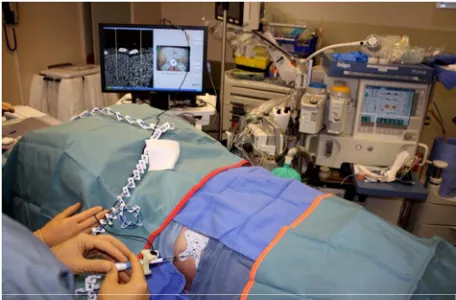
A gauge-specific sterile miniature video camera was then clipped onto the instrument and a simple fast length calibration step was performed. The navigation informa- tion is displayed in three components: a graphic simula- tion of the instrument is overlaid on two orthogonal CT images with a display of the planned path from the entry point to the target and a video image from the camera is displayed with a graphic of the instrument tip position relative to the target with real-time feedback of the re-maining distance between them. From the navigational information, the investigator first aligns the instrument’s trajectory and advances it to the target (Figure 3). On
reaching the pre-defined target, the miniature video cam-era is unclipped from the instrument and a confirmatory CT was obtained. Further instrument tip adjustments were made as necessary. Once the optimal instrument positioning was confirmed, the biopsy or ablation was performed as usual. A post procedural CT scan was per-formed after the instrument was removed in order to de-tect possible AEs.
3. Results
[image:4.595.58.286.559.709.2]Of the 20 patients that completed the study, 14 biopsies (70%) and 6 ablations (30%) were performed. The aver- age target lesion size in this cohort was 3.1 ± 1.9 cm with a median of 35.0 cm, a minimum size of 1.1 cm and a maximum of 6.9 cm, and the average depth to target was
Figure 3. The user is advancing the ablation probe into the liver based on the navigation information.
8.0 ± 2.4 cm with a range from 3.4 to 12.7 cm.
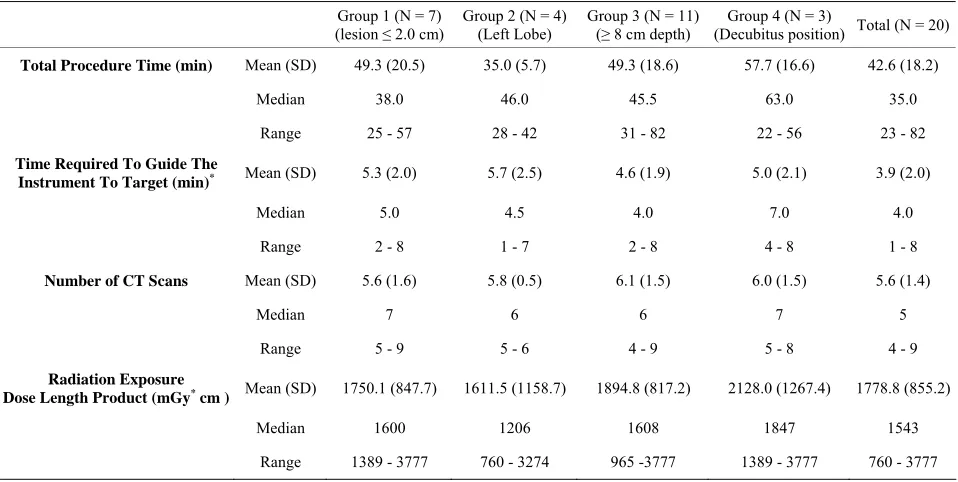
The success rate of the primary efficacy endpoint for the frequency of placing the instrument at a location sui- table for the planned intervention, as determined by the investigator reviewing the CT images, was 100% with a 95% CI. Table 1 presents the results of the secondary
end points measured in the study, for the different special infrequent condition groups as well as for the total study cohort.
No device-related or unexpected AEs were recorded. Only one mild instance of pneumonitis was reported. This was in the first procedure and was an ablation pro-cedure. This AE was not considered device related and was attributed to the extreme proximity of the ablated lesion to the pleural surface. The event was categorized as an unintended organ injury, which is a common AE in percutaneous liver procedures. It resolved without inter-vention or sequelae prior to discharge from the hospital.
4. Discussion
The CT-Guide® navigation was described previously in a laboratory study where it was shown to have an accuracy of less than 3 mm [12]. These results compared favorably to other navigation systems being used in CT-guided procedures [13-15]. However, these other reviewed navi- gation systems for CT-guided procedures utilize EM tracking technology where there can be significant limi- tations such as cost, system footprint, complexity, and environmental accuracy issues. The EM-based system accuracy degrades in the presence of metallic objects, which distort the magnetic field that is created for navi- gation [11,16]. These constraints of EM tracking tech- nologies do not limit this technology, whereas the mini- optical navigation system provided reliable accuracy in our environment and integrated with ease into our exist- ing workflow.
Table 1. Detailed results of the patient study.
Group 1 (N = 7) (lesion ≤ 2.0 cm)
Group 2 (N = 4) (Left Lobe)
Group 3 (N = 11) (≥ 8 cm depth)
Group 4 (N = 3)
(Decubitus position) Total (N = 20)
Total Procedure Time (min) Mean (SD) 49.3 (20.5) 35.0 (5.7) 49.3 (18.6) 57.7 (16.6) 42.6 (18.2)
Median 38.0 46.0 45.5 63.0 35.0
Range 25 - 57 28 - 42 31 - 82 22 - 56 23 - 82
Time Required To Guide The
Instrument To Target (min)* Mean (SD) 5.3 (2.0) 5.7 (2.5) 4.6 (1.9) 5.0 (2.1) 3.9 (2.0)
Median 5.0 4.5 4.0 7.0 4.0
Range 2 - 8 1 - 7 2 - 8 4 - 8 1 - 8
Number of CT Scans Mean (SD) 5.6 (1.6) 5.8 (0.5) 6.1 (1.5) 6.0 (1.5) 5.6 (1.4)
Median 7 6 6 7 5
Range 5 - 9 5 - 6 4 - 9 5 - 8 4 - 9
Radiation Exposure
Dose Length Product (mGy* cm ) Mean (SD) 1750.1 (847.7) 1611.5 (1158.7) 1894.8 (817.2) 2128.0 (1267.4) 1778.8 (855.2)
Median 1600 1206 1608 1847 1543
Range 1389 - 3777 760 - 3274 965 -3777 1389 - 3777 760 - 3777
*Navigation time is the time between the calibration of instrument length and the CT scan showing the instrument in place for the intervention.
Over the past 20 years, navigation systems have as-sisted physicians in a number of other specialties to over- come challenges related to percutaneous image-guided targeting. These techniques have been slow to adopt into interventional radiology applications mainly because of the lack of availability of a simple, accurate, and cost effective solution. This study demonstrated that CT- Guide® navigation is simple, safe, and effective in guid- ing optimal instrument placement for liver interventions.
REFERENCES
[1] M. Lüning, B. Schmeisser, H. Wolff, W. Schöpke, E. Hoppe and R. Meyer, “Analysis of the Results of 96 CT- Guided Fine Needle Biopsies of Liver Masses,” Fortschr Röntgenstr, Vol. 141, No. 9, 1984, pp. 267-275.
doi:10.1055/s-2008-1053132
[2] J. Bruix and M. Sherman, “Management of Hepatocellu- lar Carcinoma,” Hepatology, Vol. 42, No. 5, 2005, pp. 1208-1036. doi:10.1002/hep.20933
[3] K. R. Reddy and E. R. Schiff, “Gastrointestinal Emergen- cies,” Williams & Wilkins, Baltimore, 1996-1997. [4] S. A. Curley, P. Marra, K. Beaty, L. M. Ellis, J. N. Vau-
they, E. K. Abdalla, C. Scaife, C. Raut, R. Wolff, H. Choi, E. Loyer, P. Vallone, F. Fiore, F. Scordino, V. De Rosa, R. Orlando, S. Pignata, B. Daniele and F. Izzo, “Early and Late Complications after Radiofrequency Ablation of Malignant Liver Tumors in 608 Patients,” Annals of Sur- gery, Vol. 239, No. 4, 2004, pp. 450-458.
doi:10.1097/01.sla.0000118373.31781.f2
[5] T. de Baere,O. Risse, V. Kuoch, C. Dromain, C. Sengel, T. Smayra, M. Gamal El Din, C. Letoublon, D. Elias,
“Adverse Events during Radiofrequency Treatment of 582 Hepatic Tumors,” American Journal of Roentgenol- ogy, Vol. 181, No. 3, 2003, pp. 695-700.
doi:10.2214/ajr.181.3.1810695
[6] J. Kettenbach, W. Kostler, E. Rucklinger, B. Gustorff, M. Hüpfl, F. Wolf, K. Peer, M. Weigner, J. Lammer, W. Müller and S. N. Goldberg, “Percutaneous Saline-En- hanced Radiofrequency Ablation of Unresectable Hepatic Tumors: Initial Experience in 26 Patients,” American Journal of Roentgenology, Vol. 180, No. 6, 2003, pp. 1537-1545.doi:10.2214/ajr.180.6.1801537
[7] K. Katada, R. Kato, H. Anno, Y. Ogura, S. Koga, Y. Ida, M. Sato and K. Nonomura, “Guidance with Real-Time CT Fluoroscopy: Early Clinical Experience,” Radiology, Vol. 200, No. 3, 1996, pp. 851-856.
[8] E. K. Paulson, D. H. Sheafor, D. S. Enterline, H. P. McAdams and T. T. Yoshizumi, “CT Fluoroscopy- Guided Interventional Procedures: Techniques and Radia- tion Dose to Radiologists,” Radiology, Vol. 220, No. 1, 2001, pp. 161-167.
[9] G. Jako, “Lasers Cut a Swath in Surgical and Medical Applications,” IEEE Spectrum, Vol. 22, 1985, pp. 82-87.
doi:10.1109/MSPEC.1985.6370594
[10] R. Buchalla, S. Hopf-Jensen, O. Rubarth and W. Börm, “Frameless Navigated Biopsy with the BrainLAB® VarioGuide System: A Technical Note,” Journal of Neu- rological Surgery. Part A, Central European Neurosur- gery, 2012, in Press.
ance,” Neuroimage, Vol. 47, Suppl. 2, 2009, pp. 127-132.
doi:10.1016/j.neuroimage.2009.05.002
[12] C. von Jako, Y. Zuk, O. Zur and P. Gilboa, “A Novel Accurate Minioptical Tracking System for Percutaneous Needle Placement,” IEEE Transactions on Biomedical Engineering, Vol. 60, No. 8, 2013, pp. 2222-2225. doi:10.1109/TBME.2013.2251883
[13] B. J. Wood, H. Zhang, A. Durrani, N. Glossop, S. Ranjan, D. Lindisch, E. Levy, F. Banovac, J. Borgert, S. Krueger, J. Kruecker, A. Viswanathan and K. Cleary, “Navigation with Electromagnetic Tracking for Interventional Radi-ology Procedures: A Feasibility Study,” Journal of Vas-cular and Interventional Radiology, Vol. 16, No. 4, 2005, pp. 493-505.doi:10.1097/01.RVI.0000148827.62296.B4 [14] J. Krucker, S. Xu, N. Glossop, A. Viswanathan, J.
Bor-gert, H. Schulz and B. J. Wood, “Electromagnetic Track-
ing for Thermal Ablation and Biopsy Guidance: Clinical Evaluation of Spatial Accuracy,” Journal of Vascular and Interventional Radiology, Vol. 18, No. 9, 2007, pp. 1141- 1150.doi:10.1016/j.jvir.2007.06.014
[15] L. Appelbaum, J. Sosna, Y. Nissenbaum, A. Benshtein, and S. N. Goldberg, “Electromagnetic Navigation System for CT-Guided Biopsy of Small Lesions,” American Journal of Roentgenology, Vol. 196, No. 5, 2011, pp. 1194-1200.doi:10.2214/AJR.10.5151