http://dx.doi.org/10.4236/ojml.2016.64033
Teachers’ Cognition about Teaching and
Learning of Simple Past Tense: Can
Processing Instruction Help?
Mable ChanDepartment of English, The Hong Kong Polytechnic University, Hong Kong, China
Received 26 April 2016; accepted 14 August 2016; published 17 August 2016
Copyright © 2016 by author and Scientific Research Publishing Inc.
This work is licensed under the Creative Commons Attribution International License (CC BY).
http://creativecommons.org/licenses/by/4.0/
Abstract
This study examines how teachers perceive the difficulties and strategies of acquiring simple past tense, and the pedagogical implications. Findings show that teachers’ understanding of the nature of the acquisition problem of tense, and their use of teaching approach are instrumental in shap-ing students’ learnshap-ing outcomes. What is fortunate is that they understand the need to improve the existing teaching approach which is too form-oriented. Unfortunately, they do not seem to have much knowledge about how to do so. Findings in the literature should not be limited to research-ers; there is a pressing need for teachers to understand the nature of the acquisition problem, possible reasons leading to the difficulty, and ways to help students master both the forms and meaning of simple past tense.
Keywords
Simple Past Tense, Teachers’ Cognition, Processing Instruction
1. Introduction
Teachers’ cognition has been found to have a strong impact on classroom practices in the literature. It encom-passes the attitude of teachers, their language teaching beliefs, metalinguistic awareness, teaching experience and qualifications. What these studies are interested in is the underlying teachers’ perception and beliefs which shape the teaching and learning outcomes.
3) their practices of grammar teaching. Findings generally point to teachers’ beliefs of the importance of formal study of grammar, whether implicit or explicit grammar teaching is more effective, significance of error correc-tion, use of metalanguage and the role of training and practice. There is obviously a lack of studies concerning teachers’ cognition about the acquisition of a specific grammar item causing difficulty to ESL learners.
Grammatical markers or functional categories (e.g. tense, agreement, articles) have been found to cause diffi-culty to ESL learners. This is particularly the case when it comes to the acquisition of tense by Cantonese ESL learners. As tense is not realized overtly in Cantonese, Cantonese ESL learners have to establish the property from scratch. This study entitled Teachers’ cognition about teaching and learning of English simple past tense in Hong Kong: Can processing instruction help? fills the gap in the literature by examining how teachers perce-ive the difficulties and strategies of acquiring simple past tense, and the pedagogical implications.
There are three research questions in this study: 1) How is English simple past tense taught in Hong Kong primary and secondary classrooms?; 2) How is this related to teachers’ cognition about simple past tense acqui-sition?; 3) What are the pedagogical implications of the study? Findings reveal how teachers’ cognition might have led to the acquisition problems of tense, and if processing instruction might be effective in addressing the problem.
2. Literature Review
Correspondence between beliefs and learning/teaching outcomes has been seriously examined. While learner beliefs about second language acquisition are regarded as an important factor shaping the learning process and outcomes (Ellis, 2008), teachers’ beliefs are also found instrumental in influencing classroom practices. Instead of conducting another study investigating teachers’ beliefs towards grammar teaching in general, this study aims to examine specifically how teachers’ cognition towards the acquisition of simple past tense might result in the use of specific teaching approaches which possibly have led to the acquisition problems reported.
This section first outlines the prominent role of instruction and how teachers’ cognition about grammar in-struction might have affected its effectiveness, indicating the significance of studying teachers’ cognition. The difficulty of acquiring simple past tense by ESL learners in Hong Kong, the existing teaching approaches avail-able in Hong Kong and usefulness of processing instruction are then discussed.
2.1. Debate about the Role of Instruction
Much research has been done about the effectiveness of instruction. One question that has been addressed by researchers interested in the effects of classroom input on interlanguage grammars is whether learners who re-ceive classroom input are more successful in acquiring properties of an L2 than learners who are simply im-mersed in the target language, and whether implicit or explicit instruction is more effective.
forms (small effect). Doughty (2003)views these findings in a critical light, and she suggests that research find-ings about instruction in the literature might be biased for a number of reasons. Some of these include the use of outcome measures which favour explicit and declarative knowledge; the use of the L2 system as the criterion of success without taking into account evidence of development, and test effects. She argues for an altogether more differentiated and fine-grained approach to investigating the effects of L2 instructional treatments. Thus, she be-lieves the enhancement of input processing is the way to go in L2 instruction. She regards processing instruction (VanPatten, 2002) and focus-on-form effective in helping learners notice relevant input cues that might have been ignored. Given the importance of instruction, and particularly that of processing instruction and focus-on- form, teachers’ cognition in this regard should be examined.
As instruction is playing an inevitably significant role, the issue we should be concerned about is whether teachers’ beliefs and perception about grammar instruction are important and how they might have shaped in-structional decisions and ultimately effectiveness of instruction. This section first reviews teachers’ cognition reported in different aspects and then presents the possible correspondence between teachers’ cognition and teaching practices.
One essential part of teachers’ cognition is teachers’ knowledge of grammar and their metalinguistic aware-ness. In examining the KAL (knowledge about language) of teachers in the UK national curriculum, Chandler, Robinson and Noyes (1988), Williamson and Hardman (1995) and Wray (1993) assessed the student-teachers’ knowledge of grammatical forms, nature of grammatical rules, nature of spoken and written language, language variation and literary language.
According to Wray (1993: p. 55), for example, “the level of grammatical knowledge of these student-teachers was not particularly high (i.e. low success rates in identifying adverbs, pronouns, prepositions, etc)”. Similar findings were found in these studies indicating the student-teachers’ lack of metalinguistic knowledge. Two notable studies (Andrews, 1994, 1999a) conducted in EFL contexts (in Hong Kong) also reported consistent findings about the deficiency in grammatical knowledge of (prospective) teachers. In Andrews (1999a), a 60- item test was used to compare the knowledge of grammar and grammatical terminology of four groups. They were non-native speaker (NNS) teachers of English, NNS prospective teachers of English, English native- speaker (NS) prospective teachers with a background in English Studies, and English NS prospective teachers of modern languages. Andrews found that the non-native teachers of English performed significantly better than the native speaker groups in the test generally. Andrews (1999a) suggested a need for pre-service teacher pro-grammes to devote more time developing students’ knowledge about language.
Another integral part of teachers’ cognition is teachers’ beliefs. According to Basturkmen (2012: p. 282), the definition of teachers’ beliefs varies: “the term is generally used to refer to evaluative propositions which teach-ers hold consciously or unconsciously and which they accept as true while recognizing that other teachteach-ers may hold alternative beliefs on the same issue”. Below outlines in more detail teachers’ beliefs reported in the litera-ture towards: 1) grammar pedagogy and 2) written grammar feedback/error. There seems to be a consensus among teachers from different nationalities (e.g. UK: Chandler, 1988; Burgess & Etherington, 2002; US: Ei-senstein-Ebsworth & Schweers, 1997;Schulz, 1996, 2001; Thu, 2009; Iran: Alijanian, 2012) that grammar in-struction is essential and effective (particularly explicit grammar inin-struction), and that a number of variables shaped their belief, some of which are their own learning experience and perception of students’ emphasis on grammar. Teachers also tend to value feedback and error correction, believing that grammar errors should be corrected even when they do not affect comprehension. Non-native speaking teachers seem to pay much atten-tion to language accuracy and more stringent towards error correcatten-tion than native English speakers. Most teach-ers prefer direct feedback instead of indirect or implicit feedback.
2.2. Why Simple Past Tense? What is the Difficulty Involved?
Findings in the literature show that functional categories (e.g. tense, articles, etc.) are not available in the initial state of second language acquisition. The Minimal Trees Hypothesis, for example, contends that only lexical categories (e.g. the noun phrase) are available for first language transfer (L1 transfer) in the initial state but not functional categories which will emerge gradually triggered by positive evidence in the input (i.e. accessibility to grammatical sentences in the second language): “only lexical categories are present at the earliest stages of …L2 acquisition, and…during acquisition functional projections develop in succession” (Vainikka & Young- Scholten, 1996: p. 7). According to Chan (2013), however, TP (Tense Phrase) is in fact present in the initial state; in other words, the production of L2 (second language) may not be an accurate reflection of what L2 learners know. Thus, though second language learners are found to have the underlying representation of tense, they fail to produce the corresponding form to express the tense meaning. Thus, the challenge for teachers is to help L2 learners map forms and meaning in acquiring tense.
A number of studies have been conducted concerning acquisition of tense and aspect by Cantonese ESL learners. Tense marking is regarded as a major problem Hong Kong learners face (Green, 1991;McArthur, 2002; Law, 2005). Different accounts have been put forward to explain the situation, which seem to be related to the principle and essence of Input Processing (IP) (VanPatten, 2002: p. 757): “That learners are driven to get mean-ing from input has a set of consequences, the first bemean-ing that words (content lexical items) are searched out first… when context lexical items and a grammatical form both encode the same meaning and when both are present in a sentence/utterance, it is the lexical item that learners attend to… The use of a lexical approach by L2 learners in processing input seems to be the culprit”. Regarding the use of bare verb forms to refer to past events, learners were found to rely on temporal adverbials to indicate or recover the timing of the event (McArthur, 2002). Concerning incorrect tense marking, there seems to be a universal account claiming that learners mark verbs that are lexicosemantically more event-like for tense first, and then mark increasingly less event-like verbs in stages(Robison, 1995). VanPatten (2015) reviewed an eye-tracking experiment on the acquisition of Spanish past tense by English L1 learners and the acquisition of English past tense by Spanish L1 learners. Learners were required to listen to the sentences in which temporal adverbials and verbal inflections were mismatched or matched very well (e.g. “Yesterday I am talking to John” vs. “Now I’m talking to John” (p. 117)). Findings show that beginning and intermediate learners tended to rely on adverbials to recognize temporal reference whereas advanced learners depended on inflections. This was found to be true for both Spanish L1 and English L1 learn-ers. VanPatten (2015) generalized that relying on lexical items rather than grammatical inflections to obtain temporal reference is a universal strategy without regarding L1 experience. He also suggested that processing instruction can circumvent this incorrect processing strategy and make L2 learners aware of past tense markers.
The above studies might give some insights into the problems posed by tense to Cantonese ESL learners. Yet the reliance on non-target-like forms alone in concluding the acquisition problem of tense does not reveal the true picture about the underlying representation of tense in the interlanguage grammars, as it could be the case suggested by the Missing Surface Inflection Hypothesis: “even in the absence of consistent or appropriate in-flectional morphology, functional categories and features are fully specified in the grammar” (White, 2003: p. 194). In Chan (2013), Cantonese ESL learners were found to have an underlying knowledge of tense, but they have difficulty in mapping forms and meaning. The main challenge to teachers is thus to help learners map the forms and the meaning.
2.3. Context: Development of Teaching Approaches in Hong Kong
Lightbown, 1993;Gass, 1997; Cowan, 2009).
In Hong Kong, the historical developments of the role of grammar and English teaching methods since the post-war period are “more or less in line with the trends in the Western world within the same period” (Sze, 1992: p. 23). According to Sze (1992), Andrews (1999b) and Wu (2006), in the period after World War II, the grammar-translation method and the direct method were two major teaching methods in Hong Kong. Grammar teaching is a traditional academic style of teaching focusing on grammar explanation and translation as a teach-ing technique (Cook, 2001). The oral-structural approach was advocated in the 1970s, followed by an introduc-tion of communicative language teaching in the 1980s. Since then, there has been a tendency to focus on com-munication in terms of the curriculum design, though teachers prefer to “concentrate on the formal features of the language at the expense of encouraging students to use the language” (Education Commission, 1994: p. 25). Grammar teaching regained attention in the 1990s as a result of students making many grammatical mistakes in their writing. A task-based learning approach advocated in late 1990s encourages teachers to use both formal in-struction and contextualized communicative activities in the teaching of grammar (cf. Mai, 2003).
Processing instruction (PI) was first introduced in VanPatten and Cadierno (1993), which is a kind of input enhancement facilitating learners’ processing sentences and interpreting them correctly while attending to the form (Sharwood Smith, 1993). In the subsequent decades, PI has been found to have a clear advantage over oth-er teaching approaches, especially traditional instruction (Benati, 2005, 2010; Benati & Houghton, 2008; Van-Patten, 2015). Benati (2005) conducted an experiment to examine the effects of three different teaching ap-proaches (traditional instruction, processing instruction and meaning-output instruction) on the acquisition of English simple past tense by Chinese and Greek learners. The results showed that processing instruction has a clear advantage over meaning-output instruction and traditional instruction; the processing group outperformed meaning-output group and traditional group in the interpretation task and all these three groups obtained equal gains in the production task. Benati (2010) investigated the effects of processing instruction on both discourse- level and sentence-level interpretation tasks. Results showed that the processing group’s performance was sig-nificantly better than that of traditional instruction in both interpretation tasks.
Before examining whether processing instruction might be effective in helping L2 learners acquire simple past tense, this study is the very first attempt to investigate how simple past tense is being taught and learned by Cantonese ESL learners in Hong Kong, and how this might be a result of teachers’ cognition. The findings will provide insights into the possible root of the of the acquisition problem, and suggest possible solutions to deal with the problem.
3. Method
In order to examine the teaching and learning of simple past tense in Hong Kong, a questionnaire was sent to teachers of primary and secondary schools in Hong Kong. The questionnaire examined the teaching strategies of simple past tense, teachers’ perception of the existing teaching approaches, and the students’ problems in ac-quiring simple past tense.
3.1. Procedures
In January and February of 2012, and in May and June of 2014, two questionnaires were sent through email to the principals of primary and secondary schools in Hong Kong, asking them to forward the questionnaire to the English Panel Chairs for help. Finally, 82 questionnaires were received from 55 primary schools and 51 ques-tionnaires from 30 secondary schools, with the consent form requiring them to sign and indicate acceptance in participating in the study.
activities (there is an information gap and more like an exercise rather than a task), task-based activities (struc-tured communication activities and authentic communication activities). Except 4 struc(struc-tured input activities and 2 task-based activities in the secondary questionnaire extracted from task-based textbooks, all types of activities are taken from textbooks used in Hong Kong and classified based on Littlewood (2004). According to Littlewood (2004), activities 1 and 8 in the primary questionnaire; and 1 and 9 in the secondary one are non-communicative activities; activities 3 and 9 (primary) and 4 and 10 (secondary) are pre-communicative activities; activities 5 and 10 (primary) and 3 and 7 (secondary) are communicative activities; activities 6 and 11 (primary) and 6 and 12 (secondary one) are task-based activities, and the remaining are structured input activities for processing in-struction. Part III is to enumerate in greater detail teachers’ opinion given in Part II using open-ended questions. The questions are about teachers’ perceptions of the problems students encountered in acquiring simple past tense, and the strategies/teaching approaches used by teachers to help students.
A pilot study was first conducted to determine if there might be anything which requires attention and refine-ment in terms of questionnaire design and implerefine-mentation. 10 primary and secondary teachers who were once my students were asked to fill in the questionnaire. The reliability and validity of the questionnaire were also examined. Results showed that reliability (Cronbach’s Alpha = 0.7, 0.6 > 0.6) and validity (KMO = 0.7, 0.6 > 0.5) of the questionnaire were substantiated. For the reliability and validity of the qualitative data, a rigorous in-ductive approach, developed and used by many researchers (Lincoln & Guba, 1985; Thomas, 2006), was adopted. The qualitative data were collated and analyzed as follows:
-Independent parallel coding: First, the research assistant of this project coded and categorized the data, while the researcher also categorized the data.
-Specialist check: In order to enhance the credibility of the data analysis, two checkers specializing in second language teaching were invited to scrutinize the categorization and accuracy of data analysis.
3.2. Participants
82 questionnaires were received from 55 primary schools and 51 questionnaires from 30 secondary schools. Though they cannot represent all primary and secondary teachers in Hong Kong, the findings can be said to be quite representative as there are teachers from 55 primary schools and 30 secondary schools with different age ranges and teaching experience. The primary teachers were aged from 20 - 50 with most of them falling in the age group of 31 - 35 (24%). About 17% of them were from 36 - 40, and 16% each for those aged from 36 - 40 and 26 - 30. The age of secondary teachers who participated in this survey ranged from 20 to 50 with 27% of them from 31 - 35, 23% in the range of 26 - 30 and 12% 20 - 25. Concerning teaching experience, there was a range from 0.5 years to 30 years of teaching experience for primary teachers and 1 year to 35 years for second-ary teachers. Most of them possessed teaching qualifications such as Postgraduate Diploma in Education, Teaching English as a Second Language (TESOL), and a relevant master’s degree.
4. Findings and Discussions
This section presents and discusses both quantitative data and open-ended answers concerning how simple past tense is being taught in primary and secondary classrooms in Hong Kong (e.g. teaching activities; teaching strategies and teaching approaches), how this is related to teachers’ cognition about acquisition of simple past tense, and the pedagogical implications. Quantitative data were analyzed using SPSS 15.0 (2006). One-way ANOVA with between-groups variance was conducted to determine if there were significant differences in the mean scores of the five different teaching methods (mechanical drills; meaningful drills; communicative drills, task-based teaching activities and structured input activities). Qualitative data were analyzed as outlined in 3.1. The data were coded and categorized by two researchers before being checked by two specialists and the cate-gorization was finalized. After coding and catecate-gorization, the percentages for each category (e.g. form-focused activities; communicative approach) were generated, and compared.
4.1. How Simple Past Tense is being Taught in Primary and Secondary Classrooms in HK
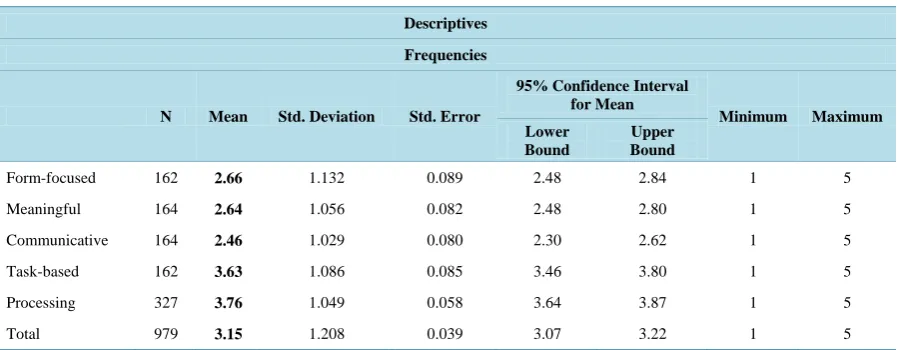
There are 12 activities included in the two questionnaires and they can be categorized into form-focused, meaningful, communicative, task-based and processing. As shown in Table 1, primary teachers tend to use task- based (a mean of 3.63) and processing instruction (3.76) significantly less frequently (p < 0.05) than other means, which included form-focused (2.66), meaningful (2.64) and also communicative activities (2.46). Such is the case for secondary teachers. Task-based (mean = 3.44) and processing instruction (mean = 3.77) are used significantly less (p < 0.05) than other three teaching methods: form-focused (2.61), meaningful (2.25) and communicative activities (2.93) (Please refer to Table 2). Since teachers might not be familiar with the termi-nology like form-focused or meaningful activities, examples of activities are shown requiring teachers to indi-cate their frequency of using such activities.
There is a question in Part III asking the participants to read some examples of teaching approaches and an-swer two main questions: 1) Which approach do you use (or close to the one you used) to teach simple past tense; 2) Would you consider using some of the other approaches listed above? Why or why not?
[image:7.595.89.538.297.472.2]The findings were consistent with the above findings concerning the use of teaching activities. 59% of the primary teachers used the traditional teaching approach and 40% and 19% used task-based and processing in-struction respectively. In the case of secondary schools, 53% teachers used the traditional teaching approach and 45% and 14% used task-based and processing instruction respectively. Similar to the findings concerning the
Table 1. How simple past tense is being taught in primary classrooms in Hong Kong.
Descriptives
Frequencies
N Mean Std. Deviation Std. Error
95% Confidence Interval for Mean
Minimum Maximum Lower
Bound
Upper Bound
Form-focused 162 2.66 1.132 0.089 2.48 2.84 1 5 Meaningful 164 2.64 1.056 0.082 2.48 2.80 1 5 Communicative 164 2.46 1.029 0.080 2.30 2.62 1 5 Task-based 162 3.63 1.086 0.085 3.46 3.80 1 5 Processing 327 3.76 1.049 0.058 3.64 3.87 1 5 Total 979 3.15 1.208 0.039 3.07 3.22 1 5 Note: Part II 1.1-1.12: Teaching Activities: 1 = form-focused activities. 2 = meaningful activities. 3 = communicative activities. 4 = task-based activities. 5 = processing instruction. Frequency: 1 = Very frequent. 2 = Frequent. 3 = Sometimes. 4 = Seldom. 5 = Never.
Table 2. How simple past tense is being taught in secondary classrooms in Hong Kong.
Descriptives
Frequency
N Me
an Std. Deviation Std. Error
95% Confidence Interval for Mean
Minimum Maximum
Lower Bound
Upper Bound
[image:7.595.89.542.517.700.2]teaching activities used, teachers used significantly more traditional teaching approach than task-based and processing instruction. It can be concluded that traditional instruction seems to be used more frequently by teachers compared with task-based and processing instruction. It seems that teachers focus on output more than input.
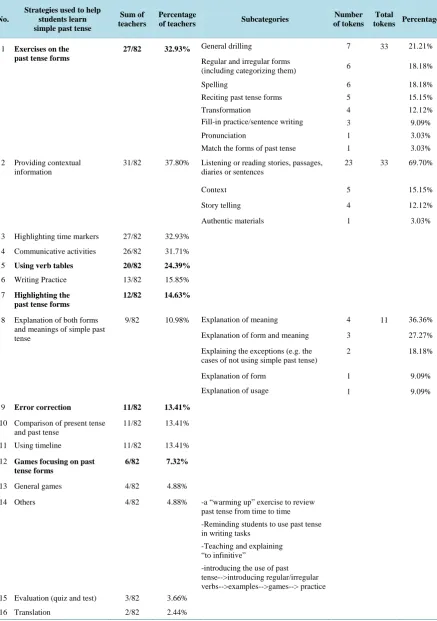
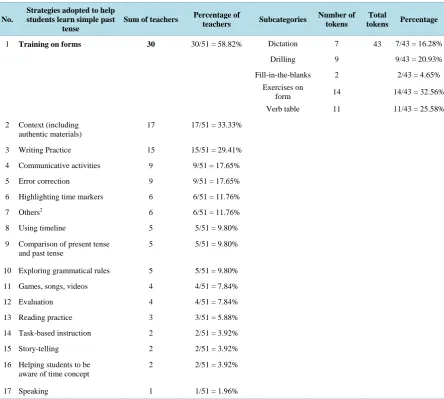
Regarding strategies used by teachers, there is an open-ended question in Part III of the questionnaire requir-ing teachers to report the strategies used to help students learn simple past tense (please refer to Table 3and
Table 4). There were eleven strategies suggested by both primary and secondary teachers, which are 1) exercis-es on past tense forms; 2) providing contextual information; 3) writing practice; 4) communicative activitiexercis-es; 5) error correction; 6) highlighting the time markers; 7) using timeline; 8) comparison of present tense and past tense; 9) story-telling; 10) games, songs and videos; 11) evaluation. Among the above strategies suggested, form focused activities seem to be most favored by primary (64.63%) and secondary (58.82%) school teachers, for example, using verb tables, drilling on past tense forms, dictating and reciting past tense forms and so forth. In contrast, fewer primary (31.71%) and secondary teachers (17.65%) adopted communicative strategies. It can be concluded that a) mechanical teaching activities seem to have a very important role to play in the teaching of simple past tense in primary and secondary schools; b) communicative activities are less frequently used by primary and secondary teachers.
Though both primary and secondary teachers agree that they should focus on both the forms and meanings in teaching simple past tense (a mean of 3.7 for primary teachers and 3.3 secondary teachers in Part II of the ques-tionnaire: 4 - 5 meaning agree and strongly agree respectively), the use of processing instruction involving re-ferential and affective activities is almost absent. Fortunately, they also agree that the present approach of teaching simple pasttense should be improved (a mean of 3.7 for primary teachers and 3.3 for secondary teach-ers).
4.2. Teachers’ Cognition about Simple Past Tense Acquisition
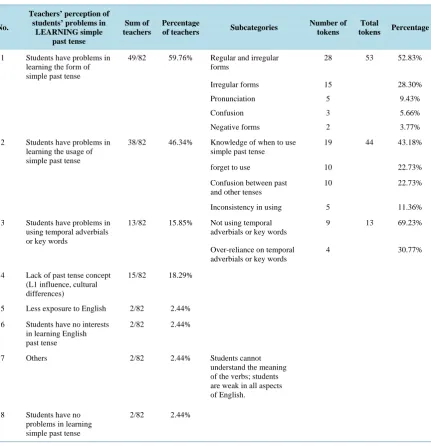
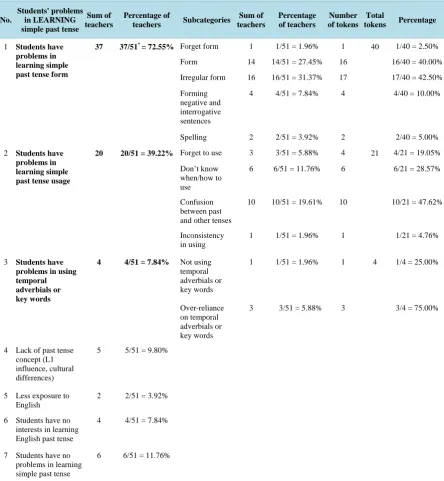
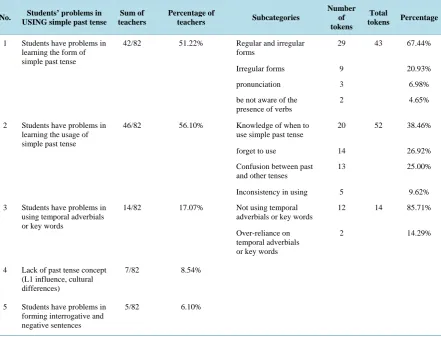
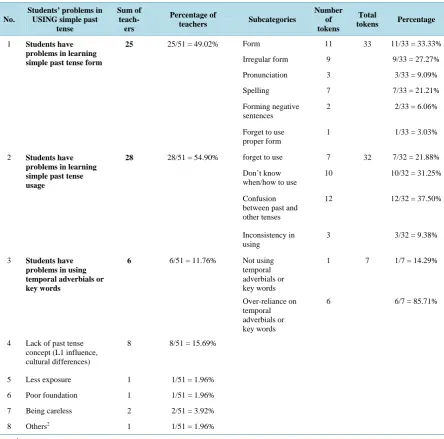
The use of teaching strategies or teaching approaches might be related to teachers’ perceptions of students’ problems in acquiring simple past tense. To examine teachers’ perception, there are two open-ended questions in part III of the questionnaire, one about the difficulties involved in LEARNING simple past tense, and the other one about USING simple past tense. Their perception about students’ problems in learning and using simple past tense seems very similar.
In learning simple past tense, both primary and secondary teachers seem to believe that there are four main difficulties encountered by students (see Table 5and Table 6), concerning the 1) form; 2) usage; 3) use of tem-poral adverbials and also 4) lack of past tense concept. Teachers believe that the major problem is to master the form (e.g. both regular and irregular forms) (59.76% primary teachers and 72.55% secondary teachers). Another problem is about the usage (46.34% primary teachers and 39.22% secondary teachers). It should be noted that (and indeed worrying) quite a number of teachers interpreted that students simply forgot to use simple past tense, implying that they believe students should have learned simple past tense and the failure to use it means forget-ting to use. Another problem is about the use of temporal adverbials. About 30% of primary teachers believed that students rely too much on temporal adverbials in marking tense, but a majority of the teachers (almost 70%) claimed that students should use temporal adverbials. However, such is not the case for secondary teachers. Most secondary teachers complain about students’ over-reliance on temporal adverbials (about 75%). It seems that secondary teachers have gradually realized that learning simple past tense by relying on temporal adverbials is not an effective way.
Table 3. Strategies primary teachers used to help students learn simple past tense (can suggest more than one strategy).
No.
Strategies used to help students learn simple past tense
Sum of teachers
Percentage
of teachers Subcategories
Number of tokens
Total
tokens Percentage
1 Exercises on the past tense forms
27/82 32.93% General drilling 7 33 21.21%
Regular and irregular forms
(including categorizing them) 6 18.18% Spelling 6 18.18% Reciting past tense forms 5 15.15% Transformation 4 12.12% Fill-in practice/sentence writing 3 9.09% Pronunciation 1 3.03% Match the forms of past tense 1 3.03% 2 Providing contextual
information
31/82 37.80% Listening or reading stories, passages, diaries or sentences
23 33 69.70%
Context 5 15.15% Story telling 4 12.12% Authentic materials 1 3.03% 3 Highlighting time markers 27/82 32.93%
4 Communicative activities 26/82 31.71%
5 Using verb tables 20/82 24.39%
6 Writing Practice 13/82 15.85% 7 Highlighting the
past tense forms
12/82 14.63%
8 Explanation of both forms and meanings of simple past tense
9/82 10.98% Explanation of meaning 4 11 36.36% Explanation of form and meaning 3 27.27% Explaining the exceptions (e.g. the
cases of not using simple past tense)
2 18.18% Explanation of form 1 9.09% Explanation of usage 1 9.09%
9 Error correction 11/82 13.41%
10 Comparison of present tense and past tense
11/82 13.41% 11 Using timeline 11/82 13.41% 12 Games focusing on past
tense forms
6/82 7.32%
13 General games 4/82 4.88%
14 Others 4/82 4.88% -a “warming up” exercise to review past tense from time to time -Reminding students to use past tense in writing tasks
-Teaching and explaining “to infinitive”
-introducing the use of past tense-->introducing regular/irregular verbs-->examples-->games--> practice 15 Evaluation (quiz and test) 3/82 3.66%
Table 4. Strategies secondary teachers used to help students learn simple past tense (can suggest more than one strategy).
No.
Strategies adopted to help students learn simple past
tense
Sum of teachers Percentage of
teachers Subcategories
Number of tokens
Total
tokens Percentage
1 Training on forms 30 30/51 = 58.82% Dictation 7 43 7/43 = 16.28%
Drilling 9 9/43 = 20.93% Fill-in-the-blanks 2 2/43 = 4.65%
Exercises on
form 14 14/43 = 32.56% Verb table 11 11/43 = 25.58% 2 Context (including
authentic materials)
17 17/51 = 33.33% 3 Writing Practice 15 15/51 = 29.41% 4 Communicative activities 9 9/51 = 17.65% 5 Error correction 9 9/51 = 17.65% 6 Highlighting time markers 6 6/51 = 11.76% 7 Others2 6 6/51 = 11.76% 8 Using timeline 5 5/51 = 9.80% 9 Comparison of present tense
and past tense
5 5/51 = 9.80% 10 Exploring grammatical rules 5 5/51 = 9.80% 11 Games, songs, videos 4 4/51 = 7.84% 12 Evaluation 4 4/51 = 7.84% 13 Reading practice 3 3/51 = 5.88% 14 Task-based instruction 2 2/51 = 3.92% 15 Story-telling 2 2/51 = 3.92% 16 Helping students to be
aware of time concept
2 2/51 = 3.92% 17 Speaking 1 1/51 = 1.96%
Note: 1Majority of teachers listed more than one teaching strategy and different teachers gave different numbers of tokens so that the total number of
tokens is more than that of teachers. In order to compare on an equal basis, the number of teachers, 82, is chosen as the base number. 2“Others”
in-cludes the following items: 1) Use activities to get students familiar with the tenses. 2) Ask students to underline connectives. 3) Frequent recap. 4) Ask them to review their own work. 5) Make use of Readers to teach. 6) Intensive practices; giving detailed feedback.
experience (in addition to their teaching experience reported in the literature). These English teachers received education when both form-focused approach and communicative approach were prevalent. It seems reasonable that they prefer form-focused or communicative approach in teaching English simple past tense. This is also re-lated to teachers’ knowledge about how simple past tense should best be taught. While studies in the literature focused much on teachers’ knowledge of grammar and grammar terminology, this study sheds light into what teachers’ cognition should encompass and how the notion could be expanded. A lack of knowledge (or having misconceptions) about how grammar items should be taught is as serious as (and actually more serious than) having insufficient knowledge of grammar knowledge. The following section reports if there might be a discre-pancy between what teachers know about how simple past tense should be taught and their actual teaching prac-tice in the classroom.
4.3. Teachers’ Suggestions of Teaching Simple Past Tense
Table 5. Primary teachers’ perception of students’ problems in LEARNING simple past tense (can give more than one
an-swer).
No.
Teachers’ perception of students’ problems in
LEARNING simple past tense
Sum of teachers
Percentage
of teachers Subcategories
Number of tokens
Total
tokens Percentage
1 Students have problems in learning the form of simple past tense
49/82 59.76% Regular and irregular forms
28 53 52.83% Irregular forms 15 28.30% Pronunciation 5 9.43% Confusion 3 5.66% Negative forms 2 3.77% 2 Students have problems in
learning the usage of simple past tense
38/82 46.34% Knowledge of when to use simple past tense
19 44 43.18% forget to use 10 22.73% Confusion between past
and other tenses
10 22.73% Inconsistency in using 5 11.36% 3 Students have problems in
using temporal adverbials or key words
13/82 15.85% Not using temporal adverbials or key words
9 13 69.23%
Over-reliance on temporal adverbials or key words
4 30.77% 4 Lack of past tense concept
(L1 influence, cultural differences)
15/82 18.29%
5 Less exposure to English 2/82 2.44% 6 Students have no interests
in learning English past tense
2/82 2.44%
7 Others 2/82 2.44% Students cannot understand the meaning of the verbs; students are weak in all aspects of English.
8 Students have no problems in learning simple past tense
2/82 2.44%
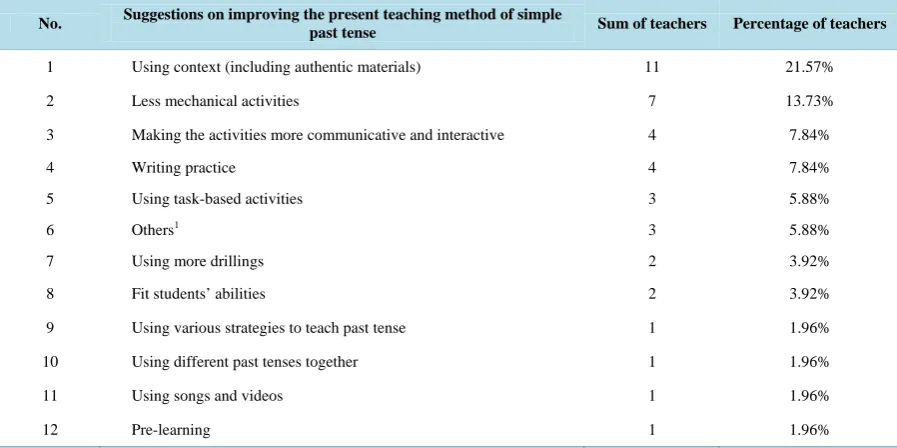
Table 9 and Table 10 show a list of suggestions given by the teachers. A range of activities were suggested; some (primary (10.98%) and secondary (21.57%)) suggested exposing students to various text types, for exam-ple, introducing simple past tense using stories, using reading materials written in simple past tense; giving stu-dents a passage for deducing the past tense form, and so forth. Other common suggestions proposed by both primary and secondary teachers included using communicative activities, and combining different teaching me-thods to make teaching more interesting. Secondary teachers suggested using less mechanical activities (13.73%) but more task-based activities (5.88%). There seems to be a gap between what teachers know should be used to teach simple past tense and what they practise in the classroom. Why is this the case and what does this imply? Is there anything we could include in the teaching programmes to equip student-teachers well for the challenge? Is processing instruction a way out?
4.4. How can Processing Instruction help?
Table 6.Secondary teachers’ perception of students’ problems in LEARNING simple past tense (can give more than one
answer).
No.
Students' problems in LEARNING simple past tense
Sum of teachers
Percentage of
teachers Subcategories Sum of teachers Percentage of teachers Number of tokens Total
tokens Percentage
1 Students have problems in learning simple past tense form
37 37/51* = 72.55% Forget form 1 1/51 = 1.96% 1 40 1/40 = 2.50% Form 14 14/51 = 27.45% 16 16/40 = 40.00% Irregular form 16 16/51 = 31.37% 17 17/40 = 42.50% Forming
negative and interrogative sentences
4 4/51 = 7.84% 4 4/40 = 10.00%
Spelling 2 2/51 = 3.92% 2 2/40 = 5.00% 2 Students have
problems in learning simple past tense usage
20 20/51 = 39.22% Forget to use 3 3/51 = 5.88% 4 21 4/21 = 19.05% Don’t know
when/how to use
6 6/51 = 11.76% 6 6/21 = 28.57%
Confusion between past and other tenses
10 10/51 = 19.61% 10 10/21 = 47.62%
Inconsistency in using
1 1/51 = 1.96% 1 1/21 = 4.76% 3 Students have
problems in using temporal adverbials or key words
4 4/51 = 7.84% Not using temporal adverbials or key words
1 1/51 = 1.96% 1 4 1/4 = 25.00%
Over-reliance on temporal adverbials or key words
3 3/51 = 5.88% 3 3/4 = 75.00%
4 Lack of past tense concept (L1 influence, cultural differences)
5 5/51 = 9.80%
5 Less exposure to English
2 2/51 = 3.92% 6 Students have no
interests in learning English past tense
4 4/51 = 7.84%
7 Students have no problems in learning simple past tense
6 6/51 = 11.76%
Note: 1. Majority of teachers listed more than one students’ problem in using simple past tense and different teachers gave different numbers of to-kens so that the total number of toto-kens is more than that of teachers. In order to compare on an equal basis, the number of teachers, 51, is chosen as the base number.
Table 7. Primary teachers’ perception of students’ problems in USING simple past tense (can give more than one answer).
No. Students’ problems in USING simple past tense
Sum of teachers
Percentage of
teachers Subcategories
Number of tokens
Total
tokens Percentage
1 Students have problems in learning the form of simple past tense
42/82 51.22% Regular and irregular forms
29 43 67.44% Irregular forms 9 20.93% pronunciation 3 6.98% be not aware of the
presence of verbs
2 4.65% 2 Students have problems in
learning the usage of simple past tense
46/82 56.10% Knowledge of when to use simple past tense
20 52 38.46% forget to use 14 26.92% Confusion between past
and other tenses
13 25.00% Inconsistency in using 5 9.62% 3 Students have problems in
using temporal adverbials or key words
14/82 17.07% Not using temporal adverbials or key words
12 14 85.71% Over-reliance on
temporal adverbials or key words
2 14.29%
4 Lack of past tense concept (L1 influence, cultural differences)
7/82 8.54%
5 Students have problems in forming interrogative and negative sentences
5/82 6.10%
strategies and means which can be used to help students.
This is, of course, also highly related to the perception of both professors and administrators involved in cur-riculum planning of these teacher education programmes as to what should and should not be included in the programmes. It is thus significant to shape the perception of not just these student-teachers but their teachers in maximizing the effectiveness of the training curriculum. Based on the results reported in this study, teachers tend to believe that the problems second language learners encountered in acquiring simple past tense concern the forms mainly, which might result in their use of the form-oriented teaching approach in teaching simple past tense.
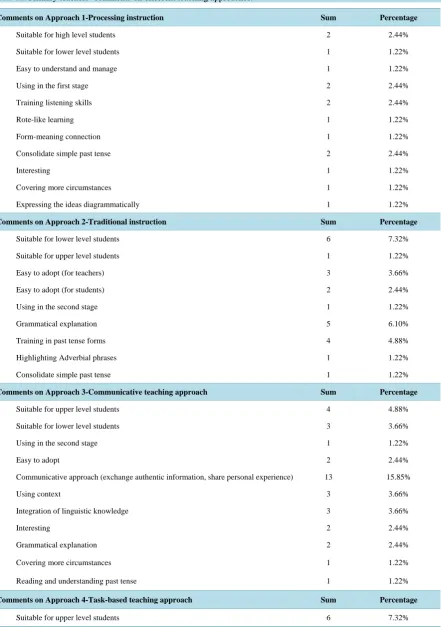
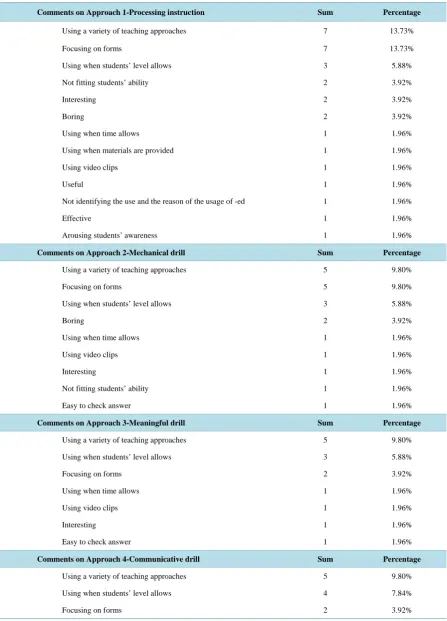
While teachers also agree that both forms and meanings are important, there exists a discrepancy between what they believe and what they do in the classroom as they emphasize a form-oriented teaching approach in teaching simple past tense. Some other beliefs can be regarded as misconceptions, for example, primary teachers’ belief that students should use temporal adverbials with simple past tense and their misconception that students’ failure to use simple past tense means forgetting to use. When being asked about what the teachers perceived are the main differences which make one teaching approach different from another in Section 1.5.2 in the question-naire, teachers mostly fail to see the point and value of processing instruction (see Table 11 and Table 12). De-spite the many relevant findings concerning the generalizabilty of processing instruction reported in the past two decades, English teachers seem to know nothing about it, and pedagogy-related research findings seem to be missing in teacher education programmes. This is obviously not a case about the PRESENCE of a gap between theory (taught in teaching education programmes) and teaching practice as reported inCheng, Cheng and Tang (2010) but a LACK of relevant information for student-teachers to make the right instructional decisions.
Table 8. Secondary teachers’ perception of students’ problems in USING simple past tense (can give more than one answer).
No.
Students’ problems in USING simple past
tense
Sum of
teach-ers
Percentage of
teachers Subcategories
Number of tokens
Total
tokens Percentage
1 Students have problems in learning simple past tense form
25 25/51 = 49.02% Form 11 33 11/33 = 33.33% Irregular form 9 9/33 = 27.27% Pronunciation 3 3/33 = 9.09% Spelling 7 7/33 = 21.21% Forming negative
sentences
2 2/33 = 6.06% Forget to use
proper form
1 1/33 = 3.03% 2 Students have
problems in learning simple past tense usage
28 28/51 = 54.90% forget to use 7 32 7/32 = 21.88% Don’t know
when/how to use
10 10/32 = 31.25% Confusion
between past and other tenses
12 12/32 = 37.50%
Inconsistency in using
3 3/32 = 9.38% 3 Students have
problems in using temporal adverbials or key words
6 6/51 = 11.76% Not using temporal adverbials or key words
1 7 1/7 = 14.29%
Over-reliance on temporal adverbials or key words
6 6/7 = 85.71%
4 Lack of past tense concept (L1 influence, cultural differences)
8 8/51 = 15.69%
5 Less exposure 1 1/51 = 1.96% 6 Poor foundation 1 1/51 = 1.96% 7 Being careless 2 2/51 = 3.92% 8 Others2 1 1/51 = 1.96%
Note: 1Majority of teachers listed more than one students’ problem in using simple past tense and different teachers gave different numbers of tokens
so that the total number of tokens is more than that of teachers. In order to compare on an equal basis, the number of teachers, 82, is chosen as the base number. 2“Others” includes the following item: “mistakes in using simple past tense are common in writing and speaking”.
1) Learners are provided with information about a particular form or structure.
2) They are told that a specific input processing strategy may negatively affect their mastery of the form or structure.
3) Structured-input activities are used to help learners map the form and the meaning. The grammatical explanation contains two parts:
1) Explicit information about past tense, including its formal features and function.
Table 9. Primary teachers’ suggestions of ways to improve the teaching method of simple past tense.
No. Suggestions on improving the present teaching method of simple
past tense Sum of teachers Percentage of teachers
1 Exposure to various text types 9 10.98% 2 Using communicative activities 8 9.76% 3 Balance form and meaning 6 7.32% 4 Combination of different teaching methods 5 6.10% 5 Listening to simple past tense 4 4.88% 6 Writing practice 4 4.88%
7 Games 4 4.88%
8 Using authentic materials 3 3.66% 9 Explanation of English simple past tense 3 3.66%
10 Timeline 2 2.44%
11 Utilizing websites and visual aids 2 2.44% 12 Drilling on past tense forms 1 1.22% 13 Proof-reading 1 1.22% 14 Meaningful activity (activity 9) 1 1.22% 15 Developing school-based curriculum 1 1.22% 16 Shift to student-centered approach 1 1.22%
Table 10. Secondary teachers’ suggestions of ways to improve the teaching method of simple past tense.
No. Suggestions on improving the present teaching method of simple
past tense Sum of teachers Percentage of teachers
1 Using context (including authentic materials) 11 21.57% 2 Less mechanical activities 7 13.73% 3 Making the activities more communicative and interactive 4 7.84% 4 Writing practice 4 7.84% 5 Using task-based activities 3 5.88%
6 Others1 3 5.88%
7 Using more drillings 2 3.92% 8 Fit students’ abilities 2 3.92% 9 Using various strategies to teach past tense 1 1.96% 10 Using different past tenses together 1 1.96% 11 Using songs and videos 1 1.96% 12 Pre-learning 1 1.96%
Note: 1“Others” includes the following items: 1) “It can be, but I think teachers nowadays are already very concerned about the balance between form
[image:15.595.87.536.426.650.2]Table 11. Primary teachers’ comments on different teaching approaches.
Comments on Approach 1-Processing instruction Sum Percentage
Suitable for high level students 2 2.44% Suitable for lower level students 1 1.22% Easy to understand and manage 1 1.22% Using in the first stage 2 2.44% Training listening skills 2 2.44% Rote-like learning 1 1.22% Form-meaning connection 1 1.22% Consolidate simple past tense 2 2.44%
Interesting 1 1.22%
Covering more circumstances 1 1.22% Expressing the ideas diagrammatically 1 1.22%
Comments on Approach 2-Traditional instruction Sum Percentage
Suitable for lower level students 6 7.32% Suitable for upper level students 1 1.22% Easy to adopt (for teachers) 3 3.66% Easy to adopt (for students) 2 2.44% Using in the second stage 1 1.22% Grammatical explanation 5 6.10% Training in past tense forms 4 4.88% Highlighting Adverbial phrases 1 1.22% Consolidate simple past tense 1 1.22%
Comments on Approach 3-Communicative teaching approach Sum Percentage
Suitable for upper level students 4 4.88% Suitable for lower level students 3 3.66% Using in the second stage 1 1.22%
Easy to adopt 2 2.44%
Communicative approach (exchange authentic information, share personal experience) 13 15.85%
Using context 3 3.66%
Integration of linguistic knowledge 3 3.66%
Interesting 2 2.44%
Grammatical explanation 2 2.44% Covering more circumstances 1 1.22% Reading and understanding past tense 1 1.22%
Comments on Approach 4-Task-based teaching approach Sum Percentage
Continued
Difficult to adopt 2 2.44% Using in stage 2 1 1.22% Communicative approach (exchange authentic information, share personal experience) 9 10.98% Integration of linguistic forms 6 7.32% Enhancing creative thinking 3 3.66% Promotion of writing skills 2 2.44%
Interesting 6 7.32%
Extended task 1 1.22%
Covering more circumstances 1 1.22% Reading and understanding past tense 1 1.22% Should have more students’ applications 1 1.22%
to access the meaning. Affective activities require learners to give opinions, express beliefs or other affective responses, and process information about the real world. The purpose is to provide learners with more opportun-ities to see or hear the form in a meaningful context.
Two points should be paid special attention to when using structured input activities.
1) Teachers’ feedback is limited to telling learners whether their answers are correct or wrong. Any explana-tion of how simple past tense is formed is not allowed.
2) Learners are not required to produce sentences with simple past tense.
The information above is just an example suggesting the importance of including relevant research findings in teacher education programmes. While people always talk about bridging the gap between theory learned in school and actual teaching practice in the classroom, curriculum developers or teacher trainers should be more aware of what theory or information is relevant for student-teachers as the initial step to addressing the problem. Though there are other issues or considerations which might have impacted teachers’ instructional decisions, for example, their understanding of the needs of students or their expectations, ignorance or misconceptions in teachers should be something teacher education programmes aim to eliminate.
5. Conclusion
This study entitled Teachers’ cognition about teaching and learning of English simple past tense in Hong Kong offers a clear picture of what teaching and learning of simple past tense are like in primary schools in Hong Kong. Despite the promotion of the communicative language approach in the 1980s and task-based approach in the 1990s, teachers still seem to prefer the form-focused approach. The findings of the study show that teachers’ understanding (or misunderstanding) of the nature of the acquisition problem of tense, and their use of teaching approach are instrumental in shaping students’ learning outcomes. What is fortunate is that they understand the need to improve the existing teaching approach which is too form-oriented. Unfortunately, they do not seem to have much knowledge about the use of processing instruction.
Findings in the literature should not be limited to researchers; there is a pressing need for frontline teachers to understand the nature of the acquisition problem, the possible reasons leading to the difficulty, and ways how to help students master both the form and meaning of simple past tense, which might be the job of future teacher education programmes. As pointed out in 4.1.4, instead of always claiming there is a gap between theory as taught in teaching education programmes and teaching practice as reported in Cheng, Cheng and Tang (2010), integration of research and education should be encouraged so as to help student-teachers make the right instruc-tional decisions.
Table 12. Secondary teachers’ comments on different teaching approaches.
Comments on Approach 1-Processing instruction Sum Percentage
Using a variety of teaching approaches 7 13.73% Focusing on forms 7 13.73% Using when students’ level allows 3 5.88% Not fitting students’ ability 2 3.92%
Interesting 2 3.92%
Boring 2 3.92%
Using when time allows 1 1.96% Using when materials are provided 1 1.96% Using video clips 1 1.96%
Useful 1 1.96%
Not identifying the use and the reason of the usage of -ed 1 1.96%
Effective 1 1.96%
Arousing students’ awareness 1 1.96%
Comments on Approach 2-Mechanical drill Sum Percentage
Using a variety of teaching approaches 5 9.80% Focusing on forms 5 9.80% Using when students’ level allows 3 5.88%
Boring 2 3.92%
Using when time allows 1 1.96% Using video clips 1 1.96%
Interesting 1 1.96%
Not fitting students’ ability 1 1.96% Easy to check answer 1 1.96%
Comments on Approach 3-Meaningful drill Sum Percentage
Using a variety of teaching approaches 5 9.80% Using when students’ level allows 3 5.88% Focusing on forms 2 3.92% Using when time allows 1 1.96% Using video clips 1 1.96%
Interesting 1 1.96%
Easy to check answer 1 1.96%
Comments on Approach 4-Communicative drill Sum Percentage
Continued
Interactive 2 3.92%
Using when time allows 1 1.96%
Effective 1 1.96%
Useful 1 1.96%
Using video clips 1 1.96% Using when materials are provided 1 1.96%
Interesting 1 1.96%
Comments on Approach 5-Task-based instruction Sum Percentage
Using a variety of teaching approaches 6 11.76% Using authentic materials 2 3.92%
Interactive 2 3.92%
Using when time allows 1 1.96% Reciting model sentences 1 1.96%
Useful 1 1.96%
Motivating students to use target grammar items 1 1.96% Good for consolidation 1 1.96% Using when materials are provided 1 1.96% Using when students’ level allows 1 1.96%
Interesting 1 1.96%
Acknowledgements
This research was supported by Research Grants Council (RGC) Direct Allocation Fund for GRF Project Rated 3.5 (DA) [grant number: PolyU 5411/10H].
References
Alijanian, E. (2012). An Investigation of Iranian EFL Teachers’ Beliefs about Grammar. Journal of Educational and Social
Research, 2, 335-340.
Andrews, S. (1994). The Grammatical Knowledge/Awareness of Native-Speaker EFL Teachers: What the Trainers Say. In M. Bygate, A. Tonkyn, & E. Williams (Eds.), Grammar and the Language Teacher (pp. 69-89). London: Prentice Hall International.
Andrews, S. (1999a). All These Like Little Name Things’—A Comparative Study of Language Teachers’ Explicit Know-ledge of Grammar And Grammatical Terminology. Language Awareness, 8, 143-159.
http://dx.doi.org/10.1080/09658419908667125
Andrews, S. (1999b). The Metalinguistic Awareness of Hong Kong Secondary School Teachers of English. Ph.D. Thesis, Hampshire, UK: University of Southampton.
Basturkmen, H. (2012). Review of Research into the Correspondence between Language Teachers’ Stated Beliefs and Prac-tices. System, 40, 282-295. http://dx.doi.org/10.1016/j.system.2012.05.001
Benati, A. (2005). The Effects of Processing Instruction, Traditional Instruction and Meaning-Output Instruction on the Ac-quisition of the English Past Simple Tense. Language Teaching Research, 9, 67-93.
http://dx.doi.org/10.1191/1362168805lr154oa
Benati, A. (2010). Exploring the Effects of Processing Instruction on Discourse-Level Interpretation Tasks with English Past Tense. In A. Benati, & J. Lee (Eds.), Processing Instruction and Discourse (pp. 178-197). New York: Continuum.
Transfer-of-Training Effects on English Third Person Singular Present Tense. In A. Benati, & J. Lee (Eds.), Grammar
Acquisition and Processing Instruction Second and Cumulative Effects (pp. 88-120). Bristol, UK/Buffalo, NY:
Multilin-gual Matters.
Borg, S. (1998). Teachers’ Pedagogical Systems and Grammar Teaching: A Qualitative Study. TESOL Quarterly, 32, 9-38. http://dx.doi.org/10.2307/3587900
Burgess, J., & Etherington, S. (2002). Focus on Grammatical Form: Explicit or Implicit? System, 30, 433-458. http://dx.doi.org/10.1016/S0346-251X(02)00048-9
Chan, D. (1992). Teachers as Clinicians: Inadequacies in Teacher Education. Chinese University Education Journal, 20, 37- 42.
Chan, M. (2013). Acquisition of Be By Cantonese ESL Learners in Hong Kong and Its Pedagogical Implications. Bern: Peter Lang.
Chandler, P. (1988). Unproductive Busywork. English in Education, 22, 20-28. http://dx.doi.org/10.1111/j.1754-8845.1988.tb00285.x
Chandler, P., Robinson, W. P., & Noyes, P. (1988). The Level of Linguistic Knowledge and Awareness among Students Training to Be Primary Teachers. Language and Education, 2, 161-173. http://dx.doi.org/10.1080/09500788809541233 Cheng, M. M. H, Cheng, A. Y. N., & Tang, S. Y. F. (2010). Closing the Gap between the Theory and Practice of Teaching:
Implications for Teacher Education Programmes in Hong Kong. Journal of Education for Teaching: International
Re-search and Pedagogy, 36, 91-104. http://dx.doi.org/10.1080/02607470903462222
Collins, P. & Lee, J. F. K. (2005). English Grammar in Current Hong Kong Textbooks: A Critical Appraisal. TESL Reporter, 38, 37-49.
Cook, V. (2001). Second Language Learning and Language Teaching (3rd ed.). London: Arnold. Cowan, R. (2009). The Teacher’s Grammar of English. Cambridge: Cambridge University Press.
Doughty, C. J. (2003). Instructed SLA: Constraints, Compensation, and Enhancement. In C. J. Doughty, & M. H. Long (Eds.), The Handbook of Second Language Acquisition (pp. 256-310). Malden, MA: Blackwell Publishing Ltd.
http://dx.doi.org/10.1002/9780470756492.ch10
Doughty, C., & Williams, J. (1998). Issues and Terminology. In C. Doughty, & J. Williams (Eds.), Focus on Form in
Class-room Second Language Acquisition (pp. 1-12). Cambridge: Cambridge University Press.
Education Commission (1994). Report of the Working Group on Language Proficiency. Hong Kong: Government Printer. Eisenstein-Ebsworth, M., & Schweers, C. W. (1997). What Researchers Say and Practitioners Do: Perspectives on Conscious
Grammar Instruction in the ESL Classroom. Applied Language Learning, 8, 237-260.
Ellis, R. (1990). Instructed Second Language Acquisition: Learning in the Classroom. Oxford: Blackwell.
Ellis, R. (2005). Controversies in Grammar Teaching. Paper Presented at Dr. Tien ChangLin Technology Innovation Foun-dation Lecture Series, Hong Kong: The Chinese University of Hong Kong.
Ellis, R. (2008). The Study of Second Language Acquisition (2nd ed.). Oxford: Oxford University Press.
Ellis, R., Loewen, S., & Erlam, R. (2006). Implicit and Explicit Corrective Feedback and the Acquisition of L2 Grammar.
Studies in Second Language Acquisition, 28, 339-368. http://dx.doi.org/10.1017/S0272263106060141
Farley, A. (2004). Processing Instruction and the Spanish Subjunctive: Is Explicit Information Needed. In B. Van Patten (Ed.), Processing Instruction: Theory, Research, and Commentary (pp. 227-239). Mahwah, NJ: Lawrence Erlbaum. Farrell, T., & Lim. P. (2005). Conceptions of Grammar Teaching: A Case Study of Teachers’ Beliefs and Classroom
Prac-tices. TESL-EJ, 9, 1-12.
Gan, Z. (2012). Understanding L2 Speaking Problems: Implications for ESL Curriculum Development in a Teacher Training Institution in Hong Kong. Australian Journal of Teacher Education, 37, 43-59.
http://ro.ecu.edu.au/cgi/viewcontent.cgi?article=1667&context=ajte http://dx.doi.org/10.14221/ajte.2012v37n1.4
Gass, S. (1997). Input, Interaction, and the Second Language Learner. Mahwah, NJ: L. Erlbaum.
Green, C. (1991). Teacher Perceptions of the Relative Gravity of Errors in Written English. Institute Of Language in
Educa-tion Journal, 2, 69-79.
Kim, T. E. (2006). Writing Instruction for English Language Learners: Teacher Beliefs, Writing Tasks and Methods. Ph.D. Thesis, Illinois: University of Illinois at Urbana-Champaign.
Law, C. (2005). The Acquisition of English Subject-Verb Agreement by Cantonese Speakers. MA Thesis, Hong Kong: The University of Hong Kong.
Lightbown, P. M., & Spada, N. (1990). Focus-on-Form and Corrective Feedback in Communicative Language Teaching: Effects on Second Language Learning. Studies in Second Language Acquisition, 12, 429-448.
Lincoln, Y., & Guba, E. (1985). Naturalistic Inquiry. Beverly Hills, CA: Sage.
Littlewood, W. (2004). Task-Based Learning of Grammar. ELT Journal, 58, 319-326. http://dx.doi.org/10.1093/elt/58.4.319
Long, M. (1991). Focus on Form: A Design Feature in Language Teaching Methodology. In K. De Bot, R. Ginsberg, & C. Kramsch (Eds.), Foreign Language Research in Cross-Cultural Perspectives (pp. 39-52). Amsterdam: John Benjamins. http://dx.doi.org/10.1075/sibil.2.07lon
Long, M. H. (1988). Instructed Interlanguage Development. In L. Beebe (Ed.), Issues in Second Language Acquisition:
Mul-tiple Perspectives (pp. 115-141). Rowley, MA: Newbury House.
Mai, H.-M. A. (2003). Grammar Pedagogy and the Task-Based Curriculum: Hong Kong Teachers’ Beliefs and Practices. MA Thesis, Hong Kong: The University of Hong Kong.
McArthur, T. (2002). The Oxford Guide to World English. Oxford/New York: Oxford University Press.
Mitchell, R. (1994). Foreign Language Teachers and the Teaching of Grammar. In M. Bygate, A. Tonkyn, & E. Williams (Eds.), Grammar and the Language Teacher (pp. 215-223). Hemel Hempstead: Prentice Hall.
Neupane, M. (2009). Processing Instruction: An Input Based Approach for Teaching Grammar. Journal of NELTA, 14, 111- 118.
Norris, J., & Ortega, L. (2000). Effectiveness of L2 Instruction: A Research Synthesis and Quantitative Meta-Analysis.
Lan-guage Learning, 50, 417-528. http://dx.doi.org/10.1111/0023-8333.00136
Robison, R. E. (1995). The Aspect Hypothesis Revisited: A Cross-Sectional Study of Tense and Aspect Marking in Inter-language. Applied Linguistics, 16, 344-370. http://dx.doi.org/10.1093/applin/16.3.344
Rutherford, W. E. (1987). Second Language Grammar: Learning and Teaching. England: Longman.
Rutherford, W., & Sharwood Smith, M. (1985). Consciousness-Raising and Universal Grammar. Applied Linguistics, 6, 274- 282. http://dx.doi.org/10.1093/applin/6.3.274
Schulz, R. A. (1996). Focus on Form in the Foreign Language Classroom: Students’ and Teacher’s Views on Error Correc-tion and the Role of Grammar. Foreign Language Annals, 29, 343-364.
http://dx.doi.org/10.1111/j.1944-9720.1996.tb01247.x
Schulz, R. A. (2001). Cultural Differences in Student and Teacher Perceptions Concerning the Role of Grammar Teaching and Corrective Feedback: USA-Colombia. The Modern Language Journal, 85, 244-258.
http://dx.doi.org/10.1111/0026-7902.00107
Sharwood Smith, M. A. (1993). Input Enhancement in Instructed SLA: Theoretical Bases. Studies in Second Language
Ac-quisition, 15, 165-179. http://dx.doi.org/10.1017/S0272263100011943
Spada, N., & Lightbown, P. M. (1993). Instruction and the Development of Questions in L2 Classrooms. Studies in Second
Language Acquisition, 15, 205-224. http://dx.doi.org/10.1017/S0272263100011967
SPSS (Statistical Package for the Social Sciences) 15.0 [Computer software] (2006). Chicago, IL: SPSS Inc.
Sze, P. (1992). A Decade of Communicative Language Teaching in Hong Kong: Where from Here. Journal of Basic Educa-tion, 2, 23-30.
Tam, M. (2006). Assessing Quality Experience and Learning Outcomes. Part I: Instrument and Analysis. Quality Assurance
in Education, 14, 75-87. http://dx.doi.org/10.1108/09684880610643629
Thomas, D. R. (2006). A General Inductive Approach for Analyzing Qualitative Evaluation Data. American Journal of
Evaluation, 27, 237-246. http://dx.doi.org/10.1177/1098214005283748
Thu, T. H. (2009). Teachers’ Perceptions about Grammar Teaching. http://eric.ed.gov/?id=ed507399
Tsui, A. B. M. (1991). Don’t Throw the Baby out with the Bath Water—The Place of Grammar in Communicative Language Teaching. Curriculum Forum, 3, 77-82.
Tsui, A. B. M. (2006). Instructional Processes in L2 Grammar Teaching. Studies in English Education, 11(2), 147-174.
Ur, P. (1988). Grammar Practice Activities: A Practice Guide for Teachers. Cambridge: Cambridge University Press.
Vainikka, A., & Young-Scholten, M. (1996). Gradual Development of L2 Phrase Structure. Second Language Research, 12,
7-39. http://dx.doi.org/10.1177/026765839601200102
VanPatten, B. (2002). Processing Instruction: An Update. Language Learning, 52, 755-803. http://dx.doi.org/10.1111/1467-9922.00203
VanPatten, B. (2015). Input Processing in Adult Second Language Acquisition. In B. VanPatten, & J. Williams (Eds.),
Theo-ries in Second Language Acquisition: an Introduction (pp. 113-134). New York, NY: Routledge.
VanPatten, B., & Cadierno, T. (1993). Input Processing and Second Language Acquisition: A Role for Instruction. The
Vibulpol, J. (2004). Beliefs about Language Learning and Teaching Approaches of Pre-Service EFL Teachers in Thailand. Ph.D. Thesis,Stillwater, OK: Oklahoma State University.
White, L. (1987). Against Comprehensible Input: The Input Hypothesis and the Development of Second Language Compe-tence. Applied Linguistics, 8, 95-110. http://dx.doi.org/10.1093/applin/8.2.95
White, L. (2003). Second Language Acquisition and Universal Grammar. Cambridge: Cambridge University Press. http://dx.doi.org/10.1017/CBO9780511815065
White, L., Spada, N., Lightbown, P. M., & Panta, L. (1991). Input Enhancement and L2 Question Formation. Applied
Lin-guistics, 12, 416-432. http://dx.doi.org/10.1093/applin/12.4.416
Williamson, J., & Hardman, F. (1995). Time for Refilling the Bath? A Study of Primary Student-Teachers’ Grammatical Knowledge. Language and Education, 9, 117-134. http://dx.doi.org/10.1080/09500789509541407
Wong, C. C. Y., & Barrea-Marlys, M. (2012). The Role of Grammar in Communicative Language Teaching: An Exploration of Second Language Teachers’ Perceptions and Classroom Practices. Electronic Journal of Foreign Language Teaching, 9, 61-75.
Wray, D. (1993). Student-Teachers’ Knowledge and Beliefs about Language. In N. Bennett, & C. Carré (Eds.), Learning to
Teach (pp. 51-72). London: Routledge.
Supplementary File 1
Questionnaire on Teaching and Learning of English Simple Past Tense
Conducted by the Department of English, The Hong Kong Polytechnic University, this study aims to examine the teaching and learning of English simple past tense in primary schools in Hong Kong. This questionnaire will take you about 15 minutes to complete and the results will be used for research purposes only. Thank you very much for your help.
1. Part I
Please provide the following information by ticking (√) in the box or writing your answers in the spaces provided.
Gender: (1) □ Male (2) □ Female
Nationality:(1) □ Hong Kong, China (2) □ Mainland, China (3) □ Others, please specify: ________ Age: (1) □ 20 - 25 (2) □ 26 - 30 (3) □ 31 - 35 (4) □ 36 - 40 (5) □ 41 - 45 (6) □ 46 - 50
(7) □ 51 - 55 (8) □ >55 School name: ________
School type: (1) □ Aided schools (2) □ Government schools (3) □ Private schools (4) □ Direct Subsidy Scheme
Student gender: (1) □ Girls (2) □ Boys (3) □ Co-education Teaching experience: ________ year(s)
Educational background: (1) □ Bachelor Degree (2) □ Master’s Degree (3) □ PhD (4) □ Others, please specify: ________
Teaching Qualifications (e.g. TESOL, ESL, TEFL, PGD): (1) ________ (2) ________ (3) ________
2. Part II
1) Below you can find different activities that teachers may use to teach English simple past tense. These activi-ties are not exactly the same with what you utilized in teaching practice. Please indicate how often you use them in teaching English simple past tense by circling a corresponding number representing the frequency.
Very frequently Frequently Sometimes Seldom Never
1 2 3 4 5
1.1 Activity 1
Fill in the blanks with simple past tense. (1) Ken _______ (work) in North Point. (2) I ________ (ask) Mr Chan some questions. (3) We _________ (play) football in the park. (4) The dog _________ (bark) at him.
(Arnold, W. (2005). Magic: Grammar book (p. 10). Hong Kong: Oxford University (China) Ltd.) In this activity, students should change the verbs in the brackets to past tense forms.
1 2 3 4 5
1.2 Activity 2
Listen to the following statements and decide whether each statement refers to an activity that takes place now or took place last summer in London.
Now Last summer [sentences heard by learners]
(1) □ □ People worked overtime at work. (2) □ □ People visit London for the first time.
(3) □ □ People celebrated different festivals. (Benati, A. G., & Lee, J. F. (2008). Grammar Acquisition and Processing Instruction: Secondary and Cumulative Effects (p. 178). Bristol; Buffalo: Multilingual Matters.)
In this activity, students are asked to listen to ten sentences containing past tense or present tense. It should be noted that time adverbials (e.g. “yesterday”, “last night”) are absent from the sentences so that students do not rely on the adverbial phrases but verb endings (e.g. -ed, -es, -s) to decide whether the activity takes place now or occurred last summer.