LeaDen-Stream: A Leader Density-Based Clustering
Algorithm over Evolving Data Stream
Amineh Amini, Teh Ying Wah
Department of Information Systems, Faculty of Computer Science and Information Technology, University of Malaya (UM), Kuala Lumpur, Malaysia.
Email: [email protected]
Received August 2013
ABSTRACT
Clustering evolving data streams is important to be performed in a limited time with a reasonable quality. The existing micro clustering based methods do not consider the distribution of data points inside the micro cluster. We propose LeaDen-Stream (Leader Density-based clustering algorithm over evolving data Stream
Keywords: Evolving Data Streams; Density-Based Clustering; Micro Cluster; Mini-Micro Cluster
1. Introduction
Mining data stream became more prominent in many applications, including real-time detection of anomalies in computer network traffic, web searches, monitoring environmental sensors, social networks, sensor networks, and cyber-physical systems [1]. In these applications, data streams arrive continuously and evolve significantly over time. Mining data streams is related to extracting knowledge structure represented in streams information. Clustering is a significant data streams’ mining task [2-6]. However, clustering in data stream environment needs some special requirements due to the data stream’s cha- racteristics such as clustering in limited memory and time with single pass over the evolving data streams and further handling noisy data [7-9].
There are various methods of clustering in the litera- ture such as partitioning and hierarchical, which are de- veloped to find spherical-shape clusters. One of the im- portant classes in clustering is density-based clustering which can discover the clusters of non-spherical shape and filter out the outliers. The density-based clustering algorithms can find non-spherical shape clusters and are useful for identifying the noise. Some typical examples of density-based algorithms include DBSCAN [10], OP- TICS [11], and DENCLUE [12]. The main idea in these
), a density-based clustering al-gorithm using leader clustering. The alal-gorithm is based on a two-phase clustering. The online phase selects the proper mini-micro or micro-cluster leaders based on the distribution of data points in the micro clusters. Then, the leader cen-ters are sent to the offline phase to form final cluscen-ters. In LeaDen-Stream, by carefully choosing between two kinds of micro leaders, we decrease time complexity of the clustering while maintaining the cluster quality. A pruning strategy is also used to filter out real data from noise by introducing dense and sparse mini-micro and micro-cluster leaders. Our performance study over a number of real and synthetic data sets demonstrates the effectiveness and efficiency of our method.
algorithms is to consider the dense area of points in the data space as clusters, which are separated by low-den- sity area (noise). Another method of clustering is grid- based which has fast processing time and is independent from the number of data points. Moreover, some algo- rithms are developed based on the integration of grid and density based termed as density grid based clustering algorithms [13].
Micro clustering is a remarkable method in stream clustering to compress data streams effectively and to record the temporal locality of data [6]. The micro-clus- ter was first proposed in [14] for large data sets, and subsequently adapted in [5] for data streams. The micro- clustering method for clustering data streams has at- tracted considerable attention in literature [5,15-20].
In [21], a two-level hybrid DBSCAN algorithm, L- DBSCAN, is proposed. First, it searches each point in dataset and finds out the coarse leaders at a coarse level in order to reduce time complexity. Then, it uses these leaders to determine density-based clusters in a finer level to reduce the deviation of the result. Furthermore, L- DBSCAN is developed into rough-DBSCAN in [22].
Stream algorithm in details. We conduct experimental study of LeaDen-Stream on real-world and synthetic data sets in Section 5 and conclude the paper in Section 6.
2. Related Work
Algorithms on clustering data streams are categorized as one-scan and evolving approaches. The one-scan ap- proaches cluster the data streams by scanning only once under the assumption that the data arrives in chunks [7,23]. In evolving approaches, the behavior of data streams is defined based on certain time window. Fading window model and sliding window model are widely adopted in stream mining [5,9,15,17,24-26].
Most of clustering algorithms over evolving data streams have two phases firstly introduced by CluStream [5]. CluStream has online and offline phases. The online phase keeps summary information, and the offline phase generates clusters based on synopsis information. How- ever, CluStream, which is based on the k-means ap- proach, finds only spherical clusters. Density-based clus- tering can overcome this limitation. Therefore, recently density-based clustering is extended in two phase clus- tering [9,17,24,27,28].
Den-stream [17] is a clustering algorithm for evolving data stream. The algorithm extends the micro cluster [5] concept, and introduces the outlier and potential micro clusters to distinguish between real data and outliers. Den-Stream is based on fading window model in which the importance of micro-clusters is reduced over time if there are no incoming data points.
MR-Stream [9] is an algorithm, which has the ability to cluster data streams at multiple resolutions. The algo- rithm partitions the data space in cells and a tree like data structure, which keeps the space partitioning. The tree data structure keeps the data clustering in different reso- lutions. Each node has the summary information about its parent and children. The algorithm improves the perfor- mance of clustering by determining the right time to generate the clusters.
D-Stream [24] is a density grid-based algorithm in which the data points are mapped to the corresponding grids and the grids are clustered based on their density. It uses a multi-resolution approach to cluster analysis.
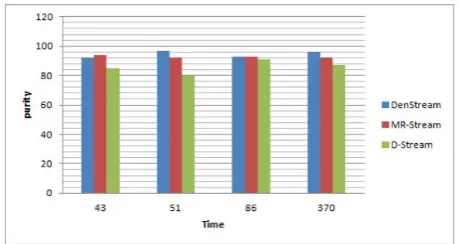
[image:2.595.313.533.86.205.2]We compared the time complexity and the clustering quality of DenStream, MR-Stream, and D-Stream algo- rithms. The results are shown in Figures 1 and 2. In terms of time complexity, D-Stream has the lowest time complexity; however, it has low quality since the clus- tering quality depends on the granularity of the lowest level of the grid structure. DenStream has a higher time complexity compared to D-Stream; however, it has a better memory usage and quality. MR-Stream has the highest time complexity and memory usage while it has
Figure 1. Data stream clustering algorithms time execution comparison.
Figure 2. Data stream clustering algorithms quality com- parison.
good quality.
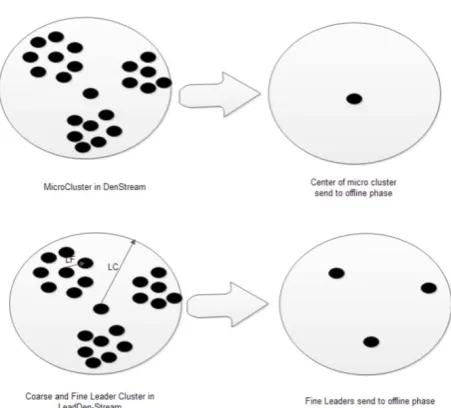
In this paper, we introduce a new algorithm which we call it LeaDenStream with good quality while its time complexity is as low as D-Stream. We introduce new concepts, which are called Mini Micro Leader Cluster and Micro Leader Cluster. We present a new method in which we have to define the granularity of Micro Leaders based on their inside data distribution (which is not con- sidered in any of the existing algorithms). For example, in Den-Stream only the center of potential micro clusters are sent to its offline phase. However, if the data points are not distributed uniformly inside the micro cluster, sending only one representative point for each micro cluster leads to less accuracy. Therefore, using Mini Mi- cro Leader Cluster keeps the quality and Micro Leader- Cluster decreases the time complexity. Figure 3 shows the Mini Micro Leader Cluster and Micro Leader Cluster in the micro cluster. The situation is compared with DenStream. We also used Mahalanobis distance instead of Euclidean distance for identifying correct cluster cen- ter, which increases the quality of clustering as well.
3. Basic Definitions
In this section, we introduce the basic definitions, which form LeaDenStream algorithm.
Definition 1. The Decaying Function:
[image:2.595.309.539.245.367.2]Figure 3. Mini micro and micro leader clusters.
defined as f(t) = 2−λt, where 0 < λ < 1. The weight of the data stream points decreases exponentially over time, i.e. the older a point gets, the less important it gets. The pa- rameter λ is used to control the importance of the histor- ical data of the stream.
Definition 2. MiniMicroLeaderCluster (MMLC): A MMLC for a group of data points pi1...pin with time
stamp at time t, Ti1...Tin, is defined as
{
1 2}
, , mm, mm, mm
CF CF W C L
• 1
1 ( )
n
j j j
CF =
∑
= f t T p− : weighted linear sum of thepoints,
• 2 2
1 ( )
n
j j j
CF =
∑
= f t T p− : weighted squared sum ofthe points,
• Wmm=
∑
nj=1f t T( − j): MMLC weight,• mm 1
mm
CF C
W
= : MMLC center,
• 2 1 2
( ) mm mm mm CF CF L W W
= − : MMLC radius
Definition 3. MicroLeaderCluster (MLC):
A MLC for a number of its mini-micro leader is de-fined as MLC = {{MMLC},Wm,Cm,Lm}
• {MMLC}: MiniMicroLeaderClusters list
• { }|
1| MMLC
m i mm
W =
∑
= W : MicroLeaqdercluster weight• { }
{
}
| | 1 | | FLC mm i m C C MMLC ==
∑
: MicroLeaderCluster Center• Lm =ε: MicroLeaderCluster radius which is equal to
DBSCAN radius threshold
Definition 4. Dense Mini Micro Leader Cluster (DM- MLC):
A MMLC with a weight more than maximum thre-
shold. λ
1 2
mm
mm mm
h
W > − =D
−
Definition 5. Sparse Mini Micro Leader Cluster (SM- MLC):
A MMLC with a weight less than maximum density
threshold. λ 1 2
mm
mm mm
k
W ≤ − =S
− hmm and kmm control the
threshold since the density cannot exceed 1 λ 1 2− − (ac- cording to Lemma 1).
Definition 6. DenseMicroLeaderCluster (DMLC): A MLC, which is in {MMLC} and is dense. DMLC = {{DMMLC}}
Definition 7. SparseMicroLeaderCluster (SMLC): A MLC, which all its mini-micro leaders are sparse. SMLC = {{SMMLC}}
Definition 8. Leader List Centers (LLcenters):
A set of centers of DMMLCs and DMLCs, which are sent to the offline phase:
LLcenters = {DMMLC}∪{ DM LC}
Definition 9. Mini Micro Leader Cluster (MMLC) Maintenance: If we have a MMLC at a time t and a point p arrives in t+1 then the statistics become
λ1λ
1 {2 . , 2 . 1}
t mm
MMLC+ = − CF +p − W +
Lemma 1. The maximum weight of the Mini Micro
Leader Cluster (MMLC) is 1 λ 1 2− −
Proof. If we assume that the data point in the data stream adds to the same Mini Micro Leader Cluster (MMLC), the weight is equal to Wmm tt2 λ( t t)
′ − − ′
=
∑
which can be converted to the following equation:
λ( t 1)
λ( t )
λ 1 2 2 1 2 t t mm t W − + ′ − − ′ − − = = −
∑
The maximum weight is defined when t → ∞, ther e-fore the maximum is defined as follows:
λ
1 1 2
maximum
mm
W = −
−
Lemma 2. The minimum time for converting DMMLC
to SMMLC and vice versa is:
( )
minλ log
mm mm
k h
t =
Proof. It is given in [17] and [24].
4. LeaDen-Stream Clustering Algorithm
Algorithm 1. LeaDen-Stream(DS, ε, Lm, Lmm).
1: Input: a data stream
2: Output: arbitrary shape clusters 3: t = 0;
4: while not end of stream do 5: Read data point x from Data Stream 6: AdjustLeaderClusters(x,Lm,Lmm); 7: if t mod tmin == 0 then
8: PuringLeaderClusters(MMLC,MLC); 9: end if
10: t=t+1; 11: end while
12: if the clustering request is arrived then 13: — Generate clusters
14: end if
Algorithm 2. Adjust leader clusters (x, Lm, Lmm).
1: Input: a data point from data stream
2: Output: list of Mini Micro Leader Clusters and Micro Leader Clus-ters {{MMLC,MLC}}
3: find the nearest MLC center Cm to x
4: if Distance(x, Cm) < lm then
5: find the nearest MMLC center Cmm to x
6: if distance(x, Cmm) < lmm then
7: Merge x to the MMLC; 8: else
9: create a new MMLC with x; 10: MMLC = MMLC∪{ x} ; 11: end if
12: else
13: create a new MLC by x; 14: MLC=MLC∪{ x} ; 15: end if
time for converting a dense mini-micro leader to a sparse, convert sparse mini-micro leader clusters to dense and vice versa. We remove the sparse mini micro and micro leader clusters in PuringLeaderClusters (Algorithm 3).
Our clustering algorithm is divided into two phases:
• Online phase: keeping Mini-Micro and Micro leader clusters
• Offline phase: generating final clusters
4.1. Keeping Mini-Micro and Micro Leader Clusters
This phase is triggered when a data point arrives from data streams. The procedure is described as follows (Al- gorithm 2, Adjust Leader Clusters):
1) We try to find the nearest micro leader cluster to the data point
2) If we find such a micro leader cluster, we try to find nearest mini-micro leader cluster to the data point.
(a) If there is such a mini-micro cluster leader then merge the data point to the nearest mini-micro cluster leader.
(b) Otherwise, form a new mini-micro cluster with x as the center of new mini-micro cluster.
3) Otherwise, there is not such micro leader cluster, form a new micro leader cluster with x as the center of
Algorithm 3. Puring leader clusters ({MMLC}, {MLC}).
1: Input: list of Mini Micro Leader Clusters and Micro Leader Clusters {MMLC},{MLC}
2: Output: List of centers {LLcenters}
3: for all {MLC} do
4: check all its mini micro leader clusters {MMLC}; 5: if all the {MMLC} are sparse then
6: delete the MLC; 7: end if;
8: if all the {MMLC} are dense then 9: add the MLC center Cm to the LLcenters
10: LLcenters = LLcenters∪{ Cm}
11: else
12: if some of {MMLC} are dense and some sparse then 13: add all the DMMLC center Cmm to the LLcenters
14: LLcenters = LLcenters∪{ Cmm}
15: Remove the SMMLCs 16: end if
17: end if 18: end for
new micro leader cluster.
Furthermore, we prune the mini-micro and micro leader clusters in the gap time in Algorithm 3, Puring Leader Clusters. In the pruning time, all the micro leader clusters and their Mini Micro Cluster Leaders are checked. Micro and mini-micro leader clusters are kept in the tree structure to make it easier for searching and updating. Based on different kinds of Mini Micro Cluster inside micro cluster different decisions are made for pruning, which are described as follows:
• All the mini-micro leader clusters are dense: micro leader cluster center is kept for the offline phase
• All the mini-micro leader clusters are sparse: mini micro leader clusters are removed as well as their mi- cro leader cluster.
• Some of mini-micro leader clusters are dense and some of them are sparse:
1) Remove the sparse mini-micro leader clusters 2) Keep the center of the dense mini-micro leader clusters for the offline phase
4.2. Generating Final Clusters
The online phase maintains micro and mini-micro leaders clusters. However, we need to use a clustering algorithm to get the final clusters. When a clustering request arrives, DBSCAN algorithm is used on the micro and mini-micro leader cluster centers to get the final results. Each mini- micro and micro leader center is used as a virtual point to be used for clustering.
5. Experimental Evaluation
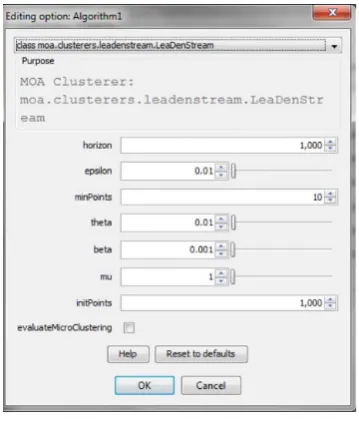
We implemented LeaDen-Stream in Massive Online Analysis (MOA)1 [30] (Figure 4). In order to evaluate the clustering quality and scalability of the LeaDen- Stream algorithm, both real and synthetic data sets are
Figure 4. LeaDenStream in MOA.
used. The synthetic data set is depicted in Figure 5. The real data set is the KDD CUP99 Network Intrusion De- tection data set (all 34 continuous attributes out of the total 42 available attributes are used). Using MOA framework, the clustering quality of LeaDen-Stream al- gorithm is evaluated and compared with CluStream and Den-Stream based on purity [31]. The efficiency is mea- sured by the execution time. The quality of LeaDen- Stream is higher than CluStream with lower execution time. The LeaDen-Stream clustering quality is equal to DenStream while it runs faster than DenStream.
6. Conclusion
In this paper, we have proposed LeaDen-Stream, an al- gorithm for density-based clustering of evolving data stream using leader clustering. The algorithm runs in two phases. The method determines data points for offline clustering based on the distribution of the data inside the micro leader clusters. If the data is uniformly distributed, it only sends the micro leaders’ centers. However, if the data is non-uniformly distributed, instead of micro leader centers their dense mini-micro leader cluster centers are kept for the offline phase. The pruning strategy is de- signed to eliminate the sparse mini-micro and micro leader clusters and to keep the dense ones for the offline phase.
Mini-micro and micro leader clusters are used in terms of increasing cluster quality and decreasing the time complexity. Using more than one representative point in cases that some of the mini-micro leader clusters are dense and some sparse, improves the quality of clustering. On the other hand, in cases that all of the mini-micro leader clusters are dense, sending only the micro leader cluster’s center is enough for the offline phase, which in
Figure 5. Synthetic data set.
turn saves the time complexity.
Experimental results on a real-world data set as well as a synthetic data validates the design goals and shows that LeaDen-Stream significantly improves over DenStream and Clustream in terms of both clustering quality and time. As a future work, we want to automate the parame- ters of LeaDen-Stream and examine our algorithm in a sliding window model.
REFERENCES
[1] J. Han, M. Kamber and J. Pei, “Data Mining: Concepts and Techniques,” 3rd Edition, Morgan Kaufmann Publi- shers Inc., San Francisco, 2011.
[2] L. OCállaghan, A. O. Meyerson, N. Mishra and S. Guha, “Streaming Data Algorithms for High-Quality Clustering,” International Conference on Data Engineering, Los Ala- mitos, IEEE Computer Society, 2002, pp. 685-694.
[3] S. Guha, A. Meyerson, N. Mishra, R. Motwani and L. O’Callaghan, “Clustering Data Streams: Theory and Prac- tice,” IEEE Transactions on Knowledge and Data Engi-neering, Vol. 15, No. 3, 2003, pp. 515-528.
[4] D. Barbará, “Requirements for Clustering Data Streams,” SIGKDD Explor. Newsl.3, 2002, pp. 23-27.
[5] C. C. Aggarwal, J. Han, J. Wang and P. S. Yu, “A Frame- work for Clustering Evolving Data Streams,” Proceed-ings of the 29th International Conference on Very Large Data Bases, VLDB Endowment, 2003, pp. 81-92.
[6] C. C. Aggarwal, “Data Streams—Models and Algorithms,” Springer, 2007.
[7] S. Guha, N. Mishra, R. Motwani and L. O’Callaghan, “Clustering Data Streams,” Proceedings of the 41st An- nual Symposium on Foundations of Computer Science, Washington DC, IEEE Computer Society, 2000, p. 359.
[8] P. Kranen, I. Assent, C. Baldauf and T. Seidl, “The Clu- stree: Indexing Micro-Clusters for Anytime Stream Min- ing,” Knowledge Information System, Vol. 29, No. 2, 2011, pp. 249-272.
[image:5.595.359.486.85.200.2]
Data, Vol. 3, No. 3, 2009, pp. 1-28.
[10] M. Ester, H. P. Kriegel, J. Sander and X. Xu, “A Density- Based Algorithm for Discovering Clusters in Large Spa-tial Databases with Noise,” Proceedings of 2nd Interna- tional Conference on Knowledge Discovery and Data Mi- ning (KDD), Portland, Oregon, AAAI Press, 1996, pp. 226-231.
[11] M. Ankerst, M. M. Breunig, H. P. Kriegel and J. Sander, “Optics: Ordering Points to Identify the Clustering Struc- ture,” SIGMOD Record, Vol. 28, 1999, pp. 49-60.
[12] A. Hinneburg and D. A. Keim, “An Efficient Approach to Clustering in Large Multimedia Databases with Noise,” KDD, 1998, pp. 58-65.
[13] A. Amini, W. Teh Ying, M. R. Saybani and S. R. Aghabo- zorgi, “A Study of Density-Grid Based Clustering Algo- rithms on Data Streams,” 8th International Conference on Fuzzy Systems and Knowledge Discovery (FSKD11), Shanghai, IEEE, 2011, pp. 1652-1656.
[14] T. Zhang, R. Ramakrishnan and M. Livny, “BIRCH: An Efficient Data Clustering Method for Very Large Data- bases,” In: J. Widom, Ed., Proceedings of the 1996 ACM SIGMOD International Conference on Management of Data, ACM Press, 1996, pp. 103-114.
[15] C. C. Aggarwal, J. Han, J. Wang and P. S. Yu, “A Frame- work for Projected Clustering of High Dimensional Data Streams,” Proceedings of the Thirtieth International Con- ference on Very Large Data Bases, Vol. 30, VLDB, 2004, pp. 852-863.
[16] C. C. Aggarwal, J. Han, J. Wang and P. S. Yu, “On High Dimensional Projected Clustering of Data Streams,” Data Mining and Knowledge Discovery, Vol. 10, 2005, pp.
251-273.
[17] F. Cao, M. Ester, W. Qian and A. Zhou, “Density-Based Clustering over an Evolving Data Stream with Noise,” SIAM Conference on Data Mining, 2006, pp. 328-339. [18] A. Forestiero, C. Pizzuti and G. Spezzano, “A Single Pass
Algorithm for Clustering Evolving Data Streams Based on Swarm Intelligence. Data Mining and Knowledge Dis- covery,” 2011.
[19] A. Amini and W. Teh Ying, “A Comparative Study of Density-Based Clustering Algorithms on Data Streams: Micro-Clustering Approaches,” In: S. I. Ao, O. Castillo and X. Huang, Eds., Intelligent Control and Innovative Computing, Vol. 110 of Lecture Notes in Electrical En- gineering, Springer, 2012, pp. 275-287.
[20] A. Amini and W. Teh Ying, “Density Micro-Clustering Algorithms on Data Streams: A Review,” International Conference on Data Mining and Applications (ICDMA), Hong Kong, 2011, pp. 410-414.
[21] P. Viswanath and R. Pinkesh, “l-dbscan: A Fast Hybrid Density Based Clustering Method,” Proceedings of the
18th International Conference on Pattern Recognition, Vol. 01, ICPR’06, Washington DC, IEEE Computer So- ciety, 2006, pp. 912-915.
[22] P. Viswanath and V. Suresh Babu, “Rough-Dbscan: A Fast Hybrid Density Based Clustering Method for Large Data Sets,” Pattern Recognition Letters, Vol. 30, No. 16, 2009, pp. 1477-1488.
[23] J. Gao, J. Li, Z. Zhang and P. N. Tan, “An Incremental Data Stream Clustering Algorithm Based on Dense Units Detection. Lecture Notes in Computer Science 3518,” 2005.
[24] Y. Chen and L. Tu, “Density-Based Clustering for Real- Time Stream Data,” Proceedings of the 13th ACM SIGKDD International Conference on Knowledge Dis-covery and Data Mining, KDD ’07, New York, ACM, 2007, pp. 133-142.
[25] A. Zhou, F. Cao, W. Qian and C. Jin, “Tracking Clusters in Evolving Data Streams over Sliding Windows,” Know- ledge and Information Systems, Vol. 15, 2008, pp. 181-
214
[26] A. Amini and W. Teh Ying, “DENGRIS-Stream: A Den- sity-Grid Based Clustering Algorithm for Evolving Data Streams over Sliding Window,” International Conference on Data Mining and Computer Engineering (ICDMCE), Bangkok, 2012, pp. 206-210.
[27] L. Tu and Y. Chen, “Stream Data Clustering Based on Grid Density and Attraction,” ACM Transactions on Know- ledge Discovery Data, Vol. 3, No. 3, 2009, pp. 1-27.
[28] A. Amini and W. Teh Ying, “On Density-Based Cluster- ing Algorithms over Evolving Data Streams: A Summa- rization Paradigm,” International Conference on Informa- tion Technology and Management Innovation (ICITMI), Guangzhou, 2012, pp. 2234-2237.
[29] W. Ng and M. Dash, “Discovery of Frequent Patterns in Transactional Data Streams,” Transactions on Large-Scale Data- and Knowledge-Centered Systems II, Vol. 6380 of Lecture Notes in Computer Science, Springer, Berlin/ Heidelberg, 2010, pp. 1-30.
[30] A. Bifet, G. Holmes, B. Pfahringer, P. Kranen, H. Kremer, T. Jansen and T. Seidl, “Moa: Massive Online Analysis, a Framework for Stream Classification and Clustering,” Journal of Machine Learning Research (JMLR), Vol. 11, 2010, pp. 44-50.
[31] Y. Zhao and G. Karypis, “Empirical and Theoretical Com- parisons of Selected Criterion Functions for Document Clustering,” Machine Learning, Vol. 55, 2004, pp. 311- 333.