http://dx.doi.org/10.4236/cn.2013.54036
Dynamic Relay Selection Method for Distributed MIMO
Relay System
Pham Thanh Hiep
Division of Physics Electrical and Computer Engineering, Graduate School of Engineering, Yokohama National University, Yokohama, Japan
Email: [email protected]
Received August 14, 2013; revised September 5, 2013; accepted September 10, 2013
Copyright © 2013 Pham Thanh Hiep. This is an open access article distributed under the Creative Commons Attribution License, which permits unrestricted use, distribution, and reproduction in any medium, provided the original work is properly cited.
ABSTRACT
The research on distributed MIMO relay system has been attracting much attention. In this paper, a decode-and-forward scheme distributed MIMO relay system is examined. For upper bound of channel capacity, the distance between trans- ceivers is optimized when the propagation loss is brought close to actuality. Additionally, the number of relay is opti- mized whether total antenna element is fixed or not. When the number of relay is assumed to be infinite, the dynamic relay selection method based on the transmission rate is proposed. We represent that with the proposed method, the transmit power and the number of relays are saving.
Keywords: Distributed MIMO Relay System; Optimizing Distance; Optimization Antenna Element; Upper Bound of Channel Capacity; Dynamic Relay Selection
1. Introduction
In the future, it is believed that the MIMO service area will become fashionable. Thus, an expansion of a ser- vice area to an isolated area is requested. Based on this idea, the authors have proposed a general idea of a MIMO relay system that can maintain the ability of high- speed and/or high-reliability data transmission [1-5]. A MIMO relay system can relay radio signals from a MIMO service area to an isolated area. In general, when a MIMO relay system has only one relay, the whole channel in the MIMO relay system is equivalent to a MIMO multi-keyhole environment. In a multi-keyhole environment, the probability density functions (PDFs) of singular values of channel response matrix or eigenval- ues of correlation matrix are important from a viewpoint of system designing such as transmission characteristic meaning channel capacity and bit error rate analysis. When the number of antennas at relay is less than that at the transmitter and the receiver, the channel capacity of MIMO relay system is smaller than the one of original MIMO system. In addition, when the number of antennas at each relay is equivalent to the one of the transmitter and the receiver, a MIMO relay system can provide the same averaged channel capacity as an original MIMO system. However in case the number of antennas of each
relay is larger than that of the transmit and the receive, the channel capacity of a MIMO relay system cannot exceed that of original MIMO system [6].
tem is analyzed and the dynamic relay selection method for conservation of transmit power is proposed.
The rest of paper is organized as follows. The system model of DMRS is explained in Section 2. Section 3 analyzes the system which has interference. The specific access control on Mac layer is described in Section 4. The end-to-end channel capacity of the outdated system is analyzed in Section 5. Finally, Section 6 concludes the paper.
2. Distributed MIMO Relay System
2.1. System Model
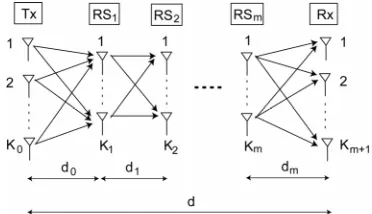
In this section, we represent obviously the DMRS with relays intervened. The structure of system is shown in Figure 1. Here Tx, Rx and i is the transmitter, the final receiver and the relay, respectively. i
m
RS
th
i K de-
notes the number of antennas and i denotes the dis- tance between each transceivers. In such system, the signal is transmitted from the Tx to the 1. After that the signal is processed and forwarded to the RS2. Similarly, the signal is transmitted over and over until to the final receiver.
d
RS
[image:2.595.330.518.83.132.2]The system parameters of each transceiver such as transceiver signal, transmit power matrix, noise vector, amplification factor of every relays are summarized in Table 1.
As expressed in Figure 2, let the channel capacity and the path loss between each transceivers is Ci and
, respectively. C denotes the channel capacity of system. Let
ii10, , i
l i m
[image:2.595.78.264.487.594.2]H denotes a channel matrix between each transceivers and Hii1 is a matrix with in-
[image:2.595.56.286.639.731.2]Figure 1. System model of distributed MIMO relay system.
Table 1. System parameters of each transceiver.
- Tx RS1 RSm Rx
Transceiver signal S0 S1 Sm Sm1
Transmit power matrix P0 P1 Pm -
Noise vector - n1 nm nm1
Amplification factor 0 1 m -
Figure 2. Channel capacity of DF scheme distributed MIMO relay system.
dependent and identically distributed (i.i.d.), zero mean, unit variance, circularly symmetric complex Gaussian entries.
Since there are several schemes for interference can- cellation by using array antenna such as linear (ZF) and nonlinear (SIC/DPC) algorithm, we assume that the interference signal from other transmitters can be ignored without loss of generality. Therefore, when the signal
1 i
S is transmitted from , the received signal at the next relay is expressed as i1
RS
1 1 ,
i ii i i i
S H S n1 (1) where i denotes an amplification factor of i. In this paper, since the decode-and-forward method is ap- plied, the amplification factor is expressed as
RS
. i Pli
i (2) Furthermore, the channel capacity is as follows,
2 1 1
SNR
log det i H , 0, , ,
i K ii ii
i
C I H H i
K
m (3)
where IKi is KiKi unit matrix. However, as described in Sect. 1, if the number of antennas at least one relay is smaller than that of other relays, this relay will be the bottleneck of system. Therefore the channel capacity of system will be decreased. In order to obtain high propagation characteristic, we assume the number of antennas at each relay to be the same. In addition,
,
1 1 ii ii 0,
H
H H i m can be assumed to be an unit matrix. Consequently, the SNR can be examined instead of channel capacity. Since the channel capacity
0, , i
C i m is independent of other ones, the chan- nel capacity of the system is expressed as
min i , with 0, , .
C C i m (4) Thus the upper bound of channel capacity of system is achieved when the channel capacity of every receivers meaning the SNR of every receivers is equivalent. There- fore, it is necessary to optimize the distance between each transceivers in order to obtain the upper bound of channel capacity of system.
2.2. Propagation Loss
propagation channel is not always a free-space propa- gation, so it is necessary to consider being attenuated by the reflection, scattering, and so on. The propagation loss in this case, namely a multi-path propagation environ- ment is expressed as
2 1 2 2 2
.
4 4 4
r r r
i
i i i
a a a
l
d d d
(5)
Here, and r denote the wavelength and the re- flection times, respectively. The reflection loss is de- fined as an amount of the attenuation by only one re- flection. However, the propagation loss of multi-path propagation environment is complex. In order to analyze the distributed MIMO relay system, the propagation loss is simplified by using only maximum receiver SNR path as
a
2 . 4
r i
i
a l
d
(6)
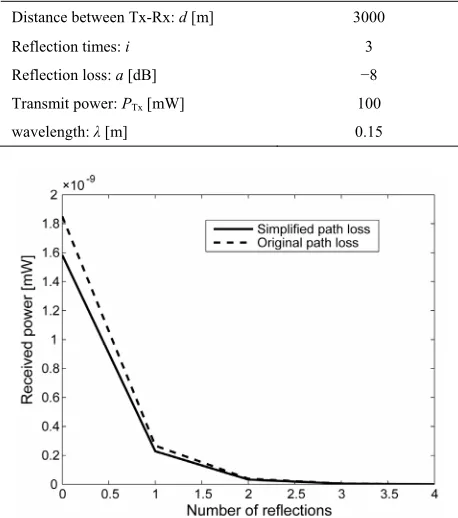
For validating the simplified loss, the parameter sum- marized in Table 2 is used to compare the original path loss to the simplified path loss.
[image:3.595.57.286.449.708.2]Figure 3 shows the received power of the original propagation loss and the simplified loss. The original path loss is approximated by the simplified path loss with the ratio of 1.16. Thus, the simplified path loss can be used instead of original path loss to analyze the DMRS.
Table 2. Parameters for validation of the simplified loss.
Distance between Tx-Rx: d [m] 3000
Reflection times: i 3
Reflection loss: a [dB] −8
Transmit power: PTx [mW] 100
wavelength: λ [m] 0.15
Figure 3. The received power of original path loss and the simplified path loss.
2.3. Propagation Environment
We consider the DMRS for several wireless networks such as 1) Extension a MIMO service area from a base station in center of city to a receiver terminal in country side, 2) Transmission a health information from monitors implanted in body to a receiver of the outside, 3) Transmission information from terminals in isolated area to the near base station. For all of these scenarios, the environment around the Tx has a lot of transmission obstacle, consequently the signal reflects many times before arriving the next relay. The number of reflections is decreased when the signal goes away from the Tx. In addition, the number of reflections is proportional to distance between each transceiver. Thus, we define the number of reflections when the signal is transmitted from the RSi to RSi1 as follows.
2 4
, i i
t
d ref
Dd
(7)
where t denotes the distance between the Tx and the 1
i
d
RS . The propagation environment coefficient is
defined as the average line of sight (LOS) distance from the Tx to the 1. Figure 4 shows the average number of reflections between each transceivers when the distance between each transceivers is changed, i.e. 250 m, 500 m, and the propagation environment coefficient is 500 m.
D
RS
D
As the result shown in Figure 4, the shorter the distance between each transceivers is and/or the farther from the Tx a relay is, the smaller the average number of reflections becomes. It means that the Equation (7) can describes correctly the propagation environment that we consider to apply this research to.
3. Upper Bound of Channel Capacity When
Total Transmit Power and Distance Are
Fixed
3.1. Optimizing Distance
We assume that the total transmit power t is fixed in spite of the change in the number of relays and the number of antennas at each relay. In order to simplify the composition of relay, the total transmit powers is equally divided into each relay. Moreover, the transmit power of each relay is equally divided into each antenna. There- fore, let
P
1, ,
i
P i m denote the transmit power of one antenna, every transmit power matrix is expressed as
1
,i
t
i i K K
P
P PI I
m K
(8)
Figure 4. Average number of reflections.
(9)
where
SNRi SNR , for j i j, and ,i j0, , , m
2SNR , with 0, , ,
1 t i i
Pl
i m m K
(10)
and 2 denotes the covariance of noise vector in each
3.2. Upper Bound of Channel Capacity
channel
ne the upper bound of channel capa- ci
small.
relay and the final receiver. By solving (9), the optimized distances are obtained. Figure 5 shows the optimized distance of each relay in case the number of relays is 5. The parameter is summarized in Table 3. As shown in Figure 5, the optimized distance between each trans- ceivers is increased when the relay goes far from the Tx. The reason can be explained that when the relay is far from the Tx, the average number of reflections become smaller, therefore, in the same channel capacity, the sig- nal can be transmitted farther.
In this section, we examine the upper bound of
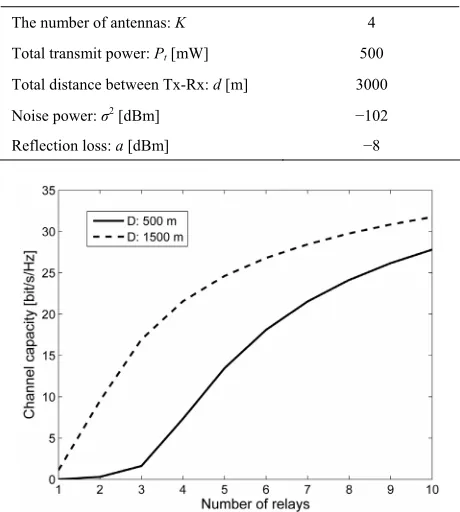
capacity in some different system models. Firstly, the propagation environment is changed. Figure 6 shows the upper bound of channel capacity when D is 500 m and 1500 m. Since the number of reflections is decreased when D is increased, the channel capacity when D is 1500 m, is larger than the one of D being 500 m. When the number of relay is increased, the distance between each transceivers is shorten, therefore the channel capa- city is increased.
Then, we exami
ty when total transmit powers is changed, i.e., 100 mW, 300 mW, 500 mW. As the channel capacity shown in Figure 7, the bigger the transmit power is, the higher the upper bound of channel capacity becomes. Therefore, in order to obtain the same channel capacity, the large num- ber of relay is requested if the total transmit power is
Figure 5. The optimized distance between each transceivers in a sense of upper bound of channel capacity.
[image:4.595.316.532.84.250.2]The number of 4
Table 3. Numerical parameters.
antennas: K
Total transmit power: P [mW] 500
d [m] 3000
−
t
Total distance between Tx-Rx:
Noise power: σ2 [dBm] 102
Reflection loss: a [dBm] −8
Figure 6. The upper bound of channel capacity when the propagation environment changes.
f Antennas When Total Number of Antennas Is Fixed
wher ber of an-
3.3. Optimizing the Number o
Up to now, we have analyzed the performance of DMRS e the number of relays as well as the num
[image:4.595.308.538.303.559.2]Figure 7. The upper bound of channel capacity when the total transmit power changes.
tween the number of relays nd the number of antennas at each relay needs to be Consequently, the relation be
a
considered. Let us assume that the total antennas is T. Since the number of antennas at every relay is assumed to be equal, the number of antennas at each relay be- comes
,
T AN
M
(11)
where M denotes the numb
number of antennas is an integral number, however, in o a
er of relays. In fact, the
order t nalyze the performance of system easily, we assume the number of antennas is a positive number. The channel capacity of each transceivers is changed as
2
log 1 i .
ref
t
MP
T a
C
2 2 (
max
4 1
i
i
M d M T
12)
The parameter is summarized in Table 3. The upper bound of channel capacity is shown in Figures 8 and 9.
re
As shown in Figure 8, there is an optimal number of relays, meaning the optimal number of antennas at each
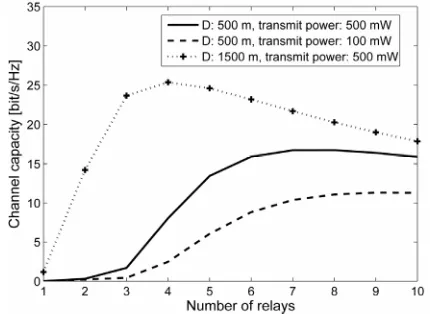
[image:5.595.318.527.84.242.2]lay in the sense of the largest channel capacity. If the number of relays is smaller than the optimal number, the distance between each transceiver is increased. As a re- sult, the channel capacity is decreased. On the other hand, if the number of relay is higher than the optimal number, the distance between each transceiver is shortened, con- sequently the SNR is increased. However the number of antennas at each relay is decreased, therefore the channel capacity is decreased. Furthermore, the optimal number of antennas is changed when the propagation environ- ment or the total transmit power is changed (Figure 9). In the same propagation environment and total transmit power, the optimal number of relays is almost the same though total number of antennas is changed.
[image:5.595.65.279.85.255.2]Figure 8. The upper bound of channel capacity when the total antennas is fixed, i.e 10, 20, and 40.
Figure 9. The upper bound of channel capacity in different channel models when total antennas is 10.
nel capacity was d. However, in
Total Distance
otal distance when d the number of
4. Maximum of Total Distance
Up to now, the upper bound of chan analyzed when the total distance is fixe
case of expansion service area, the transmit power of relay as well as the transmission rate are fixed. There- fore, the analysis of system when the transmission rate is fixed, is necessary.
4.1. Maximum of
At first, we analyze the maximum of t the transmit power of each relay an
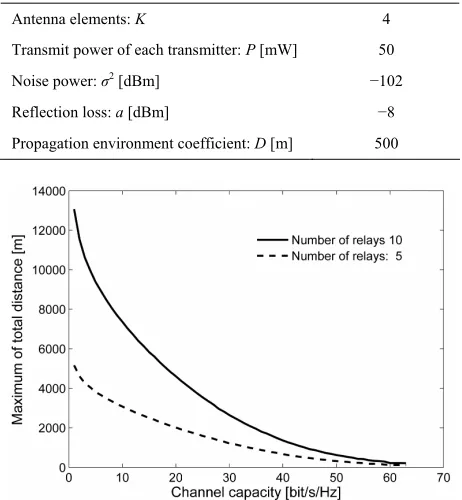
relays are fixed. In this case, the maximum of distance between each transceivers dimax must satisfies the next condition.
max
2
C
2 2
log 1 ,
4
i
ref req
i
a P K
d
(13)
[image:5.595.315.530.283.440.2]Let the number of relays is M, the maximum of total distance for each requested channel capacity becomes
max
max .
M i
d
d (1 0i
4)
The parameter is summarized
mum of total distance in case the number of relay is 5 an
ter the maximum of total di
Number of Relays
sted. The
(15)
here denotes the distance from
The rameter summarized in Table 4 is used and the ce f
ne
An
in Table 4. The maxi-
d 10, is shown in Figure 10.
For the same requested channel capacity, the smaller the number of relay is, the shor
stance becomes. In addition, the maximum of total distance is rapidly decreased when the requested channel capacity is increased.
4.2. The Necessary
In case the total distance and the channel capacity are fixed, the analysis of number of relays is reque
necessary relay number Nreq must to satisfies next equation while the maximum of distance between each transceivers follows (13).
Nreq
req
d max
0 , i i
d
req
d
pa
the Tx to the Rx.
[image:6.595.318.529.83.243.2]distan rom the Tx and the Rx is fixed at 3000 m, the cessary number of relays is shown in Figure 11. When the channel capacity is increased, the necessary number
Table 4. Parameters for maximum of total distance.
tenna elements: K 4
Transmit power of each transmitter: P [mW] 50
] −102
D [m] Noise power: σ2 [dBm
Reflection loss: a [dBm] −8
Propagation environment coefficient: 500
Figure 11. The necessary number of relays for each chan l capacity.
onsiderably increased. However, each num- er of relays can cover a range of several channel capa-
amic Relay Selection Method for
-to-peer However, in
ne
of relays is c b
cities.
5. Dyn
Conservation of Transmit Power
5.1. Dynamic Relay Selection Method The upper bound of channel capacity of peer system was analyzed in previous sections.
fact, imultiple terminals may access to the relay system via the nearest relay (Figure 12). Therefore, each relay receives the signal from not only the previous relay, but also from terminals around itself and sends the total data to the next relay or the Rx.
Let Bi1 denotes the transmission data of RSi1 and
TBi denote the total transm
d i. Therefore, the transmission data of RSi
t be Bi Bi1 TBi
ission data of the terminals aroun
mus
RS
. In this section, we assume that there are ny relays that be arranged from the Tx to the Rx and e s the distance from itself to the others as well as the propagation environment. Each relay can selects the next relay to transmit the signal. The next relay is the one that the current relay can transmit total data to. For saving the relay and the transmit power, if there are many relays that the current relay can trans- mit total data to, the farthest relay is selected. In short, the distance from the current relay to the next relay must satisfies that
ma
ach relay know
2
i
ref
i
a P B log 12 4 2.
i
K
d
(16)
This selection method is called dynam tion method.
ation of Transmit Power
The dynamic relay selection method is compared to the ic relay selec-
5.2. Conserv Figure 10. The maximum of total distance for each re-
[image:6.595.57.288.457.707.2]Figure 12. System model of dynamic relay selection method.
optimizing distance method that described in Sec. 3.1. In ase of optimizing distance method, the total transmit c
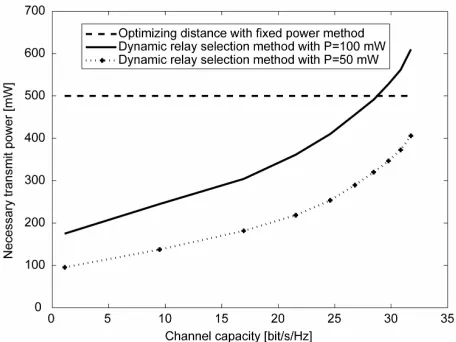
power is fixed, and the channel capacity between each transceivers is the same. On the other hand, in case of dynamic relay selection method, the transmit power of each relay is fixed, however the total transmit power is infinite, and the channel capacity between each trans- ceivers is different. We assume that the data that received at the Rx in an unit time is the same in both methods, however the transmission data of the Tx and terminals is random value. The parameter is summarized in Table 3, and the propagation environment coefficient D is assumed to be 1500 m. The DMRS transmits the signal with channel capacity that is expressed in Figure 6. Therefore the transmit power and the number of relays of opti- mizing distance method is as expressed in Figure 6. The transmit power of each relay in case of dynamic relay selection method P is assumed to be 100 mW and 50 mW. Figures 13 and 14 show the necessary transmit power and the number of relay, respectively.
When the channel capacity is low, the transmit power of dynamic relay selection method is considerably small- er than that of optimizing distance method. However when the channel capacity is increased, the transmit power of dynamic relay selection method is increased and be higher than the one of optimizing distance method as described in Figure 13. On the contrary, when the channel capacity is low, the necessary relay number of dynamic selection method is larger than that of optimiz- ing distance method. When the channel capacity is in- creased, the relay number of dynamic relay selection method is increased, however it becomes smaller than the one of optimizing distance method (Figure 14).
On the other hand, In case P = 100 mW of dynamic relay selection method, when the channel capacity is within 17 and 28 bit/s/Hz, both the necessary transmit power and the number of relays are lower than that of optimizing distance method. Similarly, in case P = 50 mW of dynamic relay selection method, when the chan- nel capacity is over 25 bit/s/Hz, both the necessary trans- mit power and the number of relays are lower than that of optimizing distance method.
[image:7.595.309.537.85.256.2]As two examples mentioned before, by adjusting the
Figure 13. The necessary transmit power in both methods, P = 50 mW and 100 mW.
Figure 14. The necessary number of relays in both methods, P = 50 mW and 100 mW.
umber of relays, the dynamic lay selection method can transmit the same channel
ecode- was examined. For upper bound of the system, the position of all relays transmit power of each relay, with lower total transmit power and the smaller n
re
capacity as the optimizing distance method.
6. Conclusions
In this paper, the performance of a DMRS with d and-forward method
channel capacity of
is paper. In the future, not only th
[1] D. Chizhik, G. J. Foschini, M. J. Gans and R. A. Valen-
zuela, “Keyho apacities of Mul-
tielement Tran nas,” IEEE
Trans-The pear-to-pear(P2P) transmission method and the multiple-users to one-user (M2P) transmission method have been considered in th
e P2P and M2P transmission method, but also multiple- user to multiple-user (M2M) transmission method will be considered. In addition, the network coding will be ap- plied to this research.
REFERENCES
les, Correlations, and C smit and Receive Anten
actions on Wireless Communications, Vol. 1, No. 2, 2002, pp. 361-368. http://dx.doi.org/10.1109/7693.994830 [2] D. Gesbert, H. Bolcskei, D. A. Gore and A. J. Paulraj,
“MIMO Wireless Channel: Capacity and Performance Prediction,” Proceedings of Global Telecommunications Conference, GLOBECOM'00, San Francisco, 27 Novem- ber-1 December 2000, pp. 1083-1088.
[3] B. Wang, J. Zhang and A. Host-Madsen, “On the Capac- ity of MIMO Relay Channel,” IEEE Transactions on In-formation Theory, Vol. 51, No. 1, 2005, pp. 29-43.
http://dx.doi.org/10.1109/TIT.2004.839487
[4] S. M. Alamouti, “A Simple Transmit Technique for Wire- less Communications,” IEEE Journal on Selected A in Communications, Vol. 16, No. 8, 1998, pp
reas
.1451-1458. http://dx.doi.org/10.1109/49.730453
[5] V. Tarokh, N. Seshadri and A. R. Calderbank, “Space- Time Codes for High Data Rate Wireless Communication: Performance Critrion and Code Constraction,” IEEE Transactions on Information Theory, Vol. 44, No. 2, 1998, pp.744-765. http://dx.doi.org/10.1109/18.661517
[6] M. Tsuruta, T. Taniguchi and Y. Karazawa, “On Statisti- cal Distribution of Eigenvalues of Channel Correlation Matrix in MIMO Multi-Keyhole Environment,” The
Communications and Network,
IEICE Transaction on Communications, Vol. E90-B, No. 9, 2007, pp. 2352-2359.
[7] P. T. Hiep, C. Sugimoto and R. Kohno, “MAC-PHY Cross-Layer for High Channel Capacity of Multiple-Hop MIMO Relay System?”