http://dx.doi.org/10.4236/jmp.2015.68107
Photon Structure Function Revisited
Christoph Berger
I. Physikalisches Institut, RWTH Aachen University, Aachen, Germany Email: [email protected]
Received 2 June 2015; accepted 7 July 2015; published 10 July 2015
Copyright © 2015 by author and Scientific Research Publishing Inc.
This work is licensed under the Creative Commons Attribution International License (CC BY). http://creativecommons.org/licenses/by/4.0/
Abstract
The flux of papers from electron positron colliders containing data on the photon structure func-tion F2
(
x Q, 2)
γ ended naturally around 2005. It is thus timely to review the theoretical basis and
confront the predictions with a summary of the experimental results. The discussion will focus on
the increase of the structure function with x (for x away from the boundaries) and its rise with
Q2
ln , both characteristics being dramatically different from hadronic structure functions. The
agreement of the experimental observations with the theoretical calculations is a striking success
of QCD. It also allows a new determination of the QCD coupling constant αS which very well
cor-responds to the values quoted in the literature.
Keywords
Structure Functions, Photon Structure, Two Photon Physics, QCD, QCD Coupling Constant
1. Historical Introduction
The notion that hadron production in inelastic electron photon scattering can be described in terms of structure functions like in electron nucleon scattering is on first sight surprising because photons are pointlike particles whereas nucleons have a radius of roughly 1 fm. Nevertheless the concept makes sense, not because the photon consists of pions, quarks, gluons etc., but because it couples to other particles and thus can fluctuate e.g. into a quark antiquark pair or a
ρ
meson. These two basic processes are distinguished by the terms pointlike andhadronic throughout the paper. The idea of a photon fluctuating into a
ρ
meson or other vector mesons was soon applied to estimate the inelastice
γ
scattering cross section in the vector meson dominance model [1] [2]. Calculating the structure function in the quark model [3] then opened the intriguing possibility to investigate experimentally a structure function rising towards large x and showing a distinctive scale breaking because of the proportionality to 2lnQ .
calculated the markedly different x dependence of the structure function in QCD but demonstrated that the QCD parameter
Λ
could in principle be determined by measuring an absolute cross section quite in contrast to lepton nucleon scattering, where small scale breaking effects in the 2Q evolution of the structure function have to be studied. This “remarkable result” [5] initiated intensive discussions between theorists and experimentalists and passed the first experimental test [6] with flying colors. QCD calculations at next to leading order [7] [8]
allowed to give
Λ
a precise meaning in the MS renormalization scheme, but also revealed a sickness of the absolute perturbative calculation, producing negative values of F2γ nearx
=
0
.In an invited talk at the 1983 Aachen conference on photon photon collisions [9], the audience was warned that the implications of these discoveries for the experimental goal of a direct determination of
Λ
from F2γwere not altogether positive despite “the almost incredible advances on the experimental side”. Instead it was recommended to utilize the 2
Q evolution like in deep inelastic scattering, a program which was also pursued by other groups [10].
Ten years later an algebraic error in the original calculation [7] was discovered. Correcting this error [11] [12]
squeezed the negative spike near
x
=
0
to very small x values where it is of negligible practical importance. For the same reason ad hoc attempts [13] to cure the problem (although still in principle important) proved to be unnecessary for experimental analyses at NLO accuracy.A new approach to follow the original goal [14] showed promising results. However, based on the results of
[15] [16] the structure function for virtual photons was calculated [17] in next-to-next-to-leading-order (NNLO). The findings of this investigation forces one to the conclusion that an absolute prediction for the structure function of real photons is unstable at the three loop level. The concern of the 1980’s is thus still valid, albeit at a higher order in the perturbative series.
2. Basics
Deep-inelastic electron-photon scattering at high energies
hadrons,
e−+ →γ e−+ (1)
is characterized by a large momentum transfer Q of the scattered electron and a large invariant mass W of the hadrons. The electron energies E1 and E1′ in initial and final state combined with the scattering angle θ1 define the (negative) momentum transfer squared, 2
Q
− , on the electron line with
2 2
1 1 1
4 sin 2.
Q = E E′ θ (2)
2
Q and the Bjorken scaling variable x defined as
2
2 2,
Q x
Q W
=
+ (3)
are the essential variables for discussing the dynamics of the scattering process as can be seen from the cross section formula corresponding toFigure 1
(
)
(
)
2 2
2 2
2
2 4
d 2π
1 1
dQ dx xQ y F y FL
γ γ
σ = α + − −
(4)
which depends on the two structure functions F2
(
x Q, 2)
γ
and FL
(
x Q, 2)
γ
. Here F2γ is a linear combination
2 2 T L
Fγ = x Fγ +Fγ of FT
(
x Q, 2)
γ
, describing the exchange of transversely polarized virtual photons, and
(
2)
, LFγ x Q , associated with the exchange of longitudinally polarized virtual photons. The scaling variable y
used in the last equation is given by
2
Q y
xs
= (5)
(with s=4EEγ) and can also be directly calculated from E E1, 1′ and θ1 via 2
1 1 1
= 1 cos 2.
y −E E′ θ (6)
1025
Figure 1. Electron-photon scattering [generic Feynman diagram]. The incoming target photon γ splits into a nearly collinear quark-antiquark pair. In QCD, the momentum of the internal quark line is reduced by gluon radiation. The impinging electron is scattered off the quark to large angles, the scatter pattern revealing the internal quark structure of the photon. Quark, anti-
quark and gluons finally fragment to hadrons.
direction of the incoming photon and the other is scattered at large angels (balancing the transverse momentum of the outgoing electron) the structure function F2γ has been calculated [11] [18] to be
(
2)
(
2)
(
2)
2,QED 1 2
1
, , ln ,
π 1
Fγ x Q α x h x Q β h x Q
β
+
= +
−
(7)
with 2 2
(
)
21 4M x 1 x Q
β
= − − and M denoting the muon mass. The functions h x Q1(
, 2)
and h2(
x Q, 2)
are given by(
)
2(
)
2 42 2
1 2 4
4 8
1 1 3 M M
h x x x x x
Q Q
= + − + − − (8)
(
)
(
)
22 2
4
8 1 1 1 M .
h x x x x Q
β
= − − − −
(9)
For heavy quarks with three colors, fractional charge eq and masses
M
Λ
the right hand side of Equation(7) has to be multiplied by
3
e
4q. Light quarks have current masses withM
Λ
(or at leastM
< Λ
). Neglecting all terms ∼M2 Q2 in Equations (8), (9) and respecting β2→1 leads for each light quark to the expression(
2)
4 2(
)
2 2(
)
(
)
2 2
0 1 3
, 1 ln 8 1 1
π q
Q x
F x Q e x x x x x
xm
γ = α + − − + − −
(10)
where m0 ≈0.3 GeV is a mass parameter somehow describing the confinement of the light quarks [3]. The QCD parameter
Λ
can be interpreted as an inverse confinement radius. We therefore replace m0 byΛ
and keep in the leading log approximation only terms proportional to 2lnQ resulting in
(
2)
4 2(
)
2 22 2
, , 3
, 1 ln
π q
q u d s
Q
Fγ x Q α e x x x
=
=
∑
+ − Λ (11)as the quark model or zero order QCD expression1 for the photon structure function if only light quarks are considered.
Using the general quark model relation
(
2)
2(
2)
2 , 2 q ,
q
Fγ x Q = x
∑
e qγ x Q (12)connecting structure function and quark densities qγ one obtains for light quarks the expression
(
2)
2( )
2QM 2
3
, ln
2π q
Q qγ x Q = αe h x
Λ (13)
1A solution which formally requires very high 2
with
( )
2(
)
2QM 1 .
h x =x + −x (14)
The factor 2 in Equation (12) accounts for the fact that the photon contains quarks and antiquarks with equal densities but the sum runs over quarks only.
3. QCD Predictions
3.1. Introduction, Leading Order Calculations
The first QCD analysis of the photon structure function [4] based on the operator product expansion (OPE) gave a unified picture of the hadronic and pointlike pieces including gluon radiation in leading order. It was shown that the x and 2
Q dependence of F2γ is unambiguously calculable for asymptotically high values of 2
Q . Due to the 1αS term in front of the pointlike piece this in turn allows for a determination of the strong coupling
constant by measuring an absolute cross section. This unique result was later confirmed by calculations using a diagrammatic ansatz [5] and/or solving the Altarelli-Parisi equations [19] [20] like in deep inelastic lepton nucleon scattering (DIS). A modern comprehensive summary of the theoretical foundations has been given by Buras [21]. In this paper we refer to [11], where the 2
Q evolution equations for massless quarks (and gluons) are solved in the Mellin n-moment space in leading logarithmic order (LO) and next to leading logarithmic order (NLO).
The nth Mellin moment of a function f x Q
(
, 2)
is defined as( )
2 1 1(
2)
0 , d .
n n
f Q =
∫
x − f x Q x (15) For example, the quark model function hQM( )
x in Equation (14) is projected to(
)(
)
2
QM
2 .
1 2
n n n
h
n n n
+ + =
+ + (16)
Like in DIS the quark densities are grouped into two classes described by different evolution equations, flavor non-singlet ( NS) and singlet (Σ):
(
2 2)
(
)
NS q
q
qγ =
∑
e − e qγ +qγ(
)
,q
q q
γ γ γ
Σ =
∑
+ (17)where Σγ is the first element of a two component singlet parton density qSγ, composed of Σγ and the gluon density Gγ. Here e2 is the average charge squared in a system with f quark flavors, e.g. e2 =2 9 for
3
f = . The connection between structure function and quark densities is in LO defined by
(
2)
(
(
2)
2(
2)
)
2 , NS , ,
Fγ x Q =x qγ x Q + e Σγ x Q (18)
analogous but not identical to the convention defined by Equation (12). Because of the factor x in Equation (18) the moments of the structure function are related to the moments of the quark densities by
(
)
( )
( )
1 2 , 2 2 , 2
2 NS
1
, d
n n n
x F x Q x q Q e Q x
γ γ γ
− = + Σ
∫
(19)or F2γ,m =qNSγ,n+ e2 Σγ,n with
m
= −
n
1
.We start with a discussion of the LO result for the pointlike qPL, NSγ,n
( )
Q2 , which is given by( )
( ) ( )
, 2 2
PL, NS 2 NS
4π
n n
S
q Q a Q
Q
γ
α
= (20)
with
2 2
0 1
4π ln
S
Q α
β
=
and β = −0 11 2f 3. The finding of [11] for NSn
a can be written as
( )
2(
1( )
2)
NS NS
0
1 1
2π 1
n NS d n n n NS
a Q k L Q
d α
β +
= −
+ (22)
with
(
4 2 2)
NS 3 2 QM,
n n
k = f e − e h (23)
(
)
1 0
4 1 2
4 3 3 1 n n n NS qq j d d
j n n
β =
= = − −
+
∑
(24)and L Q
( )
2 =α
S( ) ( )
Q2α
S Q02 giving the ratio of the strong coupling constant at Q2 and the starting point 20
Q of the evolution. In these equations the effect of gluon radiation on the quark model prediction is cast into a simple form. The quark model term kNSn in Equation (22) is multiplied by a factor accounting for the quark
quark splitting in the
q
→
qg
process. The last term in Equation (22) gives a precise meaning to the so called asymptotic solution: aNSn becomes independent of Q2 and 20
Q in the limit L→0 i.e. for Q2→ ∞. Similar (albeit more complicated) relations hold for ΣγPL,n
( )
Q2 :( )
( ) ( )
( ) ( ) ( )
(
)
, 2 2 2 2
PL 2 2
4π 4π
n n n n
S S
Q a Q a Q a Q
Q Q
γ
α
Σα
+ −Σ = = + (25)
with
( )
2(
1( )
2)
0 1 1 2π 1 n n n qq d n n
q n n n
d d
a Q k L Q
d d d
α
β
± + ± ± ± − = − − + (26) and 2 QM 3 2 n n qk = f e h (27)
(
)
21
4 .
2
n n n n n n n
qq gg qq gg qg gq
d± = d +d ± d −d − d d
(28)
The dependence of aNSn and Σγ,n on the parameter 2 0
Q is not expressed explicitly on the left hand side of Equation (22) and Equation (26). The most important consequence of this dependence is the vanishing of the parton densities at the starting scale because L = 1 at 2 2
0
Q =Q . All splitting terms n
rr
d ′ required for the evaluation of equations (22) and (26) can be derived from the splitting function moments Prr( )0′n in [11] (and reference [22] quoted therein) using n 4 ( )0n 0
rr rr
d ′= − P′
β
. Equ-ation (24) above may serve as a check of the normalization used in this paper. The asymptotic solution
(
L=0)
for aΣn( )
Q2 can be cast into the compact form [25], 0 1 2π 1 n gg n n
as q n
PP d a k d α β Σ + =
+ (29)
with
.
n n n n n n n
PP qq gg qq gg qg gq
d =d +d +d d −d d (30)
A very useful combination of the results obtained so far is given by
(
)
( )
(
1( )
)
2 2 2
2,PL 2
4π
, d 1
1 n i n d n i n i i S A
x F x Q x L Q d Q γ
α
+ − = − +∑
∫
(31)where i=NS, ,+ − and
NS 0 2π
n n
NS
A α k
β
2 0 . 2π n n qq n n
q n n
d d A k e
d d
α
β
± ± − = − (33)Setting L=0 and all n 0
rr
d ′= with r r, ′∈q g, the quark model result
( )
2, 2 4
2,QM QM 2
3 ln π m n q Q Fγ Q = α f e h
Λ (34)
with
m
= −
n
1
is retained. The splitting functions nrr
d ′ (or anomalous dimensions as they are often called following the OPE method) are not restricted to integer n values. For example, the harmonic sum
∑
1n( )
1 j in Equation (24) can be inter- polated with the help of the Digamma function Ψ( )
n . There are more complicated harmonic sums contained in the other nrr
d ′ functions and it is even necessary to continue all n dependent functions in equations (22) and (26) into the complex plane in order to invoke the standard method of inverting the Mellin moments by evaluating the integral
(
2)
(
2)
12 , 2 , d
c i m
c i
Fγ x Q =
∫
− ∞+ ∞Fγ m Q x− m (35) where m is now a continuous complex variable and the contour c has to lie on the right hand side of the rightmost singularity in F2γ(
m Q, 2)
.In practice, instead of inverting aNSn
( )
Q2 and aΣn( )
Q2 the linear combinations( )
2 4( )
2val 4 2 2 NS
1
m e n
a Q a Q
e e
α
= − (36)( )
2 2( )
2 2 2( )
2sea 4 2 2 NS
1
m n e n
a Q e a Q a Q e e α Σ = − −
were chosen because the shape of the corresponding valence and sea distributions in x-space is quite different. The pointlike LO solution in x-space is then given by
(
2)
( )
(
2)
(
2)
2,PL 2 val sea
1 4π
, , , .
S
F x Q a x Q a x Q Q
γ
α
=α
+ (37)We focus on the asymptotic solution
(
L=0)
, where aval and asea do not depend on 2Q and 2
0
Q . It was found advantageously to follow the inversion method outlined in [8], because it quickly leads to analytical ex-
pressions for F2γ
(
x Q, 2)
which can be further used in fitting the data. Using the ansatz(
)
4 01 i
i i
xδ −x β
∑
=c x for aval( )
x and asea( )
x the coefficients δ β, ,ci were determined by fitting the moments of these modelfunctions to valm
a and seam
a with
m
= −
n
1
respectively. The method can easiliy be extended to nonasymptotic solutions by repeating this procedure for any given pair of 2Q and 2
0
Q .
The results of both inversion methods agree very well, which is demonstrated inFigure 2, where aval
( )
xand asea
( )
x for f =3 andL
=
0
have been plotted. The lines were obtained using functions modeling the moments, whereas the points were calculated by numerically evaluating the integral (35) in the complex plane[24].
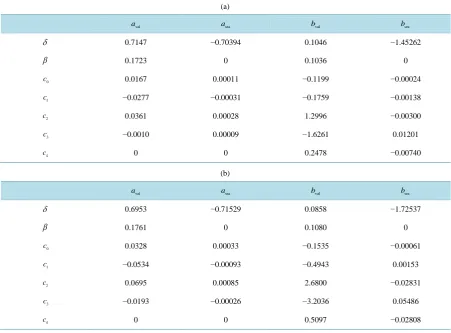
The coefficients necessary for calculating the asymptotic functions aval
( )
x and asea( )
x are listed inTable 1(a) for f =3 andTable 1(b) for f =4. Note that conventional factors connecting structure functions and quark densities like in Equations (12), (18) have been absorbed in aval( )
x and asea( )
x .Obviously the LO QCD calculation (37) preserves the 2
lnQ behavior of the quark model but changes the x
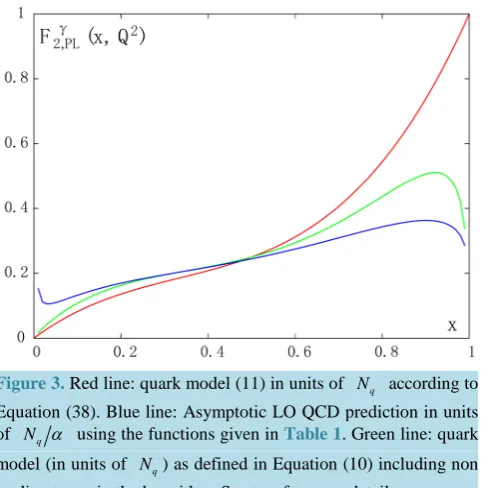
dependence significantly. This is demonstrated inFigure 3 where xhQM
( )
x i.e. the quark model result (11) in units of 2 4 2 , , 3 ln π q qq u d s
Q
N α e
=
=
Λ
Figure 2. Asymptotic pointlike solutions for f = 3. Upper curve
( )
val
a x , lower curve asea
( )
x . Both curves are calculated with thefitting method described in the text. In addition the crosses and boxes represent the numerical evaluation of the integral (35) in the complex plane.
Table 1. Coefficients needed to calculate the pointlike asymptotic contribution to F2γ according to equations (37) and (41) for (a) 3 flavors (left table) and (b) 4 flavors (right table). See text for further details. Each function (aval
( )
x etc.) is givenby the sum
(
1)
40 ii i
xδ −x β
∑
=c x . Only the first 2 columns of each table are needed for the LO result.(a)
val
a asea bval bsea
δ 0.7147 −0.70394 0.1046 −1.45262
β 0.1723 0 0.1036 0
0
c 0.0167 0.00011 −0.1199 −0.00024
1
c −0.0277 −0.00031 −0.1759 −0.00138
2
c 0.0361 0.00028 1.2996 −0.00300
3
c −0.0010 0.00009 −1.6261 0.01201
4
c 0 0 0.2478 −0.00740
(b)
val
a asea bval bsea
δ 0.6953 −0.71529 0.0858 −1.72537
β 0.1761 0 0.1080 0
0
c 0.0328 0.00033 −0.1535 −0.00061
1
c −0.0534 −0.00093 −0.4943 0.00153
2
c 0.0695 0.00085 2.6800 −0.02831
3
c −0.0193 −0.00026 −3.2036 0.05486
4
[image:7.595.87.539.392.725.2]Figure 3. Red line: quark model (11) in units of Nq according to Equation (38). Blue line: Asymptotic LO QCD prediction in units of Nq α using the functions given in Table 1. Green line: quark model (in units of Nq) as defined in Equation (10) including non leading terms in the logarithm. See text for more details.
is compared to the evaluation of Equation (37) in units of Nq
α
.The fact that the lnQ2 behavior of the quark model is preserved, is a consequence of the delicate balance between the increase of the quark population within the photon by the source term γ →qq and the depletion by gluon radiation
q
→
qg
which however is damped by the decreasing coupling due to asymptotic freedom. Would the coupling be fixed at a non-zero value [23], then the gluon radiation would be so strong that asymptotically the parton densities would fall off to zero as a power for any finite valuex
>
0
. Thus, the lnQ2 rise of the photon structure function is an exciting consequence of asymptotic freedom in QCD. For the same reason, the quark population is depleted at large x by gluon radiation, and the quarks accumulate at small x. As a result, the photon structure function is strongly tilted—a remarkable prediction of perturbative QCD.To complete the picture,Figure 3 also contains a QED like variant of the quarkmodel (10) with a log factor
2 2
0
lnW m instead of lnQ2 Λ2. With
W
2=
Q
2(
1
−
x x
)
the curve was calculated for Q2=100 GeV2 and
0 0.3 GeV
m = and then divided by Nq using
Λ =
0.3
. The curve is closer to the QCD prediction dependingon the new parameter m0.
Finally a careful inspection of the LO QCD result in Figure 3 reveals a small upward kink beginning at
0.02
x≈ , because asea increases ∼x−0.7 for x→0. This divergence can be traced back to a pole of an
− (26)
when dn
− approaches
−
1
for n<2. These poles which plague the asymptotic perturbative calculations neednot concern us as long as they are confined to very small values of x. The full solution has no poles because for
any finite value of L the quotient
(
1)
(
)
1 L+d−n 1 dn−
− + in Equation (26) remains finite for dn 1
− → − .
3.2. Next to Leading Order Calculations
In next to leading order the moments of the parton densities are changed, for example Equation (20) reads now
( )
( )
( )
, 2 2 2
pl, NS NS NS
4π
.
n n n
S
qγ Q a Q b Q
α
= + (39)
All NLO effects are contained in NS
( )
2n
b Q thus NS
( )
2n
structure function in the MS scheme are again all contained in [11] and [22]. The results can be nicely cast into the form of Equation (31)
(
)
(
)
(
)
(
)
1
2 2
2,PL
1
4π
, d 1 1
1 1 1
n n
i i
n i
n n
d d
n i i
n n
i i
S i i
n
d n
i n
i i
A B
x F x Q x L L
d d
C
L D d
γ
α +
−
+
= − + −
+
+ − +
+
∑
∑
∫
∑
(40)
containing all NLO contributions in the last three terms on the right hand side.
For the numerical evaluation we prefer again to regroup all terms according to the valence and sea scheme. After inverting the moments the final equation describing the pointlike solution
(
2)
( )
( )
( )
( )
( )
2,PL 2 val sea val sea
1 4π
,
S
F x Q a x a x b x b x Q
γ
α
=α
+ + + (41)is obtained. The strong coupling constant now has to be evaluated in NLO
(
)
2 2
1
2 2 3 2
2 2
0 0
1 ln ln
4π ln ln
S Q
Q Q
α β
β β
Λ
= −
Λ Λ (42)
with β =1 102 38− f 3. For the asymptotic solution the functions aval
( )
x , asea( )
x , bval( )
x , bsea( )
x can be calculated in a good approximation with the help of Table 1(a),Table 1(b) for f =3, 4. BecauseF
2,PLγ andS
α are defined including non leading terms, Equation (41) constitutes in the asymptotic regime
(
L=0)
an unambiguous QCD prediction depending on one parameter( )
Λ only.Like in the LO case the structure of Equation (41) does not change if non asymptotic solutions are considered. One has then, however, for each pair of 2 2
0 ,
Q Q -values first to go through the procedure of calculating and inverting the moments including now explicitly Q2 dependent factors like in Equation (22).
Due to the negative correction bval
( )
x +bsea( )
x atx
→
1
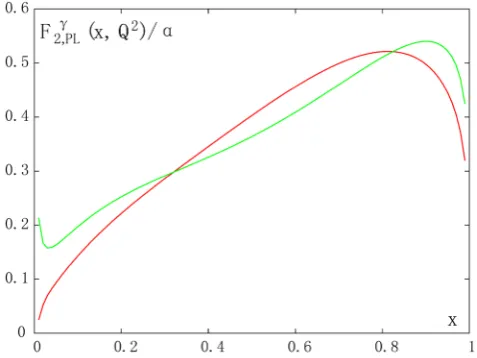
the region of high x values is further depleted in NLO as can be seen in Figure 4 where the asymptotic LO and NLO results are compared for f =3 and2 100 GeV2
Q = with Λ =300 MeV. At low x values the NLO correction is also negative and would for
0.01
x
<
due to the divergence of bsea( )
x even lead to a negative unphysical structure function. This time the divergence is caused by dn 0− = for
n
=
2
leading to a pole in B−n d−n which for the asymptotic solution isnot compensated by the factor
(
1−Ld−n)
in (40). The resulting spike is confined to very small x-values but is nevertheless of principal importance because it does not allow the calculation of a sum rule for F2,PLγ(
x Q, 2)
at0
[image:9.595.194.433.504.683.2]L
=
.Figure 4. Comparison of the asymptotic pointlike structure func- tion in units of α at leading (green curve) and next to leading order
(red curve) QCD for 2 2
100 GeV
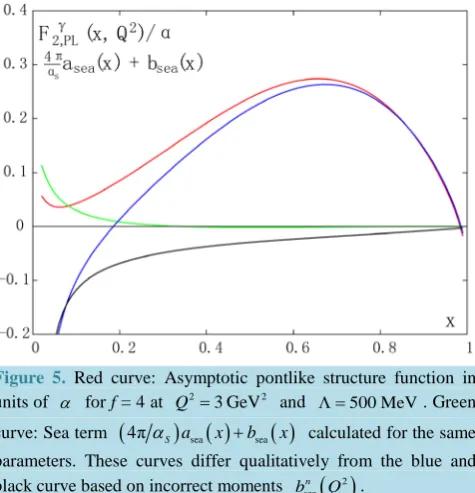
A further example is studied in Figure 5 choosing f =4 at 2 2 3 GeV
Q = and Λ =500 MeV.
F
2,PLγ is positive in the whole domain considered (red curve) with a positive sea term(
4παS)
asea( )
x +bsea( )
x given by the green curve. Due to an unfortunate algebraic error [7] the moments bsean( )
Q2 used in all papers up to 1992 were not correct and resulted in a strongly negative sea term (black curve inFigure 5) which in turn led to a negative pointlike structure function already forx
<
0.2
[8]i.e. much earlier than in the example ofFigure 4. It is not surprising that this finding caused a lot of concern in the literature.3.3. Master Formula and the Problem of Singularities
As already shown by Witten [4] the moments of the photon structrure function contain besides the pointlike
piece an additional term which in lowest order is written as din n
( )
02i iL H Q
∑
showing the characteristic hadronic2
Q dependence. The functions
( )
02n i
H Q can, however, not be calculated perturbatively. Adding the pointlike and hadronic pieces the resulting formula
(
)
(
)
(
)
(
)
2 2
2
1
1
, d 4π
1 1
1 1
1
n n
i i
n n
i i
n
n
d d
n i
i n
i S i i
n n
d d n
i i
n n
i i i i
x F x Q x A
H L L
d
B C
L L D
d d
γ
α
−
+
+
= + −
+
+ − + − +
+
∫
∑
∑
∑
∑
(43)
determines the moments of the structure function for 2 2 0
Q >Q . The functions
( )
02n i
H Q are either calculated from a fit to a structure function measured at some low input scale 2 2
0
Q =Q or taken from hadronic models like vector meson dominance (VMD) with an input scale around 0.5 GeV2 (see next section). In any case (43) is free of singularities but with 2 2
0
Q Λ the sensitivity to
Λ
is much reduced. In order to obtain an equation containing an absolute prediction which is sensitive to the QCD scale parameter one has to setL
=
0
in the pointlike part above. Instead of simply doing this by hand we investigate the conditions which allow this procedure.The pointlike terms can be rewritten as
Figure 5. Red curve: Asymptotic pontlike structure function in
units of α for f = 4 at 2 2
3 GeV
Q = and Λ =500 MeV. Green
curve: Sea term
(
4παS) ( )
asea x +bsea( )
x calculated for the sameparameters. These curves differ qualitatively from the blue and black curve based on incorrect moments
( )
2sea n
[image:10.595.195.433.464.711.2]( )
( )
( )
( )
( )
( )
( )
2 , 2 2,PL 2 2 2 2 2 0 4π 4π 1 1 4π 4π 1 1 n n i in n n
S
m i i i n
n n n
i i i i i i
S
n n n
S d d
i i i
n n n
i i i i i i
S
Q
A C B
F Q D
d d d
Q
Q
A C B
L Q L Q
d d d
Q γ α α α α = + + + + + − + − + +
∑
∑
∑
∑
∑
∑
(44)The terms proportional to n i
A and n i
B in the second row showing the typical hadronic Q2 dependence can
be combined with the first term in (43) into a new hadronic contribution din n
i iL H
∑
. The singularities connected with the Ci term are damped by a factor αS 4π but can alo be systematically absorbed into the originalhigher order (h.o.) hadronic terms. We thus find
( )
(
( ) ( )
)
( )
, 2 2 2
2 0 2
4π
h.o. .
1 1
n i
n n n
d
m n i i i n
i n n n
i S i i i i i i
A B C
F Q H Q L Q D
d d d Q
γ
α
= + + + + +
+ +
∑
∑
∑
∑
(45)In this sum of hadronic terms and the asymptotic solution
F
2,PLγ,m(
L
=
0
)
the new hadronic piece contains divergencies which exactly cancel the divergencies of the asymptotic solution [9] [26]. The basic assumption for comparison with data is then to identify the new hadronic piece for large enough x-values (sayx
>
0.1
) with the VMD parameterization of section 3.4, which is certainly only justified if the spikes are confined to very small x.We have shown this assumption to be valid for the LO and the NLO calculations. However in NNLO a completely different situation is to be faced. The most dangerous singularities originate now from NNLO terms
(
1)
i n
n =Gi −di
which have to be added on the right hand side of (45). As an example we study the behaviour
of n
d− which for f =3 approaches 1 for n = 6.0445. In the vicinity of the pole at n=n0 we write
0
n c
n n − ≈ −
(46)
which leads in x-space to a divergent term ∼c x5.0445. The coefficient c can be estimated from table II of [17].
Using 6 4007
− = −
we get
c
≈
178
resulting after multiplication with αS 4π in a contribution 52 3
Fγ x
∆ ≈ to the structure function at small x. This huge singularity is obviously not confined to small
x-values and makes (together with additional singularities) the prediction of the asymptotic F2,PL
(
x Q, 2)
γ
un- reliable.
The principal problem of the poles of 1 1
(
+din)
, 1n i
d and 1 1
(
−din)
in the LO, NLO and NNLO eva-luation of
F
2,PLγ,m(
L
=
0
)
is known since long [27]. But only after the necessary explicit three loop QCD calculations had been performed [15] [16] [28] it became clear that the residues of the NNLO-poles are not small enough to avoid a contamination of the large x-region. Consequently only the full pointlike solution(
2)
2,PL ,
Fγ x Q (starting at 2 2
0 1 GeV
Q = ) has been calculated beyond the next to leading order [28].
3.4. Modelling the Hadroncic Piece of
F
2γThe coupling of the photon to the final-state hadrons is mediated by quarks and antiquarks. If the transverse momentum k⊥ in the splitting process γ →qq is small, quark and antiquark travel for a large distance
2
s k
τ = ⊥ almost parallel with the same velocity so that strong interactions can develop and bound states form eventually. Associating a light vector meson with this hadronic quantum fluctuation, the corresponding com- ponent of the photon wave-function is described by
π 2 1 1
2 ,
3 uu 3 dd 3 ss
ρ α γ γ = − −
(47)
which is identical to the vector meson dominance (VMD) ansatz describing the hadronic nature of the photon
π π π
ρ ω φ
α α α
γ ρ ω φ
γ γ γ
= + + (48)
the measured couplings
γ γ γ
ρ, ω, φ as determined from the partial decay width Ve e+ −
Γ and utilizing isospin invariance [30]
F
2,hadγ has been tied to the well known pionic quark densities which are available in an easy to use parameterization [30].The result for
F
2,hadγα
is shown in Figure 6 for 2 210,100, 400 GeV
Q = . Above
x
=
0.1
there is littlevariation with Q2 whereas below
x
=
0.1
the sharp increase already indicates a tendency to cancel negative spikes in F2,PL(
x Q, 2)
γ
. It is interesting to see, how close a simple straight line
F
2,hadγα =
0.19 1
(
−
x
)
approaches the results of the complicated evolution model at
x
≥
0.1
. Straight line models of this sort have been used in the early experimental papers [31].4. Two Photon Kinematics
Experiments measuring the photon structure function have until now only been performed at e e+ − storage rings. The reaction
hadrons
e++e− →e++e−+ (49)
[image:12.595.195.433.296.489.2]is dominated by the so called two photon diagram shown inFigure 7 which also includes some kinematical definitions. Originally these reactions have been considered only as a background to e e+ − annihilation
Figure 6.Shown is the x dependence of F2,hadγ α according to [29]
for 2 2
10,100, 400 GeV
Q = (green, red and blue curves) in com-
[image:12.595.193.432.534.705.2]parison with the traditional straight line (black) ansatz 0.19 1
(
−x)
.(
e e+ −→hadrons)
but became, due to the absence of high energetic real photon beams, the only source of direct experimental information about F2(
x Q, 2)
γ
.
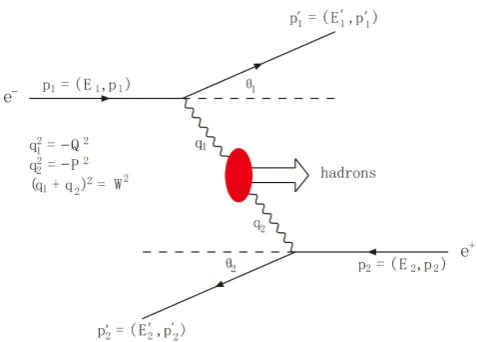
The incoming leptons inFigure 7 radiate virtual photons with four momenta q q1, 2 producing a hadronic system X with an invariant mass W=
(
q1+q2)
2 The sixfold differential cross section6
1 2
dσ d dp p′ ′ is given
by a complicated combination of kinematical factors and six in principle unknown hadronic functions (four cross sections and two interference terms) depending on W2,Q P2, 2. The general formalism has been discussed in great detail in [18], for a recent review and extension see [32]. The paper of Budnev et al. [18] served as the basis of all experimental analyses.
In the limit 2
0
P → which is realized by very small forward scattering angles of one of the incoming leptons (e.g. the positron) the relevant formulae are greatly simplified and the cross section reads
(
)
2
/
1 1
d
d
d dE t TT LT fγe z
σ = Γ σ +εσ
′
Ω (50)
with
(
)
2 12 2
1 1 2π
t
y E
y Q
α
′ + −Γ = (51)
( )
(
)
(
)
22 1 1 1
y y
y
ε
= −+ − (52)
and
(
)
(
)
2(
)
/ 2,max 2,max
1
, 1 1 ln 1
π
e
E z
f z z z
z mz
γ
α
θ = + − − θ − −
(53)
where the definition z=
(
E2−E2′)
E2 has been used.The two photon cross sections σTT and σLT depend on Q2 and 2
W . The indices represent the
transverse (T) and longitudinal (L) polarization of the virtual photons. The physical interpretation of these equations is like follows: the incoming positron is replaced by a beam of quasi real photons with transverse polarization traveling along the positron direction. The number of photons in the energy interval dz is given by
/ed
fγ z. The term Γ Ωtd 1dE1′ denotes the number of transversely polarized photons radiated from the electron
scattered into the solid angle and energy interval dΩ1dE1′ at angles θ1θ2. With the help of the polarization parameter ε the number of longitudinal photons is given by εΓt. A very useful feature of this formalism is the factorization of the flux factors into Γ ⋅t fγ/e and
ε
Γ ⋅t fγ/e where Γt and ε depend on electron variables and fγ/e on positron variables only. This allows for a considerable simplification calculating the photon fluxes in Monte Carlo routines simulating the experiments. It has been shown [33] that for θ <2 20mrad the numerical difference in evaluating the incoming photon densities from this approach or from the exact formula [18] is less than 0.5% for W 2E>0.05.
Replacing the cross sections σ σTT, LT by the structure functions
(
2)
2(
)
2 , 4π 2 TT LT
Q
Fγ x Q σ σ
α
= + (54)
(
)
22
2
,
4π
L LT
Q Fγ x Q σ
α =
we arrive after a change of variables at
(
)
(
)
3 2
2 2
2 /
2 4
d 2π
1 1
dQ d dx z xQ y F y FL f e
γ γ
γ
σ = α + − −
(55)
quark model and QCD predict F2γ to be the leading component.
The standard expression (53) has first been derived by Kessler [34]. In the spirit of the leading log appro- ximation it can be replaced by
(
)
(
)
2/ , 2,max 1 1 ln
π e
E
f z z
z m
γ
α
θ = + − (56)
useful for rough estimates of the counting rate. One has, however, to keep in mind that neglecting the cutoff
2,max
θ
has not only numerical consequences, but quickly violates the basic assumption P2 ≈0. It is difficult to quote unambiguous limits for the maximum allowed mean P2 values. Detailed calculation ofµ
pair production [35] revealed that for E=45 GeV andθ
2,max =27 mrad one has P2 =0.04 GeV2 and 97% of the cross section is contained in Equation (50), a result which is likely also to be valid for the quark model and QCD. It follows that the experiments need forward spectrometers with electromagnetic calorimeters very close to the beam pipe which allow to reject positrons with angles larger than about 25 mrad via the method of antitagging.The basic experimental procedure is thus given by investigating the reaction e e+ −→e e+ −+hadrons with the electron scattered at angles larger than
θ
2,max and the positron traveling undetected down the beam pipe (and vice versa). Due to the unknown energy E2′ of the outgoing positron Eγ is also not known and the usual relation 2Q =xys cannot be used for calculating x. Therefore hadronic calorimeters reaching down to small forward scattering angles are needed in order to measure the invariant mass W of the produced hadronic system and calculate x from Equation (3). Unfortunately the remnants of the antiquark in Figure 1 will also be dominantly concentrated at small angles and losses in the hadronic energy are unavoidable. With Wexp ≤Wtrue
sophisticated unfolding methods have to be employed in order to reconstruct x. These methods are described in the experimental publications and reviewed in [26] and [35]. A discussion of the various Monte Carlo routines used by the different experimental groups in evaluating the cross section can e.g. be found in [35].
5. Experimental Analysis
Following the pioneering work of the PLUTO collaboration [6] many experiments have been performed at all high energy e e+ − storage rings. In order to avoid the region of small x with its mixture of correlated hadronic and pointlike contributions we exclude data with x≤0.1. Data where the charm component has been subtracted and all data published in conference proceedings only are also discarded. Only the most recent publication of statistically overlapping data of the same collaboration was accepted. This selection leads to 109 experimental values of F2γ
(
x Q, 2)
α
with 2Q values ranging from 4.3 GeV2 to 780 GeV2 from the collaborations ALEPH [36] [37], AMY [38] [39], DELPHI [40], JADE [41], L3 [42]-[45], OPAL [46]-[48], PLUTO [31] [49], TASSO [50], TOPAZ [51] and TPC/2γ [52]. In cases where the experimental uncertainties could only be read off the figures the tables of Nisius [35] were used. As usual the experimental x and 2
Q
values are obtained from an averaging procedure over the sometimes rather large x and 2
Q bins. In most cases
x coincides with the bin center.
After the 1980 crisis of the perturbative calculation most QCD analyses were performed like in deep inelastic scattering by comparing the data to models obtained by evolving the parton densities from a starting scale
2 2
0
Q Λ up to 2
Q . For a recent extensive study see [53]. On the other hands side data at high 2
Q and high x
(defined by 2 2
59 GeV
Q ≥ and x≥0.45) were fitted to the asymptotic pointlike solution (41) for f =3, supplemented by the quark model formula (7) for a charm quark with mass 1.5 GeV [14]. The fit described the data very well and resulted in αS
(
MZ)
=0.1183 0.0058± with χ2=9.1 for 20 experimental data.Here we follow a more radical approach and fit the whole sample of 109 data sets to a model whose three components have been discussed in the previous sections:
1) The pointlike asymptotic NLO QCD prediction for 3 light flavors in the MS scheme with Λ3 as the only free parameter using the coefficients ofTable 1(a).
2) A quark model calculation of the charm and bottom quark contribution using Equation (7) multiplied by 4
3eq. Applying the MS scheme for the light quark QCD calculation it is only natural to use the MS masses
1.275 0.025 GeV c
M = ± and Mb =4.18 0.03 GeV± as quoted by the Particle Data Group [54].
Fitting the data with this model results in a value of Λ =3 0.338 0.020 GeV± . The quality of the fit, mea- sured in terms of the χ2 value per degree of freedom, is given by 2
dof 78 108
χ = . A value slightly below unity
is probably explained by the neglect of bin to bin correlations in the fitting procedure. These correlations were only given in six of the seventeen experimental publications used.
Following the method explained in [55] Λ3 is converted to Λ =5 0.201 0.015 GeV± and therefore
( )
20.1159 0.0013 S MZ
α
= ± is obtained in NLO where the error only reflects the experimental uncertainties. Inorder to estimate the theoretical error we first neglected the bottom quark contribution which changes
α
S( )
MZ2by a very small amount (0.0002). Varying Mc within the quoted error of ±0.0025 GeV resulted in 3 0.007
∆Λ = ± . The most important source of theoretical uncertainty is the treatment of the hadronic contri- bution. This error is hard to estimate. Possible interferences between hadronic and pointlike part are very likely restricted to the region
x
≤
0.1
which is excluded by our data selection. The authors of [29] emphasize the very good agreement of their result with pionic and photonic structure function data. Assuming a 10% normalization error forF
2,hadγα
yields ∆Λ = ±3 0.042. Adding all errors in quadrature the final result is( )
20.1159 0.0030 S MZ
α
= ± (57)which agrees nicely with the DIS average
α
S( )
MZ2 =0.1151 0.0022± and the world average( )
20.1184 0.0007 S MZ
α
= ± as given in [54] [56].In order to visualize the impressive agreement between data and theory two examples are presented. In
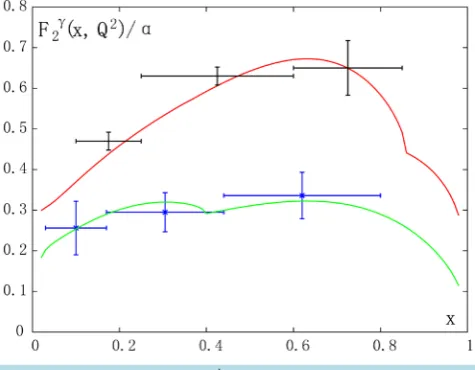
Figure 8 the PLUTO data [31] at 4.3 GeV2 (black crosses) and the OPAL data [48] at 39.7 GeV2 (blue crosses)
are compared with our model. The data clearly do not follow the typical mesonic
1
−
x
dependence and also demonstrate implicitly the rather strong 2Q dependence predicted by QCD. Next the 2
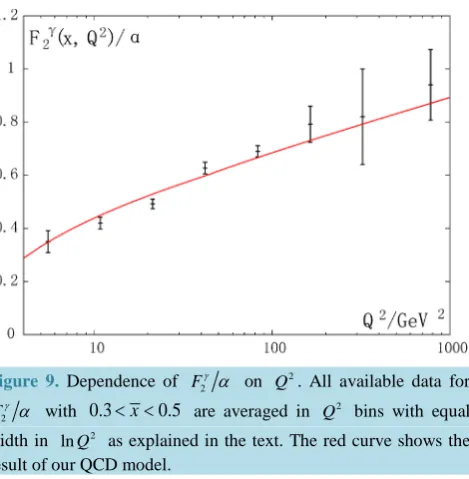
Q dependence of F2γ
(
x Q, 2)
is directly tested by selecting data with 0.3< <x 0.5. The averagex value
x
was determined taking the mean value of the x intervals quoted in the experimental papers. The 36 data sets are grouped in bins with equal bin width in 2lnQ . Each F2γ value is then shifted to the center of the corresponding bin using the theoretical model and the weighted average of all data within the bin is calculated. The result is shown inFigure 9 together with the theoretical curve calculated for
x
=
0.4
. The increase of the data with lnQ2 is clearly seen, especially in contrast to the well known slight decrease of the proton structure function forx
=
0.4
between Q2 = 5 and 800 GeV2. Neglecting the small 2 [image:15.595.195.433.489.674.2]Q dependence of the hadronic piece the theoretical model can in LO be written as F2γ
(
x Q, 2)
=a x( ) ( )
+b x ln(
Q2 GeV2)
. A fit of the data inFigure 9 according to this ansatz yields b
( )
0.4 =0.133 0.008± thus establishing numerically the predictedincrease with 2
lnQ beyond any doubt. This value agrees very well with the earlier analysis of [35].
Figure 8.Dependence of F2γ α on x for two different values of Q2. The PLUTO data [31] at 4.3 GeV2 (blue crosses) and the OPAL data [48] at 39.7 GeV2 (black crosses) are compared with
1038
Figure 9. Dependence of F2γ α on 2
Q . All available data for
2
Fγ α with 0.3< <x 0.5 are averaged in Q2 bins with equal
width in 2
lnQ as explained in the text. The red curve shows the result of our QCD model.
6. Virtual Photon Structure
The perturbative calculations have been extended to the region 2 2 2
P Q
Λ [57] [58] which is experi- mentally accessible requesting also the positron being scattered into finite angles (double tagging). Regarding the theory one has in the formalism of [11] simply to replace the parameter 2
0
Q by the variable P2 for the cal- culation of 2,PL,
(
2, 2)
n
Fγ Q P in LO. Ueamtsu and Walsh [58] emphasized that for virtual photons also the hadronic piece is perturbatively calculable. The required additional terms are given in [17][58].
Gluon radiation is efficiently suppressed for virtual photons, thus moving
( )
(
)
2
2
2 ,
P
Fγ x Q closer to the quark model result. Analytically this can be proven easily [57] by investigating the LO order solution, e.g. ,
NS
n
qγ , Equation (20). Because in LO αS is proportional to 1 ln
(
Q2 Λ2)
we have(
)
(
)
2 2
2 2
2 2 2 2
, NS
ln
ln ln
ln
. 1
n qq
d
n
n qq
P
Q P
Q q
d
γ
Λ
−
Λ Λ Λ
∼
+ (58)
Using ln
(
Q2 Λ =2) (
ln P2 Λ +2) (
ln Q2 P2)
the nominator reduces in the limit ln(
Q2 P2)
ln(
P2 Λ2)
to
(
1+dqqn) (
ln Q2 P2)
. Since a similar relation holds for the singlet term, the final result2 is
(
)
2, 2 2 4
2,PL QM 2
3
, ln ,
π
n n
q
Q F Q P f e h
P
γ = α (59)
i.e. the quark model formula (34) with the log factor replaced by ln
(
Q2 P2)
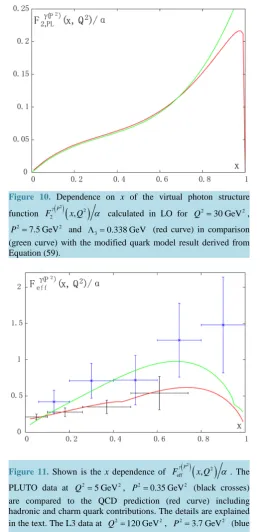
. As an illustration the LOprediction for 2 2
30 GeV
Q = , 2 2
7.5 GeV
P = and Λ =3 0.338 GeV is compared inFigure 10 with Equation
(59) showing perfect agreement at small and medium x values. The parameter free QCD prediction (59) is, however, difficult to be tested experimentally because with the present value of
Λ
the condition(
2 2)
(
2 2)
ln Q P ln P Λ can hardly be achieved.
Regarding the determination of
( )
(
)
2
2
2 ,
P
Fγ x Q from the measured cross section, it should be remembered that the virtual photon photon scattering is in general described by four cross sections and two interference terms
2
This formula also demonstrates drastically how the introduction of a second scale destroys the sensitivity to Λ. In case of the starting scale 2
0
[image:16.595.198.433.82.322.2]Figure 10. Dependence on x of the virtual photon structure
function ( )
(
)
2
2
2 ,
P
Fγ x Q α calculated in LO for Q2=30 GeV2,
2 2
7.5 GeV
P = and Λ =3 0.338 GeV (red curve) in comparison
[image:17.595.183.453.81.614.2](green curve) with the modified quark model result derived from Equation (59).
Figure 11. Shown is the x dependence of ( )
(
)
2
2 eff ,
P
Fγ x Q α . The
PLUTO data at 2 2
5 GeV
Q = , 2 2
0.35 GeV
P = (black crosses)
are compared to the QCD prediction (red curve) including hadronic and charm quark contributions. The details are explained
in the text. The L3 data at 2 2
120 GeV
Q = , 2 2
3.7 GeV
P = (blue
crosses) are compared to the same model (green curve).
(see Section IV). After proper integration over the interference terms the cross section formula of [18] can be written as
(
1 2 1 2)
TT TT LT TL LL
dσ ∼L σ +ε σ +ε σ +ε ε σ (60)
(
)
.TT TT LT TL LL
dσ ∼L σ +σ +σ +σ (61)
The relation between structure functions and cross sections is more complicated than discussed above for electron scattering off real photons. In the limit Q2 P2 the general formulae given in [26] reduce to
( )
2(
)
2 22 2
1 ,
2 4π
P
TT LT
Q
Fγ x Q σ σ
α
= +
(62)
( )
2(
)
2 22
,
4π P
L LT
Q Fγ x Q σ
α =
using σLT ≈σTL and σ ≈LL 0. Defining an effective structure function via
( )
2 2(
)
eff 4π 2
P
TT LT TL LL
Q
Fγ σ σ σ σ
α
= + + + (63)
one gets finally
( )
2(
)
( )
2(
)
( )
2(
)
2 2 2
eff 2
3
, , , .
2
P P P
L
Fγ x Q ≈Fγ x Q + Fγ x Q (64)
Experimental data is scarce. The first results of the PLUTO collaboration [60] at Q2 =5 GeV2 and 2 0.35 GeV2
P = (black crosses in Figure 11) were only followed by data of the L3 collaboration [44] at
2 120 GeV2
Q = and P2=3.7 GeV2 (blue crosses in Figure 11).
For comparison with theory
( )
(
)
2
2
2 ,
P
Fγ x Q is calculated in NLO for 3 flavors choosing Λ =3 0.338 GeV.
According to Equation (64)
( )
(
)
2
2 ,
P L
Fγ x Q cannot be neglected. The longitudinal structure function of real
photons is extensively discussed in the literature [59]. For virtual photons
( )
(
)
2
2 ,
P L
Fγ x Q has been calculated in LO and NLO [17][58]. Here we combine the LO result with the NLO calculation of the pointlike and hadronic terms. The charm quark contribution for F2 and FL is taken from the quark model result for real photons as recommended in [29]. Because the PLUTO data are taken at a 2
P value close to the real photon case a VMD
part was added multiplied by a form factor 1 1
(
+P m2 ρ2)
2 where mρ is theρ
meson mass. Using thisform factor the VMD term is reduced by a factor 2.5 and thus for the sake of simplicity the straight line model
(
)
0.19 1−x 2.5 is applied improving somehow the agreement with the data at low x. Altogether the red curve (PLUTO) and the green curve (L3) in Figure 11 are in very good agreement with the data although admittedly this is not a very decisive test due to the large experimental errors. A comparison including the rather small NNLO corrections can be found in [63].
7. Conclusions
Measurements of the photon structure function F2γ taken at e e+ − colliders were confronted with theoretical models. For real photons the main component is the fixed flavor
(
f =3)
NLO asymptotic QCD result in theMS scheme as given in Equation (41) evaluated with the functions ofTable 1. This part is complemented by charm and bottom heavy quark contributions calculated in the quark model and by a hadronic contribution taken from vector meson dominance. The model describes not only the x and 2
Q distributions very well but also allows for a precise determination of the strong coupling constant, yielding
α
S( )
MZ2 =0.1159 0.0030± . Asexplained above, the treatment of the hadronic and the heavy quark contribution to F2γ does not follow from first principles but is based on model assumptions. The validity of these assumptions is supported by the observation that using the standard model value of Λ3 the selected data are described by the model of Section
5 with 2
dof 78.5 108
![Figure 1. Electron-photon scattering [generic Feynman diagram]. The incoming target photon γ splits into a nearly collinear quark-antiquark pair](https://thumb-us.123doks.com/thumbv2/123dok_us/8101746.788089/3.595.225.404.88.169/figure-electron-scattering-generic-feynman-incoming-collinear-antiquark.webp)