2017 2nd International Conference on Communications, Information Management and Network Security (CIMNS 2017) ISBN: 978-1-60595-498-1
Research on XML Schema Transformation Algorithm
Bin JI, Jia-ju WU
*, Hui-jun LIU, Li-rong MENG and Wan-yi PENG
China Academy of Engineering Physics, Institute of Computer Application, Mianyang, China
*Corresponding author
Keywords: XML Schema, JAVA, Transformation, Integrated support system.
Abstract. An efficient method for transforming XML Schema into programming language is the development basis of XML related software. In this paper, we propose an algorithm design, which is used to transform XML Schema document into Java codes. Firstly, we studied XML Schema elements and nested relation between elements in all cases. Then we studied DOM API and used DOM parser to parse XML Schema document. Thirdly, we studied Deep First Search algorithm and used it to traverse parsed result. During the traversing process, create corresponding Java objects for XML Schema elements. Finally, we got a collection of Java objects, which is organized according to nested relation between elements. Except notation and anyAttribute, the algorithm can transform the other elements contained in XML Schema document into Java objects, which makes sure that the collection of transformational Java objects is an equivalent representation of XML Schema document.
Introduction
Integrated support data of weapon equipment is used in integrated support systems, such as automated information systems for transportation and replenishment, automated information systems for maintenance, etc. [1]. Before used in these systems, integrated support data need to be collected and edited into XML (eXtensible Markup Language) [2] format. For weapon equipment’s integrated support data is highly confidential, so we can’t apply commercial data acquisition and editing software to these systems. Therefore, design and develop a self-controllable and highly automated XML editor is one of key factors to improve weapon equipment automation and digital level. XML Schema is used to design, constrain, and validate XML, and has become the primary choice for designing, constraining, and validating XML [3]. Therefore, it is necessary to design an efficient algorithm to transform XML Schema into programming language, which is the development basis of XML data editor.
equivalent representation of XML Schema document. According to the algorithm design, we implement the algorithm implementation, which is shown in paper [8].
XML Schema Syntax
There are thirty kinds of elements and twelve kinds of facet elements defined in the latest version of XML Schema [9, 10, 11]. However, according to practical application, two kinds of elements are not taken into consideration in the algorithm design, which are notation and anyAttribute. Similar to elements, some attributes are not taken into consideration too, as shown below.
1) id and anyAttributes of all kinds of elements 2) nillable, block and final of element
3) blockDefault, finalDefault and version of schema
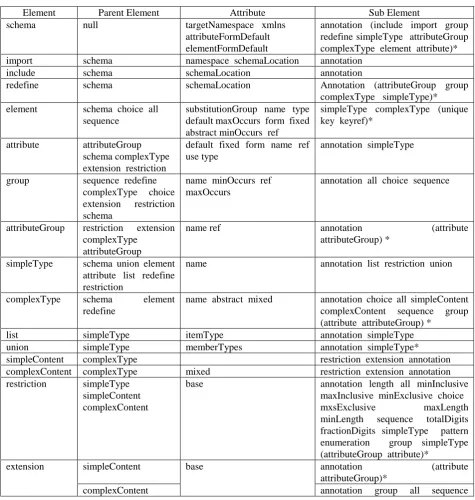
[image:2.595.60.536.298.799.2]Table 1 shows twenty-eight kinds of elements, elements’ attributes and elements’ sub elements, which are taken into consideration in the algorithm design. Any possible nested relation between elements can be concluded according to Table 1.
Table 1. The Twenty-Eight Kinds of Elements.
Element Parent Element Attribute Sub Element
schema null targetNamespace xmlns
attributeFormDefault elementFormDefault
annotation (include import group redefine simpleType attributeGroup complexType element attribute)*
import schema namespace schemaLocation annotation
include schema schemaLocation annotation
redefine schema schemaLocation Annotation (attributeGroup group
complexType simpleType)*
element schema choice all
sequence
substitutionGroup name type default maxOccurs form fixed abstract minOccurs ref
simpleType complexType (unique key keyref)*
attribute attributeGroup
schema complexType extension restriction
default fixed form name ref use type
annotation simpleType
group sequence redefine
complexType choice
extension restriction
schema
name minOccurs ref maxOccurs
annotation all choice sequence
attributeGroup restriction extension
complexType attributeGroup
name ref annotation (attribute
attributeGroup) *
simpleType schema union element
attribute list redefine restriction
name annotation list restriction union
complexType schema element
redefine
name abstract mixed annotation choice all simpleContent
complexContent sequence group (attribute attributeGroup) *
list simpleType itemType annotation simpleType
union simpleType memberTypes annotation simpleType*
simpleContent complexType restriction extension annotation
complexContent complexType mixed restriction extension annotation
restriction simpleType
simpleContent complexContent
base annotation length all minInclusive
maxInclusive minExclusive choice
mxsExclusive maxLength
minLength sequence totalDigits
fractionDigits simpleType pattern enumeration group simpleType (attributeGroup attribute)*
extension simpleContent base annotation (attribute
choice
(attribute attributeGroup)*
any choice sequence namespace processContents
minOccurs maxOccurs
annotation
key element name annotation selector field+
keyref element name refer annotation selector field+
unique element name annotation selector field+
selector key keyref unique xpath annotation
field key keyref unique xpath annotation
annotation any elements (documentation appinfo) *
documentation annotation xml:lang source
appinfo annotation source
all restriction extension
complexType group
minOccurs maxOccurs annotation element*
sequence restriction extension
complexType choice group sequence
minOccurs maxOccurs annotation (element group sequence
choice any)*
choice restriction sequence
complexType choice group extension
minOccurs maxOccurs annotation (element group sequence
choice any)*
Attention: in sub elements column, * represents the element can appear 0 time or several times in its parent element; + represents the element appear at least one time in its parent element;
For the twelve kinds of facet elements, restriction is the only parent element and value is an attribute that must be contained in each facet element. In addition, fixed attribute may be contained in facet elements, and no facet elements have sub elements. The twelve kinds of facet elements are length, maxLength, minLength, maxInclusive, minInclusive, maxExclusive, minExclusive, fractionDigits, totalDigits, enumeretion, whiteSpace and pattern.
Algorithm Design
XML Schema document conforms to XML syntax, so both DOM and SAX [12] (Simple API for XML) can be used to parse XML Schema document. DOM is chosen to parse XML Schema document in the algorithm design.
Algorithm Design Idea
The algorithm can be divided into two parts, which are parsing unit and Java object creation unit, as shown below.
Part 1: Parsing unit first implements DOM API with Java language and gets an instance of DOM parser. Then the parser calls the parse (URL url) method to parse the XML Schema document, and the url parameter is the URL path of XML Schema document. The parsing result is an instance of Document. Thirdly, parsing unit gets the first element of parsing result, which is named after n (For a well-formed and non-empty XML Schema document, n is schema actually. For convenience, the element is named after n.). At last, pass n to Java object creation unit.
Part 2: Java object creation unit receives n and gets the localName of n. Then call constructor of the Java class that is corresponding to localName to create a Java object for n.
Algorithm Description
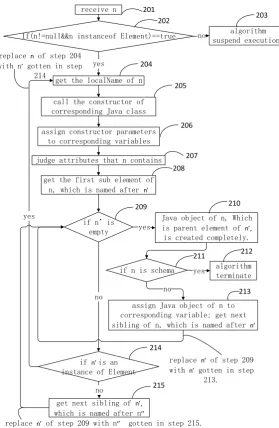
This section describes the executing process of Java object creation unit in detail, as shown below. Step 1: Receive n and get the localName of n, then call the constructor of the Java class, which is corresponding to localName. If n is schema, then (n, null, null) are passed to the constructor; if n is a facet element, then (n, this) are passed to the constructor; otherwise, (n, this, schema) are passed to the constructor. For parameters, the key word “this” represents the current Java object and the key word “schema” represents the Java object of schema. Execute step 2.
Step 2: Execute assignment statements defined for constructor parameters in constructor. Execute step 3.
Step 3: Execute judgment and assignment statements defined for attributes in constructor. Execute step 4.
Step 4: Get the first sub element of n, which is named after n’. Execute step 5.
Step 5: If n’ is an empty element, execute step 6. If not, then the Java object of n, which is the parent element of n’, is created, execute step 7.
Step 6: If parent element of n’, which is named after n, is schema, the algorithm terminated normally, which represents that a Java object is created for schema. If not, assign the Java object created for n to corresponding variable defined in the Java class, which is defined for the parent element of n. Then, get next sibling element of n, which is named after n’, execute step 5.
Step 7: If n’ is an instance of Element, execute step 1; If not, execute step 8.
receive n
If(n!=null&&n instanceof Element)==true algorithm suspend execution
get the localName of n
judge attributes that n contains
get the first sub element of n, which is named after n’
no
yes
call the constructor of corresponding Java class
if n’is empty
Java object of n, Which is parent element of n’,
is created completely. yes
if n’ is an instance of Element
no yes
get next sibling of n’, which is named after n’’
no
assign constructor parameters to corresponding variables
201
202 203
204
205
206
207 208
209
211
214
215
assign Java object of n to corresponding variable; get next sibling of n, which is named after n’
210
replace n’ of step 209 with n’ gotten in step
213.
replace n’ of step 209 with n’’ gotten in step 215. if n is schema
no
algorithm terminate
212
213
replace n of step 204 with n’ gotten in step
214
[image:5.595.159.439.67.496.2]yes
Figure 1. The executing process of Java object creation unit.
Conclusion and Discussions
References
[1] D. Xu, The Research on Key Technologies of Integrated Logistics Support, National University of Defense Technology, Beijing, 2006.
[2] W3C, eXtensible Markup Language (XML), http://www.w3.org/ XML/.
[3] Z.C. Xu and Y.S. Lei, Equipment IETM development engineering general introduction, National Defense Industry Press, Beijing, 2012.
[4] X.Z. Wang, Method and Tool for Transforming XML Schema to Conceptual Model, Wuhan University of Technology, Hubei, 2008.
[5] B. Ji, J.J. Wu and B.J. Zhou, An approach to graphically represent XML Schema, CAC2017, unpublished, 2017.
[6] J. Ma, S. Zhang, T. Hu and M. Wu, Parallel Speculative Dom-based XML Parser, IEEE International Conference on High Performance Computing & Communication & IEEE International Conference on Embedded Software & Systems, 2012, pp. 33-40.
[7] V.M. Deshmukh and G.R. Bamnote, An Empirical Study of XML Parsers across Applications, International Conference on Computing Communication Control & Automation, 2015.
[8] B. Ji, J.J. Wu and Y.H. Xie, An Algorithm to Transform XML Schema into Java Codes, CIMNS2017, unpublished 2017.
[9] D.C. Fallside and P. Walmsley, XML Schema Part 0: Primer, second ed., W3C Recommendation, 2004.
[10] H. Thompson, D. Beech, M. Maloney and N. Mendelsohn, XML Schema Part 1: Structures, second ed., W3C Recommendation, 2004.
[11] P.V. Biron, K. Permanente and A. Malhotra, XML Schema Part 2: Datatypes, second ed., W3C Recommendation, 2004.