2016 International Conference on Manufacturing Science and Information Engineering (ICMSIE 2016) ISBN: 978-1-60595-325-0
A SysML Based Conceptual Framework for
System Level Design in Micromechanical
Electrical System
YEFEI LI, JIASHENG HAN, BAODUO KAN, CHONG XU,
JIE ZHANG, CHAOJIE SI and FANGYU LI
ABSTRACT
The design of a microelectromechanical systems (MEMS) is a hard task due to the complexity of the systems. Model driven engineering approaches, like model-based systems engineering (MBSE) and SysML provide a way for the systematic design of MEMS. However, the conceptual design of MEMS is an iterative and multidisciplinary issue, which makes a long time for design space exploration. In this study, a SysML based method is proposed to implement the system design and simulation models of MEMS product. The design process reaches from requirements specification to the detailed modeling and simulation of the system. This proposed method was illustrated by designing a high-resistivity silicon based patch antenna which is used as RF front in a Beidou receiver. The results showed that the SysML based information from the different diagrams of Beidou receiver and the multidisciplinary design phases can be connected and used during the development of new MEMS product, resulting in shortened development cycles.1
1
Yefei Li, Jiasheng Han, Baoduo Kan, Chong Xu, Jie Zhang, Chaojie Si. School of Mechatronics Engineering, University of Electronic Science and Technology of China, Chengdu, P.R. China 611731
1. INTRODUCTION
The development of microelectromechanical systems (MEMS) is a complex task [1]. It require the background knowledge of multiple disciplines, such as mechanical, electronic, electromagnetic to fulfil the functional requirements. Thus there is a great need of modeling and simulation of MEMS product in the conceptual design phase.
Model-based systems engineering (MBSE) was introduced to integrated the different knowledge of each domain [2]. As in mechanical engineering, systematic approaches to design and develop products are used to improve efficiency of the design process [3]. Paper-based methods and documents centric methods are adopted to transform function, behavior and structure in concept design [4]. Now MBSE is the mainstream method for complex system design, and SysML, which has been established based on unified modeling language (UML) to support the MBSE by the International Council of Systems Engineering (INCOSE), is used to consider engineering system in general.
Research works have been carried out on the model based design of products. Shea et al. [5] proposed a multi-domain computational synthesis method in MEMS design. This method combined a generate test algorithm with an object-oriented, systems-based representation called Connected-Node System. Cao and Paredis[6] put forward a meta-model based method is proposed to integrate the system design and simulation models of mechatronic system. Simulation information was formalized in SysML to support an analysis of the system dynamic behavior with the aid of simulations.
Our objective is to introduce a conceptual design framework for MEMS using SysML. In this unified framework and modeling environment, the information of MEMS product can be utilized efficiently to evaluate design schemes in early stage.
This paper is organized as follows: ASysML based conceptual design method for MEMS is presented in Section 2. The implementation and simulation results of a high-resistivity silicon based patch antenna which is used as the RF front in a Beidou receiver are given in Section 3. Section 4 summarizes this method and describes the future works.
2. SYSML BASED CONCEPTUAL DESIGN FRAMEWORK FOR MEMS DESIGN
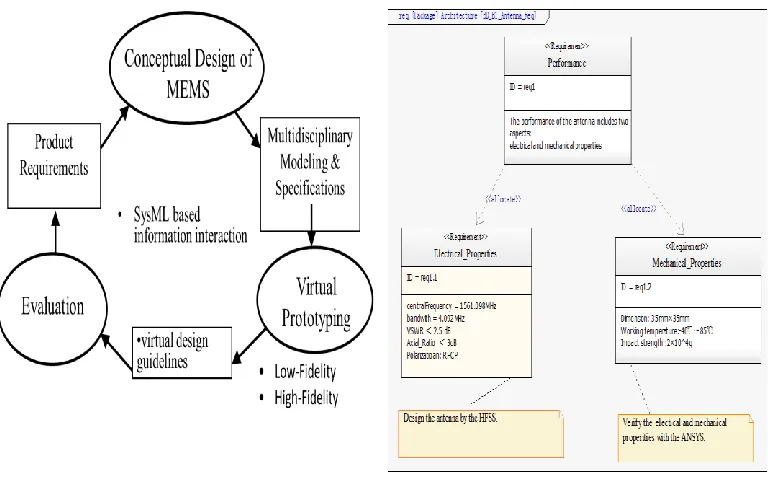
specifications about the MEMS product are figured out. The information transferred from computer aided design (CAD) tools to computer aided engineering (CAE) tools. This process helps to build a virtual prototyping in the stage of conceptual design. As supported by SysML based information interaction, virtual design guidelines abstracted from product requirement diagram are used to evaluate the initial design schemes.
Figure 1. SysML based concept design framework. Figure 2. Requirement diagram of patch antenna.
Here we use the conceptual design of a high-resistivity silicon based patch antenna which is used as the RF front in a Beidou receiver as a study case to validate the effectiveness. Since not all of the nine diagrams are not essential to the conceptual design process, just key diagrams are discussed in this paper.
2.1 Requirement Diagram
2.2Parametric Diagram
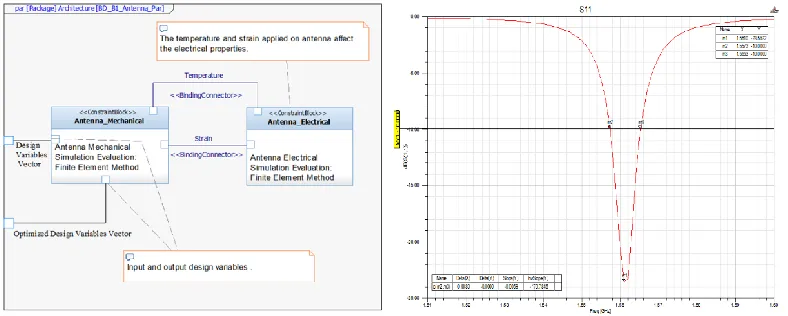
[image:4.612.101.495.251.409.2]Parametric diagram is a detailed item derived from working structure block, so the design variables properties, constrain properties and potential object properties which will build the future optimization model are derived from part blocks and constrain blocks. In Figure 3the parameters of the patch antenna are displayed as small rectangles on the blocks. Binding paths connected indicates that the parameters are the same. The constraint blocks are networked. In this diagram, the conceptual schemes computation results can be numeric simulated within a multidisciplinary optimization (MDO) framework.
Figure 3. Parametric diagram of patch antenna. Figure 4. Electrical performance of patch antenna.
Parametric diagram is an important factor because once the parameters in it have been configured, they need to be checked for the latter design process. The SysML based conceptual design modeling method in this paper is better than the previous paper based or documents centered methods, a preliminary check for consistency can be done in the early design stage. That is the parameters in patch antenna meet the needs of mechanical and electrical targets in the real working environment.
3. RESULTS
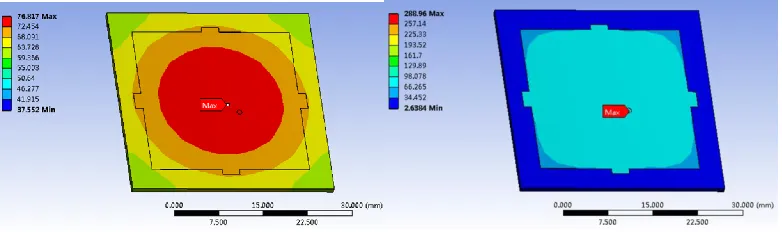
performance, thermal performance and mechanical performance. The design parameters of the patch antenna obtained after design iterations showed the results (Figure 4, Figure 5 and Figure 6) meet the initial requirement in Figure 2.
4. CONCLUSIONS
[image:5.612.100.491.329.445.2]The work has shown SysML is suitable for MEMS concept design. Combined with capabilities for design methodology and system engineering, it provides a general base for integrated multidisciplinary product models. In this MEMS concept design framework, the SysML based design process for system level development of MEMS products illustrated benefit of model driven engineering through the information seamless transferred within SysML diagrams. For modeling the MEMS products, the integrated views of the system including detailed SysML based specification and analysis of multidisciplinary design have been constructed in MEMS.
Figure 5. Thermal performance of patch antenna. Figure 6. Mechanical performance of patch antenna.
Our method has also shown a case study of a high-resistivity silicon based patch antenna which is used as the RF front in a Beidou receiver, the mechanical and electrical performances have been achieved with less design iterations under this conceptual design framework. Additionally, this framework will help the designers to focus on key design functions according to requirements diagram during the system lifecycle. All relevant information of patch antenna in the presented modeling architecture can be conducted to the new design stages, even to a new project.
ACKNOWLEDGMENT
REFERENCES
1. Wen H. Ko. 2007. "Trends and Frontiers of MEMS," Sensors and Actuators A: Physical,138(1):
62-67.
2. G. Barbieri, K. Kernschmidt, C. Fantuzzi, and B. Vogel-Heuser. 2014. "A SysML based Design
Pattern for the High-level Development of Mechatronic Systems to Enhance re-usability," in the International Federation of Automatic Control, Cape Town, South Africa. pp. 3431-3437.
3. G Pahl, W Beitz. 2005. "Engineering design: a systematic approach," Berlin:Springer.
4. Stefan Wölkl, Kristina Shea. 2009. "A Computational Product model for Conceptual Design
using SysML," in Proceedings of the ASME 2009 International Design Engineering Technical Conferences & Computers and Information in Engineering Conference IDETC/CIE 2009, San Diego, California, USA. pp. 1-11.
5. Francesca Bolognini,Ashwin A. Seshia1 and Kristina Shea. 2007. "Exploring the Application of
A Multi-Domain Simulation-Based Computational Synthesis Method in MEMS design," in Proceedings of the ICED 2007 International Conference on Engineering Design, Paris, France. pp. 1-13.
6. Yue Cao, Yusheng Liu and Christiaan J.J. Paredis. 2011."System-level Model Integration of