2017 2nd International Conference on Advances in Management Engineering and Information Technology (AMEIT 2017) ISBN: 978-1-60595-457-8
Research on the Application of Shared Mental Model in Networked
Operation Command Decision Making
Ying SHAO
1, Jing YANG
2,*, Hao-guang CHEN
1and
Hao ZHANG
11
Equipment Academy, Beijing 101416, China
2
Tawan Street No.77, Shenyang 110035, China
*
Corresponding author
Keywords: Networked operations, Shared mental models, Command decision making.
Abstract. This paper applies the shared mental model to the networked operation command decision making. Through the study, the networked operations system unit with the shared mental models can acquire other unit awareness and decision in a small amount of communication, which reduces the uncertainty of the command decision condition and enhances the coordination of the combat system. The conclusion of this paper has laid a good foundation for further enhancing the network operation effectiveness.
Introduction
The networked operations make the operational elements of decentralized deployment gather into combat system, realize the sharing among elements, and maximize the information advantage into decision advantage and action advantage, and enhance the overall combat effectiveness of combat system. The network has greatly enhanced the communication capability of the combat system, so that the combat unit can join the network equally, regardless of any geographical, any function, any command-level combat units have the potential to obtain the battlefield global information. With strong network capabilities, the power to the edge concept is used in networked operations. Network operations using decentralized command mode, the unit has a high degree of intelligence, can refer to the superior intentions and tasks to develop their own combat plan, shorten the command chain length, enhance the command effectiveness, but also enhanced the combat system complexity [1]. These changes in networked operations have put forward higher demands on their command decision making. The networked operations have stronger sharing ability than the previous operation. It can be used by the flexible command and control method to improve the combat effectiveness, and the effective realization of the cooperative operation has an important influence on the network operation effectiveness. In this paper, the concept of sharing the mental model is applied to the networked operations. The war unit can accurately predict the situation awareness and the combat plan of the other combat units through the sharing the mental model, which improves the accuracy of the decision conditions and the cooperative combat capability. This paper proposes a new way to improve the network combat effectiveness.
Information in Networked Operational Decision Making
Decision-making is composed of four parts: decision-making subject, decision-making alternative, decision-making condition and decision-making result. The decision-making subject is the individual or the group which makes the decision-making. The decision-making subject has its own decision-making criterion, which can select the decision result according to the decision-making condition. The decision option is a set of options that may be selected and can be represented by a collection A. The decision-making condition is a description of the battlefield situation, which can be expressed by S. The decision result is the value obtained from the decision analysis, expressed in R.
The decision process can be modeled as a binary function: A × S → R, and each alternative matches
the natural state to produce a unique result R, which is about to be executed.
The main subject of the decision-making in the network is the command organ or the commander, that is, the main subject of the command. The decision-making conditions are formed by the commanding subject based on the information obtained from the battlefield. The decision-making rules of the commanders are different, the criteria are related to their own cognition, and are related to the operational rules that need to be followed. The cognition is determined by the relevant content, such as the knowledge, experience and ability of the commander itself. The decision-making subject can choose the appropriate combat plan according to the decision criterion and the decision-making condition. The decision-making conditions are dynamic, and it is closely related to the real-time situation of the battlefield, whether the timely and accurate battlefield situation is closely related to the final combat effectiveness. The decision-making scheme is ultimately chosen by the commanding subject, who depends on the decision-making conditions and decision-making criteria when making decisions, and has certain uncertainty.
The famous military scientist, Clausewitz, argues that war is an area of uncertainty, and those three quarters of what is happening in the war is hidden in the fog, and there are more or less uncertainties. Lack of information so that the combat unit cannot accurately understand the battlefield situation, so that in the decision-making and action into a "fog of war", resulting in combat friction, and ultimately affect the combat effectiveness of the troops play. Eliminating the uncertainty of the battlefield is the essence of information. If it can provide more accurate, effective and complete combat information for the decision-making subject, it is an effective means to improve the combat effectiveness by reducing the uncertainty of the objective existence in the decision-making condition. Battlefield intelligence is the basis of command and decision conditions. Accurate intelligence information will generate more accurate decision-making conditions, so that the main subject of the formation of accurate situational awareness and select the optimal program. The decision-making conditions are generated by the battlefield environment information. The information sharing in the networked operations enhances the accuracy, timeliness and completeness of the intelligence, and thus reduces the uncertainty of the decision-making conditions.
Shared Mental Model
Knowing the operational plans of other combat units can effectively reduce the uncertainty of future combat situation judgments. In the past, the combat units have obtained the other unit combat plan through the communication way. The method has high dependence on the battlefield network and takes up the time and energy of the combatants in large amount, which influences the combat command performance. In this paper, we use the shared mental model to obtain other combat unit plan; the method has strong robustness and reduces the interference of decision-making process of combatants. Each combat unit can acquire the perception and combat plan of other units by sharing the mental model and improve the decision-making level and command combat effectiveness.
Rouse and Morris define the mental model as a psychological mechanism used to describe system objectives and forms, to interpret system functions, to observe system status, and to predict future state of the system [3]. Johnson-Laird argues that the mental model allows people to speculate and understand current real events and to act accordingly [4]. Endsley argues that the mental model can be used to guide the formation of situational awareness and decision making through the mental model to complete the process of information acquisition to action [5]. The theory of the current mental model includes Simon's proposed Physical Symbol System Hypothesis (PSSH), the Norman model, the SOAR model, and the social model of the mind.
In team tasks, members have their own specific mental model, which can be based on the same environment and the facts to make a different conclusion. Cannon-Bowers and Salas extend the mental model from the individual to the team level, which presents the concept of shared mental models, defined as a common knowledge structure by team members, which enables team members to have a team Actions and tasks to properly understand and anticipate the ability. The shared mental model among teams has the ability to understand other team roles, plans, information needs, and potential re-planning, as well as predictions and actions for other teams. The shared mental model allows team members to perform tasks with the same reference framework to enhance team communication so that actions by other team members can be predicted. The shared mental model predicts the actions and information needs of other team members when the communication means are limited. Through the sharing of mental models, members can coordinate their own behavior in order to adapt to the team collective operations to meet the needs of other members of the team. Endsley argues that the use of shared mental models is more effective in enhancing team awareness than verbal communication [6].
The Influence of Shared Mental Model on Command Decision Making
The shared mental model is divided into two modes: consistency sharing and distributed sharing. The team members of the consistency share have the same mental model. Distributed combat in the combat unit according to their own ability and responsibility to maintain their own mental model. Consistency mental model is simpler than the formation and maintenance of distributed mental models, and the combat units can achieve a consistent sharing of mental models by learning, training and restraint. But consistency makes the war unit easy to form a cognitive bias, and difficult to form a unique combat plan. Distributed shared mental model is the essence of the unit has more knowledge, that is, access to other units of the mental model, but the independent unit is difficult to grasp the other unit mental model, which members of their own ability to put forward higher requirements. This paper mainly uses the distributed shared mental model to realize the networked combat sharing mental model. When the combat system in the system with the other combat unit of the mental model, the combat unit cannot communicate, do not take up the limited network resources in the case of other combat units to obtain the situation awareness and combat plan.
Conclusion Validation
In order to verify the effect of shared mental model on the improvement of networked operational effectiveness, this paper simulates the decision-making process of combat unit by means of decision table. In order to simplify the analysis process, this paper sets the existence of A and B combat units in the system. When the more complex cases are analyzed, more unit cases can be generalized by referring to this method.
The shared mental model can make the decision maker have the decision criterion of other subjects, and the networked operation ensures that the combat units can have consistent battlefield situation information. Under this condition, the shared mental model allows the combat units to obtain other operational units of the combat plan, and the combat plan to join their own decision-making conditions, the other combat units can be identified next step to achieve multi-unit combat plan to form an overall combat power. In the following, we will simulate the change of the unit decision-making condition and the final gain after obtaining the other unit plan, and whether to obtain the relationship between the other unit combat plan and the action income obtained by the unit.
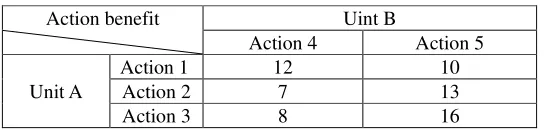
[image:4.612.171.444.346.411.2]In this paper, we use the decision table of the combat units A and B of the program set and decision conditions to simulate. At this point, the action plan of unit B will be the decision condition of unit A, and unit A will make the decision according to B action. In this paper, the combat unit will use the maximum expectation criterion to select the action to obtain the maximum benefit. The decision table for combat unit A is shown in Table 1 below.
Table 1. Networked Operation Unit a Decision Table.
Action benefit Uint B
Action 4 Action 5
Unit A
Action 1 12 10
Action 2 7 13
Action 3 8 16
When the shared mental model is not used between the units, the combat unit A considers that the probability of taking action 3 and 4 in combat unit B is possible, all 0.5. The maximum expected value criterion considers action 1, action 2, action 3 expectations to be 11, 10 and 12, respectively, under which the combat unit A chooses action 3. When the combat units A and B share the mental model, it is determined that the combat unit A judges that the combat unit B will perform action 4 by the acquired consistency situation information, then the combat unit A will select the action 1 to obtain the maximum benefit. Comparing the final benefits of these two conditions, we can see that the action income of combat unit A is 8 when the mental model is not shared, and the action obtained under the sharing of the mental model is 12. The results show that when the networked combat unit is informed of other unit mental models, the uncertainty of the decision-making conditions can be reduced by more accurate combat information, and the optimal action scheme under this condition is selected to enhance the network efficacy.
Although the shared mental model can effectively improve the network combat effectiveness, but because the mental model exists in the awareness of combatants, with a large ambiguity, how to form an accurate shared mental model, how to assess the combat unit to share the mental model level and how The dynamic adjustment of the shared mental model and other issues are still difficult to solve. This paper argues that with the continuous application of artificial intelligence in networked operations, these problems are likely to be solved in further studies because the mental model of equipment is more problematic than human mental model.
Summary
conditions of the networked combat, and the decision-making is optimized by the individual optimal to the optimal among the multiple units, and finally the network combat effectiveness is improved. The research of this paper puts forward a new way to further improve the network combat effectiveness.
Acknowledgement
The authors sincerely thank JingYang and Hao-Guang Chen for the discussion on shared mental model.
References
[1] David S Alberts. Network centric warfare: Developing and Leveraging Information Superiority
(2nd dition), www.nap.edu. 2000.
[2] David R. Anderson, Dennis J Sweeney, Thomas A Williams. Quantitative Approaches to
Decision Making (13th Edition). China Machine Press. BeiJing, 2012.
[3] W. Rouse, Morris B.N. On looking into the black box: Prospects and limits in the search for
mental models. Psychological Bulletin, 1986, 100: pp. 349-363.
[4] Johnson-Laird P N. Mental models. Cambridge. England: Cambridge University Press, 1983.
[5] Endsley, M.R. Towards a theory of situation awareness in dynamic systems. Human Factors,
1995, 37:1, pp. 32–64.
[6] Endsley, M.R., & Kiris, E.O. Situation awareness Global Assessment Technique (SAGAT)