Oaksford, Michael and Chater, N. (2014) Probabilistic single function dual
process theory and logic programming as approaches to non-monotonicity
in human vs. artificial reasoning. Thinking & Reasoning 20 (2), pp. 269-295.
ISSN 1354-6783.
Downloaded from:
Usage Guidelines:
Please refer to usage guidelines at or alternatively
Oaksford, Michael and Chater, N. (2014) Probabilistic single function dual process theory and logic programming as approaches to non-monotonicity in human vs. artificial reasoning. Thinking & Reasoning 20 (2), pp. 269-295. ISSN 1354-6783.
Probabilistic Single Function Dual Process Theory and Logic
Programming as Approaches to Non-monotonicity in Human vs.
Artificial Reasoning
Mike Oaksford*
Birkbeck College, University of London
Nick Chater
Warwick Business School, University of Warwick
Short Title: Dual processes in non-monotonic reasoning
*Corresponding author: Mike Oaksford
Department of Psychological Sciences Birkbeck College
University of London London, WC1E 7HX, UK
e-mail: [email protected] telephone: +44 (0) 20 7079 0879
Abstract
In this paper, it is argued that single function dual process theory is a more credible
psychological account of non-monotonicity in human conditional reasoning than recent
attempts to apply logic programming (LP) approaches in artificial intelligence to these data.
LP is introduced and among other critiques, it is argued that it is psychologically unrealistic
in a similar way to hash coding in the classicism vs connectionism debate. Second, it is
argued that causal Bayes nets provide a framework for modelling probabilistic conditional
inference in System 2 that can deal with patterns of inference LP cannot. Third, we offer
some speculations on how the cognitive system may avoid problems for System 1 identified
by Fodor in 1983. We conclude that while many problems remain, the probabilistic single
function dual processing theory is to be preferred over LP as an account of the
Dual process theories (Evans 2003, 2007; Evans & Stanovich, 2013; Kahneman, 2011;
Sloman, 1996; Stanovich, 2011; Stanovich & West, 2000; Wason & Evans, 1975) invoke two
separate cognitive systems to explain performance on a variety of cognitive tasks. These are
labelled System 1 and System 2. System 1 is rapid, parallel, automatic, do not require the
resources of working memory (WM), and only their final product is posted in consciousness.
In contrast, System 2 is slow sequential, and analytic and makes use of the central working
memory system. In particular, System 2 ‘‘permits abstract hypothetical thinking that cannot
be achieved by System 1’’ (Evans 2003, p. 454). Recently, Oaksford and Chater (2012)
argued that accounting for non-monotonic or defeasible reasoning in dual process theory
required that both System 2 WM representations and System 1 long term memory (LTM)
representations need to be interpreted probabilistically. This position is consistent with Evans
and Over (2004; see also Over, Evans, & Elqayam, 2010) adoption of probability logic
(Adams, 1998) as underpinning analytic processes in System 2. But it contrasts with accounts
which treat analytic processes in System 2 as underpinned by standard binary truth functional
logic (Heit & Rotello, 2010; Klauer et al., 2010; Rips, 2001, 2002; Stanovich & West, 2000;
Stanovich, 2011). Oaksford and Chater (2012) labelled the former approach, the single
function dual process (SFDP) approach and the latter the dual function dual process (DFDP)
approach. Our goal in this paper is to confront some further problems and challenges for the
probabilistic SFDP approach but first we rehearse Oaksford and Chater’s (2012) argument in
detail.
Probabilistic Single Function Dual Process Theory
Both the dual process theory (Evans 2002) and the probabilistic approach (Oaksford
and Chater 1991, 1998, 2001, 2007) developed out of a critique of the classical logicist
function dual process theory. The store of world knowledge in LTM consists of a consistent
set of logical formulae in the language of thought that can be combined with given
information in WM using logical inference rules to yield new information in a proof theoretic
derivation. Evans (2002) and Oaksford and Chater (1991, 2007) argued that the defeasiblity
of human reasoning argued strongly against this logicist single function view. Defeasible
reasoning creates two problems for such systems. In standard logic, defeasible reasoning
leads to contradictions. Suppose that if x is a bird then x flies is part of your world knowledge
in LTM, then when someone asserts that Tweety is a bird, you may validly infer that Tweety
can fly and so add this to your world knowledge in LTM. But if you are then told that Tweety
is an Ostrich your belief that ostriches can’t fly will lead you to add Tweety cannot fly to your
world knowledge in LTM resulting in a contradiction, i.e., Tweety can fly ∧Tweety cannot fly
(“∧” = and). One attempt to avoid this unacceptable conclusion is to propose a
non-monotonic logic (Reiter 1985). However, as Oaksford and Chater (1991) argued based on
critiques in artificial intelligence (McDermott 1987), that this leads to triviality—all that can
be concluded is that Tweety can fly ∨ Tweety cannot fly (a tautology and something you knew
before drawing any inferences, “∨” = or)—and to computational intractability, i.e., the Frame
Problem (see, Oaksford and Chater 1991, 2007). Can a dual function view address these
problems? Oaksford and Chater (2009, 2011) argued that it may not because the two systems
must interact. But if the systems obey fundamentally different principles, it is not clear how
this is possible.
Consider again the familiar example of inferring that Tweety flies from the general
claim that birds fly and the fact that Tweety is a bird. On the DFDP view, this inference could
be drawn logically in System 2 from the premises, on the assumption that birds fly is a true
universal generalization; System 1, by contrast, might tentatively draw this conclusion by
between the two systems, presumed to operate by different rational standards, threatens to
cause inferential chaos. Consider, for example, what happens if we consider the possibility
that Tweety is an ostrich. If System 2 works according to logical principles, the clash of two
rules threatens contradiction: we know that birds fly, but that ostriches do not. To escape
contradiction, one of the premises must be rejected: most naturally, birds fly will be rejected
as false. But we now have two unpalatable possibilities. On the one hand, suppose that this
retraction is not transferred to general knowledge and hence is not assimilated by System 1.
Then the two systems will have contradictory beliefs. Moreover, if System 2 reasoning
cannot modify general knowledge in System 1, its purpose seems unclear. On the other hand,
if birds fly is retracted from world knowledge, along with other defeasible generalizations,
then almost all of general knowledge will be stripped away—as generalizations outside
mathematics are typically defeasible (Oaksford & Chater, 2007, 2009)—leading System 1
into inferential paralysis.
Oaksford and Chater (2012) argued that the best way to avoid these unpalatable
conclusions and account for the defeasibility of human reasoning is to adopt the SFDP view
in which representing birds fly in WM amounts to the assumption that the probability that
something flies given it is a bird is very close to 1 (Pr(flies(x)|bird(x)) ≈ 1). Consequently,
rather than having to reject birds fly as false in System 2, the observation that Tweety is an
Ostrich simply provides a negative instance that leads to a reduction of Pr(flies(x)|bird(x)) in
System 1 (or the inclusion of a defeater, see below). That is, the two systems can properly
communicate. Oaksford and Chater (2012) argued that this position successfully accounted
for a range of findings that had motivated dual process theories. For example, people do
make modal responses apparently not explained by probability theory and these
non-modal responses correlate with IQ (Stanovich & West, 2000; Stanovich, 2011). However,
have been applied to human reasoning (Stenning and van Lambalgen, 2005). This application
questions part of the motivation for the probabilistic approach and in this paper we address
whether the logic programming approach provides an adequate account of actual human
reasoning.
Logic Programming and the Probabilistic SFDP Approach
The arguments for a probabilistic SFDP approach were formulated with Reiter’s
(1985) default logic in mind, where rule application involves intractable consistency checking
between the conclusion of an inference in System 2 and world knowledge in System 1.
However, recently Stenning and van Lambalgen (2005) have proposed that a different Logic
Programming (LP) approach to non-monotonic reasoning which can address the problems of
maintaining consistency within and between Systems 1 and 2. In this paper, we argue that
single function dual process theory is a more credible psychological account of
non-monotonicity in human reasoning than this attempt to apply logic programming approaches in
artificial reasoning to the human data. In addressing some of the psychological evidence, LP
appears to hold out the promise of a local computational theory of non-monotonic reasoning,
i.e., one that appeals only to the premises in System 2, and which does not engage world
knowledge in System 1. However, we argue that this is illusory and that to generalise beyond
the single experimental paradigm to which LP has been applied will involve more global
processes involving System 1. Moreover, we argue that the mechanism by which LP renders
such global processing computationally tractable in System 1 is unlikely to be
psychologically real.
An important element of the argument against LP is that there are various inferences
that are naturally accounted for in the probabilistic SFDP approach that cannot be explained
Bayes nets (CBNs) can provide a good framework within which to develop a theory of
conditional reasoning and we show that CBNs can naturally account for these patterns of
inference (Ali, Chater, & Oaksford, 2011; Fernbach & Erb, 2013; Oaksford & Chater, 2007,
2013).
The argument for a probabilistic SFDP theory relied on the need to maintain
consistency between System 1 and System 2, i.e., between the representations being
manipulated in WM and the relevant representations in LTM. As we just observed, LP seems
to provide a way of “maintaining consistency within and between Systems 1 and 2.” That is,
it goes beyond our arguments for probabilistic SFDP. While we believe the cognitive system
capable of maintaining local consistency in System 2 and between System 2 and relevant
parts of System1, we doubt that the cognitive system can maintain the global consistency of
System 1. LP uses a form of indexing to ensure the consistency of System 1 which also
provides for tractable search over world knowledge for possible exceptions, e.g., like Tweety
is an Ostrich. In criticising LP, we question the psychologically reality of this indexing
scheme. While lacking psychological reality, this scheme nonetheless does help solve the
technical frame problem for classical Artificial Intelligence (Shanahan, 1997). However,
there remains the epistemological frame problem that one cannot circumscribe the
information in System 1 that is relevant to any particular inferential goal being pursued by
System 2 (Fodor, 1983, 2001). Any information is potentially relevant, a point that Fodor
(1983) labelled “isotropy.” Computing relevance, which is global, open-ended and context
sensitive, again seems intractable. In the final section, we offer some, highly preliminary
speculations on how in everyday situations people may avoid these problems in part by
appeal to an alternative philosophy of science to that implicit in Fodor’s arguments.
In summary, in this paper our goal is to argue that single function dual process theory
attempts to apply LP approaches in artificial intelligence to these data. To achieve this goal,
we first provide a substantive critique of LP, which might otherwise be thought to provide an
alternative to a probabilistic SFDP theory. Second, we show that CBNs provide a good
framework for modelling conditional inference in System 2 because they can deal with
patterns of inference LP cannot. Third, we offer some speculations on how the cognitive
system may avoid problems for System 1 created by the putative need to compute properties
like relevance and plausibility. We first outline the LP approach.
Logic Programming
Recently the negative implications of defeasible reasoning have been questioned
(Stenning & van Lambalgen, 2005; Kowalski, 2010). In Stenning and van Lambalgen’s
(2005) approach, rather than employing the M-operator, they propose a different account
based on logic programming which seems to hold out the promise of avoiding intractable
computations in System 1.
Stenning and van Lambalgen (2005)
There are four important features of Stenning and van Lambalgen’s (2005) theory.
First, it draws a distinction between credulous interpretative reasoning and sceptical critical
reasoning. The former uses a weak logic in order to infer an interpretation of premises in
which they are true. This is a computational embodiment of Davidson’s (1974) principle of
charity in language interpretation. Sceptical inference involves critically examining the truth
or falsity of the premises/utterances employing standard binary truth functional logic.
Second, in the propositional case, conditionals are interpreted as always having a complex
conjunctive (∧) antecedent with the explicitly stated condition as one conjunct and the
bird and q = x flies, “birds fly” would represented as, if p ∧ ¬ab1 then q.1 Third, closed world
reasoning then serves to head off intractable global computations involving the whole of the
contents of long term memory. In closed world reasoning, unless there is some statement that
implies ab1in the data base (𝜗 → 𝑎𝑏1)it is treated as false (⊥ → 𝑎𝑏1). This approach was first
proposed in McCarthy’s (e.g., 1986) account of circumscription. In logic programming, the
analogous process is called completion or minimization, in which the closed world
assumption removes negated items and the resulting minimal model only represents what is
true. Fourth, the final wrinkle is that the connectives are interpreted in Kleene’s strong three
valued logic (Haack, 1974), in which a third truth “value,” u,stands for undecided. In this
system, it seems as if rule application does not involve global, intractable computations but
merely a local presumption of normality. That is, until you learn more about Tweety it is safe
to assume she is not abnormal.2
Using rules formulated in this way permits the logic to deal with the standard case as
well as when a defeater is available using only local computation. We illustrate this using the
suppression effect (Byrne, 1989). Take the following conditionals and categorical premises
used in Byrne (1989) but labelled similarly to Wernhard (2011, p. 13):
Cp: If she has an essay to write (p) she will study late in the library (q). Cs: If she has a textbook to read (s) she will study late in the library (q). Cr: If the library stays open (r) she will study late in the library (q). p: She has an essay to write.
q: She will study late in the library. r: The library stays open.
s: She has textbooks to read.
1 The reason for the subscript is that abnormality propositions must be indexed to particular conditionals, which
define in what respect a proposition or object is abnormal. This means that there are a great number of distinct abnormality propositions/predicates that potentially need to be stored and possibility accessed. Although including these explicit labels does produce search results within computationally tractable bounds, empirically not just theoretically (for some empirical tractability results see, e.g., Grégoire, Mazure, & Saïs, 1998).
2 This approach has been illustrated here and exampled with respect to empirical data (Stenning & van
We first look at the straightforward modus ponens inference, involving just the premises Cp
and p. They are interpreted in terms of the logic program in A.
A {𝑝; 𝑝 ∧ ¬𝑎𝑏 → 𝑞; ⊥ → 𝑎𝑏} (logic program)
{𝑝; 𝑝 ∧ ¬𝑎𝑏 ↔ 𝑞; ⊥↔ 𝑎𝑏} (completion)
{𝑝; 𝑝 ↔ 𝑞} ∴ 𝑞 (minimal model)
The “⊥ → 𝑎𝑏” clause embodies the closed world assumption that the abnormality
propositional is assumed to be false (⊥). If a further conditional premise, Cr, is added, then
the situation becomes as in B, where the negation of the antecedent of Cr, the library does not
stay open (¬𝑟), now functions as grounds to infer that ab is true (¬𝑟 → 𝑎𝑏).
B {𝑝; 𝑝 ∧ ¬𝑎𝑏 → 𝑞; 𝑟 ∧ ¬𝑎𝑏′→ 𝑞; ⊥ → 𝑎𝑏; ⊥ → 𝑎𝑏′; ¬𝑟 → 𝑎𝑏; 𝑏′; ¬𝑝 → 𝑎𝑏′}
{𝑝; (𝑝 ∧ ¬𝑎𝑏) ∧ (𝑟 ∧ ¬𝑎𝑏′) ↔ 𝑞; (⊥ ∨ ¬𝑟) ↔ 𝑎𝑏; (⊥ ∨ ¬𝑝) ↔ 𝑎𝑏′}
{𝑝; (𝑝 ∧ 𝑟) ↔ 𝑞} 𝑞? (need info about 𝑟)
So in A, the interpretation arrived at allows the inference to q, whereas in B it does not and
nothing can be inferred without further information about the status of r. For MP, this
behaviour is close to that observed by Byrne (1989), although Stenning and van Lambalgen
(2005) did not attempt to fit this logical model to Byrne’s data.
Problems for LP
We now present some potential problems for the LP approach. We argue that it requires a
dual process approach, i.e., some System 1 global computation is required (Dual processes),
it is implausible as a psychological theory (Psychological reality), and it cannot capture
certain patterns of inference that the probabilistic approach can handle (The probabilistic
Dual processes
In this section, we consider four problems which seem to require that LP says something
more about System 1 processing. First, we consider how different reasoning systems handle
inconsistency. Second, we suggest the LP, like other theories, needs to address the
computation of relevance in System 1. Third, conditions like r and s differ in important
respects. i.e., one is an enabler the other an alternative cause. Determining this distinction
needs to invoke general knowledge in System 1. Finally, we observe that the empirical fact
that similar effects are observed in the implicit suppression paradigm (e.g., Cummins, 1995)
requires System 1 to be invoked.
Inconsistency. Consider the standard single rule case and what happens under
inconsistency, e.g., you believe that birds fly, that Tweety is a bird, but that Tweety cannot
fly. Standard logical approaches, like mental logic or mental models, address the resulting
inconsistency by claiming that the conclusion or one the premises are false. The LP approach
provides a second way that does not involve revising our beliefs like this, i.e., these beliefs
remain consistent as long as we now believe that the implicit conjunct in the antecedent,
¬𝑎𝑏1, is false and so Tweety is abnormal with respect to flying. This is consistent with some
major examples in the philosophy of science, our prototypical rational activity. So for
example, when in 1781 Herschel observed pertubations in the orbit of Uranus, not predicted
by Newtonian celestial mechanics, astronomers did not reject the theory. Rather they rejected
the normality clause (what Putnam [1974] called auxiliary assumptions) that there were not
more than seven planets. Couch Adams and Le Verrier, inferred there was an unknown eighth
planet exerting a gravitational force on Uranus that could explain the pertubations and
Neptune was finally observed 65 years later by Galle in 1846. The perihelion of Mercury, of
anomaly for Newton’s celestial mechanics eventually required its rejection using sceptical
reasoning. It is worth noting, however, that this conclusion did not gain acceptance until an
alternative theory, relativity theory, became available.
However, in LP just concluding that ab1 is true, i.e., Tweety is abnormal with respect
to flying, is a rather unsatisfying conclusion. We would want to know whether we had any
good reason to believe this and this will involve searching LTM, i.e., System 1, to find some
proposition 𝜗 such that 𝜗 → 𝑎𝑏1 and then checking the world to see whether 𝜗 is true of
Tweety. This is the inferential process underlying explaining away the orbit of Uranus
counterexample we just discussed. This need to search LTM of course implies LP is a dual
process theory invoking both local System 2 and global System 1 computations. This is not in
itself problematic as LP was explicitly designed to improve the tractability of such searches
over LTM for world knowledge, i.e., System 1. By providing explicit indices for abnormality
conditions, rather than inferring they do not exist from prior knowledge, such searches can be
kept within tractable bounds over reasonably large data bases (see, footnote 1).
Relevance. However, it seems implausible to assume that every 𝑟𝑖 such that 𝑟𝑖 → 𝑎𝑏1
is accessed in searching for good reasons to infer that Tweety is abnormal with respect to
flying. Or indeed that just the first 𝑟𝑖 accessed is brought to mind. Rather our strong intuition
is that the most plausible or relevant𝑟𝑖 is what will come to mind. Of course, this is to appeal
to global properties of the belief system that it is not clear that indexing defaults resolves.
Why in the system is one abnormality condition 𝑟𝑖 more plausible than another? Context
could clearly disambiguate this inference. For example, if you are at a zoo, then 𝑜𝑠𝑡𝑟𝑖𝑐ℎ →
𝑎𝑏1 would seem more plausible than 𝑏𝑟𝑜𝑘𝑒𝑛 𝑤𝑖𝑛𝑔 → 𝑎𝑏1 but in the vets surgery (in the UK
at least), these plausibility judgements would reverse. Appealing to context is just to label a
major lacuna in theories of human reasoning and language interpretation (Miller, 1996) rather
may provide cues that may help avoid complex computations). Consequently, the LP
approach does not vitiate the need for more global computations or offer a straightforward
solution.
Disabler or alternative cause? In modelling the suppression effect (Byrne, 1989),
LP also seems to require general knowledge to be accessed to determine the status of the
antecedents of a conditional. Looking again at the conditionals used in Byrne (1989) in the
section Stenning and van Lambalgen (2005), Wernhard (2011, p. 15) states one important
step in applying LP as follows:
“If there are two conditionals with the same conclusion, determine whether the
premise of the second conditional is an alternative to the first one, like s in Cs which is
an alternative to p in Cp for concluding q, or is additional to the first one, like r in Cr.
This step requires to take [sic] contextual information and background knowledge
into account.”
So simply disambiguating the status of the second conditional premise, Cr or Cs, with respect
to Cp will require further access to “contextual information and background knowledge,” i.e.,
seemingly to non-local System 1 processes.
The implicit suppression paradigm. Cummins’ implicit suppression paradigm also
raises an empirical problem for LP’s ability to maintain relatively straightforward local
System 2 computations in modelling the suppression effect, (Cummins, 1995; Cummins,
Lubarts, Alksnis, & Rist, 1991; Sellen, Oaksford, & Gray, 2005). In these experiments,
participants only ever see a single conditional premise, i.e., Cp, no explicit information is
given regarding Cr or Cs. However, each of the Cp used were pretested for the number of
alternative or additional antecedents they allowed. In the inference task, with different
participants, almost identical effects were observed as in the Byrne explicit suppression
LTM for world knowledge, i.e., from System 1. That is, people seem to be spontaneously
accessing plausible abnormality conditions which affect their inferences in just the same way
as if they were explicitly present. This is the paradigm that has come to dominate research on
conditional inference over the last 20 odd years and it does not seem amenable to a
straightforward local System 2 approach.
In summary, it would appear that the LP approach is only able to maintain a local
approach to explicit suppression tasks. When we move to belief revision in the face of
apparent inconsistency and to the implicit suppression task, there seems to be a need for more
global System 1 processes. Some of these problems are shared with other approaches like
Causal Bayes Nets. Consequently, it is important not leave this section with the impression
that other approaches can fully resolve all of these problems. However, the next set of
problems, are more discriminatory between the probabilistic SFDP and LP approaches.
Psychological Reality.
When taking up ideas developed in artificial intelligence (AI) for use as psychological
theories it is a good idea to have a reality check on whether they are plausible, that is, to pose
the question, are they likely to be psychologically real? Of course, in AI it is perfectly
acceptable to come up with neat ways of making a process like non-monotonic reasoning
computationally tractable. And here using abnormality propositions as in LP, has proved to
be a very valuable tool and much better than a kluge, i.e., a cheap, non-generalizable fix.
However, how plausible is it to propose that people are explicitly indexing exceptions as
abnormal? In this section, we raise three problems for this approach. First, indexing defaults
is similar to hash coding as a way of implementing content addressable memory and seems
equally implausible as a psychological theory. Second, the approach to learning and inference
current division between System 1 and System 2 processes. Finally, the focus on abnormality
as a way of encoding disablers suggests that natural language should be replete with
imprecise expressions capturing these conditions but this does not seem to be the case.
Learning, abnormality and hash coding. In a practical data base, every conditional
statement that is defeasible would require its own abnormality proposition/predicate, 𝑎𝑏𝑖.
Furthermore, further clauses would need to added showing which actual defeaters lead to
abnormality, 𝑟𝑗 → 𝑎𝑏𝑖. So people have to learn what is normal and what is abnormal and
explicitly index the abnormal cases.This proposal is redolent of the old debate in
connectionism (Chater & Oaksford, 1990; Rumelhart & McClelland, 1986) about hash
coding as an approach to content addressable memory. Hash codes assigned a unique index to
each memory location for the descriptors of an item. So if one descriptor is presented, others
with the same hash code can be rapidly accessed. But to do this requires all the combinations
of descriptors of an item to be known in advance. In the connectionism debate, the question
posed was, well yes, the cognitive system could do it this way but is it likely? The answer
was negative because the cognitive system has to learn what goes with what in setting up a
content addressable memory and this requires learning the co-occurrence statistics of
descriptors from our interactions with the world.
Similarly, in LP what is normal has to be learnt and again it has to be learnt from the
statistical structure of the world. We only come to know that birds normally fly because most
of the birds we have observed can fly. The existence of exceptions ensures that this is a
statistical norm, i.e., the probability of x flying (q)given x is a bird (p)is high. Those
exemplars that provide the proportion in the p, ¬q cell are the exceptions. In J. L. Austin’s
(1960) terms, the concept of normality is the “trouser concept” and it is a statistical one that
we must learn from the world. We are not handed the normal and abnormal cases and just
System 1 vs system 2. So the LP approach trades the complexity of learning, i.e.,
filling the data base in System 1 with knowledge including knowledge of abnormality
conditions, against the complexity of inference in System 2. Learning is a lengthy, complex,
and slow process, whereas inference is perhaps fast and local.
There are two problems. First, no account is provided of how labelling conditions as
abnormal is incorporated in to the learning process. Second, such an account may not locate
the complexity profile in the right place to match up with dual process theory in which rule
application and inference is slow and effortful albeit also local (Evans, 2007; Stanovich,
2011). This is because System 2 analytic processes involve effortful reflective thought,
considering alternative possibilities and perhaps adopting a sceptical approach (Evans, 2007;
Stanovich, 2011). However, Stenning and van Lambalgen (2005) argue for an efficient
implementation of minimal models in neural networks over which inference is as rapid as
propagating activation from one level of the network to another. This formulation implies that
inference over the model in working memory, i.e., System 2 processing, is rapid and
non-effortful which is not consistent with current dual process theories. In addressing this
mismatch, all Stenning and van Lambalgen (2005, p. 954) say is that they draw the boundary
between System 1 and 2 in a different place without addressing the large body of evidence
cited by Evans (2007) and Stanovich (2011) for its current location.
A possible resolution is to regard LP as about interpretative processes, i.e., reasoning
to an interpretation. These processes are likely to be a quite rapid System 1 processes, like
language comprehension and inference over neural networks generally. But even then the
identification of System 2 with a minimal model represented as a neural network is
incompatible with current dual process theory.
Abnormality and natural language. If we always had to index conditional
be replete with imprecise expressions capturing these conditions. However, other than
“broken” and “not working”, English does not seem to contain a large body of terms to
describe abnormality or a perhaps an affix signifying abnormality. For example, if you
believe that if you turn the key, the car starts and you therefore turn the key but the car does
not start you would most likely describe this situation as the car did not start. It seems
unlikely, that one would articulate the denial of the condition that makes the situation
non-contradictory given the default rule interpretation of this conditional. Of course, this may
happen and people who know very little about cars may say the car did not start, it must be
broken. But, we suspect they are more likely to say, the car did not start, did you refuel last
night or did you leave the lights on…etc. where failures of these conditions (¬𝑟) are
defeaters.Although it is possible that getting to these conclusions are mediated by “silent”
abnormality propositions, i.e., (𝑝 ∧ ¬𝑎𝑏1) → 𝑞, 𝑝, ¬𝑞 ∴ 𝑎𝑏1, ¬𝑟 → 𝑎𝑏1, ∴ ¬𝑟 (the latter
inference is a data base query, 𝑎𝑏1?, i.e., given 𝑎𝑏1 is true what else needs to be true).
Abnormality propositions/predicates while being a useful way of providing more tractable
non-monotonic data-bases in AI, do not seem to leave much of a trace in our everyday way of
speaking about these situations.3
In summary, LP and abnormality propositions/predicates have proved to be a very
important tool in addressing non-monotonic inference and the technical frame problem in
logic programming in AI. However, like hash coding and content addressable memory, we
think it unlikely that this is how the human mind solves this problem.
The Probabilistic Approach
In this section, we argue that there are important inferences that can be captured by
the probabilistic SFDP approach but not by LP. The new paradigm in reasoning (Manktelow,
3 Although one could argue that the prefix “ver” in German may fulfil something like this role (we thank Fred
2012; Over, 2009; and recent special issue of Thinking and Reasoning) is explicitly
probabilistic. However, different theorists who fall under the “new paradigm,” while in broad
agreement, diverge on how probabilities figure in the psychology of human reasoning, For
example, Pfeiffer and Kleiter (2009, 2010; see also, Pfeifer, 2013) adopt a mental probability
logic approach based on deduction and an interval based probabilistic semantics. We, on the
other hand, regard causal Bayes nets (CBNs; Pearl, 1988, 2000, 2001) as an account of the
mental representations constructed in WM, i.e., in System 2, as interpretations of conditional
sentences (see also, Sloman, 2005; Sloman & Lagnado, 2005). In this section, this is the
approach we will contrast with LP with respect to two inferences which we argue can be
handled by the probabilistic approach but not by LP. These inferences are (i) learning about
the strength of the relation expressed in a conditional sentence when confronted with
inconsistency and (ii) explaining away alternative causes.
Despite Stenning and van Lambalgen (2005) themselves proposing that suppression
effects might be dealt with by causal Bayes nets, actual attempts to model these inferences
using CBNs have only just begun (Fernbach & Erb, 2013). Sloman and Lagnado (2005) and
Ali, Chater, and Oaksford (2011) both looked at conditional inference and CBNs but not
explicitly at the classical suppression effects (but see, Oaksford & Chater, 2013). The idea is
that conditionals describe dependencies which are represented as directed edges in a Bayes
net.4 This view commits one to more than just probability theory, e.g., CBNs assume the
acyclicity of dependencies, directedness, faithfulness, and the parental Markov property. All
these assumptions are about making inference more tractable but some of these assumptions
have been questioned (for a review, see Rottman & Hastie, 2013). However, the potential of
CBNs to model conditional reasoning has not been fully explored and so it would be
premature to dismiss them solely on these grounds (Oaksford & Chater, 2013; Rottman &
4 There are exceptions described in Oaksford and Chater (2013) but these are usually dismissed in the
Hastie, 2013). The idea is that conditionals build the appropriate dependency structures in
System 2, i.e., in WM. Parameterising these structural dependencies is achieved via
conversational pragmatics, i.e., the speech act of asserting a conditional indicates the
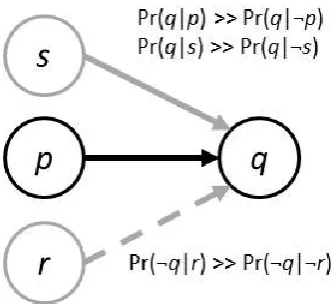
conditional probability is high, and prior knowledge in System 1, i.e., in LTM. Figure 1
shows a Bayes net with dependencies representing the conditionals Cp, Cs, and Cr. We begin
by looking at how these representations can account for explaining away inconsistency and
the suppression effect for MP. In doing so, we also address a few conceptual issues about the
interpretation of disablers in CBNs.
FIGURE 1 ABOUT HERE
Inconsistency and Suppression. So when we are told that Cp: If she has an essay to
write (p) she will study late in the library (q) and discover that p but ¬q, what do we do? An
obvious answer, following the logic of the example of Uranus in celestial mechanics, is to
hypothesize that there is an auxiliary assumption operative, i.e., Cr: If the library is open (r)
she will study late in the library (q), which is considered to be necessary but not sufficient for
q, i.e., Pr(¬q|¬r) is high but Pr(q|r) is not, and the library is closed (¬r). Given such a
parameterization of Figure 1, while Pr(q|p) is high Pr(q|p,¬r) is low. That is, assuming the
library is closed explains away the apparent counterexample. The same set up also explains
the suppression effect for MP when participants are given Cp, Cr and p as premises compared
to when they are given just Cp and p. Being told about Cr leads them to consider whether she
will study late in the library (q) when the library is closed (¬r) and she has an essay to write
(p), i.e., to evaluate Pr(q|p,¬r). Thus suppression effects for MP will arise when disablers are
explicitly represented.
In Byrne’s (1989) data, the probability of endorsing the MP inference for Cp in the
presence of a defeater, Cr, was around 30%, i.e. significantly above zero and significantly
closed or open (r), you can infer nothing about whether she studies late (q), which suggests
that at best an endorsement rate of 50% is predicted. It might be possible to improve LPs fit
to these data by counting the number of distinct defeaters, 𝑟𝑖 → 𝑎𝑏1, for a particular rule.
Presumably the more 𝑟𝑖 that are available for a particular abnormality proposition, 𝑎𝑏1, the
greater the level of suppression. However, Geiger and Oberauer (2007) have shown that the
frequency of defeaters or alternative causes matters more in suppressing inferences than the
range of different types of defeater or alternative cause (see also, Fernbach & Erb, 2013).
This finding is consistent with the probabilistic approach but not LP.
We just concluded that to explain suppression effects requires the explicit
representation of defeaters. However, this is contentious. The addition of the explicit edge for
Cr in Figure 1 to explain away the inconsistency may not be necessary because in the CBN
approach Cp is a statistical dependency, i.e., it is not inconsistent with the occurrence of a p
and ¬q counterexample. Indeed, the reason that Pr(q|p) < 1 is because of the assumed
existence of disablers like Cr. At least, this is the rationale behind the noisy OR
representation of alternative causes (Fernbach, Darlow, & Sloman, 2010, 2011; Pearl, 1988).
While alternative causes are explicitly represented as directed edges in a CBN, disablers are
only represented implicitly as probabilities less than one.
This approach represents a substantive psychological claim about the nature of the
representations underpinning human inference and action, one which we have argued is
unlikely to be true (Oaksford & Chater, 2010, 2013). Moreover, recently Fernbach and Erb
(2013) have proposed a CBN model of modus ponens in causal conditional reasoning where
disablers are represented explicitly as in Figure 1. Moreover, a similar CBN representation
has been proposed by Rottman and Hastie (2013) as a general approach to conditional
inference. So there is nothing inherent to the CBN approach that precludes the explicit
probability, e.g., the library is shut (Pr(¬r)), will rise on learning that she has an essay (p) but
she doesn’t study late in the library (¬q), thus explaining away the apparent counterexample.
While in broad agreement with these approaches, we have questioned Fernbach and
Erb’s (2013) approach in which all disablers are represented, at least all that a reasoner knows
about (Oaksford & Chater, 2013). We now briefly consider why. All disablers, or at least
those known to a reasoner, are represented in the CBN in Fernbach and Erb (2013) and in
Rottman and Hastie (2013) because Pr(q|p, ¬s), i.e., causal power,5 is treated as equal to 1
minus the aggregate disabling probability. Consequently, if there are no disablers this
probability is 1 and the cause will necessarily bring about its effect. This factor provides the
impetus to consider disablers. In the representation of Cp , Pr(q|p) = 1 and consequently a p
and ¬q observation is inconsistent with Cp. Cummins (1995) implicit suppression paradigm
provides good evidence that people do recruit and explicitly represent alternative causes and
defeaters in causal conditional inference even when presented with only a single conditional
premise, like Cp. However, we doubt that all known disablers are ever explicitly represented
as it would seem to place far too great a burden on working memory. Rather we have
suggested that they are made explicit as needed in the dynamically unfolding situations that
require agents to draw inferences to achieve their goals (Oaksford & Chater, 2013, pp.
369-370).
Perhaps someone’s goal is to find the girl referred to in Cp. They know Cp and are told
by the girl’s Mother that she has an essay to finish. They naturally infer that she’s in the
library probably without explicitly considering disablers. Considering explicit disablers
probably only happens if they subsequently learn ¬q. So on their way to the library they may
learn from a friend that, for example, the girl was seen on the other side of town to the
library. In order to guide further action to achieve the goal of finding the girl, our reasoner
then recruits Cr to explain away the apparent contradiction which leads them to consider
alternative locations where the girl may study when the library is closed. We would argue
that all of this reasoning is probabilistic, i.e., Cp is still regarded as a statistical dependency. A
reasoner’s impetus too explicitly represent the disabler comes not from the need to explain
away the inconsistency per se but from trying to achieve their goal. So attempting to explain
away the pand ¬q observation is more likely to achieve the goal of finding the girl, than
simply conceding that Cp is statistical and so there is no inconsistency. We are currently
exploring this more dynamic view of inference as belief revision (Oaksford & Chater 2013),
as are others (Hartmann & Rafie-Rad, 2012; Douven & Romeijn, 2011).
Learning and inconsistency. The fact that Cp is statistical and has presumably been
learnt from occasions when the girl has or does not have an essay to write and does or does
not study late in the library, provides an approach to inconsistency that LP cannot provide.
That is, one can learn from the occurrence of a p and ¬q observation that Pr(q|p) is lower than
one first thought. Of course, if uncertainty about Cp only derives from knowledge of
disablers, as in Fernback and Erb (2013) then this makes no sense. However, it seems far
more likely that we learn about statistical relations like Cp initially without explicit
knowledge of disablers, as in standard causal learning scenarios using contingency tables (for
a summary of such research, see, Hattori & Oaksford, 2007). This knowledge is then further
refined by uncovering disabling conditions. The latter process may not be obvious from
disablers like Cr which derive from the way libraries work and so can be inferred from
general knowledge. However, a disabler like if Coronation Street is on, she does not study
late in the library is specific to the girl and would also have to be learnt. It seems that this
more nuanced knowledge of her behavioural dispositions would have to be acquired later as it
If someone is ignorant of any disablers and cannot discover any in the current context,
then the p and ¬q counterexample can be treated as an observation and hence an opportunity
to learn about Pr(q|p). Many of the conditionals in which people are interested, like Cp,
express the habits, dispositions, intentions, and promises that underpin our folk psychological
understanding of each other and which enable us to predict and coordinate our behaviours in
the social world. Take one of the current author’s (MO) disposition to buy his morning coffee
at Pret a Manger on Euston Road whenever he goes to work, i.e., if Mike goes to work, he
buys his coffee at Pret on Euston Road. Now if he fails to buy his coffee at this coffee shop
one morning on his way to work, it is plausible that a myriad of possible disablers could be
listed to save him or an interested observer from contradiction. But ultimately unlike an
engineered causal mechanism like a car most of these defeaters are opaque not just to an
observer but to MO.6 In such a case, an observer must simply learn that MO’s disposition to
buy his morning coffee at Pret on Euston Road is less reliable than she first thought. Of
course, the converse is also true, successfully predicting that MO stopped for coffee at this
location today should be an occasion to learn that the disposition is more reliable.
Oaksford and Chater (2013) discuss the problems of dynamic inference where new
information may alter the original probability distribution. Specifically, they consider a
learning approach to explain the empirical data on the modus tollens inference (MT), i.e.,
with Cp as the conditional premise, a reasoner is given the new information that she did not
study late in the library and infers she did not have any essay to finish. However, in the above
example of looking for the girl the context is one in which it is known she had an essay to
finish and what the person looking for her now learns is the classic inconsistency that p, ¬q,
and 𝑝 → 𝑞 (see, Oaksford & Chater, 2013). Of course, this can be resolved by recourse to a
6 We remain neutral on whether subjective uncertainty arises here as a consequence of ignorance of the full
disabler. But one may just alter one’s degree of belief in the conditional premise.7 This
strategy implies that the original conditional probability, Pr0(q|p), is changed to a new
conditional probability, Pr1(q|p), which violates the invariance assumption for Bayesian
conditionalization (Jeffrey, 2004). Oaksford and Chater (2013) discuss the ramifications of
this violation at length but for now we just note how the new Pr1(q|p) may be learnt.
Oaksford and Chater (2013) showed how one can learn from the experience of the
inconsistency by using Bayesian learning to alter the degree of belief in Cp. This involves two
models represented as Bayes nets, one representing a dependence model and one representing
an independence model, familiar from Oaksford and Chater's (1994) optimal data selection
model. The counterexample is more probable in the independence model. Consequently, by
one iteration of Bayesian learning the probability associated with this conditional, Pr0(q|p),
which is also taken to be the probability of the dependence model, can be revised in a
coherent way to a new lower value. Importantly, Oaksford and Chater (2013) show that
revising the conditional probability in this way can provide much better model fits to the
canonical data on abstract conditional inference tasks (Schroyens & Schaeken, 2003). In such
tasks, using abstract material, it is implausible to hypothesize the people have access to
disablers.
These learning effects are mediated by System 1, which is responsible for acquiring
the dependencies and their associated strengths and so provide the building blocks of the
CBN representations people construct in WM, i.e., in System 2. This approach to
inconsistency is not available to LP which does not deal with how degrees of belief may be
updated.
Explaining away alternative causes. Ali, Chater, and Oaksford (2011)
demonstrated discounting effects for cases where a pair of conditionals describes convergent
7 Oaksford & Chater (2013) point out that this strategy implies that participants respond to the MT inference
causes for the same effect for which LP provides no explanation. In their experiments, they
presented participants with pairs of conditionals like Cpand Cs above, yielding two
conditionals, 𝑝 → 𝑞 and 𝑠 → 𝑞, where p and s are alternative causes for the effect q.
According to a probabilistic analysis (Morris & Larrick, 1995), discounting should be
observed. So, after learning that the effect has occurred, she is studying late in the library (q),
learning that one cause has occurred, e.g., she had an essay to write (p), should lead to
reductions in one's degree of belief that the other cause (s), she has a text book to read, has
occurred. In Ali et al’s (2011) experiments this is exactly what they observed. Participants’
degree of belief in s on being told that q and p had occurred was much lower than when they
were only told that q had occurred. The discounting inference, or explaining away, is a very
important novel contribution of the Bayesian approach (Chater, Goodman, Griffiths, Kemp,
Oaksford, & Tenenbaum, 2011).
This inference pattern cannot be captured by LP. Given two alternative conditionals
like Cpand Cs the minimal model that results from composition is simply the two
conditionals, 𝑝 → 𝑞 and 𝑠 → 𝑞. Learning q, as in an affirming the consequent inference (AC),
just licences the disjunctive conclusion, 𝑝 ∨ 𝑠, in which case nothing can be concluded
individually about p and s, which is why this case leads to fewer endorsements of the AC
inference (Byrne, 1989). Similarly, learning that s is true does not discount the possibility that
p is true. 𝑝 ∨ 𝑠 and 𝑝 ∧ 𝑠 are logically consistent. So still nothing can be concluded about p.
Learning s could only lead you to believe ¬p if 𝑝 ∨ 𝑠 were treated as exclusive-or but this pair
of conditionals, i.e., the premises, does not logically rule out the possibility that she has an
exam tomorrow and she has a textbook to read. Another possibility is that degrees of belief in
these cases are being calculated as logical probabilities where the possibilities a connective
does not rule out as false are treated as equiprobable. This is the approach adopted by the
Legrenzi, & Caverni, 1999), which Ali et al (2011) explicitly ruled out as a general account
of discounting and augmentation inferences using pairs of conditionals like these (see also,
Fernbach & Erb, 2013). In summary, LP would appear unable to account for discounting
alternative causes in causal conditional inference when two causes converge on an effect.
Summary. A probabilistic approach, in which conditionals are represented as
dependencies in causal Bayes nets can account for suppression effects (see also, Fernbach
and Erb, 2013), for learning that the conditional probability has changed (Oaksford & Chater,
2007, 2013) ), and for explaining away alternative causes (Ali et al, 2011). LP can explain
neither of the latter two observations in belief updating, nor can it explain the graded effects
observed in the explicit (Byrne, 1989) and in the implicit (Cummins, 1995) suppression
paradigm.
However, conceptually the LP and probabilistic accounts of non-monotonic reasoning
are not as distinct as these arguments portray (Pearl, 1988; Oaksford & Chater, 2007, pp.
115-118). Psychologically they both rely on accessing limited amounts of relevant
information about defeaters and alternative causes from long term memory, i.e., System 1,
and building a small scale model as the interpretation of the premises in System 2. Stenning
and van Lambalgen (2005) describe the process of constructing both a minimal model
interpretation in LP and a CBN interpretation as reasoning to an interpretation. It is
important to both accounts that once that interpretation is reached, no further information is
taken into account, i.e., the world of the model is closed (anything not explicitly represented
is assumed not to be the case in the situation being modelled). The inferences that these
interpretations licence only follow on this assumption. In particular, this assumption
underpins explaining away in Bayesian accounts (Morris & Larrick, 1995). The idea that we
reason only over a small scale model that provides an interpretation of the premises is of
next and final section, we offer some further speculations on how this idea may be part of the
solution to the problem of global computation.
Local and Global Computation
The goal of this paper has been to establish the credibility of single function dual process
theory as a psychological account of non-monotonicity in human reasoning and to argue that
it is a superior to attempts to apply logic programming approaches in artificial reasoning to
these data. Both LP and the probabilistic approaches, involve constructing small scale models
of conditional premises in System 2 and both require some global computation in System 1,
to decide on the most plausible disablers or alternative causes to include in a model. The LP
approach is to use abnormality propositions in order to maintain the consistency of System 2
and to render tractable the search for possible disablers in System 1. However, it does so at
the cost of psychological reality, i.e., how is what is normal and abnormal learned? With
respect to System 1, the probabilistic approach may not fare any better. Keeping System 1
probabilistically coherent would seem to involve maintaining a globally consistent joint
probability table for all the propositions in LTM. But this would involve computations every
bit as intractable as Reiter's M-operator. Consequently we appear to be on the horns of a
dilemma. We have argued that we require a probabilistic approach to explain all the forms of
belief revision that people engage in and to explain the empirical results but this leaves us no
better off in explaining how we do this against the background of the Quinean and isotropic
nature of human cognition.
While we do not suggest there are any easy solutions to these problems, we do think
that consideration of some recent philosophy of science (Cartwright, 1983, 1999; Hacking
properties that Fodor (1983, 2001) introduced in arguing that there was no theory of central
cognitive processes and hence of System 1.
Quine and Isotropy
In the section we look at the both these Fodorian properties in turn, starting with the
Quinean property. Why are central processes of belief fixation Quinean? Fodor argues that
there are various properties of these processes that can only be interpreted as implicating the
whole of our belief system. For example, the simplest revision is presumably the minimal one
that would cause the least changes in our overall system of beliefs. Moreover, the most
plausible defeater is again presumably the most likely one given everything we know. These
holistic properties are directly related to probabilistic versions of the Ramsey test in which
subjective conditional probabilities are determined by adding the antecedent to our stock of
beliefs and reading off the resulting probability of the consequent. This cognitive process
involves accommodating the antecedent by making minimal change to our existing beliefs.
Isotropy arises from the idea that in explaining a phenomenon or in working out how
to solve a problem everything we know is potentially relevant. Thus in explaining why the
car did not start when the key was turned we should not, for example, isolate our knowledge
of cars from celestial mechanics. After all it remains possible that the car didn't start after the
key was turned because a meteor smashed through the engine block. Our knowledge,
according to Fodor, cannot be organised in such a way that such long-distance dependencies
are impossible.
We now argue that these properties emanate from a philosophy of mind that closely
like Cartwright (1983, 1999) and Hacking (1983). After Cartwright, we refer to the view of
central processes that may emerge, as the dappled mind hypothesis (Cartwright, 1999).8
The dappled mind hypothesis.
Fodor (1983) is using an analogy between scientific inference and everyday inference in
describing the central cognitive system, i.e., the nature of System 1 processing. Prima facie it
seems that the notions of simplicity and plausibility people need can only be computed over
the whole of world knowledge and this will require a globally consistent System 1 that can
deliver to System 2 the most plausible information it needs to address its current inferential
goals. On this account, our world knowledge is construed like a globally consistent true
scientific theory. Cartwright (1999) refers to such an account as the fundamentalist position,
i.e., there is one coherent set of laws that, if known, would describe the whole world
accurately. Cartwright (1983, 1999) argues that this position is untenable. In particular she
argues that it is our specific models, which guide actions in the world, like building a laser,
that are the real candidates for truth and not theories. Most of the fundamental laws of
physics only apply all other things being right. That is, just like starting a car, turning the key
only works assuming the conditions are right and that no disablers are present. She also
argues that overarching theories, for example quantum theory, are not strictly true of the
world. Theory only really contacts the world via specific models that set various parameters
to certain values and ensures that various conditions are right. In this sense, models are the
prime candidate for truth not theories. Moreover, our models are frequently inconsistent with
each other. There are apparently, for example, several inconsistent models of the laser all of
which find application in predicting the behaviour of particular devices.
8 There is a certain irony in appealing to Cartwright's philosophy of science in the context of the arguments put
Cartwright's dappled world hypothesis is that while some parts of the world behave in
a law like manner others may not. Ian Hacking (1983, p. 219) put it as follows:
“God did not write a Book of Nature of the sort that the old Europeans imagined. He
wrote a Borgesian library, each book of which is as brief as possible, yet each book of
which is inconsistent with every other. No book is redundant. For every book there is
some humanly accessible bit of Nature such that that book, and no other, makes
possible the comprehension, prediction and influencing of what is going on.”
A slightly weaker more epistemological version of this hypothesis is that we can only ever
construct local models of bits of the world in order to predict and explain what is going on in
our immediate concrete context but can never hope to have an overarching consistent theory.
Our proposal is to take this epistemological view as an account of the central cognitive
system. That is, whether the world is dappled or not, we have a dappled mind.
The dappled mind hypothesis suggests that the limited models we construct in System
2 to guide our actions in the world take precedence, i.e., we are concerned in each context in
which we must act that they are as accurate as they can be to allow successful prediction and
action. So, inconsistencies must be repaired in our models by adding disablers or learning as
we have outlined. But our need to draw inferences about the world is generally context
bound. Models that work in one context may not work in another. The contents of System 1,
from which people build their local models, do not form an overarching theory each part of
which is consistent with every other part. That is, there is no imperative for the whole of a
cognitive agent’s world knowledge to hang together as a consistent whole. Given our
inability to do this for scientific theories it seems a big ask to expect this of the cognitive
system of individual agents. What is important is using whatever knowledge there is to hand
to build a model in System 2 that can be repaired to more accurately predict what is going on
However, constructing such models may not require computing intractable Quinean
and isotropic properties in System 1. The problems of bringing to mind relevant information
seems to underestimate the importance of the immediate concrete or deictic context in which
people must act and the fact that inferential behaviour is usually goal directed, as we argued
above. Most often, simply where we are provides a rich set of cues that bring to mind the
relevant information we need. Moreover, our goals in a context similarly cue the information
we need for their attainment. Indeed our goals are crucial for directing attention to the
relevant information within our deictic context which provides the cognitive context of most
of our inferential behaviour. That is, in most human reasoning the contents of our models in
System 2 are a function of what we need to attend to in our immediate context in order to
achieve our goals. Moreover, contra isotropy, most often people’s models are extremely
shallow and it is only our social embedding that allows us to transcend them not the isotropic
nature of the cognitive system.
For example, assume MO is in his study at home with the goal of getting to work,
which will involve using the car. His sub goal is to start the car, for which attending to its
colour or many other of its properties, is initially at least irrelevant. The physical presence of
the car, the key in his hand etc. are all concrete cues accessing information in System 1.
When he gets into his car he will turn the key without any consideration of possible defeaters
or alternative causes. Only if this action fails to produce the desired effect, the car does not
start, will he consider possible defeaters. These will already be prepotent in System 1
triggered by the deictic context he is in. If he considers, for example, that the battery is flat,
this will lead him to consider alternative causes, like bump starting. Note that the defeater
must come first as this determines his choice of alternative cause, hot wiring will not work
with a flat battery. If bump starting does not work then he will probably be stumped, i.e., this
attempting an impossible isotropic inference, he simply rings the AA (Automobile
Association, a UK based Roadside assistance scheme) to come and fix it. The fact that distant
pieces of knowledge may be relevant does not mean it makes sense for him to attempt to
establish their relevance. It may be that the reason his car is not starting is because of some
cosmic ray induced quantum effect in the complex computer system controlling the engine of
modern cars. Even if he had the relevant knowledge to establish this connection it would not
help to achieve his goal of getting to work. This goal is much more easily achieved by
contacting the AA and not taxing his limited cognitive resources any further. The knowledge
on which we rely to achieve our goals is not all inside our own heads, it is socially
distributed, and we use this fact to avoid unnecessary cognitive effort.
In summary, this section has been very brief and highly speculative and we have
introduced a range of issues that require a much more detailed treatment. However, we felt it
necessary to offer at least a glimpse of how we view the nature of System 1 and how it
interacts with System 2 that addresses, however superficially, the problems identified for
central processes by Fodor (1983). This is because Fodor (1983) was the point of departure
for our original critique of logicist cognitive science (Oaksford & Chater, 1991). As has been
argued in the philosophy of science, our models of the world parameterized to concrete
situations may be the primary candidates for truth and hence provide the principle guides to
successful action. These are constructed in System 2 and flexibly adjusted to match the
unfolding events about which we need to draw inferences by recruiting information from
System 1. While the current model in System 2 is consistent with the active parts of System 1
it seems unlikely that System 1 is a globally consistent system. Moreover, it seems unlikely
that the epistemological problems created by the putative Quinean and isotropic nature of
human reasoning are problematic for System 1. Properties like plausibility and relevance are
systems most people possess. This is not generally problematic for achieving our goals given
the social distribution of knowledge. Consequently, it may be that fixes to the technical frame
problem in AI like those offered by LP, need not be part of an eventual theory of human
reasoning.
Conclusion
In conclusion, probabilistic single function dual process theory provides a better
psychological account of non-monotonicity in human reasoning than recent attempts to apply
logic programming approaches in artificial intelligence to these data. LP only provides an
approach that avoids global processing in the one pscyhological task to which it has been
applied when all information about defeaters and alternative causes is explicit. To account for
implicit suppression tasks and to distinguish disablers from alternative causes requires access
to word knowledge. LP also is unlikely to be psychologically real, offering a solution to the
technical frame problem only if it assumed that all we have to do is index conditions as
abnormal. Like hash coding, LP provides no account of how these indices are learned.
Moreover, there are a range of inferences concerning conditionals to which LP cannot be
applied but for which a probabilistic approach using CBNs accounts naturally. However,
there are a range of problems about the nature of System 1 and its relation to System 2,
introduced by Fodor (1983), which remain problematic for both approaches. In a final
speculative section, we suggested that these may be less problematic for the actual, context
bound, and goal directed inferential behavior that guides our actions moment by moment in
the everyday world. While many problems remain, the probabilistic single function dual
processing approach remains the most promising account of the nonmonotonicity of human