using quantum well-like multiple emissive layer
structure
Ju-An Yoon
1, You-Hyun Kim
1, Nam Ho Kim
1, Seung Il Yoo
1, Sang Youn Lee
1, Fu Rong Zhu
2and Woo Young Kim
1*Abstract
In this study, the properties of blue organic light-emitting diodes (OLEDs), employing quantum well-like structure (QWS) that includes four different blue emissive materials of 4,4′-bis(2,2′-diphenylyinyl)-1,1′-biphenyl (DPVBi), 9,10-di(naphth-2-yl)anthracene (ADN), 2-(N,N-diphenyl-amino)-6-[4-(N,N-diphenyl amine)styryl]naphthalene (DPASN), and bis(2-methyl-8-quinolinolate)-4-(phenyl phenolato) aluminum (BAlq), were investigated. Conventional QWS blue OLEDs composed of multiple emissive layers and charge blocking layer with lower highest occupied molecular orbital (HOMO)-lowest unoccupied molecular orbital (LUMO) energy level, and devices with triple emissive layers for more significant hole-electron recombination and a wider region for exciton generation were designed. The properties of triple emissive layered blue OLEDs with the structure of indium tin oxide (ITO) /N,N′-diphenyl-N,N′-bis(1-naphthyl-phenyl)-(1,1′-biphenyl)-4,4′-diamine (NPB) (700Ǻ)/X (100Ǻ)/BAlq (100Ǻ)/X (100Ǻ)/4,7-diphenyl-1,10-phenanthroline (Bphen) (300Ǻ)/lithium quinolate (Liq) (20Ǻ)/aluminum (Al) (1,200Ǻ) (X = DPVBi, ADN, DPASN) were examined. HOMO-LUMO energy levels of DPVBi, ADN, DPASN, and BAlq are 2.8 to 5.9, 2.6 to 5.6, 2.3 to 5.2, and 2.9 to 5.9 eV, respectively. The OLEDs with DPASN/BAlq/DPASN QWS with maximum luminous efficiency of 5.32 cd/A was achieved at 3.5 V.
Keywords:Blue organic light-emitting diodes; HOMO-LUMO; QWS
Background
Since the report by Tang and VanSlyke on organic light-emitting diodes (OLEDs), [1,2] OLEDs have become a popular research subject due to its several technical advantages such as reduced power consumption, com-patibility with flexible substrates, high color rendering index, high contrast, and wide viewing angle. OLEDs have emerged as strong candidates for next-generation flat panel displays and solid-state lighting sources [3-6]. Many progresses have been made in improving the per-formance of OLEDs, including high power efficiency tandem organic light-emitting diodes based on bulk heterojunction organic bipolar charge generation layer [7]. However, improving the performance of blue OLEDs still remains as an open challenge [8-10]. Various methods
have been developed to optimize blue OLED's perform-ance. Such methods include replacing emitters from fluorescent to phosphorescent materials [11], including balancing the carrier ratio in the emissive layer (EML) [12], designing a better surface texture for improving external quantum efficiency [13], and reduced effi-ciency roll-off in OLEDs at ultrahigh current densities by suppression of triplet-polaron quenching [14].
Among various methods for enhanced efficiency, the QWS has proved to be an effective approach for high device performance [15,16], by confining charge carriers and exciton within the multi-emitting layer. Thus, the charge carrier recombination efficiency and exciton for-mation probability can be beneficially enhanced [17]. The organic molecules were insufficiently restricted by Van der Waals force among molecules in the organic quantum well. The main features of QWS were high
* Correspondence:[email protected]
1
Department of Green Energy & Semiconductor Engineering, Hoseo University, Asan 336-795, South Korea
Full list of author information is available at the end of the article
electroluminescence (EL) efficiency [18], tunable EL zone [19], and great carrier balance [20-23].
In this study, the performance of blue OLEDs with multiple emissive layers 4,4′-bis(2,2′-diphenylyinyl)-1, 1′-biphenyl (DPVBi), 9,10-di(naphth-2-yl)anthracene (ADN), 2-(N,N-diphenyl-amino)-6-[4-(N,N-diphenyl amine)styryl] naphthalene (DPASN), and bis(2-methyl-8-quinolinolate)-4-(phenyl phenolato) aluminum (BAlq) was investigated. These emissive materials have different highest occupied molecular orbital (HOMO)-lowest unoccupied molecular orbital (LUMO) energy levels. Emissive layers with different orders in the QWS-type OLEDs were investigated and op-timized to achieve the best device performances. Luminous efficiency andI-V-Lcharacteristics were observed consider-ing the effects of QWS and the variation of recombination region in EML.
Experiment
Indium tin oxide (ITO)-coated glass was cleaned in ultrasonic bath by regular sequences: in acetone, metha-nol, diluted water, and isopropyl alcohol. Hereafter, pre-cleaned ITO was treated by O2plasma under condition of 2 × 10⁻²Torr and 125 W for 2 min. Blue OLEDs were
fabricated using the high vacuum (1.0 × 10⁻⁶ Torr) ther-mal evaporation andN,N′-diphenyl-N,N′ -bis(1-naphthyl-phenyl)-(1,1′-biphenyl)-4,4′-diamine (NPB), BAlq, DPVBi, ADN, DPASN, 4,7-diphenyl-1,10-phenanthroline (Bphen), lithium quinolate (Liq), and aluminum (Al) were depos-ited at different evaporation rates of 1.0, 0.5, 0.5, 0.5, 0.5, 1.0, 0.1, 5.0Ǻ/s.
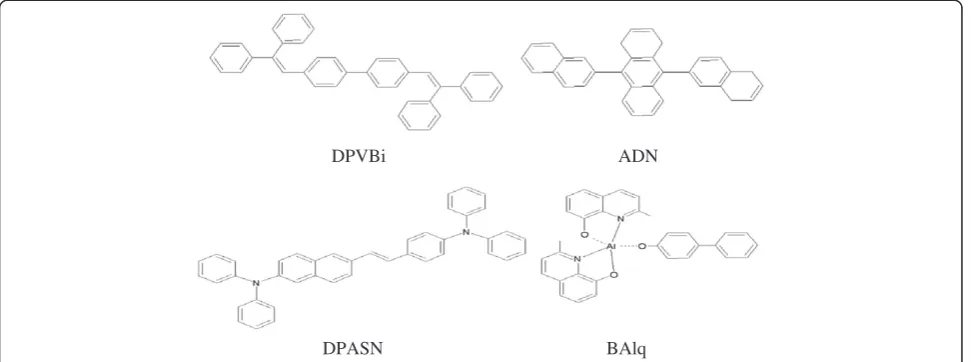
[image:2.595.57.543.90.271.2]Figure 1 shows the molecular structures of the differ-ent blue chromophores used in the OLED devices. We fabricated two types of blue OLEDs. The first type has a conventional device structure of ITO/NPB/DPVBi or ADN or DPASN/BAlq/Bphen/Liq/Al, where ITO, NPB, DPVBi (or ADN or DPASN), and Al are the anode, hole transporting layer, emissive layer, electron transporting layer, and cathode, respectively. The other type of blue OLEDs with a structure of ITO/NPB/DPVBi or ADN or DPASN/BAlq/DPVBi or ADN or DPASN/Bphen/Liq/Al was also fabricated for comparison studies. A list of OLEDs with different layer structures is summarized in Table 1.
With various DC voltage bias, the optical and electrical properties of blue OLEDs such as the current density, lumi-nance, power efficiency, luminous efficiency, Commission
DPVBi ADN
DPASN BAlq
[image:2.595.57.546.623.733.2]Figure 1Molecular structures of different blue emissive materials used in this work.
Table 1 Layer structures of OLED devices A, B, C, and D
Structure
Device A ITO (1,800Ǻ)/NPB (700Ǻ)/DPVBi (300Ǻ)/Bphen (300Ǻ)/Liq (20Ǻ)/Al (1,200Ǻ)
Device B ITO (1,800Ǻ)/NPB (700Ǻ)/ADN (300Ǻ)/Bphen (300Ǻ)/Liq (20Ǻ)/Al (1,200Å)
Device C ITO (1,800Ǻ)/NPB (700Ǻ)/DPASN (300Ǻ)/Bphen (300Ǻ)/Liq (20Ǻ)/Al (1,200Ǻ)
Device D ITO (1,800Ǻ)/NPB (700Ǻ)/BAlq (300Ǻ)/Bphen (300Ǻ)/Liq (20Ǻ)/Al (1,200Ǻ)
Device E ITO (1,800Ǻ)/NPB (700Ǻ)/DPVBi (100Ǻ)/BAlq (100Ǻ)/DPVBi (100Ǻ)/Bphen (300Ǻ)/Liq (20Ǻ)/Al (1,200Ǻ)
Device F ITO (1,800Ǻ)/NPB (700Ǻ)/ADN (100Ǻ)/BAlq (100Ǻ)/ADN (100Ǻ)/Bphen (300Ǻ)/Liq (20Ǻ)/Al (1,200Ǻ)
Device G ITO (1,800Ǻ)/NPB (700Ǻ)/DPASN (100Ǻ)/BAlq (100Ǻ)/DPASN (100Ǻ)/Bphen (300Ǻ)/Liq (20Ǻ)/Al (1,200Ǻ)
Yoonet al. Nanoscale Research Letters2014,9:191 Page 2 of 7
Internationale deL'eclairage (CIExy) coordinates, and elec-troluminescence spectra were measured with Keithley 238 (Seoul, Korea), LMS PR-650 spectrophotometer and color-imeter (Photo Research Inc., CA, USA) and the IVL system (LMS Inc., Gyeonggi-do, Korea).
Results and discussion
Figure 2a shows the current density-voltage characteris-tics measured for each conventional blue OLED devices. Device C has the highest current density, and its EML consists of DPASN which is a p-type emitting material with a higher hole mobility; device B, which also had a p-type material, shows the second highest current dens-ity device. However, device D with an n-type emitting
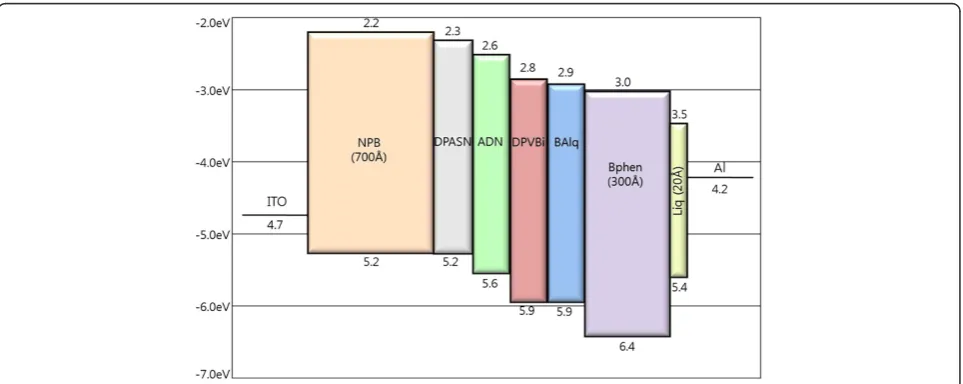
[image:3.595.60.539.89.276.2]material of BAlq shows the lowest current density. Con-sequently, we realized that a p-type semiconductor has more electron affinity than a n-type semiconductor [24]. Figure 2b shows the current density-voltage characteris-tics measured for each QWS triple emissive layer blue OLED device. Devices E, F, and G actually have similar current density characteristic, and this phenomenon is caused by different charge injection barriers between emitting materials. The energy band diagrams of devices A to G are shown in Figure 3. Although it is not so sig-nificant to compare other QWS blue OLED devices, the device G including DPASN shows the highest current density at 8 V because the hole and electron injection barriers of device G were higher than those of another
[image:3.595.58.540.524.716.2]Figure 2Current density-voltage characteristics.Measured for(a)conventional blue OLED devices A, B, C, and D and(b)OLEDs E, F, and G with QWS multiple emissive layers.
devices. As a result, the charge flow of charge injection barriers are interrupted, in turn decreasing its current density. Current densities of QWS blue OLED devices E, F, and G were lower than that of conventional OLED de-vices A, B, and C because electrons and holes are con-fined in the QWS which could possibly inhibit the current flow in EML.
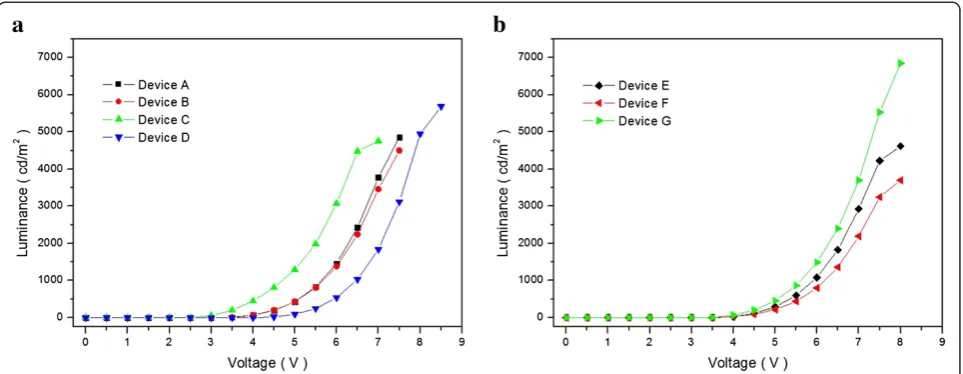
Figure 4a,b shows the luminance-voltage (L-V) charac-teristics of conventional blue OLEDs and QWS multi-emissive layer blue OLEDs. Conventional blue OLEDs have higher luminance than QWS blue OLEDs. This is because QWS blue OLEDs consist of p-type emissive materials of DPVBi, ADN, and DPASN, and n-type sive material of BAlq together. Consequently, n-type emis-sive materials influence on luminance much more than p-type emissive material although p-type emissive ma-terials tend to have a higher luminance characteristic. Table 2 summarizes the luminance of each blue OLED device measured at 5, 6, and 7 V.
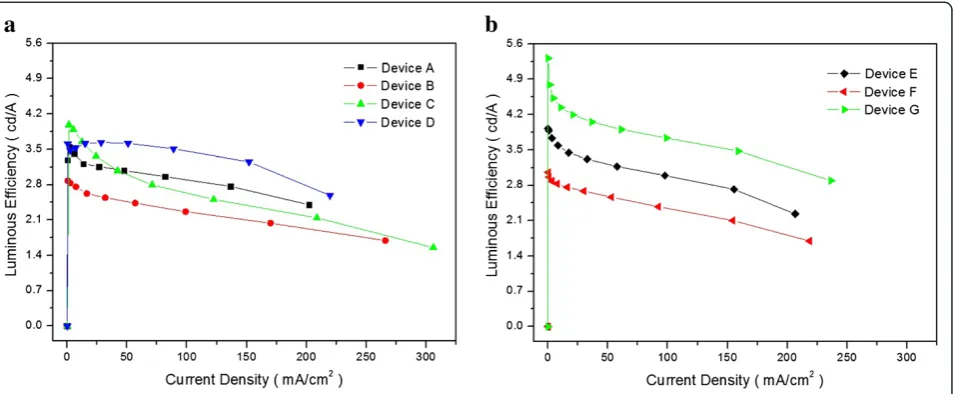
Figure 5a,b shows the plot of luminous efficiency ver-sus current density of conventional blue OLED device and QWS multi-emissive blue OLED devices. Table 3
summarizes the luminous efficiency of each device ran-ging from 50 to 150 mA/cm2. Luminous efficiency of QWS blue OLED devices is higher than that of conven-tional OLED devices. This phenomenon caused by emis-sive region of QWS OLED was evenly formed by DPVBi, ADN, DPASN, and BAlq. As a result, the power efficiency was enhanced because ADN and BAlq were emissive at different wavelengths. However, devices including DPASN show remarkable enhancement of efficiency. This can be explained by depth of QWS ac-cording to the difference of HOMO-LUMO energy level of emissive materials. HOMO and LUMO differ-ence of DPVBi, BAlq, AND, and BAlq was 0, 0.1, 0.3, and 0.3 eV, respectively. This HOMO and LUMO level difference is not enough to confine charges and excitons in the emissive layer. Therefore, it was not enough to enhance luminous efficiency of OLED de-vices. However, when DPASN was used, luminous ef-ficiency remarkably improved because HOMO and LUMO level difference of QWS OLED device was 0.7 and 0.6 eV between DPASN and BAlq. Therefore, QWS OLED devices need enough intermolecular HOMO and LUMO level difference of more than at least 0.3 eV.
The depth of QWS according to the difference of HOMO-LUMO energy level of emissive materials was concerned with the performance of the OLED. It is shown that the performance of OLEDs changes according to the depth of QWS (Figure 6). Figure 6 shows the plot of exter-nal quantum efficiency (EQE) as a function of current density for conventional OLEDs and QWS OLEDs. EQEs
of OLED devices measured at 100 mA/cm2were 2.71%,
[image:4.595.58.540.89.276.2]2.21%, 1.99%, 1.75%, 2.53%, 1.81%, and 2.76%, respectively. QWS OLEDs having DPASN demonstrated a 38% en-hancement in EQE. However, if QWS OLED devices in-clude ADN and DPVBi, the EQE did not change or
[image:4.595.57.290.622.733.2]Figure 4Luminance-voltage characteristics. (a)Conventional OLED devices A, B, C, and D and(b)QWS OLED devices E, F, and G.
Table 2 Luminance of OLED devices measured at 5 to 7 V
5 V 6 V 7 V
Device A 432.5 cd/m2 1,461 cd/m2 3,777 cd/m2
Device B 431.3 cd/m2 1,384 cd/m2 3,460 cd/m2
Device C 1,296 cd/m2 3,071 cd/m2 4,750 cd/m2
Device D 89.17 cd/m2 538.6 cd/m2 1,840 cd/m2
Device E 291.6 cd/m2 1,083 cd/m2 2,925 cd/m2
Device F 216.9 cd/m2 801.1 cd/m2 2,192 cd/m2
Device G 454.9 cd/m2 1,489 cd/m2 3,696 cd/m2
Yoonet al. Nanoscale Research Letters2014,9:191 Page 4 of 7
decrease. As mentioned before, when using DPASN, EQE enhances because the depth of QWS OLED device is enough for 0.7 and 0.6 eV. If QWS OLED devices include ADN and DPVBi, the depth of QWS was not enough to enhance EQE, and the emission region was formed at BAlq with lower EQE. Therefore, the EQE of OLED de-vices was decreased.
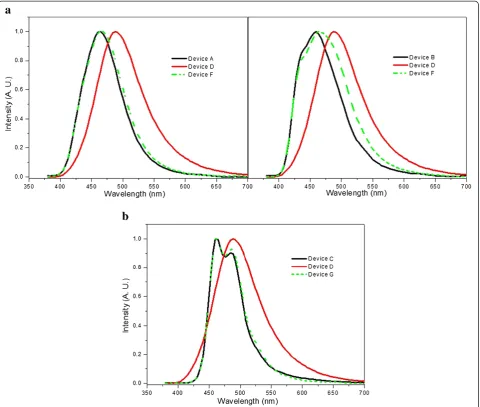
Figure 7 shows the EL spectra of conventional OLED devices and QWS OLED devices at 5 V. We know that if QWS OLED devices include ADN and DPVBi, the full width at half maximum (FWHM) of EL spectra was in-creased. We can observe this result in Figure 7a,b. As the result demonstrates, the emission region formed at BAlq. However, when using DPASN at QWS OLED, the EL spectra remained almost the same.
Conclusions
Blue OLED with triple emissive layer structure achieved lu-minous efficiency of 5.23 cd/A at 3.5 V, which is 36% higher
[image:5.595.62.539.89.286.2]than that of the conventional blue OLEDs. Obviously, the quantum well-like structure is favorable for hole-electron recombination for efficient exciton generation in the mul-tiple emissive layers of DPVBi, ADN, and DPASN with BAlq in the device. There was no significant improvement in the luminous efficiency (only about 3% and 4%) when DPVBi and ADN were used as the additional emitting layer to form a quantum well-like structure; a 36% improvement in luminous efficiency was realized in DPASN/BAlg/DPASN blue OLEDs. This result shows that blue OLEDs can only improve luminous efficiency under proper difference in HOMO and LUMO energy level between the central and surrounding emitting layers. The effect of layer thickness and combination of different emissive layers on charge
[image:5.595.306.539.538.706.2]Figure 5Luminous efficiencies. (a)Conventional OLED devices A, B, C, and D and(b)QWS OLED devices E, F, and G as a function of the current density.
Table 3 Luminous efficiency of OLED devices measured at different current densities of 50 to 150 mA/cm2
50 mA/cm2 100 mA/cm2 150 mA/cm2
Device A 3.01 cd/A 2.86 cd/A 2.57 cd/A
Device B 2.48 cd/A 2.19 cd/A 2.14 cd/A
Device C 2.93 cd/A 2.65 cd/A 2.31 cd/A
Device D 3.62 cd/A 3.38 cd/A 3.31 cd/A
Device E 3.24 cd/A 2.85 cd/A 2.84 cd/A
Device F 2.62 cd/A 2.23 cd/A 2.21 cd/A
Device G 3.97 cd/A 3.64 cd/A 3.60 cd/A
[image:5.595.55.291.622.732.2]carrier transport mechanism from the quantum well-like and the blue emitting layer based on space charge lim-ited current will be further examined.
Competing interests
The authors declare that they have no competing interests.
Authors’contributions
JY and YK conceived and designed the experiments. JY and NHK carried out the experiments with contributions from SYL. FRZ designed and synthesized the materials of OLEDs. SIY carried out the characterization of devices. YK supervised the work. JY and WYK wrote the manuscript. All authors read and approved the final manuscript.
Acknowledgements
This work was supported by the Nano-Convergence Foundation (Project Number: B-0030016) funded by the Ministry of Education, Science and Technology (MEST, Korea) and the Ministry of Knowledge Economy (MKE, Korea).
Author details
1Department of Green Energy & Semiconductor Engineering, Hoseo
University, Asan 336-795, South Korea.2Department of Physics, Hong Kong Baptist University, Hong Kong, China.
Received: 7 February 2014 Accepted: 2 April 2014 Published: 24 April 2014
References
1. Tang CW, VanSlyke SA:Organic electroluminescent diodes.Appl Phys Lett
1987,51:913.
2. Tatsuo M, Takaaki I, Teruyoshi Mizutani J:Electroluminescent properties of organic light-emitting diodes with blue-emitting Alq.Photopolym Sci Technol2004,17:2.
3. Reineke S, Lindner F, Schwartz G, Seidler N, Walzer K, Lüssem B, Leo K:
White organic light-emitting diodes with fluorescent tube efficiency.
Nature2009,59:234.
[image:6.595.59.540.89.496.2]4. Gu G, Burrows PE, Venkatesh S, Forrest SR, Thompson ME:Vaccum-deposited, nonpolymeric flexible organic light-emitting devices.Opt Lett1997,22:172.
Figure 7A comparison of EL spectra measured for conventional OLEDs and QWS OLEDs at 5 V (a, b).
Yoonet al. Nanoscale Research Letters2014,9:191 Page 6 of 7
7. Chen YH, Chen JS, Ma DG, Yan DH, Wang LX, Zhu FR:High power efficiency tandem organic light-emitting diodes based on bulk heterojunction organic bipolar charge generation layer.Appl Phys Lett2011,98:243309. 8. D'Andrade BW, Forrest SR:White organic light-emitting devices for solid-state
lighting.Adv Mater (Weinheim, Ger)2004,16:1585.
9. Krummacher BC, Choong VE, Mathai MK, Choulis SA, So F, Jermann F, Fiedler T, Zachau M:Highly efficient white organic light-emitting diode.
Appl Phys Lett2006,88:113506.
10. D'Andrade BW, Holmes RJ, Forrest SR:Efficient organic
electrophosphorescent white-light-emitting device with a triple doped emissive layer.Adv Mater (Weinheim, Ger)2004,16:624.
11. Shinar J:Organic Light-Emitting Devices.New York: Springer; 2004. 12. Gautier-Thianche E, Sentein C, Lorin A, Denis C, Raimond P, Nunzi JM:Effect
of coumarin on blue light-emitting diodes based on carbazol polymers.
J Appl Phys1998,83:4236.
13. Hubert C, Fiorini-Debuisschert C, Hassiaoui I, Rocha L, Raimond P, Nunzi JM:
Emission properties of an organic light-emitting diode patterned by a photoinduced autostructuration process.Appl Phys Lett2005,87:191105. 14. Zang FX, Sum TC, Huan ACH, Li TL, Li WL, Zhu FR:Reduced efficiency roll-off
in phosphorescent organic light emitting diodes at ultrahigh current densities by suppression of triplet-polaron quenching.Appl Phys Lett
2008,93:023309.
15. Kim SH, Jang J, Hong JM, Lee JY:High efficiency phosphorescent organic light emitting diodes using triplet quantum well structure.Appl Phys Lett
2007,90:173501.
16. Liu SM, Li B, Zhang LM, Song H, Jiang H:Enhanced efficiency and reduced roll-off in nondoped phosphorescent organic light-emitting devices with triplet multiple quantum well structures.Appl Phys Lett2010,97:083304. 17. Zhao J, Junsheng Y, Zhang L, Wang J:Non-doped phosphorescent white
organic light-emitting devices with a quadruple-quantum-well structure.
Physica B2012,407:2753.
18. Ohmori Y, Fujii A, Uchida M, Morishima C, Yoshino K:Fabrication and characteristics of 8‐hydroxyquinoline aluminum/aromatic diamine organic multiple quantum well and its use for electroluminescent diode.
Appl Phys Lett1993,62:3250.
19. Qiu Y, Gao Y, Wang L, Wei P, Duan L, Zhang D, Dong G:High-efficiency organic light-emitting diodes with tunable light emission by using aromatic diamine/5,6,11,12-tetraphenylnaphthacene multiple quantum wells.Appl Phys Lett2002,81:3540.
20. Qiu Y, Gao Y, Wei P, Wang L:Organic light-emitting diodes with improved hole-electron balance by using copper phthalocyanine/aromatic diamine multiple quantum wells.Appl Phys Lett2002,80:2628.
21. Song SF, Zhao DW, Xu Z, Xu XR:Energy transfer in organic quantum well structures.Acta Phys Sin2007,56:3499.
22. Zhu HN, Xu Z, Zhao SL, Zhang FJ, Kong C, Yan G, Gong W:Influence of well structure on efficiency of organic light-emitting diodes.Acta Phys Sin2010,59:8093.
23. Jian Z, Juan G, Zhuo G, Ke D, Jiule C:An organic light-emitting device with ultrathin quantum-well structure as light emitting layer.Opt Rev2011,
18:394.
24. Culligan W, Chen AC-A, Wallace JU, Klubek KP, Tang CW, Chen SH:Effect of hole mobility through emissive layer on temporal stability of blue organic light-emitting diodes.Adv Funct Mater2006,16:1481.
doi:10.1186/1556-276X-9-191
Cite this article as:Yoonet al.:Highly efficient blue organic light-emitting diodes using quantum well-like multiple emissive layer structure.Nanoscale Research Letters20149:191.
Submit your manuscript to a
journal and benefi t from:
7 Convenient online submission
7 Rigorous peer review
7 Immediate publication on acceptance
7 Open access: articles freely available online
7 High visibility within the fi eld
7 Retaining the copyright to your article