BIROn - Birkbeck Institutional Research Online
Chen, Taolue and Chen, Y. and Hague, M. and Lin, A.W. and Wu, Z. (2018)
What is decidable about string constraints with the ReplaceAll function.
Proceedings of the ACM on Programming Languages 2 (POPL), ISSN
2475-1421.
Downloaded from:
Usage Guidelines:
Please refer to usage guidelines at
or alternatively
3
ReplaceAll Function (Technical Report)
TAOLUE CHEN,
Birkbeck, University of London, United KingdomYAN CHEN,
State Key Laboratory of Computer Science, Institute of Software, Chinese Academy of Sciences, China and University of Chinese Academy of Sciences, ChinaMATTHEW HAGUE,
Royal Holloway, University of London, United KingdomANTHONY W. LIN,
University of Oxford, United KingdomZHILIN WU,
State Key Laboratory of Computer Science, Institute of Software, Chinese Academy of Sciences,China
The theory of strings with concatenation has been widely argued as the basis of constraint solving for verifying string-manipulating programs. However, this theory is far from adequate for expressing many string constraints that are also needed in practice; for example, the use of regular constraints (pattern matching against a regular expression), and the string-replace function (replacing either the first occurrence or all occurrences of a “pattern” string constant/variable/regular expression by a “replacement” string constant/variable), among many others. Both regular constraints and the string-replace function are crucial for such applications as analysis of JavaScript (or more generally HTML5 applications) against cross-site scripting (XSS) vulnerabilities, which motivates us to consider a richer class of string constraints. The importance of the string-replace function (especially the replace-all facility) is increasingly recognised, which can be witnessed by the incorporation of the function in the input languages of several string constraint solvers.
Recently, it was shown that any theory of strings containing the string-replace function (even the most restricted version where pattern/replacement strings are both constant strings) becomes undecidable if we do not impose some kind of line (aka acyclicity) restriction on the formulas. Despite this, the straight-line restriction is still practically sensible since this condition is typically met by string constraints that are generated by symbolic execution. In this paper, we provide the first systematic study of straight-line string constraints with the string-replace function and the regular constraints as the basic operations. We show that a large class of such constraints (i.e. when only a constant string or a regular expression is permitted in the pattern) is decidable. We note that the string-replace function, even under this restriction, is sufficiently powerful for expressing the concatenation operator and much more (e.g. extensions of regular expressions with string variables). This gives us the most expressive decidable logic containing concatenation, replace, and regular constraints under the same umbrella. Our decision procedure for the straight-line fragment follows an automata-theoretic approach, and is modular in the sense that the string-replace terms are removed one by one to generate more and more regular constraints, which can then be discharged by the state-of-the-art string constraint solvers. We also show that this fragment is, in a way, a maximal decidable subclass of the
Authors’ addresses: Taolue Chen, Department of Computer Science and Information Systems, Birkbeck, University of
London, Malet Street, London, WC1E 7HX, United Kingdom, [email protected]; Yan Chen, State Key Laboratory of
Computer Science, Institute of Software, Chinese Academy of Sciences, China , University of Chinese Academy of Sciences,
China; Matthew Hague, Department of Computer Science, Royal Holloway, University of London, Egham Hill, Egham,
Surrey, TW20 0EX, United Kingdom, [email protected]; Anthony W. Lin, Department of Computer Science,
University of Oxford, Wolfson Buildin, Parks Road, Oxford, OX1 3QD, United Kingdom, [email protected]; Zhilin
Wu, State Key Laboratory of Computer Science, Institute of Software, Chinese Academy of Sciences, China.
Permission to make digital or hard copies of all or part of this work for personal or classroom use is granted without fee
provided that copies are not made or distributed for profit or commercial advantage and that copies bear this notice and the
full citation on the first page. Copyrights for components of this work owned by others than the author(s) must be honored.
Abstracting with credit is permitted. To copy otherwise, or republish, to post on servers or to redistribute to lists, requires
prior specific permission and /or a fee. Request permissions from [email protected].
© 2018 Copyright held by the owner/author(s). Publication rights licensed to the Association for Computing Machinery.
2475-1421/2018/1-ART3
https://doi.org/10.1145/3158091
straight-line fragment with string-replace and regular constraints. To this end, we show undecidability results for the following two extensions: (1) variables are permitted in the pattern parameter of the replace function, (2) length constraints are permitted.
CCS Concepts: •Theory of computation→Automated reasoning;Verification by model checking;
Program verification;Program analysis;Logic and verification; Complexity classes;
Additional Key Words and Phrases: String Constraints, ReplaceAll, Decision Procedures, Constraint Solving, Straight-Line Programs
ACM Reference Format:
Taolue Chen, Yan Chen, Matthew Hague, Anthony W. Lin, and Zhilin Wu. 2018. What Is Decidable about String Constraints with the ReplaceAll Function (Technical Report).Proc. ACM Program. Lang.2, POPL, Article 3 ( January 2018),36pages.https://doi.org/10.1145/3158091
1 INTRODUCTION
The problem of automatically solving string constraints (aka satisfiability of logical theories over
strings) has recently witnessed renewed interests [Abdulla et al. 2017,2014;Bjørner et al. 2009;
D’Antoni and Veanes 2013;Hooimeijer et al. 2011;Kiezun et al. 2012;Liang et al. 2014;Lin and
Barceló 2016;Saxena et al. 2010;Trinh et al. 2014,2016;Veanes et al. 2012;Wang et al. 2016;Yu et al.
2014;Zheng et al. 2013] because of important applications in the analysis of string-manipulating
programs. For example, program analysis techniques like symbolic execution [Cadar et al. 2006;
Godefroid et al. 2005;King 1976;Sen et al. 2013] would systematically explore executions in a
program and collect symbolic path constraints, which could then be solved using a constraint
solver and used to determine which location in the program to continue exploring. To successfully
apply a constraint solver in this instance, it is crucial that the constraint language precisely models
the data types in the program, along with the data-type operations used. In the context of
string-manipulating programs, this could include concatenation, regular constraints (i.e. pattern matching
against a regular expression), string-length functions, and the string-replace functions, among
many others.
Perhaps the most well-known theory of strings for such applications as the analysis of
string-manipulating programs is the theory of strings with concatenation (akaword equations), whose
decidability was shown by Makanin [Makanin 1977] in 1977 after it was open for many years. More
importantly, this theory remains decidable even when regular constraints are incorporated into
the language [Schulz 1990]. However, whether adding the string-length function preserves the
decidability remains a long-standing open problem [Büchi and Senger 1990;Ganesh et al. 2012].
Another important string operation—especially in popular scripting languages like Python,
JavaScript, and PHP—is thestring-replace function, which may be used to replace either thefirst
occurrence orall occurrences of a string (a string constant/variable, or a regular expression)
by another string (a string constant/variable). The replace function (especially the replace-all
functionality) is omnipresent in HTML5 applications [Lin and Barceló 2016;Trinh et al. 2016;Yu
et al. 2014]. For example, a standard industry defense against cross-site scripting (XSS) vulnerabilities
includes sanitising untrusted strings before adding them into the DOM (Document Object Model)
or the HTML document. This is typically done by various metacharacter-escaping mechanisms
(see, for instance, [Hooimeijer et al. 2011;Kern 2014;Williams et al. 2017]). An example of such a
mechanism is backslash-escape, which replacesevery occurrenceof quotes and double-quotes (i.e.
'and") in the string by\'and\". In addition to sanitisers, common JavaScript functionalities likedocument.write()andinnerHTMLapply animplicit browser transduction— which decodes
HTML codes (e.g.'is replaced by') in the input string — before inserting the input string
string-replace function. Moreover, although these examples replace constants by constants, the
popularity of template systems such as Mustache [Wanstrath 2009] and Closure Templates [Google
2015] demonstrate the need for replacements involving variables. Using Mustache, a web-developer,
for example, may define an HTML fragment with placeholders that is instantiated with user data
during the construction of the delivered page.
Example 1.1. We give a simple example demonstrating a (naive) XSS vulnerability to illustrate
the use of string-replace functions. Consider the HTML fragment below.
<h1> User <span onMouseOver="popupText('{{bio}}')">{{userName}}</span> </h1>
This HTML fragment is a template as might be used with systems such as Mustache to display
a user on a webpage. For each user that is to be displayed – with their username and
biogra-phy stored in variablesuserandbiorespectively – the string{{userName}}will be replaced by
userand the string{{bio}}will be replaced bybio. For example, a userAmeliawith biography
Amelia was born in 1979...would result in the HTML below.
<h1> User
<span onMouseOver="popupText('Amelia was born in 1979...')"> Amelia </span> </h1>
This HTML would displayUser Amelia, and, when the mouse is placed overAmelia, her biography
would appear, thanks to theonMouseOverattribute in thespanelement.
Unfortunately, this template could be insecure if the user biography is not adequately sanitised:
A user could enter a malicious biography, such as'); alert('Boo!'); alert('which would
cause the following instantiation of thespanelement1.
<span onMouseOver="popupText(''); alert('Boo!'); alert('')">
Now, when the mouse is placed over the user name, the malicious JavaScriptalert('Boo!')is
executed.
The presence of such malicious injections of code can be detected using string constraint solving
and XSSattack patternsgiven as regular expressions [Balzarotti et al. 2008;Saxena et al. 2010;Yu
et al. 2014]. For our example, given an attack patternP and templatetemp, we would generate the
constraint
x1=replaceAll(temp,{{userName}},user) ∧x2=replaceAll(x1,{{bio}},bio) ∧x2∈P
which would detect if the HTML generated by instantiating the template is susceptible to the attack
identified byP. □
In general, the string-replace function has three parameters, and in the current mainstream
language such as Python and JavaScript,all of the three parameters can be inserted as string variables.
As result, when we perform program analysis for, for instance, detecting security vulnerabilities as
described above, one often obtains string constraints of the formz=replaceAll(x,p,y), wherex,y
are string constants/variables, andpis either a string constant/variable or a regular expression. Such
a constraint means thatzis obtained by replacing all occurrences ofpinxwithy. For convenience,
we callx,p,yas thesubject, thepattern, and thereplacementparameters respectively.
ThereplaceAllfunction is a powerful string operation that goes beyond the expressiveness
of concatenation. (On the contrary, as we will see later, concatenation can be expressed by the
replaceAllfunction easily.) It was shown in a recent POPL paper [Lin and Barceló 2016] that any theory of strings containing the string-replace function (even the most restricted version
1
Readers familiar with Mustache and Closure Templates may expect single quotes to be automatically escaped.
How-ever, we have tested our example with the latest versions of mustache.js [Lehnardt and contributors 2015] and Closure
where pattern/replacement strings are both constant strings) becomes undecidable if we do not
impose some kind ofstraight-line restriction2on the formulas. Nonetheless, as already noted in
[Lin and Barceló 2016], the straight-line restriction is reasonable since it is typically satisfied by
constraints that are generated by symbolic execution, e.g., all constraints in the standard Kaluza
benchmarks [Saxena et al. 2010] with 50,000+ test cases generated by symbolic execution on
JavaScript applications were noted in [Ganesh et al. 2012] to satisfy this condition. Intuitively,
as elegantly described in [Bjørner et al. 2009], constraints from symbolic execution on
manipulating programs can be viewed as the problem of path feasibility over loopless
string-manipulating programsSwith variable assignments and assertions, i.e., generated by the grammar
S::=y:=f(x1, . . . ,xn) |assert(д(x1, . . . ,xn))|S1;S2
wheref :(Σ∗)n →Σ∗andд :(Σ∗)n → {0,1}are some string functions. Straight-line programs
with assertions can be obtained by turning such programs into a Static Single Assignment (SSA)
form (i.e. introduce a new variable on the left hand side of each assignment). A partial decidability
result can be deduced from [Lin and Barceló 2016] for the straight-line fragment of the theory of
strings, where (1)f in the above grammar is either a concatenation of string constants and variables,
or thereplaceAllfunction wherethe pattern and the replacement are both string constants, and (2)
дis a boolean combination of regular constraints. In fact, the decision procedure therein admits
finite-state transducers, which subsume only the aforementioned simple form of thereplaceAll
function. The decidability boundary of the straight-line fragment involving thereplaceAllfunction
in its general form (e.g., when the replacement parameter is a variable) remains open.
Contribution.We investigate the decidability boundary of the theorySL[replaceAll]of strings
in-volving thereplaceAllfunction and regular constraints, with the straight-line restriction introduced
in [Lin and Barceló 2016]. We provide a decidability result for a large fragment ofSL[replaceAll],
which is sufficiently powerful to express the concatenation operator. We show that this decidability
result is in a sense maximal by showing that several important natural extensions of the logic result
in undecidability. We detail these results below:
• If the pattern parameters of thereplaceAllfunction are allowed to be variables, then the
satisfiability ofSL[replaceAll]is undecidable (cf. Proposition4.1).
• If the pattern parameters of thereplaceAllfunction are regular expressions, then the
satisfia-bility ofSL[replaceAll]is decidable and in EXPSPACE (cf. Theorem4.2). In addition, we show
that the satisfiability problem is PSPACE-complete for several cases that are meaningful in
practice (cf. Corollary4.7). This strictly generalises the decidability result in [Lin and Barceló
2016] of the straight-line fragment with concatenation, regular constraints, and thereplaceAll
function where patterns/replacement parameters are constant strings.
• IfSL[replaceAll], where the pattern parameter of thereplaceAllfunction is a constant letter, is
extended with the string-length constraint, then satisfiability becomes undecidable again. In
fact, this undecidability can be obtained with either integer constraints, character constraints,
or constraints involving theIndexOffunction (cf. Theorem9.4and Proposition9.6).
Our decision procedure forSL[replaceAll]where the pattern parameters of thereplaceAllfunction
are regular expressions follows an automata-theoretic approach. The key idea can be illustrated as
follows. Let us consider the simple formulaC ≡x =replaceAll(y,a,z) ∧x ∈e1∧y∈e2∧z∈e3.
Suppose thatA1,A2,A3are the nondeterministic finite state automata corresponding toe1,e2,e3
respectively. We effectively eliminate the use ofreplaceAllby nondeterministically generating
fromA1a new regular constraintA′
2foryas well as a new regular constraintA
′
3forz. These
2
Similar notions that appear in the literature of string constraints (without replace) include acyclicity [Abdulla et al. 2014]
constraints incorporate the effect of thereplaceAllfunction (i.e. all regular constraints are on the
“source” variables). Then, the satisfiability ofC is turned into testing the nonemptiness of the
intersection ofA2andA′
2, as well as the nonemptiness of the intersection ofA3andA
′
3. When
there are multiple occurrences of thereplaceAllfunction, this process can be iterated. Our decision
procedure enjoys the following advantages:
• It is automata-theoretic and built on clean automaton constructions, moreover, when the
formula is satisfiable, a solution can be synthesised. For example, in the aforementioned XSS
vulnerability detection example, one can synthesise the values of the variablesuserandbio
for a potential attack.
• The decision procedure is modular in that the replaceAllterms are removed one by one
to generate more and more regular constraints (emptiness of the intersection of regular
constraints could be efficiently handled by state-of-the-art solvers like [Wang et al. 2016]).
• The decision procedure requires exponential space (thus double exponential time), but under
assumptions that are reasonable in practice, the decision procedure uses only polynomial
space, which is not worse than other string logics (which can encode the PSPACE-complete
problem of checking emptiness of the intersection of regular constraints).
Organisation.This paper is organised as follows: Preliminaries are given in Section2. The core
string language is defined in Section3. The main results of this paper are summarised in Section4.
The decision procedure is presented in Section6-8, case by case. The extensions of the core string
language are investigated in Section9. The related work can be found in Section10. The appendix
contains missing proofs and additional examples.
2 PRELIMINARIES
General Notation.LetZandNdenote the set of integers and natural numbers respectively. For
k ∈N, let[k]={1,· · ·,k}. For a vectorx®=(x1,· · ·,xn), let| ®x|denote the length ofx®(i.e.,n) and ®
x[i]denotexi for eachi∈ [n].
Regular Languages.Fix a finitealphabet Σ. Elements inΣ∗are calledstrings. Letεdenote the
empty string andΣ+=Σ∗\ {ε}. We will usea,b,· · · to denote letters fromΣandu,v,w,· · · to
denote strings fromΣ∗. For a stringu∈Σ∗, let|u|denote thelengthofu(in particular,|ε|=0). A
positionof a nonempty stringuof lengthnis a numberi ∈ [n](Note that the first position is 1,
instead of 0). In addition, fori ∈ [|u|], letu[i]denote thei-th letter ofu. For two stringsu1,u2, we
useu1·u2to denote theconcatenationofu1andu2, that is, the stringvsuch that|v|=|u1|+|u2|
and for eachi ∈ [|u1|],v[i]=u1[i]and for eachi∈ |u2|,v[|u1|+i]=u2[i]. Letu,vbe two strings.
Ifv =u·v′for some stringv′, thenuis said to be aprefixofv. In addition, ifu,v, thenuis said
to be astrictprefix ofv. Ifuis a prefix ofv, that is,v=u·v′for some stringv′, then we useu−1v
to denotev′. In particular,ε−1v=v.
AlanguageoverΣis a subset ofΣ∗. We will useL1,L2, . . .to denote languages. For two languages
L1,L2, we useL1∪L2to denote the union ofL1andL2, andL1·L2to denote the concatenation of
L1andL2, that is, the language{u1·u2 |u1∈L1,u2∈L2}. For a languageLandn∈N, we define
Ln, theiterationofLforntimes, inductively as follows:L0
={ε}andLn =L·Ln−1forn>0. We
also useL∗to denote the iteration ofLfor arbitrarily many times, that is,L∗= Ð
n∈N
Ln. Moreover,
letL+= Ð
n∈N\{0}
Ln.
Definition 2.1 (Regular expressionsRegExp).
edef
Since+is associative and commutative, we also write(e1+e2)+e3ase1+e2+e3for brevity. We
use the abbreviatione+ ≡e◦e∗. Moreover, forΓ ={a1,· · ·,an} ⊆Σ, we use the abbreviations
Γ≡a1+· · ·+an andΓ ∗≡ (a
1+· · ·+an) ∗.
We defineL(e)to be the language defined bye, that is, the set of strings that matche, inductively
as follows:L(∅)=∅,L(ε)={ε},L(a)={a},L(e1+e2)=L(e1) ∪ L(e2),L(e1◦e2)=L(e1) · L(e2),
L(e∗1)=(L(e1))
∗. In addition, we use|e|to denote the number of symbols occurring ine.
Anondeterministic finite automaton(NFA)AonΣis a tuple(Q,δ,q0,F), whereQis a finite set of states,q0∈Qis theinitialstate,F ⊆Qis the set offinalstates, andδ⊆Q×Σ×Qis thetransition relation. For a stringw=a1. . .an, arunofAonw is a state sequenceq0. . .qnsuch that for each
i ∈ [n],(qi−1,ai,qi) ∈δ. A runq0. . .qn isacceptingifqn ∈F. A stringw isacceptedbyAif there
is an accepting run ofAonw. We useL(A)to denote the language defined byA, that is, the
set of strings accepted byA. We will useA,B,· · · to denote NFAs. For a stringw=a1. . .an, we
also use the notationq1
w
−−→ A qn+1
to denote the fact that there areq2, . . . ,qn ∈Qsuch that for each
i ∈ [n],(qi,ai,qi+1) ∈δ. For an NFAA=(Q,δ,q0,F)andq,q
′∈Q, we useA(q,q′)to denote the
NFA obtained fromAby changing the initial state toqand the set of final states to{q′}. Thesizeof
an NFAA=(Q,δ,q0,F), denoted by|A |, is defined as|Q|, the number of states. For convenience,
we will also call an NFA without initial and final states, that is, a pair(Q,δ), as atransition graph.
It is well-known (e.g. see [Hopcroft and Ullman 1979]) that regular expressions and NFAs are
expressively equivalent, and generate precisely allregular languages. In particular, from a regular
expression, an equivalent NFA can be constructed in linear time. Moreover, regular languages are
closed under Boolean operations, i.e., union, intersection, and complementation. In particular, given
two NFAA1=(Q1,δ1,q0,1,F1)andA2=(Q2,δ2,q0,2,F2)onΣ, the intersectionL(A1) ∩ L(A2)is
recognised by theproduct automatonA1×A2ofA1andA2defined as(Q1×Q2,δ,(q0,1,q0,2),F1×F2),
whereδcomprises the transitions((q1,q2),a,(q
′ 1,q
′
2))such that(q1,a,q ′
1) ∈δ1and(q2,a,q ′ 2) ∈δ2.
Graph-Theoretical Notation.A DAG (directed acyclic graph)Gis a finite directed graph(V,E)
with no directed cycles, whereV (resp.E ⊆V×V) is a set of vertices (resp. edges). Equivalently, a
DAG is a directed graph that has a topological ordering, which is a sequence of the vertices such
that every edge is directed from an earlier vertex to a later vertex in the sequence. An edge(v,v′)
inGis called anincomingedge ofv′and anoutgoingedge ofv. If(v,v′) ∈E, thenv′is called a
successorofvandvis called apredecessorofv′. Apathπ inGis a sequencev0e1v1· · ·vn−1envn
such that for eachi∈ [n], we haveei =(vi−1,vi) ∈E. Thelengthof the pathπis the numbernof
edges inπ. If there is a path fromvtov′(resp. fromv′tov) inG, thenv′is said to bereachable
(resp.co-reachable) fromvinG. Ifvis reachable fromv′inG, thenv′is also called anancestor
ofvinG. In addition, an edge(v′,v′′)is said to be reachable (resp. co-reachable) fromvifv′is
reachable fromv(resp.v′′is co-reachable fromv). Thein-degree(resp.out-degree) of a vertexvis
the number of incoming (resp. outgoing) edges ofv. AsubgraphG′ofG=(V,E)is a directed graph
(V′,E′)withV′⊆V andE′⊆E. LetG′be a subgraph ofG. ThenG\G′is the graph obtained from
Gby removing all the edges inG′.
Computational Complexity.In this paper, we study not only decidability but also the complexity of string logics. In particular, we shall deal with the following computational complexity classes
(see [Hopcroft and Ullman 1979] for more details): PSPACE (problems solvable in polynomial space
and thus in exponential time), and EXPSPACE (problems solvable in exponential space and thus
in double exponential time). Verification problems that have complexity PSPACE or beyond (see
[Baier and Katoen 2008] for a few examples) have substantially benefited from techniques such as
3 THE CORE CONSTRAINT LANGUAGE
In this section, we define a general string constraint language that supports concatenation, the
replaceAllfunction, and regular constraints. Throughout this section, we fix an alphabetΣ.
3.1 Semantics of thereplaceAllFunction
To define the semantics of thereplaceAllfunction, we note that the function encompasses three
parameters: the first parameter is thesubject string, the second parameter is apatternthat is a
string or a regular expression, and the third parameter is thereplacementstring. When the pattern
parameter is a string, the semantics is somehow self-explanatory. However, when it is a regular
expression, there is no consensus on the semantics even for the mainstream programming languages
such as Python and Javascript. This is particularly the case when interpreting the union (aka
alternation) operator in regular expressions or performing areplaceAllwith a pattern that matches
ε. In this paper, we mainly focus on the semantics ofleftmost and longest matching. Our handling
ofεmatches is consistent with our testing of the implementation in Python and thesedcommand
with the--posix flag. We also assume union is commutative (e.g. replaceAll(aa,a +aa,b) =
replaceAll(aa,aa+a,b)=b) as specified by POSIX, but often ignored in practice (wherebbis a common result in the former case).
Definition 3.1. Letu,v be two strings such thatv =v1uv2for somev1,v2ande be a regular
expression. We say thatuis theleftmost and longestmatching ofeinvif one of the following two
conditions hold,
• caseε<L(e):
(1) leftmost:u ∈ L(e), and(v′
1) −1v
<L(e◦Σ∗)for every strict prefixv′
1ofv1,
(2) longest: for every nonempty prefixv′
2ofv2,u·v
′ 2<L(e). • caseε∈ L(e):
(1) leftmost:u ∈ L(e), andv1=ε,
(2) longest: for every nonempty prefixv′
2ofv2,u·v
′ 2<L(e).
Example 3.2. Let us first considerΣ = {0,1},v = 1010101,v1 = 1,u = 010,v2 = 101, and
e =0∗01(0∗+1∗). Thenv =v1uv2, and the leftmost and longest matching ofeinvisu. This is
becauseu∈ L(e),ε−1v =v <L(e◦Σ∗)(notice thatv1has only one strict prefix, i.e.ε), and none
ofu1=0101,u10=01010, andu101=010101 belong toL(e)(notice thatv2has three nonempty
prefixes, i.e. 1,10,101). For another example, let us considerΣ={a,b,c},v=baac,v1=ε,u=ε,
v2 =v, ande=a
∗. Thenv =v
1uv2and the leftmost and longest matching ofeinvisu. This is
becauseu∈ L(e),v1=ε, andb,ba,baa,baac<L(e). On the other hand, similarly, one can verify
that the leftmost and longest matching ofe =a∗inv=aacisu=aa.
Definition 3.3. The semantics ofreplaceAll(u,e,v), whereu,v are strings ande is a regular expression, is defined inductively as follows:
• ifu<L(Σ∗◦e◦Σ∗), that is,udoesnotcontain any substring fromL(e), thenreplaceAll(u,e,v)=
u,
• otherwise,
– ifε∈ L(e)anduis the leftmost and longest matching ofeinu, thenreplaceAll(u,e,v)=v,
– ifε∈ L(e),u=u1·a·u2,u1is the leftmost and longest matching ofeinu, anda∈Σ, then
replaceAll(u,e,v)=v·a·replaceAll(u2,e,v),
– ifε < L(e),u =u1·u2·u3, andu2 is the leftmost and longest matching ofe inu, then
replaceAll(u,e,v)=u1·v·replaceAll(u3,e,v).
Example 3.4. At first,replaceAll(abab,ab,d)=d·replaceAll(ab,ab,d)=dd·replaceAll(ϵ,ab,d)=
replaceAll(baac,a∗,b) = bbbcb. The argument forreplaceAll(baac,a∗,b) = bbbcb proceeds as
follows: The leftmost and longest matching ofa∗inbaacisu1 =ε, wherebaac=u1·b·u2and
u2 =aac. ThenreplaceAll(baac,a
∗,b)=b·b·replaceAll(aac,a∗,b). Sinceaais the leftmost and
longest matching ofa∗ inaac, we havereplaceAll(aac,a∗,b) = b·c·replaceAll(ε,a∗,b) = bcb.
Therefore, we getreplaceAll(baac,a∗,b)=bbbcb. (The readers are invited to test this in Python
andsed.)
3.2 Straight-Line String Constraints With thereplaceAllFunction
We consider the String data typeStr, and assume a countable set of variablesx,y,z,· · · ofStr.
Definition 3.5 (Relational and regular constraints). Relational constraints and regular constraints are defined by the following rules,
s def
= x |u (string terms)
p def
= x |e (pattern terms)
φ def
= x =s◦s |x =replaceAll(s,p,s) |φ∧φ (relational constraints)
ψ def
= x ∈e |ψ∧ψ (regular constraints)
wherex is a string variable,u∈Σ∗andeis a regular expression overΣ.
For a formulaφ(resp.ψ), letVars(φ)(resp.Vars(ψ)) denote the set of variables occurring inφ
(resp.ψ). Given a relational constraintφ, a variablex is called asource variableofφifφdoes not
contain a conjunct of the formx=s1◦s2orx =replaceAll(−,−,−).
We then notice that, with thereplaceAllfunction in its general form, the concatenation operation
is in fact redundant.
Proposition 3.6. The concatenation operation (◦) can be simulated by thereplaceAllfunction.
Proof. It is sufficient to observe that a relational constraintx =s1◦s2can be rewritten as
x′=
replaceAll(ab,a,s1) ∧x=replaceAll(x′,b,s2),
wherea,bare two fresh letters. □
In light of Proposition3.6, in the sequel, we willdispense the concatenation operatormostly and
focus onthe string constraints that involve thereplaceAllfunction only.
Another example to show the power of the replaceAll function is that it can simulate the
extension of regular expressions with string variables, which is supported by the mainstream
scripting languages like Python, Javascript, and PHP. For instance,x ∈y∗can be expressed by
x =replaceAll(x′,a,y) ∧x′∈a∗, wherex′is a fresh variable andais a fresh letter.
The generality of the constraint language makes it undecidable, even in very simple cases. To
retain decidability, we follow [Lin and Barceló 2016] and focus on the “straight-line fragment" of the
language. This straight-line fragment captures the structure of straight-line string-manipulating
programs with thereplaceAllstring operation.
Definition 3.7 (Straight-line relational constraints). A relational constraintφwith thereplaceAll
function is straight-line, ifφ
def = Ó
1≤i≤m
xi =Pi such that
• x1, . . . ,xmare mutually distinct,
• for each i ∈ [m], all the variables in Pi are either source variables, or variables from
{x1, . . . ,xi−1},
Definition 3.9 (Straight-line string constraints). A straight-line string constraintC with the
replaceAllfunction (denoted bySL[replaceAll]) is defined asφ∧ψ, where
• φis a straight-line relational constraint with thereplaceAllfunction, and
•ψ is a regular constraint.
Example 3.10. The following string constraint belongs toSL[replaceAll]:
C ≡x2=replaceAll(x1,0,y1) ∧x3=replaceAll(x2,1,y2) ∧x1∈ {0,1} ∗
∧y1∈1 ∗
∧y2∈0 ∗.
4 THE SATISFIABILITY PROBLEM
In this paper, we focus on the satisfiability problem ofSL[replaceAll], which is formalised as follows.
Given anSL[replaceAll]constraintC, decide whetherCis satisfiable.
To approach this problem, we identify several fragments ofSL[replaceAll], depending on whether
the pattern and the replacement parameters are constants or variables. We shall investigate
exten-sively the satisfiability problem of the fragments ofSL[replaceAll].
We begin with the case where the pattern parameters of thereplaceAllterms are variables. It
turns out that in this case the satisfiability problem ofSL[replaceAll]is undecidable. The proof is by
a reduction from Post’s Correspondence Problem. Due to space constraints we relegate the proof
to AppendixA.
Proposition 4.1. The satisfiability problem ofSL[replaceAll]is undecidable, if the pattern
param-eters of thereplaceAllterms are allowed to be variables.
In light of Proposition4.1, we shall focus on the case that the pattern parameters of thereplaceAll
terms are constants, being a single letter, a constant string, or a regular expression. The main result
of the paper is summarised as the following Theorem4.2.
Theorem 4.2. The satisfiability problem ofSL[replaceAll]is decidable in EXPSPACE, if the pattern
parameters of thereplaceAllterms are regular expressions.
The following three sections are devoted to the proof of Theorem4.2.
• We start with thesingle-lettercase that the pattern parameters of thereplaceAllterms are
single letters (Section6),
• then consider theconstant-stringcase that the pattern parameters of thereplaceAllterms are
constant strings (Section7),
• and finally theregular-expressioncase that the pattern parameters of thereplaceAllterms are
regular expressions (Section8).
We first introduce a graphical representation ofSL[replaceAll]formulae as follows.
Definition 4.3 (Dependency graph). SupposeC =φ∧ψ is anSL[replaceAll]formula where the
pattern parameters of thereplaceAllterms are regular expressions. Define thedependency graphofC
asGC =(Vars(φ),EC), such that for eachi∈ [m], ifxi =replaceAll(z,ei,z′), then(xi,(l,ei),z) ∈EC
and(xi,(r,ei),z′) ∈EC. A final (resp. initial) vertex inGC is a vertex inGC without successors (resp.
predecessors). The edges labelled by(l,ei)and(r,ei)are called thel-edges andr-edges respectively.
ThedepthofGC is the maximum length of the paths inGC. In particular, ifφis empty, then the
depth ofGCis zero.
Note thatGC is a DAG where the out-degree of each vertex is two or zero.
Definition 4.4 (Diamond index andl-length). LetC be an SL[replaceAll]formula andGC =
paths fromztoz′for somez,z′∈Vars(φ). The verticeszandz′are called thesourceanddestination
vertex of the diamond respectively. A diamond∆2with the source vertexz2and destination vertex
z′
2is said to be reachable from another diamond∆1with the source vertexz1and destination vertex
z′
1ifz2is reachable fromz
′
1(possiblyz2=z
′
1). Thediamond indexofGC, denoted byIdxdmd(GC),
is defined as the maximum length of the diamond sequences∆1· · ·∆n inGC such that for each
i ∈ [n−1],∆i+1is reachable from∆i. Thel-lengthof a path inGC is the number ofl-edges in the
path. Thel-length ofGC, denoted byLenlft(GC), is the maximuml-length of paths inGC.
For each dependency graphGC, since each diamond uses at least onel-edge, we know that
Idxdmd(GC) ≤Lenlft(GC).
Proposition 4.5. LetCbe anSL[replaceAll]formula andGC =(Vars(φ),EC)be its dependency
graph. For each pair of distinct verticesz,z′ inGC, there are at most(|Vars(φ)||EC|)O(Idxdmd(GC)) different paths fromztoz′.
It follows from Proposition4.5that for a class ofSL[replaceAll]formulaeCsuch thatIdxdmd(GC)
is bounded by a constantc, there are polynomially many different paths between each pair of
distinct vertices inGC.
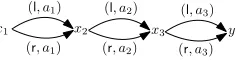
Example 4.6. LetGC be the dependency graph illustrated in Figure 1. It is easy to see that
Idxdmd(GC)is 3. In addition, there are 23=8 paths fromx1toy1. If we generaliseGC in Figure1to
a dependency graph comprisingndiamonds fromx1tox2,· · ·, fromxn−1toxn, and fromxn toy1
respectively, then the diamond index of the resulting dependency graph isnand there are 2n paths
fromx1toy1in the graph.
x1
(r, a1) (l, a1)
x2 x3 y1
(l, a2) (r, a2)
[image:11.486.184.302.360.391.2](l, a3) (r, a3)
Fig. 1. The diamond index and the number of paths inGC
In Section6–8, we will apply a refined analysis of the complexity of the decision procedures for
proving Theorem4.2and get the following results.
Corollary 4.7. The satisfiability problem is PSPACE-complete for the following fragments of
SL[replaceAll]:
• the single-letter case, plus the condition that the diamond indices of the dependency graphs are bounded by a constantc,
• the constant-string case, plus the condition that thel-lengths of the dependency graphs are bounded by a constantc,
• the regular-expression case, plus the condition that thel-lengths of the dependency graphs are at most1.
Corollary4.7partially justifies our choice to present the decision procedures for the single-letter,
constant-string, and regular-expression case separately. Intuitively, when the pattern parameters
of thereplaceAllterms become less restrictive, the decision procedures become more involved, and
more constraints should be imposed on the dependency graphs in order to achieve the PSPACE
upper-bound. The PSPACE lower-bound follows from the observation that nonemptiness of the
intersection of the regular expressionse1,· · ·,en over the alphabet{0,1}, which is a
PSPACE-complete problem, can be reduced to the satisfiability of the formulax ∈e1∧ · · · ∧x∈en, which
restrictions in Corollary4.7are partially inspired by the benchmarks in practice. Diamond indices
(intuitively, the “nesting depth” ofreplaceAll(x,a,x)) are likely to be small in practice because the
constraints likereplaceAll(x,a,x)are rather artificial and rarely occur in practice. Moreover, the
l-length reflects the nesting depth of replaceall w.r.t. the first parameter, which is also likely to be
small. Finally, for string constraints with concatenation andreplaceAllwhere pattern/replacement
parameters are constants, the diamond index is no greater than the “dimension” defined in [Lin and
Barceló 2016], where it was shown that existing benchmarks mostly have “dimensions" at most
three for such string constraints.
5 OUTLINE OF DECISION PROCEDURES
We describe our decision procedure across three sections (Section6–Section8). This means the
ideas can be introduced in a step-by-step fashion, which we hope helps the reader. In addition, by
presenting separate algorithms, we can give the fine-grained complexity analysis required to show
Corollary4.7. We first outline the main ideas needed by our approach.
We will use automata-theoretic techniques. That is, we make use of the fact that regular
expres-sions can be represented as NFAs. We can then consider a very simple string expression, which
is a single regular constraintx ∈ e. It is well-known that an NFAAcan be constructed that is
equivalent toe. We can also test in LOGSPACE whether there is some wordwaccepted byA. If
this is the case, then this word can be assigned tox, giving a satisfying assignment to the constraint.
If this is not the case, then there is no satisfying assignment.
A more complex case is a conjunction of several constraints of the formx ∈e. If the constraints
apply to different variables, they can be treated independently to find satisfying assignments. If the
constraints apply to the same variable, then they can be merged into a single NFA. Intuitively, take
x ∈e1∧x ∈e2andA1andA2equivalent toe1ande2respectively. We can use the fact that NFA
are closed under intersection a check if there is a word accepted byA1× A2. If this is the case, we
can construct a satisfying assignment toxfrom an accepting run ofA1× A2.
In the general case, however, variables are not independent, but may be related by a use of
replaceAll. In this case, we perform a kind ofreplaceAllelimination. That is, we successively remove
instances ofreplaceAllfrom the constraint, building up an expanded set of regular constraints
(represented as automata). Once there are no more instances ofreplaceAllwe can solve the regular
constraints as above. Briefly, we identify somex = replaceAll(y,e,z)wherex does not appear
as an argument to any other use ofreplaceAll. We then transform any regular constraints onx
into additional constraints onyandz. This allows us to remove the variablexsince the extended
constraints onyandzare sufficient for determining satisfiability. Moreover, from a satisfying
assignment toyandzwe can construct a satisfying assignment toxas well. This is the technical
part of our decision procedure and is explained in detail in the following sections, for increasingly
complex uses ofreplaceAll.
6 DECISION PROCEDURE FORSL[replaceAll]: THE SINGLE-LETTER CASE
In this section, we consider the single-letter case, that is, for theSL[replaceAll]formulaC =φ∧ψ,
every term of the formreplaceAll(z,e,z′)inφsatisfies thate=afora∈Σ. We begin by explaining
the idea of the decision procedure in the case where there is a single use of areplaceAll(−,−,−)
term. Then we describe the decision procedure in full details.
6.1 A Single Use ofreplaceAll(−,−,−)
Let us start with the simple case that
where, fori =1,2,3, we supposeAi =(Qi,δi,q0,i,Fi)is the NFA corresponding to the regular
expressionei.
From the semantics,Cis satisfiable if and only ifx,y,zcan be assigned with stringsu,v,w so
that: (1)uis obtained fromvby replacing all the occurrences ofainvwithw, and (2)u,v,ware
accepted byA1,A2,A3respectively. Letu,v,wbe the strings satisfying these two constraints. As
uis accepted byA1, there must be an accepting run ofA1onu. Letv =v1av2a· · ·avksuch that for
eachi∈ [k],vi ∈ (Σ\ {a})∗. Thenu=v1wv2w· · ·wvkand there are statesq1,q
′
1,· · ·,qk−1,q ′
k−1,qk such that
q0,1
v1 −−→ A1 q1 w −−→ A1 q′ 1 v2 −−→ A1 q2 w −−→ A1 q′ 2· · ·qk−1
w
−−→ A1
q′
k−1
vk −−→
A1 qk
andqk ∈ F1. LetTz denote
(qi,q′
i) |i∈ [k−1] . Thenw ∈ L(A3) ∩ Ñ
(q,q′)∈T
z
L(A1(q,q′)). In
addition, letBA
1,a,Tz be the NFA obtained fromA1by removing all thea-transitions first and then
adding thea-transitions(q,a,q′)for(q,q′) ∈Tz. Then
q0,1
v1
−−−−−−−→ BA1,a,Tz
q1
a
−−−−−−−→ BA1,a,Tz
q′ 1
v2
−−−−−−−→ BA1,a,Tz
q2
a
−−−−−−−→ BA1,a,Tz
q′ 2· · ·qk−1
a
−−−−−−−→ BA1,a,Tz
q′
k−1
vk −−−−−−−→
BA1,a,Tz qk.
Therefore,v ∈ L(A2) ∩ L(BA
1,a,Tz). We deduce that there isTz ⊆Q1×Q1such thatL(A3) ∩
Ñ
(q,q′)∈T
z
L(A1(q,q′)) , ∅ andL(A2) ∩ L(BA
1,a,Tz) , ∅. In addition, it is not hard to see that
this condition is also sufficient for the satisfiability ofC. The arguments proceed as follows: Let
v ∈ L(A2) ∩ L(BA1,a,Tz)andw ∈ L(A3) ∩
Ñ
(q,q′)∈T
z
L(A1(q,q′)). Fromv ∈ L(BA
1,a,Tz), we
know that there is an accepting run ofBA
1,a,Tz onv. Recall thatBA1,a,Tz is obtained fromA1by
first removing all thea-transitions, then adding all the transitions(q,a,q′)for(q,q′) ∈Tz. Suppose
v=v1av2· · ·avksuch thatvi ∈ (Σ\ {a}) ∗
for eachi ∈ [k]and
q0,1
v1
−−−−−−−→ BA1,a,Tz
q1
a
−−−−−−−→ BA1,a,Tz
q′ 1
v2
−−−−−−−→ BA1,a,Tz
q2
a
−−−−−−−→ BA1,a,Tz
q′ 2· · ·qk−1
a
−−−−−−−→ BA1,a,Tz
q′
k−1
vk −−−−−−−→
BA1,a,Tz qk
is an accepting run ofBA
1,a,Tz onv. Thenq0,1
v1
−−→ A1
q1, and for eachi∈ [k−1]we have(qi,q
′
i) ∈Tz
andqi′
vi+1
−−−→ A1
qi+1; moreover,qk ∈ F1. Letu = replaceAll(v,a,w) = v1wv2· · ·wvk. Sincew ∈
Ñ
(q,q′)∈T
z
L(A1(q,q′)), we infer that
q0,1
v1 −−→ A1 q1 w −−→ A1 q′ 1 v2 −−→ A1 q2 w −−→ A1 q′ 2· · ·qk−1
w
−−→ A1
q′
k−1
vk −−→
A1 qk
is an accepting run ofA1onu. Therefore,uis accepted byA1andCis satisfiable.
Proposition 6.1. We haveC≡x=replaceAll(y,a,z) ∧x ∈e1∧y∈e2∧z∈e3is satisfiable iff
there existsTz ⊆Q1×Q1withL(A3) ∩ Ñ
(q,q′)∈T
z
L(A1(q,q′))
,∅andL(A2) ∩ L(BA1,a,Tz),∅.
From Proposition6.1, we can decide the satisfiability ofCin polynomial space as follows:
Step I.Nondeterministically choose a setTz ⊆Q1×Q1.
Step II. Nondeterministically choose an accepting run of the product automaton ofA3and
A1(q,q′)for(q,q′) ∈Tz.
Step III.Nondeterministically choose an accepting run of the product automaton ofA2and
BA1,a,Tz.
During Step II and III, it is sufficient to recordTz and a state of the product automaton, which
The above decision procedure can be easily generalised to the case that there are multiple
atomic regular constraints forx. For instance, letx ∈ e1,1 ∧x ∈ e1,2 and forj = 1,2, A1,j =
(Q1,j,δ1,j,q0,1,j,F1,j)be the NFA corresponding toe1,j. Then in Step I, two setsT1,z ⊆Q1,1×Q1,1
andT2,z ⊆ Q1,2×Q1,2 are nondeterministically chosen, moreover, Step II and III are adjusted
accordingly.
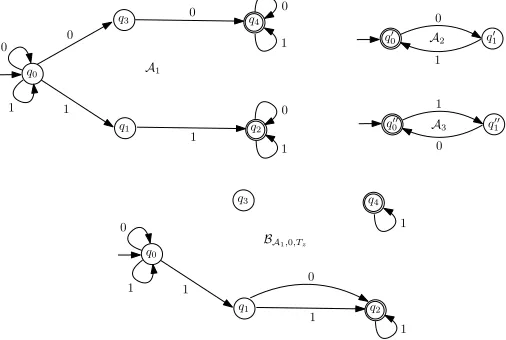
Example 6.2. LetC ≡ x = replaceAll(y,0,z) ∧x ∈ e1 ∧y ∈ e2∧z ∈ e3, wheree1 = (0+ 1)∗(00(0+1)∗+11(0+1)∗),e2 = (01)
∗
, ande3 = (10)
∗
. The NFAA1,A2,A3corresponding to
e1,e2,e3respectively are illustrated in Figure2. LetTz ={(q0,q0),(q1,q2)}. Then
L(A3) ∩ Ñ
(q,q′)∈T
z
L(A1(q,q′)) = L(A3) ∩ L(A1(q0,q0)) ∩ L(A1(q1,q2))
= L((10)∗) ∩ L((0+1)∗) ∩ L(1(0+1)∗) , ∅.
In addition,BA
1,0,Tz (also illustrated in Figure2) is obtained fromA1 by removing all the
0-transitions, then adding the transitions(q0,0,q0)and(q1,0,q2). Then
L(A2) ∩ L(BA1,0,Tz)=L((01) ∗
) ∩ L((0+1)∗101∗),∅.
We can choosezto be a string fromL(A3) ∩ Ñ
(q,q′)∈T
z
L(A1(q,q′)) =L((10)∗) ∩ L((0+1)∗) ∩
L(1(0+1)∗), say 10, andyto be a string fromL(A2) ∩ L(BA
1,0,Tz)=L((01)
∗) ∩ L((0+1)∗101∗), say
0101, then we setxtoreplaceAll(0101,0,10)=101101, which is inL(A1). Thus,Cis satisfiable. □
q0
q2
q3
q1
q4
0
0
1
1 0
1
0
1
1 0 A1
q0
0
0
1 q0
1
A2
q00
0
1
0 q00
1
A3
q0
q2
q3
q1
q4
1
1 0
1
1
1 BA1,0,Tz
[image:14.486.117.370.351.521.2]0
Fig. 2. An example for the single-letter case: One replaceAll
6.2 The General Case
Let us now consider the general case whereCcontains multiple occurrences ofreplaceAll(−,−,−)
terms. Then the satisfiability ofCis decided by the following two-step procedure.
Step I.We utilise the dependency graphCand compute nondeterministically a collection of atomic
regular constraintsE(x)for each variablex, in a top-down manner.
Notice thatE(x)is represented succinctly as a set of pairs(T,P), whereT =(Q,δ)is a transition
regular constraints containing(Q,δ,q,{q′})for each(q,q′) ∈ P, whereqis the initial state and
{q′}is the set of final states.
Initially, letG0 :=GC. In addition, for each variablex, we defineE0(x)as follows: Letx ∈
e1∧ · · · ∧x ∈enbe the conjunction of all the atomic regular constraints related toxinC. For each
i ∈ [n], letAi =(Qi,δi,q0,i,Fi)be the NFA corresponding toei. We nondeterministically choose
qi ∈Fi and setE0(x):=((Qi,δi),{(q0,i,qi)}) |i∈ [n] .
We begin withi:=0 and repeat the following procedure until we reach someiwhereGiis an
empty graph, i.e. a graph without edges. Note thatG0was defined above.
(1) Select a vertexx ofGi such thatx has no predecessors and has two successors via edges
(x,(l,a),y)and(x,(r,a),z)inGi. SupposeEi(x)={(T1,P1),· · ·,(Tk,Pk)}, where for each
j∈ [k],Tj =(Qj,δj). ThenEi+1(z)andEi+1(y)andGi+1are computed as follows:
(a) For eachj∈ [k], nondeterministically choose a setTj,z ⊆Qj ×Qj.
(b) Ify,z, then let
Ei+1(z):=Ei(z) ∪(Tj,Tj,z) |j∈ [k] and Ei+1(y):=Ei(y) ∪(TT
j,a,Tj,z,Pj) |j ∈ [k]
whereTT
j,a,Tj,z is obtained fromTjby first removing all thea-transitions, then adding all the
transitions(q,a,q′)for(q,q′) ∈Tj,z. Otherwise, letEi+1(z):=Ei(z) ∪(Tj,Tj,z) |j∈ [k] ∪
(TTj,a,Tj,z,Pj) |j ∈ [k] . In addition, for each vertexx
′distinct fromy,z, letE
i+1(x′):= Ei(x′).
(c) LetGi+1:=Gi \ {(x,(l,a),y),(x,(r,a),z)}.
(2) Leti:=i+1.
For each variablex, letE(x)denote the setEi(x)after exiting the above loop.
Step II.Output “satisfiable” if for each source variablexthere is an accepting run of the product of
all the NFA inE(x); otherwise, output “unsatisfiable”.
It remains to argue the correctness and complexity of the above procedure and show how to
obtain satisfying assignments to satisfiable constraints. Correctness follows a similar argument to
Proposition6.1and is presented in AppendixB. Intuitively, Proposition6.1shows our procedure
correctly eliminates occurrences ofreplaceAlluntil only regular constraints remain.
If, in the case that the equation is satisfiable, one wishes to obtain a satisfying assignment to all
variables, we can proceed as follows. First, for each source variablex, nondeterministically choose
an accepting run of the product of all the NFA inE(x). As argued in AppendixB, the word labelling
this run satisfies all regular constraints onxsince it is taken from a language that is guaranteed
to be a subset of the set of words satisfying the original constraints. For non-source variables, we
derive an assignment as in Proposition6.1, proceeding by induction from the source variables. That
is, select some variablexsuch thatxis derived from variablesyandzand assignments to bothyand
zhave already been obtained. The value forxis immediately obtained by performing thereplaceAll
operation using the assignments toyandz. That this value satisfies all regular constraints onx
follows the same argument as Proposition6.1. The procedure terminates when all variables have
been assigned.
We now give an example before proceeding to the complexity analysis.
Example 6.3. SupposeC ≡x=replaceAll(y,0,z) ∧y=replaceAll(y′,1,z′) ∧x ∈e1∧y∈e2∧z∈
e3∧y ′∈e
4∧z
′∈e
5, wheree1,e2,e3are as in Example6.2,e4=0
∗
1∗0∗1∗, ande5=0 ∗
1∗. LetA4,A5
be the NFA corresponding toe4ande5respectively (see Figure3). The dependency graphGC ofC
is illustrated in Figure3. LetT1,· · ·,T5be the transition graph ofA1,· · ·,A5respectively. Then
• LetG0 = GC. Pick the setsE0(x) = {(T1,{(q0,q2)})}, E0(y) = {(T2,{(q ′ 0,q
′
0)})},E0(z) =
{(T3,{(q ′′ 0,q
′′
0)})},E0(y
′)={(T
4,{(p0,p1)})}, andE0(z ′)={(T
5,{(p ′ 0,p
′
1)})}
nondeterministi-cally.
• Select the vertexx inG0, constructE1(y)andE1(z)as in Example6.2, that is,
nondeterminis-tically chooseTz ={(q0,q0),(q1,q2)}, let
E1(z)={(T3,{(q ′′ 0,q
′′
0)}),(T1,{(q0,q0),(q1,q2)})}andE1(y)={(T2,{(q ′ 0,q
′
0)}),(TT1,0,Tz,{(q0,q2)})},
whereTT
1,0,Tz is the transition graph ofBA1,0,Tz illustrated in Figure2. In addition,E1(x)=
E0(x),E1(y′)=E0(y′)andE1(z′)=E0(z′). Finally, we getG1fromG0by removing the two
edges fromx.
• Select the vertexyinG1, constructE2(y
′)andE2(z′)as follows: Nondeterministically choose
T1,z′={(q ′ 0,q
′
0)}forT2andT2,z′={(q0,q1),(q1,q2)}forTT1,0,Tz, let E2(z′)=
(T5,{(p ′ 0,p
′
1)}),(T2,{(q ′ 0,q
′
0)}),(TT1,0,Tz,{(q0,q1),(q1,q2)}) , and
E2(y′)=(T4,{(p0,p1)}),(TT2,1,T1,z′,{(q
′ 0,q
′
0)}),(TTT1,0,Tz,1,T2,z′,{(q0,q2)}) ,
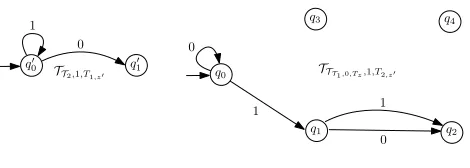
whereTT
2,1,T1,z′ andTTT1,0,Tz,1,T2,z′are shown in Figure4. In addition,E2(x)=E1(x),E2(y)=
E1(y), andE2(z)=E1(z). Finally, we getG2fromG1by removing the two edges fromy.
SinceG2 contains no edges, we haveE(x) = E2(x), similarly forE(y), E(z),E(y
′)
, and E(z′).
For the three source variablesy′,z′,z, it is not hard to check that 01 belongs to the intersection
of the regular constraints inE(z′), 11 belongs to the intersection of the regular constraints in
E(y′), and 10 belongs to the intersection of the regular constraints inE(z). Thenytakes the value
replaceAll(11,1,01)=0101∈ L(e2), andxtakes the valuereplaceAll(0101,0,10)=101101∈ L(e1).
Therefore,Cis satisfiable. □
x
y z
y0 z0 (l,0) (r,0)
(l,1) (r,1)
p0 1 p1
1 0 p2 0 0 p3 1 1 p0
0 1 p01
1 0
A4
A5
[image:16.486.92.401.410.483.2]GC
Fig. 3. An example for the single-letter case: Multiple replaceAll
q0 0 0 1 q0 1
TT2,1,T1,z0 q0
q2 q3 q1 q4 1 0 0
TTT1,0,Tz,1,T2,z0
1
[image:16.486.128.363.541.625.2]6.2.1 Complexity.To show our decision procedure works in exponential space, it is sufficient to
show that the cardinalities of the setsE(x)are exponential w.r.t. the size ofC.
Proposition 6.4. The cardinalities ofE(x)for the variablesxinGC are at most exponential in
Idxdmd(GC), the diamond index ofGC.
Therefore, according to Proposition6.4, if the diamond index ofGC is bounded by a constantc,
then the cardinalities ofE(x)becomepolynomialin the size ofCand we obtain a polynomial space
decision procedure. In this case, we conclude that the satisfiability problem is PSPACE-complete.
Proof of Proposition6.4. LetKbe the maximum of|E0(x)|forx ∈Vars(φ). For each variable
x inGC, all the regular constraints inE(x)are either fromE0(x), or are generated from some
regular constraints fromE0(x′)for the ancestorsx′ofx. Letx′be an ancestor ofx. Then for each
(T,P) ∈ E0(x′), according to Step I in the decision procedure, by an induction on the maximum
length of the paths in fromx′tox, we can show that the number of elements inE(x)that are
generated from(T,P)is at most the number of different paths fromx′tox. From Proposition4.5, we
know that there are at most(|Vars(φ)|·|EC|)O(Idxdmd(GC))different paths fromx′tox. Since there are at
most|Vars(φ)|ancestors ofx, we deduce that|E(x)| ≤K· |Vars(φ)| · (|Vars(φ)||EC|)O(Idxdmd(GC)). □
7 DECISION PROCEDURE FORSL[replaceAll]: THE CONSTANT-STRING CASE
In this section, we consider the constant-string special case, that is, for anSL[replaceAll]formula
C=φ∧ψ, every term of the formreplaceAll(z,e,z′)inφsatisfies thate=uforu∈Σ+. Note that
the case whenu=ϵwill be dealt with in Section8.
Again, let us start with the simple situation thatC ≡x =replaceAll(y,u,z)∧x ∈e1∧y∈e2∧z∈e3,
where|u| ≥2. Fori=1,2,3, letAi =(Qi,δi,q0,i,Fi)be the NFA corresponding toei. In addition,
letk =|u|andu=a1· · ·ak withai ∈Σfor eachi∈ [k].
From the semantics,Cis satisfiable iffx,y,zcan be assigned with stringsv,w,w′such that: (1)
v=replaceAll(w,u,w′), and (2)v,w,w′are accepted byA1,A2,A3respectively. Letv,w,w′be
the strings satisfying these two constraints. Sincev=replaceAll(w,u,w′), we know that there are
stringsw1,w2,· · ·,wnsuch thatw=w1uw2· · ·uwnandv=w1w
′w 2· · ·w
′wn
. Asvis accepted by
A1, there is an accepting run ofA1onv, say
q0,1
w1
−−→ A1
q1
w′
−−→ A1
q′ 1
w2
−−→ A1
q2
w′
−−→ A1
q′ 2· · ·qn−1
w′
−−→ A1
q′
n−1
wn −−→
A1 qn.
LetTz = {(qi,q′i) | i ∈ [n]}. Thenw′ ∈ L(A3) ∩ Ñ
(q,q′)∈T
z
L(A1(q,q′)). Therefore, L(A3) ∩
Ñ
(q,q′)∈T
z
L(A1(q,q′)),∅. Similar to the single-letter case, we construct an NFABA
1,u,Tz to
char-acterise the satisfiability ofC. More precisely,C is satisfiable iff there isTz ⊆Q1×Q1such that
L(A3) ∩ Ñ
(q,q′)∈T
z
L(A1(q,q′)),∅andL(A2) ∩ L(BA
1,u,Tz),∅. Intuitively, when reading the
stringw,BA
1,u,Tz simulates the generation ofvfromw andw
′(that is, the replacement of every
occurrence ofuinwwithw′) and verifies thatvis accepted byA1, by usingTz. To buildBA
1,u,Tz,
we utilise the concepts of window profiles and parsing automata defined below. Intuitively, a
window profile keeps track of which positions in the preceding characters could form the beginning
of a match ofu.
Definition 7.1 (window profiles w.r.t.u). Letv be a nonempty string withk = |v|, andi ∈ [k].
Then thewindow profile of the positioniinvw.r.t.uisW→− ∈ {⊥,⊤}k−1defined as follows:
• Ifi <k−1, then for eachj∈ [i], − →
W[j]=⊤iffv[i−j+1] · · ·v[i]=u[1] · · ·u[j], and for each
j:i<j ≤k−1, − →
W[j]=⊥.
LetWPu denote the set of window profiles of the positions in nonempty strings w.r.t.u.
Proposition 7.2. |WPu| ≤ |u|.
Proof. Letk=|u|. For each profile
− →
W, letvbe a nonempty string andibe a position ofvsuch
that for eachj ∈ [k−1],→W−[j]=⊤iffv[i−j+1]. . .v[i]=u[1]. . .u[j]. Defineidx−→
W as follows:
If there isj ∈ [k−1]such thatW→−[j]=⊤, thenidx−→
W is the maximum of such indicesj∈ [k−1],
otherwise,idx−→
W =0. The following fact holds for
− →
W andidx−→
W:
• for eachj′:idx−→
W <j′≤k−1,
− →
W[j′]=⊥,
• in addition, sincev[i−idx−→
W+1] · · ·v[i]=u[1] · · ·u[idxW−→], the values of
− →
W[1],· · ·,→W−[idx−→
W]
are completely determined byu[1] · · ·u[idx−→
W].
Letη :WPu → {0} ∪ [k−1]be a function such that for each
− →
W ∈WPu,η( − →
W)=idx−→
W. Thenη
is an injective function, since for every − →
W,W−→′∈
WPu,idx−→
W =idxW−−→′iff
− →
W =W−→′
. Therefore, we
conclude that|WPu| ≤k. □
Example 7.3. LetΣ={0,1},u=010. ThenWPu ={⊥⊥,⊤⊥,⊥⊤}.
• Consider the stringv=1 and the positioni=1 inv. Sincev[1]=1,u[1]=0, the window
profile ofiinvw.r.t.uis⊥⊥.
• Consider the stringv =00 and the positioni =2 inv. Sincev[2] =u[1]andv[1]v[2] ,
u[1]u[2], the window profile ofiinvw.r.t.uis⊤⊥.
• Consider the stringv =01 and the positioni =2 inv. Sincev[2] ,u[1]andv[1]v[2] =
u[1]u[2], the window profile ofiinvw.r.t.uis⊥⊤.
Note that⊤⊤<WPu, since for every stringvand the positioniinv, ifv[i−1]v[i]=u[1]u[2]=01,
thenv[i]=1,0=u[1].
We will construct a parsing automatonAu fromu, which parses a stringvcontaining at least
one occurrence ofu(i.e.v ∈Σ∗uΣ∗) intov1uv2u. . .vluvl+1such thatvju[1]. . .u[k−1]<Σ
∗uΣ∗
for each 1≤j ≤l. This ensures that the only occurrence ofuin eachvjuis a suffix. Finally, we
also requirevl+1<Σ∗uΣ∗. The window profiles w.r.t.uwill be used to ensure thatvis correctly
parsed, namely, the first, second,· · ·, occurrences ofuare correctly identified.
Definition 7.4 (Parsing automata). Given a stringuwe define theparsing automatonAu to be
the NFA(Qu,δu,q0,u,Fu)whereq0,u =q0and the remaining components are given below.
• Qu ={q0} ∪n search,W→− − →
W ∈WPuo∪n vfy,j,W→− j∈ [k−1], − →
W ∈WPuo, whereq0is
a distinguished state whose purpose will become clear later on, and the tags “search" and
“vfy" are used to denote whetherAu is in the “search” mode to search for the next occurrence
ofu, or in the “verify” mode to verify that the current position is a part of an occurrence ofu.
• δuis defined as follows.
– The transition
q0,a,
search,→W− ∈ δu, where − →
W[1] = ⊤iffa = u[1], and for each
i : 2≤i ≤k−1,W→−[i]=⊥.
– The transition
q0,u[1],
vfy,1,W→− ∈δu, whereW→−[1]=⊤and for eachi: 2≤i ≤k−1,
− →
– For each state
search,→W−anda∈Σsuch that − →
W[k−1]=⊥ora,u[k],
∗ the transition search,→W−
,a,search,W−→′ ∈δu, whereW−→′[1]=⊤iffa=u[1], and
for eachi : 2≤i ≤k−1,
−→
W′[i]=⊤ iff (
− →
W[i−1]=⊤anda=u[i]),
∗ ifa =u[1], then the transition search,→W−
,a,vfy,1, −→
W′ ∈ δu, whereW−→′[1] =⊤,
and for eachi: 2≤i≤k−1,
−→
W′[i]=⊤iff (W→−[i−1]=⊤anda=u[i]).
– For each state
vfy,i−1, − →
Wanda∈Σsuch that
∗ 2≤i ≤k−1,
∗→W−[i−1]=⊤,a=u[i], and
∗ either→W−[k−1]=⊥ora,u[k],
we have vfy,i−1,W→−
,a,vfy,i,W−→′ ∈δu, where for eachj: 2≤j≤k−1,
−→
W′[j]=⊤
iff − →
W[j−1]=⊤anda=u[j].
– For each state
vfy,k−1, − →
Wanda ∈Σsuch that
− →
W[k−1]=⊤anda =u[k], we have
vfy,k−1,→W−
,a,q0
∈δu.
Note that the constraint→W−[k−1]=⊥ora,u[k]is used to guarantee that each occurrence
of the stateq0, except the first one, witnesses thefirstoccurrence ofufrom the beginning
or after its previous occurrence. In other words, the constraint − →
W[k−1]=⊥ora,u[k]is
used to guarantee that after an occurrence ofq0, ifq0has not been reached again, thenuis
forbidden to occur.
• Fu ={q0} ∪n search,→W− − →
W ∈WPuo.
Note that the states
vfy,j,→W−are not final states, since, when in these states, the verification
of the current occurrence ofuhas not been complete yet.
LetQsearch= n
search,→W− − →
W ∈WPu
o
, andQvfy,i =
n
vfy,i,W→− − →
W ∈WPu
o
for eachi ∈ [k−
1]. In addition, letQvfy= Ð
i∈[k−1]
Qvfy,i. Supposev =v1uv2u· · ·vluvl+1such thatvju[1]. . .u[k−1]<
Σ∗uΣ∗
for each 1≤j ≤l, in addition,vl+1<Σ
∗uΣ∗
. Then there exists auniqueaccepting runr of
Auonvsuch that the state sequence inr is of the formq0r1q0r2q0 · · ·rlq0rl+1, where for each
j∈ [l],rj ∈ L((Qsearch)+◦Qvfy,1◦ · · · ◦Qvfy,k−1), andrl+1∈ L((Qsearch) ∗)
.
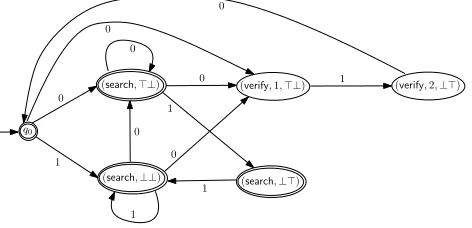
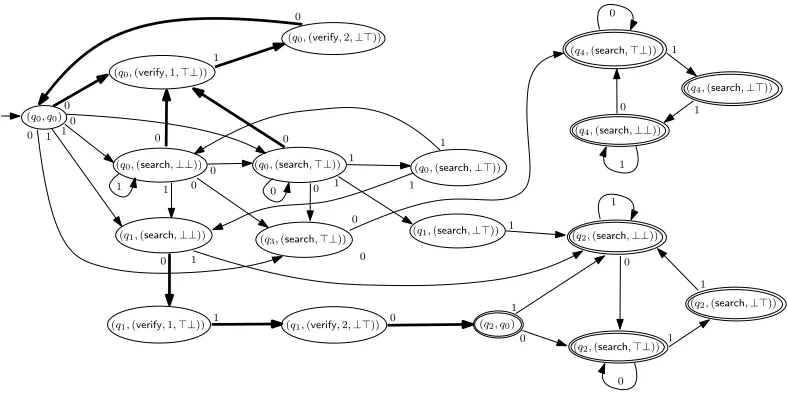
Example 7.5. Consideru = 010 in Example7.3. The parsing automatonAu is illustrated in
Figure5. Note that there are no 0-transitions out of (search,⊥⊤), since this would imply an
occurrence ofu=010, which should be verified by the states fromQvfy, more precisely, by the state
sequenceq0(vfy,1,⊤⊥)(vfy,2,⊥⊤)q0.
We are ready to present the construction ofBA
1,u,Tz. The NFABA1,u,Tz is constructed by the
following three-step procedure.
(1) Construct the product automatonA1× Au. Note that the initial state ofA1× Au is(q0,q0)
and the set of final states ofA1× AuisF1×Fu.
(2) Remove fromA1× Au all the (incoming or outgoing) transitions associated with the states
fromQ1×Qvfy.
(3) For each pair(q,q′) ∈Tzand each sequence of transitions inAu of the form
p,u[1],
vfy,1, −→
W′
1 , vfy,1,
−→
W′ 1
,u[2],
vfy,2, −→
W′
2 ,· · ·, vfy,k−1, −−−→
W′
k−1
,u[k],q0
q0
(search,>⊥) 0
1
(search,⊥⊥)
(verify,1,>⊥) (verify,2,⊥>) 0
0
1 0
1
0
0
(search,⊥>) 1
[image:20.486.127.363.89.203.2]1 0
Fig. 5. The parsing automatonAu foru=010
wherep=q0orp =
search,→W−, add the following transitions
(q,p),u[1],
q,vfy,1, −→
W′ 1
, q,vfy,1, −→
W′
1 ,u[2],
q,vfy,2, −→
W′ 2
,· · ·,
q,vfy,k−2, −−−→
W′
k−2 ,u[k−1],
q,vfy,k−1, −−−→
W′
k−1
, q,vfy,k−1, −−−→
W′
k−1 ,u[k],(q ′,q0).
Note that the number of aforementioned sequences of transitions inAuis at most|Qsearch|+1,
since −→
W′ 1, . . . ,
−−−→
W′
k−1are completely determined by
− →
W andu. Intuitively, whenAu identifies
an occurrence ofu, if the current state ofA1isq, then after reading the occurrence ofu,
BA1,u,Tz jumps fromqto some stateq
′
such that(q,q′) ∈Tz.
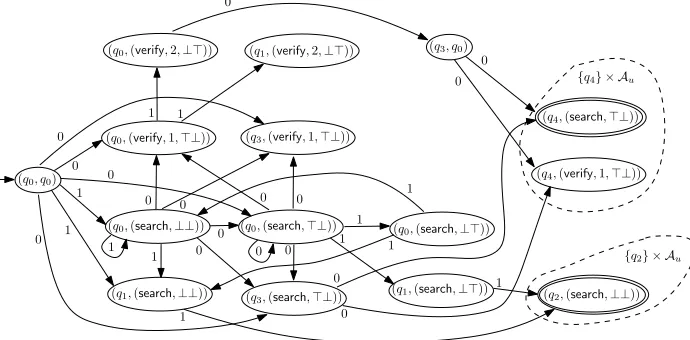
Example 7.6. ConsiderC ≡x =replaceAll(y,u,z) ∧x ∈e1∧y ∈e2∧z ∈e3, whereu =010,
ande1,e2,e3are as in Example6.2(cf. Figure2). LetTz ={(q0,q0),(q1,q2)}. The NFABA1,u,Tz is
obtained from the product automatonA1× Au (which we give in the appendix for reference)
by first removing all the transitions associated with the states fromQ1×Qvfy, then adding the
transitions according toTz as aforementioned (see Figure6, where thick edges indicate added
transitions). It is routine to check that 01010101 is accepted byBA
1,u,Tz andA2. Moreover, 10∈
L(A3) ∩ L(A1(q0,q0)) ∩ L(A1(q1,q2)). Letybe 01010101 andzbe 10. Thenx takes the value
replaceAll(01010101,010,10)=101101, which is accepted byA1. Therefore,Cis satisfiable.
For the more general case that theSL[replaceAll]formulaCcontains more than one occurrence of
replaceAll(−,−,−)terms, similar to the single-letter case in Section6, we can nondeterministically
remove the edges in the dependency graphGC in a top-down manner and reduce the satisfiability
ofCto the satisfiability of a collection of regular constraints for source variables.
Complexity.When constructingGi+1fromGi, suppose the two edges fromxtoyandz
respec-tively are currently removed, let the labels of the two edges be(l,u)and(r,u)respectively. Then
each element(T,P)ofEi(x)may be transformed into an element(T′,P′)ofEi+1(y)such that
|T′| =O(|u||T |), meanwhile, it may also be transformed into an element(T′′,P′′)ofEi+1(z)
such thatT′′has the same state space asT. In each step of the decision procedure, the state
space of the regular constraints may be multiplied by a factor|u|. The state space of these regular
constraints is at most exponential in the end, so that we can still solve the nonemptiness problem
of the intersection of all these regular constraints in exponential space. In addition, if thel-length
ofGC is bounded by a constantc, then for each source variable, we get polynomially many regular
constraints, where each of them has a state space of polynomial size. Therefore, we can get a