H i n d a ~ Publishing Corporation
International Journal of Antennas and Propagation Volume 2012, Article ID 914868,6 pages doi:10.1115i20121914868
Research Article
Resonant Elements
for Tunable Refledarray Antenna Design
M.
Y. Ismail
and M. Inam
Wireless andRadio Science Centre [WARAS), Faculty ofElectrica1 and Electronic Engineerins Uniniverriti Tun Huriein Onn Malaysia [UTHM), 86400 Batu Pahat, Johor, Malaysia
Correspondence should be addressed to M. Y. Ismail, [email protected]
Received 8 February 2012; Revised 5 April 2012; Accepted 5 June 2012
Academic Editor: Sandra Costanzo
Copyright O 2012 M. Y lsmail and M. Inam. This is an open access article distributed unda the Creative Commons Attribution License, which permits unrestricted use, distribution, and reproduction in any medium, provided the original work is properly cited.
This paper presents an accurate analysis of different configurations of ~eflectarray resonant elements that can be used for the design of passive and tunable reflectarrays. Rdection loss and bandwidth performances of these reflectarray elements have been analyzed in the X-band frequency range with the Finite Integral Method technique, and the results have been verified by the waveguide scattering parameter measurements. The results demonstrate a reduction in the phase errors offering an increased static linear phase range of 22Y which allows to improve the bandwidth performance of single layer reflectarray antenna. Moreover a
maximum dynamic phase range of 320' and a volume ~eduction of 22.15% have been demonstrated for a 10GHz reflectarray element based on the use of rectangular patch with an embedded circular slot.
1.
Jntroduction
Due to the modern day need for long distance communica- tions, higher data rate and finer radar imaging resolution, high gain or large aperture antennas are usually required. Deep space exploration and earth remote sensing are f a v missions of NASA where the antenna performance require- ments are increasing in order to extract more information. O n the other hand, lower mass and smaller stowage volume for the space craft antennas are demanded in order to reduce payload weight and required shroud space to minimize overall launch cost. Traditionally high gain applications have relied upon parabolic reflectors and phased arrays 111. However, due to the curvature of their surface, parabolic reflectors are difficult to be manufactured in many cases at higher microwave frequencies 121. The shape of the parabolic reflector also causes an increased weight and size of the antenna. Moreover, it has also been demonstrated in 131 that wide-angle electronic beam scanning cannot be achieved using a parabolic reflector. On the other hand, high gain phased array antennas offer the possibility to electronically scan the main beam along wide angle positions provided they are equipped with controllable phase shifters. However in order to reduce the problem of power inefficiency due to
the problem of high loss heamformers and phase shifters, suitable amplifier modules have to be integrated with the array antennas. These amplifier modules are usually of high cost so making phased array antennas a very expensive solution for high gain applications. Therefore in order to eliminate these problems, a flat andlow cost microstrip array antenna, known as reflectarray, has been acknowledged as a potential alternative to these traditionally used high gain antennas. Reflectarravin its basic form is a combination of a flat reflector and a n array of microstrip patches illuminated by a primary feed horn. Reflectarray can achieve a wide- angle electronic beam scanning. Direct Broadcast Satellites (DBS) and Multibeam Antennas (MBAs) are also considered as potential applications of reflectarrays. Moreover they can also act as amplifying arrays by including an amplifier in each reflectarray element 141.
International Journal of Antennas and Propagation
Resonant frequency (GHz)
(4
Resonant frequency (GHz) D ~ o d e off
- Diode an W~thout diode
[image:5.606.107.498.119.332.2](b)
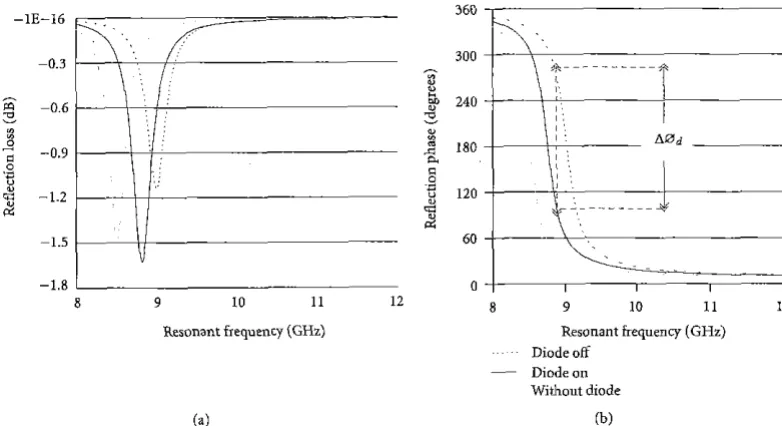
FIGURE 8: Reflection lass and reflection phase curves far tunable refleaarray design with PIN diodes
In this work, a circular slot with
R = 2.5 m m hasbeen integrated with an APD 0805-000 PIN diode. The APD 0805-000 PIN diode can operate at high frequencies and has low capacitance and low series resistance which provides lower losses and a higher degree of tunability. Figure 8 shows reflection loss and refection phase curves for the design without diode and with two different states of a PIN diode. It can he observed from Figure 8 that the on state of PIN diode provides a higher reflection loss equal to 1.64dB with respect to the other states. A frequency tunability of 270 MHz and a dynamic phase range of 171' at 8.88 GHz can be observed by the results shown in Figure 8.
The results demonstrate the feasibility of effectively utilizing the proposed slot configurations with PIN diodes for the design of tunable reflectarray antennas.
4. Conclusion
A reflectarray elementbased o n the use of a rectangular patch with an embedded circular slot has been proposed. It has been demonstrated that the configuration can be effectively utilized for the design of passive and tunable reflectarrays with low loss and high bandwidth performance. From the measurements of the slot embedded patch element, it can be concluded that proposed configuration can be employed for the miniaturization of the reflectarrays as a wide range of resonant frequencies can be achieved without varying the size of the patch element. Moreover the reduction in the phase errors produced by the limited phase range and the possibiliv of designing a miniaturized reflectarray has also been demonstrated using the proposed configurations. Preliminary investigations for the integration of slots and PIN diodes have shown that the dynamic phase range can
be utilized to design electronically controllable reflectarrays with progressive phase distribution.
Acknowledgments
This research work is fully funded by Prototype Research Grant Scheme (PRGS VOT 0904) and Best Awarded Funda- mental Research Grant Scheme (FRGS VOT 0983), Ministry of Higher Education, Malaysia. The authors would like to thank the st& of Wireless and Radio Science Centre (WARAS), Universiti Tun Hussein Onn Malaysia (UTHM) for the technical support.
References
[I] G. D. G. Berry, R. G. Malech, and W. A. Kennedy, "The reflect
array antenna," IEEE Tramactronr on Antennas and Propagation,
vol,ll, pp. 645-651,1963.
[2] J. Huang and J. A. Encinar, Refledarray Antennas, Wdey Inter- science, 2007.
[3] J. A. Encinar, M. Arrebola, M. Dejus, and C. Jauve, "Design ofA
l-metre reflectarray far DBS application with 15% bandwidth:' in Proceedings of the European Conference on Antennas and Propagation (EuCAP '06), pp. 1-5, Nice, France, November 2006.
[4] M. E. Bialkowski, A. W. Robinson, and H. J. Song, "Design, devtlopment, and testing of X-hnd amplifying reflectarrays:'
IEEE Transa~iom on Antennu and Propagation, "01. 50, no. 8,
pp. 1065-1076,2002.
[5] M. Y. Ismail. M. Inam, and J. Abdullah, "Design optimization
of reconfigurable reflectarray antenna based an phase agility
International Journal of A n t e n n a s and Propagation
[6] M. I. Abbasi and M. Y. Ismail, "Reflection loss and bandwidth performance of X-band infinite reflectarrays: simulations and measurements:' Microwave and Optical Technology Letters, "01.
53,no. 1, pp. 77-80,2011.
[7] H. Rajagopalan, Y Rahmat-Samii, and W. A. Imbriale,