ISSN(Online): 2320-9801
ISSN (Print): 2320-9798
I
nternational
J
ournal of
I
nnovative
R
esearch in
C
omputer
and
C
ommunication
E
ngineering
(An ISO 3297: 2007 Certified Organization)
Vol. 4, Issue 7, July 2016
Content Based Image Retrieval Using Affinity
Graph Based on Image Segmentation
Vrunda Korde1, Prof. Swati Bhavsar2
M.E Student, Dept. of Computer Engineering, MCOERC, Savitribai Phule Pune University, Maharashtra, India1 Asst. Professor, Dept. of Computer Engineering, MCOERC, Savitribai Phule Pune University, Maharashtra, India2
ABSTRACT:As digital images increased, the need of image retrieval also increased. Graph construction for capturing perceptual grouping cues of an image is important for graph based image segmentation. Basic CBIR system capture only the local visual feature, thus to coverthe gap between local feature and high level visual perception we proposed this system.This technique introduces graph-based image segmentation method in order to retrieve thecontent-based images. In this CBIR system first, query image get over-segmented, in whichthe many regions (or super-pixels) with homogeneous color are detected, image segmentation is performed by iteratively merging the regions according to a statistical test. Affinitygraph construction is there for building a graph from super-pixels. Furthermore, the image Segmentation problem is solved by computing the partitions of a graph obtain from previousaffinity graph which result into sub-graphs. Finally graph edit distance is used for graphmatching between query image and database images. Then images with smallest edit costsare retrieved and display relevant result to user. Experiments on Corel Photo collection areconducted to demonstrate the performance of the proposed content based image retrieval algorithm. To elaborate the effectiveness of the presented work, the proposed method is compared with existing CBIR systems, and it is proved that the proposed method has performedbetter then all of the comparative systems.
KEYWORDS: Content Based Image Retrieval, Image Segmentation, Graph Construction, Graph Matching, Super pixel.
I. INTRODUCTION
Today digital images are very important bearer of information. There are various techniques to process digital images, which are categorized into three types, image processing, image analysis, and image understanding. Image segmentation is type of image analysis. Image segmentation aims to divide an image into various significant areas and is important step for many computer vision tasks e.g. object recognition[1], scene interpretation[2], or content based image retrieval[3].As the size and volume of digital images increases, the need for CBIR has also been increased. CBIR techniques provide great solution to retrieved relevant images from large digital images database. In previous CBIR techniques all digital images in database are represented by their visual features (e.g. Image contents) which include color, shape, and texture. Visual feature present a visual perception of digital images. In basic CBIR technique visual features are extracted from all images and stored into feature database for further use. In basic CBIR system, query image is given as input to the system, then system extract feature from query image. Then similarity between visual feature of query image and visual feature of all images stored in image feature database get compared using a matching method. System retrieved only those images having higher similarity scores. Traditional image retrieval systems are content based image retrieval system in which low-level features are used for indexing and retrieval of images.
Basic CBIR systems unable to cover the gap between the low level features and high level perception of images. To meet this requirement as a pre-processing step, graph based image segmentation is used in content based image retrieval (CBIR). In this technique, construction of graph capturing perceptual grouping cues of an image is fundamental for graph based image segmentation. Due to the huge variety and uncleared visual grouping patterns, in presence of faint object boundaries and cluttered background, segmentation is very difficult in natural images.
ISSN(Online): 2320-9801
ISSN (Print): 2320-9798
I
nternational
J
ournal of
I
nnovative
R
esearch in
C
omputer
and
C
ommunication
E
ngineering
(An ISO 3297: 2007 Certified Organization)
Vol. 4, Issue 7, July 2016
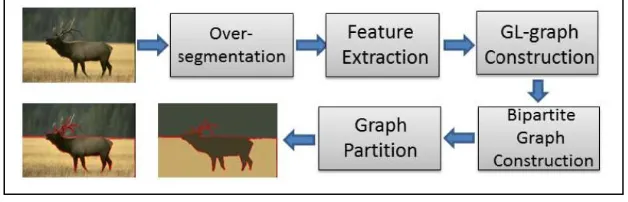
extracted from the superpixels. A Global /Local graph is then formed to capture both short and long range grouping cues. Finally result of image segmentation is gained by constructing bipartite graph and its partition [4].
Fig. 2 Existing Graph cut system for image segmentation
Paper Organization: This paper is arranged as follows, in Section II we discuss few content based image retrieval methods and basic principle of graph based image segmentation. In section IIIwe present proposed CBIR system architecture using graph based image segmentation. In Section VI we give implementation details with arithmetic strategies. In section V we present details of dataset, experimental result respectively. Finally, conclusion is drawn in section VI.
II. RELATED WORK
In this section, we have studied various research papers related to the content based image retrieval techniques and also various image segmentation methods. These paper focused on different Edge-based, Region-based, Graph-based methods for both CBIR and image segmentation. The brief review of previous research papers is as follows:
A. Content Based Image Retrieval Technique:
Technique based on image or visual contents usually referred as features for the purpose of searching images with respect to request and interest of user from large image databases. Since 1990s with the emergence and advancement of this field makes it possible to represent image by using low-level features instead of keywords. For CBIR technology few strong applications could be identified as architecture design, art & craft museums, archaeology, medical imaging and geographic info system, trademark databases, weather forecast, criminal investigations, image classification, image search over the Internet and remote sensing field for indexing biomedical images by contents.
Definition of CBIR:Visual features as color, shape and texture are implemented for retrieval of images. Traditional methods of image indexing have been proven neither suitable nor efficient in terms of space and time so it triggered the development of the new technique. It is a 2 step processwhere image features are extracted in first step to a distinguishable extent. In second step matching of features which are visually similar is done.
ISSN(Online): 2320-9801
ISSN (Print): 2320-9798
I
nternational
J
ournal of
I
nnovative
R
esearch in
C
omputer
and
C
ommunication
E
ngineering
(An ISO 3297: 2007 Certified Organization)
Vol. 4, Issue 7, July 2016
High level features as keywords, text description uses by humans to measure similarity and image interpretation. On the other hand the low level features with semantics [10, 11] usually color, shape,texture extraction is done automatically using computervision techniques. System proposed in [12] was designedto cope with audiovisual queries combining generalapproach to any real valued similarity measure forembedding in current CBIR systems [13]. In order toeliminate the semantic gap CLUE methodology ispresented to retrieve image clusters which are semantically coherent. In other CBIR systems top matched target images are displayed to users. After giving image as query, target image collections are chosen near or similar to query image. These target images can be clustered by using N-Cut clustering into different semantic classes by putting image of same semantic in one cluster. Then the image clusters is displayed by the system and similarity measure model is adjusted with respect to feed back of user.
B. Image Segmentation
However, image segmentation remains to be a challenging research topic in the computer vision. Imagesegmentation is a way to partition an image in to the regions with similar visual features. Here we are focused on graph based segmentation techniques which turn the problem of image segmentation into a problem of graph partitioning. Graphs are very effective tool, to build a graph we need to describe nodes and edges and also their weights which represents relationship between them. Lots of works have been done to build a graph. There two categories of graph construction, Supervised and Unsupervised. Unsupervised method again divided into adaptive and static technique. In adaptive graphs, similarities between data point get computed by considering all other data points and edges and simultaneously weights on them are assigned. Without consideration of other data point pairwise similarities get computed in static graphs. There is various graph construction method which are used in different task of computer vision. Most graph-based image segmentation approaches construct a static graph in which only local relationship between data points are taken into consideration [14]. Some methods for graph construction are:
1) KNN Graph (K Nearest Neighbors): In this graph each and every points get connect to all others points in its k-nearest neighbour and using pairwise similaritydistance between them is computed.But as pointed in [15] the problem with KNN-graph is it may include noisy edges in neighbourhood of data points and its size is fixed.
2) ε-Graph: It is a neighbourhood graph which connects all neighbouring data points whose pairwise similarity is
less than ε. Constructed graph is unweighted and constant pairwise similarity is chosen. Problem with this graph is selection of single ε for all nodes in graph not select neighbour’s data points properly.
3) Fully Connected Graph: These graphs consider positive similarity of data points while connecting all point with each other. Here if similarity function compute local neighbourhood relationship by itself then only this graph in useful.
These graphs are not able to give expected segmentation result, as only local relationship between all the data points are considered [12],[13]. For instance in [14], author proposed segmentation with multi-scale graph decomposition, which only consider fine and coarse level details of image. In [13], author proposed a segmentation method in that input image pre-segmented into various small regions to consider every pixel as a graph node.
After studying literature and finding the research gap, we proposed a system aims to develop a “CBIR using affinity graph based on image segmentation” which construct static graph for e.g. Adjacency Graph over all super-pixels to enforce the perceptual grouping laws e.g., proximity, similarity and continuity over local and global relationship among super-pixels in order to improve result of image segmentation and also improve performance of CBIR system.
III.SYSTEM ARCHITECTURE
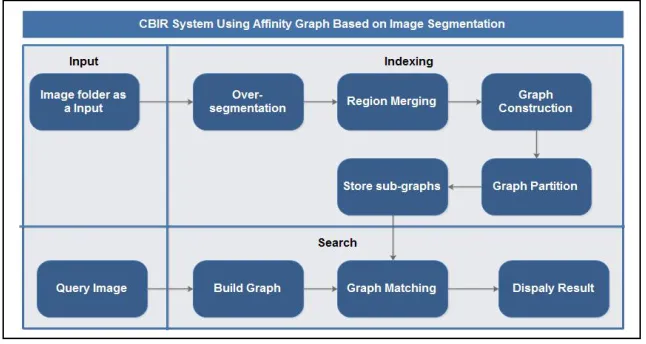
System is divided into two parts
Indexing
Search
ISSN(Online): 2320-9801
ISSN (Print): 2320-9798
I
nternational
J
ournal of
I
nnovative
R
esearch in
C
omputer
and
C
ommunication
E
ngineering
(An ISO 3297: 2007 Certified Organization)
Vol. 4, Issue 7, July 2016
input where graph edit distance will be usedfor graph matching between query image and database images. Then images with smallestedit cost will be retrieve and display relevant result to user.
Fig. 2The framework of proposed CBIR system
A. Over-Segmentation
As shown in fig.2, query image I, get first over-segmented which result into super-pixels. Here super-pixel means a connected maximal region larger than pixel or we can also say that super-pixel is collection of pixels with similar feature.
Here we used Watershed Segmentation Algorithm [15] to over-segment an image into regions i.e. super-pixels. Topological gradient approach of watershed algorithm is used to pre-process grey scale image and for detecting edges from images. In this approach image has high pixel value along foreground object and low pixel values in background. The watershed algorithm provides global over-segmentation with high accuracy. Result of watershed transform is watershed ridge lines along object edges.
B. Region Merging
Region merging is an order to solve over-segmented regions in which regions are merged based on their color similarity.With an initially over-segmented image, in which the many regions (or super-pixels) with homogeneous color are detected, image segmentation is performed by iteratively merging the regions according to a statistical test.
In proposed system we use region merging algorithm as a dynamic region merging (DRM) [16]. DRM algorithm is started from a set of over-segmented regions. This is because a small region can provide more stable statistical information than a single pixel, and using regions for merging can improve a lot the computational efficiency.
C. Graph Construction
Let G = (V, E) be an undirected graph, where vi∈ is a set of nodes corresponding toimage elements (e.g. super-pixels or regions). E is a set of edges connecting the pairsof neighboring nodes.Two regions are considered as neighbor if they are separated bya small number of pixels in the horizontal or vertical direction. In other words, betweentwo nodes there exists an edge if the nodes are adjacent. Each edge (vi,vj) ∈E has acorresponding weight w((vi,vj)) to measure the similarity of the two nodes connectedby that edge. Euclidean distance as in eq.(1), w(vi,vj) of similarity is used to computethe similarity between two nodes.
w(vi, vj) = ( − )
, (1)
ISSN(Online): 2320-9801
ISSN (Print): 2320-9798
I
nternational
J
ournal of
I
nnovative
R
esearch in
C
omputer
and
C
ommunication
E
ngineering
(An ISO 3297: 2007 Certified Organization)
Vol. 4, Issue 7, July 2016
D. Graph Partition
The graph partition problem is defined on data represented in the form of a graph G = (V, E), with V vertices and E edges generated from previous step, such that it is possible to partition G into sub-graphs. VEAM is the only algorithm that computes frequent approximate subgraphs on a simple-graph collection, keeping the graph topology.The VEAM algorithm starts computing all frequent approximate subgraphs corresponding to singlevertex graphs and single-edge graphs. Then, following a Depth-First Search (DFS) approach, each frequent single-edge is extended by adding another single-edge at a time through a recursive function. When all frequent approximate single-edges have been extended, then the set of all frequent approximate subgraphs in the multi-graph collection is returned.
E. Graph Matching
To determine the similarity between the segmented images we first need to compute the similarity between graphs. The technique of evaluating the similarity of graphs is known as Graph Matching. The most appropriate method for graph matching is based on the graph edit distance. The basic phenomenon of graph edit distance is to define the dissimilarity of graphs by the amount of transformation that is needed to convert one graph into another. To work with arbitrary graph and various types of node and edges Graph edit distance is used [17].
Computation of GED:
Let graph g1 be the query image graph g1 = (V1, E1, µ1, ν1) and g2 be the target graph g2 = (V2, E2, µ2, ν2) where,
V (set of nodes)
E (set of edges)
µ:V→ L ( node labelling function)
ν :E→ L ( edge labelling function)
The graph edit distance is defined by Eq. (2),
(2)
Where, ϒ (g1, g2) be the set of edit paths transforming g1into g2 and c be the cost function measuring the edit operation e.
IV.IMPLEMENTATION DETAILS
A. Algorithmic Strategies
1. Algorithm for Over-segmentation: 1. Input: Query Image I
2. Denote x, y the co-ordinate of plane, and z denote pixels values.
3. Find minimum and maximum values of g(x, y) and each given different label(label can be index number or color values)
4. Insert neighbouring pixel of each marked area into priority queue. 5. Sort the priority queue from high to low pixel.
6. The pixel with high priority level is extracted from queue.
- If there are at least two pixels with differentlabel then mark this pixel as “edge” pixel. - Add all neighbouring pixels that do not have label to the priority queue.
7. Repeat step 6 until priority queue is empty.
8. Output: Over-segmented Image
2. Algorithm for Region Merging
ISSN(Online): 2320-9801
ISSN (Print): 2320-9798
I
nternational
J
ournal of
I
nnovative
R
esearch in
C
omputer
and
C
ommunication
E
ngineering
(An ISO 3297: 2007 Certified Organization)
Vol. 4, Issue 7, July 2016
2. Set i=0
3. For each region in segmentation Si check value of predicate P with respect to its neighboring regions.
4. Merge the pairs of neighboring regions whose predicate P is true such that segmentation Si +1 is
constructed.
5. Go back to step 2 until Si + 1 = Si.
6. Return Si
7. Output: Region merging result.
3. Algorithm for Graph Construction 1. Input: Set of regions R.
2. Take each region Ri
3. Create a graph vertex Vi
4. For each neighbour region Rj of Ri create a vertex Vj
5. Connect Viwith Vj.
6. Repeat step 3, 4 for each region until all regions have been considered.
7. Output: Adjacency Graph G= (V, E, W).
4. Algorithm for Graph Matching
1. Input: Source Graph g1 and Target graph g2.
2. Compute the graph edit distanced (g1,g2) between g1 and g2as given in eq.2.
3. Repeat step 2 for all target graph from dataset. 4. Return edit cost e for all edit operation.
5. Output : Graph Edit Cost
V. RESULTS ANALYSIS
A. Dataset
To evaluate performance of proposed system,all experiments are carried out on thedatabase of Corel Photo Collection. It contains 10,000 different images of different categories such as bear tiger, balloon, butterfly, lion, flower, lion, model, mountain, sky, church and waterfall. Every imagein database is of size 126*187 or 187 * 126pixels and their format is JPEG.
B. Performance Evaluation
ISSN(Online): 2320-9801
ISSN (Print): 2320-9798
I
nternational
J
ournal of
I
nnovative
R
esearch in
C
omputer
and
C
ommunication
E
ngineering
(An ISO 3297: 2007 Certified Organization)
Vol. 4, Issue 7, July 2016
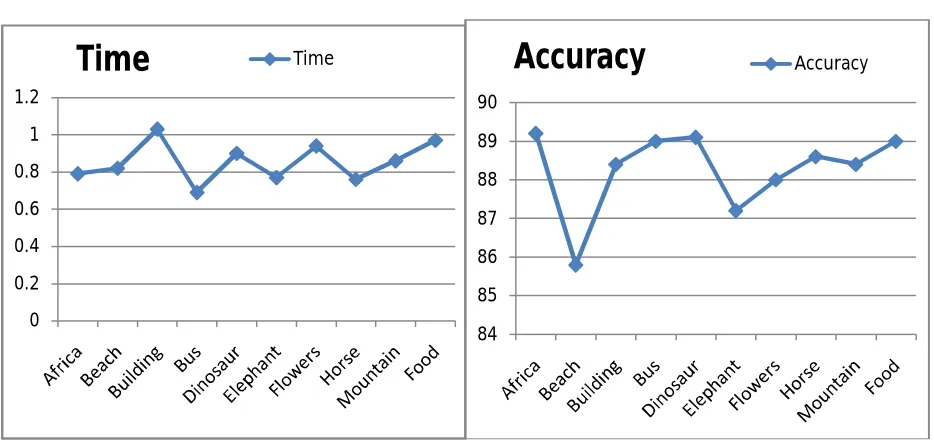
Fig. 5 AverageRetrieval Time Fig. 6 Average Accuracy
Fig. 7Avearge Precision and Recall Obtain By Proposed Method
C. Result Screenshots
Result of this CBIR system consists of two modules. First one is indexing, which performs all preprocessing steps i.e. Over-segmentation, region merging, Graph construction etc. Second module is Search, in which retrieval of image get performed. Following figure show the result snapshots, Fig.5 demonstrate the Indexing Module in which first user select the image folder from database and perform indexing. In Fig.6 relevant images get retrieved from query image.
VI.CONCLUSION
Content based image retrieval techniques are viable solutions to find desired images fromlarge image dataset. This project reveals the hidden solution to CBIR with graph basedimage segmentation. The proposed system consist of two novel approaches, indexing withimage dataset and image search using graph matching instead of future matching whichimproves the retrieval performance of the system. In this CBIR system first, query imageget over-segmented, in which the many regions (or super-pixels) with homogeneous colorare detected, image segmentation is performed by iteratively merging the regions according to a statistical test. Affinity graph construction is there for building a graph
0 0.2 0.4 0.6 0.8 1 1.2
Time
Time84 85 86 87 88 89 90
Accuracy
Accuracy76 78 80 82 84 86 88 90
Precision
ISSN(Online): 2320-9801
ISSN (Print): 2320-9798
I
nternational
J
ournal of
I
nnovative
R
esearch in
C
omputer
and
C
ommunication
E
ngineering
(An ISO 3297: 2007 Certified Organization)
Vol. 4, Issue 7, July 2016
from super-pixels. Furthermore, the image segmentation problem is solved by computing the partitions of a graph obtain from previous affinity graph which result into sub-graphs. Finally graphedit distance is used for graph matching between query image and database images. Thenimages with smallest edit costs are retrieved and display relevant result to user. Performancemeasure shows the proposed image retrieval system achieves the improvement in precision,recall as well as accuracy of retrieval.
Fig.5 Indexing Module Fig.6 Search Module
REFERENCES
[1] Y. J. Lee and K. Grauman, “Object-graphs for context-aware category discovery,” in Proc. IEEE Conf. Computer. Vis. Pattern Recognition., pp. 1–8, Jun. 2010.
[2] M. P. Kumar and D. Koller, “Efficiently selecting regions for scene understanding,” in Proc. IEEE Conf. computer. Vis. Pattern Recognition., pp. 3217–3224,Jun. 2010.
[3] S. Belongie, C. Carson, H. Greenspan, and J. Malik, “Color- and texture based image segmentation using EM and its application to content-based image retrieval,” in Proc. IEEE 6th Int. Conf. Computer. Vis.,pp. 675–682, Jan. 1998.
[4] Xiaofang Wang, Yuxing Tang, Simon Masnou, and Liming Chen, “A Global/Local Affinity Graph For Image Segmentation”, IEEE TRANSACTIONS ON IMAGE PROCESSING, VOL. 24, NO. 4, APRIL 2015.
[5] Swati Agarwal, A. K. Verma, Preetvanti Singh, “Content Based Image Retrieval using Discrete Wavelet Transform and Edge Histogram Descriptor", International Conference on Information Systems and Computer Networks, proceeding of IEEE xplore-2013.
[6] Feng Jing, Mingjing Li, Hong-Jiang Zhang, Bo Zhang. “An Efficient and Effective Region-Based Image Retrieval Framework”. IEEE Transactions on Image Processing, vol. 13, NO. 5, MAY 2004.
[7] Xiang-Yang Wang, Hong-Ying Yang, Dong-Ming Li “A new content-based image retrieval technique using color and texture information", Computers Electrical Engineering, Volume 39, Issue 3, Pages 746-761, April 2013.
[8] Ying Liu, Xin Chen, Chengcui Zhang, Alan Sprague, “Semantic clustering for region-based image retrieval "J. Vis. Communication. Image R. (2009)
[9] HengChen, zhichengzhao, “An effective relevance feedback algorithm for image retrieval" 978-1-4244-6853-9/10/ 2010 IEEE. [10] U. von Lux burg, “A tutorial on spectral clustering,” Statist. Computer. Vol. 17, no. 4, pp. 395–416, 2007.
[11] X. Yang and L. J. Latecki, “Affinity learning on a tensor product graph with applications to shape and image retrieval,” in Proc. IEEE Conf. Computer. Vis. Pattern Recognition. (CVPR, pp. 2369–2376), Jun. 2011.
[12] T. H. Kim, K. M. Lee, and S. U. Lee, “Learning full pairwise affinities for spectral segmentation,” in Proc. IEEE Conf. Computer. Vis. Pattern Recognition, pp. 2101–2108,Jun. 2010.
[13] Z. Li, X.-M. Wu and S.-F. Chang, “Segmentation using superpixels: A bipartite graph partitioning approach,” in Proc. IEEE Conf. Computer. Vis. Pattern Recognition, pp. 789–796., Jun. 2012.
[14] T. Cour, F. Bénézit, and J. Shi, “Spectral segmentation with multiscale graph decomposition,” in Proc. IEEE Computer. Soc. Conf. Computer. Vis. Pattern Recognition, pp. 1124–1131, Jun. 2005.
[15] LamiaJaafarBelaid and WalidMourou, “Image Segmentation: A Watershed Transformation Algorithm” Image Anal StereOriginal Research Paper,2009.
ISSN(Online): 2320-9801
ISSN (Print): 2320-9798
I
nternational
J
ournal of
I
nnovative
R
esearch in
C
omputer
and
C
ommunication
E
ngineering
(An ISO 3297: 2007 Certified Organization)
Vol. 4, Issue 7, July 2016