Journal of Chemical and Pharmaceutical Research, 2013, 5(11):518-522
Research Article
ISSN : 0975-7384
CODEN(USA) : JCPRC5
Optimization of emulsifying effectiveness of phytosterol in milk using span as
emulsifiers by orthogonal experimental design
Guowei Shu
1*, Jili Cao
2, He Chen
1, Yuan Tan
2and Ling Ma
11
College of Life Science & Engineering, Shaanxi University of Science & Technology, Xi’an, China
2
Xi’an Oriental Dairy Co., Ltd., Xi’an, China
____________________________________________________________________________________________
ABSTRACT
The objective of this study was to investigate effect of four emulsifiers including Span 20, Span 40, Span 60 and Span 80 on emulsifying effectiveness of phytosterol in milk through single factor and orthogonal experimental design to get the best emulsification conditions. The concentrations of four emulsifiers were all 0.2%, 0.3%, 0.4%, 0.5%, 0.6% and 0.7%. The optimal emulsified conditions showed as follows: the optimal concentrations of Span 20, Span 40, Span 60 and Span 80 were 0.35%, 0.50%, 0.60% and 0.45%, respectively, the emulsification R reached 1.022±0.0015 under the conditions mentioned above.
Keywords: orthogonal experimental design; phytosterol; emulsifier; Span; emulsifying effectiveness.
____________________________________________________________________________________________
INTRODUCTION
Phytosterols (Plant sterols) such as campesterol, β-sitosterol, and stigmasterol mainly derived from vegetable oils, cereals, nuts, seeds, fruits, and vegetables. They are 28- or 29-carbon alcohols and resemble cholesterol in vertebrates in terms of both function (stabilization of phospholipid bilayers in plant cell membranes) and structure (steroid nucleus, 3β-hydroxyl group, 5, 6 double bond) [1-3]. More than 200 different types of phytosterols have been identified in plants [4-8]. In general, vegetable oils and products derived from oil are regarded as the richest natural sources of sterols, followed by cereals, cereal-based products and nuts [9]. Plant sterols have proved to lower serum total, low density lipoproteins (LDL)-cholesterol concentration and protect against cardiovascular diseases, besides above effects, phytosterols have other important pharmacological properties, such as anti-atherosclerotic, anti-inflammatory and anti-oxidative activities, so the free or esterified phytosterols have been incorporated into a variety of commercial foods including spreads, milk, orange juice, and yoghurt over the past 15 years [10-17].
EXPERIMENTAL SECTION
Materials
Four emulsifiers including Span 20 (sorbitan monolaurate), Span 40 (sorbitan- monopalmitate), Span 60(sorbitan mono stearate) and Span 80 (Sorbitan Monooleate) were bought from LSB Biochemical Co. (Xi’an, China); fresh milk was bought from a local farmer (Weiyang district,Xi’an, China); phytosterol was kindly supplied from from Xi’an Oriental Dairy Co. (Xi’an, China).
Preparation of emulsion
For the preparation of the emulsified milk containing phytosterols, a certain amount of emulsifier and phytosterols were accurately weighted and added into to fresh milk served in a beaker, a magnetic stirrer (Model 78-1, Jiangsu Zhengji Instruments Co., Ltd, JinTan, China) was used to stir fresh milk containing emulsifier and phytosterols and then the emulsification R was determined.
Determination of emulsifying properties of the emulsion
After emulsifiers, phytosterols and fresh milk were stirred for 10min at 70℃ by a magnetic stirrer, the absorbance A1of the sample was determined at a wavelength of 678 nm. The absorbance A2 of the sample was determined at a
wavelength of 678 nm again after the sample was stand at room temperature for 24 h. The emulsification R (A2/A1) was
used to predict emulsion stability of product, and the larger the R value, the better the stability of the emulsified system.
Design of experiment
An orthogonal L9 (3 4
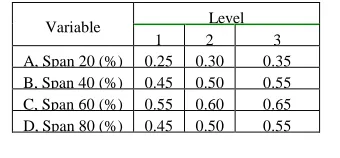
[image:2.595.223.393.422.501.2]) experimental design was used for optimization the emulsifying effectiveness of phytosterol in milk using Span 20, Span 40, Span 60 and Span 80 as emulsifiers. In the study, emulsification was accomplished with 40 ml fresh milk. Nine emulsifications were carried out at Span 20 of 0.25, 0.30 and 0.35%, Span 40 of 0.45, 0.50 and 0.55%, Span 60 of 0.55, 0.60 and 0.65%, Span 80 of 0.45, 0.50 and 0.55% on the basis of the single-factor experimental. Table 1 showed the emulsification conditions for emulsifying effectiveness of phytosterol in milk using Span as emulsifiers.
Table 1 Factors and levels for orthogonal experimental design
Variable Level 1 2 3 A, Span 20 (%) 0.25 0.30 0.35 B, Span 40 (%) 0.45 0.50 0.55 C, Span 60 (%) 0.55 0.60 0.65 D, Span 80 (%) 0.45 0.50 0.55
RESULTS AND DISCUSSION
Effect of four emulsifiers on emulsifying effectiveness of phytosterol in milk
Four emulsifiers including Span 20, Span 40, Span 60 and Span 80 were added to fresh milk at the concentrations of 0.20%, 0.30%, 0.40%, 0.50%, 0.60% and 0.70%, respectively. phytosterol was added to above milk at 0.5%(w/v) and stirred for 10min at 70℃ by the magnetic stirrer, the results were shown in Figure1.
As be shown in Fig. 1, with the increasing concentration of four emulsifiers, the emulsification R all first increased and then decreased. The emulsification R of Span 20 first increased from 0.977 at 0.20% to 0.992 at 0.30% then decreased to 0.982 at 0.70%, the maximum emulsification R of Span 20 was 0.992 at 0.30%. The emulsification R of Span 40 first increased from 0.986 at 0.20% to 0.988 at 0.50% then decreased to 0.981 at 0.70%, the maximum emulsification R of Span 40 was 0.988 at 0.50%. The emulsification R of Span 60 first increased from 0.965 at 0.20% to 0.982 at 0.60% then decreased to 0.975 at 0.70%, the maximum emulsification R of Span 60 was 0.982 at 0.60%. The emulsification R of Span 80 first increased from 0.971 at 0.20% to 0.981 at 0.50% then decreased to 0.971 at 0.70%, the maximum emulsification R of Span 80 was 0.981 at 0.50%. So the favorable concentrations of Span 20, Span 40, Span 60 and Span 80 were 0.40%, 0.40, 0.20 and 0.20% for emulsifying effectiveness of phytosterol adding to cow milk, respectively.
Optimization of the emulsification conditions for phytosterol in milk
design. The total evaluation index was used to analysis by statistical method. The results of orthogonal experimental and extreme difference analysis were presented in Table 2. The analysis of variance was performed by Orthogonal design Assistant II 3.1 and the result was listed in Table 2.
Emulsifiers(%)
0.2 0.3 0.4 0.5 0.6 0.7
E
m
u
ls
if
ic
a
ti
o
n
R
0.960 0.965 0.970 0.975 0.980 0.985 0.990 0.995
[image:3.595.94.504.125.453.2]Span 20 Span 40 Span 60 Span 80
Fig.1 Effect of four emulsifiers on emulsifying effectiveness of phytosterol adding to milk
Table 2 Results and range analysis of orthogonal experimental [L9 (34)]
No. A B C D Emulsification R Span 20(%) Span 40(%) Span 60(%) Span 80(%)
1 1 1 1 1 0.722 2 1 2 2 2 0.975 3 1 3 3 3 0.893 4 2 1 2 3 0.974 5 2 2 3 1 1.008 6 2 3 1 2 0.866 7 3 1 3 2 0.965 8 3 2 1 3 0.943 9 3 3 2 1 1.016 K1 0.863 0.887 0.844 0.915
K2 0.949 0.975 0.988 0.935 K3 0.975 0.925 0.955 0.937 R 0.112 0.088 0.144 0.022
R refers to the result of extreme analysis.
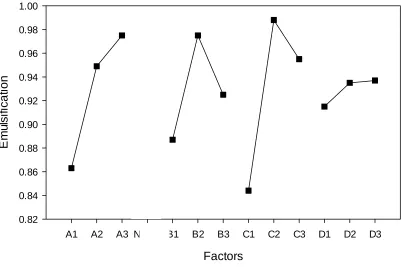
[image:3.595.166.448.510.676.2]Span 80 were 0.35%, 0.50%, 0.50% and 0.55% according to Fig.2, respectively. The analyses of variance of the results were shown in Table 3.
Factors
A1 A2 A3 N.a.N. B1 B2 B3 C1 C2 C3 D1 D2 D3
E
m
u
ls
if
ic
a
ti
o
n
[image:4.595.99.501.107.374.2]0.82 0.84 0.86 0.88 0.90 0.92 0.94 0.96 0.98 1.00
Fig.2 Trend of factors
Table 3 Analysis of variance for the orthogonal experimental design
Factors SS DF F Significance
A 0.020 2 20.000 **
B 0.012 2 12.000 *
C 0.034 2 34.000 **
D 0.001 2 1.000
Error 0.001 2
* p<0.10; ** p<0.05;F0.1 (2, 2) =9.00; F0.05 (2, 2) =19.00.
As be shown in Tab.3, the primary and secondary order of factors analyzed by variance analysis of was consistent with the intuitive analysis, Factor A (Span 20) and C (Span 60) were very significant, Factor B (Span 40) was significant and Factor D (Span 40) was not significant, So the optimal condition of emulsification for phytosterol in milk was A3B2C2D1, i.e. the concentration of Span 20, Span 40, Span 60 and Span 80 were 0.35%, 0.50%, 0.60% and 0.45%.
The emulsification R reached 1.022±0.0015 under condition mentioned above through verification test(N=3), which showed the experimental design was reasonable.
CONCLUSION
The optimal concentrations of Span 20, Span 40, Span 60 and Span 80 were 0.35%, 0.50%, 0.60% and 0.45% for emulsifying effectiveness of phytosterol in milk, respectively, the emulsification reached 1.022±0.0015 under the conditions mentioned above. Span 20 and Span 60 were very significant (p<0.05) and Span 40 is significant(p<0.10), the experimental design was reasonable.
Acknowledgements
[image:4.595.206.406.432.521.2]REFERENCES
[1]Anonymous. Inform, 2001, 12:1011–1016. [2]MH Moghadasian. Life Sci. 2000, 67:605–615.
[3]V Piironen, DG Lindsay, TA Miettinen, J Toivo, AM Lampi. J Sci Food Agric 2000, 80:939–66. [4]GL Guadalupe, TR María. Chemistry and Physics of Lipids, 2011, 164: 607–624
[5]J Ashok kumar, T Rekha, S Shyamala Devi, M Kannan, A Jaswanth,V.Gopal. J. Chem. Pharm. Res., 2010, 2(5): 177-180
[6]R Senthamarai, T Shri Vijaya Kirubha and S Gayathri. J. Chem. Pharm. Res., 2011, 3(6):829-838
[7]MN Palaksha and K Ravishankar. Journal of Chemical and Pharmaceutical Research, 2012, 4(11):4757-4761 [8]J Joselin, T Sarasabai S Brintha, A Rajam F and S Jeeva. Journal of Chemical and Pharmaceutical Research, 2013, 5(4):106-111
[9]F Marangoni, A Poli. Pharmacological Research, 2010, 61:193–199
[10] K Tatematsu, S Fuma, T Nagase, Y Ichikawa, Y Fujii, H Okuyama. Food and Chemical Toxicology, 2004, 42:1443–1451.
[11] S Harrabi, S Boukhchina, H Kallel and P Mayer. Journal of Food Biochemistry, 2011, 35:260–277 [12] RA Moreau, BD Whitaker and KB Hicks. Prog. Lipid Res. 2002,41:457–500
[13] S Devaraj, I Jialal, J Rockwood, D Zak. Clinical Nutrition,2011, 30:668-671 [14] S Devaraj, I Jialal, S Vega-López.Arterioscler Thromb Vasc Biol, 2004,24(3):25-8 [15] S Devaraj, BC Autret, I Jialal. Am J Clin Nutr 2006, 84(4):756-761.
[16] Y Park, P Timothy. Carr. Nutrition Research ,2013,33:154-61
[17] A Berger, PJ Jones and SS Abumweis. Lipids Health Dis. 2004, 3:1–19.
[18] MJ Lagarda, G Garcia-Liatas and R Farre. J Pharm. Biomed. Anal. 2006,41:1486–1496 [19] MM Delgado, M. Bustamante, D. Carabias. Anal Sci,2009,25:765–768
![Table 2 Results and range analysis of orthogonal experimental [L9 (34)]](https://thumb-us.123doks.com/thumbv2/123dok_us/8775826.901380/3.595.94.504.125.453/table-results-range-analysis-orthogonal-experimental-l.webp)