Journal of Chemical and Pharmaceutical Research
____________________________________________________
ISSN No: 0975-7384
J. Chem. Pharm. Res., 2010, 2(1): 196-210
196
Formulation Development and evaluation of Fast Dissolving Tablets
of Carvedilol
B.S. Venkateswarlu1, R. Margret Chandira*1, Talele Ajay1, Debjit Bhowmik1, Chiranjib1, B. Jayakar2 , K. P. Sampath Kumar2
1
Vinayaka Missions College of Pharmacy, Salem 2
Deparment of Pharmaceutical Sciences, Coimbatore Medical College, Coimbatore
______________________________________________________________________________
Abstract
Carvedilol is a poorly water soluble oral antihypertensive agent, with problems of variable bioavailability and bioequivalence related to its poor water solubility. Carvedilol is a nonselective beta adrenergic blocking agent with alpha-1 blocking activity and is indicated for the treatment of hypertension and mild to moderate heart failure of ischematic or cardiomyopathic origin In the present work solubility was enhanced by using β- cyclodextrin as a complexing agent. Sweeteners and flavors were used to enhance the organoleptic properties of tablet. Solubility studies were performed to investigate the drug carrier interaction. I.R. and D.S.C studies carried out to investigate any interaction and stability of formulation. Tablets were prepared by direct compression technique. Prepared tablets were evaluated for thickness, uniformity of weight, hardness, friability, wetting time, in-vitro disintegration time, drug content and in vitro drug release. All the formulations were evaluated for the influence of disintegrates and their concentrations on the characteristics of fast dissolving tablets mainly in terms of disintegration time and dissolution studies. Optimized formulation of Ac-Di-Sol Superdisintegrant in the concentration of (6mg) i.e. F3 batch gives best results than all the formulation. Formulation F3 of Ac-Di-sol superdisintegrant required minimum disintegration time, wetting time Compared to Formulations of Crosspovidone, or Sodium-starch glycoate with same concentration. From this study it can be concluded that Carvedilol can be successfully complexed with Beta-cyclodextrin to prepare fast dissolving tablets in the ratio of 1: 4.
Key words: Carvedilol, superdisintegrant, in-vitro disintegration time, β- cyclodextrin.
197
Introduction
Fast Dissolving Tablet is solid unit dosage form which disintegrates or dissolves rapidly in the mouth without chewing and water. To design fast dissolving oral tablet of Carvedilol in order to improve bioavailability, ease of administration and patient compliance. In the present study, fast dissolving tablet of Carvedilol was attempted with the aim to develop a dosage form that was easy to administer, provided fast release of drug and also enhanced bioavailability of the drug. Pregastric absorption through mouth, pharynx and oesophagus, could enhance the bioavailability by suitable formulation approaches and also provide local action, as the drug releases in saliva and passes down in to the stomach. The market survey revealed that the conventional tablets are available. Hence it was thought to formulate novel and convenient solid dosage form i.e. fast dissolving tablet. Carvedilol was selected as a drug candidate for the formulation of fast dissolving tablet for the following reasons, It is practically insoluble in water therefore taste related problems can be avoided.It is chemically stable.Having t1/2 of – 7 to 10 hrs.In view of
substantial first pas effect and its shorter plasma half life, therefore is an ideal drug candidate for fast dissolving tablet. Appropriate disintegrating agents and highly hydrophilic excipients are the main ingredients of fast dissolving tablets.
EXPERIMENTAL
Preparation of the Fast dissolving tablet of Carvedilol
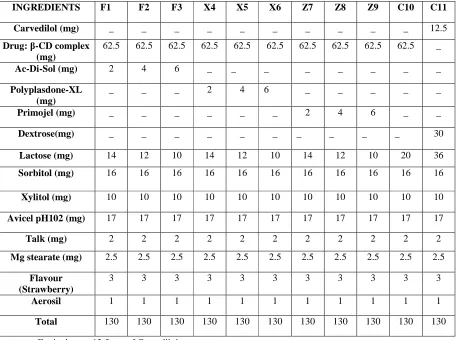
The tablet consisted of drug: β-CD complex, super disintegrant like Ac-di-sol/ Polyplasdone-XL /Primojel, Avicel pH102 (diluent), talk (lubricant), Magnesium stearate (lubricant), Lactose (filler), Dextrose (Binder/Diluent), sorbitol (Wetting agent), Xylitol (sweetener), Aerosil (glidant), Strawberry (flavor), . These ingredients were weighed and mixed stoichometrically to obtain the final formulation. The weight of the tablet in all formulations was kept constant to 130mg. All the batches were prepared by direct compression method using the 27-station rotary punch tablet compression machine using 7 mm biconvex plain on both side die-punches set. The variables maintained in the formulation were the different types of super-disintegrant and their concentration (in mg) in the formulation.
198
Preformulation Study
Solubility:
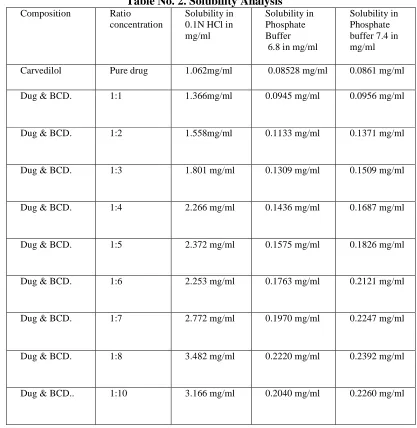
The solubility of Carvedilol and Carvedilol β-cyclodextrin complex was checked in various solvent at room temperature for 24 hours using rotary shaker / mechanical shaker. Solubility of the drug was determined by saturation method. In 100 ml of solvent 100mg of drug was added so 1000µg/ml of solution prepared. Drug was saturated because of insolubility in the solvent. Out of that 25ml was taken in the 50 ml of volumetric flask. With the help of mechanical shaker shaking of 24hrs was completed. After 24hrs of shaking solution was filtered through Whatman filter
paper and with suitable dilution absorbance recorded. Using slope of drug in the solvent concentration of drug in the solution was determined. From this concentration
[image:3.595.85.542.320.660.2]amount dissolved in the solvent i.e. solubility was determined. Similar procedure was followed for the various complex of Carvedilol β – cyclodextrin.
Table No. 1. Formulation of Fast dissolving tablet of Carvedilol
INGREDIENTS F1 F2 F3 X4 X5 X6 Z7 Z8 Z9 C10 C11
Carvedilol (mg) _ _ _ _ _ _ _ _ _ _ 12.5
Drug: β-CD complex (mg)
62.5 62.5 62.5 62.5 62.5 62.5 62.5 62.5 62.5 62.5 _
Ac-Di-Sol (mg) 2 4 6 _ _ _ _ _ _ _ _
Polyplasdone-XL (mg)
_ _ _ 2 4 6 _ _ _ _ _
Primojel (mg) _ _ _ _ _ _ 2 4 6 _ _
Dextrose(mg) _ _ _ _ _ _ _ _ _ _ 30
Lactose (mg) 14 12 10 14 12 10 14 12 10 20 36
Sorbitol (mg) 16 16 16 16 16 16 16 16 16 16 16
Xylitol (mg) 10 10 10 10 10 10 10 10 10 10 10
Avicel pH102 (mg) 17 17 17 17 17 17 17 17 17 17 17
Talk (mg) 2 2 2 2 2 2 2 2 2 2 2
Mg stearate (mg) 2.5 2.5 2.5 2.5 2.5 2.5 2.5 2.5 2.5 2.5 2.5
Flavour (Strawberry)
3 3 3 3 3 3 3 3 3 3 3
Aerosil 1 1 1 1 1 1 1 1 1 1 1
Total 130 130 130 130 130 130 130 130 130 130 130
199
Table No. 2. Solubility Analysis
Composition Ratio
concentration
Solubility in 0.1N HCl in mg/ml
Solubility in Phosphate Buffer 6.8 in mg/ml
Solubility in Phosphate buffer 7.4 in mg/ml
Carvedilol Pure drug 1.062mg/ml 0.08528 mg/ml 0.0861 mg/ml
Dug & BCD. 1:1 1.366mg/ml 0.0945 mg/ml 0.0956 mg/ml
Dug & BCD. 1:2 1.558mg/ml 0.1133 mg/ml 0.1371 mg/ml
Dug & BCD. 1:3 1.801 mg/ml 0.1309 mg/ml 0.1509 mg/ml
Dug & BCD. 1:4 2.266 mg/ml 0.1436 mg/ml 0.1687 mg/ml
Dug & BCD. 1:5 2.372 mg/ml 0.1575 mg/ml 0.1826 mg/ml
Dug & BCD. 1:6 2.253 mg/ml 0.1763 mg/ml 0.2121 mg/ml
Dug & BCD. 1:7 2.772 mg/ml 0.1970 mg/ml 0.2247 mg/ml
Dug & BCD. 1:8 3.482 mg/ml 0.2220 mg/ml 0.2392 mg/ml
Dug & BCD.. 1:10 3.166 mg/ml 0.2040 mg/ml 0.2260 mg/ml
Partition coefficient
A measurement of a drug's lipophilicity and an indication of its ability to cross cell membranes is the oil/water partition coefficient in systems such as octanol/water and chloroform/water. The partition coefficient is defined as the ratio of un-ionized drug distributed between the organic and aqueous phase as equilibrium.
200
characterizing the lipophilic/hydrophilic nature of the drug. Drugs having values of logP much greater than one are classified as lipophilic, whereas those with partition coefficients less than one are indicative of a hydrophilic drug.
Table No. 3. Process of Determination of Partition coefficient
S.No. Drug (mg) Octanol (ml) Water (ml)
1. 10 50 50
2. 20 50 50
3. 30 50 50
Table No. 4. Observation and Calculation of Partition Coefficient
Preparation of blend:- Accurately weighed all the ingredients. All the ingredients passed
through sieve no.60 except lubricants; lubricants passed through sieve no.80. All ingredients mixed stoichometrically; lubricants added at the time of compression. This is the blend ready for compression.
S.No
Conc. of drug in Octanol (µg\ml)
x DF
Conc of drug in water (µg\ml) x
DF
Po\w = conc. of octanol\conc. water
Average P o\w
1 0.8113 0.266 3.05
3.06
2 0..80066 0.266 3.01
201
Evaluation of Blend:-
Angle of Repose: - The angle of repose is the constant, three dimensional angle (relative to
horizontal base) assumed by a cone like pile of material formed by any of several different methods. When the angle of repose exceeds 50 degrees, the flow is rarely acceptable for manufacturing purposes.
Bulk Density: -
Bulk density often is the bulk density of the powder “as poured” or as passively filled into the measuring cylinder. Bulk density is determined by measuring the known mass of powder sample that has been passed through a screen in to a graduated cylinder or through a volume measuring apparatus into a cup.
Bulk Density= Mass/Volume Bulk Density= M/Vo
Tapped Density: -
The tapped density is a limiting density attained after “tapping down,” usually in a device that
lifts and drops a volumetric measuring cylinder containing the powder a fixed distance. Tapped density is achieved by mechanically taping a measuring cylinder containing a powder sample. After observing the volume, the cylinder is mechanically tapped, and volume reading taken until little further volume change is observed. The mechanical tapping is achieved by raising the cylinder and allowing it to drop under its own weight a specified distance by either of two methods as described below. Devices that rotate the cylinder during tapping may be preferred to minimize any possible of the mass during tapping down.
Tapped Density= Mass/Tapped volume. Tapped Density=M/Vf.
Compressibility Index and Hausner Ratio: - (Measure of powder compressibility)
The Compressibility Index and Hausner ratio are measures of the propensity of a powder to be compressed. As such, they are measures of the relative importance of interparticulate interactions, in a free flowing powder, such interactions are generally less significant, and the bulk and tapped densities will be closer in value. For poorer flowing materials, there are frequently greater interparticle interactions, and a greater difference between the bulk and tapped densities will be observed. These differences are reflected in the Compressibility Index and the Hausner Ratio.
Compressibility Index – calculate by the formula 100(Vo - Vf)
Hausner Ratio calculates by the formula Vo /Vf
Determination of moisture content:-
Moisture content of the prepared blend was determined using Moisture Analyzer of A and D Co. Ltd of model no CE-N 92. 5gm of blend laced on moisture analyzer at 1050C & it determines moisture content.
Phase Solubility Analysis of Carvedilol:-
202
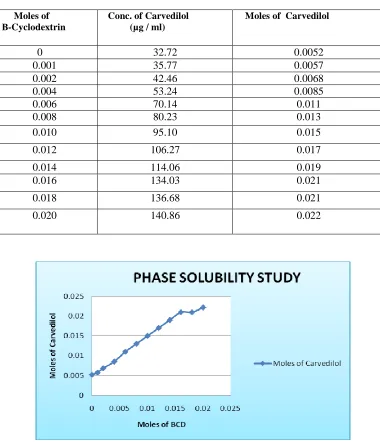
with distilled water to give molar solutions in the range of 0.001 M to 0.02 M. Screwcapped bottles were filled with constant volume of these molar solutions and excess of drug quantities were added to these bottles. These solutions were equilibrated for 24 hours by constant shaking on rotary shaker. The supernatants were filtered and analyzed using UV-Visible spectrophotometer. A plot of molar concentrations of ß- CD vs. molar concentrations of drug was plotted.The stability constant was calculated according to equation,
Kc = Slope / Intercept (1 - slope)
Table 5. Phase solubility Analysis
Moles of Β-Cyclodextrin
Conc. of Carvedilol (µg / ml)
Moles of Carvedilol
0 32.72 0.0052
0.001 35.77 0.0057
0.002 42.46 0.0068
0.004 53.24 0.0085
0.006 70.14 0.011
0.008 80.23 0.013
0.010 95.10 0.015
0.012 106.27 0.017
0.014 114.06 0.019
0.016 134.03 0.021
0.018 136.68 0.021
0.020 140.86 0.022
[image:7.595.127.507.244.688.2]
203
The phase solubility analysis diagram of Carvedilol with β-Cyclodextrin can be observed in above Figure. As can be seen, this diagram is an AL type curve with a linear relationship between
solubilized Carvedilol and β-Cyclodextrin with a negative curvature. The initial linear ascending part of solubility diagram in Figure is generally ascribed to the formation of a 1:4 complex. The apparent stability constant (K1:4) calculated using formula.
K1:4 = Slope / S0 (1 – Slope)
Where S0 is the intrinsic solubility of Carvedilol.
The apparent stability constant (K1:4) for the Carvedilol: β-Cyclodextrin complex was calculated
from the solubility data and found to be 2083 M-1s.
Characterization of drug: β-CD complex.
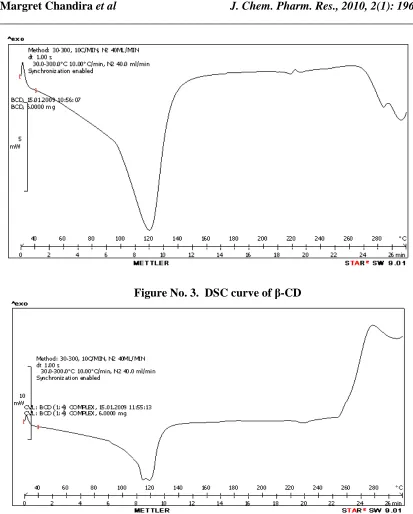
b) Differential Scanning Calorimetry (DSC) Study:
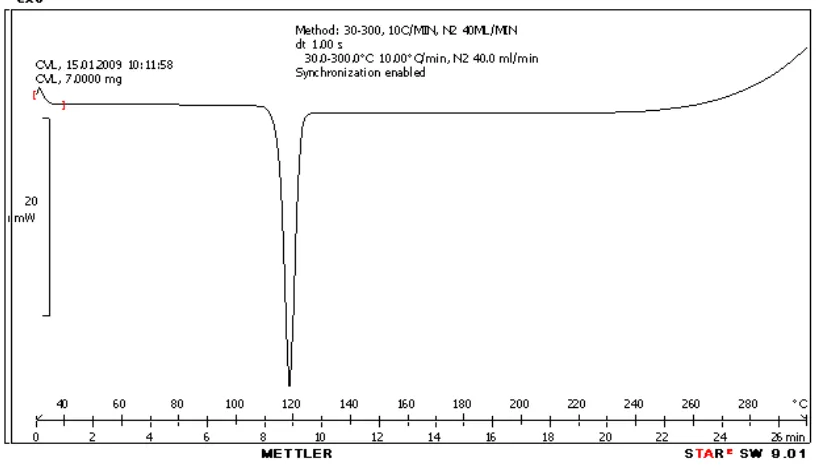
[image:8.595.108.518.366.600.2]The Differential Scanning Calorimetric study was carried out using Mettler Toledo Differential Scanning Calorimeter. Samples were placed in an aluminum crucible and the DSC thermograms were recorded at heating rate of 100 C/ min in the range 30 to 3000C.
204
Figure No. 3. DSC curve of β-CD
Figure No. 4. DSC curve of β-CD - Carvedilol complex
205
Physical properties of β- Cyclodextrin and complex:
1.Shape: The shape of both β- Cyclodextrin and drug: β-CD complex was found to be irregular as determined by microscopic method.
2.Flow properties: The angle of repose was found to be 29.350 for drug: β-CD complex. The angle of repose of uniform spheres is 20° and angles larger than 45° exist for cohesive powders. So the Drug: β-Cyclodextrin complex can flow.
[image:10.595.88.543.267.347.2]3.Bulk Density: The bulk density value was found to be 0.65 for drug: β-CD complex.
Table No. 6. Physical properties of drug: β-Cyclodextrin (1:4) complex
β – Cyclodextrin /
Drug: β-CD complex
Physical properties
Shape Angle of repose Bulk Density
Β – Cyclodextrin Irregular 31.570 0.57
Drug: β-CD (1:4) complex Irregular 29.350 0.65
Results and Discussion
Preparation of blend:
Accurately weighed all the ingredients. All the ingredients passed through sieve no.60 except lubricants; lubricants passed through sieve no.80. All ingredients mixed stoichometrically; lubricants added at the time of compression. This is the blend ready for compression.
Evaluation of Blend:-
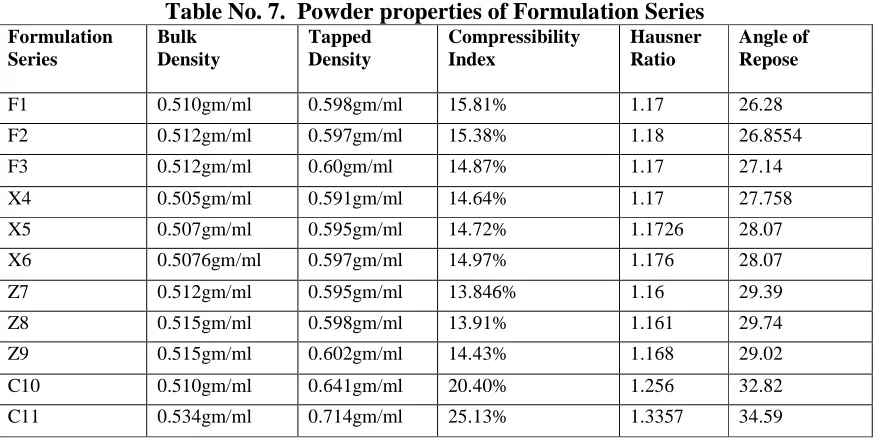
Table No. 7. Powder properties of Formulation Series
Formulation Series
Bulk Density
Tapped Density
Compressibility Index
Hausner Ratio
Angle of Repose
F1 0.510gm/ml 0.598gm/ml 15.81% 1.17 26.28
F2 0.512gm/ml 0.597gm/ml 15.38% 1.18 26.8554
F3 0.512gm/ml 0.60gm/ml 14.87% 1.17 27.14
X4 0.505gm/ml 0.591gm/ml 14.64% 1.17 27.758
X5 0.507gm/ml 0.595gm/ml 14.72% 1.1726 28.07
X6 0.5076gm/ml 0.597gm/ml 14.97% 1.176 28.07
Z7 0.512gm/ml 0.595gm/ml 13.846% 1.16 29.39
Z8 0.515gm/ml 0.598gm/ml 13.91% 1.161 29.74
Z9 0.515gm/ml 0.602gm/ml 14.43% 1.168 29.02
C10 0.510gm/ml 0.641gm/ml 20.40% 1.256 32.82
[image:10.595.98.538.481.701.2]206
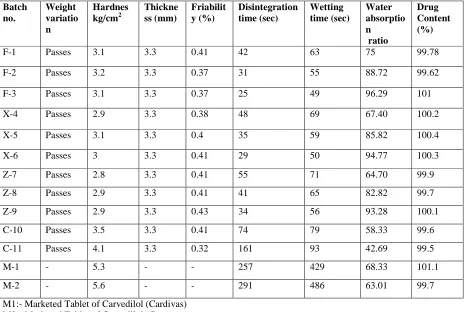
Table No. 8. Evaluation of Formulation Series
Batch no. Weight variatio n Hardnes kg/cm2 Thickne ss (mm) Friabilit y (%) Disintegration time (sec) Wetting time (sec) Water absorptio n ratio Drug Content (%)
F-1 Passes 3.1 3.3 0.41 42 63 75 99.78
F-2 Passes 3.2 3.3 0.37 31 55 88.72 99.62
F-3 Passes 3.1 3.3 0.37 25 49 96.29 101
X-4 Passes 2.9 3.3 0.38 48 69 67.40 100.2
X-5 Passes 3.1 3.3 0.4 35 59 85.82 100.4
X-6 Passes 3 3.3 0.41 29 50 94.77 100.3
Z-7 Passes 2.8 3.3 0.41 55 71 64.70 99.9
Z-8 Passes 2.9 3.3 0.41 41 65 82.82 99.7
Z-9 Passes 2.9 3.3 0.43 34 56 93.28 100.1
C-10 Passes 3.5 3.3 0.41 74 79 58.33 99.6
C-11 Passes 4.1 3.3 0.32 161 93 42.69 99.5
M-1 - 5.3 - - 257 429 68.33 101.1
M-2 - 5.6 - - 291 486 63.01 99.7
M1:- Marketed Tablet of Carvedilol (Cardivas) M2:- Marketed Tablet of Carvedilol (Carca)
Determination of Drug content of the Drug: β-CD complex:
Drug: β-Cyclodextrin (1:4) complex was evaluated for the drug content. Drug: β-Cyclodextrin complex equivalent to 12.5 mg of drug was stirred with 100ml of 0.1N HCl for 60 minutes, then the solution was filtered and treated as stock solution containing 100 mg/ml drug. From this stock solution the concentration of 10 µg/ml was prepared and the drug content was determined using the calibration curve of pure drug in 0.1N HC1 spectrophotometrically at 242 nm using 0.1N HC1 as blank.
Procedure:
207
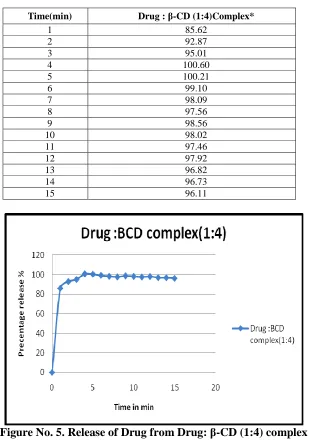
Table No. 9. Release of drug from Drug: β-CD (1:4) complex
Time(min) Drug : β-CD (1:4)Complex*
1 85.62
2 92.87
3 95.01
4 100.60
5 100.21
6 99.10
7 98.09
8 97.56
9 98.56
10 98.02
11 97.46
12 97.92
13 96.82
14 96.73
15 96.11
[image:12.595.166.475.125.565.2][image:12.595.93.528.576.733.2]
Figure No. 5. Release of Drug from Drug: β-CD (1:4) complex
Table No. 10. Drug release Profile of various CVL- β-CD complexes in 5 minutes:-
Time(min) Drug : β-CD Complex* % Drug Release
5 1:0.5 69.35
5 1:1 77.18
5 1:2 87.59
5 1:3 91.47
5 1:4 100.21
5 1:8 102.84
208
Figure No. 6. Comparative drug release profile of F3, X6 and Z9 formulations with marketed formulations (M1 and M2)
Conclusion
209
References
[1] Tayade P. T., Vavia P. R., Indian Journal Pharmaceutical Sciences., 1999, 97-99. [2] Baboota S., Dhaliwal M., Kohli K., Ali J., Indian J. Pharm. Sci., 2005, 226-228. [3] Kaushik D. Dureja H. and Saini T.R. Indian Drugs, 2004, 41 (4), 503-508.
[4] Nazma Inamdar, Kiran Bhise, Shakeel Memon; Asian Journal of pharmaceutics, April
2008 ,128-132.
[5] Arun Shirwaikar, et.al, Indian Journal of Pharmaceutical Sciences, Sept-Oct 2007, 633-639. [6] Ashutosh Mohapatra Rajesh K Parikh 2008 Asian Journal of pharmaceutics, July-September 2008, 177-181.
[7] Mukesh C Gohel., et al. Asian Journal of pharmaceutics, July-september 2008, 167-171. [8] Balakrishnan Prabagar, et.al, Indian Journal of Pharmaceutical Sciences, Jan-Feb 2006, 89-94.
[9] Shishu and ashima Bhatti, et.al, Indian Journal of Pharmaceutical Sciences, Jan-Feb 2008, 80-84.
[10]Shishu and ashima Bhatti, et.al, Indian Journal of Pharmaceutical Sciences, Jan-Feb
2008,71-76.
[11]Shailesh Sharma, G.D.Gupta, Asian Journal of pharmaceutics, Jan- 2008, 70-74.
[12]P.V.Swami, et al. Indian Journal of Pharmaceutical Sciences, May-June 2007, 427-430. [13]Omaima A. Sammour,Mohammed A. Hammad, Nagia A. Megrab, and Ahmed S. Zidan,
AAPS PharmSciTech 2006; 7 (2) Article 55; E1-E9.
[14]Darío Leonardi, María Gabriela Barrera, María Celina Lamas, and Claudio Javier Salomón,
AAPS PharmSciTech 2007; 8 (4) Article 108; E1-E8.
[15]Shagufta Khan, Prashant Kataria,Premchand Nakhat, and Pramod Yeole AAPS
PharmSciTech 2006; 9 (2) Article 22, E1-E9.
[16]Yogesh Rane, Rajshree Mashru, Mayur Sankalia, and Jolly Sankalia, AAPS PharmSciTech
2007; 8 (2) Article 27, E1-E11.
[17]Na Zhao1 and Larry L. Augsburger1 Jan 2005 AAPS, E634-E640.
[18]Tartara., Mitsutoshi. Matsuyama. Koji and Shimizu., US patent No., US 6316026, 1999. [19]Yunxia bi, yorinobu yonezawa and hisakazu sunada 1999. Journal of pharmaceutical
science.88:1004-101
[20]Mutasem M. Rawas-Qalaji, F. Estelle R. Simons, and Keith J. Simons, AAPS PharmSciTech
2006; 7 (2) Article 41, E1-E7.
[21]Mane Avinash, R., Kusum Devi, V.and Asha, A.N.2003. Indian Drug, 40(9), 544-546. [22] Chowdary KPR, Murli Krishna M.N., Tripura Sundari, 2006. International journal of
pharmaceutical excipient.5: (2) 42-46.
[23]S.N.Hiremath,U.V.Bhosale , F.Sunil; Asian Journal of Pharmaceutics, Jan-2008; Page
no. 73-76.
[24]Sajal Kumar Jha, Vijayalakshmi P, Roopa Karki, Divakar Goli, Asian Journal of
Pharmaceutics, Oct-2008; Page no, 255-260.
[25]Aithal K.; Harish N.M.; Rathnanand M.; Shirwaikar A.A; Dutta M.; Indian Drugs, 2006; 43(7), 576-582.
[26]Nirav V Patel .et.al Asian Journal of Pharmaceutics, Jan-2008; Page no, 22-25. [27]Gohel M. and Nehal B. (2004) Indian Journal of Pharmaceutical Sciences, 5(3), 1-6.
[28]Shishu and ashima Bhatti, et.al, Indian Journal of Pharmaceutical Sciences, Jan-Feb
210
[29]C. Mallikaarjuna Setty, et al. Indian Journal of Pharmaceutical Sciences, March-April 2008, 180-185.
[30]R. S. Masareddy*,R. V. Kadia and F. V. Manvi Indian Journal of Pharmaceutical Sciences., July-August 2008, 526-528.
[31]D.M. Patel, et.al Indian Journal of Pharmaceutical Sciences., Jan- 2008, 71-76.
[32]Narendra Kumar, Akhilesh K Jain and et al, Asian Journal of Pharmaceutics,
July-Sept-2008; Page no, 154-178.
[33]Sheetal Malke,Supria Shidhaye, Indian Journal of Pharmaceutical Sciences., March-April