REDUCTION OF PAPR IN ORTHOGONAL FREQUENCY DIVISION
MULTIPLEXING USING OPTIMAL SEARCH PARTIAL TRANSMIT
SEQUENCE TECHNIQUE
T. Jaya1, V. Margaret Suganthi1 and E. Gopinathan2
1Department of Electronics and Communication Engineering, Vels University, Chennai, India 2School of Engineering, Vels University, Chennai, India
E-Mail: [email protected]
ABSTRACT
Orthogonal frequency division multiplexing is one of the modulation techniques used as a high speed transmission technology with good interference reduction properties. High peak to average power ratio (PAPR) in transmitted signal is one of the major disadvantages of OFDM technique. We propose a optimal search algorithm called Partial Transmit Sequences (OSA-PTS) is used to reduce peak to average power ratio. The proposed new OSA-PTS method is a very effective in reducing the high peak to average power ratio during transmission. The earlier method is selective mapping (SLM) technique has the disadvantage that it requires high computational complexity which increases with increasing number of sub blocks. The new optimization search algorithm based partial transmit sequences method is used to reduce the high peak to average power ratio with low computational complexity. The output response of proposed new optimal search algorithm provides better PAPR reduction in the transmitted signal compared to the existing SLM method.
Keywords: Orthogonal frequency division multiplexing (OFDM), PAPR, OSA-PTS, PTS, SLM.
1. INTRODUCTION
OFDM is a popular technique for broadband mobile communications because of its very important properties. The important features of OFDM are high data rate, efficient bandwidth efficiency and robust against frequency selective fading etc. In OFDM the total bandwidth of the channel is divided into number of sub band channels. Each channel has a fixed bandwidth. In a multiple – user environment, however each user is reserved for one sub channel. The orthogonality property effectively denotes that each carrier frequency has null response at the centre frequency of other carrier signal. The system can also preserve an integer number of cycle over symbol period of each user [1].
OFDM signal has high peak to average power ratio during transmission. In OFDM technique the output signal contains super position of multiple numbers of subcarriers. However the instantaneous received power may increases significantly and it become much more than the mean power of the systems.
a) Power ratio reduction
Orthogonal Frequency division multiplexing is a very effective method for future communication over wireless transmission medium. One of the most important disadvantages of OFDM is high Peak to Average Power Ratio which degrades the system output performances. In this section, briefly describe the PAPR problem which appears in OFDM and analyse the performance of proposed ew optimization algorithm OSA-PTS which is used to reduce the high PAPR in the signal during transmission.
The future fourth generation wireless communication system need high speed data transmission for high speed internet access, digital
audio and digital video broadcasting for real time applications. OFDM technique has high data rate approximately equal to 100 Mbps but it is having high PAPR which occur during transmission of signal. The ratio between peak powers to average power of the signal is called peak to average power ratio in OFDM. Figure-1a corresponds to the non-linear characteristic of high power amplifier with amplitude and phase transfer functions.
Figure-1(a). Characteristic of high power amplifier - amplitude and phase transfer functions. A (u) = α.u/1+β.u2 (1)
P (u) = α.u2/1+β.u2 (2)
A (u) denotes the amplitude characteristic of the signal and P (u) denotes the phase characteristic of the signal.
α and β are the coefficients..
Where
Ppeak = max [|en | 2] = peak power of OFDM signal
Pave = E [| en|2] = average power of OFDM signal E [ɾ] is the expectation operator of the signal.
The PAPR of an oversampled version of e (t) calculated as per the above equation. In this equation the main aim is to minimize the max [|en|2].
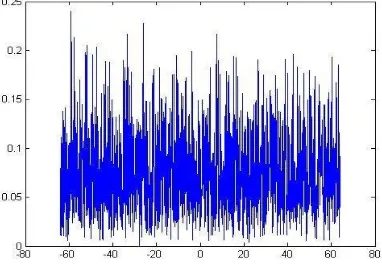
Figure- 1(b). Large peak of OFDM waveform.
Figure-1(b) shows typical values of the transmitted signal. This figure also shows 64 data symbol per frame using IFFT. This waveform shows clearly that the peak value of signal goes very high as compared to the average value of the signal. Hence there is a need to reduce the high peak to average power ratio. Different types of methods are discussed in literature for reducing this PAPR.
2. RELATED WORKS
The peak to average power ratio affects the performances and efficiency of power amplifier. The Selective Mapping (SLM) technique using inverse Discrete Fourier Transform (IDFT) and Selective Mapping (SLM) with Inverse Fast Fourier Transform (IFFT) have been reported in the literature [1, 2]. In this paper it is shown that a combination of SLM with DCT gives better reduction in PAPR performances compared to that of ordinary SLM techniques. A very attractive technique to reduce PAPR is companding transform method used in [3]. There are two companding techniques μ- law and exponential companding. The drawback of this method is side lobes generation in the spectrum, but the exponential. companding schemes create less side lobes compared to μ- law method. Also this technique increases the average received power and out of band radiation [4].
The repeated clipping and frequency domain filtering of an orthogonal frequency division multiplexing
average power ratio (PAPR) of the transmitted signal. Clipping is a very simple method of removing the high amplitude peaks of the waveform which is maximum than predetermined value. Clipping simply removes the high amplitude peaks by selecting the optimum clipping value. However the performance of the system decreases due to In Band Radiation (IBR) and Out of Band Radiation (OBR) which can be improved by the filtering process. Through filtering after clipping can reduce the out of band radiation, it may create some peak re-growth in the filtered signal so that signal after clipping and filtering will exceed clipping level at some points [6]. To decrease the overall peak re-growth, again a clipping after filtering operations can be used repeatedly. However this repeated clipping and filtering process takes a number of iterations to reach desired amplitude level and thus it will increase the computational complexity of the transmitter.
This technique does not cause any increases in out of band power [5]. Different techniques are available to decrease the PAPR are classical clipping and filtering, selective mapping, tone reservation and partial transmit sequences. Through analysis of different PAPR reduction techniques it is shown that clipping on 4- QAM with 64 subcarrier and classical clipping is better than oth techniques using QPSK modulation with 64 subcarriers [8, 9].
3. PAPR REDUCTION SCHEMES
The PAPR reduction schemes are divided into two groups which are
1) Signal distortion techniques. 2) Signal scrambling techniques
In the signal distortion techniques include peak windowing, clipping and filtering, and companding.
The signal scrambling techniques are block coding, selective mapping, tone reservation, tone injection, and partial transmit sequence.
a) SLM for reducing PAPR
[image:2.612.90.281.239.374.2]Thus, the receiver is required to learn information about selected phase vector sequence and ensure that the vector sequence is received correctly. The perceptive approach is to select the whole sequence of branch number m as side information transmitted to the receiving end. Practically it can be realized by sending the route number of the vector sequence instead as a substitute. This is only achievable when the receiving end is capable to recover the random phase sequence by using look-up table or any other method [7].
Figure-2. Schematic of selected mapping technique.
In this technique, it is assumed that M number of OFDM symbols carries the same information and that these are statistically independent of each other.
b) Tone reservation and tone injection
In this technique, some set of tones are reserved called as peak reduction carriers and these are added to the data signal to isolate energy to cancel large peaks of the signal. These tones do not carry any information and are orthogonal to each other. The Tone Injection (TI) technique decreases the PAPR without reducing the data rate similar to Active Constellation Extension (ACE) algorithm, few constellation points are presented outside the signal constellation but in a different way than in ACE.
ACE method change the amplitude and phase of tones of original OFDM signal whose base band modulation symbol in an outer point of the signal constellation. The outer constellation points are dynamically comes towards the original constellation.
c) PTS technique
Partial Transmit Sequence (PTS) algorithm is a PAPR reduction technique for improving the statistic data of a multicarrier signal. The basic idea of partial transmit sequence algorithm is to partition the original OFDM sequence into number of sub-sequences. Each sequence is multiplied by independent phase weights until an optimum value is reached.
In general, the known sub-block partitioning methods can be classified into three categories: 1) Adjacent partitioning, 2) Interleaved partitioning and 3) Pseudo- random partitioning. The third one pseudo-random partitioning is suitable for this PTS method [9]. Figure-3 gives the block diagram of PTS technique. The input information in frequency domain X is separated into M non-overlapping sub-blocks, with each sub- block vectors having the same size N. Each and every sub-block contains N/M nonzero elements and set the rest of part to zero. Assume that these no overlapping sub-blocks have the same size and no gap between each other. The signal in time domain is obtained by applying IFFT operation.
Finally the optimum value one with the suitable phase factor from the combination b = [b1, b2,.., bM] is selected for transmission.
Figure- 3. Schematic of PTS technique.
4. RESULT AND DISCUSSION
Figure-4(A) shows the original transmitted signal of OFDM technique which has 16dB PAPR. In figure (C) shows the Amplitude clipping of PAPR reduction technique. This technique shows the PAPR as 16 dB, it is same as in the original transmitted signal.
In Figure-4 (D) shows the selective mapping technique which reduces the PAPR by 5 dB. Figure 4(B) shows the proposed partial transmit sequence technique. It can be seen that the reduction of PAPR is10.5dB.Thus we proved that the Partial sequence method gives high peak to average power ratio reduction compared to other two methods selected mapping and clipping. The PTS scheme provides 10.5 dB PAPR reductions as shown in Figure-4 (B).
a) Comparison of PAPR reduction techniques
Figure-5. Comparison of PAPR reduction techniques symbols-12.
Figure-6. Comparison of PAPR reduction techniques symbols-16.
Figure-7. Comparison of PAPR reduction techniques symbols-20.
Figures-5, 6, and 7 show the comparison of PAPR reduction techniques viz. Amplitude clipping, SLM and OSA-PTS. We find that the Selective mapping method reduces the PAPR by 5.5 dB compared to transmitted signal peak power. However the proposed OSA-PTS method provides
10.5 dB PAPR reductions as compared with the original transmitted signal peak power. The Partial Transmit Sequences method gives high PAPR reduction compare with the selective mapping technique. Table-1 shows the PAPR and PAPR reduction for different methods and Table-2 shows the proposed method simulation parameters.
Table-1. Comparison between different PAPR
Reduction techniques.
PAPR reduction techniques
PAPR
(dB) Reduction PAPR (dB)
Transmitted signal 16 -
Amplitude Clipping 16 -
Selected mapping 11 5
OSA-Partial transmit
sequence 5.5 10.5
Table-2. Simulation parameters.
IFFT Bin size 1024
Carrier count 20
Bits per symbol 12,16,18 Carriers per symbol 12
PAPR Reduction methods Clipping, SLM, PTS
Table- 3. Comparison of bits per symbols vs. CCDF.
Bits per symbol CCDF
12 0.35
16 0.3
CONCLUSIONS
Hence we proved that the proposed partial transmit sequences method gives better result than the existing one as shown in Table- 1. In future using optimal search algorithm with this technique to reduce the disadvantage of computation complexity in PTS method.
REFERENCES
[1] PAPR Reduction in OFDM System Based on SLM Techniques IJITEE, Vol. 3, N o . 4, September 2013 Author- Anamit shulka, Vineeta.
[2] Reduction PAPR of OFDM Signals by Combining SLM With DCT Transform Int. J. Communications, Network and System Sciences, 2010, Vol. 3, pp. 888-892 Zhongpeng Wang.
[3] Combined DCT and Companding for PAPR Reduction in OFDM Signals Journal of Signal and Information Processing, 2011, Vol. 2, pp. 100-104 Zhongpeng Wang
[4] Exponential companding technique for PAPR reduction in OFDM systems IEEE transaction on. Vol. 51, pp. 244-248, June 2005 No. 2 Yang Yang, Yong –hua song.
[5] Peak to average power reduction for OFDM by repeated clipping and frequency domain filtering IET Digital library, Electronics letters, Volume: 38, Issue: 5,28 February 2002, 246-247 Armstrong.
[6] An Overview: Peak-to-Average Power Ratio Reduction Techniques for OFDM Signals IEEE transactions on broadcasting, vol. 54, no. 2, June 2008 Tao Jiang, Member, IEEE, and Yiyan Wu, Fellow, IEEE.
[7] Different Techniques to Reduce the PAPR in OFDM System (IJERA). Vol. 2, Issue 3, May-June
2012, pp.1292-1294 Malhar Chauhan, Saurabh, Hardik patel.
[8] A Comparison of different PAPR Reduction Techniques in OFDM using various Modulations (IJMNCT) Vol.2, No.4, August 2012 Gaurav Sikri1 and Rajni2.
[9] Survey Paper on PAPR Reduction Techniques in WIMAX OFDM MODEL IJARCSSE Volume 4, Issue 7, July 2014 Er. Rajnish Kansal, Stephy.