Georgia State University Georgia State University
ScholarWorks @ Georgia State University
ScholarWorks @ Georgia State University
Nutrition Theses Department of Nutrition
Summer 6-13-2014
The Use of Indirect Calorimetry to Accurately Assess Energy
The Use of Indirect Calorimetry to Accurately Assess Energy
Needs In Members of the Georgia State University Student
Needs In Members of the Georgia State University Student
Recreation Center and a Comparison of Nutrition Services
Recreation Center and a Comparison of Nutrition Services
Available To Students on Urban College Campuses
Available To Students on Urban College Campuses
Leslie S. Knapp
Georgia State University
Follow this and additional works at: https://scholarworks.gsu.edu/nutrition_theses
Recommended Citation Recommended Citation
Knapp, Leslie S., "The Use of Indirect Calorimetry to Accurately Assess Energy Needs In Members of the Georgia State University Student Recreation Center and a Comparison of Nutrition Services Available To Students on Urban College Campuses." Thesis, Georgia State University, 2014.
https://scholarworks.gsu.edu/nutrition_theses/53
This Thesis is brought to you for free and open access by the Department of Nutrition at ScholarWorks @ Georgia State University. It has been accepted for inclusion in Nutrition Theses by an authorized administrator of
This thesis, THE USE OF INDIRECT CALORIMETRY TO ACCURATELY ASSESS ENERGY NEEDS IN MEMBERS OF THE GEORGIA STATE UNIVERISTY
STUDENT RECREATION CENTER AND A COMPARISON OF NUTRITION SERVICES AVAILABLE TO STUDENTS ON URBAN COLLEGE CAMPUSES, by Leslie S. Knapp was prepared under the direction of the Master’s Thesis Advisory Committee. It is accepted by the committee members in partial fulfillment of the
requirements for the degree Master of Science in the Byrdine F. Lewis School of Nursing and Health Professions, Georgia State University. The Master’s Thesis Advisory
Committee, as representatives of the faculty, certify that this thesis has met all standards of excellence and scholarship as determined by the faculty.
_____________________ ________________________
Sarah T. Henes, PhD, RD, LD Barbara Hopkins, MMSc, RD, LD
Committee Chair Committee Member
______________________
Caroline L. Dotts, MSA, ACSM HFS Committee Member
AUTHOR’S STATEMENT
In presenting this thesis as a partial fulfillment of the requirements for the advanced degree from Georgia State University, I agree that the library of Georgia State University shall make it available for inspection and circulation in accordance with its regulations governing materials of this type. I agree that permission to quote, to copy from, or to publish this thesis may be granted by the professor under whose direction it was written, by the Byrdine F. Lewis School of Nursing and Health Professions director of graduate studies and research, or by me. Such quoting, copying, or publishing must be solely for scholarly purposes and will not involve potential financial gain. It is understood that any copying from or publication of this thesis which involves potential financial gain will not be allowed without my written permission.
All theses deposited in the Georgia State University library must be used in accordance with the stipulations prescribed by the author in the preceding statement. The author of this thesis is:
Leslie S. Knapp 3676 School Street Chamblee, GA 30341
The director of this thesis is:
Sarah T. Henes, PhD, RD, LD Assistant Professor Department of Nutrition
Byrdine F. Lewis School of Nursing and Health Professions Georgia State University
VITA
Leslie S. Knapp
ADDRESS: 3676 School St.
Chamblee, GA 30341
EDUCATION: M.S. 2014 Georgia State University Health Sciences – Nutrition
B.B.A. 2005 Western Michigan University Business Administration
B.A. 2005 Western Michigan University Public Relations
PROFESSIONAL EXPERIENCE:
• Dining Hall Nutritionist 2013-2014
Piedmont & Patton Dining Halls
Georgia State University, Atlanta, GA
• Server 2007-2012
Seasons 52 Fresh Grill & Wine Bar, Atlanta, GA
PROFESSIONAL SOCIETIES AND ORGANIZATIONS:
• Academy of Nutrition and Dietetics 2013-present
THE USE OF INDIRECT CALORIMETRY TO ACCURATELY ASSESS ENERGY NEEDS IN MEMBERS OF THE GEORGIA STATE UNIVERISTY STUDENT RECREATION CENTER AND A COMPARISON OF NUTRITION SERVICES
AVAILABLE TO STUDENTS ON URBAN COLLEGE CAMPUSES by
Leslie S. Knapp
Background: The greatest increase in obesity rates have been seen with young adults in college due to their unhealthy dietary habits and behaviors. Interventions at this life stage
may reduce the development of obesity related health concerns. There is an evident need
for nutrition and lifestyle interventions yet there is limited research on the
implementation of comprehensive nutrition programs for college students.
Objective: This research study has a dual focus. We aim (1) to describe nutrition services offered through the Georgia State University Student Recreation Center to
include nutrition assessment in a college population. Specifically, measured energy
needs (Korr ReeVue™ Portable Indirect Calorimeter) were compared with estimated
energy needs (predictive equations) and nutrition software (BioEx Nutrition Maker
Software© Plus 2.0). In addition, this study aims (2) to survey what types of nutrition
services are offered by campus recreation centers that are part of the Urban 13
research-sharing institutions.
Methods: (1) Twenty-three healthy weight (n=8) and overweight/obese (n=15) 18 -37 year old males (n=11) and females (n=12) that were members of the Georgia State
University student recreation center and had undergone indirect calorimetry. Paired
(RMR) with RMR estimated from the Harris-Benedict and Mifflin-St. Jeor equations.
Measured and estimated RMR were used to calculate total energy expenditure (TEE).
Paired sample t-tests were also used to compare the means of each calculated TEE. A
p-value ≤ 0.05 defined significance. (2) The 21 campus recreation centers of the Urban 13
were asked to complete a five-question survey by email or phone. Survey results were
tabulated based on result frequencies.
Results: (1) A statistical significance (p < 0.003) was found when comparing the means of measured RMR (1627 ± 393 kcal/day) with RMR estimated with the Harris Benedict
equation (1781 ± 321 kcal/day). Significant differences (p < 0.001) were found between
TEE calculated via measured RMR (2153 ± 534 kcal/day) and TEE calculated with
estimated RMR via the Harris-Benedict equation (2354 ± 420 kcal/day) and Nutrition
Maker© Plus 2.0 (2623 ± 582 kcal/day). Results were not statistically significant when
comparing the means (p=0.308) of measured RMR (1626 ± 393 kcal/day) with RMR
estimated with the Mifflin-St. Jeor equation (1677 ± 287 kcal/day), or between the means
(p=0.317) of calculated TEE from measured RMR (2153 ± 534 kcal/day) and the Mifflin
St-Jeor equation (2218 ± 381 kcal/day). (2) Of the 21 schools evaluated, seven stated
nutrition services were provided through the campus recreation center. Of the seven
schools, five staff an RD at the recreation center, and two schools, including Georgia
State University, staff an RD and offer indirect calorimetry.
Conclusions: To our knowledge, this is the first study to describe nutrition services offered at a campus recreation center. In the absence of indirect calorimetry, the
Mifflin-St. Jeor equation is the best method to estimate energy needs for a college population.
THE USE OF INDIRECT CALORIMETRY TO ACCURATELY ASSESS ENERGY NEEDS IN MEMBERS OF THE GEORGIA STATE UNIVERISTY STUDENT RECREATION CENTER AND A COMPARISON OF NUTRITION SERVICES
AVAILABLE TO STUDENTS ON URBAN COLLEGE CAMPUSES
by Leslie S. Knapp
A Thesis
Presented in Partial Fulfillment of Requirements for the Degree of
Master of Science in Health Sciences
The Byrdine F. Lewis School of Nursing and Health Professions
Department of Nutrition
Georgia State University
ii
I owe my deepest gratitude Dr. Sarah T. Henes for her guidance and for mentoring me
through this thesis process. I would also like to thank Caroline Dotts and Barbra Hopkins
for providing their feedback and taking the time to work with me on this project, and to
the Georgia State University Student Recreation Center. Additionally, a huge thank you
to Corey Mack for your love and support through this process, and for continually
reminding me of how proud you are of me. Finally, this thesis could not have been
completed without the unconditional love, encouragement, and reassurance from my
parents, Robert and Mary Janet Knapp. Your support has gotten me to where I am today
iii
TABLE OF CONTENTS
List of Tables ...v
Abbreviations ... vi
Chapter I. INTRODUCTION ...1
Topic and Problem ...1
Significance...2
Purpose and Research Questions ...2
II. REVIEW OF LITERATURE ...4
Defining Nutrition Services ...4
Nutrition Services on College Campuses ...6
Importance of Nutrition Services on College Campuses ...7
Nutrition Services at Georgia State University ...8
Importance of an Accurate Assessment of Energy Needs ...10
Total Energy Expenditure ...10
Methods to Measure and Estimate RMR ...11
Indirect Calorimetry ...12
Predictive Equations ...13
The Harris-Benedict Equation ...13
The Mifflin-St. Jeor Equation ...14
The Institute of Medicine Equation ...15
Electronic Methods of Measuring Energy Needs ...16
Review of Literature Summary ...16
III. METHODS ...18
Nutrition Assessment at the Georgia State University Student Recreation Center ...18
Indirect Calorimetry at the Georgia State University Student Recreation Center ...18
Participants to Compare Indirect Calorimetry, Predictive Equations, and Nutrition Maker© Plus 2.0 ...19
Research Design to Compare Indirect Calorimetry, Predictive Equations, and Nutrition Maker© Plus 2.0 ...19
Statistical Methods to Compare Indirect Calorimetry, Predictive Equations, and Nutrition Maker© Plus 2.0 ...22
Evaluation of Nutrition Services of the Urban 13 ...23
iv
Results form Comparison of Indirect Calorimetry, Predictive Equations, and
Nutrition Maker© Plus 2.0 ...25
Results from the Urban 13 Survey ...29
V. DISCUSSION AND CONCLUSIONS ...34
Implications from the Comparison of Indirect Calorimetry, Predictive Equations, and Nutrition Maker© Plus 2.0 ...34
Significance of Physical Activity Values ...34
Comparison of Healthy, Overweight/Obese, and Gender Groups ...35
Importance of Accurately Assessing Energy Needs ...35
Importance of Clinical Judgment and Physical Activity Values ...36
Importance of a Registered Dietitian and Clinical Judgment ...37
Benefits of Pairing Personal Training and Nutrition Services at a Campus Recreation Center...37
Prevalence of Electronic Methods to Calculate Energy Needs ...39
Strengths, Weaknesses, and Suggestions for Future Studies ...40
Conclusions ...40
REFERENCES ...42
v
LIST OF TABLES
Table Number Page
1. Predictive Equations to Estimate Energy Needs ...20
2. Physical Activity Values ...21
3. Survey to Evaluate Nutrition Services offered by Campus Recreation Centers of the Urban 13 ...24
4. Sample Population Group Characteristics ...25
5. Sample Population Anthropometrics ...26
6. Mean and Frequency of Physical Activity Values ...26
7. Comparison of Measured RMR and Estimated RMR ...26
8. Comparison of Measured TEE and Estimated TEE ...27
9. Nutrition Services Offered on Campus ...29
10.Nutrition Services Offered by Campus Recreation Centers ...30
vi
CDC Center for Disease Control and Prevention
CVD Cardiovascular Disease
IC Indirect Calorimetry
Georgia State Georgia State University
RD Registered Dietitian
NA Nutrition Assessment
NC Nutrition Counseling
NE Nutrition Education
NCP Nutrition Care Process
IG Intervention Group
CG Control Group
SF-36 Short Form Health Survey
NQoL Nutrition Quality of Life
BMI Body Mass Index
SLT Social Learning Theory
HDL High-Density Lipoprotein
LDL Low-Density Lipoprotein
TG Triglyceride
GA Graduate Assistant
IOM Institute of Medicine Estimated Energy Requirement Equation
vii
kcal/day Kilocalories per Day
BMR Basal Metabolic Rate
PA Physical Activity
RMR Resting Metabolic Rate
PAF Physical Activity Factors
CO2 Carbon Dioxide
O2 Oxygen
kg Kilograms
cm Centimeters
DRI Dietary Reference Intake
EER Estimated Energy Requirements
PAL Physical Activity Level
SPSS Statistical Package for the Social Sciences
N Sample Size
1
THE USE OF INDIRECT CALORIMETRY TO ACCURATELY ASSESS ENERGY NEEDS IN MEMBERS OF THE GEORGIA STATE UNIVERISTY STUDENT RECREATION CENTER AND A COMPARISON OF NUTRITION SERVICES
AVAILABLE TO STUDENTS ON URBAN COLLEGE CAMPUSES
INTRODUCTION
Topic and Problem
In the United States, obesity and the associated health consequences have
produced an estimated annual medical cost of $147 billion dollars in 2008.1 Regrettably,
obesity continues to be a common diagnosis with severe health implications. In
2009-2010, the Centers for Disease Control and Prevention (CDC) cited that 69.2 percent of
adults age 20 years and over were overweight or obese.2,3 Being overweight1 or obese2
increases the risk of developing chronic disease including cardiovascular disease (CVD),
type 2 diabetes and some cancers.1 Excess weight can also lead to the development of
hypertension, dyslipidemia, stroke, sleep apnea, respiratory problems and liver disease.1
Shockingly, individuals as young as 18 years of age have reported risk factors associated
with chronic disease, specifically CVD and type 2 diabetes.4 Recently, young adults of
college-age, defined as those 18-24 years of age, have had the greatest increase in obesity
prevalence.4,5 In 2006, a National College Health Assessment Survey of over 80,000
college students found one-third of respondents to be overweight or obese based on
self-reported height and weight.4 In response to this growing problem, research supports a
1Overweight is determined by a Body Mass Index ≥ 25 kg/m2 .3 2Obese is determined by a Body Mass Index ≥ 30 kg/m2
2
need for personalized information, individualized risk assessments and the promotion of
healthy lifestyles in this population.4,5
Significance
College students experience the pressures of independent, hurried lifestyles and
the stress of college life.5 It is unsurprising that, of all age groups, college-aged adults
have some of the poorest dietary and lifestyle habits: consumption of large-portioned,
calorie-dense foods; frequent fast-food consumption; unbalanced diets, limited
consumption of fruits and vegetables; and insufficient physical activity.5,6 For example,
nine out of ten students eat fewer than five servings of fruits and vegetables per day,
while six out of ten students participate in physical activity of vigorous3 or moderate4
intensity less than three days per week.8 Additionally, the hurried lifestyle of college
students leads to the frequent purchase of foods around campus, a behavior which is
positively associated with skipping meals and an increase in fast-food intake.6 Similarly,
it has been discovered that college students who purchase food on or around campus
commonly make unhealthy dietary choices, primarily choosing high-fat and high-sugar
foods, based on their surrounding environment.6 These activities not only increase the
risk for the development of unhealthy eating behaviors, but are also primary contributors
to weight gain, negative dietary influences, obesity, and a poor nutrition quality of life.5,6
Purpose and Research Questions
The greatest increase in obesity rates have been seen with young adults in college
due to their unhealthy dietary habits and behaviors.4,5,8 The college years are a critical
3Vigorous intensity physical activity include activities that burn more than six times as much energy per minute as sitting quietly.7
time to shape adult behaviors, especially dietary, exercise, and lifestyle behaviors.
Interventions at this life stage may reduce the development of obesity and obesity-related
health concerns.9,10 Nutrition interventions have been found to have an impactful and
effective outcome in changing the dietary behaviors of college students, suggesting a
need for nutrition programs on college campuses.11 There is an evident need for nutrition
and lifestyle interventions yet there is limited research on the implementation of
comprehensive nutrition programs for college students.4,5
This research study has a dual focus: 1) compare measured energy needs using
indirect calorimetry (IC) with estimated energy needs (predictive equations) and nutrition
software in a college population, and 2) describe the types of nutrition services offered by
campus recreation centers at urban universities similar to Georgia State University
(Georgia State). We hypothesize that predictive equations and nutrition software will
4
CHAPTER II
REVIEW OF LITERATURE
Defining Nutrition Services
The Academy of Nutrition and Dietetics and the Society for Nutrition Education
suggest that school-based nutrition services include “policies that link nutrition
education, child nutrition programs, a healthful school environment, and community
involvement promoting healthful eating and physical activity.” 12 Although nutrition
services can include a wide range of activities, those performed by a registered dietitian
(RD) include, the nutrition assessment (NA), nutrition counseling (NC), and nutrition
education (NE), which are fundamental components to the nutrition care process (NCP).
The NCP is a critical and systematic approach used by nutrition professionals (registered
dietitians or nutritionist) to address nutrition related problems and provide high quality
nutrition care.13
An NA is defined as “a systematic process of obtaining, verifying, and
interpreting data in order to make decisions about the nature and cause of
nutrition-related problems,” and is the first step of the NCP. 13 Part of an NA involves asking an
individual questions about lifestyle, environment, and dietary intake. The information
collected provides important insight into an individual’s health and nutritional status.13
The next step in the NCP is the nutrition diagnosis, or the main nutrition-related problem.
The final step is the nutrition monitoring and evaluation to evaluate and measure
outcomes.13
While the NA helps the nutrition professional establish nutritional care needs for
an individual, NC aims to assist an individual in making beneficial diet and lifestyle
changes.13 During NC, an RD provides supported self-care to the client by working with
the client to set goals and developing a collaborative relationship to motivate healthy
changes.13
NE includes a group of learning techniques focused on the adaptation of healthy
eating and lifestyle behaviors.5 A literature review by Lin et al (2011) found NE as an
effective method to improve students’ dietary habits and their understanding of overall
health.11 NE is commonly used to provide healthy lifestyle information to a variety of
populations, and yet this type of intervention is seldom offered to college students.11
Dali et al (2014) conducted a longitudinal nutrition education intervention study
with 380 undergraduate students.5 Participants were randomized into two groups: the
intervention group (IG) and the control group (CG). Over a six-month period,
researchers promoted three key messages via lectures, brochures, and text messages to
the IG students: 1) always be healthy 2) eat moderately and 3) live the future. The
researchers administered a short form 36 health survey (SF-36) and a nutrition quality of
life (NQoL) instrument before and after the intervention to evaluate the efficacy of their
nutritional education intervention.5 The SF-36 measured concepts such as Physical
Functioning, Bodily-Pain, and Mental Health, while the NQoL instrument assessed
Food Impact, Self Image, Psychological Factors, Social / Interpersonal Factors,
6
scores with the IG between pre-intervention and post-intervention periods.5 Significant
improvements were found between the IG and CG in the Food Impact (p = 0.001),
Social / Interpersonal (p = 0.008), Physical Functioning (p = 0.001), and Overall NQoL
(p = 0.001) domains.5 These findings agree with the literature that establishes nutrition
education as an effective method in health promotion and disease prevention programs
to build nutrition knowledge and improve nutrient intakes.5
Nutrition Services on College Campuses
Nationwide, campus services offer numerous programs to support students
through emotional issues, such as substance use or sexuality.8 Surprisingly, nutrition
services are often not available to students to assist them towards changing their poor
nutrition behaviors and dealing with the emotional issues that lead to obesity.8 Providing
college students with university-supported nutrition programs can help promote a healthy
weight status, improve eating habits and diminish the incidence of overweight and
obesity.14 Furthermore, these programs could be designed to include a weight reduction
component to help students focus on reducing their dietary intake, increasing their
frequency of physical activity and modifying their behavior/lifestyle choices.15
King et al (2013) explored the efficacy of nutrition programs among college
students.14 The researchers commented that colleges could provide an opportune setting
for health promotion programs to develop and encourage students’ health knowledge,
attitudes, and behaviors.14 The authors recommended that college health programs focus
on individual, social and environmental factors to effectively overcome obesity among
abilities to prepare healthy foods, how to plan ahead for healthy eating, and promote
physical activity and nutrition.14
Kelly et al (2013) performed a systematic review to evaluate nutrition and dietary
interventions in college and university settings.16 The researchers concluded that a
variety of intervention styles may improve the dietary behaviors of college students and
suggested that future programs include in-person interventions and techniques such as
self-regulation, self-monitoring, and goal setting to maximize outcomes of future of
dietary interventions with college students.16
Importance of Nutrition Services on College Campuses
Combining personal training and nutrition services at a campus recreation center
may provide students with an individualized, healthy lifestyle program that will
encourage healthy and responsible eating habits and physical activity.
In 2012 Fuglestad et al explored lifestyle patterns such as diet, physical activity,
and recent weight loss in addition to changes in body mass index (BMI).17 Their findings
stated consuming less calories and exercising more were effective behavioral patterns for
weight control and reducing the risk for obesity.17 The food environment on a college
campus plays a large role in students’ overall dietary consumption. A study by Pellitier
et al (2013) found students commonly make unhealthy food/beverages choices when
purchasing food in the campus area.6 The authors stated that these unhealthy choices
contribute to the student’s unhealthy diet and weight gain, however dietary intake can
improve through healthful interventions in college settings.6 Inspiring healthful eating
habits and behaviors are the main goals of nutritional support, thus demonstrating the
8
Brawley et al (2012) conducted an intervention study with obese adults, which
was driven by the social learning theory (SLT) and group-mediated interactions.18
According to SLT, behaviors are influenced by the environment, cognitions and
observations.19 The researchers created three intervention groups: a physical activity
group (walking), a physical activity and weight loss group (walking + a dietary
intervention with an RD), and a successful aging education control group (lecture series).
Both the physical activity and physical activity and weight loss groups contained a
group-mediated component. The physical activity and weight loss group showed more
improvement in weight loss and improvements in mobility after the intervention.18 This
study highlights the importance of group-mediated counseling interventions to facilitate
maintenance behaviors in adults.18 This evidence-based research supports the notion that
personal training paired with nutrition services could provide a collaborative
group-mediated intervention to students, offering success in promoting prolonged healthy
behaviors. Despite the promising results from this multiple-group intervention, minimal
studies have been conducted comparing multiple interventions from different health
disciplines.18
Nutrition Services at Georgia State University
In 2000 the Fitness Center at the Georgia State University Student Recreation
Center began offering lipid testing twice a semester.20 Each person received a five-page
document with his or her lipid profile, which included total cholesterol, high-density
lipoprotein (HDL), low-density lipoprotein (LDL), and triglyceride (TG) measurements.
Additionally, a fasting blood glucose level was provided. These reports triggered
lipid levels.20 As this service grew in popularity, a need for consistent nutrition services
became apparent. In order to handle the increased demand for nutrition consults, the
Georgia State University Fitness Center partnered with the Georgia State University
Department of Nutrition to create a graduate assistant (GA) position. In addition, a
part-time registered dietitian (RD) was hired to supervise and mentor coordinated program
graduate nutrition students as they completed their supervised practice hours at the
Georgia State Student Recreation Center Fitness Center.20 Currently, the facility has an
RD and graduate students from the Department of Nutrition who meet with students and
recreation center members to perform nutrition assessments. The nutrition GA also
performs initial assessments and conducts follow-ups.20 This assistantship provides
tuition coverage and stipend, which is funded through the Department of Recreational
Services. The Student Recreation Center Fitness Center also staffs personal trainers that
are GAs working towards graduate degrees in Exercise Science through the Department
of Kinesiology and Health.20
For a fee, the Georgia State University Fitness Center at the student recreation
center offers students and recreation center members a variety of packages.21 The fitness
packages offer an assessment performed by a personal trainer that includes an American
College of Sports Medicine Health History Screening and Risk Stratification, blood
pressure and resting heart rate screening, sub-max cardiorespiratory testing via treadmill
or bike test, body fat composition using a seven-site skinfold test, muscular endurance,
flexibility testing, cholesterol testing, and individualized one-on-one training sessions.21
Components of the nutrition packages include an evaluation of a two-day food diary with
10
Indirect Calorimeter, cholesterol testing, and a one hour nutrition consultation with two,
30 minute follow-up sessions with the nutrition GA or RD.21 Clients have the option of
purchasing a combined training and nutrition package.22,23
Importance of an Accurate Assessment of Energy Needs
Assessing individual energy needs is a principal component of nutrition
practice.24 An accurate assessment of energy needs is important to develop an effective
nutrition care plan and to prevent undesirable outcomes such as weight gain or weight
loss, depending on the nutrition goals established by the client.25 The nutrition
assessment (NA) is individualized and includes collecting information on
anthropometrics, diet history, client history, biochemical data, and it also evaluates
individual energy needs. Energy needs are estimated by predictive equations or
measured by IC. A predictive equation is commonly used as a low-cost method for
estimating energy needs that can be calculated by hand or by using nutrition software
programs.26 Some of the most popular equations are the Harris-Benedict equation, the
Mifflin-St Jeor equation, and the Institute of Medicine (IOM) estimated energy
requirement equation, or IOM.25 Although these predictive equations are frequently used
in practice, there is a great deal of discrepancy with their outcomes.25 According to the
Academy of Nutrition and Dietetics, indirect calorimetry is recommended as the best
method to assess energy needs.26 IC is a distinctive component of the nutritional
assessment package at Georgia State.
Total Energy Expenditure
Total energy expenditure (TEE) is the total amount of calories used by an
comprised of three components: basal metabolic rate (BMR), physical activity (PA) and
the thermic effect of food.24 BMR, the largest component of TEE, is defined as the
minimum amount of energy required for the body to perform basic physiological
processes.24,26 BMR can be affected by age, body composition, gender, stress, fasting,
starvation, caffeine, smoking, hormones and lack of sleep.24 PA is the most varied
component of TEE and can be a significant contributor to weight loss or weight gain.24
PA represents energy expended and is dependent upon muscle mass, body weight and the
type of activity.24 The third and smallest component of TEE is the thermic effect of food,
which is an estimation of the energy required for the body to process food and is
proportional to the amount of food consumed.24
The method to measure BMR is exacting and requires strict testing conditions
such as a temperature controlled room and a long fasting period.24,26 Therefore, resting
metabolic rate (RMR) is commonly used to measure energy expenditure, and although
RMR measurements are slightly higher than BMR, testing conditions are less stringent
and more apt to “real-world” conditions.24,26 To quantify average daily energy needs,
TEE is calculated by multiplying RMR by a physical activity factor (PAF).27 A PAF is
associated with physical activity level that combines the level of intensity and the
frequency of the exercise.24
Methods to Measure and Estimate RMR
In nutrition practice, an accurate estimation of energy needs is important for the
NA to design an effective nutrition intervention and to prevent undesired nutrition
12
IC, the Harris-Benedict, and Mifflin-St. Jeor predictive equations. The Institute of
Medicine equations and electronic methods calculate total TEE.
Indirect Calorimetry
Indirect Calorimetry (IC) has been proven as an effective method for measuring
energy needs in healthy populations and is the recommended method to assess energy
needs by The Academy of Nutrition and Dietetics.26,28 IC is a noninvasive procedure that
measures respiratory gas exchange, specifically the amount of carbon dioxide (CO2)
output and oxygen (O2) input while an individual respires through a tube, canopy hood,
or fitted mask while at rest.28 Although metabolic carts are considered the gold standard
for measuring RMR, they are expensive and time consuming.29 Additionally, these carts
are large, difficult to maneuver, and require technical expertise to maintain and operate
the cart.30 In response to these drawbacks, portable indirect calorimeters were developed
as a method for measuring RMR in a clinical setting. These devices are affordable,
lightweight, transportable, convenient, and easy to use on many patients.29 Portable
metabolic systems can provide an affordable method for measuring RMR that is practical
for the office and clinical settings. The ReeVue ™ Portable Indirect Calorimeter is
example of a portable indirect calorimeter that has been validated in an adult population,
which measures O2 consumption.31 When assessing RMR, portable calorimeters are
more accurate than predictive equations based on gender, age, and ethnicity.32
When portable indirect calorimeters have been compared with predictive
equations, the literature reflects mostly negative outcomes. Spears et al (2009) compared
popular predictive equations (the Harris-Benedict equation, the Mifflin-St. Jeor equation,
obese women.33 The results found discrepancies between measured RMR via handheld
IC and estimated RMR via predictive equations.33 Specifically, only 37% - 46% of the
estimated RMR values were within 10% of her measured values.33 Frankenfield et al
(2005) stated that errors in estimating RMR via predictive equations would be eliminated
with IC.25
Predictive Equations
Predictive equations are commonly used in nutrition practice to estimate energy
needs. Some of the most commonly used are the Harris-Benedict equation, the Mifflin-St
Jeor equation, and the IOM equation. Electronic methods, such as nutrition software and
mobile applications, also estimate calorie needs using the predictive equations listed
above. Predictive equations estimate RMR using variables such as gender, body weight,
height, and age.34 These equations are free, time-effective and fairly easy to use;
however, Frankenfield et al (2005) emphasized the importance of clinical judgment when
accepting RMR results from predictive equations.25
The Harris-Benedict Equation
In 1919 the Harris-Benedict equation was developed to establish a standardized
method to estimate BMR for people in a variety of disease states.35 The equation is
gender dependent and uses actual body weight in kilograms (kg), height in centimeters
(cm), and age in years.26 However, as clinical practice has evolved, the Harris-Benedict
equation is now used to estimate RMR. The clinician selects a physical activity factor
(PAF) based on the individual’s level of physical activity to determine an estimated daily
14
The Harris-Benedict equation has been extensively validated by many researchers
and it remains one of the most widely used methods for researchers and clinicians to
estimate RMR.27,35 Despite its popularity, studies have continuously shown the
Harris-Benedict equation to be an inaccurate estimation of energy needs. When compared to
Mifflin-St. Jeor equation and IOM, the Harris-Benedict equation was found to be the
most biased equation towards overestimating energy needs.36 In 2008, a study by
Amirkalali et al found the Harris-Benedict equation to be the most accurate when
compared to the Mifflin-St. Jeor equation, however 39% of patients had an unacceptably
high error in RMR.37 The Harris-Benedict equation has also been shown to overestimate
RMR anywhere from 5-15% in healthy populations of men and women.27,37 Therefore,
this equation may not be appropriate for all patients, specifically those who are
obese.27,35,37
The Mifflin-St. Jeor Equation
When IC is not available, the Academy of Nutrition and Dietetics identifies the
Mifflin-St. Jeor equation as the most appropriate equation for predicting metabolic rate in
non-obese and obese healthy people.36 Similar to Harris-Benedict equation, the
Mifflin-St. Jeor equation uses gender, actual body weight (kg), height (cm), and age (years) to
compute RMR.36
Frankenfield et al (2005) evaluated predictive equations and their RMR results in
healthy non-obese and obese adults.25 This review concluded that the Mifflin-St. Jeor
equation estimated RMR within 10% of measured RMR, which was better than the
Harris-Benedict and IOM equations.25 When estimating energy needs in non-obese
equation was also found to underestimate energy needs versus overestimating energy
needs.25 Frankenfield et al (2013) explored the accuracy of predictive equations and
stated the Mifflin-St. Jeor equation was established as a useful method to predict RMR in
ambulatory adults of various body sizes.36 Furthermore, Frakenfield et al (2013) also
noted a need for the Mifflin-St. Jeor equation to be validated before it is adopted for
clinical use.36
The Institute of Medicine Equation
To create awareness to the growing prevalence of overweight and obesity, The
Institute of Medicine (IOM) of The National Academies created the Dietary Reference
Intake (DRI) for average dietary intake for weight maintenance, or the Estimated Energy
Requirement (EER).38 EER is estimated using an equation to predict an individual’s
energy expenditure based on a variety of factors.39 There are a series of equations for
different age groups and genders, but the adult equation is based on an individual’s
energy intake, energy expenditure, gender, weight, height, and physical activity, which is
associated with a physical activity level (PAL).38
The IOM is based on a large population with attention to the association with
metabolic rate and body size.36 Yet when analyzed by the Academy of Nutrition and
Dietetics in 2003, the IOM equation was not recommended for calculating energy needs
due to lack of validation work.36 When compared with common predictive equations, the
IOM and the Harris-Benedict equation had lower accuracy rates for estimating energy
needs than the Mifflin-St. Jeor equation.36 Furthermore, the IOM was more likely to
overestimate energy needs and had the widest error distribution of all the predictive
16
Electronic Methods of Measuring Energy Needs
Total energy needs can also be estimated by various software packages, such as
Nutrition Maker© or NutriBase©. These programs often use the aforementioned
predictive equations to assess individual energy needs based on height, weight, age,
gender and reported physical activity. However, estimated energy needs for an individual
may vary depending on which program is used. MyFitnessPal is a popular mobile
application that estimates calorie needs electronically using the Mifflin-St Jeor predictive
equation.40 As previously noted, this can lead to an inaccurate estimation of calorie
needs.
Review of Literature Summary
There is a clear problem in the college-aged population with unhealthy dietary
and lifestyle habits.5,14 The literature supports a need for university-supported nutrition
programs for college students to improve dietary intake, develop nutrition knowledge and
attitudes, and motivate behavior change.6,14–16 Despite the apparent need for these
programs, research detailing the implementation or description of comprehensive
nutrition programs at a college or university is limited.4,5
A critical part of nutrition practice includes the effective measurement of energy
needs so an effectual nutrition intervention can be designed.25 Many studies have
compared methods to measure (indirect calorimetry) or estimate (predictive equations)
energy needs in youth and adult populations.26,37 However, there does not appear to be
research comparing different methods to measure or estimate energy needs (i.e. indirect
With the main goal of describing the nutrition services offered at the Georgia
State Student Recreation Center and using IC to measure energy needs, we discovered
another gap in the literature. There does not appear to be any literature documenting or
comparing the types of nutrition services are offered to college-aged students or who
18
CHAPTER III
METHODS
This research study has a dual focus: 1) support use of IC to accurately measure
energy needs of the members of a campus recreation center, and 2) evaluate the
availability of nutrition services offered through campus recreation centers at urban
institutions.
Nutrition Assessment at the Georgia State University Student Recreation Center
Members of the Georgia State University Student Recreation Center that have
signed up for a nutrition package complete a nutrition assessment form that includes
anthropometric information, medical history, family medical history, physical activity,
medications, and a two-day food diary. The RD or the GA analyzes the assessment data
(age, height, weight and physical activity) using BioEx Nutrition Maker© Software Plus
2.0 to calculate the individual’s total energy expenditure (TEE) in kilocalories per day
(kcal/day).
Indirect Calorimetry at the Georgia State University Student Recreation Center
The nutrition assessment form, including the two-day food diary, must be
completed before an individual can undergo indirect calorimetry testing. To minimize
the thermic affect of food, each individual is asked to refrain from eating or drinking any
liquid, besides water, from 12:00am the night before and up until test time. It is also
requested that medications are not taken prior to testing. Once it is confirmed that the
motionless in the testing chair. The Korr ReeVue™ Portable Indirect Calorimeter is
calibrated and the logistics of the testing are explained to the participant. The participant
is asked to place nose plugs over his or her nostrils, and then are handed the IC tubing
with the attached mouthpiece. They are instructed to breath steadily through the tube as
the RD or GA conducts the testing. The indirect calorimeter uses the first two minutes to
calibrates based on the person’s breathing. In total, the average IC test takes about 10
minutes, however, based on how effectively the person is breathing, the test may run
longer. After each 30 second increment, the ReeVue ™ Portable Indirect Calorimeter
will produce a measured RMR amount. At the completion of the test, an average
measured RMR value in kcal/day is produced.
Participants to Compare Indirect Calorimetry, Predictive Equations, and Nutrition Maker© Plus 2.0
The study sample was comprised of members of the Georgia State Student
Recreation Center who had undergone IC testing from January 2013-April 2014.
Additional inclusion factors included: ≥18 years of age; members of Georgia State
University Student Recreation Center; paid for a nutrition package that included IC,
finished a two-day food diary and general assessment; and had completed IC testing.
Research Design to Compare Indirect Calorimetry, Predictive Equations, and Nutrition Maker© Plus 2.0
The goal of the research analysis was to compare energy needs calculated from
the Harris-Benedict equation, the Mifflin-St. Jeor equation, the IOM equation, and BioEx
Nutrition Maker© Plus 2.0 with the measured energy needs from the Korr ReeVue™
20
This study performed a retrospective chart review with the sample group. Each
chart contained a nutrition assessment questionnaire containing self-reported
anthropometric data and results from the indirect calorimetry test. The participant’s age,
gender, height, weight, activity level, and measured RMR via IC were acquired from
each chart. Participant’s BMI (kg/m2) was calculated using self-reported height and
weight. The RMR (kcal/day) for each participant was also estimated using the
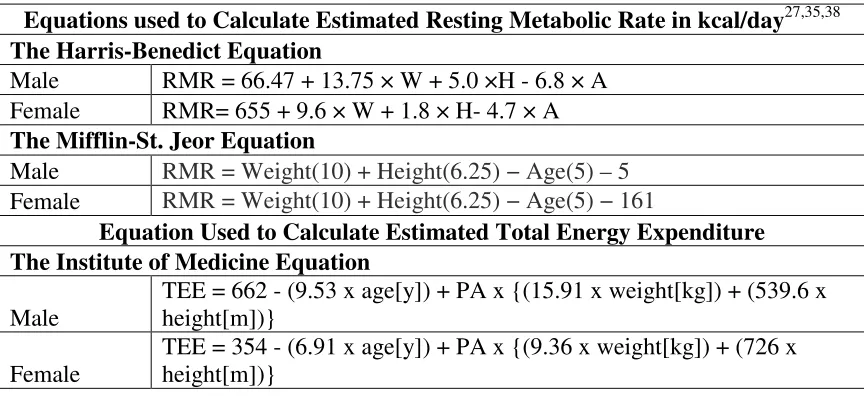
[image:35.612.108.540.291.492.2]Harris-Benedict and the Mifflin-St. Jeor energy equations as shown in Table 1.
Table 1. Predictive Equations to Estimate Energy Needs
Equations used to Calculate Estimated Resting Metabolic Rate in kcal/day27,35,38 The Harris-Benedict Equation
Male RMR = 66.47 + 13.75 × W + 5.0 ×H - 6.8 × A
Female RMR= 655 + 9.6 × W + 1.8 × H- 4.7 × A
The Mifflin-St. Jeor Equation
Male RMR = Weight(10) + Height(6.25) − Age(5) – 5
Female RMR = Weight(10) + Height(6.25) − Age(5) − 161
Equation Used to Calculate Estimated Total Energy Expenditure The Institute of Medicine Equation
Male
TEE = 662 - (9.53 x age[y]) + PA x {(15.91 x weight[kg]) + (539.6 x height[m])}
Female
TEE = 354 - (6.91 x age[y]) + PA x {(9.36 x weight[kg]) + (726 x height[m])}
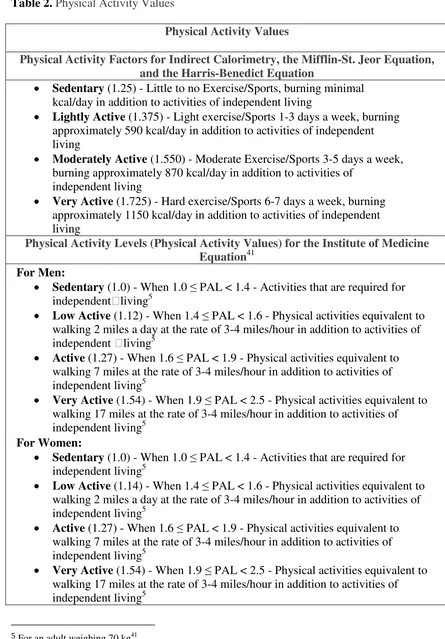
An appropriate physical activity factor (PAF) was determined for each participant
based on self-reported activity level and clinical judgment. The same PAF value was
multiplied by RMR from indirect calorimetry, the Harris-Benedict equation, and the
Table 2. Physical Activity Values
Physical Activity Values
Physical Activity Factors for Indirect Calorimetry, the Mifflin-St. Jeor Equation, and the Harris-Benedict Equation
• Sedentary (1.25) - Little to no Exercise/Sports, burning minimal kcal/day in addition to activities of independent living
• Lightly Active (1.375) - Light exercise/Sports 1-3 days a week, burning approximately 590 kcal/day in addition to activities of independent living
• Moderately Active (1.550) - Moderate Exercise/Sports 3-5 days a week, burning approximately 870 kcal/day in addition to activities of
independent living
• Very Active (1.725) - Hard exercise/Sports 6-7 days a week, burning approximately 1150 kcal/day in addition to activities of independent living
Physical Activity Levels (Physical Activity Values) for the Institute of Medicine Equation41
For Men:
• Sedentary (1.0) - When 1.0 ≤ PAL < 1.4 - Activities that are required for independentliving5
• Low Active (1.12) - When 1.4 ≤ PAL < 1.6 - Physical activities equivalent to walking 2 miles a day at the rate of 3-4 miles/hour in addition to activities of independent living5
• Active (1.27) - When 1.6 ≤ PAL < 1.9 - Physical activities equivalent to walking 7 miles at the rate of 3-4 miles/hour in addition to activities of independent living5
• Very Active (1.54) - When 1.9 ≤ PAL < 2.5 - Physical activities equivalent to walking 17 miles at the rate of 3-4 miles/hour in addition to activities of independent living5
For Women:
• Sedentary (1.0) - When 1.0 ≤ PAL < 1.4 - Activities that are required for independent living5
• Low Active (1.14) - When 1.4 ≤ PAL < 1.6 - Physical activities equivalent to walking 2 miles a day at the rate of 3-4 miles/hour in addition to activities of independent living5
• Active (1.27) - When 1.6 ≤ PAL < 1.9 - Physical activities equivalent to walking 7 miles at the rate of 3-4 miles/hour in addition to activities of independent living5
• Very Active (1.54) - When 1.9 ≤ PAL < 2.5 - Physical activities equivalent to walking 17 miles at the rate of 3-4 miles/hour in addition to activities of independent living5
22
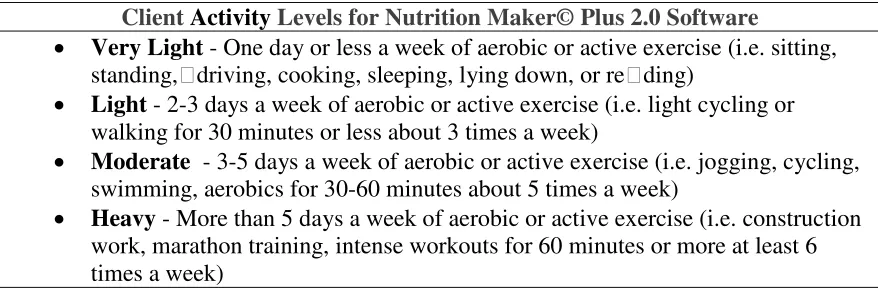
Client Activity Levels for Nutrition Maker© Plus 2.0 Software
• Very Light - One day or less a week of aerobic or active exercise (i.e. sitting, standing,driving, cooking, sleeping, lying down, or reding)
• Light - 2-3 days a week of aerobic or active exercise (i.e. light cycling or walking for 30 minutes or less about 3 times a week)
• Moderate - 3-5 days a week of aerobic or active exercise (i.e. jogging, cycling, swimming, aerobics for 30-60 minutes about 5 times a week)
• Heavy - More than 5 days a week of aerobic or active exercise (i.e. construction work, marathon training, intense workouts for 60 minutes or more at least 6 times a week)
A physical activity (PA) value is used in the IOM equation to estimate TEE. This
value is associated with a physical activity level (PAL) based on frequency and intensity
of exercise, as shown in Table 2. Researchers matched the PAF used to estimate TEE
with IC, the Harris-Benedict, and Mifflin-St. Jeor equation within a PAL range, and the
corresponding PA value was selected to calculate TEE using the IOM equations.
Researchers also estimated TEE using Nutrition Maker© Plus 2.0 by entering each
participant’s age, height, and weight, and a client activity level comparable to the PAF
[image:37.612.104.543.71.215.2]and PA used for IC and the predictive equations. Client activity levels are outlined in
Table 2.
Statistical Methods to Compare Indirect Calormetry, Predictive Equations, and Nutrition Maker© Plus 2.0
The data were analyzed using Statistical Package for the Social Sciences (SPSS)
Version 21.0. Data including gender, age, weight, BMI, PAF, and RMR assessed with the
ReeVue™ portable indirect calorimeter, the Harris-Benedict equation, and the Mifflin-St.
Jeor equation were described using frequency analysis. The
Kolmogovov-Smirnov/Shapiro-Wilk test for normality determined the data to be normally distributed.
estimated with those of the Harris-Benedict and Mifflin-St. Jeor equations. Separate
paired t-tests were also used to compare the means of TEE calculated with measured and
estimated RMR as well as the means of TEE calculated with the IOM equation and
Nutrition Maker© Plus 2.0. Two independent sample t-tests were conducted, one to
compare TEE between the Healthy (BMI 18.5 - 24.9 kg/m2) and Overweight BMI (BMI
>25.0 kg/m2) groups and another to compare measured RMR between males and
females.1 A p-value ≤ 0.05 defined significance.
Evaluation of Nutrition Services of the Urban 13
Twenty-one schools that comprise the Urban 13 research-sharing institutions were
evaluated for the type, location, and administration of nutrition services they provide for
students. The Urban 13 is group of 21 research-sharing public universities and colleges
based in major metropolitan areas across the United States.21,42 All of the 21 schools,
including Georgia State University, were included in the study based on their
geographical location, student demographics and campus recreation centers.
Research Design to Evaluate Nutrition Services of the Urban 13
The goal of this research assessment was to evaluate the types of nutrition
services offered through campus recreations centers at urban institutions comparable to
Georgia State.
Contact information for directors, assistant directors, managers and coordinators
of the campus recreation centers were gathered from each university’s or college’s
campus recreation website. A contact from each of the campus recreation centers was
administered a five-question survey either by email or phone. Survey results were
24
Nutrition services are not provided by the campus recreation centers at The University of
Missouri-St. Louis, University of Missouri- Kansas City, City College of New York,
Indiana University-Purdue University-Indianapolis, University of Toledo, and Wayne
State University. A review of each institution’s website provided information about the
types of nutrition services offered and by whom.
Table 3. Survey to Evaluate Nutrition Services offered by Campus Recreation Centers of the Urban 13
Survey to Evaluate Nutrition Services offered by Campus Recreation Centers of the Urban 13
1) Are nutrition services offered through your university's recreation center? 2) If so, what types of services are offered? (For example, nutrition counseling or nutrition assessments)
3) Does a Registered Dietitian (RD) provide nutrition services through your recreation center?
4) If so, what types of services does the RD provide?
25
CHAPTER IV
RESULTS
Results from Comparison of Indirect Calorimetry, Predictive Equations, and Nutrition Maker© Plus 2.0
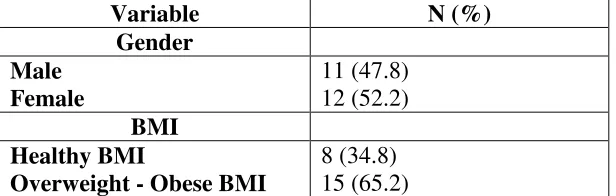
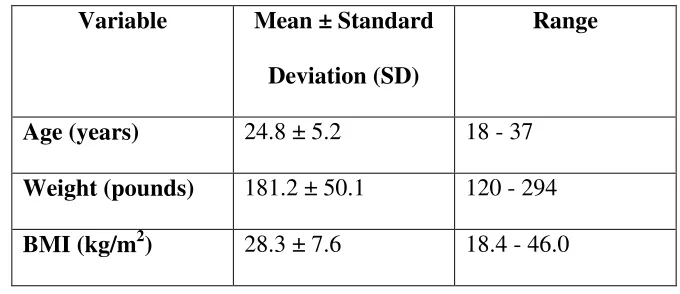
Characteristics of the sample population are shown in Table 4 and Table 5. Of the
23 participants (n=23), a majority were female (52.2%) and were overweight or obese
(65.2%) with a BMI >25 kg/m2. Participants above the defined college-age of 18-24
were included in the sample population to represent the increase in students over the age
of 25 enrolled in higher education institutions.43 Characteristics of the sample and
[image:40.612.172.480.458.556.2]PAF/PAL statistics are shown in Table 6.
Table 4. Sample Population Group Characteristics
Variable N (%)
Gender Male
Female
11 (47.8) 12 (52.2)
BMI Healthy BMI
Overweight - Obese BMI
26
Table 5. Sample Population Anthropometrics
Variable Mean ±Standard Deviation (SD)
Range
Age (years) 24.8 ± 5.2 18 - 37
Weight (pounds) 181.2 ± 50.1 120 - 294
[image:41.612.101.547.292.465.2]BMI (kg/m2) 28.3 ± 7.6 18.4 - 46.0
Table 6. Mean and Frequency of Physical Activity Values
Statistics PAF PA
Mean ± SD 1.33 ± .14 1.06 ± .10
Range 1.250 - 1.725 1.00 – 1.27
PAF/PAL Value (Frequency)
1.250 (14) 1.300 (3) 1.375 (2) 1.400 (1) 1.550 (1) 1.725 (2)
[image:41.612.155.492.518.634.2]1.00 (16) 1.12 (1) 1.14 (3) 1.27 (3)
Table 7. Comparison of Measured RMR and Estimated RMR
RMR Method Mean ± SD
(kcal/day)
Range (kcal/day) Indirect Calorimetry 1627 ± 393 1066 - 2376
Harris-Benedict 1781 ± 321 1389 - 2583
Mifflin-St. Jeor 1678 ± 287 1301 - 2315
Table 7 describes the mean RMR in kilocalories per day (kcal/day). A statistical
± 393 kcal/day) with estimated RMR from the Harris-Benedict equation (1781 ± 321
kcal/day). When comparing the means of measured RMR (1626 ± 393 kcal/day) and
estimated RMR from the Mifflin-St. Jeor equation (1677 ± 287 kcal/day), results were
not statistically significant (p=0.308); however, there was a strong, positive correlation
between the means (0.81).
Indirect calorimetry measures RMR, while predictive equations (the
Harris-Benedict and the Mifflin-St. Jeor equations) estimate RMR. A physical activity factor is
multiplied by measured RMR or estimated RMR to calculate TEE. The IOM equation
estimates TEE since physical activity is included in the equation. Nutrition Maker© Plus
2.0 uses the Mifflin-St. Jeor equation with a client activity value to calculate TEE.
Therefore, measured RMR and estimated RMR can be compared, and calculated TEE
[image:42.612.135.513.430.672.2]from IC, predictive equations and Nutrition Maker© Plus 2.0 can be compared.
Table 8. Comparison of Measured TEE and Estimated TEE
Methods Average TEE Means ± SD
(kcal/day)
Difference in Means compared to
IC (kcal)
Range (kcal/day)
Methods to Measure RMR and Estimate TEE Indirect
Calorimetry 2153 ± 534 0 1423 - 3147
Methods to Estimate RMR and Estimate TEE The
Harris-Benedict Equation 2354 ± 420 202 1784 - 3229
The Mifflin St. Jeor
Equation 2218 ± 381 66 1683 - 2894
Methods to Estimate TEE The Institute of
Medicine Equation 2542 ± 462 390 1941 - 3465
Nutrition Maker©
28
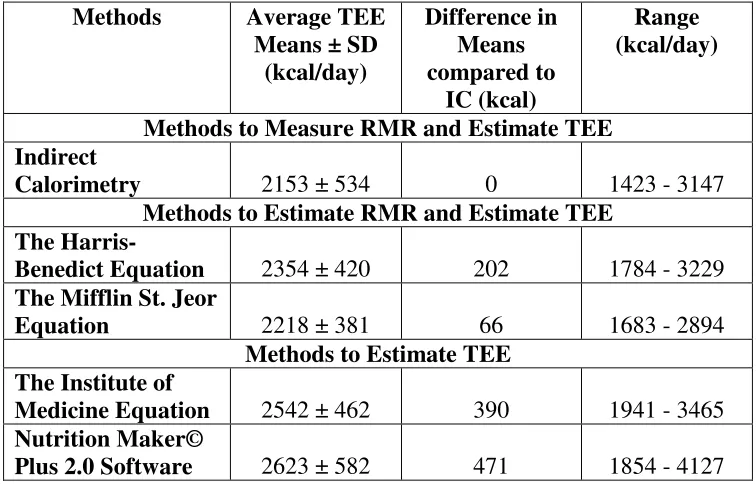
Table 8 describes the method for calculation and the average mean TEE compared
to the mean IC standard. When TEE means were compared, the IC (2153 ± 534
kcal/day) and the Harris-Benedict equation (2354 ± 420 kcal) had a strong, positive
correlation (0.84) and a significant difference was found between the means (p < 0.001).
TEE calculated from measured RMR (2153 ± 534 kcal/day) and the Mifflin St-Jeor
equation (2218 ± 381 kcal/day) did not show statistical significance (p=0.317). A
significant difference (p < 0.001) was found between the TEE means of IC (2153 ± 534
kcal/day) and the IOM equation (2542 ± 461kcal/day) and between the TEE means (p <
0.001) of IC (2153 ± 534 kcal/day) and Nutrition Maker© Plus 2.0 (2623 ± 582
kcal/day).
A statistically significant difference (p < 0.001) was found between the TEE
calculated from measured RMR (2153 ± 534 kcal/day) and the IOM equation (2542 ±
461 kcal/day), the Harris-Benedict equation (2354 ± 420) and the IOM equation (2542 ±
461 kcal/day), and the Mifflin-St. Jeor equation (2218 ± 381 kcal/day) and the IOM
equation (2542 ± 461 kcal/day). However, there was not a significant difference
(p=0.142) between the TEE means of Nutrition Maker© Plus 2.0 (2623 ± 582 kcal/day)
and IOM (2542 ± 461 kcal/day).
There was a statistically significant difference (p=0.05) between the RMR means
of IC (kcal/day) when comparing the Healthy BMI (1402 ± 369 kcal/day) and the
Overweight BMI (1746 ± 361 kcal/day) groups. When comparing measured RMR
between genders, there was a significant difference (p=0.001) between the males (1896 ±
Results from the Urban 13 Survey
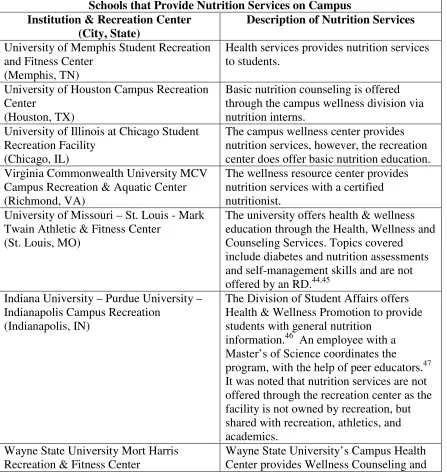
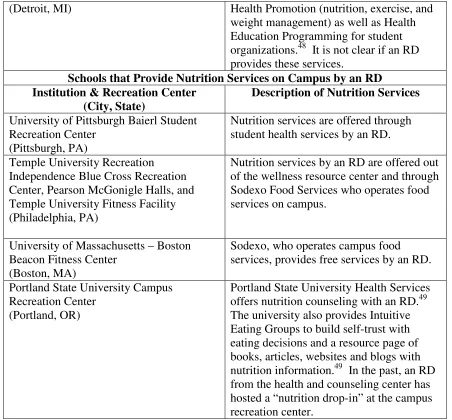
Seventeen of the 21 schools (n=21) provide nutrition services for students on
campus or through the campus recreation center. Results from the survey are shown in
Table 9 – Table 11. Seven of those 17 schools provide nutrition services on campus, and
[image:44.612.104.551.240.712.2]four provide nutrition services on campus with an RD, as shown in Table 9.
Table 9. Nutrition Services Offered on Campus
Schools that Provide Nutrition Services on Campus Institution & Recreation Center
(City, State)
Description of Nutrition Services
University of Memphis Student Recreation and Fitness Center
(Memphis, TN)
Health services provides nutrition services to students.
University of Houston Campus Recreation Center
(Houston, TX)
Basic nutrition counseling is offered through the campus wellness division via nutrition interns.
University of Illinois at Chicago Student Recreation Facility
(Chicago, IL)
The campus wellness center provides nutrition services, however, the recreation center does offer basic nutrition education. Virginia Commonwealth University MCV
Campus Recreation & Aquatic Center (Richmond, VA)
The wellness resource center provides nutrition services with a certified nutritionist.
University of Missouri – St. Louis - Mark Twain Athletic & Fitness Center
(St. Louis, MO)
The university offers health & wellness education through the Health, Wellness and Counseling Services. Topics covered include diabetes and nutrition assessments and self-management skills and are not offered by an RD.44,45
Indiana University – Purdue University – Indianapolis Campus Recreation
(Indianapolis, IN)
The Division of Student Affairs offers Health & Wellness Promotion to provide students with general nutrition
information.46 An employee with a Master’s of Science coordinates the program, with the help of peer educators.47 It was noted that nutrition services are not offered through the recreation center as the facility is not owned by recreation, but shared with recreation, athletics, and academics.
Wayne State University Mort Harris Recreation & Fitness Center
30
(Detroit, MI) Health Promotion (nutrition, exercise, and
weight management) as well as Health Education Programming for student organizations.48 It is not clear if an RD provides these services.
Schools that Provide Nutrition Services on Campus by an RD Institution & Recreation Center
(City, State)
Description of Nutrition Services
University of Pittsburgh Baierl Student Recreation Center
(Pittsburgh, PA)
Nutrition services are offered through student health services by an RD.
Temple University Recreation Independence Blue Cross Recreation Center, Pearson McGonigle Halls, and Temple University Fitness Facility (Philadelphia, PA)
Nutrition services by an RD are offered out of the wellness resource center and through Sodexo Food Services who operates food services on campus.
University of Massachusetts – Boston Beacon Fitness Center
(Boston, MA)
Sodexo, who operates campus food services, provides free services by an RD.
Portland State University Campus Recreation Center
(Portland, OR)
Portland State University Health Services offers nutrition counseling with an RD.49 The university also provides Intuitive Eating Groups to build self-trust with eating decisions and a resource page of books, articles, websites and blogs with nutrition information.49 In the past, an RD from the health and counseling center has hosted a “nutrition drop-in” at the campus recreation center.
As indicated in Table 10, seven schools offer nutrition services through the
campus recreation center. Five of those schools have an RD that provides the nutrition
services through the recreation center, and two of the schools (University of Cincinnati
[image:45.612.99.551.71.491.2]and Georgia State University) offer IC with an RD.
Table 10. Nutrition Services Offered by Campus Recreation Centers
Schools that Provide Nutrition Services at a Campus Recreation Center Institution & Recreation Center
(City, State)
Description of Nutrition Services
University Recreation Center (Tallahassee, FL)
education, conducts diet assessments with the assistance of electronic applications (MyFitnessPal) and performs BMI and body fat measurements.
University of Alabama at Birmingham Campus Recreation
(Birmingham, AL)
Health coaching, which includes exercise plans, examples of healthy foods/meals, assistance with grocery shopping, fitness assessments and body fat testing are provided to students at the campus recreation center.
Schools that Provide Nutrition Services at a Campus Recreation Center with an RD Institution & Recreation Center
(City, State)
Description of Nutrition Services
Cleveland State University Recreation Center
(Cleveland, OH)
An RD provides: nutrition counseling, nutrition assessments, aids in developing personal nutrition plans, and general nutrition education.
University of New Orleans Recreation & Fitness Center
(New Orleans, LA)
An RD provides: nutrition counseling, meal planning and nutrition advice. The RD is part-time and meets with clients by appointment only.
University of Wisconsin – Milwaukee University Recreation Building (Milwaukee, WI)
RDs provide one-on-one nutrition consultations, as well as support health fairs and the Stepping Forward Weight Loss Program.
Schools that Provide Nutrition Services at a Campus Recreation Center with an RD and Offer Indirect Calorimetry
Institution & Recreation Center (City, State)
Description of Nutrition Services
University of Cincinnati Campus Recreation Center
(Cincinnati, OH)
An RD provides RMR testing with The BodyGem® Indirect Calorimeter, nutrition coaching, nutrition education classes & presentations, and grocery store tours. Georgia State University Student
Recreation Center (Atlanta, GA)
32
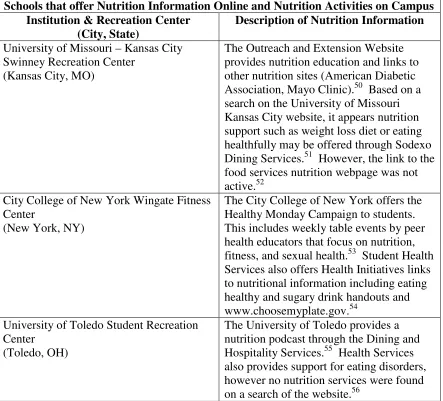
Table 11 displays the three schools that offered general nutrition information to
students through websites or links on the university or college webpage. The websites
did not provide information about specific nutrition services (i.e. nutrition assessments or
nutrition counseling), but instead provided online nutrition information or nutrition
activities on campus. Appendix A provides the direct responses from the contacts of the
[image:47.612.105.548.267.668.2]Urban 13 survey.
Table 11. Nutrition Information Offered Online and on Campus
Schools that offer Nutrition Information Online and Nutrition Activities on Campus Institution & Recreation Center
(City, State)
Description of Nutrition Information
University of Missouri – Kansas City Swinney Recreation Center
(Kansas City, MO)
The Outreach and Extension Website provides nutrition education and links to other nutrition sites (American Diabetic Association, Mayo Clinic).50 Based on a search on the University of Missouri Kansas City website, it appears nutrition support such as weight loss diet or eating healthfully may be offered through Sodexo Dining Services.51 However, the link to the food services nutrition webpage was not active.52
City College of New York Wingate Fitness Center
(New York, NY)
The City College of New York offers the Healthy Monday Campaign to students. This includes weekly table events by peer health educators that focus on nutrition, fitness, and sexual health.53 Student Health Services also offers Health Initiatives links to nutritional information including eating healthy and sugary drink handouts and www.choosemyplate.gov.54
University of Toledo Student Recreation Center
(Toledo, OH)
A web search was performed to assess which schools offered personal training
services at the campus recreation center. Nineteen of the 21 Urban 13 schools offered a
personal training component through their recreation centers.21,44,57–73 Personal training
services could not be found on the websites of City College of New York or Indiana
34
CHAPTER V
DISCUSSION AND CONCLUSIONS
Implications from the Comparison of Indirect Calorimetry, Predictive Equations, and Nutrition Maker© Plus 2.0
Our analysis discovered a significant difference between the means of measured
resting metabolic rate (RMR) and the estimated RMR from the Harris-Benedict equation,
but there was not a significant difference between the means of measured RMR and
estimated RMR from the Mifflin-St. Jeor equation. It is interesting to note that total
energy expenditure (TEE) estimated by the IOM equation and Nutrition Maker© Plus 2.0
both significantly over-estimated energy needs when compared with TEE that was
calculated by multiplying measured RMR and an appropriate activity factor.
These findings suggest that in the absence of IC, the Mifflin-St. Jeor equation
would be a suitable substitute method to estimate RMR in a non-obese and obese college
population. This is similar to other studies that suggest the Mifflin-St. Jeor equation,
secondary to IC, is a useful predictor of RMR and is more likely than other equations to
estimate RMR within 10% of measured RMR.25,36 Accuracy rates of the Mifflin-St. Jeor
equation are lower in obese people versus non-obese people.36
Significance of Physical Activity Values
A statistical significance was found between the TEE means of the IOM equation
and the measured RMR with an activity factor and the estimated TEE from the