Image Compression Using Hybrid Transform
K. Sai Krishna1, B. Raja Sekhar2
1, 2
ECE Dept, Anurag Group of Institutions Hyderabad, India.
Abstract: Image Compression is a method, which reduces the size of the data or the amount of space required to store the data. Digital image in their raw form require an enormous amount of storage capacity. There are various transformation techniques used for data compression. Discrete Cosine Transform (DCT) and Discrete Wavelet Transform (DWT) are the most commonly used transformation. The Discrete cosine transform (DCT) is a method for transform a signal or image from spatial domain to frequency component. DCT has high energy compaction property and requires less computational resources. On the other hand, DWT is multi resolution transformation. In this paper, we propose a hybrid DWT-DCT algorithm for image compression and reconstruction taking benefit from the advantages of both algorithms
Keywords: Compression technique, DCT, DWT, hybrid transform, PSNR
I. INTRODUCTION
Image compression is very important for efficient transmission and storage of images. Demand for communication of multimedia data through the telecommunications network and accessing the multimedia data through Internet is growing explosively. With the use of digital cameras, requirements for storage, manipulation, and transfer of digital images, has grown explosively .These image files can be very large and can occupy a lot of memory. A gray scale image that is 256 x 256 pixels have 65, 536 elements to store and a typical 640 x 480 color image have nearly a million. Downloading of these files from internet can be very time consuming task. Image data comprise of a significant portion of the multimedia data and they occupy the major portion of the communication bandwidth for multimedia communication. Therefore for the development of efficient techniques image compression has become quite necessary. The image compression technique most often used is transform coding. Transform coding is an image compression technique that first switches to the frequency domain, then does its compressing. The transform coefficients should be decor related, to reduce redundancy and to have a maximum amount of information stored in the smallest space. These coefficients are then coded as accurately as possible to not lose information. In this research, we will use transform coding.
Two fundamental components of compression are redundancy and irrelevancy reduction. Redundancies reduction aims at removing duplication from the signal source(image/video). Irrelevancy reduction omits parts of the signal that will not be noticed by the signal receiver.
A. Types of Compression
Lossless versus Lossy compression: In lossless compression schemes, the reconstructed image, after compression, is numerically identical to the original image. However lossless compression can only to achieve a modest amount of compression. Lossless compression is preferred for archival purposes and often medical imaging, technical drawings, clip art or comics. This is because lossy compression methods, especially when used at low bit rates, introduce compression artifacts. An image reconstructed following lossy compression contains degradation relative to the original. Often this is because the compression scheme completely discards redundant information. However, lossy schemes are capable of achieving much higher compression Lossy methods are especially suitable for natural images such as photos in applications where minor (sometimes imperceptible) loss of fidelity is acceptable to achieve a substantial reduction in bit rate. The lossy compression that produces imperceptible differences can be called visually lossless Predictive versus Transform coding: In predictive coding, information already sent or available is used to predict future values, and the difference is coded. Since this is done in the image or spatial domain, it is relatively simple to implement and is readily adapted to local image characteristics. Differential Pulse Code Modulation (DPCM) is one particular example of predictive coding. Transform coding, on the other hand, first transforms the image from its spatial domain representation to a different type of representation using some well-known transform and then codes the transformed values (coefficients). This method provides greater data compression compared to predictive methods, although at the expense of greater computational requirements.
In digital image compression, three basic dataredundancies can be identified and exploited:
a) Coding redundancy
b) Inter pixel redundancy
Data compression is achieved when one or more of these redundancies are reduced or eliminated.
2) Coding Redundancy: Use shorter code words for the more common gray levels and longer code words for the less common gray
levels. This is called Variable Length Coding. To reduce this redundancy from an image we go for the Huffman technique were
we are, assigning fewer bits to the more probable gray levels than to the less probable ones achieves data compression.
3) Inter pixel Redundancy: Another important form of data redundancy is inter pixel redundancy, which is directly related to the inter pixel correlations within an image. Because the value of any given pixel can be reasonable predicted from the value of its neighbors, the information carried by individual pixels is relatively small. Much of the visual contribution of a single pixel to an image is redundant; it could have been guessed on the basis of its neighbor’s values. A variety of names, including spatial redundancy, geometric redundancy, and inter frame Redundancies have been coined to refer to these inter pixel dependencies.
4) Psycho visual Redundancy: Human perception of the information in an image normally does not involve quantitative analysis of every pixel or luminance value in the image. In general, an observer searches for distinguishing features such as edges or textural regions and mentally combines them into recognizable groupings. The brain then correlates these groupings with prior knowledge in order to complete the image interpretation process. Thus eye does not respond with equal sensitivity to all visual information. Certain information simply has less relative importance than other information in normal visual processing. This information is said to be psycho visually redundant. To reduce psycho visual redundancy we use quantizer. Since, the elimination of psycho visually redundant data results in a loss of quantitative information.
B. Discrete Cosine Transform
The discrete cosine transform (DCT) represents an image as a sum of sinusoids of varying magnitudes and frequencies. The DCT has the property that, for a typical image, most of the visually significant information about the image is concentrated in just a few coefficients of the DCT. The DCT works by separating images into the parts of different frequencies. During a step called Quantization, where parts of compression actually occur, the less important frequencies are discarded, hence the use of the lossy. Then the most important frequencies that remain are used retrieve the image in decomposition process. As a result, reconstructed image is distorted.
C. Discrete Wavelet Transform
All mainstream encoders use the Discrete Cosine Transform (DCT) to perform transform coding. The DCT maps a time domain signals to a frequency domain representation. We can compress the frequency domain spectrum by truncating low intensity regions. However, the DCT has several drawbacks. Computation of the DCT takes an extremely long time and grows exponentially with signal size. To calculate the DCT of an entire video frame takes an unacceptable amount of time. The only solution is to partition the frame into small blocks and then apply the DCT to each block. However, this leads to degradation in picture quality. The Discrete Wavelet Transform, DWT, offers a better solution. The DWT is another transform that maps time domain signals to frequency domain representations. But the DWT has a distinct advantage; The DWT, in essence, can be computed by performing a set of digital filters which can be done quickly. This allows us to apply the DWT on entire signals without taking a significant performance hit. By analyzing the entire signal the DWT captures more information than the DCT and can produce better results. The DWT separates the image’s high frequency components from the rest of the image, resizes the remaining parts and rearranges them to form a new ‘transformed ‘image.
II. LITERATURESURVEY
The rapid growth of digital imaging applications, including desktop publishing, multimedia, teleconferencing, and high- definition television (HDTV) has increased the need for effective and standardized image compression techniques. Among the emerging standards are JPEG, for compression of still images [Wallace 1991]; MPEG, for compression of motion video [Puri 1992]; and CCITT H.261 (also known as Px64), for compression of video telephony and teleconferencing. All three of these standards employ a basic technique known as the discrete cosine transform (DCT). Developed by Ahmed, Natarajan, and Rao [1974], the DCT is a close relative of the discrete Fourier transform (DFT). Its application to image compression was pioneered by Chen and Pratt [1984]. In this article, I will show you the DCT and DWT of the selected image &also by using both DCT-DWT, which is hybrid transform, as it is much better than DCT
III.PREVIOUS WORK
most visible applications of wavelets. The rapid increase in the range and use of electronic imaging justifies attention for systematic design of an image compression system and for providing the image quality needed in different applications. A typical still image contains a large amount of spatial redundancy in plain areas where adjacent picture elements (pixels, pels) have almost the same values. It means that the pixel values are highly correlated in addition, a still image can contain subjective redundancy .The redundancy (both statistical and subjective) can be removed to achieve compression of the image data. The basic measure for the performance of a compression algorithm is compression ratio (CR), defined as a ratio
between original data size and Manuscript received in a lossy compression scheme, the image compression algorithm achieve a tradeoff between compression ratio and image quality. Higher compression ratios will produce lower image quality and vice versa. Quality and compression can also vary according to input image characteristics and content. Transform coding is a widely used method of compressing image information. An effective transform will concentrate useful information into a few of the low-frequency transform coefficients. Very effective and popular ways to achieve compression of image data are based on the discrete cosine transform (DCT) and discrete wavelet transform (DWT).
IV. PROPOSED HYBRID DWT- DCT TECHNIQUE
A. Select an image to compress
B. Divide image into sub blocks that is block division
C. Apply DCT row wise and column wise
D. Recombine block to make image again from blocks
E. Now apply wavelet transform for compression
F. Declare decomposition level for compression
G. Sym8 wavelet technique is used
H. Recombine the separate wavelet layer on basis of threshold value
I. Reconstruct image from wavelets get compressed image
J. Get results by comparing received images & PSNR, BER & MSE
K. Benefits of Compression
Provides a potential cost savings associated with sending less data over switched telephone network where cost of call is really usually based upon its duration.
1) It not only reduces storage requirements but also overall execution time.
2) It also reduces the probability of transmission errors since fewer bits are transferred.
3) It also provides a level of security against illicit monitoring.
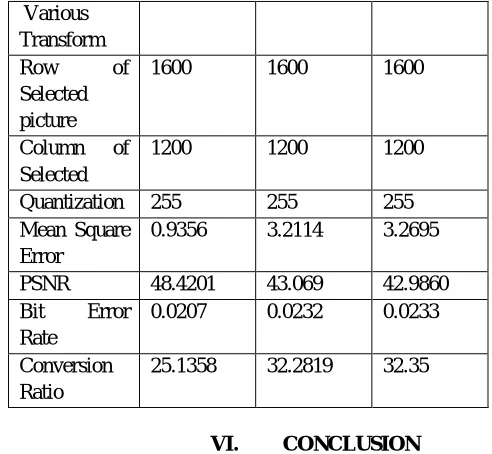
V. EXPERIMENTAL RESULTS
Table 1: Comparative analysis of various compression techniques Various
Transform
Row of
Selected picture
1600 1600 1600
Column of
Selected
1200 1200 1200
Quantization 255 255 255
Mean Square Error
0.9356 3.2114 3.2695
PSNR 48.4201 43.069 42.9860
Bit Error
Rate
0.0207 0.0232 0.0233
Conversion Ratio
25.1358 32.2819 32.35
VI. CONCLUSION
In this research work, a hybrid scheme combining the DWT and the DCT algorithms has been presented. The algorithm was tested on the image. The result show consistent improved performance for the hybrid scheme compared to DCT. The scheme has also reduced the false contouring effects and blocking artifacts significantly which occurs in the images reconstructed using DCT algorithm at higher compression ratio. It was observed that the proposed hybrid algorithm performs better than the existing algorithms. The proposed scheme is intended to be used as the image compressor engine in imaging.
VII. FUTURE SCOPE
Going deeper, the result provides a strong foundation for future work. It can also be a good option for the image processor of the wireless capsule endoscopic system; research can be performed to relax high compression ratio constraint. Further work can be used for the removal redundancy of the video sequences using inter coding.
REFERENCES [1] Rafael C. Gonzalez, Richard Eugene; “Digital image processing”, Edition 3, 2008, page 466
[2] M. Ghanbari "Standard Codecs: Image Compression to Advanced Video Coding" Institution Electrical Engineers, ISBN: 0852967101, 2003 [3] Chuanwei Sun 1Quanbin Li,Jingao Liu “The Study of Digital Image Compression Based on Wavelets”, ICALIP2010
[4] KamrulHasanTalukder and Koichi Harada, Enhancement of Discrete “Wavelet Transform (DWT) for Image Transmission over Internet”, 2011 EighthInternational Conference on Information Technology: New Generations
[5] Still Image and video compression with MATLAB, K. S. Thyagarajan, A JOHN WILEY & SONS, INC., PUBLICATION [6] Ken Cabeen and Peter Gant“Image Compression and Discrete Cosine Transform “
[7] DCT-BASED IMAGE COMPRESSION”, Vision Research and Image Sciences Laboratory http://visl.technion.ac.il
[8] Mr. Mahendra M. Dixit1, Prof. Priyatamkumar, Comparative Analysis of Variable Quantization DCT and Variable Rank Matrix SVD Algorithms for Image Compression Applications