
An Improved Digital Image Watermarking
Scheme using Particle Swarm Optimization
Technique
Tamirat Tagesse Takore1, P. Rajesh Kumar2, G. Lavanya Devi3
1, 2
Dept. of ECE, College of Engineering (A), Andhra University, Visakhapatnam, India
3
Dept. of CS&SE, College of Engineering (A), Andhra University, Visakhapatnam, India
Abstract: Digital watermarking has been proposed as most effective ways to protect a copyright of digitally formatted multimedia documents in networked environments by inserting secret data into host image without significantly affecting the visual quality. Robustness to different accidental or intentional attacks is the most desired watermarking requirements for copyright protection application. This study presents a robust, blind and an imperceptible image watermarking scheme based on lifting wavelet transforms (LWT), discrete cosine transform (DCT), singular value decomposition (SVD) and particle swarm optimization (PSO). Block-based DCT and SVD are performed on reference sub-images which are formed by taking alternative pixels across row and column. A binary watermark is embedded in the first reference sub-image by modifying singular values and the other sub-image is used as a reference for both watermarks embedding and extracting. Different standard grayscale images have been used as test images and the obtained experimental results show improvement in both imperceptibly and robustness against various attacks.
Keywords: Digital watermarking, LWT, DCT, SVD, PSO, PSNR, NCC
I. INTRODUCTION
The advent and proliferation of high speed computers along with high capacity storage device and fast Internet have made the task of copying, reproducing, modifying and sharing digital multimedia data simple. Thus, digital data can be lossless copied and rapidly disseminated at large scale with less expense and effort. However, these technologies have also created a means for malicious attackers to copy, modify and redistribute copyrighted digital resources illegally without the consent of legit producers. This seriously violates the commercial advantages of many digital resources producing corporations. As a result, protecting digital properties from unauthorized use has become an issue of critical concern that the needs for tools which can protect ownership, guarantee authenticity and trace an illegal copy distribution, is extremely increasing from time to time. Cryptography provides a means for secure delivery of contents to the legitimate consumer with a key to decrypt the content. But untrustworthy consumers can buy a single copy of a legit document and distribute decrypted copies in a manner that is not allowed by content producers. Therefore, other effective copyright protection techniques are necessary to prevent unauthorized copying of digital content or trace illegal copy distribution. The newly evolving digital watermarking technique is the most effective method for digital property protection, and it complements the cryptographic process [1-3]. Digital watermarking is a process that inserts a digital message, signature, text or logo called watermark in a host object such that the embedded watermark, which fully characterizes the person who applies it can be extracted later to make an assertion about the object. It has been used to address the problem of authenticity verification, copyright protection and illegal dissemination of valuable digital resources. In fact, the field of digital watermarking is relatively young, and gained popularity as a research topic starting 1993 when Tirkel et al. [4] presented two techniques to hide data in images.
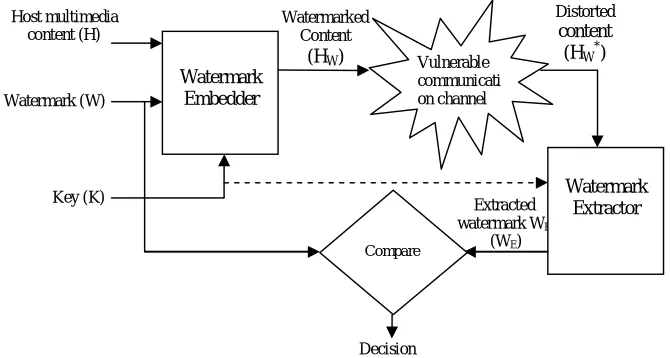
A typical watermarking system consists of two major components, namely watermark Embedder and Detector/ Extractor. Fig. 1 shows a block diagram of a generic watermarking scheme [5, 6]. The watermark Embedder E (.) takes a host image ‘H’, watermark ‘W’, and key ‘K’ as input parameters and provides a watermarked content ‘Hw’ as an output.
WE= Ex(Hw*,K, [H], [W]) (2) Where, Ex (.) is the watermark extraction algorithm. Hw*, WE represent the attacked watermarked content and extracted watermark respectively. The enclosed braces around H and W are used to denote optional input for watermark extraction.
[image:3.612.124.459.148.327.2]Therefore, depending upon the type of input data required for watermark detection/extraction, watermarking techniques can be classified into blind (or oblivious) and non-blind.
Fig. 1 A block diagram of generic watermarking system
Blind watermarking schemes extract the embedded watermark without the knowledge of original data (i.e., without using original host data and original watermark). Only with the help of a secret key, the watermark is extracted. However, non-blind watermarking techniques require original host document and a copy of the embedded watermark as input for watermark extraction. Compared to non-blind, a blind watermarking scheme is more preferred for a huge amount data-oriented watermarking applications due to its advantages such as reduced transmission time and storage cost overhead. Digital watermarking techniques can also be classified into four groups depending upon the type of data to be watermarked: text watermarking, image watermarking, audio watermarking, and video watermarking [7]. However, in this paper, only gray image watermarking technique is considered.
Furthermore, the watermarking techniques can be classified into spatial domain and transform domain watermarking techniques based on the working domain. Spatial domain watermarking techniques are straightforward and embed a watermark directly manipulating the pixel values of the host image. Usually, these types of watermarking techniques are computationally simple and easy to implement; however, they are less robust to various attacks. Least significant bit (LSB) substitution, correlation and spread spectrum based watermarking methods are common spatial domain based watermarking techniques. The transform domain techniques insert the watermark into transformed coefficients of the cover image. These watermarking techniques provide more information hiding capacity, better imperceptibility and more robustness compared to spatial domain techniques. A watermarking scheme is said to be robust when the embedded watermark is capable to survive against both accidental and intentional attacks. Discrete Cosine Transform (DCT), Discrete Fourier Transform (DFT), Discrete Wavelet Transform (DWT), Singular Value Decomposition (SVD) and Lifting Wavelet Transform (LWT) are the most popular transforming techniques which are often used in transform domain watermarking techniques [8-11].
Designing a robust and imperceptible image watermarking scheme for copyright protection applications that can insert a watermark without significantly affecting the visual quality of the host image has become the major challenge in the field of digital watermarking due to the existence of two inversely related watermarking properties namely robustness and imperceptibility. Different watermarking schemes employing various techniques have been proposed to address this issue. Recently, blind-image watermarking techniques that embed a watermark into sub-images which are derived from the host image have become the most popular watermarking technique. Different reference sub-images forming methods have been proposed and available in the literature [12]. Authors in [13] proposed a blind and robust image watermarking scheme using Multiple Descriptions Coding (MDC) and Quantization Index Modulation (QIM). MDC was used to partition the host image into two sub-images called even description and odd description. A binary watermark has been embedded into the odd description using the even description as the reference.
Decision
Extracted watermark WE
(WE)
Distorted
content (HW*)
Watermarked Content
(HW)
Watermark (W) Host multimedia
content (H)
Watermark Embedder
Key (K)
Vulnerable communicati on channel
Watermark Extractor
Murity et.al [14] proposed semi-blind reference based image watermarking scheme using DWT-SVD for copyright protection application. The authors formed reference sub-images by taking alternative blocks based on the magnitude of spatial frequency. The other alternative strategy that has been adopted to address the aforementioned design challenges is using appropriate transform technique in the proposed scheme for watermark embedding. Numerous image watermarking schemes have been proposed employing different transform techniques and available in the literature. Singular value decomposition has been used widely for image watermarking due to its unique properties [15]. R. Liu et.al [16] proposed a novel watermarking scheme based on SVD and the proposed method can perform well in both security and robustness. The watermark has been embedded into the host image by modifying singular values. However, the scaling factor which controls the strength of the watermark to be inserted could not guarantee the trade-off between imperceptibility and robustness. SVD operation can be performed either at the whole image or block wise. But, recently, block-based image watermarking techniques become more popular because of their advantages, one of which is the ability to process each block individually [17]. To boost the performance of imperceptibility and robustness of the scheme and to overcome the drawbacks of SVD, several authors have proposed watermarking schemes using other transform techniques like DWT, DCT, and LWT in combination with SVD [18]. However, in recent years, because of its higher computational efficiency and lossless decomposition, lifting wavelet transform technique (LWT) widely used in watermarking than traditional wavelet transforms. Moreover, LWT can map integer to integer without the rounding error, hence it can be used for lossless data hiding. I. A. Ansari et al. [19] proposed robust and false positive free watermarking scheme using LWT and SVD. The authors employed a metaheuristic optimization technique in their scheme to find the optimal value of scaling factor. Scaling factors (SF), that are employed to adjust the coefficients during watermark embedding process, extremely determine the trade-off between imperceptibility and robustness. In [20] robust digital image watermarking scheme based on edge detection and singular value decomposition has been proposed. A sub-image, which is used as a region for watermark embedding, has been formed from selected blocks based on the number of edges. PSO algorithm has been used to achieve enhanced performance by searching embedding parameters which can maintain a better trade-off between robustness and imperceptibility.
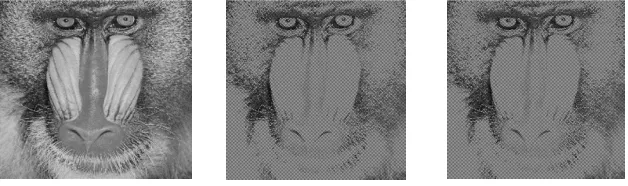
[image:4.612.148.462.459.552.2]The primary objective of this work is to build a secured, robust and perceptual transparent digital image watermarking system in a hybrid domain (i.e., employing LWT, DCT, and SVD) using PSO to find suitable multiple SF, which can give an optimal performance maintaining the trade-off between imperceptibility and robustness. Two non-overlapping sub-images are formed by taking even and odd pixels alternatively across the row and column, and a binary watermark is embedded into the even sub-image using an odd sub - image as a reference point. Fig. 2 depicts the two sub-image formed from the original Manderill image. We have used quality metric normalized-correlation-coefficient (NCC) and peak-signal-to-noise-ratio (PSNR) to measure the robustness and transparency of the proposed scheme respectively.
Fig. 2 Mandrill host image, even sub-image and odd sub-image
The rest of this paper is organized as follows. In section II provides a mathematical description of the transform techniques, which we have used in the proposed scheme, is explained briefly. Detail of PSO based MSF optimization processes are described in section III. Section IV illustrates the proposed watermark embedding and extraction procedure. Section V presents experimental setup and results. Finally, the concluding remarks are presented in section VI.
II. THEMATHEMATICALPRELIMINARIESOFUSEDTRANSFORMS
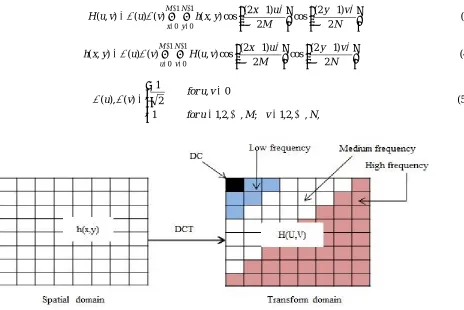
A. Discrete cosine transforms
N v y M u x y x h v u v u H M x N y 2 ) 1 2 ( cos 2 ) 1 2 ( cos ) , ( ) ( ) ( ) , ( 1 0 1 0
(3)
N v y M u x v u H v u y x h M u N v 2 ) 1 2 ( cos 2 ) 1 2 ( cos ) , ( ) ( ) ( ) , ( 1 0 1 0
(4)
, , , 2 , 1 ; , , 2 , 1 1 0 , 2 1 ) ( ), ( N v M u for v u for v u
[image:5.612.91.555.73.383.2] (5)
Fig. 3 Different frequency regions of DCT coefficients
B. Lifting wavelet transform
Using traditional wavelet transform for watermark scheme designing faces certain limitations. Since traditional wavelet transform is a floating point algorithm, Computers with limited data processing ability create rounding error such that the process of reconstructing the exact signal becomes unattainable. Moreover, this transform needs sophisticated computation facility, and it makes hardware implementation to be complex and costly. The mentioned constraints can be resolved by using lifting wavelet transforms. LWT is a more versatile technique, and it was first introduced by W. Sweldens in 1995 [21]. The technique inherits multi-resolution properties of traditional wavelet transform while adding new other properties. The main procedure of LWT involves three main operations viz. splitting, predicting and updating and the block diagram of forward and inverse LWT is shown in Fig. 4.
Fig. 4 Block diagram of lifting scheme.
C. Singular value decomposition
From the view of image processing, a digital image can be considered as a matrix such that pixel intensity values represent entries of the matrix. So, a linear algebra technique, namely singular value decomposition (SVD) can be used for digital image watermarking because of its popular advantages. The SVD of an image matrix H of size M×N is the factorization of H into the product of three matrices U, S, and V such that,
C Split ) ( Ck e
) ( Ck o
Predict
-
Update
+ A
D
-
+
) ( Ck e
) ( Ck o
Merge Update Predict
[image:5.612.91.487.528.641.2] NN N N N MN MM M M M T v v v v v v s s s u u u u u u USV H 1 2 21 1 11 22 11 1 2 21 1 11 0 0 0 0 0 0 0 (6)
where,HMN,UMM, SMNand VMN. The matrix U and V are called the left and right singular vectors. Since U and V are orthogonal matrices, the following conditions are always satisfied.
UUT UTUI and VVT VTV I (7)
S is a nonnegative diagonal matrix containing the square root of the eigenvalues of either U or V matrix and the elements is arranged in descending order
s
1
s
2
s
MN.III.PARTICLESWARMOPTIMIZATION
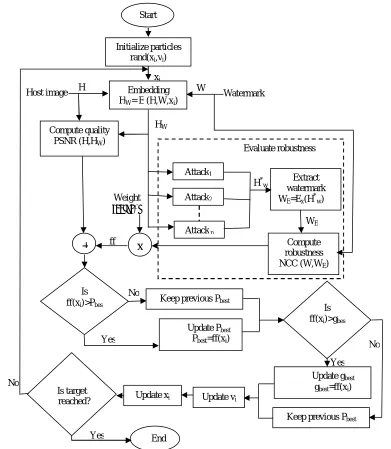
The amount of signal embedded into host image determines the level of robustness and imperceptibility of the watermarked image. In fact, robustness and imperceptibility are the most required watermarking properties for the copyright protection application. However, both properties are conflicting with each other that increasing one decreases the other and vice-versa. The quantity of signal embedded and robustness have a direct relationship, whereas imperceptibility and the amount of embedded signal are inversely related. Scaling factors (SF), which are used to modify the coefficients during watermark embedding control the quantity of the signal to be embedded. Therefore, the problem of finding suitable SF, which can give optimum performance and maintain the trade-off between transparency and robustness, can be viewed as an optimization problem. Appropriate SF can be obtained using a metaheuristic optimization algorithm, and in this paper, we have used particle swarm optimization algorithm. PSO algorithm was first developed by Eberhart and Kennedy in 1995 [22]. The algorithm starts searching process by randomly initializing particles having position xi (t) and velocity vi (t). The particles update their position and velocity in every iteration using the following equation.
vi(t1)Wivi(t)C1rand(pbestxi(t))C2rand (gbest xi(t)) (8)
xi(t1)xi(t)vi(t1) (9) Where, pbest and gbest are personal best and global best of the particles at a given iteration. Wi is inertia weight which determines the step size, C1 and C2 are learning factors which determine the effectiveness of local and global learning. The term ‘rand’ refers to an operation which randomly generates numbers between 0 and 1.
The fitness function ff is formulated from quality measuring metric PSNR and NCC, and the definition is presented as follows.
n
i E
w NCCW W
H H PSNR Max ff 1 ) , ( ) ,
( (10)
Where, H and Hw are original host image and watermarked image respectively; while W and WE are original watermark and extracted watermark respectively. The detail definition of PSNR and NCC are presented in section V. The flowchart for the proposed PSO based optimum scaling factors searching and objective value computation is shown in Fig. 5.
IV.PROPOSEDWATERMARKINGSCHEME
The proposed watermarking scheme consists of two main algorithms: watermark embedding and extraction algorithms. The detail of each algorithm is presented in the following sub-section.
A. Proposed watermark embedding algorithm
The watermark embedding algorithm takes a host image and a watermark logo as an input and provides a watermarked image as an output. The followings are the steps involved in the watermark embedding.
1) Step1: perform LWT operation on host image.
2) Step2: take approximation coefficient (LL) and split it into two sub-images called even and odd description (i.e.,HrfE and O rf
H
by taking alternative pixels along the row and column wise.
3) Step3: Apply block based DCT on the reference images using block size of 4×4.
) ( ) ( 2 ) , ( 1 ) , ( O rf DCT n m rf E rf DCT n m rf F DCT H F DCT H (12)
4) Step4: Factorize DCT coefficient using SVD operation. ) ( ) ( 2 ) , ( ) , ( ) , ( ) , ( 1 ) , ( ) , ( ) , ( ) , ( DCT n m rf O n m rf O n m rf O n m rf DCT n m rf E n m rf E n m rf E n m rf H SVD V S U H SVD V S U (13)
[image:7.612.104.495.256.705.2]5) Step5: Use the obtained multiple scaling factors (MSF) from PSO and insert binary watermark by modifying singular values using equation (14).
Fig 5. A flowchart of PSO based scaling factor optimization. Weight factor, β ff Yes No No Yes Yes No W Host image H
xi Start
Initialize particles rand(xi,vi)
Embedding HW= E (H,W,xi)
HW
Watermark
Compute quality PSNR (H,HW)
Evaluate robustness Attack1
Attack2
Attack n
H*w
Extract watermark WE=Ex(H*w)
WE
+
Is
ff(xi)>Pbes Keep previous Pbest
Update Pbest Pbest=ff(xi)
Is ff(xi)>gbes
Update gbest gbest=ff(xi)
Keep previous Pbest Update vi
)
,
(
)
,
(
),
,
(
)
,
(
)
,
(
)
,
(
),
,
(
1
)
,
(
)
,
(
)
,
(
),
,
(
)
,
(
)
,
(
)
,
(
),
,
(
1
)
,
(
)
,
(
) , ( ) , ( ) , ( ) , ( ) , ( ) , ( ) , ( ) , ( ) , ( ) , ( ) , ( ) , ( ) , ( ) , ( ) , (j
i
S
j
i
S
if
j
i
S
j
i
S
j
i
S
j
i
S
if
j
i
S
n
m
W
if
j
i
S
j
i
S
if
j
i
S
j
i
S
j
i
S
j
i
S
if
j
i
S
n
m
W
if
j
i
S
O n m rf E n m rf O n m rf E n m rf O n m rf E n m rf E n m rf O n m rf E n m rf O n m rf E n m rf O n m rf E n m rf E n m rf E n m Wrf
(14)Where i=j=1 and kif the magnitude SrfE(m,n)(i,j)SrfO(m,n)(i,j) is in the intervalrk.
6) Step6: Perform inverse SVD operation to obtain watermarked blocks. T E n m rf E n m Wrf E n m rf E n m
W U S V
B ( , ) ( , ) ( , ) ( , )
(15)
7) Step7: Apply inverse DCT on BWE(m,n)and merge the blocks to get watermarked sub-image.
HWrfE IDCT(BWE(m,n)) (16)
8) Step8: Merge the two sub-images (i.e. HWrfE and O rf
H ) together to obtain watermarked approximation coefficientLLW.
9) Step9: Finally a watermarked image FWcan be obtained by performing inverse LWT. F ILWT(LL ,LH,HL,HH)
W
W (17)
B. Proposed watermark extraction algorithm
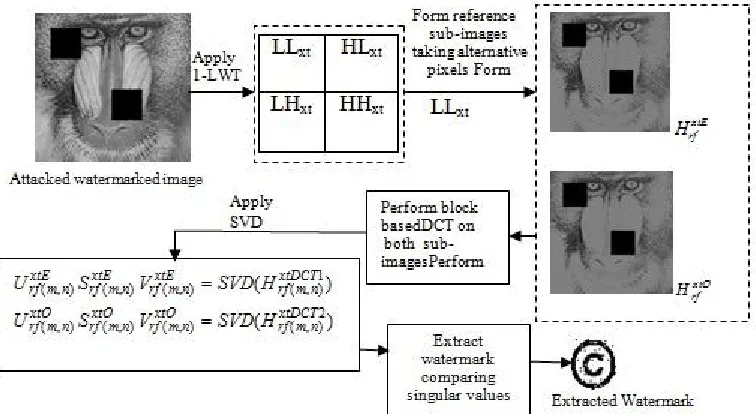
Since the proposed watermarking scheme is blind, neither original host image, nor a copy of embedded watermark is required for extraction. The watermark extraction algorithm takes only watermarked image only which could also be an attacked one by pirates while being transmitted through an insecure medium. The steps of the proposed watermark extraction algorithm are presented as follows.
1) Step1: Take possibly an attacked watermarked image (H*w) and performs LWT.
(LLxt,LHxt,HLxt,HHxt)LWT(HW*) (18) 2) Step2: Split LLxt into two sub-image HrfxtEand
xtO rf
H .
3) Step3: Divide the sub-images into non-overlapping blocks and perform DCT. ( ) ) ( 2 1 xtO rf xtDCT rf xtE rf xtDCT rf H DCT H H DCT H (19)
4) Step4: Factorize DCT coefficients. ) ( ) ( ) ( ) ( 2 ) , ( ) , ( ) , ( ) , ( 1 ) , ( ) , ( ) , ( ) , ( xtDCT n m rf xtO n m rf xtO n m rf xtO n m rf xtDCT n m rf xtE n m rf xtE n m rf xtE n m rf F SVD V S U F SVD V S U (20)
5) Step5: Finally, Extract the watermark using the following equation.
Fig. 6 Flowchart of the proposed watermark embedding algorithm
Fig. 7. Flowchart of the proposed watermark extraction algorithm V. EXPERIMENTALRESULTSANDDISCUSSION
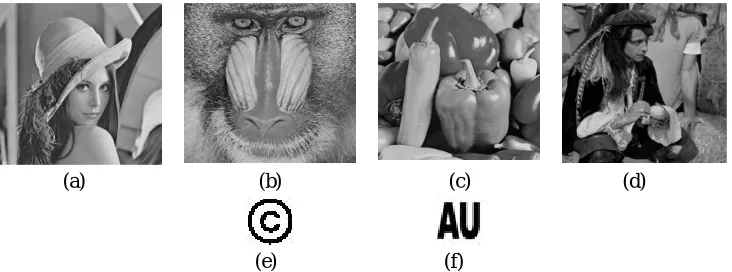
We have simulated the proposed watermarking algorithm using Matlab software and have conducted a series of experiments to examine the performance of the scheme. The grayscale image of Lena, Manderill, man, and pepper of size 512×512 has been used as test cover images. In addition, the scheme takes the copyright logo and ‘AU’ character of size 32×32 as input watermarks and inserts them into the host images using the proposed procedure. Fig. 8 shows the test images and watermark logo images. We have employed multiple scaling factors (MSF) instead of a single scaling factor (SSF) to improve the robustness maintaining the quality of the watermarked image within an acceptable level. The PSO parameters C1 and C2 are set to be 2, and the value of the inertia weight Wi is made to vary adaptively depending on the iteration. To reduce computational burden, we have set a number of particles and maximum iteration to 20 and 100 respectively.
[image:9.612.129.507.356.563.2]measure the degree of similarity between the original cover image and watermarked image. The definition of PSNR is given in equation 22.
dB y x H y x H MN
PSNR
M
x N
y W
1 1
2 2
)) , ( ) , ( ( 1
255 log
10 (22)
Where, His original cover image and HW is a watermarked image.
In the field of digital image watermarking, the minimum acceptable PSNR value is 38 dB [23]. Attaining higher value of PSNR confirms that the watermarking scheme is able to insert secret information into cover image without causing significant quality loss.
(a) (b) (c) (d)
[image:10.612.125.491.214.350.2](e) (f)
Fig. 8. The test images (a) Lena (b) mandrill (c) pepper (d) man (e) watermark logo, WM1 (f) binary watermark logo, WM2
Fig. 9 Watermarked test images.
By merely looking the obtained watermarked images which are shown in Fig. 9, we can conclude that the proposed scheme is capable to achieve the imposed quality requirement. The obtained PSNR values in attack free scenario are given in Table1.
TABLE 1
PSNR OF WATERMARKED IMAGES USING MSF IN ATTACK FREE SCENARIO.
Images Lena Mandrill Pepper Man PSNR 46.2781 45.8172 45.4817 45.079
[image:10.612.133.481.394.485.2]the proposed watermark extraction algorithm as input to check the existence of the embedded watermark resisting the performed attacks. Fig. 11 shows the list of attacks performed and the respective extracted watermark images.
GNA SPNA HEA CRA
[image:11.612.133.475.104.284.2]RTA PNA SNA RCBA
Fig. 10 Attacked watermarked Lena images
As we can see from the figure, the proposed watermarking scheme is able to provide good quality extracted image after the performed attacks. The metric, normalized correlation coefficient (NCC) has been used to measure the level of similarity between the original and extracted watermark. Let W is an original watermark and WE is extracted watermark of size (p,q), then the NCC can be computed by using the following equation.
p
i q
j
E E
p
i q
j p
i q
j E E
j i W j
i W
j i W j
i W NCC
1
2 1
2 1
) ) , ( ( )
) , ( (
) ) , ( )( ) , ( (
(23)
Attacks Extracted watermark
Using SSF Using MSF
Lena Mandrill Lena Mandrill WM1 WM2 WM1 WM2 WM1 WM2 WM
1
WM2 Attack free (AF)
Gaussian Noise attack (GNA)
(µ=0, v=0.001)
Salt & pepper noise attack (SPNA) (D=0.02) Median filter attack (MFA)
(3x3)
Histogram Equalization attack (HEA)
Gamma correction attack
(GCA) (γ=0.925)
Rotation attack (RTA) (5o)
JPEG compression attack (JPCA) (QF=70%) Average filter attack (AVFA)
(3x3)
Gaussian low pass filter (GLPFA) (3x3) Camera motion attack (CMA)
(len=9,θ=0)
Least bit removing attack (LBRA) (LSB removed) Image sharpening attack (SRA)
Resizing attack (RSA) (512256512) Wiener filter attack (WFA)
(3x3)
Poison noise attack (PNA) Speckle noise attack (SNA)
(µ=0, v=0.04)
Row-Column blanking attack (RCBA)
Fig. 11 Extracted watermark images from attacked images
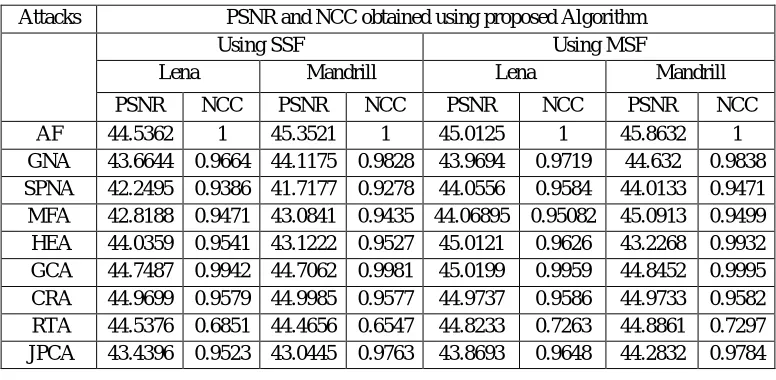
A watermarking scheme is said to be robust to a given attack when the NCC between an original watermark and extracted watermark is closer to 1. In fact, a robustness of a scheme is at an acceptable level if the NCC value is greater than or equal to 0.75 [23]. Table 2 shows the value of PSNR and NCC of proposed watermarking scheme using SSF and MSF by applying different attacks. From the table, we can notice that the PSNR and NCC values are in the acceptable level except rotation attack. Therefore, from overall result one can confirm that the proposed scheme can attain the imposed quality and robustness requirements.
TABLE 2 PSNR AND NCC RESULT OBTAINED FROM SIMULATIONS USING WM1 Attacks PSNR and NCC obtained using proposed Algorithm
Using SSF Using MSF
Lena Mandrill Lena Mandrill
[image:12.612.112.500.553.743.2]AVFA 41.4154 0.9341 42.9391 0.9352 43.7485 0.9573 43.1576 0.9426 GLPFA 43.0961 0.9743 44.5342 0.9836 44.8803 0.9768 43.9761 0.9867 CMA 44.4666 0.8679 41.6452 0.9081 44.8093 0.8924 43.3565 0.9155 LBRA 44.5028 0.9925 45.0161 0.9925 44.9976 0.9945 44.8548 0.9946 SRA 44.9771 0.9925 43.9254 0.9874 45.0073 0.9932 44.7919 0.9964 RSA 44.3489 0.9358 42.8788 0.9475 44.4379 0.9546 43.0774 0.9501 WFA 42.8733 0.9533 42.9315 0.9147 43.3146 0.9617 43.3828 0.9165 PNA 42.8312 0.9441 43.1235 0.9551 43.0152 0.9572 43.9018 0.9595 SNA 42.1291 0.9031 42.3941 0.9129 42.4632 0.9184 42.9712 0.9194 RCBA 43.0521 0.9236 42.7812 0.9302 43.0125 0.9355 43.0528 0.9357
TABLE 3 OPTIMIZED MSF FOR JPCA(QF=80%)
Cover image
PSNR NCC (JPCA, QF=80)
Optimized MSF [λk] for different ranges
λ1 λ2 λ3 λ4 λ5
Lena 43.8693 0.9949 0.1737 0.1635 0.1550 0.0169 0.0009 Mandrill 44.2832 0.9969 0.1821 0.1600 0.0863 0.0800 0.0520 Pepper 43.0961 0.9934 0.1884 0.0808 0.0483 0.0264 0.0193 Man 42.4154 0.9929 0.1912 0.1150 0.0706 0.0470 0.0120
10 20 30 40 50 60 70 80 90
0.8 0.85 0.9 0.95 1
JPEG (QF %)
N
C
C
Lena,SSF Lena,MSF Mandrill,SSF Mandrill,MSF
[image:13.612.115.499.73.213.2]Fig. 12 NCC values of extracted watermark for JPEG attack
Table 3 shows the result of optimized multiple scaling factors in the case of JPEG compression attacks. In Fig. 12 plot of NCC value versus QF of JPCA for both SSF and MSF is shown. From the above results we can observe that using MSF improve the result of PSNR and NCC compared SSF.
VI.CONCLUSION
[image:13.612.98.500.232.579.2]obtain optimized parameters. Compared to existing schemes, the performance of the proposed scheme has been evaluated by applying a maximum number of attacks and the obtained confirm that the scheme is able to provide improved NCC and PSNR results.
REFERENCES
[1] L. Me and G. Arce, “A class of authentication digital watermarks for secure multimedia communication,” IEEE Transactions on Image Processing, vol. 10, no. 11, pp. 1754–1764, 2001.
[2] P. C. Korus, “Digital image integrity – a survey of protection and verification techniques,” Digital Signal Processing, vol. 71, pp. 1–26, 2017.
[3] C. Rey and J.-L. Dugelay, “A Survey of Watermarking Algorithms for Image Authentication,” EURASIP Journal on Advances in Signal Processing, vol. 2002, no. 6, pp. 613–621, 2002.
[4] A.Z.Tirkel et al., Electronic Watermark, Aust. Pattern Recognition. Soc., Canberra, ACT, Australia, pp. 666–673, 1993.
[5] H. Nyeem, W. Boles, and C. Boyd, “Digital image watermarking: its formal model, fundamental properties and possible attacks,” EURASIP Journal on Advances in Signal Processing, vol. 2014, no. 1, 2014.
[6] H. Tao, L. Chongmin, J. M. Zain, and A. N. Abdalla, “Robust Image Watermarking Theories and Techniques: A Review,” Journal of Applied Research and Technology, vol. 12, no. 1, pp. 122–138, 2014.
[7] C. Song, S. Sudirman, and M. Merabti, “Recent advances and classification of watermarking techniques in digital images,” in Proceedings of post graduate network symposium, pp. 1–6, 2009.
[8] S. Liu, Z. Pan, and H. Song, “Digital image watermarking method based on DCT and fractal encoding,” IET Image Processing, vol. 11, no. 10, pp. 815–821, Oct. 2017.
[9] Xiangui Kang, Jiwu Huang, Y. Q. Shi, and Yan Lin, “A DWT-DFT composite watermarking scheme robust to both affine transform and JPEG compression,” IEEE Transactions on Circuits and Systems for Video Technology, vol. 13, no. 8, pp. 776–786, Aug. 2003.
[10] T. T. Takore, P. R. Kumar, and G. L. Devi, “Efficient gray image watermarking algorithm based on DWT-SVD using genetic algorithm,” Proc. IEEE, in International Conference on Information Communication and Embedded Systems (ICICES), pp. 1–6, 2016.
[11] Z. Zhang, L. Wu, S. Xiao, and S. Gao, “Adaptive reversible image watermarking algorithm based on IWT and level set,” EURASIP Journal on Advances in Signal Processing, vol. 2017, no. 1, Dec. 2017.
[12] T. T. Takore, P. R. Kumar, and G. L. Devi, “A modified blind image watermarking scheme based on DWT, DCT and SVD domain using GA to optimize robustness,” Proc. IEEE, International Conference on Electrical, Electronics, and Optimization Techniques (ICEEOT),pp. 2725–2729, 2016.
[13] K. Ramanjaneyulu and K. Rajarajeswari ,“An Oblivious and Robust Multiple Image Watermarking Scheme Using Genetic Algorithm,” The International journal of Multimedia & Its Applications, vol. 2, no. 3, pp. 19–38, 2010.
[14] P. Satyanarayana Murty, M. Uday Bhaskar, Nanna Babu, and Rajesh Kumar, “A Semi-Blind Reference Watermarking Scheme Using DWT-SVD for Copyright Protection,” The International journal of Multimedia & Its Applications, vol. 3, no. 3, pp. 61–70, Aug. 2011.
[15] R. A. Ghazy et al., “Block-based SVD image watermarking in spatial and transform domains,” International Journal of Electronics, vol. 102, no. 7, pp. 1091– 1113, Jul. 2015.
[16] R. Liu and T. Tan, “An SVD-based watermarking scheme for protecting rightful ownership,” IEEE Transactions on Multimedia, vol. 4, no. 1, pp. 121–128, 2002.
[17] M.-R. Keyvanpour and F. Merrikh-Bayat, “Robust dynamic block-based image watermarking in DWT domain,” Procedia Computer Science, vol. 3, pp. 238– 242, 2011.
[18] Z. Zhang, C. Wang, and X. Zhou, “Image watermarking scheme based on Arnold transform and DWT-DCT-SVD,” in Signal Processing (ICSP), 2016 IEEE 13th International Conference on, 2016, pp. 805–810.
[19] I. A. Ansari, M. Pant, and C. W. Ahn, “Robust and false positive free watermarking in IWT domain using SVD and ABC,” Engineering Applications of Artificial Intelligence, vol. 49, pp. 114–125, Mar. 2016.
[20] Department of Electronics and Communication Engineering, Andhra University, Visakhapatnam, India, T. Tagesse Takore, P. Rajesh Kumar, and G. Lavanya Devi, “Robust Image Watermarking Scheme Using Population-Based Stochastic Optimization Technique,” International Journal of Image, Graphics and Signal Processing, vol. 9, no. 7, pp. 55–65, Jul. 2017.
[21] W. Sweldens, "The lifting scheme: A construction of second generation wavelets." SIAM journal on mathematical analysis, vol. 29, no. 2, pp. 511-546, 1998. [22] J. Kennedy and R. Eberhart, “Particle swarm optimization,” vol. 4, pp. 1942–1948, 1995.

![TABLE 3 OPTIMIZED MSF FOR JPCA (QF=80%) NCC ] for different ranges](https://thumb-us.123doks.com/thumbv2/123dok_us/8302184.854789/13.612.98.500.232.579/table-optimized-msf-jpca-qf-ncc-different-ranges.webp)
