5
II
February 2017
Technology (IJRASET)
Mechanical Studies of Self Compacting Concrete
Using Plastic Aggregate
J. Vengadesh Marshall Raman1, R.Senthil Raj2
1Mailam Engineering College, Assistant professor, Mailam,Villupuram(Dt), Tamilnadu,India 2Mailam Engineering College, Assistant professor, Mailam,Villupuram(Dt), Tamilnadu,India
Abstract:In this present study the plastic aggregate obtained from E-waste is used as a partial replacement of coarse aggregate in self compacting concrete. An experimental investigation on the fresh, hardened characteristics of concrete using M40 grade of Self compacting concrete are carried out by casting standard concrete with various volume fractions of plastic aggregate such as 0%, 10%, 20%, 30%, 40%, 50% to determine optimum dosage. The fresh properties of SCC reveal that the workability of concrete are enhanced by using plastic aggregate. Strength properties such as compressive strength shows that up to 30% replacement of coarse aggregate there is no significant change in compressive strength as compared to normal concrete. Beyond that there is drop in compressive strength for 50% replacement of coarse aggregate by plastic aggregate. Split tensile strength, Flexural strength and Young modulus of concrete increases for 10% plastic aggregate. Beyond that strength decreases upto 50% replacement. Impact strength decreases for all replacement levels.
Key words: Self compacting concrete, plastic aggregate, M40 grade concrete, fresh properties, Mechanical properties,
I. INTRODUCTION
In a few studies, an increase in the slump value due to the incorporation of plastic aggregate is also reported The increase of the slump of concrete mixes due to the incorporation of plastic aggregates is due to the presence of more free water in the mixes containing plastic than in the concrete mix containing natural aggregate since, unlike natural aggregate, plastic aggregates cannot absorb water during mixing .The addition of some types of plastic aggregate such as rigid polyurethane foam waste or heat-treated expanded polystyrene foam (MEPS) decrease the slump value of the resulting concrete mix due to the presence of large amounts of surface pores in these aggregates . Ismail and Al-Hashmi reported that at 20% replacement of fine aggregate by plastic aggregates density decreases by 8.7% below the reference concrete. Marzouk et al. The compressive strength of concrete and cement mortar is a fundamental property that is thoroughly studied in almost all research works related to plastic aggregate. In all of these studies it was found that the incorporation of plastic as aggregate decreased the compressive strength of the resulting concrete/mortar. Albano et al. reported that concrete with 10% of recycled PET exhibits a compressive strength that meets the standard strength values for concrete with moderate strength.
The reduction in compressive strength was more pronounced in concrete containing larger flaky PET aggregate than smaller one. Saikia and de Brito observed similar trends in compressive strength for concrete containing fine and coarse flaky PET aggregate, which was mainly due to the loss of workability of the concrete mix due to the shape of the PET aggregate, especially for larger particles. Batayneh et al. For 20% replacement compressive strength shows a sharp reduction up to 72% of the original strength. Ismail and Al-Hashmi reported that the compressive strength of concrete prepared by replacing 10%, 15% and 20% of fine natural aggregate by PET aggregate are higher than the minimum compressive strength required for structural concrete, which is 17.24 MPa, even though the values are lower than the compressive strength of concrete containing only natural aggregate. Frigione reported that the compressive strength of concrete prepared by replacing 5% in weight of natural fine aggregate by PET waste aggregate (PETW) is slightly lower (not lower than 2%) than that of concrete containing natural aggregate . Kou et al. reported that the reduction is up to 47.3% at 45 % replacement of natural fine aggregate by PVC granules with respect to the control mix.
II. MATERIAL INVESTIGATION
A. Cement
Technology (IJRASET)
Table 1.Physical properties of Cement (OPC 53 grade)
B. Fine Aggregate
Good quality river sand free from silt and other impurities passing through 4.75 mm sieve is used in this study. The physical properties of fine aggregate are shown in Table 3.2
Table 2. Physical properties of Fine aggregate
C. Coarse aggregate
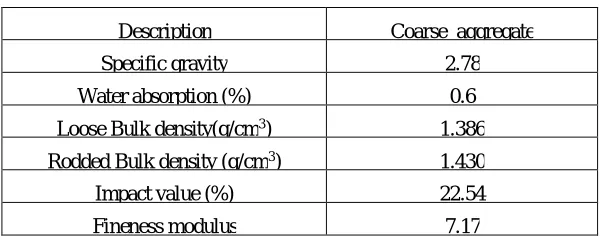
Coarse aggregate is passing through 20 mm and retaining on 10mm sieves are used for experimental work. The physical properties of coarse aggregate are given in Table 3.3.
Table 3. Physical properties of Coarse aggregate
D. Plastic Aggregate
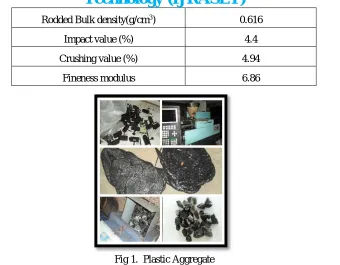
[image:3.612.156.456.440.561.2]The polystyrene waste material collected from Lotus plastic Pvt.Ltd. Mettupalayam Puducherry. The physical properties of plastic aggregates are given in Table.3.4. Plastic aggregates are shown in figure1
Table 4. Physical Properties of Plastic Aggregate
Sl.no Property Value
1 Standard Consistency 31%
2 Initial setting time 137min
3 Final setting time 303 min
4 Specific gravity 3.11
Description Fine Aggregate
Specific gravity 2.7
Water absorption (%) 1.05
Bulk density(g/cm3) 1.560
Fineness modulus 2.99
Zone I
Description Coarse aggregate
Specific gravity 2.78
Water absorption (%) 0.6
Loose Bulk density(g/cm3) 1.386 Rodded Bulk density (g/cm3) 1.430 Impact value (%) 22.54
Fineness modulus 7.17
Description Plastic Aggregate
Specific gravity 1.08
Technology (IJRASET)
Fig 1. Plastic Aggregate
E. Fly ash
Class F is fly ash normally produced from burning anthracite or bituminous coal and is procured from Ennore, Chennai and is used for this project work. Specific gravity of Fly-ash is 2.05
F.Silica Fume
However, silica fume is also very effective in reducing or eliminating bleed and this can give rise to problems of rapid surface crusting.
G. Super Plasticizer
In this project SP with higher specific gravity, named Supaflo SPL for attaining the required flow characteristics is used. Specific gravity of Super Plasticizer is 1.21
H. Water
Potable drinking water with pH value ranging between 6 to 7 available within the Pondicherry Engineering College Campus has been used for making Self Compacting concrete.
III. MIX PROPORTIONING
The mix design arrived for the M40 grade of concrete using the above mentioned procedure is given in the following Table 5 Table 5. Mix Proportioning
Rodded Bulk density(g/cm3) 0.616
Impact value (%) 4.4
Crushing value (%) 4.94
Fineness modulus 6.86
Sl.No Materials Quantity(kg/m3)
1 Cement 450
2 Flyash 126
3 Silica Fume 45
4 Sand 894
5 Coarse aggregate (20mm) 307
6 Coarse aggregate(12.5mm) 307
7 Water 220
Technology (IJRASET)
IV. EXPERIMENTAL PROGRAM
A. Fresh properties
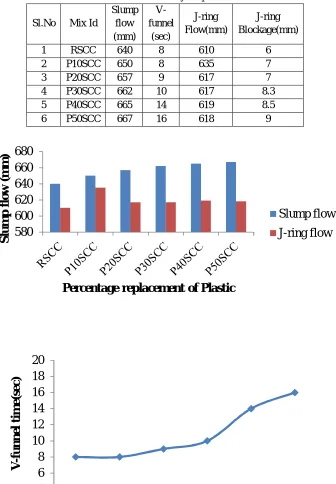
[image:5.612.141.477.157.641.2]The results of the fresh properties are given in Table 5.1 and its variation is shown in fig 5.1 to fig 5.6 forM40 grade of concrete at various percentage replacements of plastic aggregate.
Table 6. Workability Properties
Sl.No Mix Id
Slump flow (mm) V-funnel (sec) J-ring Flow(mm) J-ring Blockage(mm)
1 RSCC 640 8 610 6
2 P10SCC 650 8 635 7
3 P20SCC 657 9 617 7
4 P30SCC 662 10 617 8.3
5 P40SCC 665 14 619 8.5
6 P50SCC 667 16 618 9
580
600
620
640
660
680
S
lu
m
p
f
low
(
m
m
)
Percentage replacement of Plastic
Slump flow
J-ring flow
0
2
4
6
8
10
12
14
16
18
20
0
10
20
30
40
50
V
-f
u
n
n
el
t
im
e(
se
c)
Technology (IJRASET)
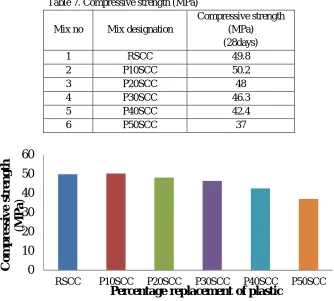
B. Strength characteristics1) Compressive Strength: Compressive strength has been found out at the age of 28 days after moist curing the specimens continuously. Results shows that up to 30% replacement of coarse aggregate there is no significant change in compressive strength as compared to the normal concrete. Beyond that there is drop in compressive strength for 50% replacement of coarse aggregate by plastic aggregate.
Table 7. Compressive strength (MPa)
Mix no Mix designation
Compressive strength (MPa) (28days)
1 RSCC 49.8
2 P10SCC 50.2
3 P20SCC 48
4 P30SCC 46.3
5 P40SCC 42.4
[image:6.612.137.471.156.457.2]6 P50SCC 37
Fig 2 Compressive Strength at 28 days
[image:6.612.127.483.556.673.2]2) Split Tensile Strength: The split tensile strength of the SCC was found out at the ages of 28 days. The values are represented in Table 8 and in Fig 3.In general concrete is poor in tension and good in compression. Since the thermoplastics are ductile in nature and are good in tensile strength, from the graph it is concluded that as the replacement percentage increases the tensile strength decreases.
Table 8. Split tensile strength (MPa)
Sl.no Mix id Split tensile strength (MPa) 28 days
1 RSCC 4.10
2 P10SCC 4.17
3 P20SCC 3.82
4 P30SCC 3.71
5 P40SCC 3.55
6 P50SCC 3.37
0
10
20
30
40
50
60
RSCC P10SCC P20SCC P30SCC P40SCC P50SCC
C
om
p
re
ss
ive
st
re
n
gt
h
(
M
P
a
)
Technology (IJRASET)
Fig 3 Split tensile Strength at 28 days
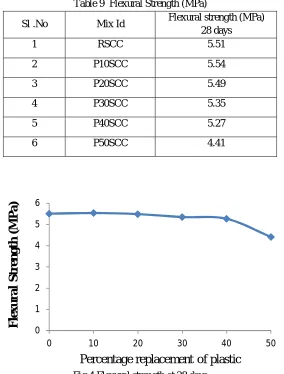
[image:7.612.166.450.303.677.2]3) Flexural Strength:The result of flexural strength with percentage replacement of coarse aggregate with plastic aggregate has given in Table 9and its variation is shown in Fig 4
Table 9 Flexural Strength (MPa)
Sl .No Mix Id Flexural strength (MPa) 28 days
1 RSCC 5.51
2 P10SCC 5.54
3 P20SCC 5.49
4 P30SCC 5.35
5 P40SCC 5.27
6 P50SCC 4.41
.
Fig 4 Flexural strength at 28 days
4) Impact Strength: The impact strength of the SCC was found out at the ages of 28 days. The results are given in the Table10 and its variation is shown in Fig.5
0 1 2 3 4 5
0 10 20 30 40 50
S
p
li
t
te
n
si
le
s
tr
en
gt
h
(M
P
a)
Percentage replacement of plastic
0 1 2 3 4 5 6
0 10 20 30 40 50
F
le
x
u
ral
S
tr
en
gt
h
(
M
P
a)
Technology (IJRASET)
Table 10 Impact Strength (Joule)
Sl.No Mix id Initial crack (blows) Final crack (blows) Impact strength ( Joule)
1 RSCC 12 15 601.92
2 P10SCC 10 12 481.53
3 P20SCC 6 9 361.15
4 P30SCC 5 7 280.89
5 P40SCC 3 6 240.77
6 P50SCC 3 5 200.64
Fig5 Impact Strength
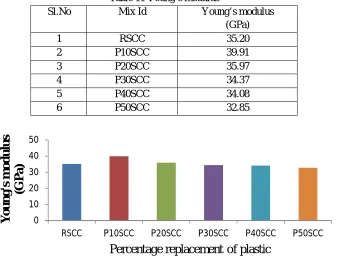
[image:8.612.142.485.444.701.2]5) Young’s modulus: The effect of plastic aggregate on elastic modulus of SCC shows that for 10% plastic aggregate the elastic modulus is higher when compared to the normal concrete. The results of modulus of elasticity are given in the Table11 and its variation is shown in Fig.6
Table 11 Young’s modulus
Sl.No Mix Id Young’s modulus (GPa)
1 RSCC 35.20
2 P10SCC 39.91
3 P20SCC 35.97
4 P30SCC 34.37
5 P40SCC 34.08
6 P50SCC 32.85
Fig6. Young’s modulus
0 200 400 600 800
0 10 20 30 40 50
Im
p
ac
t
S
tr
en
gt
h
(Jou
le
)
Percentage replacement of plastic
0 10 20 30 40 50
RSCC P10SCC P20SCC P30SCC P40SCC P50SCC
Y
ou
n
g'
s
m
od
u
lu
s
(G
P
a)
Technology (IJRASET)
V. CONCLUSIONS
Reduction in the compressive strength was between 15%and 33% for concrete containing 20–50% plastic waste. The reduction in Split tensile strength of about 17.8% at 50% plastic aggregate when compared to reference concrete.
The reduction of Flexural strength about 19.9% at 50% replacement of plastic aggregate when compared to reference concrete. Impact strength of concrete tends to decrease at all replacement of coarse aggregate by plastic aggregate .The decrease of about 66 % at 50% replacement when compared to reference concrete.
For 10% replacement the elastic modulus is higher than reference concrete. The reduction of about 7% at 50% replacement of plastic aggregate when compared to reference concrete.
REFERENCES
[1] Albano C, Camacho N, Hernandez M, Matheus A, Gutierrez A(2009),Influence of content and particle size of pet waste bottles on concrete behaviour at
different w/c ratios, Waste Management(Oxford) ;29:2707–16.
[2] ASTMC642-13, Standard Test Method for Density, Absorption, and Voids in Hardened Concrete.
[3] Akcaozoglu S, Atis CD, Akcaozoglu K(2010).An investigation on the use of shredded pet waste bottles as aggregate in lightweight concrete, Waste Management;32:285–90.
[4] Batayneh M, Marie I, Ibrahim A(2007) Use of selected waste materials in concrete mixes. Waste Management; 27:1870–6
[5] Brahim Safi , Mohammed Saidi , Djamila Aboutaleb , Madani Maallem (2013).The use of plastic waste as fine aggregate in the self-compacting mortars: Effect
on physical and mechanical propertiesConstruction and Building Materials, 436–442.
[6] Choi YW, Moon DJ, Kim YJ, Lachemi M (2009). Characteristics of mortar and concrete containing fine aggregate
[7] manufactured from recycled waste polyethylene terephthalate bottles”. Construction Building Materials; 23:2829–35.
[8] Choi YW, Moon DJ, Chung JS, Cho SK (2005). Effects of pet waste bottles aggregate on the properties of concrete. Cement Concrete Research; 35:776–81.
[9] Fraj AB, Kismi M, Mounanga P(2010).Valorization of coarse rigid polyurethane foam waste in lightweight aggregate
[10] concrete, Construction Building Materials;24:1069–77.
[11] Frigione M (2010). Recycling of PET bottles as fine aggregate in concrete, Waste Management; 30:1101–6.
[12] Hannawi K, Kamali-Bernard S, Prince W (2010). Physical and mechanical properties of mortars containing PET and PC waste aggregates, Waste Management;
30: 2312–20.
[13] Ismail ZZ, Al-Hashmi EA(2008).Use of plastic waste in concrete mixture as aggregate replacement, Waste Management ;28:2041–2047. \
[14] IS 456 (2000) Plain and Reinforced concrete, BIS, New Delhi.
[15] IS 2386 (1963) Methods of test for Aggregate for concrete, BIS, New Delhi
[16] IS 12269 (2013), 53 Grade Ordinary Portland cement Specification, BIS, New Delhi.
[17] IS 10262 (2009) Concrete mix proportioning, BIS, New Delhi.
[18] IS 516 (1959) Method of tests for strength of concrete, BIS, New Delhi.
[19] Kan A, Demirbog˘a R (2009). A novel material for lightweight concrete production, Cement Concrete Composite; 31:489–95.
[20] Kou SC, LeeG, Poon CS, Lai WL (2009). Properties of lightweight aggregate concrete prepared with PVC granules derived from scraped PVC pipes, Waste
Management ;29:621–8.
[21] Marzouk OY, Dheilly RM, Queneudec M (2007). Valorisation of post-consumer plastic waste in cementitious concrete composites, Waste Management;
27:310–8.
[22] Nan Su, Kung-Chung Hsu, His-Wen Chai (2001). A simple mix design method for self-compacting concrete, Cement and Concrete Research, Taiwan, pp.
1799-1807.
[23] Nanthagopalan Prakash and Manu Santhanam (2010).A simple and systematic mixture design procedure for self-compacting concrete”, 6thInternational
RILEM Symposium, Vol. II, 55.
[24] Recycling of plastics, Dr. Sue Jackson and Dr. Tamás Bertényi(2006).Department of Engineering, University of Cambridge.
[25] Saikia N, de Brito J(2012). Mechanical properties and abrasion behaviour of concrete containing shredded pet waste bottle aggregate as a partial substitution of
natural aggregate. Cement Concrete Composite.