Direct Detection of Pyrazinamide Resistance in
Mycobacterium
tuberculosis
by Use of
pncA
PCR Sequencing
Kingsley King-Gee Tam,aKenneth Siu-Sing Leung,aGilman Kit-Hang Siu,b Kwok-Chiu Chang,cSamson Sai-Yin Wong,a Pak-Leung Ho,aEunice Ka-Chun Leung,aWing-Cheong Yama
aDepartment of Microbiology, Queen Mary Hospital, The University of Hong Kong, Hong Kong Special Administrative Region, China bDepartment of Health Technology and Informatics, The Hong Kong Polytechnic University, Hong Kong Special Administrative Region, China cTuberculosis and Chest Service, Centre for Health Protection, Department of Health, Hong Kong Special Administrative Region, China
ABSTRACT An in-house-developedpncA sequencing assay for analysis of pyrazin-amide (PZA) resistance was evaluated using 162 archivedMycobacterium tuberculosis
complex (MTBC) isolates with phenotypic PZA susceptibility profiles that were well defined by analysis of Bactec MGIT 960 PZA kit and PZase activity data. Preliminary
results showed 100% concordance between pncA sequencing and phenotypic PZA
drug susceptibility test (DST) results among archived isolates. Also, 637 respiratory specimens were prospectively collected, and 158 were reported as MTBC positive by the Abbott Realtime MTB assay (96.3% sensitivity [95% confidence interval {CI}: 92.2% to 98.7%]; 100% specificity [95% CI: 99.2% to 100.0%]). Genotypic and pheno-typic PZA resistance profiles of these 158 MTBC-positive specimens were analyzed by pncAsequencing and Bactec MGIT 960 PZA kit, respectively. For analysis of PZA resistance,pncAsequencing detectedpncAmutations in 5/5 (100%) phenotypic PZA-resistant respiratory specimens within 4 working days. No pncAmutations were de-tected among PZA-susceptible specimens. Combining archived isolates with
pro-spective specimens, 27 were identified as phenotypic PZA resistant with pncA
mutation. Among these 27 samples, 6/27 (22.2%) phenotypic PZA-resistant strains carried novel pncA mutations without rpsA and panD mutations. These included 5 with mutations (a deletion [Del] at 383T [Del383T], Del 380 to 390, insertion of A [A Ins] at position 127, A Ins at position 407, and G Ins at position 508) inpncA struc-tural genes and 1 with a mutation (T-12C) at the pncA promoter region. All six of these strains had no or reduced PZase activities, indicating that the novel mutations might confer PZA resistance. Additionally, 25/27 phenotypic PZA-resistant strains were confirmed multidrug-resistant tuberculosis (MDR-TB) strains. As PZA is com-monly used in MDR-TB treatment regimens, direct pncAsequencing will rapidly de-tect PZA resistance and facilitate judicious use of PZA in treating PZA-susceptible MDR-TB.
KEYWORDS drug-resistant TB, molecular diagnosis,Mycobacterium tuberculosis, pyrazinamide
T
uberculosis (TB) has been a global public health problem for decades. In 2017, estimates of 10.0 million new TB cases and 1.7 million TB-related deaths were reported worldwide (1). The situation was worsened by the presence of multidrug-resistant TB (MDR-TB), which is defined by bacillary resistance to both isoniazid (INH) and rifampin (RIF). Rapid diagnosis of drug resistance is essential for timely initiation of optimal treatment to quickly contain infection at the source.Pyrazinamide (PZA) is a prodrug that is activated by mycobacterial pyrazinamidase (PZase) encoded bypncA. The resultant activated product (pyrazinoic acid) can provide a sterilizing effect to Mycobacterium tuberculosis complex (MTBC) infection (2). PZA
CitationTam KK-G, Leung KS-S, Siu GK-H, Chang K-C, Wong SS-Y, Ho P-L, Leung EK-C, Yam W-C. 2019. Direct detection of pyrazinamide resistance inMycobacterium tuberculosisby use ofpncAPCR sequencing. J Clin Microbiol 57:e00145-19.https://doi.org/ 10.1128/JCM.00145-19.
EditorGeoffrey A. Land, Carter BloodCare & Baylor University Medical Center
Copyright© 2019 American Society for Microbiology.All Rights Reserved. Address correspondence to Wing-Cheong Yam, [email protected].
Received29 January 2019
Returned for modification11 March 2019 Accepted5 June 2019
Accepted manuscript posted online12 June 2019
Published
AEROBIC ACTINOMYCETES
crossm
26 July 2019
on May 17, 2020 by guest
http://jcm.asm.org/
plays a critical role in the treatment of both drug-susceptible TB and MDR-TB. Its unique sterilizing property of killing persister bacilli has been proven to shorten the treatment period of drug-susceptible TB from 12 months to 6 months (3, 4). PZA is also recom-mended by World Health Organization (WHO) for MDR-TB treatment regimens (5). Inclusion of PZA in PZA-susceptible MDR-TB may improve MDR-TB treatment outcomes (6, 7). Potential synergistic activities among PZA, important second-line drugs, and novel drugs (such as bedaquiline, delamanid, and pretomanid) highlight its importance in both current and future MDR-TB treatment (5, 8).
Currently, growth-based drug susceptibility tests (DST) using an MGIT 960 PZA kit are widely regarded as representing the gold standard for determining MTBC drug susceptibility to PZA. However, there are limitations to the current PZA resistance tests. The long turnaround time of mycobacterial culture means phenotypic drug suscepti-bility tests may take up to months to complete, which leads to diagnostic delays. The tests could take even longer for drug-resistant MTBC strains with an even lower replication rate (9). Moreover, PZA phenotypic DSTs are rarely performed in routine clinical settings as the test is time-consuming and technically demanding. The low pH medium and the stringent inoculum size of the assays often lead to inconsistent and nonreproducible results which deter clinicians from relying on these tests for guidance. PZA resistance has been reported to be predominantly associated withpncAmutations, leading to reduced or lost PZase activity and failure to activate PZA (10, 11). Never-theless, mutations inpncAare diverse in nature and scattered throughout the whole
pncAgene without any hot spot regions (12). This makes probe-based real-time PCR assay approaches challenging.Other molecular approaches such aspncAsequencing and use of the commercial Genoscholar PZA-TB II assay (NIPRO Corporation, Japan) have been evaluated for analyzingpncAmutations in previous studies (13–15). How-ever, evaluation studies of these platforms included only purified isolates or specimens subjected to genolysis with confirmed smear-positive and MTBC culture results that were positive for acid-fast bacilli (AFB) (13–15). In response to the current threat of MDR-TB pandemic, a rapid and highly accurate PZA resistance diagnostic tool is, therefore, urgently needed (16).
In this study, we aimed to evaluate an algorithm forM. tuberculosisdetection using the Abbott Realtime MTB assay and subsequent in-house-developed genotypic PZA resistance detection targeting the PZA resistance-related pncA gene. The in-house-developed pncAPCR-sequencing assay allows detection of PZA resistance MTBC di-rectly from respiratory specimens. With a sequencing size corresponding to 828 base pairs (NC_000962.3 positions 2288495 to 2289322), our sequencing assay covered not only the entire 561 bp of thepncAgene but also the putative promoter region that regulatespncAexpression (10).
To the best of our knowledge, this publication represents the first prospective evaluative study of an in-house-developedpncAsequencing platform for direct detec-tion of PZA resistance in MTBC by the use of both AFB smear-positive and AFB smear-negative respiratory specimens. The accuracy of the sequencing platform results were also evaluated using archived MTBC clinical isolates collected over a 14-year period. Detection of genotypic PZA resistance bypncAsequencing was compared with detection by the use of phenotypic DSTs with a Bactec MGIT 960 PZA kit as well as the PZase activity in the subsequent mycobacterial cultures.
MATERIALS AND METHODS
Archived MTBC clinical isolate collection.Archived clinical isolates collected between April 2003 and January 2017 from Queen Mary Hospital and Grantham Hospital were available for this study and were stored at⫺80°C prior to usage. Resuscitation of archived MTBC clinical isolates was performed using Lowenstein-Jensen (LJ) medium and Middlebrook 7H9 supplemented with oleic acid dextrose catalase (OADC). The cultures were incubated at 37°C and were supplemented with 5% CO2.
Respiratory specimen collection. Respiratory specimens were available from newly diagnosed patients suffering from lower respiratory infection between May and December 2017 in five general hospitals (inpatients) and in 13 chest clinics of the Department of Health (outpatients) in Hong Kong. After being subjected to direct AFB smear microscopy using fluorescence auramine O and confirmed by Ziehl-Neelsen staining, all respiratory specimens were decontaminated by the conventionalN-acetyl-L
on May 17, 2020 by guest
http://jcm.asm.org/
cysteine-NaOH method as described previously (17). Processed sediments were then inoculated onto a Bactec MGIT 960 mycobacterial detection system (Becton, Dickinson, Baltimore, MD, USA) and LJ medium (bioMérieux, Marcyl’Etoile, France) at 37°C.
Specimen DNA extraction and Abbott Realtime MTB assay.For each processed specimen, 500-l samples were taken for TB detection using the Abbott Realtime MTB assay. Processed specimens were inactivated and subjected to DNA extraction using an Abbott m2000sp instrument as previously described (18, 19). The extracts were then transferred onto an Abbott m2000rtreal-time PCR thermo-cycler for real-time PCR. Upon completion, either “MTBC detected” or “MTB not detected” and a manufacturer defined cutoff cycle number (Cn) of 40.0 were reported. For samples reported as “MTBC Positive” by the Abbott Realtime MTB assay, specimen DNA was extracted from another 500-l volume of processed sediments using a Roche Amplicor respiratory specimen preparation kit (Roche Diagnostics, Berlin, Germany) for in-housepncAsequencing platform analysis.
Genotypic identification of culture isolates.Mycobacterial DNA was extracted from all culture isolates using a Roche Amplicor respiratory specimen preparation kit as described previously (20). The presence of MTBC was confirmed by an in-house PCR assay, and species identification of nontuberculosis mycobacterium (NTM) was confirmed using 16S rRNA sequencing as described previously (20, 21).
Phenotypic drug susceptibility testing (DST).PZA susceptibility was defined by phenotypic DST, which was conducted using a Bactec MGIT 960 PZA kit and a Bactec MGIT 960 SIRE kit (Becton, Dickinson, Baltimore, MD, USA). The critical concentrations used were 100 mg/liter for PZA, 0.1 mg/liter for INH, and 1.0 mg/liter for RIF.
Pyrazinamidase (PZase) activity assay.The PZase activity assay was performed using a modified Wayne procedure as described previously (22). The PZase activity assay was interpreted independently by 2 well-trained observers.M. tuberculosisH37Rv and a clinical isolate ofM. boviscollected from the diagnostic microbiology laboratory of Queen Mary Hospital in Hong Kong were used as positive and negative controls, respectively.
PCR amplification and DNA sequencing forpncA.All archived clinical isolates and “MTBC de-tected” specimens were subjected topncAPCR amplification and sequencing targeting a 828-bp region covering the 561-bppncAgene and the promoter region. ThepncAPCR was performed using primers pncA_1F (5=-CGGCGTCATGGACCCTATATC-3=) and pncA_1R (5=-GCCCGATGAAGGTGTCGTAG-3=). The PCR mixture consisted of 1⫻PCR buffer (Qiagen, Hilden, Germany), 1⫻Q solution (Qiagen, Hilden, Germany), a 0.2 mM concentration of each deoxynucleoside triphosphate (dNTP) (Life Technologies, CA, USA), 1.5mM MgCl2, a 0.4M concentration of each primer (Integrated DNA Technologies, IA, USA), and 5 U
HotStarTaq Plus DNA polymerase (Qiagen, Hilden, Germany). The PCR was carried out under the following conditions: initial denaturation at 96°C for 8 min, followed by 40 cycles at 95°C for 1 min, 60°C for 1 min, and 72°C for 1 min and a final elongation step at 72°C for 10 min. The PCR products were subjected to Sanger sequencing using an ABI 3130 Genetic Analyzer (Applied Biosystems, USA). Con-sensus sequences ofpncAwere assembled and edited using the Staden Package (version 2.0.0) and compared with data from the referenceM. tuberculosisH37Rv strain by the use of the BioEdit sequence alignment editor (version 7.0.5). In cases of novelpncAmutations detected in PZA-resistant MTB,rpsAand
panDsequencing were performed as described previously to exclude PZA resistance corresponding to
rpsAand/orpanDmutations (10, 23).
Cross reactivity ofpncAPCR amplification.To determine the specificity ofpncAPCR, DNA from 10 NTM clinical strains was subjected topncAPCR amplification. These strains were selected in order to represent the most common pathogenic NTM species identified in Hong Kong (24). Mycobacterial DNAs fromM. tuberculosisH37Rv,M. bovis, andM. africanumwere used as positive controls.
Statistical analysis.The diagnostic performance of Abbott Realtime MTB assay was evaluated with reference to mycobacterial culture results. The sensitivities, specificities, positive predictive values (PPV), and negative predictive values (NPV) were calculated based on bacteriology information. The diagnostic performance ofpncA sequencing was evaluated using the PZA susceptibility test as the reference standard. Any nonsynonymous mutations detected bypncAsequencing were regarded as representing genotypic resistance, and the percentage of concordance was calculated based on “MTBC detected” specimens with positive MTBC cultures and interpretablepncAsequencing results.
RESULTS
Drug susceptibility patterns and PZase activity.Using MGIT SIRE and MGIT PZA kits, phenotypic resistance to INH, RIF, and PZA for the 326 MTBC culture isolates, including 162 from archived MTBC strains and 164 isolates from respiratory specimens, was determined. Among these isolates, 266/326 were pan-susceptible strains, 19/326 were INH monoresistant, 4/326 were RIF monoresistant, and 37/326 were MDR-TB. PZA resistance was identified in 2/266 (0.8%) pan-susceptible strains and 25/37 (67.6%) MDR-TB strains (Table 1; see also Table 2). Using a modification of the Wayne method, the levels of PZase activity of the 326 MTBC culture isolates were determined. Among the 299 PZA-susceptible strains, 100% (299/299) showed positive PZase activity. For the 27 PZA-resistant strains, 26/27 (96.3%) strains showed negative PZase activity and 1/27 (3.7%) strain exhibited weak PZase activity (Table 1; see also Table 2).
Analytical performance ofpncAsequencing on archived isolates.A total of 162 archived isolates were collected in this study to evaluate the analytical performance of
on May 17, 2020 by guest
http://jcm.asm.org/
pncAsequencing. Of the 162 archived isolates, 22/162 (13.6%) were phenotypically PZA resistant and 140/162 (86.4%) were phenotypically PZA susceptible as determined by the use of the MGIT PZA kit. All isolates were positive forpncAPCR, withpncAmutations detected in all 22 phenotypic PZA-resistant isolates but not in 140 PZA-susceptible isolates.pncAsequencing detected known PZA resistance-related missense mutations in 16 PZA-resistant strains (F13S [n⫽1], C14R [n⫽1], S66P [n⫽3], W68R [n⫽1], I90S [n⫽2], V125D [n⫽1], G162D [n⫽6], and L182S [n⫽1]) (Table 1). Novel mutations were identified in the other 6 PZA-resistant strains, which included two deletion (Del) patterns (Del 383 T [n⫽1] and Del 380 to 390 [n⫽1]) and three insertion (Ins) patterns (insertion of A [A Ins] at 127[n⫽2], A Ins at 407[n⫽1], and G Ins at 508 [n⫽1]). All
TABLE 1Pyrazinamide susceptibility andpncAmutation profile of 162 archived purifiedM. tuberculosisisolates
MGIT PZA (100 mg/liter) susceptibility test result
(no. of isolates) No. of strains PZase activity
Sanger PCR sequencing result forpncA
SNP location(s) Nucleotide changea Amino acid change(s)
Susceptible (n⫽140)b 140 Positive WTd WT WT
Resistant (n⫽22)c 1 Negative 38 tTc¡tCc F13S
1 Negative 40 Tgc¡Cgc C14R
3 Negative 196 Tcg¡Ccg S66P
1 Negative 202 Tgg¡Agg W68R
2e Negative 269 aTc¡aGc I90S
1 Negative 374 gTc¡gAc V125D
6 Negative 485 gGt¡gAt G162D
1 Negative 545 tTg¡tCg L182S
2 Negative 127 A Ins at 127 Frameshift at codon 43
1 Negative 407 A Ins at 407 Frameshift at codon 136
1 Negative 508 G Ins at 508 Frameshift at codon 170
1 Negative 383 Deletion 383 T Deletion of codon 128 1 Negative 380–390 Deletion, 380 to 390 Deletion of codons 127–130
aUppercase sequence characters represent the nucleotide change.
bAmong 140 PZA-susceptible isolates, 6 were MDR-TB, 10 were INH monoresistant, 2 were RIF monoresistant, and 122 were pan-susceptible strains as determined by
use of the MGIT 960 SIRE kit.
cAmong 22 PZA-resistant isolates, 20 were MDR-TB by MGIT 960 SIRE kit. dWT, wild type.
eTwo PZA-resistant isolates from the same patient were PZA monoresistant.
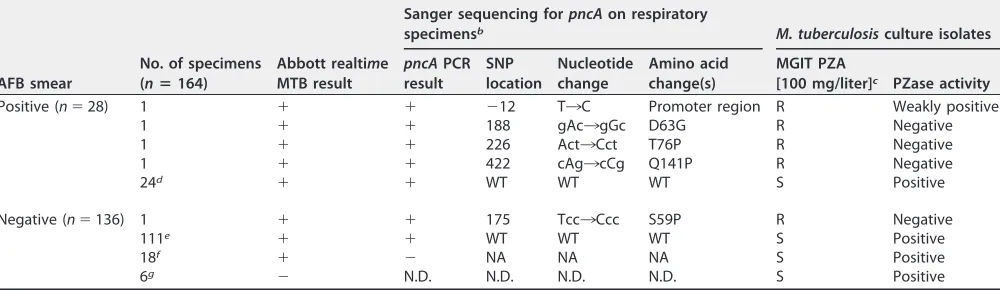
TABLE 2Rapid diagnosis of pyrazinamide resistance usingpncAsequencing on 164 “MTBC culture-positive” direct specimensa
AFB smear
No. of specimens (nⴝ164)
Abbott realtime MTB result
Sanger sequencing forpncAon respiratory
specimensb M. tuberculosisculture isolates
pncAPCR result
SNP location
Nucleotide change
Amino acid change(s)
MGIT PZA
[100 mg/liter]c PZase activity
Positive (n⫽28) 1 ⫹ ⫹ ⫺12 T¡C Promoter region R Weakly positive
1 ⫹ ⫹ 188 gAc¡gGc D63G R Negative
1 ⫹ ⫹ 226 Act¡Cct T76P R Negative
1 ⫹ ⫹ 422 cAg¡cCg Q141P R Negative
24d ⫹ ⫹ WT WT WT S Positive
Negative (n⫽136) 1 ⫹ ⫹ 175 Tcc¡Ccc S59P R Negative
111e ⫹ ⫹ WT WT WT S Positive
18f ⫹ ⫺ NA NA NA S Positive
6g ⫺ N.D. N.D. N.D. N.D. S Positive
aAbbreviations: NA, not applicable; N.D., not done.
bAll results frompncAPCR Sanger sequencing performed on direct specimens were concordant with the results seen with subsequent culture isolates. cIn this study, all five phenotypically PZA-resistant specimens were confirmed to represent MDR-TB by the use of an MGIT 960 SIRE kit.
dAmong 24 AFB smear-positive specimens phenotypically susceptible to PZA, 4 were MDR-TB, 4 were INH monoresistant, and the remaining 16 were pan-susceptible
to all first-line antibiotics.
eAmong the 111 AFB smear-negative specimens phenotypically susceptible to PZA, 2 were MDR-TB, 2 were RIF monoresistant, 5 were INH monoresistant, and the
remaining 102 were pan-susceptible to all first-line antibiotics.
fEighteen AFB smear-negative MTB-positive pan-susceptible specimens showed negativepncAPCR results. NopncAmutations were detected in subsequent culture
isolates.
gSix AFB smear-negative pan-susceptible specimens were reported to be “MTB-Negative” by the Abbott Realtime MTB assay. Therefore, nopncAsequencing was
performed on these six direct specimens. NopncAmutations were detected in subsequent culture isolates.
on May 17, 2020 by guest
http://jcm.asm.org/
[image:4.585.43.543.495.640.2]PZA-resistant archived isolates showed negative PZase activity in the modified Wayne test. Overall, PZA resistance results determined bypncAsequencing among archived isolates were 100% concordant with the MGIT PZA kit results (Table 1).
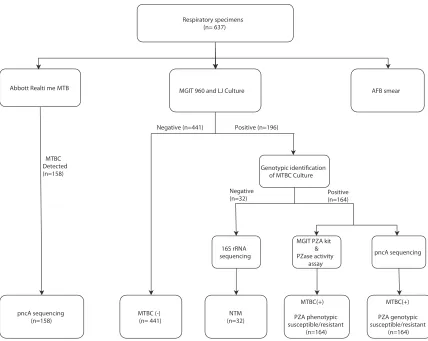
Mycobacterial culture and AFB smear on respiratory specimens. The overall workflow for respiratory specimens processing is illustrated in Fig. 1. A total of 637 respiratory specimens were prospectively collected from 427 newly diagnosed patients suspected with lower chest infection. Among the 637 specimens, 164/637 (24.8%) specimens from 109 patients were culture positive for MTBC and 32/637 (5.0%) specimens from 19 patients were culture positive for NTM (M. avium[n⫽6],
M. abscessus [n⫽3], M. colombiense [n⫽1], M. chelonae [n⫽4], M. fortuitum
[n⫽2],M. gordonae[n⫽2],M. intracellulare[n⫽6],M. kansasii[n⫽4],M.
scrofu-laceum [n⫽1] M. parascrofulaceum [n⫽1], M. neoaurum [n⫽1], and M. xenopi
[n⫽1]). The remaining 441 specimens were negative for mycobacterial culture. Among the 164 bacteriologically confirmed specimens, 28/164 (17.1%) were AFB smear positive. The rates of culture positivity in MGIT 960 and LJ medium were 89.6% (147/164) and 79.9% (131/164), with mean times to detection of 20.7 days (⫾ 0.8 days) and 47.9 days (⫾2.6 days), respectively.
Of the 164 MTBC culture-positive specimens, the Abbott Realtime MTB assay re-ported 158/164 (96.3%) as “MTBC detected.” “MTBC not detected” results were rere-ported for 473/473 (100%) MTBC culture-negative specimens. No indeterminate result due to the presence of a PCR inhibitor was obtained. The Abbott Realtime MTB assay exhibited no cross-reactivity for 32 NTM specimens, and these specimens were reported as “MTBC not detected.” Among the 52/637 (8.2%) AFB smear-positive and the 585/637 (91.8%) AFB smear-negative specimens, the Abbott Realtime MTB assay demonstrated
sensi-Respiratory specimens (n= 637)
MGIT 960 and LJ Culture AFB smear
Abbott Realti me MTB
Positive (n=196) Negative (n=441)
Genotypic identification of MTBC Culture
Positive (n=164) Negative
(n=32)
16S rRNA sequencing
MGIT PZA kit & PZase activity
assay
MTBC(+)
PZA phenotypic susceptible/resistant
(n=164) NTM
(n=32) MTBC (-)
(n= 441) pncA sequencing
(n=158)
pncA sequencing MTBC
Detected (n=158)
MTBC(+)
PZA genotypic susceptible/resistant
(n=164)
FIG 1Workflow of evaluating in-housepncAsequencing for the detection ofpncAmutation and PZA resistance in respiratory specimens. Abbreviations: MTBC,M. tuberculosiscomplex; NTM, nontuberculosis mycobacterium.
on May 17, 2020 by guest
http://jcm.asm.org/
[image:5.585.42.470.69.410.2]tivities of 100% and 95.6% with specificities of 100% and 100%, respectively. Overall sensitivity, specificity, positive predictive values, and negative predictive values and corresponding 95% confidence intervals (CI) determined by the Abbott Realtime MTB assay were 96.3% (95% CI: 92.2% to 98.7%), 100% (95% CI: 99.2% to 100.0%), 100% (95% CI: 100%), and 98.8% (95% CI: 97.2% to 99.4%), respectively. All 158 specimens reported as “MTBC positive” and the corresponding isolates were analyzed by in-house-developedpncAsequencing.
Diagnostic performance of in-house-developed pncA sequencing on respira-tory specimens.ThepncAgene was successfully sequenced in 140 (88.6%) specimens, including all (n⫽28) of the AFB-smear-positive specimens and 112/130 (86.2%) of the AFB smear-negative specimens (Table 2).pncAmutations (including T-12C [n⫽1], S59P [n⫽1], D63G [n⫽1], T76P[n⫽1], and Q141P[n⫽1]) were detected in five respiratory specimens, all of which were subsequently confirmed to be phenotypically resistant to PZA by using MGIT 960 PZA phenotypic DST. None of the 135 PZA-susceptible specimens harboredpncAmutations (Table 2). Therefore, ourpncAsequencing assay was 100% concordant with the MGIT 960 PZA phenotypic DST in determination of PZA resistance in pncA PCR-positive respiratory specimens. Follow-up pncA sequencing performed on subsequent isolates showed identical results with their corresponding specimens.
Regarding the 6 false-negative specimens reported by the Abbott Realtime MTB
assay and the 18 pncA PCR-negative specimens, the subsequent isolates gave no
mutation bypncAsequencing and were phenotypically susceptible to PZA (Table 2). In addition, pncA PCR exhibited no cross-reactivity with 10 NTM strains, including M.
avium,M. intracellulare,M. abscessus,M. chelonae,M. gordonae,M. fortuitum,M. kansasii,
M. colombiense,M. xenopi, andM. scrofulaceum.
DISCUSSION
The demand for rapid detection of drug-resistant TB from direct specimens is ever-increasing. Review of the current literature showed that the levels ofpncA muta-tion concordance in PZA-resistant strains ranged from 72% to 99%, suggesting that
pncAis a good indicator for detecting PZA resistance (25). The diagnostic performance
of the use of the pncA sequence to predict PZA resistance has been previously
evaluated (10, 15, 26, 27), but those retrospective evaluations were conducted on clinical isolates or AFB smear-positive specimens only. In our current study, apart from using archived MTBC clinical isolates collected over a 14-year period to demonstrate test accuracy, we also extended our findings by prospectively evaluating our in-house-developedpncAsequencing for genotypic identification of PZA resistance in both AFB smear-positive and AFB smear-negative respiratory specimens. To the best of our knowledge, this was the first prospective study to have evaluated the diagnostic performance ofpncAsequencing in clinical specimens collected from TB intermediate-burden regions.
In this study, the Abbott Realtime MTB assay was used to primarily detect the presence of MTBC in respiratory specimens. Concordant with our previous studies (18, 19), the Abbott RealtimeMTB assay demonstrated high sensitivity (95.6%) and speci-ficity (100%). The results demonstrated that the Abbott Realtime MTB assay is a suitable platform for rapid screening of MTBC-positive specimens. Specimens reported as “MTBC detected” by the Abbott Realtime MTB assay were subsequently selected for in-house-developedpncAsequencing.
The in-house-developedpncAsequencing method uses a PCR-based platform that
screens the entire pncA sequence and upstream promoter for any potential PZA
resistance-related mutations. As PZA resistance-related mutations are scattered along the entirepncAgene without any hot spot regions, the sequencing-based approach of our assay can provide exact mutation profiles in the targeted DNA sequence. Compared to other commercially available PZA line-probe assays such as the Genoscholar PZA-TB II assay, which uses 48 wild-type probes forpncAmutation detection (14), our in-house-developed assay can identify the exact mutation patterns and thus prevent false
on May 17, 2020 by guest
http://jcm.asm.org/
reports of PZA resistance that are due to the presence of silent mutations. This is critical for early diagnosis of drug resistance and pivotal for optimal TB infection control and patient care. In this study, in-house-developedpncAsequencing demonstrated 100% sensitivity among AFB smear-positive specimens. In addition, the current evaluation was also extended to include AFB smear-negative specimens and demonstrated an acceptable sensitivity level of 86.2%. With overall specificity of 100% and no cross-reactivity to NTM pathogens, our result suggested that the in-house-developedpncA
sequencing system could be a highly accurate diagnostic tool for PZA resistance detection.
In the current study, all phenotypically PZA-resistant MTBC cultures were found to carrypncAmutations as identified by in-house-developedpncAsequencing. The results were further supported by a modified Wayne’s test with reduced levels or an absence of PZase activity. Meanwhile, no pncA polymorphism was displayed in any of the PZA-susceptible strains from either respiratory specimens and archive isolates. The result suggested that silent mutations and natural polymorphisms in pncA are not common among PZA-susceptible strains. On the other hand, PZA resistance is mainly associated withpncAmutations in our locality, despite the association ofrpsAandpanD
mutations with PZA-resistant MTBC strains (10, 11). Similarly to previous studies, our cohort of pncA mutations included missense mutations, deletions, and insertions dispersed along thepncAgene and its promoter regions without any hot spot regions (19, 25). This indicates that pncAsequencing is most likely to be the most suitable diagnostic tool for genotypic prediction of PZA resistance due to its ability to accurately identify mutations throughout the wholepncAgene and its promoter regions.
Overall, the operation of pncA sequencing was deemed to be simpler and less technically demanding than that of the MGIT 960 PZA kit. Our combined turnaround time of 4 working days includes specimen digestion and decontamination (0.5 day), MTBC detection by the Abbott Realtime MTB assay (0.5 day),pncAsequencing (2 days), and data analysis and reporting (1 day). This is much shorter than the average of 35.2 days (⫾3.8 days) for phenotypic DST. As analyses using the 3130 Genetic Analyzer as described in this study can be selectively performed on a maximum of 45 specimens per batch,pncAsequencing can be used for small-to-large-scale PZA resistance detec-tion. The frequency ofpncAsequencing can be adjusted according to the workload of the clinical laboratory and can provide a more efficient choice for PZA resistance detection.
In our sample cohort, six phenotypically PZA-resistant strains were found to carry a novel pncAmutation(s). These novel pncAmutations included five inpncAstructural genes and one at thepncApromoter region. As there are no additional mutations in
rpsA and panD mutations in these six isolates (data not shown), these novel pncA
mutations were postulated to be correlated with PZA resistance. Interestingly, one
phenotypic PZA-resistant specimen (HKU14621) harboring a novel pncA promoter
mutation at T-12C was found to have weak PZase activity. PZase analysis of this particular strain was performed in triplicate, and consistent weak PZase activities were detected. In a previous study conducted by Marttila et al. (28), instead of a T-12C mutation, a promoter mutation at the same nucleotide (position T-12G) was identified in TB clinical isolates with phenotypic PZA resistance. In this study, we demonstrated that a nucleotide transition from thymine to cytosine at position 12 upstream of the
pncAgene could also result in PZA resistance. As the T-12C mutation was located in the promoter region ofpncA, the mutation is very likely to affect the expression level of
pncA, causing the weakened PZase activity but phenotypic PZA-resistant profile in HKU14621. In-depth investigation is still required in order to delineate the molecular characteristics associated with the abnormal PZase activity and phenotypic PZA profile of this TB strain.
The in-house-developedpncAsequencing approach has its limitations. It is notable thatpncAmutations might not necessarily correlate with PZA resistance. According to a comprehensive study conducted by Whitfield et al. (29), pncA polymorphisms at codon positions 35 and 130 could also exist among PZA-susceptible strains. Although
on May 17, 2020 by guest
http://jcm.asm.org/
we demonstrated 100% concordance betweenpncAmutations and phenotypic PZA resistance in clinical strains in our current study, it is still important to consider the potential occurrence ofpncAmutations in phenotypic PZA-susceptible cases. In addi-tion, our study did not explore all of the possiblepncAmutants globally even though we have reflected a realistic representation of the clinical setting in our locality. With the effective implementation of directly observed short-course treatment, we could identify only a relatively small number of phenotypic PZA-resistant clinical specimens. The use of a low number of strains/specimens in this study could potentially result in missing other low-frequency PZA resistance mechanisms such as mutations inrpsAand
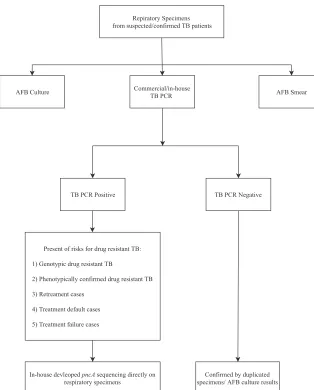
panD. Thus, a multicenter study with a larger cohort is clearly warranted. Nevertheless, among the 37 MDR-TB isolates included in the current cohort, 25/37 (65.6%) were resistant to PZA. This is similar to the PZA resistance prevalence of 31% to 89% among MDR-TB reported in other studies (9, 30). Considering the high cost of PCR sequencing and the high PZA resistance rate among MDR-TB in not only our locality but also other regions (31), we have suggested an algorithm for selectively applying directpncAPCR sequencing in respiratory specimens or culture isolates. The algorithm is particularly crucial for early chemotherapeutic guidance for treatment of patients at risk of drug-resistant TB (Fig. 2), including those with genotypic drug-drug-resistant TB or MDR-TB detected by commercial molecular assays (32, 33) or phenotypical DST methods,
Repiratory Specimens from suspected/confirmed TB patients
Commercial/in-house
TB PCR AFB Smear
TB PCR Positive
Present of risks for drug resistant TB:
1) Genotypic drug resistant TB
2) Phenotypically confirmed drug resistant TB
3) Retreament cases
4) Treatment default cases
5) Treatment failure cases
In-house devleoped pncA sequencing directly on respiratory specimens
AFB Culture
TB PCR Negative
Confirmed by duplicated specimens/ AFB culture results
FIG 2Recommended algorithm for the implementation of genotypic detection of PZA resistance by in-house-developedpncAsequencing. Abbreviation: MTBC,M. tuberculosiscomplex.
on May 17, 2020 by guest
http://jcm.asm.org/
[image:8.585.44.358.68.458.2]retreatment cases (34), treatment defaulters (35), and treatment failure cases (36). Referring to the recommended algorithm (Fig. 2), a total of 164/637 specimens could be identified as “MTBC detected” by the Abbott Realtime MTB assay. Among these 164 specimens, 22 strains, including 11 MDR-TB, 2 mono-RIF-resistant TB, and 9 mono-INH-resistant TB strains, would have qualified for pncA sequencing, providing a more cost-efficient routine application. Alongside rapid diagnosis of bacillary resistance to rifampin, isoniazid, fluoroquinolones, and second-line injectable drugs, direct pncA
sequencing can further inform clinicians to formulate the most optimal regimen against drug-resistant TB.
Among the 164 MTBC culture-positive specimens, six AFB smear-negative speci-mens were reported as “MTBC not detected” by the Abbott RealtimeMTB assay, which may be accounted for by the paucibacillary nature of these specimens. Follow-uppncA
sequencing performed on subsequent isolates revealed no pncAmutation, and the specimens were shown to be phenotypically susceptible to PZA, with positive PZase activity. On the other hand, 18 AFB smear-negative but “MTBC detected” specimens failed to amplify during pncA PCR step, which might also be attributable to low bacterial load. It is noted that Abbott RealtimeMTB assay detects MTBC using multiple copies of IS6110, in contrast topncAsequencing, which detect resistance in only the single-copypncAgene. The difference in copy numbers could account for the differ-ence in sensitivities between the Abbott RealtimeMTB assay andpncAPCR.
In conclusion, results from the use of in-house-developed pncA sequencing as a molecular-method diagnostic algorithm exhibited high sensitivity and specificity, and the technique was able to provide an accurate and reliable PZA resistance profile among respiratory specimens within four working days. With the flexible and user-friendly nature of its workflow,pncAsequencing could potentially serve as a rapid and high-throughput diagnostic tool for clinical routine service situated in TB intermediate-burden regions. As PZA plays a critical role in MDR-TB treatment regimen, directpncA
sequencing will rapidly detect PZA resistance and facilitate judicious use of PZA in the treatment of PZA-susceptible MDR-TB.
Ethics approval.This study has been approved by the Institutional Review Board of the University of Hong Kong/Hospital Authority Hong Kong West Cluster (reference UW 12-309).
ACKNOWLEDGMENTS
This study was supported by The Hong Kong Tuberculosis, Chest and Heart Diseases Association Scientific Committee on Lung Health (project identifier: TB project 1/2014). The funders had no role in study design, data collection and interpretation, or the decision to submit the work for publication.
We declare that we have no conflicts of interest.
REFERENCES
1. WHO. 2018. Global tuberculosis report 2018. World Health Organization, Geneva, Switzerland.
2. Zhang Y, Shi W, Zhang W, Mitchison D. 2013. Mechanisms of pyrazin-amide action and resistance. Microbiol Spectr 2:1–12.https://doi.org/10 .1128/microbiolspec.MGM2-0023-2013.
3. Njire M, Tan Y, Mugweru J, Wang C, Guo J, Yew W, Tan S, Zhang T. 2016. Pyrazinamide resistance in Mycobacterium tuberculosis: review and update. Adv Med Sci 61:63–71.https://doi.org/10.1016/j.advms .2015.09.007.
4. Zhang Y, Mitchison D. 2003. The curious characteristics of pyrazinamide: a review. Int J Tuber Lung Dis 7:6 –21.
5. WHO. 2019. WHO consolidated guidelines on drug-resistant tuberculosis treatment. World Health Organization, Geneva, Switzerland.
6. Chang KC, Leung CC, Yew WW, Leung EC, Leung WM, Tam CM, Zhang Y. 2012. Pyrazinamide may improve fluoroquinolone-based treatment of multidrug-resistant tuberculosis. Antimicrob Agents Chemother 56: 5465–5475.https://doi.org/10.1128/AAC.01300-12.
7. Zhang Y, Chiu Chang K, Leung CC, Wai Yew W, Gicquel B, Fallows D,
Kaplan G, Chaisson RE, Zhang W. 2012. ’Z(S)-MDR-TB’ versus ’Z(R)-MDR-TB’: improving treatment of MDR-TB by identifying pyrazin-amide susceptibility. Emerg Microbes Infect 1:1.https://doi.org/10 .1038/emi.2012.18.
8. Chang KC, Yew WW, Zhang Y. 21 December 2018, posting date. Pyrazi-namide is a two-edged sword: do WHO guidelines matter? Antimicrob Agents Chemotherhttps://doi.org/10.1128/AAC.01907-17.
9. Chang KC, Yew WW, Zhang Y. 2011. Pyrazinamide susceptibility testing in Mycobacterium tuberculosis: a systematic review with meta-analyses. Antimicrob Agents Chemother 55:4499 – 4505.https://doi.org/10.1128/ AAC.00630-11.
10. Tan Y, Hu Z, Zhang T, Cai X, Kuang H, Liu Y, Chen J, Yang F, Zhang K, Tan S, Zhao Y. 2014. Role of pncA and rpsA gene sequencing in detection of pyrazinamide resistance in Mycobacterium tuberculosis isolates from southern China. J Clin Microbiol 52:291–297.https://doi.org/10.1128/ JCM.01903-13.
11. Liu W, Chen J, Shen Y, Jin J, Wu J, Sun F, Wu Y, Xie L, Zhang Y, Zhang W. 2018. Phenotypic and genotypic characterization of pyrazinamide
on May 17, 2020 by guest
http://jcm.asm.org/
tance among multidrug-resistant Mycobacterium tuberculosis clinical isolates in Hangzhou, China. Clin Microbiol Infect 24:1016 e1–1016.e5.
https://doi.org/10.1016/j.cmi.2017.12.012.
12. Whitfield MG, Soeters HM, Warren RM, York T, Sampson SL, Streicher EM, van Helden PD, van Rie A. 2015. A global perspective on pyrazinamide resistance: systematic review and meta-analysis. PLoS One 10:e0133869.
https://doi.org/10.1371/journal.pone.0133869.
13. Driesen M, Kondo Y, de Jong BC, Torrea G, Asnong S, Desmaretz C, Mostofa KSM, Tahseen S, Whitfield MG, Cirillo DM, Miotto P, Cabibbe AM, Rigouts L. 2018. Evaluation of a novel line probe assay to detect resis-tance to pyrazinamide, a key drug used for tuberculosis treatment. Clin Microbiol Infect 24:60 – 64.https://doi.org/10.1016/j.cmi.2017.05.026. 14. Willby MJ, Wijkander M, Havumaki J, Johnson K, Werngren J, Hoffner S,
Denkinger CM, Posey JE. 21 December 2018, posting date. Detection of Mycobacterium tuberculosis pncA mutations by the Nipro Genoscholar PZA-TB II assay compared to conventional sequencing. Antimicrob Agents Chemotherhttps://doi.org/10.1128/AAC.01871-17.
15. Streicher EM, Maharaj K, York T, Van Heerden C, Barnard M, Diacon A, Mendel CM, Bosman ME, Hepple JA, Pym AS, Warren RM, van Helden PD. 2014. Rapid sequencing of the Mycobacterium tuberculosis pncA gene for detection of pyrazinamide susceptibility. J Clin Microbiol 52: 4056 – 4057.https://doi.org/10.1128/JCM.02438-14.
16. Kam KM, Yip CW, Tse LW, Leung OC, Sin LP, Chan MY, Wong WS. 2002. Trends in multidrug-resistant Mycobacterium tuberculosis in relation to sputum smear positivity in Hong Kong, 1989 –1999. Clin Infect Dis 34:324 –329.https://doi.org/10.1086/324164.
17. Pfyffer GE. 2015. Mycobacterium: general characteristics, laboratory de-tection, and staining procedures, p 536 –569. Manual of clinical micro-biology, 11th ed. American Society of Micromicro-biology, Washington, DC. 18. Chen JH, She KK, Kwong TC, Wong OY, Siu GK, Leung CC, Chang KC,
Tam CM, Ho PL, Cheng VC, Yuen KY, Yam WC. 2015. Performance of the new automated Abbott RealTime MTB assay for rapid detection of Mycobacterium tuberculosis complex in respiratory specimens. Eur J Clin Microbiol Infect Dis 34:1827–1832. https://doi.org/10.1007/ s10096-015-2419-5.
19. Tam KK, Leung KS, To SW, Siu GK, Lau TC, Shek VC, Tse CW, Wong SS, Ho PL, Yam WC. 2017. Direct detection of Mycobacterium tuberculosis and drug resistance in respiratory specimen using Abbott Realtime MTB detection and RIF/INH resistance assay. Diagn Microbiol Infect Dis 89: 118 –124.https://doi.org/10.1016/j.diagmicrobio.2017.06.018.
20. Yam WC, Yuen KY, Kam SY, Yiu LS, Chan KS, Leung CC, Tam CM, Ho PO, Yew WW, Seto WH, Ho PL. 2006. Diagnostic application of genotypic identification of mycobacteria. J Med Microbiol 55:529 –536.https://doi .org/10.1099/jmm.0.46298-0.
21. Yam WC, Cheng VC, Hui WT, Wang LN, Seto WH, Yuen KY. 2004. Direct detection of Mycobacterium tuberculosis in clinical specimens using single-tube biotinylated nested polymerase chain reaction-enzyme linked immunoassay (PCR-ELISA). Diagn Microbiol Infect Dis 48:271–275.
https://doi.org/10.1016/j.diagmicrobio.2003.11.006.
22. Singh P, Wesley C, Jadaun GP, Malonia SK, Das R, Upadhyay P, Faujdar J, Sharma P, Gupta P, Mishra AK, Singh K, Chauhan DS, Sharma VD, Gupta UD, Venkatesan K, Katoch VM. 2007. Comparative evaluation of Lowenstein-Jensen proportion method, BacT/ALERT 3D system, and enzymatic pyrazinamidase assay for pyrazinamide susceptibility testing of Mycobacterium tuberculosis. J Clin Microbiol 45:76 – 80.https://doi .org/10.1128/JCM.00951-06.
23. Zhang S, Chen J, Shi W, Liu W, Zhang W, Zhang Y. 2013. Mutations in panD encoding aspartate decarboxylase are associated with pyrazin-amide resistance in Mycobacterium tuberculosis. Emerg Microbes Infect 2:e34.https://doi.org/10.1038/emi.2013.38.
24. Hosker HS, Lam CW, Ng TK, Ma HK, Chan SL. 1995. The prevalence and
clinical significance of pulmonary infection due to non-tuberculous mycobacteria in Hong Kong. Respir Med 89:3– 8. https://doi.org/10 .1016/0954-6111(95)90063-2.
25. Miotto P, Zhang Y, Cirillo DM, Yam WC. 2018. Drug resistance mecha-nisms and drug susceptibility testing for tuberculosis. Respirology 23: 1098 –1113.https://doi.org/10.1111/resp.13393.
26. Alexander DC, Ma JH, Guthrie JL, Blair J, Chedore P, Jamieson FB. 2012. Gene sequencing for routine verification of pyrazinamide resistance in Mycobacterium tuberculosis: a role for pncA but not rpsA. J Clin Micro-biol 50:3726 –3728.https://doi.org/10.1128/JCM.00620-12.
27. Xia Q, Zhao LL, Li F, Fan YM, Chen YY, Wu BB, Liu ZW, Pan AZ, Zhu M. 2015. Phenotypic and genotypic characterization of pyrazinamide resis-tance among multidrug-resistant Mycobacterium tuberculosis isolates in Zhejiang, China. Antimicrob Agents Chemother 59:1690 –1695.https:// doi.org/10.1128/AAC.04541-14.
28. Marttila HJ, Marjamaki M, Vyshnevskaya E, Vyshnevskiy BI, Otten TF, Vasilyef AV, Viljanen MK. 1999. pncA mutations in pyrazinamide-resistant Mycobacterium tuberculosis isolates from northwestern Russia. Antimi-crob Agents Chemother 43:1764 –1766.https://doi.org/10.1128/AAC.43 .7.1764.
29. Whitfield MG, Warren RM, Streicher EM, Sampson SL, Sirgel FA, van Helden PD, Mercante A, Willby M, Hughes K, Birkness K, Morlock G, van Rie A, Posey JE. 2015. Mycobacterium tuberculosis pncA polymorphisms that do not confer pyrazinamide resistance at a breakpoint concentra-tion of 100 micrograms per milliliter in MGIT. J Clin Microbiol 53: 3633–3635.https://doi.org/10.1128/JCM.01001-15.
30. Whitfield MG, Streicher EM, Dolby T, Simpson JA, Sampson SL, Van Helden PD, Van Rie A, Warren RM. 2016. Prevalence of pyrazinamide resistance across the spectrum of drug resistant phenotypes of Myco-bacterium tuberculosis. Tuberculosis (Edinb) 99:128 –130. https://doi .org/10.1016/j.tube.2016.05.003.
31. Verdugo D, Fallows D, Ahuja S, Schluger N, Kreiswirth B, Mathema B. 2015. Epidemiologic correlates of pyrazinamide-resistant Mycobacte-rium tuberculosis in New York City. Antimicrob Agents Chemother 59:6140 – 6150.https://doi.org/10.1128/AAC.00764-15.
32. Dorman SE, Schumacher SG, Alland D, Nabeta P, Armstrong DT, King B, Hall SL, Chakravorty S, Cirillo DM, Tukvadze N, Bablishvili N, Stevens W, Scott L, Rodrigues C, Kazi MI, Joloba M, Nakiyingi L, Nicol MP, Ghebrekristos Y, Anyango I, Murithi W, Dietze R, Lyrio Peres R, Skrahina A, Auchynka V, Chopra KK, Hanif M, Liu X, Yuan X, Boehme CC, Ellner JJ, Denkinger CM, Dorman SE, Schumacher SG, Alland D, Nabeta P, Armstrong DT, King B, Hall SL, Chakravorty S, Cirillo DM, Tukvadze N, Bablishvili N, Stevens W, Scott L, Rodrigues C, Kazi MI, Joloba M, Nakiyingi L, Nicol MP, et al. 2018. Xpert MTB/RIF Ultra for detection of Mycobacterium tuberculosis and rifampicin resistance: a prospective multicentre diagnostic accuracy study. Lancet Infect Dis 18:76 – 84.https://doi.org/10.1016/S1473-3099(17)30691-6.
33. Barnard M, Gey van Pittius NC, van Helden PD, Bosman M, Coetzee G, Warren RM. 2012. The diagnostic performance of the GenoType MTB-DRplus version 2 line probe assay is equivalent to that of the Xpert MTB/RIF assay. J Clin Microbiol 50:3712–3716.https://doi.org/10.1128/ JCM.01958-12.
34. Panickar JR, Hoskyns W. 2007. Treatment failure in tuberculosis. Eur Respir J 29:561–564.https://doi.org/10.1183/09031936.00092406. 35. Horsburgh CR, Jr, Feldman S, Ridzon R. 2000. Practice guidelines for the
treatment of tuberculosis. Clin Infect Dis 31:633– 639.https://doi.org/10 .1086/314007.
36. Dooley KE, Lahlou O, Ghali I, Knudsen J, Elmessaoudi MD, Cherkaoui I, El Aouad R. 2011. Risk factors for tuberculosis treatment failure, default, or relapse and outcomes of retreatment in Morocco. BMC Public Health 11:140.https://doi.org/10.1186/1471-2458-11-140.