R E S E A R C H
Open Access
The sharp bounds on general
sum-connectivity index of four operations on
graphs
Shehnaz Akhter
1and Muhammad Imran
1,2**Correspondence:
1Department of Mathematics,
School of Natural Sciences (SNS), National University of Sciences and Technology (NUST), Sector H-12, Islamabad, Pakistan
2Department of Mathematical
Sciences, College of Science, United Arab Emirates University, P.O. Box 15551, Al Ain, United Arab Emirates
Abstract
The general sum-connectivity index
χ
α(G), for a (molecular) graphG, is defined as thesum of the weights (dG(a1) +dG(a2))αof alla1a2∈E(G), wheredG(a1) (ordG(a2))
denotes the degree of a vertexa1(ora2) in the graphG;E(G) denotes the set of edges
ofG, and
α
is an arbitrary real number. Eliasi and Taeri (Discrete Appl. Math. 157:794-803, 2009) introduced four new operations based on the graphsS(G),R(G), Q(G), andT(G), and they also computed the Wiener index of these graph operations in terms ofW(F(G)) andW(H), whereFis one of the symbolsS,R,Q,T. The aim of this paper is to obtain sharp bounds on the general sum-connectivity index of the four operations on graphs.MSC: 05C12; 05C90
Keywords: general sum-connectivity index; operation on graphs; cartesian product; total graph
1 Introduction
LetG= (V,E) be a simple connected graph having vertex setV(G) ={a,a,a, . . . ,an}
and edge setE(G) ={e,e,e, . . . ,em}. The order and size of graphGare denoted bynand
m, respectively. The degree of a vertexa∈V(G) is the number of vertices whose distance fromais exactly one and denoted bydG(a). The minimum and maximum degrees of graph
Gare denoted byδGandG, respectively. We will use the notations ofPn,Cn, andKnfor
path, cycle, and complete graph with ordern, respectively.
A topological index is a mathematical measure which correlates to the chemical struc-tures of any simple finite graph. They are invariant under the graph isomorphism. They play an important role in the study of QSAR/QSPR. There are numerous topological de-scriptors that have some applications in theoretical chemistry. Among these topological descriptors the degree-based topological indices are of great importance.
The first degree-based topological indices that were defined by Gutman and Trinajstić [] in , are the first and second Zagreb indices. These indices were originally defined as follows:
M(G) =
a∈V(G)
dG(a)
, M(G) =
aa∈E(G)
dG(a)dG(a).
Here M(G) and M(G) denote the first and second Zagreb indices, respectively. The
Randić connectivity index, proposed by Randić in [], is the most used molec-ular descriptor. It is defined as the sum over all the edges of the graph of the terms (dG(a)dG(a))–
. It has been extended to the general Randić connectivity index
(product-connectivity index) by Li and Gutman [], which is defined as follows:
Rα(G) =
aa∈E(G)
dG(a)dG(a)
α
,
whereαis a real number. The sum-connectivity index was proposed by Zhou and Trina-jstić [] in , which is defined as the sum over all the edges of the graph of the terms (dG(a) +dG(a))–
. This concept was extended to the general sum-connectivity index in
[], which is defined as follows:
χα(G) =
aa∈E(G)
dG(a) +dG(a)
α
,
whereαis a real number. Thenχ–/(G) is the classical connectivity index. The
sum-connectivity index and product-sum-connectivity index correlate well with theπ-electron en-ergy of benzenoid hydrocarbons []. Another variant of the Randić index ofGis the har-monic index, denoted byH(G) and defined as follows:
H(G) =
aa∈E(G)
dG(a) +dG(a)
= χ–(G).
We haveH(G)≤R(G) by the inequality between arithmetic means and geometric means, with equality if and only ifGis a regular graph. For more details of these topological indices we refer the reader to [–].
LetGandHbe two vertex-disjoint graphs. The cartesian product ofGandH, denoted byGH, is a graph with vertex setV(GH) =V(G)×V(H) and (a,b)(a,b)∈E(G
H) whenever [a=aandbb∈E(H)] or [aa∈E(G) andb=b]. The order and size of
GHarennandmn+mn, respectively.
For a connected graphG, define four related graphs as follows:
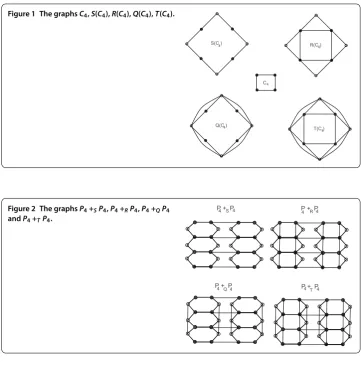
. S(G)is the graph obtained by inserting an additional vertex in each edge ofG. Equivalently, each edge of G is replaced by a path of length . The graphS(G)is called the subdivision graph ofG.
. R(G)is obtained fromGby adding a new vertex corresponding to each edge ofG, then joining each new vertex to the end vertices of the corresponding edge. . Q(G)is obtained fromGby inserting a new vertex into each edge ofG, then joining
with edges those pairs of new vertices on adjacent edges ofG.
. T(G)has as its vertices, the edges and vertices ofG. Adjacency inT(G)is defined as adjacency or incidence for the corresponding elements ofG. The graphT(G)is called the total graph ofG.
The four operations on graphS(C),R(C),Q(C),T(C) are depicted in Figure .
Eliasi and Taeri [] introduced four new operations that are based onS(G),R(G),Q(G), T(G), as follows:
LetFbe one of the symbolsS,R,Q,T. TheF-sum, denoted byG+FHof graphsGandH,
Figure 1 The graphsC4,S(C4),R(C4),Q(C4),T(C4).
Figure 2 The graphsP4+SP4,P4+RP4,P4+QP4
andP4+TP4.
E(G+F H), if and only if [a=a∈V(G) andbb∈E(H)] or [b=b∈V(H) andaa∈
E(F(G))].
G+FHis consists ofncopies of the graphF(G), and we label these copies by vertices
ofH. The vertices in each copy have two types, the vertices inV(G) (black vertices) and the vertices inE(G) (white vertices). Now we join only black vertices with the same name inF(G) in which their corresponding labels are adjacent inH. The graphsP+F Pare
shown in Figure .
Several extremal properties of the sum-connectivity index and general sum-connectivity index for trees, unicyclic graphs, -connected graphs and bicyclic graphs were given in [–]. Eliasi and Taeri [] computed the expression for the Wiener index of four graph operations which are based on these graphs S(G), R(G), Q(G), andT(G), in terms of W(F(G)) andW(H). Denget al.[] computed the first and second Zagreb indices for the graph operationsS(G),R(G),Q(G), andT(G). In this paper, we will compute the sharp bounds on the general sum-connectivity index ofF-sums of the graphs.
2 The general sum-connectivity index ofF-sum of graphs
Theorem . Ifα< ,then the lower and upper bounds on the general sum-connectivity index areγ≤χα(G+SH)≤γ,where
γ= αnm(G+H)α+ αnm(G+H)α,
γ= αnm(δG+δH)α+ αnm(δG+δH)α.
Equality holds if and only if G and H are regular graphs.
Proof By the definition of the general sum-connectivity index, we have
χα(G+SH) =
(a,b)(a,b)∈E(G+SH)
dG+SH(a,b) +dG+SH(a,b)
α
=
a∈V(G)
bb∈E(H)
dG+SH(a,b) +dG+SH(a,b)
α
+
b∈V(H)
aa∈E(S(G))
dG+SH(a,b) +dG+SH(a,b)
α
. ()
Note thatdG(a)≤ GanddG(a)≥δG, equality holds if and only ifGis a regular graph,
and similarlydH(b)≤ HanddH(b)≤δG, equality holds if and only ifHis a regular graph.
We have
a∈V(G)
bb∈E(H)
dG+SH(a,b) +dG+SH(a,b)
α
=
a∈V(G)
bb∈E(H)
dG(a) +dH(b)
+dG(a) +dH(b)
α
=
a∈V(G)
bb∈E(H)
dG(a) +dH(b) +dH(b)
α
≥αn
m(G+H)α. ()
Since|E(S(G))|= |E(G)|andS(G)=G, we have
b∈V(H)
aa∈E(S(G))
dG+SH(a,b) +dG+SH(a,b)
α
=
b∈V(H)
aa∈E(S(G))
dS(G)(a) +dH(b) +dS(G)(a)
α
≥n|E
S(G)|(S(G)+H)
= nm(G+H). ()
Using equations () and () in equation (), we get
χα(G+SH)≥αnm(G+H)α+ nm(G+H).
Similarly we can compute
χα(G+SH)≤αnm(δG+δH)α+ nm(δG+δH).
Example The lower and upper bounds on the general sum-connectivity index ofPn+S
Pmare
γ=mn
α+ ×α– αn– ×αm,
γ=mn
α+ ×α– αn– ×αm.
Example The general sum-connectivity index ofCn+SCmandKn+SKmis
χα(Cn+SCm) =mn
α+ ×α,
χα(Kn+SKm) =mn
α–(m– )(m+n– )α+ (n– )(n+m– )α.
Theorem . Ifα< ,then the lower and upper bounds on the general sum-connectivity
index areγ≤χα(G+RH)≤γ,where
γ= α(nm+nm)(G+H)α+ nm(G+H+)α,
γ= α(nm+nm)(δG+δH)α+ nm(δG+δH+ )α.
Equality holds if and only if G and H are regular graphs.
Proof By the definition of the general sum-connectivity index, we have
χα(G+RH) =
(a,b)(a,b)∈E(G+RH)
dG+RH(a,b) +dG+RH(a,b)
α
=
a∈V(G)
bb∈E(H)
dG+RH(a,b) +dG+RH(a,b)
α
+
b∈V(H)
aa∈E(R(G))
dG+RH(a,b) +dG+RH(a,b)
α
. ()
Note thatdG(a)≤ GanddG(a)≥δG, equality holds if and only ifGis a regular graph,
and similarlydH(b)≤ HanddH(b)≤δG, equality holds if and only ifHis a regular graph.
We have
a∈V(G)
bb∈E(H)
dG+RH(a,b) +dG+RH(a,b)
α
=
a∈V(G)
bb∈E(H)
dR(G)(a) +dH(b) +dR(G)(a) +dH(b)
α
=
a∈V(G)
bb∈E(H)
dR(G)(a) +
dH(b) +dH(b)
α
=
a∈V(G)
bb∈E(H)
dG(a) +
dH(b) +dH(b)
α
≥αnm(G+H), ()
b∈V(H)
aa∈E(R(G))
dG+RH(a,b) +dG+RH(a,b)
=
b∈V(H)
aa∈E(R(G))
a,a∈V(G)
dG+RH(a,b) +dG+RH(a,b)
α
+
b∈V(H)
aa∈E(R(G))
a∈V(G),a∈V(R(G))–V(G)
dG+RH(a,b) +dG+RH(a,b)
α
. ()
(i)aa∈E(R(G)) anda,a∈V(G) if and only ifaa∈E(G), (ii)dR(G)(a) = dG(a), we
have
b∈V(H)
aa∈E(R(G))
a,a∈V(G)
dG+RH(a,b) +dG+RH(a,b)
α
=
b∈V(H)
aa∈E(G)
dG+RH(a,b) +dG+RH(a,b)
α
=
b∈V(H)
aa∈E(G)
dR(G)(a) +dH(b)
+dR(G)(a) +dH(b)
α
=
b∈V(H)
aa∈E(G)
dG(a) +dG(a)
+ dH(b)
α
≥αnm(G+H)α. ()
Note that |E(R(G))|= |E(G)|, and if a ∈ V(G) then dR(G)(a) = dG(a) and if a ∈
V(R(G)) –V(G) thendR(G)(a) = , we have
b∈V(H)
aa∈E(R(G))
a∈V(G),a∈V(R(G))–V(G)
dG+RH(a,b) +dG+RH(a,b)
α
=
b∈V(H)
aa∈E(R(G))
a∈V(G),a∈V(R(G))–V(G)
dR(G)(a) +dH(b)
+dR(G)(a)
α
=
b∈V(H)
aa∈E(R(G))
a∈V(G),a∈V(R(G))–V(G)
dR(G)(a) +dR(G)(a)
+dH(b)
α
=
b∈V(H)
aa∈E(R(G))
a∈V(G),a∈V(R(G))–V(G)
dG(a) +
+dH(b)
α
≥nE
R(G)(G+H+)α
= nm(G+H+)α. ()
Using equations ()-() in equation (), we get the required result,
χα(G+RH)≥α(nm+nm)(G+H)α+ nm(G+H+)α.
Similarly, we can compute
χα(G+RH)≤α(nm+nm)(δG+δH)α+ nm(δG+δH+ )α.
Example The lower and upper bounds on the general sum-connectivity index ofPn+R
Pmare
γ= α+mn
α+ α– αn– αmα+ α+, γ= mn
α+ α– αn–mα+ ×α.
Example The general sum-connectivity index ofCn+RCmandKn+RKmis
χα(Cn+RCm) = α+mn
α+ α,
χα(Kn+RKm) = α–mn(m+n– )(m+ n– )α+mn(n– )(n+m– )α.
Theorem . Ifα< ,then the lower and upper bounds on the general sum-connectivity index areγ≤χα(G+QH)≤γ,where
γ= αnm(G+H)α+ nm(G+H)α+ αnαG
M(G) –m , γ= αnm(δG+δH)α+ nm(δG+δH)α+ αnδαG
M(G) –m . Equality holds if and only if G and H are regular graphs.
Proof By the definition of the general sum-connectivity index, we have
χα(G+QH) =
(a,b)(a,b)∈E(G+QH)
dG+QH(a,b) +dG+QH(a,b)
α
=
a∈V(G)
bb∈E(H)
dG+QH(a,b) +dG+QH(a,b)
α
+
b∈V(H)
aa∈E(Q(G))
dG+QH(a,b) +dG+QH(a,b)
α
. ()
Note thatdG(a)≤ GanddG(a)≥δG, equality holds if and only ifGis a regular graph,
and similarlydH(b)≤ HanddH(b)≤δG, equality holds if and only ifHis a regular graph.
We have
a∈V(G)
bb∈E(H)
dG+QH(a,b) +dG+QH(a,b)
α
=
a∈V(G)
bb∈E(H)
dQ(G)(a) +dH(b)
+dQ(G)(a) +dH(b)
α
=
a∈V(G)
bb∈E(H)
dQ(G)(a) +
dH(b) +dH(b)
α
=
a∈V(G)
bb∈E(H)
dG(a) +
dH(b) +dH(b)
α
≥αnm(G+H)α, ()
b∈V(H)
aa∈E(Q(G))
dG+QH(a,b) +dG+QH(a,b)
=
b∈V(H)
aa∈E(Q(G))
a∈V(G),a∈V(Q(G))–V(G)
dG+QH(a,b) +dG+QH(a,b)
α
+
b∈V(H)
aa∈E(Q(G))
a,a∈V(Q(G))–V(G)
dG+QH(a,b) +dG+QH(a,b)
α
, ()
b∈V(H)
aa∈E(Q(G))
a∈V(G),a∈V(Q(G))–V(G)
dG+QH(a,b) +dG+QH(a,b)
α
=
b∈V(H)
aa∈E(Q(G))
a∈V(G),a∈V(Q(G))–V(G)
dQ(G)(a) +dH(b) +dQ(G)(a)
α
=
b∈V(H)
aa∈E(Q(G))
a∈V(G),a∈V(Q(G))–V(G)
dG(a) +dH(b) +dQ(G)(a)
α
. ()
Note thatdQ(G)(a) =dG(wi) +dG(wj) fora∈V(Q(G)) –V(G),ais the vertex inserted
into the edgewiwjofG. Then we have
b∈V(H)
aa∈E(Q(G))
a∈V(G),a∈V(Q(G))–V(G)
dG(a) +dH(b) +
dG(wi) +dG(wj)
α
≥nm(G+H)α,
b∈V(H)
aa∈E(Q(G))
a,a∈V(Q(G))–V(G)
dG+QH(a,b) +dG+QH(a,b)
α
=
b∈V(H)
aa∈E(Q(G))
a,a∈V(Q(G))–V(G)
dQ(G)(a) +dQ(G)(a)
α
.
()
Sinceais the vertex inserted into the edgewiwjofGandais the vertex inserted into the
edgewjwkofG,
b∈V(H)
wiwj∈E(G)
wjwk∈E(G)
dG(wi) +dG(wj) +dG(wj) +dG(wk)
α
=
b∈V(H)
wiwj∈E(G)
wjwk∈E(G)
dG(wi) +dG(wk) + dG(wj)
α
≥ααGn
M(G) +m . () Therefore, using equations ()-() in equation (), we get the required result,
χα(G+QH)≥αnm(G+H)α+ nm(G+H)α+ αnαG
M(G) –m . Similarly, we can compute
χα(G+QH)≤αnm(δG+δH)α+ nm(δG+δH)α+ αnδGα
Example The lower and upper bounds on the general sum-connectivity index ofPn+Q
Pmare
γ= α(mn–n– m), γ= α(mn–n– m).
Example The general sum-connectivity index ofCn+QCmandKn+QKmis
χα(Cn+QCm) = α+mn,
χα(Kn+QKm) = α–mn(m– )(m+n– )α+mn(n– )(n+m– )α
+ α–mn(n– )(n– )α.
SincedegG+TH(a,b) =degG+RH(a,b) fora∈V(G) andb∈V(H),degG+TH(a,b) =degG+QH(a, b) fora∈V(T(G)) –V(G) andb∈V(H), we can get the following result by the proofs of Theorems . and ..
Theorem . Ifα< ,then the lower and upper bounds on the general sum-connectivity index areγ≤χα(G+TH)≤γ,where
γ= α(nm+nm)(G+H)α+ nm(G+H)α
+ αnαG
M(G) –m ,
γ= α(nm+nm– )(δG+δH)α+ nm(δG+δH)α
+ αnδGα
M(G) –m .
Equality holds if and only if G and H are regular graphs.
Example The lower and upper bounds on the general sum-connectivity index ofPn+T
Pmare
γ= αmn
×α+ α+ ×α– αn– αmα+ ×α+ ×α,
γ=mn
×α+ α+ ×α– αn–mα+ ×α+ ×α.
Example The general sum-connectivity index ofCn+TCmandKn+TKmis
χα(Cn+TCm) = αmn
×α+ α+ ×α,
χα(Kn+TKm) = α–mn(m+n– )(m+ n– )α+mn(n– )(n+m– )α
+ α–mn(n– )(n– )α+. 3 Conclusion
The sharp bounds on the general sum-connectivity index of the new four sums of the graphs were computed in this paper, forα< . However, ifα> then these bounds will becomeγ≤χα(G+FH)≤γ. These results can be extended for a tenser product and the
Competing interests
The authors declare that they have no competing interests.
Authors’ contributions
The idea to obtain the bounds for the four operations of the graphs for general sum-connectivity index of the graphs was proposed by MI. After several discussions, SA obtained some sharp bounds for four operations. MI checked these bounds and suggested improvements. The first draft was prepared by SA which was verified and improved by MI. The final version was prepared by SA. Both authors read and approved the final manuscript.
Acknowledgements
The authors are very grateful to the referees for their constructive suggestions and useful comments, which improved this work very much. This research is supported by the grant of Higher Education Commission of Pakistan
Ref. No. 20-367/NRPU/R&D/HEC/12/831.
Received: 26 May 2016 Accepted: 21 September 2016
References
1. Eliasi, M, Taeri, B: Four new sums of graphs and their Wiener indices. Discrete Appl. Math.157, 794-803 (2009) 2. Gutman, I, Trinajsti´c, N: Graph theory and molecular orbitals. Totalπ-electron energy of alternant hydrocarbons.
Chem. Phys. Lett.17, 535-538 (1972)
3. Randi´c, M: On characterization of molecular branching. J. Am. Chem. Soc.97, 6609-6615 (1975)
4. Li, X, Gutman, I: Mathematical Aspects of Randi´c Type Molecular Structure Description. University of Kragujevac, Kragujevac (2006)
5. Zhou, B, Trinajsti´c, N: On a novel connectivity index. J. Math. Chem.46, 1252-1270 (2009) 6. Zhou, B, Trinajsti´c, N: On general sum-connectivity index. J. Math. Chem.47, 210-218 (2010)
7. Luˇci´c, B, Trinajsti´c, N, Zhou, B: Comparison between the sum-connectivity index and product-connectivity index for benzenoid hydrocarbons. Chem. Phys. Lett.475, 146-148 (2009)
8. Akhter, S, Imran, M: On degree based topological descriptors of strong product graphs. Can. J. Chem.94(6), 559-565 (2016)
9. Khalifeh, MH, Azari, HY, Ashrafi, AR: The first and second Zagreb indices of some graph operations. Discrete Appl. Math.157, 804-811 (2009)
10. Zhou, B: Zagreb indices. MATCH Commun. Math. Comput. Chem.52, 113-118 (2004)
11. Du, Z, Zhou, B, Trinajsti´c, N: On the general sum-connectivity index of trees. Appl. Math. Lett.24, 402-405 (2011) 12. Du, Z, Zhou, B, Trinajsti´c, N: Minimum general sum-connectivity index of unicyclic graphs. J. Math. Chem.48, 697-703
(2010)
13. Tache, R-M: General sum-connectivity index withα≥1 for bicyclic graphs. MATCH Commun. Math. Comput. Chem.
72, 761-774 (2014)
14. Tomescu, I, Kanwal, S: Ordering trees having small general sum-connectivity index. MATCH Commun. Math. Comput. Chem.69, 535-548 (2013)
15. Tomescu, I, Kanwal, S: Unicyclic graphs of given girthk≥4 having smallest general sum-connectivity index. Discrete Appl. Math.164, 344-348 (2014)
16. Tomescu, I: 2-connected graphs with minimum general sum-connectivity index. Discrete Appl. Math.178, 135-141 (2014)
17. Tomescu, I, Kanwal, S: On the general sum-connectivity index of connnected unicyclic graphs withkpendant vertices. Discrete Appl. Math.181, 306-309 (2015)