Describe a Bell and Breathe Solitons by Using Harmonic
Oscillator Soliton
Isam Ahmed Attia1,*, Mubarak Dirar Abd Alla1, Rasha Abdelhai Mohammad Taha1,2
1Physics Department, College of Science, Sudan University of Science & Technology, Khartoum, Sudan 2Physics Department, College of Science, Majmaah University, Zulfi, Saudi Arabia
Abstract
Schrodinger harmonic oscillator equation in the momentum space in friction medium (Harmonic Oscillator Soliton model) was used to describe properties of two types of solitons, permanent and time dependent. First one a bell soliton has a permanent profile, while other one is breathers have an internal dynamic, even So, their shape oscillates in time.Keywords
Harmonic Oscillator Soliton, Momentum Space, a bell Soliton, Breathers Soliton, Friction Term1. Introduction
Solitons were first described by N.J. Zabusky and M.D. Kruskal [1] in 1965 and they form now a paradigm in mathematical physics (see also [2, 3, 4]). Soliton is a solitary wave with finite energy and the necessary conditions of its existence include nonlinearity and dispersion. Soliton dynamics is one of the hot topics due to wide applications in hydrodynamics, electronics, solid mechanics, biophysics and other disciplines, [5] They dealt with the dynamics of one-dimensional (1D) anharmonic lattices and their (quasi) continuum approximation [5] provided by the Boussinesq–Korteweg- de-Vries equation [6, 7, 8]. That work followed research done by Schrödinger, gives the Nonlinear Schrödinger Equation (NLSE) [9, 10]. It appears in various physical contexts to describe the propagation of nonlinear waves [11].
The nonlinear models [12-16] well-known nowadays are such as the KdV equation and the nonlinear Schrödinger equation (NSE). There are explained by the fact that they describe a wide spectrum of phenomena in various nonlinear media; their fundamentality consists in a latent symmetry in the one-dimensional case which results in the integrability of the given equations by the inverse scattering transform. The methods of soliton stability studies are also within the framework of these models. The KdV equation arises when describing weakly nonlinear waves in media with a dispersion law w(k) which is close to the linear one.
The nonlinear Schrödinger equation is usually used for the
* Corresponding author:
[email protected] (Isam Ahmed Attia) Published online at http://journal.sapub.org/ijtmp
Copyright © 2019 The Author(s). Published by Scientific & Academic Publishing This work is licensed under the Creative Commons Attribution International License (CC BY). http://creativecommons.org/licenses/by/4.0/
description of the propagation of wave packets with a small amplitude, i.e., when the field differs weakly from a harmonic one and nonlinear effects are small. This gives an opportunity to take into account dispersion and nonlinear effects separately for the derivation of the equation which describe the wave packet envelope, where a slowly varying function of space and time [16].
We confirm that quantum friction is inevitably related to material dispersion, and that such friction vanishes in nondispersive media. Very interestingly, the harmonic oscillator comprises one of the most important examples of elementary Quantum Mechanics. There are several reasons for its pivotal role. The linear harmonic oscillator describes vibrations in molecules and their counterparts in solids, the phonons. Many more physical systems can, at least approximately, be described in terms of linear harmonic oscillator models. However, the most eminent role of this oscillator is its linkage to the electron, one of the conceptual building blocks of microscopic physics. For example, electron describe the modes of the radiation field, providing the basis for its quantization [17].
While trying to understand soliton creation, we used the mathematical aspects of the quantum friction instabilities are manifested in the fact that the system may support natural modes of oscillation that grow exponentially with time [18, 19, 20], even in presence of system loss [21].
There are a few ways to classify solitons [22]. All solitons can be divided into two groups by taking into account their profiles: permanent and time dependent. For example, kink solitons have a permanent profile (in ideal systems), while all breathers have an internal dynamic, even, if they are static. So, their shape oscillates in time.
where we were established definite link between the classical effect and quantum friction for harmonic oscillator soliton.
2. Theoretical Model
In ordinary quantum mechanics Schrodinger equation can be written in momentum representation in the following form [24]:
𝐻𝐻Ψ(p, t) = iћ𝜕𝜕Ψ𝜕𝜕𝜕𝜕(p,t) (1) where 𝑖𝑖 is the imaginary number √𝑖𝑖, ħ is the reduced Planck constant which is h/2π, 𝜓𝜓(p, 𝜕𝜕) is the wave function of the quantum system, p is the momentum in a one-dimensional coordinate system, and t the time. 𝐻𝐻 is the Hamiltonian operator (which characterizes the total energy of the system under consideration).
The use of the harmonic oscillator model is that almost any potential can be approximated as a harmonic oscillator. When the oscillating string is embedded in a resistive matter or crystal, having crystal field of potential 𝑉𝑉𝑜𝑜, the
total Hamiltonian operator is given by
𝐻𝐻=𝐻𝐻𝑜𝑜+𝑉𝑉𝑜𝑜+𝐸𝐸𝑓𝑓 =𝐻𝐻𝑜𝑜+𝑉𝑉𝑜𝑜𝑓𝑓 (2)
Where, 𝐻𝐻𝑜𝑜 is the Hamiltonian operator for an undamped
harmonic oscillator, 𝐸𝐸𝑓𝑓 is frictional energy for the
harmonic oscillator affected by a resistive force of friction, while the friction force is inversely proportional to the relaxation time τ [25, 26], thus the potential takes the following form [23]:
𝑉𝑉𝑜𝑜𝑓𝑓 =𝑉𝑉𝑜𝑜+𝐸𝐸𝑓𝑓= ±𝑉𝑉𝑜𝑜± iћτ (3)
Hence the total Hamiltonian oscillator in equation (2) assumes the form:
𝐻𝐻=𝐻𝐻𝑜𝑜+𝑉𝑉𝑜𝑜𝑓𝑓 +𝐸𝐸𝜕𝜕 =𝐻𝐻𝑜𝑜+𝑉𝑉1 (4) Where, 𝐸𝐸𝜕𝜕 = ±𝛾𝛾𝑜𝑜𝑘𝑘𝑘𝑘 standing for thermal energy and
𝑉𝑉1=𝑉𝑉𝑜𝑜𝑓𝑓±𝛾𝛾𝑜𝑜𝑘𝑘𝑘𝑘.
The classical harmonic oscillator is most frequently introduced as a mass on an undamped spring, The Hamiltonian is thus given by:
𝐻𝐻𝑜𝑜= P
2
2m+ 1
2 kx2 (5)
𝐻𝐻𝑜𝑜 is the Hamiltonian operator acting on a complex
wave-function, ψ(x, t), whose time evolution is governed by the Schrödinger equation [24]:
𝐻𝐻𝑜𝑜𝜓𝜓(𝑥𝑥,𝜕𝜕) = iћ𝜕𝜕𝜓𝜓𝜕𝜕𝜕𝜕(𝑥𝑥,𝜕𝜕) (6)
Quantization of this system is done by replacing the classical variables p and x by the operators p� and x�, In the view of equations (1,3,4,5) and using the fact that in momentum space:
𝑝𝑝̂=𝑝𝑝 , 𝑥𝑥�=−ℎ𝑖𝑖𝜕𝜕𝑝𝑝𝜕𝜕 (7) One gets, the Schrodinger equation in momentum representation as the following equation:
�2mP2 −12 kℎ2 𝜕𝜕2
𝜕𝜕𝑝𝑝2� Ψ(p, t) +𝑉𝑉1Ψ(p, t) = iћ
𝜕𝜕Ψ(p,t)
𝜕𝜕𝜕𝜕 (8)
One can easily find solutions of the Schrödinger equation by separating the variables, i.e.
Ψ(p, t) =Ψ(p)𝑓𝑓(𝜕𝜕) (9) such that one can write the harmonic oscillator equation in the momentum space. This can be obtain by equations (1) and (2):
1
Ψ(𝑝𝑝)�
𝑝𝑝2
2𝑚𝑚−
1 2𝑘𝑘ћ2
𝜕𝜕2
𝜕𝜕𝑝𝑝2� Ψ(𝑝𝑝) +𝑉𝑉1 =
𝑖𝑖ћ 𝑓𝑓(𝜕𝜕)
𝜕𝜕𝑓𝑓(𝜕𝜕)
𝜕𝜕𝜕𝜕 =𝐸𝐸 (10)
Then the momentum part is given by
𝑝𝑝2
2𝑚𝑚Ψ(𝑝𝑝)−
1 2𝑘𝑘ћ2
𝜕𝜕2
𝜕𝜕𝑝𝑝2Ψ(𝑝𝑝) = (𝐸𝐸𝑜𝑜 ) Ψ(𝑝𝑝) = (𝐸𝐸 − 𝑉𝑉1) Ψ(𝑝𝑝)
(11) Carrying out the rearranging
𝜕𝜕2Ψ(𝑝𝑝)
𝜕𝜕𝑝𝑝2 −
𝑝𝑝2
𝑚𝑚𝑘𝑘 ћ2Ψ(𝑝𝑝) =�−
2𝐸𝐸𝑜𝑜
𝑘𝑘ћ2� Ψ(𝑝𝑝) (12)
This A differential equation for wave function in momentum tells us that we want to find a function whose second derivative is proportional to the negative of itself. But we already know some functions with this property, namely sines, cosines, and exponentials. So, let’s be fairly general and try a solution of the form the integral of a derivative of a function is the function plus an arbitrary constant. The arbitrary constant represents the lost information resulting from when the derivative is calculated.
The wave function in momentum space is given according equation (12) by
2𝑝𝑝𝑚𝑚2 Ψ − 𝐶𝐶𝑜𝑜Ψ𝐼𝐼𝐼𝐼 =𝐸𝐸𝑜𝑜Ψ (13)
With
𝐶𝐶𝑜𝑜=12𝑘𝑘ћ2− 12𝑚𝑚ћ2𝜔𝜔02 (14) Consider now the solution
Ψ=𝐴𝐴𝑒𝑒−𝛼𝛼𝑝𝑝2
(15) Thus,
Ψ𝐼𝐼𝐼𝐼=−2𝛼𝛼Ψ −2𝛼𝛼𝑝𝑝Ψ𝐼𝐼=−2𝛼𝛼Ψ+ 4𝛼𝛼2𝑝𝑝2Ψ (16) Inserting eq (16) in eq (13) gives
� 2𝑝𝑝𝑚𝑚2 − 𝐶𝐶𝑜𝑜(−2𝛼𝛼+ 4𝛼𝛼2𝑝𝑝2)� Ψ=𝐸𝐸𝑜𝑜Ψ (17)
Equating the coefficient of 𝑝𝑝2 and free term, one gets
2𝛼𝛼𝐶𝐶𝑜𝑜=𝐸𝐸𝑜𝑜 (18)
Thus, from eq (14) and eq (17)
𝛼𝛼= ± 2�21𝑚𝑚𝐶𝐶 𝑜𝑜 = ±
1
2𝑚𝑚ћ𝜔𝜔𝑜𝑜 (19)
Thus, from eq. (18)
𝛼𝛼= 𝐸𝐸𝑜𝑜
2𝐶𝐶𝑜𝑜=
𝐸𝐸𝑜𝑜
𝑚𝑚ћ2𝜔𝜔𝑜𝑜2 (20)
In view of eq (20) and equation (19)
𝐸𝐸𝑜𝑜= ±12ћ𝜔𝜔𝑜𝑜 (21)
The negative zero-point energy is rejected due to the fact that restoring force resembles an attractive force since it tends to attract the particle towards the origin against the direction of coordinate x, in view of equation (15) and equation (19) by choosing positive sign
𝛼𝛼= 2𝑚𝑚ћ𝜔𝜔1
𝑜𝑜 (22)
Using the fact that, according to Special Relativity
𝑚𝑚𝑐𝑐2=ћ𝜔𝜔
𝑜𝑜 (23)
𝛼𝛼= 2(ћ𝜔𝜔𝑐𝑐2
𝑜𝑜)2 (24)
But equation (15) tells that, the probability for having momentum p is
|Ψ|2=𝐴𝐴2𝑒𝑒−2𝛼𝛼𝑝𝑝2 (25)
The probability is maximum for
2𝛼𝛼𝑝𝑝2< 1 (26) i.e.
𝑝𝑝2< 1
2𝛼𝛼 (27)
Using equation (24) the momentum becomes satisfied:
𝑝𝑝<ћ𝜔𝜔𝑜𝑜
𝑐𝑐 (28)
But the Wave-particle duality as expressed by the de Broglie wave equation requires
𝑝𝑝=ℎ𝜆𝜆 =2ℎ𝜋𝜋2𝜋𝜋𝑓𝑓𝑐𝑐 =ћ𝜔𝜔𝑐𝑐 (29) Therefore, by substituting eq (29) in eq (28) one gets:
𝜔𝜔 ≤ 𝜔𝜔𝑜𝑜 (30)
This means that the most probable momentum state is that for the frequency of oscillation near the natural frequency.
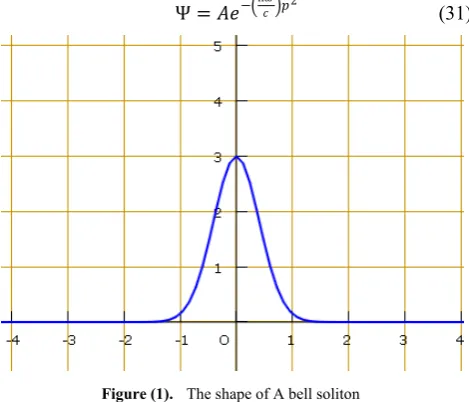
In view of eq (29) and equation (15) the equation of a bell soliton given by:
Ψ=𝐴𝐴𝑒𝑒−�ћ𝜔𝜔𝑐𝑐�𝑝𝑝2 (31)
Figure (1). The shape of A bell soliton
The soliton solution has a bell shape and a low frequency. Another soliton solution corresponds to the negative value of 𝛼𝛼 in equation (19), i.e.
𝛼𝛼=− 2𝑚𝑚ћ𝜔𝜔1
𝑜𝑜=−𝛽𝛽 (32)
In view of equation (15)
Ψ=𝐴𝐴𝑒𝑒𝛽𝛽𝑝𝑝2
(33) This momentum soliton requires p to be very small, to secure finite probability, which again conform with the fact that the most probable momentum should be very small. The soliton shape in the momentum space visualized by taking in to account equations (4, 12, 13) and (17) beside equation (20) to get
𝛼𝛼= 𝐸𝐸𝑜𝑜
2𝐶𝐶𝑜𝑜=
𝐸𝐸𝑜𝑜ћ𝜔𝜔+𝑉𝑉𝑜𝑜+𝛾𝛾𝑜𝑜𝑘𝑘𝑘𝑘−iћτ
2𝐶𝐶𝑜𝑜 =β𝑜𝑜−
iћ
τ𝑚𝑚ћ2𝜔𝜔𝑜𝑜2 (34) 𝛼𝛼=β𝑜𝑜−τ𝑚𝑚2 i𝑐𝑐ћ2ћ𝜔𝜔𝑜𝑜 =β𝑜𝑜−
iλ𝑜𝑜
τ𝑚𝑚2𝑐𝑐2(2𝜋𝜋𝑓𝑓𝑜𝑜λ𝑜𝑜) (35) 𝛼𝛼=β𝑜𝑜−πτ𝑚𝑚 ix2𝑜𝑜𝑐𝑐2𝑣𝑣𝑜𝑜 =β𝑜𝑜−iγx𝑜𝑜 (36)
Where, one assumes 𝑚𝑚𝑐𝑐2=ћ𝜔𝜔
𝑜𝑜
γ= (πτ𝑚𝑚2𝑐𝑐2𝑣𝑣
𝑜𝑜)−1 (37)
thus, in view of equations (7) and (15) the soliton in the momentum space is given by:
Ψ(p, t) =Ψ(p)𝑓𝑓(𝜕𝜕) =𝐴𝐴𝑒𝑒−𝑖𝑖𝜔𝜔𝜕𝜕𝑒𝑒𝑖𝑖𝛾𝛾𝑝𝑝2𝑥𝑥𝑜𝑜
𝑒𝑒−𝛽𝛽𝑝𝑝2 (38) Ψ(p, t) = A𝑒𝑒−𝛽𝛽𝑝𝑝2
𝑒𝑒𝑖𝑖�𝛾𝛾𝑝𝑝2𝑥𝑥𝑜𝑜−𝜔𝜔𝜕𝜕 � 𝑒𝑒𝑖𝑖𝛾𝛾𝑝𝑝2𝑥𝑥𝑜𝑜
(39) Under the influence of friction, the solitons slow down and decay rapidly, here, 𝐴𝐴𝑒𝑒−𝛽𝛽𝑝𝑝2
𝑒𝑒𝑖𝑖𝛾𝛾𝑝𝑝2𝑥𝑥𝑜𝑜
is a function describing the wave envelope. The definition of an envelope is a function which varies much more slowly in momentum space as compared to the phase of the wave is preserving its shape fig. (2). Such solution is called the breather soliton fig. (3) and it can be considered as a complex root of soliton.
Figure (2). The shape of the enveloping curve in the momentum space (the dashed line)
3. Discussion
The Equation (1) represents Schrodinger equation in the momentum space describes, at least in the one-dimensional case, the evolution of wave oscillations, by using the modeling of the harmonic oscillator embedded in a crystal having friction eqs. (3-5). Thus, the result of the perturbation analysis concerning the soliton growth rate.
This equation is simplified separate variables as shown by equations (10, 11).
The solution in equation (15) shows soliton wave with negative and positive rest mass energy, the positive one is strikingly typical to that of the quantum oscillator's negative one predicts the existence of the anti-particles, this means that our model is more informative than that in the coordinate space.
In the eq (19) for positive alpha the wave function predicts Exponential soliton which describe a bell soliton, which that like Pulses with a certain shape and energy that can propagate unchanged over large distances with speed c.
For negative alpha in the eq (19) the maximum probability is near to the zero-point energy, this conforms with the fact that the particles tend to have minimum energy. This solution represents decaying soliton in the momentum space. This means physically that particles tend to occupy lower energy states.
If the wave amplitude varies periodically in this manner, the envelope of the wave also becomes a periodic function.
Eq (39) show that under the influence of friction, the solitons only slow down and eventually stop and, at rest, they can live eternally in infinite system. eq (39) represent travelling wave in the momentum space with exponentially decaying amplitude as shown in fig. (2). Furthermore, we assume that the envelope varies slowly in time and space (as compared to the carrier wave).
We recognize that waves do not necessarily have the same amplitude. If we observe them carefully, we note that several waves with relatively low amplitude are followed by one or two waves with large amplitude. Hence, the amplitude of the wave varies gradually with time and space, as is shown in Fig. 3. This is a phenomenon of wave amplitude modulation caused by modulational instability.
The fact that the breather function is a slowly varying function of momentum space indicates that the frequency spectrum has a localized structure around the carrier frequency, as shown in Fig. 3. In this figure shows the width of the frequency spectrum of the envelope function.
4. Conclusions
In the present work, one considered the harmonic oscillator soliton equation in the momentum space, this a differential equation for wave function shows that, we have two solitons solutions, one is a bell soliton, where the most probable momentum state is that makes the frequency of oscillation near the natural frequency. This means that
particles prefer occupying minimum zero point energy. The second solution describes breather solitons having tendency to occupy minimum enegy states.
REFERENCES
[1] N.J. Zabusky and M.D. Kruskal, Phys. Rev. Lett. 15, 57 (1965).
[2] A.C. Scott, F.Y.F. Chu and D.W. McLaughlin, Proc. IEEE 61, 1443 (1973).
[3] A.C. Scott, Nonlinear Science: Emergence & Dynamics of Coherent Structures, 2nd edn. (Oxford University Press, New York, 2003).
[4] N.J. Zabusky, Chaos 15, 015102 (2005).
[5] C.I. Christov, G.A. Maugin and M.G. Velarde, Phys. Rev. E 54, 3621 (1996).
[6] BOUSSINESQ, J.V. (1877). "Essay on the Current Water Theory." ('Essay on the Theory of Water Flow.') Memoirs presented by various scientists at the Academy of Sciences, Paris, France, Vol. 23, ser. 3, No. 1, supplement 24, pp. 1-680 (in French).
[7] D.J. Korteweg and G. de Vries, On the change of form of long waves advancing in a rectangular canal, and on a new type of long stationary waves, Phil. Mag. (5) 39 (1895), 422–443. [8] Richard H. Enns, "It's a Nonlinear World," Springer New
York, 2010.
[9] V. Yu. Belashov and S.V. Vladimirov, "Solitary Waves in Dispersive Media Complex", Springer-Verlag Berlin Heidelberg 2005, p-02.
[10] Catherine Sulem and Pierre-Louis Sulem, "The Nonlinear Schrodinger Equation: Self-Focusing and Wave Collapse," Springer-Verlag New York, 1999.
[11] Shekhar Guha and Leonel P. Gonzalez, "Laser Beam Propagation in Nonlinear Optical Media", CRC Press, Taylor & Francis Group, Boca Raton (USA), 2014.
[12] S.P. Novikov, yE. Zakharov, S.V. Manakov and L.P. Pitaevsky, Theory of Solitons, Consultants Bureau, New York, 1984.
[13] G. Whitham, Linear and Nonlinear Waves (Wiley, N.Y., 1974).
[14] V.1. Karpman, Nonlinear Waves in Dispersive Media (Pergamon, Oxford, 1975).
[15] AC. Scott, F. Chu and P.W. McLaughlin, The Soliton: A New concept in applied science, Proc. IEEE 61(1975) 1447. [16] yE. Zakharov, S.L. Musher and AM. Rubenchik, Hamiltonian
approach to the description of non-linear plasma Phenomena, Phys. Reports 129 (1985) 285.
[18] S. I. Maslovski, M. G. Silveirinha, Quantum friction on monoatomic layers and its classical analogue, Phys. Rev. B, 88, 035427, (2013).
[19] M. G. Silveirinha, “Quantization of the Electromagnetic Field in Non-dispersive Polarizable Moving Media above the Cherenkov Threshold”, Phys. Rev. A, 88, 043846, (2013). [20] O. Sydoruk, et al, Terahertz instability of surface
optical-phonon polaritons that interact with surface plasmon polaritons in the presence of electron drift, Phys. of Plasmas, 17,102103, (2010).
[21] A. I. Volokitin and B. N. J. Persson, Quantum Friction, Phys. Rev. Lett. 106, 094502 – Published 2 March 2011.
[22] Yousef Yousef and Khikmat Kh. Muminov, A Simple Classification of Solitons, arXiv: 1206.1294v2 [math-ph.] 7 Jun 2012.
[23] Isam Ahmed Attia et al, Quantization of Harmonic Oscillator Soliton by Friction Term Method, International Journal of Theoretical and Mathematical Physics 2018, 8(4): 89-93 DOI: 10.5923/j.ijtmp.20180804.02.
[24] Pavel Kundrát and Miloš Lokajíček. Three-dimensional harmonic oscillator and time evolution in quantum mechanics. Phys. Rev. A 67, 012104 –13 January 2003.
DOI: https://doi.org/10.1103/PhysRevA.67.012104. [25] Mubarak Dirar et al, Quantum Schrodinger String Theory for
Frictional Medium & Collision, International Journal of Innovative Science, Engineering & Technology, Vol. 2 Issue 11, November (2015).
[26] Roumen Tsekov, Quantum friction, Chin. Phys. Lett. 29 (2012) 120504, arXiv 1203.2421.