2019 International Conference on Applied Mathematics, Modeling, Simulation and Optimization (AMMSO 2019) ISBN: 978-1-60595-631-2
Research on Community Center-metric and Community Detection
Algorithm for Complex Networks
Gui-shan WANG, Xue-zao REN
*and Xue-ying LIU
School of Science, Southwest University of Science and Technology, 59 Qinglong Street, Mianyang, Sichuan, 621010, China
*Corresponding author
Keywords: Complex networks, Community central metric, Local community detection.
Abstract. To resolved the present-existing problem that local community detection is great sensitive to the initial node position in large-scale network, a new community detection algorithm CCMA (Community Central Metric Algorithm) by using the community central node-set as the initial node is proposed. Firstly, community centrality node-set (LC≥0) is determined by using Leverage Centrality (LC). Then, starting from the node with the largest central index, we expand the community according to the community fitness function until completing the acquisition of the entire local community. And community’s numbers does not need to be given. Experiments on existing real networks and artificial networks show that our community central metric algorithm can detect local community structures more efficiently and accurately by comparing the method of expanding community’s central node with the existing best local community detection method.
Introduction
There are a lot of complex systems in nature. These systems can be described by complex networks, such as interpersonal networks[1], collaboration networks of scientific research communities[2], journal citation networks[3], information network[4],protein interaction network[5] and World Wide Web[6], etc. Besides the small world effect[7] and scale-free properties[8], the community structure subsequently is regarded as the most important characteristic of the complex networks. A community is a set of nodes with similar properties in a network. The characteristics of community are that the internal nodes are closely connected but the nodes between the communities are loosely connected[9]. Communities always have the same characteristics or functional entities. For instance, the community can be grouped by the relevant individuals in a social network, the collection of web pages which can handle the same theme, or the cell mass with identical or similar functions. Community detection, in complex networks[10-11], is of great practical significance for us to understand real-world networks. Recently, many community detection algorithms have been proposed. Some community detection methods[12-14] require the information of the global network structure. Yet, the actual network structures, such as, the World Wide Web, Internet, Taobao, etc[15], often have millions of nodes, or even more. Those existing global algorithms are not suitable for mass detection in large networks. Therefore, some local community detection methods are proposed to identify the local community structure[16]. Although these local community detection methods are simple and feasible, the random selections of initial nodes often lead to the instability of the communities discovered, and the relevant parameters also need determining in advance.
The Central Node of a Community
We divide the nodes in the network with community structure into the central node of the community and the peripheral node around the central node of the community. Thus, our problem is which nodes can be regarded as the center node of the community. It is very important to find out the central nodes in complex networks, because these nodes are influenced. Existing nodal importance indexes are mainly degree centrality[18], betweenness centrality[19], closeness centrality[20], eigenvector centrality[21], mutual information centrality[22-23] and so on. The degree centrality index reflects its influence in the network and the node's ability of acquiring network information. The betweenness centrality reflects the proportion of the shortest path passing through a node to all paths. Closeness centrality respects the distance between two nodes. Eigenvector centrality comprehensively takes into account the importance of neighbor nodes of a node. Central nodes, corresponding to these indexes above-mentioned, are general not the ones for a community.
In this paper, we use the leveraged central (LC) proposed by reference[24]
1 ii j
j
i i j
k k
LC i
k k k
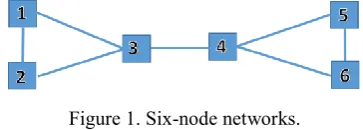
(1) as the centrality index of the local community, where i is the set of neighbor nodes closest to community node i. We can get LC of every node in the communication and descend these values by Eq (1). Only those nodes which satisfy LC0 can be regarded as the central nodes of community. These nodes are significant for local community, while those nodes meeting LC0 are peripheral nodes of community. This definition can avoid the disadvantage of using TOP-K nodes as community center nodes. [image:2.595.205.387.467.532.2]Next, we introduce the calculation on this definition by the artificial network which has six nodes constructed in figure 1. Table 1 shows the degree and centrality of each node in this network. From Table 1, we can see that the community centrality indexes of node 3 and of node 4 are greater than zero. Consequently, the network shown by figure 1 has two community center nodes which are node 3 and node 4 respectively.
[image:2.595.145.451.555.619.2]Figure 1. Six-node networks.
Table 1. Community node degree distribution and centrality information.
Node 1 2 3 4 5 6
degree 2 2 3 3 2 2
LC -1/10 -1/10 2/15 2/15 -1/10 -1/10
[image:2.595.190.407.711.765.2]In figure 2, we add node 7 based on the network in figure 1. Obviously, for those nodes not adjacent to node 7 like 1, 2 and 5, 6, its addition does not affect their centrality index, which is extremely important for quickly calculating the center index values of nodes in dynamic network. For node 7-self and node 3, 4 adjacent to it, we need to recalculate their center index. Table 2 show that only nodes 3, 4 are the center node of the community while the others are the peripheral nodes of the community.
Table 2. Community node degree distribution and centrality information.
Node 1 2 3 4 5 6 7
degree 2 2 3 3 2 2 2
LC -1/10 -1/10 1/5 1/5 -1/10 -1/10 -1/5
Local Community Detection
With the network scale increasing and its dynamic changing, it becomes more and more unrealistic and unnecessary to identify the network from the global perspective. Most local community detection methods are set as an optimization function firstly. And starting from different seed nodes, local communities may be explored in the sub-network where the seed resides. Finally, different local communities found by the seeds can mix to form the overlapping communities in the networks.
In order to detect the local community, the method for detecting local communities[25] is proposed by Bagrow et al., which extends the l-shell outward from the starting node n, where l is the distance from n to all shell nodes. Their approach does not perform very well, because if the algorithm starts from an arbitrary boundary node rather than a core node, the results may be very different from each other. Clauset has proposed a local modularity measure R[26] for the local community detection problem. R focuses on the boundary node set B to assess the quality of the discovered local community D.
As the local community algorithms do, the fitness function F index is proposed to measure the difference of connection density within and outside the community. These algorithms are simple and feasible. Yet the results of community detection are instable because of the selecting initial nodes randomly. In order to overcome this defect, some methods are arranged in descending the node degree or kernel degree[27], where community is extended starting from the node with the highest score which belongs to one of K nodes selected from community. Unfortunately, another disadvantage of this method is that K is unknown. Besides, some rest methods consider maximal clique as the initial community and extend community starting from it. However, the computation of searching the largest clique is too heavy to be suitable for community detection in large-scale networks. Chen et al has proposed a community detection method LMD[28] based on local maximum degree center, in which the largest local center nodes can be found in first step and then local communities also can be found around these nodes. This method can achieve recognition performance well, but there exist the communities without the central node with the largest local degree.
It is worth mentioning that, LC, as the index of community centrality node, overcomes the defect of LMD. Because the degree of these community center nodes is not required to being the maximum degree of local communities, there exist community central nodes in any local community.
In this paper, we adopt the method that may optimize the local node fitness function similar with the FLM[29] method. And the local fitness function
g in
g g g
in out k f
k k
(2)
is defined as the ratio of the internality degree value to the sum of the externality and internality degree values for a community, where g
in
k is internality degree of community g whose value is twice
as much as the number of connected edges between nodes in the community, and koutg is externality
degree of community g whose value is the number of connected edges between each node in
community g and nodes beyond community g. By the way, for the weighted networks, king is twice
Compared with the FLM method, our community central metric algorithm (CCMA) has two advantages. One is that there is no parameter in the fitness function Eq. (2). In CCMA, secondly, initial seed nodes actually are the central nodes of the community due to its originating from central node set, which ensures that the community extending from these nodes is always the optimal local community. This method is no need to delete nodes repeatedly in the algorithm, which greatly improves calculation speed of the CCMA algorithm.
Accordingly, taking the artificial network in figure 2 as an example, we firstly calculate the community centrality index LC for each node in our method and obtain community center nodes 3, and node 4 satisfying LC0. For the network in figure 2, we may form a set of community central nodes {3, 4}. The second step is that, starting from node 3, the local community is expanded in its neighborhood according to the fitness function to form local community g1 [3, 1, 2, 7] at local
maximum fitness
9 8
1
g
f . Generally, the local community may contain more than one central node,
which will be explained in the Karate Club Network below. To solve this situation, we can remove these used central nodes from central nodes set. Thus, there is only one element 4 left in central node set of network in figure 2 which find out another local community g2 [4, 5, 6, 7]. Apparently, node 7 is an overlapping node due to its connecting central node 3 and node 4. Now, there are no nodes in the central node set. So, the network can be divided into two local communities. If there are still peripheral nodes which are not extended at this time, incidentally, we can select node with the largest
LC from those nodes to search out some small sub-community.
Accordingly, we can quickly find that, in figure 1, network has two local communities, which is [1, 2, 3] and [4, 5, 6] respectively.
Community Detection of Real Network
To evaluate this method’s validity, we use it to analyze the Karate Club Network[30]
and Social network of Dolphins[31]. Since the community structure of these networks is known, by comparing with the real network communities, we can check whether our method is correct for the division of communities.
In the karate club network, firstly we use LC to establish a set of central nodes {34, 1, 33, 3, 2}. Secondly, the local community g1 [34, 27, 30, 24, 28, 16, 33, 19, 15, 23, 21, 31, 9, 10] can be obtained by extending from node 34. Now, the central node set becomes {1, 3, 2}, because node 34 and node 33 both are included in local community g1. Therefore, the next extension starts from node
1 and another local community g2 [1, 12, 22, 18, 2, 20, 8, 4, 14, 3, 13, 10, 9, 31] which includes the rest central nodes 1, 3 and 2 is formed. This indicates that the karate club network is finally divided into two local communities. Furthermore, one of our method’s advantages is that we don't need to know the number of communities. Here, we find that there are still nine peripheral nodes 32, 29, 25, 26, 11, 5, 7, 6, 17 that don’t belong to any community sets by checking the network. Starting from node 32, when LC gets maximal, we extend the community to form g3 [32, 25, 26, 29]. For the rest peripheral nodes, similarly, we select the node 6 with maximal LC to extend the community into another small sub-community g4 [6, 17, 7, 5, 11]. Accordingly, the karate club network is divided into four natural communities. Considering that nodes 10, 9, 31 are overlapping nodes between the communities g1 and g2, these three nodes should belong to the local community g1 by comparing those communities’ fitness function, if it is necessary to assign overlapping nodes strictly to the corresponding communities. Thus, we can obtain exactly identical community structure as the real karate club network, if we merge the local communities g1 and g3, g2 and g4.
41, 1, 16, 60, 9, 25, 46, 19, 30, 22, 52, 56, 38, 24, 37, 36, 5, 12, 51, 34, 17, 21, 39, 44, 35, 45, 13, 59, 40, 47, 50, 54, 62, 3, 11, 43, 48, 29, 31] with 42 nodes. Secondly, we extend from the node 18 and obtain another local community g2 [18, 32, 23, 26, 28, 27, 2] including central nodes 18 and node 2.
Next, we extending from the node 58 and further get local community g3 [58, 49, 40, 6, 57, 7, 10, 14,
42, 55, 33, 61, 20] containing the rest central nodes 58, 14, 10, 55. At last, we check the whole network, and start from the remaining peripheral node 8. The local community expands to g4 [8, 20,
31, 55, 2, 28, 27, 26, 29, 42] which has three overlapping nodes [20, 55, 42] with g1, four overlapping
nodes [2, 26, 27, 28] with g2 and two overlapping nodes [29, 31] with g3. From this, it is reasonable
to merge community g2 and g3 into a new community G2 which concludes node 8. Consequently,
community g1 has 42 members and community G2 has 21 members, where node 40 is an overlapping one. It is consistent with the original real social network of dolphins.
From the real network community detection results, compared with the existing the local optimal community detection method, the detection method improves the recognition performance by extending local community from the community centrality nodes. The analysis above indicates that the detection method measured by the community centrality can deal better with the heterogeneous distribution of node degree and community size in real networks, because that it takes full use of the topological information of network nodes under local conditions in this paper. Therefore, this method has higher recognition performance. In other words, this method can detect the local community structure more efficiently and accurately from the local information.
Conclusions
For the problem of initial position sensitivity in local community detection, we divides the nodes in community into the central nodes (LC0 ) and the peripheral nodes (LC0 ) by the community centrality index in this paper. On this basis, we have proposed an expending local community detection method algorithm based on community central nodes set. The concrete operation is as follows. Firstly, the community central nodes set is constructed according to LC in descending order. Secondly, these seeds are selected from community central node set, and the community expands according to the fitness function. Starting from the central node set with community centrality, we can find the node ownership of local communities quickly and accurately. Compared with existing local community detection algorithms, the detection method of extending local community by the community centrality node set has higher recognition performance due to its no necessity of the number of communities given artificially. And this method can deal with the situation where global information is difficult to obtain online in the current network.
References
[1]Jeong H, Tombor B, Albert R, Oltvai Z N and Barabási A L Nature 2000 407 651-654. [2]Newman M E J PNAS 2001 98 404-409.
[3]Newman M E J Phys.Rev.E. 2006 74 0361041-19.
[4]Nettleton D F Computer Science 2013 Rev. 7 1-34.
[5]Pizzuti C, Rombo S E and Marchiori E Proc.10th European Conf. on Evolutionary Computation, Machine Learing and Data Ming in Bioinformatigs ed Timmy M, Paul W, Mario G, Leonardo V and William S B (Spain: Málaga) 2012 p211-223.
[6]Li Z W, Liu R R, Zhang Y H and Guan H B Soft Science 2014 28 103-1.6.
[7]Watts D J and Strogatz S H Nature 1998 393 440-442.
[9]Newman M E J and Girvan M Phys. Rev. E. 2004 69 0261131-15.
[10]Fortunato S, Latora V and Marchiori M Phys. Rev. E. 2004 70 0561041-13.
[11]Newman M E J Phys. Rev.E. 2004 69 0661331-5.
[12]Radicchi F, Castellano C, Cecconi F, Loreto V and Parisi D PNAS 2004 101 2658-2663.
[13]Lai D R Research on the Complex Network Community Structure Analysis Method (China: Shanghai: Shanghai Jiao Tong University)p12-24(2011).
[14]Cheng J J Research on the Community Detection Methods in Complex Networks (China: Lanzhou: Lanzhou University) p15-2(2015).
[15]Wang L, Liang Y Q, Yang J, Song C and Chen S H AMM 2014 513-517 2433-2438.
[16]Xia S X, Zhou R R, Zhou Y and Zhu M Mathematical Problems in Engineering 2014 2014 4064851-10.
[17]Deng K, Zhang J P and Yang J Journal of Harbin Engineering University 2013 34 1438-1444.
[18]Zhao W J, Tian Y, Wang T B and Liu J L Community detection algorithm based on degree central nodes local expansion Computer & Digital Engineering 2017 45 2207-2233.
[19]Yu H E, Zhao H L, Yao Y, Zhao D J and Fu Y Complex Systems & Complexity Science 2011 8 44-53.
[20]Shao Y S, Cui B, Ma L and Yin H Z Chinese Journal of Computers 2016 39 1965-1978.
[21]Wu P Information Studies: Theory & Application 2014 37 107-113.
[22]Lv Y L and Liao S Z Pattern Recognition & Artificial Intelligence 2011 24 123-129.
[23]Hu F New Algorithms on Multivariate Evaluation for Node Centrality and Community Detection in Complex Networks (China: Wuhan: Central China Normal University) p. 22 (2015).
[24]Joyce K E, Laurienti P J, Burdette J H and Hayasaka S Plos One 2010 5 e12200.
[25]Bagrow J P and Bollt E M Phys. Rev. E. 2005 72 0461081-10.
[26]Clauset A, Newman M E J and Moore C Phys Rev E 2004 70 0661111-6.
[27]Kitsak M, Gallos L K, Havlin S, Liljeros F, Muchnik L, Stanley H E and Makse H A Nature Physics 2010 6 888-893.
[28]Chen Q and Wu T T Proc.9th Int. Conf. on Machine Learning and Cybernetics (China: Shandong: Qingdao) IEEE:8-13(2010).
[29]Lancichinetti A, Fortunato S and Kertész J New Journal of Physics 11 0330151-18(2009).
[30]Havens, T C, Bezdek J C and Leckie C IEEE Transactions on Fuzzy Systems 21 1170-1175(2013).