International Journal of Mathematics and Mathematical Sciences Volume 2011, Article ID 746918,8pages
doi:10.1155/2011/746918
Research Article
A New Solution for the Director Relaxation
Problem in Twisted Nematic Film Based on
Wavelet Analysis
Aleksey Kudreyko
1and Nail Migranov
21Department of Mathematics and Computer Science, University of Salerno, Via Ponte Don Melillo,
84084 Fisciano (SA), Italy
2Department of Engineering Physics, Bashkir State University, 100 Mingazheva Street, Ufa 450014, Russia
Correspondence should be addressed to Aleksey Kudreyko,[email protected]
Received 4 December 2010; Accepted 24 January 2011
Academic Editor: Hari Srivastava
Copyrightq2011 A. Kudreyko and N. Migranov. This is an open access article distributed under the Creative Commons Attribution License, which permits unrestricted use, distribution, and reproduction in any medium, provided the original work is properly cited.
The present research considers and explains the application of the Haar wavelets as basis functions in solution of the propagation of perturbations in low-dimensional anisotropic media. The computations of the relaxation problem in the form of traveling waves have shown that the present approach possesses several advantages over regular methods.
1. Introduction
Not to mention that the study of such non-Newtonian fluids as liquid crystalsLChas lead to the commercial production of widely used electronic devices, the theory of LC still has a few problems, whose solution presents a difficulty. The problem of a director relaxation in twisted nematic cellsTNCsin the form of nonlinear waves still remains unsolved. TNCs are integral parts of liquid crystal displays, which are used in laptops and personal computers. TNC is a drop of LC placed between two parallel surfaces, separated by a spacer, and arranged in such a way that the director in the upper surface nof the liquid crystal cell is perpendicular to the director in the lower surface n−; in this case, the director always lies in the plane parallel to
to an external electric field EEj aligned parallel to the two bounding surfaces along theY -axis, the twist re-orientation of the director field occurs toward the external electric field. The threshold value of the external electric field, when nonlinear relaxation mechanisms of the director field can occur, we will denote asEcr.
The use of TNC in production of LC monitors provided a strong encouraging stimulus for intensive research in this field. The present paper shows that angular moments acting on a unit element of nematic LC can generate traveling waves along the Z-axis. This problem can be easily reduced to the solution of dimensionless parabolic partial differential equation.
The goal of the paper is to present the director relaxation problem using the Haar wavelet method 3 . The earlier effort for the solution of this problem was realized in 2 . However, the considered mathematical model does not take into account the perpendicularity of the directors’ orientations located in the plane of bounded plates at the initial momentt0.
Methods of wavelet analysis adapted for the solution of partial differential equations have been actively developing in the past 15 years. The advantages of the application of wavelets for the solution of differential problems over regular numerical methods consist of linearly increasing computational costs because of the sparsity of intermediate matrices. Moreover, the quality of solutions obtained by analytically defined basis functions always exceeds classical numerical methods.
2. Problem Formulation
The dynamic equation based on the balance of elastic, electric, and hydrodynamic torques
2,4 is written as follows:
γ1Φtt, z K2Φz,zt, z Δsin 2Φt, z, 2.1
whereΔ ε0εaE2/2,ε0is the vacuum permittivity andεa-dielectric anisotropy coefficient of
nematic LC,K2is the twist elastic constant.
In order to study the problem of propagation of the traveling wave from the top plate to the bottom plate, it is convenient to present2.1with respect to dimensionless coordinates
Φττ, z Φz,zτ, z
1
2sin 2Φτ, z, 2.2
where t τγ1/ε0εaE2, τ-dimensionless time and z
K2/ε0εaE2 z, z-dimensionless
coordinate2 .
this equation takes the form
vΦq∗τ∗, q∗ Φq∗,q∗τ∗, q∗1
2sin 2Φ
τ∗, q∗ Φτ∗τ∗, q∗,
q∗∈qin, qfin
, τ ≥τin.
2.3
In the case of strong anchoring of LC molecules with bounding surfaces, the torque balance for these surfaces leads to the following boundary and initial conditions:
Φτ, q∗q∗q∗
1 0, Φ
τ, q∗q∗q∗
2
π
2,
Φ0, q∗ √1
2πexp
−
q∗−q3∗2
2σ2
×H8.9999−q∗
π
4H
q∗−9
sin
π2q∗−19 2 1 , 2.4
whereHpresents the Heaviside step function. The main feature of such an initial condition is that the solution strongly satisfies the upper boundary condition by adding sin which was not fulfilled in2 . Otherwise, the initial condition means that at the initial moment,
Φτ, q∗q∗q∗
2≈0, which is physically wrong. The location of the external disturbanceq
∗
3 8 is
set at our choice. The number 8.9999 means that the Gaussian cannot belong to two intervals of the Heaviside step function. Such form of the initial condition can be generated by a laser pulse2 .
3. Haar Wavelets
From all families of wavelets, we can distinguish a few easily defined functions, which represent a powerful tool in the solution of partial differential equations. Such wavelets are: Shannon wavelets 5 , harmonic wavelets 6 , and Haar wavelets. The latter wavelets are wellstudied in3,7,8 and references therein.
The family of Haar wavelets forq∈0; 1 is defined as follows:
hi q ⎧ ⎪ ⎪ ⎪ ⎪ ⎪ ⎪ ⎪ ⎪ ⎪ ⎪ ⎪ ⎨ ⎪ ⎪ ⎪ ⎪ ⎪ ⎪ ⎪ ⎪ ⎪ ⎪ ⎪ ⎩
1, q∈
k m,
k0.5
m
,
−1, q∈
k0.5
m ,
k1
m
,
0, q /∈
k m,
k1
m
,
3.1
where integer numbers m 2j, j 0,1, . . . , J show the approximation level of a wavelet
and its minimum value is 2. The maximum value of iis 2M 2J1. The scaling function
corresponds toi1
h1 q ⎧ ⎪ ⎨ ⎪ ⎩
1, q∈0,1,
0, elsewhere.
3.2
In order to proceed the solution of2.3, we must compute3 the following integrals:
pi q q 0 hi
qdq
⎧ ⎪ ⎪ ⎪ ⎪ ⎪ ⎪ ⎪ ⎪ ⎪ ⎪ ⎨ ⎪ ⎪ ⎪ ⎪ ⎪ ⎪ ⎪ ⎪ ⎪ ⎪ ⎩
q− k
m, q∈
k m,
k0.5
m
,
k1
m −q, q∈
k0.5
m ,
k1
m
,
0, q /∈
k m,
k1
m , ri q q 0 pi
qdq
⎧ ⎪ ⎪ ⎪ ⎪ ⎪ ⎪ ⎪ ⎪ ⎪ ⎪ ⎪ ⎪ ⎪ ⎪ ⎪ ⎪ ⎪ ⎪ ⎨ ⎪ ⎪ ⎪ ⎪ ⎪ ⎪ ⎪ ⎪ ⎪ ⎪ ⎪ ⎪ ⎪ ⎪ ⎪ ⎪ ⎪ ⎪ ⎩
0, q∈
0, k m
0.5
q− k m
2
, q∈
k m,
k0.5
m
1 4m2 −
1 2
k1
m −q
2
, q∈
k0.5
m ,
k1
m
1
4m2, q∈
k1
m ,1
.
3.3
Thus, Haar wavelets are transformed into piecewise polynomials of the second order. To get the solution of 2.3 with initial and boundary conditions 2.4, we will employ the collocation method. The idea of this method consists of the following: differential equation
2.3is fulfilled in equally spaced pointsthe so-called collocation pointswithin the space bounded by the plates. Define the location of collocation points as follows:
ql
l−0.5
2M , l1,2, . . . ,2M. 3.4
Also, let us introduce matricesH, P, Rwith its elementsHi, l hiql,Pi, l piql, and
Ri, l riql. It is necessary to underline that the dimension of these matrices equals to
4. Solution of the Base Equation
The unknown function in2.3is searched within the intervalτ ∈τs, τs1 as the following
series:
˙
Φτ, q2M
i1
asihi
q, 4.1
where the wavelet coefficientsasirepresent coordinates of a vector of dimension 2M. Ifτ
differs fromτs, τs1 , then coefficientsasichange their values.
It is obvious to present a question about our choice of basis functions. As we know, many other bases exist, which could be suitable for the solution of this problem. The answer to this question should be originated from the limited opportunities of disclosure of the angle between two directors located in parallel planes, and separated by distanceΔzΔq∗. It thus appears the discretization of the space variable, and the plot ofΦτs, qcan be presented by
means of scaling functionspiqandriqwithout any losses of the corresponding data.
Since the Haar wavelets are defined forq∈0; 1 , then we must present2.3in new variables, that is,
q 1
L
q∗−qin
, τ τ∗−τin, Lqfin−qin. 4.2
In view of formulae4.2,2.3takes the form
v LΦq
τ, q v L2Φq,q
τ, q 1
2sin 2Φ
τ, q Φτ
τ, q, q∈0,1 , τ≥0. 4.3
At this point we have everything to proceed to the study of the relaxation process in a TNC governed by the external electric field E Ej. Let us integrate 3.1with respect to τ on intervalτs, τs1 , and twice with respect toqon0;q . Then, we get
Φτ, q τ−τ
s
2M
i1
asihi
q Φτs, q
,
˙
Φτ, q
2M
i1
asiri
qΦ˙ τ,0 qΦ˙τ,0,
Φτ, q τ−τ
s
2M
i1
asipi
q Φτs, q
Φτ
s,0 Φτ,0,
Φτ, q τ−τs 2M
i1
asiri
q Φτs, q
−Φτs,0 q
Φτ,0−Φτ
s,0
Φτ,0.
10 8
6 4
2
q
0.5 1 1.5
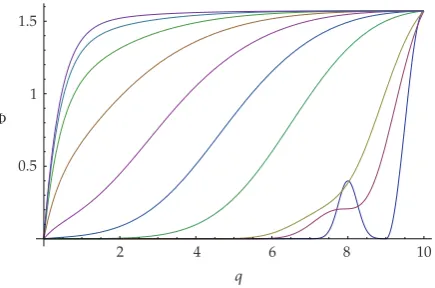
[image:6.600.193.411.98.242.2]Φ
Figure 1: Propagation of the traveling waveΦτ, qin a TNC for the moving coordinate system. Parameters
of the method:J7,Δτ0.005; parameters of the problem:v2,q10, 2q210,σ0.25,q38.
The boundary condition on the bottom plate yieldsΦτ,0 Φτs,0 Φ˙ τ,0 0, while the
one on the top plate givesΦτ,1 Φ˙ τ,1 π/2. Then, we obtain
Φτ,0−Φτ
s,0 −τ−τs
2M
i1
asiri1,
˙
Φτ,0 −2M
i1
asiri1.
4.5
The substitution of 4.5 into 4.4 and the corresponding discretization of independent variables gives the following system of equations:
q−→ql, τ −→τs1, whereql
l−0.5
2M , l1,2, . . . ,2M,
Δτ τfin−τin
N , τs s−1Δτ, s1, . . . , N,
Φ
s1l Δτas:H:, l Φsl,
Φ
s1l Δτas:P:, l−Elr: Φsl,
Φs1l Δτas:
R:, l−qlr: Φsl,
˙
Φs1l as:
R:, l−qlr:.
4.6
The initial values ofΦ1l,Φ1l, and Φ1lcan be computed from the initial condition2.4
and the corresponding change of variables4.2.
10 8
6 4
2 0
z/d∗0.1
0 0.5 1 1.5
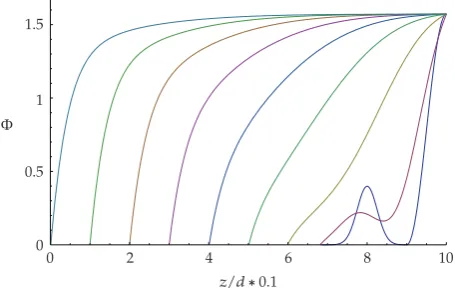
[image:7.600.186.414.102.246.2]Φ
Figure 2: Propagation of the traveling wave with respect to the laboratory coordinate system ΦE/Ecrz/d−vτversusz/d∗10−1. Parameters of the method: J 7,Δτ 0.005; parameters of
the problem:q17−vτ,q210,v2,σ0.25,E/Ecr10.
The simulations have shown that this approach for the problem of relaxation of a director toward its equilibrium position allows its the computation of different dynamic modes in TNC. The relaxation of a director with respect to the laboratory coordinate system is shown inFigure 2.
The criterion for relaxation of a director was chosen in the form:ε|Φτs1−Φτs| ≤
10−4. In other words, if the azimuthal angle between two time steps is less than ε, then
the algorithm stops. It is worth emphasizing that the Haar wavelet method permits to get solutions with a smaller error. However, in this case, lower values of ε do not play any significant role and only increase the CPU load.
5. Conclusions
The present paper describe the phenomenon of spatial relaxation in a TNC for the case of strong anchoring of LC molecules with the bounded plates. It was suggested to employ the Haar wavelet method for getting a function, which describes the evolution of the azimuthal angle. The advantage of such an approach over regular methods is that the unknown function is searched as a superposition of analytically defined functions, which constitute a complete basis in theL20; 1 space. Another reason for our choice of basis functions is low
computational costs conditioned8 by the sparsity of matrixasi.
Acknowledgments
The work of A. A. Kudreyko is supported by the Istituto Nazionale di Alta Matematica Francesco Severi Rome-IT under scholarship U 2010/000139, 1 October 2010. A. A. Kudreyko is thankful to Professor Carlo CattaniUniversity of Salernofor many valuable discussions.
References
1 P. G. de Gennes and J. Prost, The Physics of Liquid Crystals, Oxford Science, 2nd edition, 1995.
3 U. Lepik, “Numerical solution of evolution equations by the Haar wavelet method,” Applied¨
Mathematics and Computation, vol. 185, no. 1, pp. 695–704, 2007.
4 A. V. Zakharov and A. A. Vakulenko, “Intrinsic torsional reorientations in a twisted nematic liquid crystal cell,” Physical Review E, vol. 72, no. 2, Article ID 021712, 7 pages, 2005.
5 C. Cattani and J. Rushchitsky, Wavelet and Wave Analysis as Applied to Materials with Micro or
Nanostructure, vol. 74 of Series on Advances in Mathematics for Applied Sciences, World Scientific,
Hackensack, NJ, USA, 2007.
6 C. Cattani, “Multiscale analysis of wave propagation in composite materials,” Mathematical Modelling
and Analysis, vol. 8, no. 4, pp. 267–282, 2003.
7 U. Lepik, “Numerical solution of di¨ fferential equations using Haar wavelets,” Mathematics and
Computers in Simulation, vol. 68, no. 2, pp. 127–143, 2005.
8 I. Daubechies, Ten Lectures on Wavelets, vol. 61 of CBMS-NSF Regional Conference Series in Applied
Submit your manuscripts at
http://www.hindawi.com
Hindawi Publishing Corporation
http://www.hindawi.com Volume 2014
Mathematics
Journal ofHindawi Publishing Corporation
http://www.hindawi.com Volume 2014 in Engineering
Hindawi Publishing Corporation http://www.hindawi.com
Differential Equations
International Journal of
Volume 2014
Applied MathematicsJournal of
Hindawi Publishing Corporation
http://www.hindawi.com Volume 2014
Probability and Statistics Hindawi Publishing Corporation
http://www.hindawi.com Volume 2014
Journal of
Hindawi Publishing Corporation
http://www.hindawi.com Volume 2014 Mathematical PhysicsAdvances in
Complex Analysis
Journal ofHindawi Publishing Corporation
http://www.hindawi.com Volume 2014
Optimization
Journal ofHindawi Publishing Corporation
http://www.hindawi.com Volume 2014
Combinatorics
Hindawi Publishing Corporation
http://www.hindawi.com Volume 2014
International Journal of
Hindawi Publishing Corporation
http://www.hindawi.com Volume 2014 Operations Research
Journal of
Hindawi Publishing Corporation
http://www.hindawi.com Volume 2014
Function Spaces
Abstract and Applied Analysis Hindawi Publishing Corporation
http://www.hindawi.com Volume 2014
International Journal of Mathematics and Mathematical Sciences
Hindawi Publishing Corporation http://www.hindawi.com Volume 2014
The Scientific
World Journal
Hindawi Publishing Corporationhttp://www.hindawi.com Volume 2014
Hindawi Publishing Corporation
http://www.hindawi.com Volume 2014
Algebra
Discrete Dynamics in Nature and Society Hindawi Publishing Corporation
http://www.hindawi.com Volume 2014 Hindawi Publishing Corporation
http://www.hindawi.com Volume 2014
Decision Sciences
Discrete Mathematics
Journal ofHindawi Publishing Corporation
http://www.hindawi.com Volume 2014
Hindawi Publishing Corporation
http://www.hindawi.com Volume 2014