Learning for Life. Routledge, London, p. 356. ISBN 0815367112, 978-0815367116 Link to Leeds Beckett Repository record:
http://eprints.leedsbeckett.ac.uk/5587/
Document Version: Book Section
Creative Commons: Attribution-Noncommercial-No Derivative Works 4.0
This is an Accepted Manuscript of a book chapter published by Routledge in Per-spectives on Play: Learning for Life on 3rd December 2018, available online: http://www.routledge.com/https://www.routledge.com/Perspectives-on-Play-Learning-for-Life-3rd-Edition/Brock-Jarvis-Olusoga/p/book/9780815367116
The aim of the Leeds Beckett Repository is to provide open access to our research, as required by funder policies and permitted by publishers and copyright law.
The Leeds Beckett repository holds a wide range of publications, each of which has been checked for copyright and the relevant embargo period has been applied by the Research Services team.
We operate on a standard take-down policy. If you are the author or publisher of an output and you would like it removed from the repository, please contact us and we will investigate on a case-by-case basis.
Chapter 1: Three Perspectives on Play Pam Jarvis, Avril
Brock and Fraser Brown
Introduction
This book enters the world at an exciting time for the children’s agenda in the United Kingdom, being launched in the same year as the Early Years Foundation Stage (EYFS), which is endorsed with government intentions for a child-led, play-based curriculum for children under 6. As might have been expected, this is already causing controversy in the British press, with the ‘Times’ proposing that the EYFS is, in fact a ‘stealth curriculum’ which is ‘a threat to all toddlers’ (Frean 2007). However, government funding has been provided to ensure that this curriculum will be led by adults in the new role of ‘Early Years Professional (EYP)’, who will be trained to fulfil a similar function to that of the Scandinavian ‘Pedagogue’. Such ‘Pedagogues’ are charged with developing the whole child, body, mind and emotions, within a specific historical and cultural background, while facilitating each child’s potential for creativity and socialisation with others (Moss and Petrie 2002). The first endeavour for the new British EYPs has already been set out by the new Department for Children Families and Schools (DCFS)- to transform and lead practice in play-based learning. The Children’s Plan, published in December 2007, sets out the aspirations of the Brown New Labour Government for the development of children’s services from 2008-2020. This includes provision of play areas and a comprehensive review of the primary curriculum, including the consideration of a more gradual transition from play-based learning to more formal curriculum for 6-7 year olds.
As such, it is a fortuitous time to deliver a new book that presents so many different facets of play, and while it cannot claim to cover every single aspect, it contains a wealth of practice-based research and reflection from many very different perspectives. These range from a synthesis of culture, biology and evolution in a new ‘biocultural’ theory of play, to the innovative use of dramatherapy play, the pivotal role of playwork, and the importance of play in the Early Years/ Primary school classroom and playground. Authors will also explore recent discoveries about the developing brain that indicate a crucial role for play during the first months of life, the essential place of play in the lives of children with special needs, and the impact of social, cultural and gender issues upon children’s play activities.
post-industrial societies, particularly in the Anglo-American nations, including a huge increase in vehicle numbers, the geographic dispersal of the extended family and a decrease in average nuclear family sizes have resulted in the curtailment of children’s opportunities to independently engage in social free play. An increasingly sophisticated mass media has also heightened parent perception of traffic and ‘stranger’ danger, simultaneously negatively impacting upon opportunities for outdoor free play for children in such societies.
The period spanning the end of the 20th Century and the beginning of the 21st has
brought a wealth of new opportunities for the world’s children, but each set of new opportunities has been accompanied by a new set of risks. New technologies that have revolutionized teaching methods have also created new e-forums for children to
engage in unpleasant behaviour, sometimes leading to serious, sustained bullying. Mass opportunities for long distance travel and mass access to the internet have opened world-wide travel and a wealth of multi-cultural learning opportunities for children and adults. However, such technological advance has also spawned
international industries in drug trafficking and pornography, resulting in an increased risk of the exploitation of children, both as workers within such dark industries, and as users. The balance between risk and opportunity is also inequitably balanced between children from the rich western and poor eastern nations, with many of the poorest foregoing play and education to work long hours to produce luxury goods for the richest. This is currently a focal point for ongoing international concern, which will hopefully lead to more multi-nation derived solutions with the potential to underpin increasing co-operation towards positive intervention strategies as we move into the 2010s.
As Britain steps forward into a new programme for Early Years services which has been clearly endorsed by the DCFS as supportive of play-based learning, we must remember that there is still a lot more to do to for our children, including the pressing need to develop a smoother ‘ramp’ into mainstream education, with more room for child-led, play-based learning in the later stages of primary school, and, as part of the same initiative, to explore and facilitate the play and recreation needs of older children and teenagers, and the play needs of children of all ages in out- of- school
environments.
The authors of this book offer a wide-ranging set of practical and theoretical ideas to help facilitate training for those with an ambition to go forward to contribute to future local, national and international play and education initiatives. In order to offer a suitably broad introduction to such a text, this chapter will present three alternative perspectives of the role of play in children’s lives; psychology, education and playwork, which provide different, but not incompatible standpoints and constructs for examining the complex concept of play. This book arose from our realization that when we talked together as colleagues we were communicating similar values and aiming for
equivalent results. We are all in agreement that play is crucially important for children’s development, learning and well-being, reflecting the fact that the concept of play itself is infinitely flexible, offering choices and allowing for freedom of interpretation.
Should play serve the needs of the child, rather than the needs and expectations of adults?
What real choices are offered to children in their everyday play experiences?
Is play about experiencing and doing, or about achieving a specific end result?
How flexible should children’s play be, with regard to offering freedom of movement and expression?
Perspective 1: The usefulness of play: Pam Jarvis
This part of the chapter will focus on the developmental usefulness of play for the child, particularly with regard to providing the psychological foundation for the social and intellectual skills that human adults need to function in the increasingly complex social environment that sociologists call ‘the global village’. In this way, play is about a flexible, self-directed experience, which both serves the needs of the individual child, and the future society in which s/he will live in adulthood.
Ideas in action
The value of play experience (author’s observation notes)
Five year old Nathan, one of the reception class boys, was one of the most active children within my observation sample, and was frequently to be found engaged in highly active play. However, when it came to his turn to be the focus of one of my focal child observations, he was involved in an incident at the beginning of the relevant play session where he mistakenly hurt another boy in play fighting. His actions were mistaken for real aggression by the supervising adult, which resulted in a ‘time out’ punishment. When this was over, Nathan sought out the boy he had accidentally injured, apologised and explained that the incident had been an accident; the boy accepted the apology. Nathan then asked the boy to come with him to speak to the supervising adult and tell her what had happened. She listened to what they had to say, and asked the boys to shake hands, which they did. Nathan then walked away alone, still looking upset and sucking hard on his thumb (which had been in and out of his mouth since the situation arose). He continued to look rather morose, while Chris, one of his closest friends, jumped around him, clearly trying to entertain. Nathan turned around and smiled at Chris, but continued to stand quite still in the middle of the playground, with his thumb in his mouth.
Improving practice
Playtime is useful even when it is not ‘fun’!
competently with the vast range of complex social situations, including misunderstandings, that one meets in the adult world.
Reflection: How would human beings learn to independently deal with difficult social situations if they did not experience sufficient independent free play opportunities in their daily lives during early development?
Key theory and research…
Introducing evolution
If we use evolutionary theory as our starting point, we must presume that the urge to play that is present within young human beings and many species of non-human animals advantages the survival of the creature in some way. If there was no inherent advantage in playful behaviours, animals that play during their developmental years would not have survived to pass their genes down to their descendants. It is therefore generally theorised among developmental psychologists and ethologists that play provides essential practice experience for young animals; that they can use their playful behaviour to develop skills that they will use in adulthood to advantage the survival potential of themselves and their own offspring. Bruner (1976, p.67) emphasises the huge importance of play in his comment ‘animals do not play because they are young, but they have their youth because they must play’.
The more complex the adult society, the longer animals spend in their developmental period, and the more complex the play activities in which they engage. The most complex societies on earth, requiring an extensive range of cognitive, physical and above all, social skills are those found among the great apes- gorillas, orang-utans, bonobos, chimpanzees, and the most complex of all- our own species, homo sapiens, or, more commonly, human beings. This section therefore starts from the position that play is, above all, a useful activity through which much learning is accomplished.
Key theory and research….
The problem of defining ‘play’ and ‘not play’
It is easy (particularly for early years practitioners) to casually discuss the concept of ‘play’ without fully specifying what we mean. Which activities undertaken within a pedagogical environment are ‘play’ and which are not? How do we define the difference between children’s ‘work’ and children’s play? Reed and Brown (2000) suggested that play may be hard to define because it is something ‘felt’ rather than ‘done’, commenting that there is no agreed universal definition for play in the literature. Ramsay (1998, p.23) defined play as a social vehicle for ‘exploring differences and developing common themes’. But how can this encompass all types of play; for example, how would solitary play fit this definition?
The following criteria for defining play were proposed by Garvey (1977, p.10):
It is enjoyable to the player;
It has no extrinsic goals, the goal being intrinsic, the pursuit of enjoyment;
It is spontaneous and voluntary;
But are these definitions over-exclusive? It could be argued that this list excludes sport, as sporting activity involves certain extrinsic goals and inhibition of spontaneous behaviour, yet sport is still undertaken as an enjoyable leisure pursuit by many human beings, both children and adults. If we see the term ‘play’ as equivalent to ‘having fun’ (Anderson 1998, p.107), it becomes clear how different individuals and different demographic groups may perceive what is and is not ‘play’ very differently, and how many diverse behaviours might qualify as ‘play’. Play thus appears to be a relative behaviour category. It may be that where an individual reports that they were playing, they probably were: ‘it is fruitless to devote time and effort to defining what play is and what it is not… by de-emphasising the label “play” it might be easier to get on with the problem of studying the development of behaviour’ (Meaney and Stewart 1985, pp.11-12).
Ideas in action
‘Work’ or ‘play’? (author’s observation notes)
One afternoon, while I was carrying out an observation of the Reception home corner, the teacher told the children to tidy up, as she wanted to read them a story before they went home. Four and a half year old Rory tidied briefly around the home corner, then, with the area behind him still in a state of some disarray, started to carefully organise the play knives and forks in the home corner drawer. He was taking a long time over this, moving them from slot to slot, muttering to himself as he did so. He then stopped and looked over towards some other children who were passing pencils to one another at a nearby table, commenting to me ‘they are just playing’. ‘What are you doing, then, Rory?’ I asked. ‘I’m working’ he said proudly. ‘Putting the knives and forks away?’ I asked. ‘Yes’ he replied, returning to moving them from slot to slot.
Reflection:Are adults really more competent at defining differences between ‘work’ and ‘play’ than children, or might they, like Rory, also be inclined to define what they are doing themselves as ‘work’, and what others are doing as ‘play’?
Key theory and research….
Play and psychological development
The linkage of ‘play’ with ‘the development of behaviour’ is a common focus for developmental researchers. Consequently, although it is generally accepted that human beings of all ages play, play research has mainly been carried out within the human developmental paradigm, investigating the play of children, and the role of play within their learning and developmental processes. Many theories of play have therefore focused upon the function that different types of play may have for specific aspects of children’s development, rather than seeking exclusive categorisations of ‘play and not-play’. As such, many researchers have attempted to categorise the most common types of play observed in children’s behaviour. Hutt (1979, p.115) divided play types into three main categories, which she referred to as:
Epistemic: play associated with development of cognitive/ intellectual skills;
Games with rules: for example team sports or chess.
Whether and how adults study children’s play is ‘based on a set of values about the nature and function of childhood…. held by the society in which a child lives’ (Sylva and Czerniewska 1985, p.40); however, there are very many differences between human cultures in both time and geography; as such, we have to accept at the outset of our play studies that it is impossible to narrowly and simplistically define a complex activity like play. It is therefore unlikely that we will ever come to any firm, universally agreed definitions of ‘play’ and ‘not play’, but nevertheless, many insightful theories of play have been created over the past 200 years. The following sections list a small selection of these.
Key theory and research….
Classical theories (nineteenth and early 20
thcenturies)
For a long time, play was considered to be just something that children did which did not merit the effort of adult attention. As is typical of many aspects of western culture, there is a brief reference to children’s play in Ancient Greek writings which was not followed up until the time of the ‘Enlightenment’, from the late eighteenth century onwards.
Energy regulation theories: These propose that play is just a way of ‘letting off steam’ and using up energy that has not been used elsewhere, or conversely, restoring energy through relaxation activities. The idea of ‘letting off steam’ originated in Ancient Greek texts with Aristotle’s concept of ‘Catharsis’. In the eighteenth century German philosopher Friedrich Schiller defined play as ‘the aimless expenditure of exuberant energy’ (Mellou 1994, p.91). However, the German poet Moritz Lazarus (1883, in Mellou 1994) proposed that play is a way to restore energy lost in work, directly opposing surplus energy theories. British philosopher Herbert Spencer (1820-1895) used Darwinian Evolutionary theory to propose that the more highly evolved the animal, the more ‘surplus energy’ it had, and the more complex its play would be (Mellou 1994). It is true that the only creatures that appear to play are birds (in a very simple way) and mammals, with primates showing the most extended and complex forms of play. However, we know nowadays that there are many differences between the species, particularly in terms of brain physiology, which means that the picture is not quite as simple as differing levels of ‘surplus energy’ between species.
Recapitulation theory: G. Stanley Hall (1920) viewed childhood as a link between the animal and human way of thinking and behaving. This is a theory that draws upon Darwin’s theory of evolution in a rather strange way. Hall proposed that play helped children work out primitive instincts which exist in human beings via the evolutionary process, but which would not be helpful in a more civilised human lifestyle. Hall’s stages follow what he proposes is the evolutionary path: animal, savage, tribal society, modern society. However, we now know that Western people are no more ‘evolved’ than people who still live in a tribal environment, and that it is technology that makes the superficial difference, not basic human instincts and behaviours, which can be seen in all human environments. So this theory has been discredited as it is based upon an outdated understanding of ‘instincts’ and ‘evolution’.
animals and human children learn in play, practicing skills that they need to develop for adulthood. Groos was also one of the first researchers to consider the idea that adults may use play in a similar way. He developed (1901) an early, very basic ‘taxonomy’ of play, listing the following types: experimental play (rule-based games), socio-economic play (chasing and play fighting) and imitative, social and family games (make believe play).
Ideas in Action
Case Study: Recapitulation Theory in Popular Fiction?
In 1954, William Golding published his world famous book, ‘Lord of the Flies’, which tells the story of some pre-adolescent British boys marooned without adults on a tropical island. As the story unfolds, the boys make a good start in trying to organise their society along the lines of Western social codes, but it rapidly deteriorates until they are behaving in a dangerous, wild, savage fashion, which includes painting their faces and carrying out tribal dances. This behaviour eventually results in the violent deaths of two of the group. Golding’s rationale for this novel appears to be directly drawn from Hall’s theory, in that he seems to propose that the unchecked play activities of Western children are likely to lead to undeveloped, primitive and ‘savage’ behaviours, which will be ultimately harmful to their safety. The book’s characters are drawn as in desperate need of firm guidance from more ‘highly evolved’ Western adults.
Question: What might this tell us about the author’s attitude towards children’s independent free play activities?
Key theory and research….
Play therapy
Psychoanalytic theory was originated by Sigmund Freud (1854-1938) who believed that play had an important role in children’s emotional development. Freud reintroduced the term catharsis, in terms of a ‘cathartic effect’, believing that, through play, children could remove negative feelings associated with traumatic events. Freud’s daughter Anna subsequently originated and developed Freudian play therapy over the mid 20th century. Play therapy can be used to help children who have had traumatic
experiences, breaking the memory down into small segments and encouraging the children to ‘play out’ the troubled feelings, offering a variety of play experiences for this purpose; e.g., dolls, sand, water, art materials (Gitlin Weiner 1998). Much use was made of play therapy in the years directly after World War II to help children who had been traumatised by violent events in Nazi-occupied Europe.
Ideas in Action
Case Study: Play as Therapy
at school and at home improved, particularly his ability to concentrate.
Improving Practice
Play ‘ therapy’ in everyday life
Children who are not ‘in therapy’ can also benefit from activities drawn from play therapy concepts. One example that works well with girls aged from eight upwards is to seat a small group (4-8) around a table upon which there are several bottles of different coloured nail varnish. Each girl in turn has to talk about a feeling that she had, and pick a colour to represent it. The group are then invited to use the varnish to paint their finger nails, choosing a different colour for each finger to represent different feelings that they have, chatting about this as they do so.
Question: Can you think of a more gender-balanced, similar activity that children could carry out during an art activity, which involves using different colours to represent different feelings? Consider how this could be converted for children in different developmental stages.
Key theory and research…
Arousal modulation theory
Arousal modulation theory was developed by Berlyne (1960), who proposed that play was the result of a drive in the central nervous system to keep arousal at an optimum level. Ellis (1973) proposed that children use play to increase stimulation and level of arousal. In Berlyne’s model children respond to a given environment to increase arousal; in Ellis’ children actually create that arousal in their actions upon the environment. Arousal modulation theory can be related to the current debate about the role of boredom versus potential over- stimulation in childhood. The question is whether by removing boredom by a constant round of stimulating experiences, 21st
century child rearing practice is removing children’s development and practice of independent self-directed activities that regulate their own arousal levels. The sociologist Corsaro (1997) suggested that, in modern Western societies children’s time is increasingly taken up by adult- directed activities, and that consequently modern Western childhood is being ‘colonised’ by adults in this way.
Ideas in action
Case Study: A 21
stcentury childhood
in outdoor play unaccompanied by adults. The only regular chance she gets to play undirected by adults is in her school playground. However, her school has recently reduced the lunch break, so this equates to one fifteen minute break in the morning and approximately twenty minutes at lunchtime, depending on how quickly she finishes her lunch. Aimee’s mother complains that Aimee can be ‘difficult’ during the school holiday periods; she seems unable to settle down to anything other than watching television for longer than a few minutes and, despite being surrounded by expensive educational toys, she constantly complains to adults that she is ‘bored’. This indicates that Aimee lacks strategies to balance her own levels of arousal.
Reflection: How might this effect Aimee’s future teenage and adult life?
Key theory and research
Metacommunicative theory
Metacommunicative theory was developed by Gregory Bateson (1955). Bateson proposed that in pretend play children learn to operate on two different levels, i.e., in the scenes that they are acting out, while still maintaining their existence in the real world. Garvey (1977) proposed the term ‘break frame’ for what children do when problems or disagreements arise and they come out of their make-believe to solve the issue, then re-enter into the pretend scenario. This indicates that children do not just learn about the role itself, but about the concept of playing a role and how this relates to reality.
Ideas in action
Vignette: a ‘breaking frame’ example
Five year olds Sophie and Elizabeth are playing in the home corner. They have previously agreed that Sophie is the mummy and Elizabeth is the baby. Sophie puts Elizabeth to bed and goes into the kitchen area. Elizabeth gets up and wanders in after her, picks up a toy saucepan and puts it on the cooker. Sophie turns around and, ‘breaking frame’, says ‘you’re the baby, you can’t use the cooker’. Elizabeth says ‘but what if baby tried to use the cooker?’ Sophie moves back into the mummy role (the ‘pretend frame’), adopting a scolding tone. ‘Naughty baby, get away from that cooker, you’ll burn yourself’. Elizabeth starts pretending to cry, Sophie says ‘oh, no, baby, what have you done?’ She takes Elizabeth’s hand and says ‘shall we get a bandage?’ Elizabeth nods her head, still ‘pretend crying’.
Question: What do Sophie and Elizabeth learn about caring for younger children and babies from this interaction?
Key theory and research…
Play texts
adult human being. Jarvis (2006; 2007) studied children’s playground- based play texts, finding them to be complex and highly gendered (see chapter 7).
Ideas in action
Playground play texts (author’s observation notes)
On a bitterly cold winter’s day, the children were briefly in the playground during a light fall of snow. I observed Rory, Elliot and Adam absorbed in an energetic chasing game, which they had to leave when they were called back into school. Directly we arrived back in the classroom I sat down with them to ask them about their game. The resulting conversation is reported below:
Pam Jarvis: What were you playing?
Rory (to Elliot): What were we doing?
E: We were helping Adam.
R: We were helping Adam not to freeze.
PJ: Helping Adam not to do what?
R: Not to freeze. It was snowing and blowing in my eyes.
PJ: Yes, I know, it was very cold.
R: If you freeze you never get out.
This play text would appear to reflect some of the ‘superhero’ narratives frequently played out in western action cartoons and fantasy films.
Question: What might these boys be learning about adult male roles, responsibilities and relationships from collectively designing and playing out this play text?
Improving Practice
Play Texts Research
Key theory and research….
Cognitive development theories
Cognitive development theories propose that play is a vital part of building up a set of mental representations (Piaget called these ‘schemas’) of the world around the child. This is achieved in very small ‘bites’, each piece of learning in a particular area building upon the previous piece over the entire period of development, with the young adult finally achieving a ‘cognitive map’ of how the world s/he lives in actually works. For example all human beings learn about the basic operation of gravity (why we would not purposely drop a basket of eggs), but only those who live in an area with motor vehicles know that you have to look and listen carefully before you cross a road that initially appears to be clear. The two most prominent theorists in this area are Jean Piaget (1896-1980) and Lev Vygotsky (1896-1934).
Piaget proposed a developmental system of ‘assimilation and accommodation’, the child either assimilating a new experience (taking it into thought without creating a new concept, e.g., you lick an ice cream and you also lick an ice lolly) or accommodating it (creating a new concept in thought, e.g., you can’t pick up spaghetti with just a spoon, or a knife and fork, you have to learn a new action with a spoon and a fork). The child moves into accommodation by a process of ‘equilibration’, which means needing to balance all related schemas against one’s current picture of reality (Piaget 1955).
Vygotsky proposed the concept of a ‘zone of proximal development’ (Vygotsky 1978). The ‘ZPD’ is an area of competence that a child can access with help from an adult or in collaboration with peers, but cannot achieve alone. For example a child building a lego model may not be able to work out how s/he uses the different shaped bricks to make a wheel arch on a model of a car, but an adult may help by demonstrating and breaking down the task (Jerome Bruner later referred to this as ‘scaffolding’). Two or more children may also ‘put their heads together’ and work out by discussion, trial and error how it is done.
Improving Practice
Vignette: Schema Focus
Three year old children may easily accept the existence of Santa Claus, given their very limited knowledge of everyday practical physics, but by the time they are six or seven they will be asking questions like ‘how can he come down the chimney if we haven’t got one?’ and ‘how can he get round all the children in the world in one night?’ This indicates that the process of equilibration is occurring, and sooner or later the child will realise that the concept of Santa is a myth rather than a reality, as his existence is not commensurate with the other knowledge that they now have about the world.
Reflection: By focusing upon the specific questions that children ask, we can discover what ideas they may be currently engaged in bringing to a new state of equilibration.
Activity: Some learning may involve working on the ZPD with both teachers and peers. You can consider this through designing/ engaging in/ observing any activity that involves an adult demonstration followed by group work. For example, show children aged six or over how to make a simple lego model or a simple craft item such as a decorative paper chain (which could be linked to learning about various religious festivals). Demonstrate how to carry out the task, and then compare how children complete it either working alone, working with a peer of similar ability and working with a peer of slightly higher ability. You should particularly focus on how children discuss the task, and what they appear to gain (or occasionally lose) from such discussion.
Conclusion
This part of the chapter has introduced a range of theoretical perspectives rooted in developmental psychology, many of which will be revisited and further explored by various authors in the later chapters of this book. It has outlined the vital link between play and psychological development, and suggested that play does not always have to result in an obvious or even a positive outcome to usefully contribute to the child’s current and future social competence, which is both to his/ her own benefit, and the benefit of the society in which s/he lives.
Improving Practice
Observation focus idea
Activity: Why not carry out a 10-15 minute focal area observation, and then see how many of the above theories you could apply to the behaviour that you recorded?
Perspective 2: Capitalising on play – harnessing it for learning:
Avril Brock
Introduction
This section on educational play promotes play for learning. Children are both pre-programmed and motivated to play – it is quite simply, as Susan Isaacs declared in the 1920s ‘their life’s work’. So from an educational perspective children’s disposition to play, their inherent motivation and driving purpose to play, should be harnessed to promote learning and fulfil educational potential. Play is important for learning – educators ‘milk’ it; hijack it from children; use it as a vehicle to develop cognition and all aspects of the curriculum – why not - particularly if it is both effective and enjoyable. Children play naturally; through a developmental process; to discover their environment; to learn about what and why things happen and, primarily, to have fun.
Ideas in action
Valuing Play (author’s Interview data)
that’s the way I feel that children learn best and it’s our job to direct that and channel it. Our planning will provide support to develop what the children are interested in, whilst meeting the demands of the early learning goals. It’s about being practical but also being creative in what you’re doing with the children and trying to stimulate them in as many sensory ways as you can.
People don’t always see the value and really don’t realise what goes into it. They think we turn up on the day, we open up nursery and that’s it, children come in and you just play with them, not that there’s hours of preparation, planning, finding and making resources. Yes, even my own girlfriend doesn’t realize.
Mike, Nursery Nurse
Improving practice
Many early years educators find it hard to understand why some people, including educators of older children, belittle play, when it is such a powerful motivating force that yields such rich results. The nursery nurse in the above quote was interviewed for a PhD research thesis. He worked in a nursery within an inner city school in an Education Action Zone, which had a very mixed catchment of children, including a percentage learning English as an additional language. He worked as an equal partner in an early years team in a nursery that had been recently integrated into the school. The team was developing the links and curriculum across the then newly introduced foundation stage
This nursery nurse believed strongly in the power and importance of play, promoting the curriculum through quality play experiences. He was also very aware of the status of play and that public perception from parents, other educators and policymakers was not always understanding or in favour of play being promoted in educational settings.
It is therefore important to be both knowledgeable and articulate about the importance of play in educational contexts. Educators must be articulate and prepared to justify their provision for a play based curriculum and pedagogy to a range of audiences
Reflection: Do we need to justify play and do you feel able to be articulate this to an external audience? Reading this book should help you in the process of being accountable for play!
Key theory and research…
The Importance of Play
By the beginning of the 19th century, the idea of childhood not just being a preparation for adult life, but existing in its own right as a special period of life was gaining acceptance. Philosophers, psychologists and early educationalists were the pioneers of theories regarding the importance of play for learning and education. Here is a brief introduction to some of these:
Pestalozzi’s (1746 - 1827) ideas influenced Robert Owen when he set up the first infant school in Scotland in 1816, promoting suitable learning environments for young children which included free outdoor play.
Wilderspin (1792 - 1866) promoted literacy, language and numeracy, through both rote learning and the availability of materials and active practical experiences.
Froebel (1782 - 1852) suggested the significance of educative play in young children’s development for children to absorb knowledge, develop imagination and language. He developed a child centred approach and stressed active learning.
Steiner (1861 – 1925) was concerned with children’s individuality, their whole development through experiencing a creative and balanced curriculum. He proposed that the role of the adult, the environment and the provision of natural resources as play materials were important.
Montessori (1870 - 1952) advocated the value of play in children’s learning and provided real life learning experiences in a structured planned environment, which developed the inner lives of children through sensory and scientific experiences.
Isaacs (1885 - 1948) promoted play and exploration through active involvement, encouraging children’s clear thinking and independent behaviour. She studied child psychology scientifically, through undertaking systematic child observations, examining the influence of language on thought and emotions
McMillan (1860 – 1931) firstly provided environments to support children’s health, but she also believed in the important of first hand experiences and active learning, particularly that play was important for their development of imagination, feelings and emotions.
Vygotsky (1896 – 1934) believed that the quality of children’s social and cultural relationships was crucial; that adults and peers support children’s learning and that play created a zone of proximal (potential) development, which enabled them to function at a high level.
Bruner (1915 - present) sees children as active learners, who need first hand experiences to help them develop their thinking and learning. Like Vygotsky, he believes that the adult is important for scaffolding children’s learning.
learning is important for development and that imaginary play led to games with rules.
Adapted from Beardsley and Harnett (1998); Curtis and O’Hagan (2003); Bruce (2004); Broadhead (2004)
This is quite a long list of renowned figures, who have provided evidence for their beliefs, demonstrating a breadth of knowledge regarding the importance of play for learning and education. Educators need to not only consider these aforementioned theories, they also need to be able explain their provision of play experiences to a wider audience. They need to be able to articulate this knowledge in a way that parents, policymakers and the public at large understand and accept that a play-based curriculum and pedagogy is an essential part of children’s education. Both early years and primary educators need to not only understand the value of play and so put it into practice with children, but to be able to explain and celebrate play-based learning with others. Educators need to provide rich learning environments that promote all types of play - spontaneous, structured, imaginative and creativeand so enable children to fulfil their learning potential.
Ideas in Action
Making sense of the world through play (author’s observational data)
I visited Mina, aged 14 months, and her mother to interview them about Mina’s early language development. Mina was extremely shy of me for the first 30 minutes and kept her distance. However she had seen me place my small digital recorder on the coffee table and as soon as she had plucked up her courage, she came to sit with me, immediately grasping the recorder. It fitted neatly in her hand and within seconds she had worked out how to turn it on and off and listen to the recordings. Her next task was to ‘take photos’ with my digital camera. This was a larger instrument, but again she had no trouble manipulating it, holding it correctly to take photos, whilst modelling appropriate poses and smiles. She then manoeuvred herself to my handbook and systematically selected items one by one. Firstly she took out the purse, followed by appointment cards, lipsticks, perfume, pens, memory sticks, mobile phone and glasses. She used each item appropriately - except for the memory sticks! The purse went in her plastic handled box, which she used as a handbag, as she copied what her mum does with hers. She scribbled on my notepad with each pen. She experimented wearing my glasses on the front, top and back of her head. She made her ‘smelling face’ as she pretended to apply the lipstick and perfume. How did she know that the small round bottle had a top that could be removed? ‘Ah, beautiful’ declared her mum, whenever Mina showed her each new acquisition.
Reflection: In your observations of children, upon which contexts do they most readily base their play? How often is this from previously ‘modelled’ adult behaviours?
Improving Practice
could see there was much evidence to indicate her thinking processes. Her mother commented that she and Mina’s father felt that they could often observe their daughter thinking things through as she played. As Hutchin (1996) observed children draw on a range of experiences, which they have in every aspect of their daily lives. Mina has learnt through watching, listening and reflecting, and has already had many
opportunities to imitate, imagine and repeat actions through her playful activities
Reflection: Do watch babies when you meet them at the supermarket or in the park. Observe and reflect on how they are avidly seeking to make sense of the world.
Mina is learning through her play and early years educators have become skilled at capitalising on young children’s inclination to learn, their appetite for new experiences and their inclination to ‘play’ first and foremost. What then defines a ‘play’ experience as being different from a ‘work’ experience in school and other educational settings? Are ‘play’ experiences only those that are freely chosen by the children themselves? Are having fun or enjoyment key elements in defining what play is? When an adult in a foundation stage setting directs children to paint a picture, create a construction with the large blocks or complete a jigsaw - is this play or work? When a child chooses to plant bulbs in the garden, bake a cake or listen to a story - is this work or play? All children have a right to relax, play and join in with a wide range of activities (Article 31 UN Rights of the Child) to free play as well as structured learning and this is of value in itself as part of the child’s cognitive and creative development. Play is fun, rewarding, enjoyable and complete in itself.
Ideas in Action
Outdoor Social Free Play (author’s observational data)
Zack and his older brother Kurt were playing in their garden. They threw, caught, kicked, batted and balls playing golf, football and basketball; they climbed ladders and trees in role as firefighters; they used gardening tools in the soil and sandpit; drove a tractor, car and tricycle round and round the garden and were mechanics in overalls using a range of tools and implements; they played team games and races with the adults. Within a span of three hours, there was no whingeing, lots of collaborative play, imaginative thinking, exploratory language and socialising with the adults.
Zack (age 4) was playing in my garden. Amongst lots of self-initiated activities, he carefully watered the flowers and worms with a water pistol, watched the sparrows eating seed from a feeder and saw the water boatmen swimming in the pond. He observed, asked questions and discussed what was happening.
Improving Practice
the world’ in the Early Years Foundation Stage, but also meeting aspects of Personal, Social and Emotional Development and Communication, Language and Literacy.
Reflection: Access the Early Years Foundation Stage document – if you don’t have a copy – view or print it from the DfES website. Read and reflect on the early learning goals for physical development.
Key theory and research…
A play-based curriculum
In this way it can be seen that play for learning naturally occurs. The educator’s role is to provide a multitude of opportunities in which children are motivated to become involved, individually and collaboratively. These activities need to be planned for potential and optimal learning. The educator needs to be able to analyse these learning opportunities, make decisions about when and how to be involved and move the play forward; all the time observing and analysing the achievements and benefits for learning. This does not preclude having fun and enjoyment, as these should be essential components of learning through play. Children’s individual needs must be met for successful learning and development. The activities and experiences provided by educators need to be structured through a cycle of planning, organisation, implementation, assessment and evaluation. As Riley (2003) proclaims, a rigorous and comprehensive grasp of a holistic curriculum is required, not only in the Foundation Stage, but also in Key Stage 1, with developmentally appropriate learning experiences offered across all curriculum subjects.
Moyles et al. (2002) in their Study of Pedagogical Effectiveness in Early Learning (SPEEL) determine that quality teaching and learning is characterised by practitioners’ ability to apply knowledge of young children’s learning to promoting their progression and achievement, and in identifying and measuring the effectiveness of the provision. A nursery nurse in a Foundation Stage Unit explained to me about the system she and the early years co-ordinator had organised for the children.
Ideas in Action
Organising and resourcing ‘play for learning’
A few years ago our children were entering school with no pre-school experience and they’d been thrown into a reception class and expected to do work at a National Curriculum stage, when all they wanted to do was play. They were not ready to sit down and work or ready to sit down for twenty minutes and listen to a story in English. All they wanted to do was wander and play with play-dough for the first time, splash in water, play with the sand.
So now when they come in there are a lot of activities set up for them - the sand and water and the home corner is ongoing and we alternate the painting table, flat painting, finger painting, and they choose for the 20 minutes and then we find that they do come and sit on the carpet, that they are so much more ready to listen.
to a Punjabi girl and they have to speak in English because neither of them speak the same home language.
Peta, Nursery Nurse
Improving Practice
This nursery nurse articulated her appreciation and increased understanding of the children learning through play. Ninety-eight percent of the children in the unit spoke English as an additional language and the nursery nurse and her teacher were making changes that suited the children’s individual needs. Building on their knowledge of the children’s previous experiences and their individual needs, they had decided to allow the children free play when they entered the classroom in the morning. Her team evaluated their practice through ongoing observations and monitoring of the children’s learning and they determined that their free play provision was effective in meeting the children’s needs. They found that the children’s play was focused, that they did move and select from a range of experiences, able to concentrate for prolonged periods, engaging in co-operative play, using both home language and English. The team supported the children and provided experiences that allowed them to meet the objectives of the early learning goals. Educators need to be concerned with demonstrating that their provision promotes effective learning. They need to engage in ongoing analysis of children’s learning; they need to be reflective practitioners, examining both the curriculum and the pedagogy that occurs in their practice.
Reflection: How often do you stand back and objectively analyse the quality of provision and the impact it has on learning? What constraints do you feel inhibit the existence of ‘free play’?
Key theory and research….
Instrumental theories of play
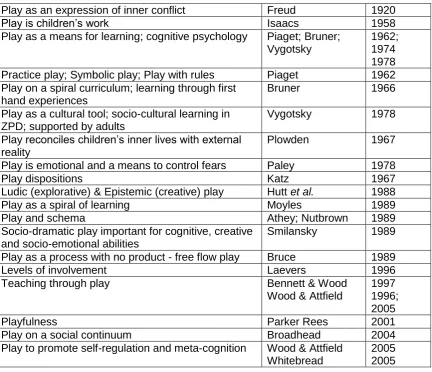
That play is essential for learning has been validated by many contemporary researchers in the field of early years education, including Moyles (1989); Hutt et al. (1989); Anning, (1991) Bruce (1991); Hall & Abbott (1991); Wood & Attfield (1996); Bennett et al. (1997); Sayeed & Guerin (2000); Drake (2001); MacIntyre (2001), Riley (2003) and Broadhead (2005). The first problem to be encountered is its definition, as ‘play’ can cover a range of behaviours related to varied activities (Wood & Attfield, 1996; 2005). Play is an ‘umbrella word’ (Bruce, 1991) and a ‘jumbo category’ (Hutt et al., 1989) which encompasses a multiplicity of activities, most of which are conducive to learning. Throughout the last two centuries there have been a wide variety of theories that all proclaim the importance of play from different perspectives; as Bruce (2004, p.129) observes ‘different theories offer support in different ways’. The complexity of this ‘simple’ activity called play can be seen in the following table:
Table 1.1: Instrumental Theories of Play
View of Play Source Date
Play as an expression of inner conflict Freud 1920
Play is children’s work Isaacs 1958
Play as a means for learning; cognitive psychology Piaget; Bruner; Vygotsky
1962; 1974 1978 Practice play; Symbolic play; Play with rules Piaget 1962 Play on a spiral curriculum; learning through first
hand experiences
Bruner 1966
Play as a cultural tool; socio-cultural learning in ZPD; supported by adults
Vygotsky 1978
Play reconciles children’s inner lives with external reality
Plowden 1967
Play is emotional and a means to control fears Paley 1978
Play dispositions Katz 1967
Ludic (explorative) & Epistemic (creative) play Hutt et al. 1988
Play as a spiral of learning Moyles 1989
Play and schema Athey; Nutbrown 1989
Socio-dramatic play important for cognitive, creative and socio-emotional abilities
Smilansky 1989
Play as a process with no product - free flow play Bruce 1989
Levels of involvement Laevers 1996
Teaching through play Bennett & Wood Wood & Attfield
1997 1996; 2005
Playfulness Parker Rees 2001
Play on a social continuum Broadhead 2004
Play to promote self-regulation and meta-cognition Wood & Attfield Whitebread
2005 2005
[image:20.595.84.517.82.454.2]However there are critics of providing play experiences as a means for learning and of the quality of the actual provision that may be provided in educational settings:
Table 1.2: Critical Theories of Play
View of Play Source Date
Play is just a means to let of steam and to exercise Spencer 1878 Play is heavily idealised Meadows &
Cashdan
1988
Children think work is sitting still or producing something
Tizard et al 1989
Play does not have to be worked at it is deemed less valuable then activities that have measurable
outcomes
Cleave & Brown 1989
Play activities can be low in intellectual challenge Hall & Abbott 1991 Play is tends to be seen as trivial by a male
dominated society which emphasises the power of rational thought
Anning 1994
Play seen as the enemy to education Hirst 1994 Difference between rhetoric and reality in teachers
providing play
Bennett et al. 1997
There is substantial evidence from many researchers that children can demonstrate higher levels of verbal communication, creative thinking, imagination, and problem-solving through play (Wood & Attfield, 1996; 2005; Anning et al., 2004). Play-based learning is highly motivating and enables young children to self-direct their learning, encouraging engagement and concentration (Riley, 2003). Moyles (1989) develops Norman’s (1978) model of accretion to show that play builds on personal experiences and knowledge to create new concepts and experiences:
Accretion - Acquiring new knowledge, facts, information, skills.
Restructuring -Reorganising existing knowledge to accommodate the new and seeing patterns, structures and principles.
Tuning - restructuring guides the acquisition of further new knowledge.
Play emphasises the restructuring, enrichment and discovery - building on personal experiences and knowledge to create new concepts and experiences. This affirms Froebel’s (1782 – 1852) belief that play is the way that children integrate their learning, gain understanding, apply this understanding and begin to work in more abstract ways. All these theories offer insights into the way play enables children to develop their ideas, thoughts, feelings, relationships, knowledge and understanding of the world around them.
In 1967 the Plowden Report gave play a strong endorsement. It stated that play was important for children’s development and that wide ranging and satisfying play is a means of learning.
Adults who criticise teachers for allowing children to play are unaware that play is the principal means of learning in early childhood; it is the way through which children reconcile their inner lives with external reality. In play, children gradually develop concepts of causal relationships, the power to discriminate, to make judgments, to analyse and synthesise, to imagine and to formulate. Children become absorbed in their play and the satisfaction of bringing it to a satisfactory conclusion fixes habits of concentration that can be transferred to other learning. (CACE, 1967 in Pollard 2002, p.143)
children learn. In the 1990s, the move towards a traditional subject based curriculum resulted in most Initial Teacher Training courses focusing mostly on how to deliver subject knowledge. Issues about these different perspectives on knowledge base, curriculum and pedagogy will be explored in later chapters.
Despite a constant validation of play and a widespread agreement that early years education should be play-based from contemporary early years theorists – Rumbold (1990); Moyles et al. (2002); Bennett et al. (1997); House of Commons (2000); QCA (2000), its place in the curriculum was not secure and embedded until recently. Its status and value continued to be questioned at the level of policy by government until its validation in the Curriculum Guidance for the Foundation Stage (2000). Unfortunately there is still a lack of affirmation from parents, and even from primary teachers and headteachers, regarding the place of play in school.
The Researching Effective Pedagogy in the Early Years (Siraj-Blatchford et al., 2002) research demonstrates that some practitioners have a narrow conceptualisation of play - that it was only relevant to some areas of the curriculum. Siraj-Blatchford et al. propose that these practitioners seemed to believe that the involvement of imagination for it was a necessary component before it could be considered to be play. Similarly, when Siraj-Blatchford & Sylva (2005) evaluated the implementation of the foundation phase for the Welsh Assembly Government, they found that some practitioners were not confident about what a play-based pedagogy entailed, and failed to grasp what is meant by children being actively involved in their own learning. There was a general perception that play is accepted as part of what children do outdoors but not indoors!
The debates about the educational value of play derive from this lack of clarity about what is and what is not play (Riley, 2003). This therefore reiterates the importance of educators gaining a through understanding of broadly what constitutes play in an education environment and how to provide rich learning environments. This is important for both early years settings and primary schools.
Ideas in Action
Play for ‘rich’ learning
Brock’s (1999) research demonstrates how children from 5 to 8 years gained curriculum knowledge through practical experiences in an ‘Enchanted Forest’. This was a holistic dramatic environment that enabled the children to play, explore and problem solve collaboratively in an imaginative setting, through story, role-play and drama. The main curriculum area promoted in the Forest was science, but the children also gained a wealth of literacy, technological, geographical and artistic knowledge and skills. The children not only had meaningful experiences, through which they gained understanding of difficult concepts, they had an exciting and enjoyable time! The children were given time to reflect and articulate their knowledge and understanding back to adults, and even when interviewed several years later, they could remember the concepts.
Improving Practice
-Time to allow reciprocity and momentum to build;
-Time for shared goals to be constructed and for play themes to be developed; -Time to become friends;
-Time for problems to be set and solved both socially and cognitively
Our current society is generally so extremely time-poor and we are always rushing children to get on to activity - both in educational settings and in the home environment. In this way, do we teach children that completion is more important than quality, that accomplishment is more important than thinking, that achievement is more important than in-depth understanding? It is therefore crucial that we take on board Broadhead’s (2006) advice and provide time for children to develop in holistic and valuable ways
Reflection: Do you find yourself agreeing with this point of view? Can you think of evidence in practice that supports your standpoint?
Conclusion
Do educators provide enough ‘quality’ time for children to learn through play? Is there a real understanding by educators to provide and to justify why time for play experiences need to occur in a rich learning environment in both early years settings and schools? Siraj-Blatchford et al. (2002) proposed that the richest play experiences occur in nursery, indicating that perhaps schools need to examine their practice, visiting these areas of excellence to help their provision become richer, and so meet children’s developmental needs. The new Early Years Foundation Stage promotes a curriculum and pedagogy that is play-based from birth to five years. The primary review, a large scale research project is ongoing at the time of writing (late 2007), and although this initiative does not include the word ‘play’ in any of its ten themes, it does at least include the collection of a body of pupil voice data, which will no doubt refer to play-based learning at some points. Many Local Education Authorities are not only encouraging that this play-based pedagogy continues throughout Key Stage 1, they are actively ensuring that it is taking place. These are exciting times for advocators for play for learning; perhaps the pioneers of play will soon be able to take a sigh of relief and gasp ‘AT LAST!’
Perspective 3: Playwork: Fraser Brown
Introduction
‘One thing that observation of children makes clear ... is that children will play everywhere and with anything’. (Ward 1978, p.86)
has value not just in terms of individual child development, but also that it contributes to the evolution of the species (Hughes 2001). How does this work?
Key theory and research…
Playwork Principles
The recently redrafted Playwork Principles define play in the following terms:
1. All children and young people need to play. The impulse to play is innate. Play is a biological, psychological and social necessity, and is fundamental to the healthy development and well being of individuals and communities.
2. Play is a process that is freely chosen, personally directed and intrinsically motivated. That is, children and young people determine and control the content and intent of their play, by following their own instincts, ideas and interests, in their own way for their own reasons. (PPSG 2005)
This is an ethos that reflects many previous statements by respected playwork
organisations. For example, the National Occupational Standards for Playwork state:
Children's play is freely chosen, personally directed behaviour, motivated from within; through play, the child explores the world and her or his relationship with it, elaborating all the while a flexible range of responses to the challenges she or he encounters; by playing, the child learns and develops as an
individual. (SPRITO 1992)
And finally, the Joint National Committee on Training for Playwork says:
Play is an innate drive and is essential for human development. It is manifested as behaviour that is freely chosen, personally directed and intrinsically motivated. The value of play derives from the play process itself, not from any extrinsic goal, reward or end product. Play is often spontaneous and unpredictable. Through play children experience their world and their relationship with it. (JNCTP 2002)
Obviously, as Sutton-Smith (1997) has pointed out, definitions such as this cannot be said to be accurate, since they clearly do not apply to all possible instances of play. In fact he represents them as an idealisation of play. Nevertheless, the 'freely chosen, personally directed, intrinsically motivated' mantra is now quite widespread amongst playworkers, probably in response to the type of work they recognise as being their most effective. On a daily basis playworkers see the positive benefits that accrue to children from widening their freedom of choice; enabling them to take control of their environment; and enhancing their self esteem. As has already been mentioned, this not only benefits the individual, but also enables the human species to survive.
Ironically it is Sutton-Smith that is most often quoted in support of that view, because it is he who offers such a cogent argument concerning the links between play and species survival.
Sutton-Smith (2008) identifies a close link between Damasio's (1994) primary emotions (shock, fear, anger, sadness, happiness and disgust) and various forms of play
stage further to suggest that through a dialectical process of action and rebuttal, we learn the survival skills that enable the individual to cope with the daily trials of life. For example teasing involves harassment which when met with resilience may be seen to prepare us for social initiation procedures in later life;risks involve dangers being confronted with courage, which prepares us for the chances we take with our physical and economic fate; etc. He also suggests that play might be seen as an evolutionary mechanism; the means by which human beings adapt to an ever-changing world. We are born with the potential to be adaptable. Through play we develop and refine that ability. We now know that play activity stimulates the brain in such a way that brain cells retain their 'plasticity'. If we don't play, our brain cells rigidify, and our flexibility of thought is reduced. Ultimately we become unable to cope with change, which could have dire consequences both for the individual, and for the future of our species. Thus, Sutton-Smith is making the not inconsiderable claim that play is at the very heart of the evolutionary process.
One strand of playwork theory that follows this line of thinking is based upon Haeckel's (1901) theory of recapitulation, and its subsequent development by first Hall (1904) and then Reaney. This is the idea that each stage in a child's development corresponds to successive adult forms of evolutionary history, and that this is represented in current and future play behaviour. Reaney (1916) suggested that this life summary reveals itself as play periods that correspond to the various evolutionary stages of human history (animal, savage, nomad, pastoral and tribal). Her analysis of this actually makes something of a mockery of her own ideas. For example, she equates the pastoral and tribal stages with doll play, gardening and team games played by children of between 12 and 17 years (Schwartzman 1978, p.47). Most children are engaged in those activities at a much earlier age. Nevertheless, the idea has been taken up strongly by the leading playwork theorist Bob Hughes (2001), who suggests that children have a fundamental biological drive to play, and that there are clear links between certain play forms and the behaviour patterns of our human ancestors. Hughes’s interpretation, which is rooted in his own experience of working with children, makes more sense than Reaney's earlier analysis. He translates the stages in a contemporary context as follows:
animal - children interacting with the elements
savage- cruel interaction with other species
nomad- ranging for mental mapping
pastoral- mastery play e.g. gardening
tribal - membership of gangs and clubs
In an earlier part of this chapter, Pam Jarvis stated that Hall's original idea of recapitulation has largely been discredited. In terms of his interpretation of
evolutionary theory, that is obviously true. However, the general idea of recapitulative play should not be dismissed merely because its early interpretation was incorrect. There can be little doubt that modern day children are born with a genetic make up that suits a bygone age. Biological evolution has certainly not kept pace with social
grow up psychologically and physically detached from their environment. They are then likely to develop a negative and critical approach to the world, rather than a positive and accommodating one.
Hall (1904) suggested it would be counterproductive to push a child ahead of its natural stage of development, and Hughes (2003) has taken this idea as a cautionary warning of the dangers of a certain form of play deprivation. He says children are born with a genetic expectation of the type of play they should experience. If that does not happen, they may become very ill as a result. If children are deprived of the
opportunity to light fires, stamp on insects, play games of chase, etc., we run the risk that they will grow into adults who still feel the need to enact those forms of behaviour (but in a distorted adult mode). Thus, for Hughes, one of the most important roles of the playworker is to recreate environments that allow children to experience
fundamentally recapitulative play.
A second strand of thought that derives from evolutionary psychology is my own theory of compound flexibility (Brown 2003). This is the idea that the most productive
developmental relationship is that between the child and a flexible play environment, and that adults have a responsibility to create and maintain opportunities for that relationship to work effectively. In an ideal world the child would be able to experiment with, and exercise control over the environment. This would produce positive feelings, which would in turn encourage the development of self acceptance and self
confidence. With the development of self confidence the child inevitably becomes a better problem solver, and thus able to make better use of the environment. It is that interrelationship between flexibility in the environment and the development of flexibility in the child that I termed 'compound flexibility'.
The relevance of this theory to playwork lies in the idea that the world in which the UK's children are growing up is an inflexible place. The role of playwork is to create
environments that provide the sort of flexibility that is fast diminishing. As a society the UK is increasingly suspicious of children (perhaps because we see them in our
communities less and less); the growth of traffic means children are no longer able to play on the streets; parental fears mean children are driven to and from school, which means they don't get to play with their friends immediately before and after school; we have a national curriculum that tells children exactly what they should learn during the whole of their school life; we use ASBO's to control their boisterous excesses; etc. Early in 2007 the UNICEF report, An Overview of Child Well-being in Rich Countries, placed the UK bottom of all the western nations in terms of the quality of life of its children. During the same week a second child was shot in London. The
Government's immediate response was not to question the way in which UK society treats its children, but to suggest a new law enabling us to lock up more fifteen year olds.
For example, a child who is playing with a doll, a ball and a box, has the potential to play many different games, and become involved in a wide range of creative activities. Each artefact has its own inherent flexibility, while in combination they have even more potential flexibility. Thus, the investigative and experimental nature of play inevitably leads to the development of problem solving skills. The role of the playworker is to develop environments that offer the child the opportunity, in the words of Brian Sutton-Smith (1992), "to control their own little microcosm of the world."
Playwork is rooted in an understanding that children learn and develop through their play. There are many instances in modern society where that process is interrupted or impaired. Playwork involves identifying and removing barriers to the play process, and enriching the child’s play environment. Playwork is a generic term for a profession that encompasses those occupations where the medium of play is used as the major mechanism for redressing aspects of developmental imbalance (Brown and Webb 2002). This may