International Research Journal of Marketing and Economics
Vol. 3, Issue 3, March 2016 IF- 3.949 ISSN: (2349-0314)© Associated Asia Research Foundation (AARF)
Website: www.aarf.asia Email : [email protected], [email protected]RETALIATING POVERTY THROUGH SUBJECTIVE WELLBEING:A
QUALITATIVE COMPARATIVE ANALYSIS
Satabdi Roy Choudhury
Research Scholar
Department of Business Administration Assam University, Silchar-788011
India
ABSTRACT
Milieu of the Problem
Poverty is a general state of life existing in present which lacks certain amount of possession
which is insufficient to meet basic need. It is a complicated perception which includes lacking
of well-being factors in relation to physical, psychological, social and spiritual elements to
participate fully towards social contribution. Though many policies and government laws
have been formulated after the agricultural and industrial revolution but still fails to assess
the other context of social dimension beyond financial criteria. Today, policy makers should
consider well-being factors which can influence poverty in terms of fostering life satisfaction,
expressing humanity and encouraging the feel good factor while sustaining life.
Objectives of the Study
The paper is based on literature review method to produce a qualitative comparative analysis
between the public policies towards the abatement of poverty and how these policies can be
strengthen by taking subjective well-being factors into consideration.
Aim of Study
This, study aims to explore the objective determinants of poverty and subjective judgement of
self reported assessment of people‟s life. The paper also provides a framework by developing
to get the people out of poverty but also give them a place within the society to participate
effectively towards societal well-being.
Implication of the Study
The paper can be used for any academic and professional relevance as it mainly focuses on
poverty, poverty retaliating programmes and subjective well-being approach to eradicate
poverty. The study can prove beneficial as it provides in-depth analysis of poverty based on
the holistic parameters of subjective well-being to present the diverse impact of poverty upon
life as a whole.
Key Words Government Policies, Poverty, Subjective Being, Social Impact, Well-Being Parameters,
Conceptualising Poverty
The term poverty comes from the old French term „poverte‟ which means „poor‟. In this
regard the word; poverty is a challenging concept which generally refers to, not having
enough money to fulfil the basic needs as food, clothing and shelter. However, the perception
of poverty does not limit itself within this, as the concept very much depend on the
ideological and political context within which it is used. Though, no universal
characterization is available for the term poverty but the term has been defined as: Poverty is
a hunger. Poverty is lack of shelter. Poverty is being sick and not being able to see a doctor.
Poverty is not having access to school and not knowing how to read. Poverty is not having a
job, living one day at a time. Poverty is losing a child to illness brought about by unclean
water. So poverty is a call to action for the poor and the wealthy alike a call to change the
world so that many more may have enough to eat, adequate shelter, access to education and
health, protection from violence, and a voice in what happens in their communities (World
Bank, 2010).
“Absolute poverty is a condition characterised by severe deprivation of human needs,
including food, safe drinking water, sanitation facilities, health, shelter education and
information, it depends not only on income but also on access to social services”
(Copenhagen Summit, 1995).
“Fundamentally, poverty is a denial of choices and opportunities, a violation of human
dignity. It means lack of basic capacity to participate effectively in society. It means not
having enough to feed and clothe a family, not having a school or clinic to go to; not having
credit. It means insecurity, powerlessness and exclusion of individuals, households and
communities. It means susceptibility to violence, and it often implies living on marginal or
fragile environments, without access to clean water or sanitation” Gordon (2005) & United
Nation (June, 1998).
From the past few decades, poverty reduction has become a major goal and global issue
though mainly for the developing country. Today essential ideas underlying the adoption of
strategies for poverty reduction is to reduce the state of privation and lack of necessities in
terms of income, housing tenure, and satisfaction standard of living. Therefore, poverty needs
to be understood as being strongly influenced by the resources that people can claim, under
what conditions and with what level of choice (Suich, 2012). But on the same time the
amount of wealth require for survival is not the same in all the places and time periods as
each country has their own National Poverty Line.
Policies to Retaliate Poverty
Poverty occurs in both developing countries and developed countries. While poverty is much
more widespread in developing countries, both types of countries undertake poverty
reduction measures. Such as:
Poverty alleviation policies involve improving the living conditions of poor people. Providing aid in the field of medical and scientific development is essential inproviding better lives such as Green Revolution etc.
World Bank proposes to provide subsidised fertilizer to the farmers of the poor nationas many of the farmers cannot purchase on market price.
Increasing Foreign Direct Investment (FDI) and Remittances flow to speed up the economic expansion of fast growing Asian nation.
Building quality roads and information network helps market reform which ultimatelyleads to bring economic freedom by making financial service accessible to the poor.
The growing economic development has great potential to retaliate poverty by
simultaneous increase of employment opportunities and increased skilled labour
productivity.
Raising the farm income is one of the core poverty retaliate weapon as estimate shows
that growth in the agricultural productivity of small farmers is effective in benefiting
the poorest half of a country‟s population as growth generated in non-agricultural
sectors. For example, a 2012 study suggested that new varieties of chickpea could
Improving water management is an effective way to help reduce poverty among
farmers. During the Green Revolution of the 1960s and 1970s, for example, irrigation
was a key factor in unlocking Asia's agricultural potential and reducing poverty.
Empowering women has one of the significant areas of discussion. World Bank
suggested that promoting gender equality through empowerment of women is a
qualitatively significant poverty reduction strategy. For example the White Revolution
leads to contribution from women in the form of dairy products marketed under the
name „Amul‟ and small scale industries like „Lijat Papad‟ also gave financial freedom
to women in India.
Thus, regarding above policies, other than the psychologist, many utilitarian‟s such as Jeremy
Bentham, James Mill, John Austin etc., supported the subjective well-being measures to
study the world. According to utility theory, people are best judged on the overall quality of
life and which can be understand by adopting the straightforward strategy of asking to them
either single question or group of questions on the level of life satisfaction or happiness based
on circumstance and comparison to other person (Roy Choudhury & Barman, 2014).
Poverty and Subjective Well-Being
The above policies to reduce poverty through contributed a lot for poverty reduction, but
these policies have number of weakness:
The traditional policies for retaliating poverty does not provide a basis for alternative
measure for calculating other dimension of life (beyond financial increment)
Assessment criterion is not efficient enough to judge that how increase in income or
getting an employment is helpful to reduce well-being deprivation
Policies fail to address the other poverty context (e.g. social dissonance context)
Policies made a contradiction about the concept whether people getting out of poverty
does also means increasing their subjective well-being and giving them a satisfying
Figure 1 Interactive Model of Poverty and Subjective Well-Being
ical
Thus, in the limelight of subjective well-being it can be said that the poverty is not created by
the so called low-income people. They are the victims. The poverty is a vicious cycle created
by the designed economic boundaries and social system within the society.
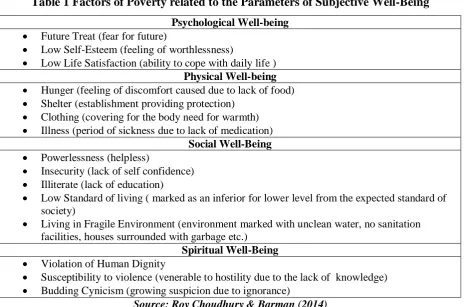
Table 1 Factors of Poverty related to the Parameters of Subjective Well-Being
Psychological Well-being
Future Treat (fear for future)
Low Self-Esteem (feeling of worthlessness)
Low Life Satisfaction (ability to cope with daily life )
Physical Well-being
Hunger (feeling of discomfort caused due to lack of food) Shelter (establishment providing protection)
Clothing (covering for the body need for warmth) Illness (period of sickness due to lack of medication)
Social Well-Being
Powerlessness (helpless)
Insecurity (lack of self confidence) Illiterate (lack of education)
Low Standard of living ( marked as an inferior for lower level from the expected standard of society)
Living in Fragile Environment (environment marked with unclean water, no sanitation facilities, houses surrounded with garbage etc.)
Spiritual Well-Being
Violation of Human Dignity
Susceptibility to violence (venerable to hostility due to the lack of knowledge) Budding Cynicism (growing suspicion due to ignorance)
Source: Roy Choudhury & Barman (2014)
Does Economic Development is Identical to Better Subjective Well-Being? The term
subjective well-being is used as a synonymous to the word „happiness‟ and generally within
the society the economic development is also used as the synonymous of „happiness‟. In this
regard many argument can be stated to question the existence of clearly define the margin
Psychological Well-Being: (Low Self-Acceptance)
Spiritual Well-Being: (Defiance Human Dignity)
Physical Well-Being: (Sullied Lifestyle)
Social Well-Being:
[image:5.595.67.532.356.663.2]between the two variables. Many parameters are utilized by the financial institution as GNP
(Gross National Product), GDP (Gross Domestic Product), HDI (Human Development
Index), Life Expectancy Ratio, Per Capita Income, Mortality Rate etc; to judge the quality of
life. Still there is a nagging worry when we calculate the true implementation of these
parameters. Even if true implementation is tried much less stringent vision is applied for the
elimination of poverty and its supporting factors.
Firstly, per capita income can indicate the wealth in the hands of the people but it does not
indicate that they all have the same amount of money and thus, unable to figure out the
amount of well-being within a country or even within a state (Abdul Kalam & Rajan, 2002).
Secondly, greater economic well-being does not signify greater amount of well-being as the
related subjective well-being can only be achieved through efficient use of the resources.
Therefore, an increase in income may lead to little or no increase in the well-being (Rojas,
2012).
Thirdly, economic progress can also lead to social dysfunctional for example due to rapidly
changing technology many dysfunctional elements can within the society as skills
obsolescence, job insecurity and longer hours of work, which leads to increased stressed and
loosing social ties (OECD, 2001).
Fourthly, economic development does not mean achievement of overall life satisfaction. For
example in US happiness does not increase despite economic growth. Now it has been
realised that though for many decades economic growth being the dominant model now there
should be a search for new models of progress. The model which will not only provide means
to end but also end with fulfilment (World Economic Forum, 2012).
Fifthly, there are many vital wants which does not require economic growth for its fulfilment
as many of which appears social in character than economic. Thus, in recent years some have
began to argue against further trying to raise the material standard of living, claiming that
such increases will do little to raise well-being. These arguments are based on a key finding
in the emerging literature on subjective well-being, called raise well-being, called the “Easterlin paradox,” (Stevenson & Wolfers , 2008).
Sixthly, lone development of material life within the society might be helpful to meet the
basic need only but in order to maintain happiness, being more resilient individual within the
family and a better member within the society, development of moral life is vital and which
broad range of existing measures that go beyond gross domestic product (GDP) to offer a
more complete and accurate picture of how a society and its economy are faring (Leon &
Boris, 2010).
Depending on these symposiums, it can be answered that economic development is not
identical to greater subjective well-being. Therefore, in order to retaliate the poverty only
economic development alone is not sufficient rather the economic development should go
hand in hand with betterment of other domain areas of life.
Subjective Well-Being Approach to Retaliate Poverty The concept of the „subjective
well-being‟ is considered synonyms to the word „happiness‟ and generally referred to an
evaluation of one‟s own life considered as a whole. (Sarracino, 2008) thus, well-being is a
positive outcome which is meaningful for many people and many sectors of society, because
it tells us that people perceive that their lives are going well. The term happiness is also
commonly used in regards to subjective well-being and has been defined variously as “satisfaction of desires and goals” (Barman, & Roy Choudhury, 2013).
A number of study have founded that subjective well-being constructs are strongly associated
with a range of personality traits. As the study conducted by the Camfield, Laura (2006) in
four developing countries of Bangladesh, Ethiopia, Peru and Thailand revealed that the
people of Bangladesh are happy when all needs are fulfilled and have achievements,
Ethiopian men relate their happiness with good health, Peruvian site the happiness with the
time spent with family and Thai people are happy when they have high education and good
friendship..This gives a notable difference of culture that is whether the individualist culture
of western countries are more fascinated towards subjective well-being rather than the
collectivist culture of eastern countries (Stocks (South Africa), April (South Africa), Lynton
(China ,2012).
Therefore, subjective well-being approach to retaliate poverty is based on broad category of
phenomena that includes people emotional responses, domain satisfactions and global
judgements of life satisfaction. Each of the specific construct needs to be understood in their
own rights, yet the components often correlate substantially [....]” (Diener, Suh, Luca and
Smith, 1999).
Today‟s economic context has radically changed, we are practicing such a economic
model where most of the poverty policies and programmes are directed towards
rights etc; without any basis of knowledge of its actual requirement. But subjective
well-being methods are based on survey questions which are declared as an answer as
improvement in which sphere will lead to maximum life satisfaction.
It has been seen that performance of the world economy between 2004 and 2007 may
have been achieved at the expense of future. But very soon it became clear that some
of the performance was a “mirage”, profit that was based on price that had been
inflamed by the bubble (Stiglitz, Sen, Fitoussi). But subjective well-being works with
the well-being of sustainable development by taking every domain of life rather than
making policies on academically defined agents as Human Development Index (HDI),
Index of Social Progress, and Measuring of economic welfare Index etc.
The Great Recession which also referred as lesser depression which occur at
December 2007 and lead to sharp down turn of countries economic structure in
September 2008 is mainly due to the one headed direction to lessen poverty by
blocking money within the country though creation of hedge funds resulting
bankruptcy and huge money loss. In this regard subjective well-being approach states
that it is better to create a proper measurement on the usage of money on each of the
factors contributing to poverty to avoid systematic imbalance. Thus subjective
well-being adopts a straight forward strategy of asking questions based on on-going life
situation.
Though financial bodies provide a logical system design to measure subjective social
performance of the society as sustainable economic welfare and genuine progress
indicators measuring income distribution, net capital growth, resource depletion etc.,
but the system take the bird eye view picture of the societal structure and does not
provide person to person variation and his/her view of the countries situation. Here,
subjective well-being believes that the people living in and facing the every aspect
and impact of governments‟ policies has the lone authority to assess his well-being as
being well or not is essentially a subjective experience.
The coming of various behavioural model, challenges the traditional economic
indicators, as subjective well-being approach typically forms the basis for alternative
measure for calculating well-being. For instance the economic indicator does not
provide the explanation for social dissonance context of poverty, that is, the existence
of certain social elements which are known to be immoral or unethical but still these
elements are: racism, caste-related violence, gender biasness, regional hostility
leading to state division etc.
Lastly, subjective well-being approach tries to provide an overview: “shift emphasis
from measuring economic production to measuring people‟s well-being” (Stiglitz, Sen,
Fitoussi). As income and consumption calculation of households provide the
statistical result in terms of standard of living but the real motive of these behind the
consumption goods and services is to increase the current well-being at the expense of
its future well-being. Moreover, life satisfaction goes beyond economic perception of
the state; rather, it embraces people‟s health, everyday activities, environment they are
living etc.
Thus, the subjective well-being approach to retaliate poverty aimed at reaching policy makers
to provide them a holistic sense of the different domains of life and as well as which of these
domain areas needs more attention to foster greater well-being and social progress. The
subjective well-being approach takes into account the inter-disciplinary mode of study to
[image:9.595.68.530.375.764.2]understand the complexity of the wellbeing.
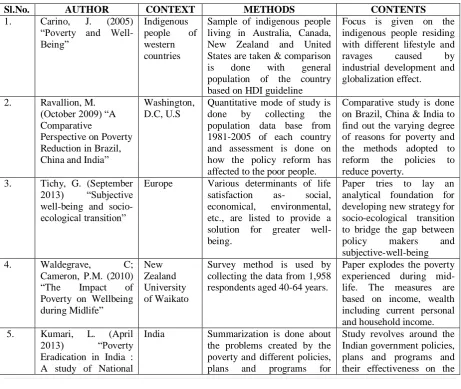
Table 2 Review Matrix
Sl.No. AUTHOR CONTEXT METHODS CONTENTS
1. Carino, J. (2005) “Poverty and Well-Being”
Indigenous people of western countries
Sample of indigenous people living in Australia, Canada, New Zealand and United States are taken & comparison is done with general population of the country based on HDI guideline
Focus is given on the indigenous people residing with different lifestyle and ravages caused by industrial development and globalization effect.
2. Ravallion, M. (October 2009) “A Comparative
Perspective on Poverty Reduction in Brazil, China and India”
Washington, D.C, U.S
Quantitative mode of study is done by collecting the population data base from 1981-2005 of each country and assessment is done on how the policy reform has affected to the poor people.
Comparative study is done on Brazil, China & India to find out the varying degree of reasons for poverty and the methods adopted to reform the policies to reduce poverty.
3. Tichy, G. (September 2013) “Subjective well-being and socio-ecological transition”
Europe Various determinants of life satisfaction as- social, economical, environmental, etc., are listed to provide a solution for greater well-being.
Paper tries to lay an analytical foundation for developing new strategy for socio-ecological transition to bridge the gap between policy makers and subjective-well-being 4. Waldegrave, C;
Cameron, P.M. (2010) “The Impact of Poverty on Wellbeing during Midlife”
New Zealand University of Waikato
Survey method is used by collecting the data from 1,958 respondents aged 40-64 years.
Paper explodes the poverty experienced during mid-life. The measures are based on income, wealth including current personal and household income. 5. Kumari, L. (April
2013) “Poverty Eradication in India : A study of National
India Summarization is done about the problems created by the poverty and different policies, plans and programs for
policies, plans and
Programs” poverty eradication based on secondary data collected through the websites, journals and newspapers.
eradication of the poverty and controlling of marginalized people within the society.
6. Office of the United Nations High Commissioner for Human Rights
New York A framework of human rights is discussed and guidelines on equality, human rights, indication on poor are given to reduce poverty from the root.
The importance of human right approach is discussed to reduce the poverty and its inter-related factors.
7. Foresti, M; Ludi, E with Griffiths, R (2007). “Human Rights and Livelihood Approaches for Poverty Reduction”
Switzerland A qualitative comparative study on the key factors as SLA‟s & HRBAs is done and how the combination of this two factors can contribute reduce poverty
A briefing paper finds the two key factor- Sustainable Livelihood Approaches (SLAs) & Human-Rights Based Approaches (HRBAs) to analyse the reasons for poverty. 8. Costanza, R; Hart, M;
Posner, S; Talberth, J. (January 2009) “Beyond GDP: The Need for New Measures of Progress”
United States, Boston University
Qualitative mood of study is conducted and discussion is presented on various economic indicators as HDI, GDP, with relation to well-being indictors as NGH, Living planet report & Happy planet Index.
Paper focuses to search for better indicators of well-being excluding the GDP as it is used sometimes inappropriately. As GDP can measure economic quantity not Quality.
9. Wartenberg, J. (May 2011) “Human Well-Being at the Heart of Economics”
United States
Critical review is prepared on the economic model of measuring well-being as many of the well-being measure are absent as reproduction and economic sustainability.
Discussion is done on the 2007 great depression on US and the worst impact on the well-being of the people‟s daily life.
10. New Economic Foundation- NEF (2012) a registered charity. “The Happy Planet Index”
United Kingdom
The report developed the first global measure of sustainable development on the basis of life-expectancy and ecological foot prints for the upcoming future generation.
The report provides a comparison of well-nations with nations having lack of well-being in terms of how well-nations are supporting their inhabitants to live good life.
11. Conceição, P & Bandura, R,
“Measuring Subjective Wellbeing: A
Summary Review of the Literature”
United Nations
Qualitative mood of study is conducted where objective and subjective GDP measures on well-being and its flaws are discussed with alternative measures on well-being.
Paper mainly outlines the growing literature of subjective well-being. Focus is mainly on single multi-dimensional in nature of well-being.
12. UK Department for International Development (April 2012) “Understanding Poverty and Well-Being ”
United Kingdom
Various unresolved challenges and gaps in current knowledge of poverty are highlighted and key future research direction is also stimulated.
Main purpose of the discussion is to focus on further quality research on poverty to help identify the limitation in contemporary research on poverty. 13. Lao People‟s
Democratic Republic, “National Growth and Poverty Eradication Strategy (NGPES)”
Laos Implementation of the NGPES is one by taking many major cross-sectors as private, government, agriculture & forestry, infrastructure etc; for broad based country development.
A strategic framework is produced for the least-developed countries to develop poverty eradication programmes to enhance growth and reducing poverty by 2020.
14. IMF (January 2011) & MFEA, Tanzania (July 2010) “National Strategy for Growth and Reduction of
Tanzania, Africa
A series of strategies ranging from sector specific to multi-sartorial strategies are developed into three clusters to fight back the poverty.
Poverty II /
MKUKUTA” people.
15. Alkire, S & Sarwar, B.M(January 2009) “Multidimensional Measures of Poverty & Well-being”
United Kingdom
Case study method is adopted and 6 countries were taken to understand the multi-dimensional approach to alleviate poverty and increase well-being.
Paper emphasises the importance of multi-dimensional approach for measuring poverty. This takes a broader spectrum to know policies and flaws. 16. Morduch, J & Haley,
B (June 2002) “Analysis of the
Effects of
Microfinance on Poverty Reduction”
Canada Qualitative method of study is conducted where various micro-finance programs present worldwide is discussed to understand the effect its effect on varying degree of poverty
Role of microfinance is emphasised to reduce poverty and importance is given on the synergy between microfinance and other poverty eradication programs.
17. Shaffer, P (2001), “New Thinking on Poverty: Implications for Poverty Reduction Strategies”
United Nations
Co-relational mood of study is conducted by examining the existing policies against poverty and developing a new concept for poverty eradication.
Three main changes are generated as a new thinking on poverty eradication with combination of already existing policies and programs for fighting back poverty.
18. Bonilla G. A & Gruat, J.V. (2003) “Social Protection: A Life Cycle Continuum Investment for Social Justice, Poverty Reduction and Sustainable Development”
Geneva, Switzerland
Qualitative method is adopted to prepare a conference report for ILO on social protection as an integral path to poverty eradication.
Poverty is redefined in terms of social protection v/s „no‟ social protection and its status in the global era as it‟s an important need towards well-being.
19. UNDP (December 2006) “What is Poverty? Concepts and Measurement”
United Nations
Analytical study is done by dividing the concepts into various clusters and then tested to value the meaning of well-being for people under poverty.
Concept of poverty is analysed in terms of inequality and on various approaches. Research based policies are recommended for its reduction.
20. Greeley, M (1994) “Measurement of Poverty and Poverty of Measurement” University of Sussex, United Kingdom
Discussion is proposed by highlighting the income as a core factor for poverty reduction. Income is presented as only source of welfare.
Paper presents the argument against the well-being measure which is confused with poverty reduction measure.
Conclusion
The paper addresses the subjective well-being approach to retaliate poverty, which can
provide a wonderful guideline to fight back the root cause of poverty and as well as the
factors contributing to its origin. The paper presents a cause effect cyclic relation between the
poverty and self assessed condition of the people‟s life within the society with the help of
four parameters of the subjective well-being. In order to understand the relation more closely,
various literature review on the various context has been illuminated. Though, a thorough
analysis of the poverty with a relation to subjective well-being has been discussed but the
study is limited only to the qualitative basis. Hence, there could be many other determinants
government laws and well-being tools. Hence, poverty is a global challenge which demand
more holistic thinking beyond the financial and employment terms and therefore, could
extend to many other dimensions leading to future research.
Reference
1. Abdul Kalam, A P J with Rajan, Y S (2002), “INDIA 2020 A Vision for the New
Millennium” first published in Vikings by Penguin Books, New Delhi-110 017, ISBN
9780140278330
2. Alkire, Sabina & Sarwar, (January 2009), “Multidimensional Measures of Poverty &
Well-being”, Department of International Developmet, Oxford, United Kingdom (Available online at URL http://www.ophi.org.uk/wp-content/uploads/OPHI-RP-6a.pdf; assessed 6th march 2014)
3. Bonilla & Gruat (November 2003) “Social Protection: A Life Cycle Continuum
Investment for Social Justice, Poverty Reduction and Sustainable Development”,
Version1.0 (Available online at URL
http://www.ilo.org/public/english/protection/download/lifecycl/lifecycle.pdf; assessed on 12th march 2014)
4. Barman. Dr. A & Roy Choudhury, S (2013), “Subjective wellbeing of corporate employees - development in the research context”, (Available online at URL http://papers.ssrn.com/sol3/papers.cfm?abstract_id=2257097)
5. Roy Choudhury, S & Barman, Dr. A (March 2014), “Holistic Model of Subjective Well-Being -A Proposed Model and Exploration of Contents”, ZENITH International
Journal of Multidisciplinary Research Vol.4 (3) (Available online at URL
zenithresearch.org.in; assessed on 1st march 2014)
6. Copenhagen Summit (1995) “World Summit on Social Development”, (Available
online at URL
http://www.thl.fi/thl-client/pdfs/b8f78a80-ac1d-49ff-a50a-f6e14fd80dde ; assessed on 7th march 2014.)
7. Carino & Jijo (2005), “Poverty and Well-Being” (Available online at URL
http://www.un.org/esa/socdev/unpfii/documents/SOWIP_chapter1.pdf; assessed on 9th march 2014)
8. Camfield, L (December 2006) “The Why and How of Understanding „Subjective‟
well-being: Exploratory Work by the WeD Group in Four Developing Country”, (Available online http://www.welldev.org.uk/research/workingpaperpdf/wed26.pdf, Accessed on 25th April 2013)
9. Cahyat et al., (2007), “Assessing Household Poverty and Wellbeing”, (Available
online at http://www.cifor.org/publications/pdf_files/Books/BCahyat0701.pdf;
assessed on 5th march 2014)
10.Costanza et al., (January 2009), “Beyond GDP: The Need for New Measures of
Progress”, the pardee papers no. 4 (Available online at URL
http://www.bu.edu/pardee/files/documents/PP-004-GDP.pdf; assessed on 9th march
2014)
11.Conceição et al., “Measuring Subjective Wellbeing: A Summary Review of the
Literature”, (Available online at URL
http://web.undp.org/developmentstudies/docs/subjective_wellbeing_conceicao_bandu ra.pdf; assessed on 11th march 2014)
12.Diener et al., (1999), “Subjective Well-Being: Three Decades of Progress”,
http://dipeco.economia.unimib.it/persone/stanca/ec/diener_suh_lucas_smith.pdf; accessed on 12thOctober 2013)
13.Foresti et al., (2007), “Human Rights and Livelihood Approaches for Poverty
Reduction”, (Available online at URL
http://www.odi.org.uk/sites/odi.org.uk/files/odi-assets/publications-opinion-files/2297.pdf; assessed on 12th march 2014)
14.Greeley, M (1994) “Measurement of Poverty and Poverty of Measurement”, Bulletin
of Institute of Development Studies, (Available online at URL
http://www.ids.ac.uk/files/dmfile/greeley25.2.pdf; assessed on 3rd march 2014) 15.Gordon, Dr. David (2005) “Indicators of Poverty and Hunger” (Available online at
URL http://www.un.org/esa/socdev/unyin/documents/ydiDavidGordon_poverty.pdf ; assessed on 7th March 2014)
16.International Monetary Fund (January 2011) & Ministry of Finance and Economic
Affairs, Tanzania (July 2010), “National Strategy for Growth and Reduction of
Poverty II” / MKUKUTA (Available online at URL
http://www.imf.org/external/pubs/ft/scr/2011/cr1117.pdf; assessed on 12th march
2014)
17.Kumari, Lalita (April 2013), “Poverty Eradication in India: A study of National
policies, plans and Programs”, (Available online at URL
http://www.researchersworld.com/vol4/issue2/Paper_10.pdf; assessed on 5th march
2014)
18.Leon et al., (2010),“The State of Society Measuring Economic Success and Human
Well-Being”, (Available online at URL
http://www.partnershipway.org/get-
connected/social-wealth-indicators/the-state-of-society-measuring-economic-success-and-human-well-being/FINAL-state-of-society.pdf; assessed on 8th March 2014)
19.Lao People‟s Democratic Republic, “National Growth and Poverty Eradication
Strategy (NGPES)” (Available online at URL
http://www.sunlabob.com/data/documents/energy_issues/LG-National_Growth_and_Poverty_Eradication_Strategy.pdf; assessed on 12th march
2014)
20.Morduch & Haley (June 2002) “Analysis of the Effects of Microfinance on Poverty
Reduction”, (Available online at URL
http://www.microfinancegateway.org/gm/document-1.9.29382/analysis%20of%20the%20effects.pdf; assessed on 6th march 2014)
21.New Economic Foundation- NEF (2012) a registered charity, “The Happy Planet
Index”, (Available online at URL http://www.happyplanetindex.org/assets/happy-planet-index-report.pdf; assessed on 9th March 2014)
22.Organization for Economic Co-Operation and Development – OECD (2001),
“Well-being of Nations: The Role of Human and Social Capital” (Available online at URL
http://www.oecd.org/site/worldforum/33703702.pdf; assessed on 8th march 2014)
23.Rojas, Mariano (December 2007), “Enhancing Poverty-Abatement Programmes: A
Subjective Well-Being Contribution”, (Available online at URL
http://www.welldev.org.uk/research/workingpaperpdf/wp37.pdf ; assessed on 3rd march 2014)
24.Rojas (December 2012), “Do People in Income Poverty Use Their Income
Efficiently? A subjective well-being approach”, (Available online at URL
file:///C:/Users/Lenovo/Downloads/wp2012-110.pdf; assessed on 8th march 2014)
25.Ravallion (October 2009), “A Comparative Perspective on Poverty Reduction in
http://elibrary.worldbank.org/doi/pdf/10.1596/1813-9450-5080; assessed on 6th march 2014)
26.Stiglitz et al., “Report by the Commission on the Measurement of Economic
Performance and Social Progress” (Available online at URL
http://www.stiglitz-sen-fitoussi.fr/documents/rapport_anglais.pdf; assessed on 8th march 2013)
27.Shaffer (2001), “New Thinking on Poverty: Implications for Poverty Reduction
Strategies”, (Available online at URL
http://www.un.org/esa/socdev/social/papers/paper_shaffer.pdf; assessed on 7th march 2014)
28.Stevenson, Betsey &Wolfers, Justin (August 2008), “Economic Growth and
Subjective Well-Being:Reassessing the Easterlin Paradox” (Available online at URL http://ftp.iza.org/dp3654.pdf; assessed on 7th March 2014)
29.Sarracino (2008), “Subjective Well-Being in Low Income Countries: positional,
relational and social capital components”, (Available online at URL
http://www.mps.it/NR/rdonlyres/4407FFBE-7442-490C-AD49-C03F0CBBB027/34058/Sarracino.pdf, Accessed on 15th August 2013)
30.Suich, (27th February 2012), ESPA Impact Researcher, ESPA Directorate
“Conceptual Framework: Poverty”, (Available online at URL
http://www.espa.ac.uk/files/espa/Povertyframework.pdf; assessed on 4th March 2014)
31.Stocks et al., (2012), “Locus of control and subjective well-being – a cross-cultural study, Peoblems and perspectives in management”, Vol-10, (Available online at URL http://www.ceibs.edu/images/bmt/bmtevents/mediaevents/2012/03/31/56B8646D873 F105BB20645C741A90690.pdf, accessed on 2013)
32.Tichy (September 2013), “Subjective well-being and socio-ecological transition”
(Available online at URL
http://www.foreurope.eu/fileadmin/documents/pdf/PolicyPapers/WWWforEurope_Po licy_Paper_006.pdf; assessed on 8th march 2014)
33.United Nations Development Programme –UNDP (December 2006), “What is
Poverty? Concepts and Measurement” (Available online at URL
http://www.ipc-undp.org/pub/IPCPovertyInFocus9.pdf; assessed on 8th march 2014)
34.UK Department for International Development (April 2012), “Understanding Poverty
and Well-Being”, (Available online at URL
http://www.odi.org.uk/sites/odi.org.uk/files/odi-assets/publications-opinion-files/7654.pdf ; assessed on 12th march 2014)
35.World Bank (2010), “Overview: Understanding, measuring and overcoming poverty”,
(Available online at URL
http://www.colorado.edu/philosophy/heathwood/pdf/worldbank.pdf ; assessed on 7th March 2014)
36.Waldegrave et al., (2010),“The Impact of Poverty on Wellbeing during Midlife”, New
Zealand, Journal of Psychology, Vol. 39, No. 2 (Available online at URL
http://www.psychology.org.nz/cms_show_download.php?id=969; assessed on 28th
February 2014)
37.Wartenberg (May 2011), “Human Well-Being at the Heart of Economics”, A briefing
paper from the Global Women‟s Project (Available Online at
https://www.coc.org/files/Briefing-Paper-5-Human-Wellbeing(1).pdf; assessed on 9th
march 2014)
38.World Economic Forum (2012), “Well-being and Global Success” (Available Online