0095-1137/10/$12.00 doi:10.1128/JCM.01881-09
Copyright © 2010, American Society for Microbiology. All Rights Reserved.
Comparison of Two Matrix-Assisted Laser Desorption Ionization–Time
of Flight Mass Spectrometry Methods with Conventional
Phenotypic Identification for Routine Identification
of Bacteria to the Species Level
䌤
Abdessalam Cherkaoui,
1* Jonathan Hibbs,
2Ste
´phane Emonet,
1Manuela Tangomo,
2Myriam Girard,
2Patrice Francois,
2and Jacques Schrenzel
1,2Clinical Microbiology Laboratory1and Genomic Research Laboratory,2Service of Infectious Diseases, University of Geneva Hospitals (HUG), CH-1211 Geneva 14, Switzerland
Received 23 September 2009/Returned for modification 23 November 2009/Accepted 9 February 2010
Bacterial identification relies primarily on culture-based methodologies requiring 24 h for isolation and an additional 24 to 48 h for species identification. Matrix-assisted laser desorption ionization–time of flight mass spectrometry (MALDI-TOF MS) is an emerging technology newly applied to the problem of bacterial species identification. We evaluated two MALDI-TOF MS systems with 720 consecutively isolated bacterial colonies under routine clinical laboratory conditions. Isolates were analyzed in parallel on both devices, using the manufacturers’ default recommendations. We compared MS with conventional biochemical test system iden-tifications. Discordant results were resolved with “gold standard” 16S rRNA gene sequencing. The first MS system (Bruker) gave high-confidence identifications for 680 isolates, of which 674 (99.1%) were correct; the second MS system (Shimadzu) gave high-confidence identifications for 639 isolates, of which 635 (99.4%) were correct. Had MS been used for initial testing and biochemical identification used only in the absence of high-confidence MS identifications, the laboratory would have saved approximately US$5 per isolate in marginal costs and reduced average turnaround time by more than an 8-h shift, with no loss in accuracy. Our data suggest that implementation of MS as a first test strategy for one-step species identification would improve timeliness and reduce isolate identification costs in clinical bacteriology laboratories now.
Pathogen identification is crucial to confirm bacterial infec-tions and to guide antimicrobial therapy. Clinical laboratories develop ever more rapid, cost-effective, and reliable methods for bacterial identification. Identification to the species level typically requires numerous consecutive steps based on defined phenotypic assays. Definitive results require 24 to 36 h after isolation, using conventional approaches.
Rapid bacterial identification should benefit from molecular methods. The PCR is one of the most sensitive of such meth-ods. Most PCR-based identifications in current clinical use rely on amplification of conserved genes, such as those encoding elongation factors (20) or RNA polymerase (rpoB) (6), or ribosomal DNA genes (10, 26), followed by detection of spe-cies-specific sequences in the product (12, 13). In some cases, species-specific genes, such as those encoding cytotoxins (4), can be amplified at the outset. Enhanced strategies include the use of multiplexing (14, 26) or of highly parallel techniques, such as diagnostic DNA microarrays (5, 8), to amplify and detect multiple sequences at once. Since each PCR primer can be considered a separate reagent, the quality control issues of such testing become more formidable with each additional gene target. Cost and workload requirements for microarray or
multiplexing technology currently preclude their routine use on every isolate.
PCR-based identifications are further complicated by pro-cedures needed to get the sample ready. PCR theoretically permits identification of slow-growing organisms and has been used even to establish pathogenesis by noncultivable organisms in clinical research (22). Most PCR-based bacterial identifica-tions performed in the routine clinical laboratory, however, still require nucleic acids obtained from isolated colonies. Di-rect PCR of clinical samples is usually restricted to detecting a small number of species and to a specific sample (typically a normally sterile body fluid, such as cerebrospinal fluid or plasma) (14, 26), which must be extracted in such a way as to preserve nucleic acids while removing PCR inhibitors.
Matrix-assisted laser desorption ionization–time of flight mass spectrometry (MALDI-TOF MS) is another molecular analytic tool which may prove helpful diagnostically. MALDI-TOF MS has been used extensively as a research tool for protein analysis and was applied recently to clinical microbiol-ogy (15, 21). Compared with conventional phenotype- or PCR-based identification, MALDI-TOF MS shows rapid turn-around time, low sample volume requirements, and modest reagent costs. Peptide or protein mass-to-charge (m/z) values form mass spectral peaks, indicating the molecular masses and charge densities of components present in a biological sample. These spectra can generate pathognomonic patterns that pro-vide unbiased identifications of particular species and even genotypes within species. Due to short turnaround times and readily interpretable data, MALDI-TOF MS has long been
* Corresponding author. Mailing address: Clinical Microbiology Laboratory, Service of Infectious Diseases, University of Geneva Hospitals (HUG), CH-1211 Geneva 14, Switzerland. Phone: 41 22 3727321. Fax: 41 22 3727312. E-mail: [email protected].
䌤Published ahead of print on 17 February 2010.
1169
on May 16, 2020 by guest
http://jcm.asm.org/
popular for protein identification in mixtures of moderate complexity. MALDI-TOF MS has characterized the ribosomal proteins fromEscherichia coli (1, 7) and distinguished muta-tions involved in antibiotic resistance (7). Pineda et al. (18) used MALDI-TOF MS for identification of intact microorgan-isms based on biomarker masses derived from ribosomal pro-teins. A recent article by Williams et al. (24) discusses the experimental factors that affect the quality and reproducibility of bacterial analysis by MALDI-TOF MS.
Previous studies of MALDI-TOF MS had limited reproduc-ibility, increasing variability within and between laboratories. Substantial efforts have led to standardized sample preparation protocols (3), leading to improved reproducibility, databases, and analytical tools (16, 21). It is these newer-generation meth-ods that we compare with state-of-the art sequence-based and conventional biochemical identifications in the present study. In order to prove the usefulness of MALDI-TOF MS for clinical testing, it is necessary to show the method to be appli-cable to a wide diversity of clinically relevant organisms and demonstrate that variations in growth conditions in the clinical laboratory have minimal impact. The goal of this study was to use standardized data collection to assess the performance of MALDI-TOF MS analysis under real routine laboratory con-ditions. The intent was to evaluate MALDI-TOF MS as a first-test strategy, that is, a single test capable of identifying most isolates accurately in a short time frame, with ambiguous results set up for secondary testing only if the MALDI-TOF MS failed.
A key requirement for successful application of MALDI-TOF MS and other proteomics strategies is the assembly of mass databases that allow experimental data to be character-ized based on matching profiles. The MALDI-TOF MS instru-ment serves little diagnostic purpose on its own; rather, it must be combined with such a database in a MALDI-TOF MS system. This approach shows appreciable discrimination power and was successfully used for rapid identification of Burkhold-eria cepaciacomplex species recovered from cystic fibrosis pa-tients (17). The exquisite reproducibility of MS-based bacterial identification relies on measurement of several highly abun-dant proteins, including many ribosomal proteins. Because ri-bosomal proteins are part of the cellular translational machin-ery, they are present in all living cells. As a result, the MS protein fingerprints are not significantly influenced by variabil-ity in environmental or growth conditions (11) and encompass targets widely used for identification of bacteria to the species level (25).
This study compares two commercially available MALDI-TOF MS devices, databases, and related analytical tools with common biochemical tests routinely used for bacterial species identification. We use PCR and sequence-based identification of 16S rRNA genes to resolve discrepancies. Outcome mea-sures include the accuracy of speciation, turnaround time, cost, and ease of use of the different methods. Our major objective was to assess whether MS-based species identification, used immediately after isolation, could reduce laboratory turn-around time and cost without sacrificing accuracy.
MATERIALS AND METHODS
Setting.The Hospital of the University of Geneva is a 2,200-bed health care center providing primary and tertiary care for Geneva (Switzerland) and
sur-rounding areas. The Bacteriology Laboratory of the hospital receives all clinical specimens sent for bacterial culture from the hospital and its outpatient clinics, as well as several outlying clinics. The laboratory also serves as a reference center, receiving isolates for identification from other clinical bacteriology lab-oratories in Switzerland and the rest of Europe. Every year the laboratory reports more than 150,000 analyses of clinical specimens.
Bacterial strains.In order to capture a broad diversity of clinical isolates encountered in a large clinical microbiology laboratory, all 720 clinical isolates identified by conventional methods during 21 consecutive days were included in this study.
Routine identification.Bacterial identification in our laboratory uses CLSI standard methods. In brief, isolates are first evaluated based on plate morphol-ogies after overnight growth, typically 24 h after the specimen is received. Col-onies consistent withE. colion eosin methylene blue agar are confirmed with rapid indole testing only; colonies consistent withStaphylococcus aureus are confirmed with rapid catalase, the Pastorex Staph-Plus latex agglutination test (Bio-Rad, Marnes-la-Coquette, France), and coagulase testing. Isolates con-firmed by rapid testing are reported within 4 h of isolation, while isolates which are not confirmed or for which rapid test confirmation is not available must be identified with more-extensive biochemical panels, principally the API and Vitek2 identification systems. Identifications using these supplementary methods in the clinical laboratory typically require an additional 24 h after isolation before species identification can be reported.
16S rRNA gene sequencing and sequence analysis.DNA was extracted with the MagNAPure LC DNA isolation kit II (Roche Molecular Biochemicals, Mannheim, Germany) according to the manufacturer’s instructions. PCR am-plification of the full 16S rRNA gene was performed as previously described (2, 4, 10) using the primers BAK11w and BAK2 (Eurogentec, Seraing, Belgium). Amplicons were purified and sequenced using the primer BAK11w. Fragments were analyzed using an automatic DNA sequencer (ABI Prism 3130 XL genetic analyzer; Applied Biosystems, Foster City, CA) and queried against both local and public databases.
Harvesting of bacteria for MALDI-TOF MS.All organisms were grown over-night on defined agar medium and simultaneously assessed during a single determination on both MALDI-TOF systems. For MS-based determination, colonies were picked from the nonselective sheep blood agar plate for aerobic bacteria, from the CDC anaerobic sheep blood agar for anaerobic bacteria, from chocolate agar forHaemophilusspp., and from Karmali medium for Campy-lobacter. Two laboratory technologists were in charge of performing the MS analyses by rotating on the two systems after a 1-week training period to avoid any learning bias.
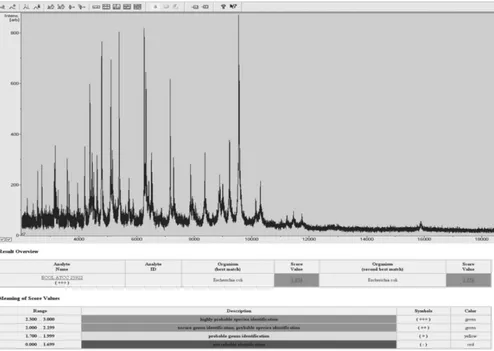
Bruker MALDI-TOF MS system.MALDI target plates were inoculated by picking a freshly grown overnight colony with the tip of a sterile toothpick and smearing the specimen directly onto a ground steel MALDI target plate in a thin film. The microbial film was then overlaid with 1.5l of a MALDI matrix (a saturated solution of␣-cyano-4-hydroxy-cinnamic acid in 50% acetonitrile–2.5% trifluoroacetic acid) and allowed to dry at room temperature. Mass spectra were acquired using the MALDI-TOF spectrometer in a linear positive mode (Mi-croflex; Bruker Daltonics). Measured mass spectra ranged from 2,000 to 20,000 Da. Figure 1 shows a typical spectrum, derived fromE. coli(American Type Culture Collection 25922). We emphasize, however, that comparisons of spectra were entirely automated, and it was never necessary to print such a spectrum for identification purposes. Extraction of the peaks from the generated mass spectra and their matching against the reference spectra (“main spectra”) of the inte-grated database provided by the manufacturer was performed with MALDI Biotyper software (Bruker Daltonics). The score value is defined by three com-ponents, the matches of the unknown spectrum against the main spectrum, the matches of the main spectrum peaks against the unknown spectrum, and the correlation of intensities of the matched peaks. This leads to a first score, from 0 (no match) to 1,000 (perfect identity), which is converted into a log score from 0 to 3. When the score wasⱖ1.7, the identification was considered high confi-dence based on communication from the manufacturer. When the score was
⬍1.7, a second attempt was performed on another run, and the higher of the two scores was used for analysis. Final scores of⬍1.7 were considered ambiguous identifications.
Shimadzu MALDI-TOF MS system. The FlexiMass MALDI target plates were inoculated by picking a freshly grown overnight colony with the tip of a sterile toothpick and smearing the specimen directly onto the plate. Matrix solution (0.5l of 20 mg 2,5-dihydroxy benzoic acid dissolved in a 1-ml water-ethanol-acetonitrile [1:1:1] mix) was added to each sample and allowed to dry at room temperature. Mass spectra were generated with the Axima Assurance system (Shimadzu Corporation), using the Shimadzu Launchpad software pro-gram and the SARAMIS database application (AnagnosTec GmbH) for
on May 16, 2020 by guest
http://jcm.asm.org/
matic measurement and identification. The score values are determined by com-parison against the superspectra for confidence identification and allow the identification on the family, genus, and species levels. When the score was ⱖ70%, identification was considered high confidence. When the score was
⬍70%, a second attempt was performed on another run, and the higher of the two scores was used for analysis. Final scores of⬍70% were considered ambig-uous identifications based on information provided by the manufacturer.
Discordant results.Both MS system results were compared to phenotypic bacterial identifications routinely performed in our laboratory. When MS and phenotypic identifications agreed at the species level, we considered MS species identification correct and no further determination was performed. When the methods gave discordant results, we performed 16S rRNA gene sequencing as the “gold standard” identification method. MS results discordant with conven-tional phenotyping but concordant with 16S identification were considered cor-rect, while MS results discordant with 16S identification were considered incorrect. No further characterization to improve strain identification (e.g.,sodA-based se-quencing for coagulase-negative staphylococci) (19) was attempted in this study, since our goal was to compare MS-based results against current routine practice. Similarly, we did not employ separate extraction procedures recommended by the manufacturers for individual species.
Timeliness estimates.We defined timeliness as the time between colony iso-lation and species identification, since the initial colony isoiso-lation was the same for all methods. ForS. aureusandE. coli, we estimated the timeliness of con-ventional methods as 1 h for Gram stain and rapid species confirmation. For all other species, we estimated the timeliness of conventional methods as 24 h for completion of more-extensive phenotypic identification tests. For MS
identifica-tions, we estimated timeliness as 5 min. (In our experience, these figures tend to underestimate the time required for most conventional identifications and over-estimate the time required for MS identifications). We over-estimated the time re-quired for PCR followed by 16S sequence matching as one working shift, or approximately 8 h.
Cost estimates.All cost estimates are in U.S. dollars and reflect the actual costs to our laboratory rather than charges to the patient. The marginal cost of MS identifications was less than $0.25 per test; however, we used an estimate of $0.50 for MS identification in order to allow for performance of two independent tests. The average marginal cost of conventional identifications was approxi-mately $1.50 per test forS. aureusand $0.20 per test forE. coliisolates and greater than $10.00 per test for other isolates.
Statistics.We calculated Mantel-Haenszel corrected chi-square andP val-ues using EpiInfo, version 6 (Centers for Disease Control and Prevention, Atlanta, GA).
RESULTS
Samples originated with the following sources: urine (n ⫽
[image:3.585.45.539.69.420.2]197), stools (n⫽12), respiratory tract (n⫽120), wound and skin swabs (n ⫽ 166), gynecological swabs (n ⫽ 8), blood cultures (n⫽120), and other swabs (n⫽97). Isolates included 33 genera, most of which are known to cause human infections. Figure 2 shows that high-confidence identifications by both
FIG. 1. Illustration of mass spectrum results. Measured mass spectra ranged from 2,000 to 20,000 Da. Extraction of the peaks from the generated mass spectra and their matching against the reference spectra (“main spectra”) of the integrated database was performed with the MALDI Biotyper software program (Bruker Daltonics). The score value is defined by three components, the matches of the unknown spectrum against the main spectrum, the matches of the main spectrum peaks against the unknown spectrum, and the correlation of intensities of the matched peaks. This leads to a first score from 0 (no match) to 1,000 (perfect identity), which is converted into a log score from 0 to 3.
on May 16, 2020 by guest
http://jcm.asm.org/
MS systems had excellent accuracy. The yield was higher for the Bruker MS system, which gave high-confidence identifica-tions for 680 (94.4%) of 720 isolates, compared with 639 (88.8%) high-confidence identifications for the Shimadzu MS
system (2⫽15.2;P⬍0.0001). Among high-confidence
[image:4.585.42.284.63.214.2]iden-tifications, only 6/680 (0.9%) of the Bruker and 3/639 (0.5%) of the Shimadzu identifications were incorrect (not statistically significant). When high-confidence MS identifications dis-agreed with conventional biochemical methods, 16S sequenc-ing resolved most identifications in favor of the MS system (24/32 [75.0%] for the Bruker and 18/23 [78.3%] for the Shi-madzu). Three isolates not identified by conventional testing were identified as unspecifiedPseudomonasspp. by PCR but to the species level by MS. High-confidence identifications were based on second runs for 39/680 (5.7%) of the Bruker and 54/639 (8.5%) of the Shimadzu identifications.
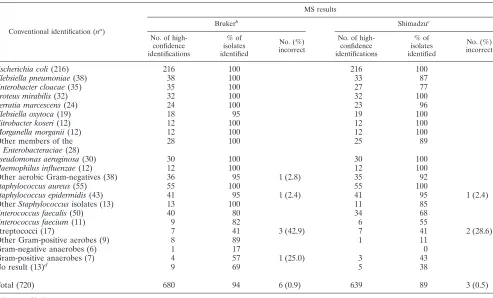
Table 1 shows that although high-confidence identifications from both the Bruker MS and the Shimadzu MS systems were
⬎99% accurate compared with conventional and 16S identifi-cations, both the diagnostic yield and the accuracy of MS identifications varied by taxonomy. In particular, the yield for streptococcal species and for Gram-negative anaerobes was less than 50%, and the accuracy of “high-confidence” species identification for streptococci was only 4 (57.1%) of 7 identi-fications for the Bruker and 5 (71.4%) for the Shimadzu MS
[image:4.585.48.541.342.640.2]FIG. 2. Accuracy of MALDI-TOF MS identifications of 720 clini-cal isolates.
TABLE 1. High-confidence identifications by MALDI-TOF system and taxonomy
Conventional identification (na)
MS results
Brukerb Shimadzuc
No. of high-confidence identifications
% of isolates identified
No. (%) incorrect
No. of high-confidence identifications
% of isolates identified
No. (%) incorrect
Escherichia coli(216) 216 100 216 100
Klebsiella pneumoniae(38) 38 100 33 87
Enterobacter cloacae(35) 35 100 27 77
Proteus mirabilis(32) 32 100 32 100
Serratia marcescens(24) 24 100 23 96
Klebsiella oxytoca(19) 18 95 19 100
Citrobacter koseri(12) 12 100 12 100
Morganella morganii(12) 12 100 12 100
Other members of the
Enterobacteraciae(28)
28 100 25 89
Pseudomonas aeruginosa(30) 30 100 30 100
Haemophilus influenzae(12) 12 100 12 100
Other aerobic Gram-negatives (38) 36 95 1 (2.8) 35 92
Staphylococcus aureus(55) 55 100 55 100
Staphylococcus epidermidis(43) 41 95 1 (2.4) 41 95 1 (2.4)
OtherStaphylococcusisolates (13) 13 100 11 85
Enterococcus faecalis(50) 40 80 34 68
Enterococcus faecium(11) 9 82 6 55
Streptococci (17) 7 41 3 (42.9) 7 41 2 (28.6)
Other Gram-positive aerobes (9) 8 89 1 11
Gram-negative anaerobes (6) 1 17 0
Gram-positive anaerobes (7) 4 57 1 (25.0) 3 43
No result (13)d 9 69 5 38
Total (720) 680 94 6 (0.9) 639 89 3 (0.5)
a
n, no. of isolates. b
The six incorrect Bruker results were as follows: one isolate identified asAchromobacter xylosoxidansby 16S analysis, not identified by biochemical methods, and identified asAchromobacter denitrificansby MS; one isolate not identified by 16S analysis, identified asStaphylococcus epidermidisby biochemical methods, and identified asStaphylococcus capitisby MS; one isolate identified to the genus level only by 16S analysis, identified asStreptococcus mitisby biochemical methods, and identified asStreptococcus pneumoniaeby MS; two isolates identified to the genus level only by 16S analysis, identified asStreptococcus bovisby biochemical methods, and identified asStreptococcus lutiensisby MS; and one isolate identified asClostridium bolteiby 16S analysis, not identified by biochemical methods, and identified as
Clostridium caseiby MS. c
The three incorrect Shimadzu results were as follows: one isolate identified to the genus level only by 16S, identified asStaphylococcus epidermidisby biochemical methods, and identified ambiguously asStaphylococcus capitisorStaphylococcus capraeby MS; two isolates identified to the genus level only by 16S analysis, as
Streptococcus mitisby biochemical methods, and asStreptococcus oralisandStreptococcus pneumoniaeby MS. d
See footnotebof Table 3.
on May 16, 2020 by guest
http://jcm.asm.org/
system. On the other hand, only one of 496 aerobic Gram-negative organisms was identified incorrectly by either MS system (an isolate not identified by conventional methods, identified as Acinetobacter lwoffii by PCR, and identified as
Acinetobacterspecies only by the Bruker MS system). Similarly, MS gave no inaccurate identifications of any enterococci and inaccurately identified only one Staphylococcus isolate (a
Staphylococcus epidermidis isolate on conventional testing, identified only asStaphylococcusspecies by PCR and as Staph-ylococcus capitisby both MS systems). We also note that all of the high-confidence MS identifications were accurate at the genus level. Finally, the Bruker MS system correctly identified 9 (69%) and the Shimadzu MS system 5 (38%) of 13 isolates for which conventional phenotyping offered no identification.
DISCUSSION
A single test can now identify more than three-quarters of the isolates in a large clinical bacteriology laboratory to the species level in less than 5 min per sample, with less marginal cost than conventional methods and with equal or greater accuracy. Our data show that MALDI-TOF MS is that test. While previous studies hint at the promise of MALDI-TOF MS for future testing and its current usefulness for research, our data suggest that current MALDI-TOF MS technology would make vast improvements in the efficiency of the clinical laboratory today.
Cost restrictions, training and quality control requirements, and the need for rapid turnaround times make MS quite ap-pealing compared to conventional identifications. While the MS instruments are expensive, the expense is comparable to that of other common bacteriology laboratory equipment, such as automated blood culture and 16S sequencing devices, and the marginal costs are substantially less than those of conven-tional identification strategies. (As with other capital equip-ment, we would budget maintenance costs as 10% of the price of the instrument each year. The labor costs of deploying the instrument are substantially less than those of the more labor-intensive procedures of phenotype identification). Phenotypic identification using modern automated platforms costs at least approximately US$10 per isolate (list price for reagents, with-out labor costs), whereas reagents required for MS-based iden-tification do not exceed $0.50. MS devices tested in this study are commercially available and are simple to use, requiring no elaborate processing steps. The MS protocols we follow, rely-ing directly on whole-cell analysis from a fresh colony, are easier to learn and use than well-established culture-based
platforms such as the Vitek2 or API system. The hands-on time required for loading an MS target is approximately equivalent to that needed for calibrating a bacterial suspension and load-ing a Gram-positive or Gram-negative identification card, but the prior Gram stain is unnecessary, and turnaround time strongly favors the MS system. The analysis of 10 isolates in parallel can be done in less than 15 min by MS, from picking the colonies to reviewing the results. This would typically re-quire⬎360 min on an automated system and more hands-on time for each isolate. In the present study, we were processing all isolates with conventional methods in parallel, so each spec-imen served as its own control. The addition of known species controls to each day’s runs, however, would involve a trivial investment of time and materials.
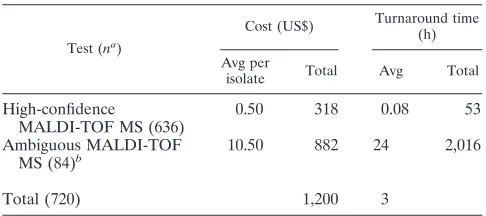
Because of the extreme speed and low marginal cost of MS, it can improve laboratory efficiency when used early in identi-fication protocols as a first test for all isolates. Lengthier, more labor-intensive, and costlier techniques can be reserved for the small minority of isolates not identified with high confidence by the MS alone. Tables 2 and 3 illustrate the marginal cost and timeliness of such a strategy (Table 3) if we had used it on the 720 isolates in this study instead of our routine methods (Table 2). This strategy would cut postisolation marginal costs by more than three-quarters and turnaround time by more than 90% if deployed now. Further improvements are likely to offer even greater benefits from MS in the immediate future—that is, in the expected working lifetime of devices deployed this year.
Although our data show that MS correctly identifies the great majority of isolates processed routinely by our labora-tory, MS cannot yet identify every such isolate. We note that most of the isolates not currently identified by MS are Gram-positive organisms. We deliberately did not attempt to modify our extraction protocols for Gram-positive organisms in this study; however, optimized protocols do exist for such organ-isms (23). The cost of reagents is so low that even doing such an extraction in duplicate (one negative and one Gram-positive extraction protocol) on every sample would be cheaper than the current use of biochemical phenotyping as a first-test strategy.
[image:5.585.300.543.88.196.2]As a molecular alternatives to MS, nucleic acid-based iden-tification strategies currently suffer problematic limitations. Enzymatic amplifications used for nucleic acid detection are
TABLE 2. Cost and timeliness estimates of conventional identification
Bacterium (na)
Cost (US$) Turnaround time (h)
Avg per
isolate Total Avg Total
E. coli(216) 0.20 43 1 216
S. aureus(55) 1.50 83 1 55
Other (449) 10.00 4,490 24 10,776
Total (720) 4,616 15
a
n, no. of isolates.
TABLE 3. Cost and timeliness estimates of MALDI-TOF MS (Bruker) followed by conventional identification
Test (na)
Cost (US$) Turnaround time (h)
Avg per
isolate Total Avg Total
High-confidence
MALDI-TOF MS (636)
0.50 318 0.08 53
Ambiguous MALDI-TOF MS (84)b
10.50 882 24 2,016
Total (720) 1,200 3
an, no. of isolates.
bCost and time of conventional identification added to isolates with ambigu-ous MALDI-TOF MS results are given.
on May 16, 2020 by guest
http://jcm.asm.org/
[image:5.585.43.284.89.178.2]impaired by inhibitory compounds (9), requiring specific ex-traction and purification strategies. MS involves no enzymatic step, so purification is much less of an issue. The products of nucleic acid amplification serve as templates for subsequent reactions, making contamination a difficult problem and often requiring separate areas for sample preparation, amplification, and analysis; MS involves no target amplification and conse-quently demands much less real estate in the clinical labora-tory. Molecular methods in theory should be able to identify multiple organisms at once in a single assay, with sufficient sensitivity and specificity to improve on culture-based strate-gies and in a shorter time frame. Despite considerable efforts, however, and despite our own laboratory’s long investment in this technology, we have found nucleic acid-based methods for microbial identification to have limited usefulness. In practice, nucleic acid analysis of primary clinical samples is largely lim-ited to identification of a few individual species in specific samples, such asMycobacterium tuberculosisin cerebrospinal fluid orChlamydiain urine. Nucleic acid-based methods have not proven compatible with most biological samples that can contain a broad diversity of pathogens as well as amplification inhibitors. In identifying isolated colonies, nucleic acid-based methods, such as 16S rRNA gene sequencing, do offer a wider range of species identifications, but reagent and labor costs remain formidable, and turnaround time is much longer than that with MS. For these reasons, the use of nucleic acid-based methods for isolate identification, while useful, has largely been restricted to confirmatory testing or confirmation of iso-lates for which other methods have failed. We propose reten-tion of 16S sequencing for this purpose, and in fact it is possible to foresee a clinical bacteriology laboratory in which MS is used as a first-line test, 16S sequencing is used to confirm the minority of isolates not identified by MS, and conventional phenotyping tests are used little if at all.
MALDI-TOF MS, however, currently does not provide ad-equate data on antimicrobial susceptibility and requires an isolate for starting material. Hence, there will be a continuing requirement for bacterial culture. It is likely, however, that further database refinements of MS will allow rapid identifi-cation of antibiotic resistance characteristics dependent on the production of specific proteins or peptides. Database refine-ment and enrichrefine-ment are essential elerefine-ments of MALDI-TOF MS, which will allow the method to increase its power as it is used more frequently. While our study was set up to evaluate the efficacy of MALDI-TOF MS as a method and not specif-ically to explain the differences between MALDI-TOF plat-forms, we speculate that at least some of the observed differ-ence between the Bruker and Shimadzu platforms may be due to differences in the proprietary databases provided by the manufacturers.
In summary, MALDI-TOF MS-based identification pro-vides cheaper and faster bacterial species identification than conventional phenotypic identification methods, with equal or better accuracy. This is especially relevant for routine clinical microbiology, since most results can be reported 1 day earlier. Supplemental extraction strategies, as well as expanded data-bases including other bacterial groups of clinical importance, identifiers of resistance to antimicrobials, and genotype markers, will soon enhance the utility of MALDI-TOF MS. In the future, a polyphasic molecular approach beginning with
MALDI-TOF MS and resolving ambiguities with 16S sequenc-ing might become an attractive paradigm to reduce the time, labor, cost, and safety hazards posed by identification strate-gies which rely on the growth characteristics of secondary cul-tures.
ACKNOWLEDGMENTS
This work was supported by grants from the Swiss National Science Foundation, 3100A0-116075/1 (to P.F.) and 3100A0-112370/1 (to J.S.), COST project B28 (C05.0103; to J.S.), and the European Commission 6th framework program (MagRSA project no. 37957; to J.S.).
REFERENCES
1.Arnold, R. J., J. A. Karty, A. D. Ellington, and J. P. Reilly.1999. Monitoring the growth of a bacteria culture by MALDI-MS of whole cells. Anal. Chem. 71:1990–1996.
2.Bosshard, P. P., R. Zbinden, S. Abels, B. Boddinghaus, M. Altwegg, and E. C. Bottger.2006. 16S rRNA gene sequencing versus the API 20 NE system and the VITEK 2 ID-GNB card for identification of nonfermenting Gram-negative bacteria in the clinical laboratory. J. Clin. Microbiol.44:1359–1366. 3.Cairns, D. A., D. N. Perkins, A. J. Stanley, D. Thompson, J. H. Barrett, P. J. Selby, and R. E. Banks.2008. Integrated multi-level quality control for proteomic profiling studies using mass spectrometry. BMC Bioinformatics 9:519.
4.Cherkaoui, A., S. Emonet, D. Ceroni, B. Candolfi, J. Hibbs, P. Francois, and J. Schrenzel.2009. Development and validation of a modified broad-range 16S rDNA PCR for diagnostic purposes in clinical microbiology. J. Micro-biol. Methods79:227–231.
5.Couzinet, S., C. Jay, C. Barras, R. Vachon, G. Vernet, B. Ninet, I. Jan, M. A. Minazio, P. Francois, D. Lew, A. Troesch, and J. Schrenzel.2005. High-density DNA probe arrays for identification of staphylococci to the species level. J. Microbiol. Methods61:201–208.
6.Drancourt, M., and D. Raoult.2002.rpoBgene sequence-based identifica-tion ofStaphylococcusspecies. J. Clin. Microbiol.40:1333–1338.
7.Fenselau, C., and P. A. Demirev.2001. Characterization of intact microor-ganisms by MALDI mass spectrometry. Mass Spectrom. Rev.20:157–171. 8.Francois, P., Y. Charbonnier, J. Jaquet, D. Utinger, M. Bento, D. P. Lew, G.
Kresbach, W. Schlegel, and J. Schrenzel.2006. Rapid bacterial identification using evanescent waveguide oligonucleotide microarray classification. J. Mi-crobiol. Methods65:390–403.
9.Fredricks, D. N., and D. A. Relman.1998. Improved amplification of micro-bial DNA from blood cultures by removal of the PCR inhibitor sodium polyanetholesulfonate. J. Clin. Microbiol.36:2810–2816.
10.Goldenberger, D., A. Kunzli, P. Vogt, R. Zbinden, and M. Altwegg.1997. Molecular diagnosis of bacterial endocarditis by broad-range PCR amplifi-cation and direct sequencing. J. Clin. Microbiol.35:2733–2739.
11.Jarman, K. H., D. S. Daly, C. E. Petersen, A. J. Saenz, N. B. Valentine, and K. L. Wahl.1999. Extracting and visualizing matrix-assisted laser desorption/ ionization time-of-flight mass spectral fingerprints. Rapid Commun. Mass Spectrom.13:1586–1594.
12.Johnson, G., M. Ayers, S. C. McClure, S. E. Richardson, and R. Tellier. 2003. Detection and identification ofBartonellaspecies pathogenic for hu-mans by PCR amplification targeting the riboflavin synthase gene (ribC). J. Clin. Microbiol.41:1069–1072.
13.Johnson, J. R.2000. Development of polymerase chain reaction-based assays for bacterial gene detection. J. Microbiol. Methods41:201–209.
14.Kotilainen, P., J. Jalava, O. Meurman, O. P. Lehtonen, E. Rintala, O. P. Seppala, E. Eerola, and S. Nikkari.1998. Diagnosis of meningococcal men-ingitis by broad-range bacterial PCR with cerebrospinal fluid. J. Clin. Mi-crobiol.36:2205–2209.
15.Marklein, G., M. Josten, U. Klanke, E. Muller, R. Horre, T. Maier, T. Wenzel, M. Kostrzewa, G. Bierbaum, A. Hoerauf, and H. G. Sahl.2009. Matrix-assisted laser desorption ionization–time of flight mass spectrometry for fast and reliable identification of clinical yeast isolates. J. Clin. Microbiol. 47:2912–2917.
16.Mellmann, A., J. Cloud, T. Maier, U. Keckevoet, I. Ramminger, P. Iwen, J. Dunn, G. Hall, D. Wilson, P. Lasala, M. Kostrzewa, and D. Harmsen.2008. Evaluation of matrix-assisted laser desorption ionization–time-of-flight mass spectrometry in comparison to 16S rRNA gene sequencing for species iden-tification of nonfermenting bacteria. J. Clin. Microbiol.46:1946–1954. 17.Minan, A., A. Bosch, P. Lasch, M. Stammler, D. O. Serra, J. Degrossi, B.
Gatti, C. Vay, M. D’aquino, O. Yantorno, and D. Naumann.2009. Rapid identification ofBurkholderia cepaciacomplex species including strains of the novel Taxon K, recovered from cystic fibrosis patients by intact cell MALDI-ToF mass spectrometry. Analyst134:1138–1148.
18.Pineda, F. J., J. S. Lin, C. Fenselau, and P. A. Demirev.2000. Testing the significance of microorganism identification by mass spectrometry and pro-teome database search. Anal. Chem.72:3739–3744.
on May 16, 2020 by guest
http://jcm.asm.org/
19.Poyart, C., G. Quesne, C. Boumaila, and P. Trieu-Cuot.2001. Rapid and accurate species-level identification of coagulase-negative staphylococci by using thesodAgene as a target. J. Clin. Microbiol.39:4296–4301. 20.Schneider, B., K. S. Gibb, and E. Seemuller.1997. Sequence and RFLP
analysis of the elongation factor Tu gene used in differentiation and classi-fication of phytoplasmas. Microbiology143(Pt 10):3381–3389.
21.Seng, P., M. Drancourt, F. Gouriet, B. La Scola, P. E. Fournier, J. M. Rolain, and D. Raoult.2009. Ongoing revolution in bacteriology: routine identifica-tion of bacteria by matrix-assisted laser desorpidentifica-tion ionizaidentifica-tion time-of-flight mass spectrometry. Clin. Infect. Dis.49:543–551.
22.Shankar, P., N. Manjunath, R. Lakshmi, B. Aditi, P. Seth, and Shriniwas. 1990. Identification ofMycobacterium tuberculosisby polymerase chain re-action. Lancet335:423.
23.Smole, S. C., L. A. King, P. E. Leopold, and R. D. Arbeit.2002. Sample
preparation of Gram-positive bacteria for identification by matrix assisted laser desorption/ionization time-of-flight. J. Microbiol. Methods48:107–115. 24.Williams, J. B., T. M. Chapman, and D. M. Hercules.2003. Matrix-assisted laser desorption/ionization mass spectrometry of discrete mass poly(butylene glutarate) oligomers. Anal. Chem.75:3092–3100.
25.Wunschel, S. C., K. H. Jarman, C. E. Petersen, N. B. Valentine, K. L. Wahl, D. Schauki, J. Jackman, C. P. Nelson, and E. White.2005. Bacterial analysis by MALDI-TOF mass spectrometry: an inter-laboratory comparison. J. Am. Soc. Mass Spectrom.16:456–462.
26.Xu, J., B. C. Millar, J. E. Moore, K. Murphy, H. Webb, A. J. Fox, M. Cafferkey, and M. J. Crowe.2003. Employment of broad-range 16S rRNA PCR to detect aetiological agents of infection from clinical specimens in patients with acute meningitis—rapid separation of 16S rRNA PCR ampli-cons without the need for cloning. J. Appl. Microbiol.94:197–206.