REVIEW
Neonatal encephalopathy (NE) is the term used to describe newborns ≥35 weeks’ gestation who have an abnormal level of consciousness or seizures, which may be accompanied by abnormal tone and reflexes.[1,2] Intrapartum hypoxia resulting in hypoxic-ischaemic
encephalopathy (HIE) is only one of the many causes of NE, with no definitive test to make the diagnosis[1] and very little available in
terms of neuroprotective strategies, except for the use of therapeutic hypothermia (TH).[2] For this reason, it is important for clinicians
to conduct a comprehensive evaluation (including determining the type and timing of contributing factors, performing a neurological examination, analysing the blood gas and searching for markers of multi-organ involvement)[1] to either exclude or strengthen the
diagnosis of HIE, to select newborns who may benefit from TH. The incidence of HIE has decreased to 1 - 8 per 1 000 live term births in developed countries;[3] however, 96% of cases are still from
low- and middle-income countries,[4] with an incidence reported in
one South African study ranging between 8.7 and 15.2 per 1 000 live term deliveries.[5]
The outcome for newborns suspected to have suffered an intrapartum hypoxic-ischaemic insult in the pre-cooling era has been well described. In 1976, Sarnat and Sarnat[6] reported that 25%
of newborns with moderate encephalopathy and 100% of newborns with severe encephalopathy had a severely abnormal neurological outcome or were dead at 1 year of age. The Thompson score, a long-term prognostication score described in 1997, reports that a maximum score ≤10 assures a normal neurological outcome at 1 year of age; however, 65% of infants with a score >10, and 92% of infants with a score >15, will have an abnormal neurological outcome at 1 year of age.[7] In South Africa,Bruckmann and Velaphi[5] reported an
in-hospital mortality rate of 1.4%, 7.1% and 62.5% in mild, moderate and severe encephalopathy, respectively, in newborns with HIE prior to the introduction of therapeutic hypothermia.
Management
Resuscitative care
The current recommendation is not to practise delayed cord clamping in asphyxiated newborns requiring resuscitation.[2,8] Normothermia
must be maintained during resuscitation.[2,3] Once the neonate has
been stabilised and a definitive decision is made by a senior clinician
to offer TH, passive cooling can be commenced in the delivery room by turning off the radiant warmer while awaiting the initiation of active cooling.[2] However, passive cooling is not a recommended
method of providing prolonged TH, even in low-resource settings. Hyperthermia during resuscitation and stabilisation should be avoided as it is associated with adverse outcomes.[2,3]
It is reasonable to initiate neonatal resuscitation in term infants using air (21% oxygen) and titrating the concentration to achieve target pre-ductal saturations after delivery.[8] The optimal oxygen
concentration required during cardiac compressions remains unknown,[2] but the Neonatal Guidelines Writing Group recommend
increasing to 100%.[8] However, it has been shown that hyperoxia
during newborn resuscitation is associated with poorer outcomes[2]
and therefore the oxygen concentration should be decreased as soon as the heart rate recovers.[8] There is no evidence for the use of
sodium bicarbonate infusions during neonatal resuscitation.[9]
Supportive care
Supportive care may include assisted ventilation, with care to avoid hypocarbia and hyperoxia.[2] Hypocarbia causes vasoconstriction with
decreased cerebral perfusion and hyperoxia increases oxidative stress; therefore the recommended PaCO2 is 40 - 55 mmHgand PaO2 is 50 - 100 mmHg.[3] It is particularly important to avoid hypoglycaemia as
this may exacerbate brain injury.[2,3] There is limited evidence to use a
sodium bicarbonate infusion to correct metabolic acidosis; however, Azzopardi[10] suggests correcting a severe metabolic acidosis (pH <7)
persisting for >4 hours despite adequate supportive interventions. As HIE impairs cerebral autoregulation, a critical mean blood pressure range of 40 - 60 mmHg[3] is recommended to ensure cerebral
perfusion. The use of fluid boluses, inotropes or vasopressors to maintain adequate perfusion will be guided by echocardiography.[3,11]
Cerebral perfusion can also be assessed directly using near infrared spectroscopy (NIRS) if available.[2] Additionally, an
amplitude-integrated electroencephalogram (aEEG) should be used to identify seizures,[3,11] abnormal background patterns, and abnormalities of the
sleep-wake cycle.[2] Although phenobarbital augmented hypothermic
neuroprotection in a rodent model,Sarkar et al.[12] reported no
clinical benefit of combining phenobarbital with TH in neonates with HIE. Of concern is the reported increase in the combined Hypoxic-ischaemic encephalopathy (HIE) is only one of the many causes of neonatal encephalopathy, with no definitive test to make the diagnosisand very little available in terms of neuroprotective strategies, except for the use of therapeutic hypothermia (TH). TH improves survival and neurodevelopmental outcome at 18 months of age in neonates with moderate or severe encephalopathy. Based on this evidence, the International Liaison Committee on Resuscitation has recommended TH as standard of care since 2010. Low-cost methods of administering TH in low- and middle-income countries are effective as long as intensive care facilities are available, and provided that a TH guideline based on published international trials is in place. A local guideline, taking into consideration the care capable at different hospital levels, would be valuable in a developing country with resource constraints and increasing litigation.
S Afr J Child Health 2018;12(4):175-180. DOI:10.7196/SAJCH.2018.v12i4.1539
Hypoxic-ischaemic encephalopathy: Identifying
newborns who will benefit from therapeutic
hypothermia in developing countries
M Coetzee, MB ChB, DCH, FCPaed, MMed (Paed), Cert Neonatology, MPhil (Neonatology)
Division of Neonatology, Department of Paediatrics and Child Health, School of Medicine, University of Pretoria, South Africa
Corresponding author: M Coetzee ([email protected])
REVIEW
outcome of death or an abnormal post-cooling magnetic resonance imaging (MRI) brain in neonates who received combination therapy.
[12] Until large randomised controlled trials are available, the use of
phenobarbital to augment TH cannot be recommended. Additionally, prophylactic phenobarbital should not be used to prevent seizures.[13]
There is also no evidence to administer corticosteroids to prevent or treat cerebral oedema secondary to HIE.[11]
Newborns with HIE are at an increased risk of fluid overload secondary to syndrome of inappropriate antidiuretic hormone and acute kidney injury,[2] and intravenous fluids should therefore be
restricted to 40 - 70 mL/kg/day[2,3] with adjustment according to
the urine output. A meta-analysis has reported that a single dose of prophylactic theophylline within 1 hour of delivery may prevent acute kidney injury and can be considered in cases of suspected hypoxic-ischaemic injury; however, it must be kept in mind that, despite the immediate renal benefits of prophylactic theophylline, the long-term renal and neurological effects are unknown, and it is not yet recommended as routine practice.[14]
Medications that are excreted by the kidneys or metabolised by the liver need to be used cautiously and may require dose adjustment if there is organ dysfunction.[2] Additionally, TH may delay hepatic
metabolism of some medications and newborns should be monitored for toxic effects secondary to any drugs administered.[15] Pain and
stress can diminish the neuroprotective effects of TH, and it is suggested that analgesia and sedation be provided for these infants.[15]
Signs of pain or distress include tachycardia (heart rate >110 beats/ min.), facial grimacing and shivering.[15] For spontaneously breathing
newborns, respiration must be monitored closely if providing sedation.[15]
Therapeutic hypothermia
A recent meta-analysis of 7 large randomised controlled trials has demonstrated that TH improves survival (without increasing disability) and neurodevelopmental outcome at 18 months of age in neonates with moderate or severe encephalopathy.[16] When
compared with standard supportive care, there is a significant reduction in death (risk ratio (RR) 0.75, 95% confidence interval (CI) 0.63 - 0.88), major disability (RR 0.68, 95% CI 0.56 - 0.83), cerebral palsy (RR 0.62, 95% CI 0.49 - 0.78), developmental delay (RR 0.66, 95% CI 0.52 - 0.82) and blindness (RR 0.56, 95% CI 0.33 - 0.94) at 18 months of age.[16] The number of infants with HIE who need to
be treated with TH to prevent death or major disability in neonates with moderate and severe encephalopathy is 6 and 7, respectively.[16]
Based on these outcomes, the International Liaison Committee on Resuscitation have recommended TH as the standard of care for infants with suspected HIE since 2010.[9] In 2015, the American
Heart Association stated that TH may also be practised in resource-limited settings, as long as protocols are based on those from large clinical trials, a multidisciplinary team is available for patient care, and long-term follow-up is possible.[8] However, despite the use of
TH, the rate of death or disability for infants with HIE remains high (44 - 55%).[17]
In a South African web-based survey, 66% of paediatrician and neonatologist respondents stated that TH was effective, although only 42% offered TH and a further 9% referred patients to another facility for TH.[18] Twenty-four percent of respondents had not introduced
TH in their unit.[18] The reluctance of almost a quarter of South
African doctors to use TH as standard of care for newborns with HIE may be attributed to the lack of local published recommendations by a neonatal or paediatric association. Such a guideline, based on internationally published protocols but adjusted for South African conditions, would be valuable in a developing country with resource constraints and increasing litigation.
Timely and accurate identification of newborns who may benefit from TH is imperative so that treatment can be initiated within the
6-hour therapeutic window. However, it is advisable to initiate TH immediately if eligible, as Thoresen et al.[19] showed that neonates
initiated before 3 hours of life had improved motor outcomes at 18 - 20 months of age. Additionally, as injury to the brain is not static the clinical neurological examination should be repeated at 1 - 2-hour intervals within the first 6 hours of life to identify neonates with progression of encephalopathy (mild to moderate/severe) who would then be eligible for TH.[2] Eligibility is defined by 3 main categories,
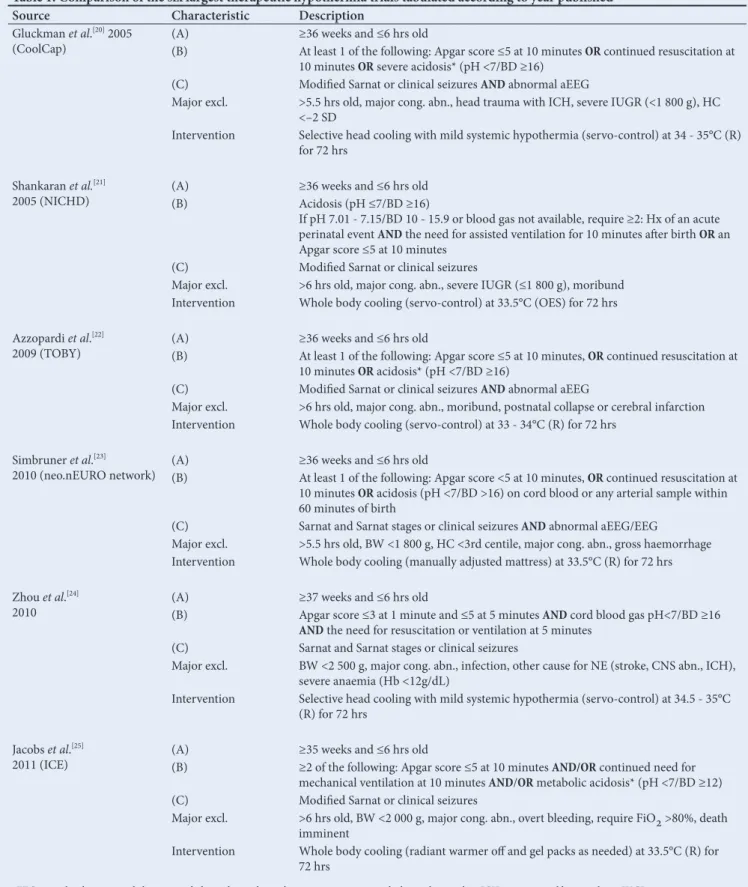
which must be met sequentially. The eligibility criteria of the 6 largest published international trials[20-25] are summarised in Table 1.Category
(A) describes general criteria such as age in hours after birth and gestational age. The majority of trials used age ≤6 hours old[20-25] and
a gestational age ≥36 weeks.[20-23] Category (B) searches for evidence
of possible intrapartum hypoxia-ischaemia, evidenced by either low Apgar scores (≤5 at 10 minutes),[20-22,24,25] acidosis (pH ≤7 and/or
base deficit ≥16)on arterial cord blood or a blood gas done within 60 minutes of delivery,[20-24] or the need for continued resuscitation
at 10 minutes of life.[20-23,25] Category (C) defines the neurological
picture, including encephalopathy and/or clinical seizures and/ or an abnormal background aEEG. Exclusions for TH include major congenital abnormalities,[20-25] intra-uterine growth restriction
(weight <1 800 g),[20,21,23] intracranial haemorrhage[20,23,24] or stroke[22,24]
and a moribund state.[21,22,25]
These 6 trials defined encephalopathy clinically using the modified Sarnat stages[26] or the Sarnat and Sarnat stages.[6] However, the
Thompson score has also been used in some studies to establish eligibility for TH.[7] As described by Thompson et al.,[7] the following
scores equated to specific Sarnat and Sarnat stages: neonates scoring 0 - 10 had mild encephalopathy (stage I), those scoring 11 - 14 had moderate encephalopathy (stage II), and those scoring >14 had severe encephalopathy (stage III). According to the current recommendations, only newborns with moderate or severe encephalopathy qualify for TH, namely a Thompson score >10. However, various TH protocols using the Thompson score include newborns with a score ≤10,[27-29] implying that neonates with mild
encephalopathy, according to Thompson et al.,[7] are receiving TH.
However, the number of neonates included in Thompson’s study was small, and the numerical threshold with the best sensitivity and specificity to identify neonates with encephalopathy who will benefit from TH is yet to be validated in large clinical trials. This is of particular importance in a developing country, where the incidence of HIE is high and resources for providing TH are limited, so that the resources are offered to patients who will have the greatest benefit. There are, however, a few small studies that attempted to identify a threshold Thompson score which predicted an abnormal aEEG or an adverse outcome. Horn et al.[30]showed that an early Thompson
score, before 6 hours of age, ≥7 had the best sensitivity and specificity (100% and 66.7%, respectively) to predict an abnormal 6-hour aEEG. This study also showed that there was no significant difference in the ability of either an early Thompson score or the modified Sarnat stages to predict an abnormal aEEG by 6 hours of age.[30] Weeke
et al.[27] showed a significant association between the Thompson
REVIEW
Thorsen et al.[28] showed that a Thompson score ≥12 had a 3.9-fold
increased odds of death before discharge and an 8.4-fold increased odds of severe seizures compared with infants with a Thompson score <12. Table 1. Comparison of the six largest therapeutic hypothermia trials tabulated according to year published
Source Characteristic Description
Gluckman et al.[20] 2005
(CoolCap) (A)(B) ≥36 weeks and ≤6 hrs oldAt least 1 of the following: Apgar score ≤5 at 10 minutes OR continued resuscitation at 10 minutes OR severe acidosis* (pH <7/BD ≥16)
(C) Modified Sarnat or clinical seizures AND abnormal aEEG
Major excl. >5.5 hrs old, major cong. abn., head trauma with ICH, severe IUGR (<1 800 g), HC <–2 SD
Intervention Selective head cooling with mild systemic hypothermia (servo-control) at 34 - 35°C (R) for 72 hrs
Shankaran et al.[21]
2005 (NICHD) (A)(B) ≥36 weeks and ≤6 hrs oldAcidosis (pH ≤7/BD ≥16)
If pH 7.01 - 7.15/BD 10 - 15.9 or blood gas not available, require ≥2: Hx of an acute perinatal event AND the need for assisted ventilation for 10 minutes after birth OR an Apgar score ≤5 at 10 minutes
(C) Modified Sarnat or clinical seizures
Major excl. >6 hrs old, major cong. abn., severe IUGR (≤1 800 g), moribund Intervention Whole body cooling (servo-control) at 33.5°C (OES) for 72 hrs
Azzopardi et al.[22]
2009 (TOBY) (A)(B) ≥36 weeks and ≤6 hrs oldAt least 1 of the following: Apgar score ≤5 at 10 minutes, OR continued resuscitation at 10 minutes OR acidosis* (pH <7/BD ≥16)
(C) Modified Sarnat or clinical seizures AND abnormal aEEG
Major excl. >6 hrs old, major cong. abn., moribund, postnatal collapse or cerebral infarction Intervention Whole body cooling (servo-control) at 33 - 34°C (R) for 72 hrs
Simbruner et al.[23]
2010 (neo.nEURO network) (A)(B) ≥36 weeks and ≤6 hrs oldAt least 1 of the following: Apgar score <5 at 10 minutes, OR continued resuscitation at 10 minutes OR acidosis (pH <7/BD >16) on cord blood or any arterial sample within 60 minutes of birth
(C) Sarnat and Sarnat stages or clinical seizures ANDabnormal aEEG/EEG
Major excl. >5.5 hrs old, BW <1 800 g, HC <3rd centile, major cong. abn., gross haemorrhage Intervention Whole body cooling (manually adjusted mattress) at 33.5°C (R) for 72 hrs
Zhou et al.[24]
2010 (A)(B) ≥37 weeks and ≤6 hrs oldApgar score ≤3 at 1 minute and ≤5 at 5 minutes AND cord blood gas pH<7/BD ≥16 AND the need for resuscitation or ventilation at 5 minutes
(C) Sarnat and Sarnat stages or clinical seizures
Major excl. BW <2 500 g, major cong. abn., infection, other cause for NE (stroke, CNS abn., ICH), severe anaemia (Hb <12g/dL)
Intervention Selective head cooling with mild systemic hypothermia (servo-control) at 34.5 - 35°C (R) for 72 hrs
Jacobs et al.[25]
2011 (ICE) (A)(B) ≥35 weeks and ≤6 hrs old≥2 of the following: Apgar score ≤5 at 10 minutes AND/OR continued need for mechanical ventilation at 10 minutes AND/OR metabolic acidosis* (pH <7/BD ≥12)
(C) Modified Sarnat or clinical seizures
Major excl. >6 hrs old, BW <2 000 g, major cong. abn., overt bleeding, require FiO2 >80%, death imminent
Intervention Whole body cooling (radiant warmer off and gel packs as needed) at 33.5°C (R) for 72 hrs
aEEG = amplitude-integrated electroencephalography; excl = exclusion; cong. = congenital; abn. = abnormality; ICH = intracranial haemorrhage; IUGR = intrauterine growth restriction; HC = head circumference; SD = standard deviation; R = rectal; NICHD = National Institute of Child Health and Human Development; BD = base deficit (mmol/L); Hx = history; TOBY = total body hypothermia for neonatal encephalopathy trial; OES = oesophagaael; BW = birth weight; NE = neonatal encephalopathy; CNS = central nervous system; Hb = haemoglobin; ICE = infant cooling evaluation; FiO2 = fraction of inspired oxygen.
REVIEW
Similarly, the modified Sarnat stages is a clinical staging method developed to establish whether an early neurological examination performed within the first 12 hours of life could predict a persistent abnormal neurological state beyond 5 days of life or death in the first week of life comparable with an aEEG.[26] Encephalopathy
was defined as the presence of 1 or more signs in at least 3 of the following 6 categories: level of consciousness, spontaneous activity, posture, tone, primitive reflexes and autonomic dysfunction.[26] This
study reported that an aEEG had a better specificity (89% v. 78%) and positive predictive value (73% v. 58%), with similar sensitivity (79% and 78%) and negative predictive values (90% v. 91%), compared with an abnormal clinical examination, but also reported that the combination of abnormalities in both the early clinical examination and aEEG had the highest specificity and positive predictive value for an abnormal short-term outcome (sensitivity 78%, specificity 94%, positive predictive value 85%, negative predictive value 92%).[26]
Although whole-body cooling is more commonly used owing to the ease of administration, both whole-body and selective head cooling are effective methods to provide TH and have comparable outcomes.[16] Servo-controlled (automated) devices are easier to use
to maintain core body temperature within the appropriate range, but these devices are expensive to purchase and maintain and may preclude many neonatal units in resource-limited settings from implementing TH. A systematic review of TH in low- and middle-income countries showed no survival benefit, which was suggested to be secondary to the use of low-cost TH methods and the lack of neonatal intensive care facilities.[31] However, many individual studies
have shown that low-cost methods of cooling are effective, so a systematic review was done to assess the use of low-cost methods in facilities where neonatal intensive care was available.[32] The 3 studies
included in the present review used gel packs to provide TH. This review showed a significant reduction in mortality at discharge (RR 0.60; 95% CI 0.39 - 0.92), mortality at 6 - 24 months (RR 0.63; 95% CI 0.43 - 0.93), and neurological morbidity at discharge (RR 0.46; 95% CI 0.33 - 0.63). One study reported on outcomes at 24 months, with a significant reduction in severe neurological morbidity or mortality (RR 0.77; 95% CI 0.62 - 0.98). Two studies reported an increased survival without morbidity at 6 months (RR 1.31; 95% CI 1.09 - 1.58) and 24 months (RR 1.75; 95% CI 1.13 - 2.7), respectively.[32] A
study comparing two commonly used low-cost methods of cooling, namely frozen gel packs and phase-changing material, showed that both methods are as effective as servo-controlled methods of TH with similar complication rates and short-term outcomes.[33]
It has also been investigated whether a longer duration of cooling of 120 hours or deeper cooling to 32ºC or both will have further neuroprotective benefits above the current recommendations. However, both of these variations have significantly increased complications, and have not demonstrated any benefit to in-hospital survival.[17] These practices can therefore not be recommended;
and existing TH guidelines recommending maintaining the core body temperature of 33°C - 34°C for 72 hours,[17] and then slowly
re-warming, should be followed.
Early predictors of outcome
It has been suggested that the addition of TH to the management of newborns with HIE may alter the prognostic value of predictive tests. As the level of care offered to the newborn with HIE is often based on the perceived prognosis, information regarding predictive tests during the era of TH should be used.
The predictive value of an early clinical examination is lower in newborns receiving TH compared with those who are kept normothermic.[34] However, considering that many of the
sophisticated predictive tests may only be available in specialist centres, a detailed clinical neurological examination is imperative. Shankaran et al.[35] reported that the persistence of moderate to
severe encephalopathy at 72 hours, an abnormal neurological examination (hypertonia, fisting, abnormal movements, absent gag reflex, and an asymmetric tonic neck reflex) at discharge, or the need for gastrostomy tube feeding at discharge were all associated with an increased risk of death or disability. Importantly, the presence of seizures per se is not associated with an abnormal outcome; however, a high seizure burden is. Kharoshankaya et al.[36] showed
that the odds of an abnormal outcome at 24 - 48 months of age were increased 9 times with a total seizure burden >40 minutes (p=0.001) and 8 times with a maximum seizure burden >13 minutes per hour (p=0.003), irrespective of the use of TH. Maartens et al.[37] also
reported that neonates requiring more than two anti-epileptic drugs to control seizures had a significantly poorer outcome at 2 years of age (p<0.01).
Although TH does not alter the interpretation of cranial ultrasound, the predictive value of an abnormal cranial ultrasound remains poor, with a sensitivity of 79% and specificity of 55%.[38] A recent
meta-analysis showed that the predictive value of an aEEG at 6 hours of age in newborns receiving TH is poor (post-test probability 59.1%), and the maximum predictive reliability of aEEG for death or moderate/ severe disability in newborns receiving TH is at 72 hours (post-test probability 95.7%). However, the presence of an abnormal aEEG persisting beyond 48 hours also had a high predictive reliability for an adverse outcome (post-test probability 93%). Consequently, in the era of TH, the predictive reliability of aEEG is delayed from 24 - 36 hours to 48 - 72 hours of life.[39] While TH reduces brain injury on
MRI, the predictive value remains unchanged[40] and MRI remains
the gold standard neuroimaging modality in newborns with HIE. A meta-analysis by Van Laerhoven et al.[38] reported that T1/2-weighted
MRI has the best predictive values of outcome for all neuroimaging investigations, with sensitivities of 84% and 98% and specificities of 90% and 76% when done in the first and second week of life, respectively. Additionally, early MRI images performed on day 4 of life after completion of TH highly correlated with late images done during the second week of life.[41] Similarly, MRI done during
TH (day 2 - 3 of life) demonstrated the full extent of brain injury compared with MRI done on day 10 of life.[42] This information is
essential for early prognostication in terms of family counselling and early re-direction of care.
Late predictors of outcome
Using Prechtl’s assessment of general movements, Ferrari et al.[43]
showed that cramped-synchronised general movements at 1 and 3 months of age were associated with the development of cerebral palsy at 24 months of age in infants with HIE (sensitivity 68.7%, specificity 100%). Additionally, abnormal general movements at 1 and 3 months of age correlated well with early MRI abnormalities in these infants (cramped-synchronised general movements had predominantly deep grey-matter injury on MRI). The combination of information using these two techniques had the best predictive value for outcome at 24 months.[43] Similarly, Soleiman et al.[44] showed that the absence
of fidgety movements at 3 months of corrected age in infants who suffered from HIE was associated with abnormal neurological outcomes at 12 - 18 months of age (sensitivity 80%, specificity 100%). Cordes et al.[45] showed that reduced head growth by 4 months of
age was highly predictive of long-term neurological abnormalities; however, normal head growth does not preclude an abnormal neurological outcome.
Conclusion
REVIEW
is effective, provided that intensive care facilities are available. However, a protocol for TH based on one of the large trials should first be in place, keeping in mind that these may require adaptation to the South African environment. In accordance with the large trials, TH should be reserved for neonates ≥36 weeks and ≤6 hours old with evidence of possible intrapartum hypoxia-ischaemia (Apgar score ≤5 at 10 minutes, or continued resuscitation at 10 minutes, or severe acidosis (pH <7/base deficit (BD) ≥16) and an abnormal neurological examination (moderate/severe encephalopathy or clinical seizures or an abnormal aEEG). Although the use of the Thompson score to determine eligibility cannot be disregarded, there is no consensus on the ideal numerical threshold that should be used as Horn et al.[30]
suggest ≥7,Weeke et al.[27] suggest ≥11and Thorsen et al.[28] suggest
≥12, and therefore further large studies are necessary. Institutions using the Thompson score to determine eligibility should select a threshold according to the resources available at that facility, i.e. the private sector and tertiary hospitals may use a lower threshold and regional hospitals, with fewer resources, a higher threshold.
Acknowledgements. None. Author contribution. Sole author. Funding. None.
Conflicts of interest. None.
1. Neonatal Encephalopathy and Neurologic Outcome, 2nd ed. Report of the American College of Obstetricians and Gynecologists’ Task Force on neonatal encephalopathy. Pediatrics 2014;133(5):e1483-1488. https://doi.org/10.1542/ peds.2014-0724
2. Martinello K, Hart AR, Yap S, Mitra S, Robertson NJ. Management and investigation of neonatal encephalopathy: 2017 update. Arch Dis Child Fetal Neonatal Ed 2017;102(4):F346-F358. https://doi.org.org/10.1136/ archdischild-2015-309639
3. Douglas-Escobar M, Weiss MD. Hypoxic-ischemic encephalopathy: A review for the clinician. JAMA Pediatrics 2015;169(4):397-403. https://doi. org/10.1001/jamapediatrics.2014.3269
4. Lee AC, Kozuki N, Blencowe H, et al. Intrapartum-related neonatal encephalopathy incidence and impairment at regional and global levels for 2010 with trends from 1990. Pediatr Res 2013;74 suppl 1:50-72. https://doi. org/10.1038/pr.2013.206
5. Bruckmann EK, Velaphi S. Intrapartum asphyxia and hypoxic ischaemic encephalopathy in a public hospital: Incidence and predictors of poor outcome. S Afr Med J 2015;105(4):298-303. https://doi.org.org/10.7196/SAMJ.9140 6. Sarnat HB, Sarnat MS. Neonatal encephalopathy following fetal distress: A
clinical and electroencephalographic study. Arch Neurol 1976;33(10):696-705. https://doi.org/10.1001/archneur.1976.00500100030012
7. Thompson CM, Puterman AS, Linley LL, Hann FM, van der Elst CW, Molteno CD. The value of a scoring system for hypoxic ischaemic encephalopathy in predicting neurodevelopmental outcome. Acta Paediatr 1997;86(7):757-761. 8. Wyckoff MH, Aziz K, Escobedo MB, et al. Part 13: Neonatal Resuscitation.
2015 American Heart Association Guidelines update for cardiopulmonary resuscitation and emergency cardiovascular care. Circulation 2015;132(18 Suppl 2):S543-S560. https://doi.org/10.1161/CIR.0000000000000267
9. Perlman KM, Wyllie J, Kattwinkel J, et al. Part 11: Neonatal Resuscitation. 2010 international consensus on cardiopulmonary resuscitation and emergency cardiovascular care science with treatment recommendations. Circulation 2010;122(16 Suppl 2):S516-S538. https://doi.org/10.1161/ CIRCULATIONAHA.110.971127
10. Azzopardi D. Clinical management of the baby with hypoxic ischaemic encephalopathy. Early Human Development 2010;86(6):345-350. https://doi. org/10.1016/j.earlhumdev.2010.05.008
11. Fanaroff and Martin’s Neonatal-Perinatal Medicine: Diseases of the Fetus and Infant. 9th ed. In Martin RJ, Fanaroff AA, Walsh MC, eds. Vol 2; Chapter 40; p. 952-976. Elsevier: Mosby, 2011.
12. Sarkar S, Barks JD, Bapuraj JR, et al. Does phenobarbital improve the effectiveness of therapeutic hypothermia in infants with hypoxic-ischemic encephalopathy? J Perinatol 2012;32:15-20.
13. Young L, Berg M, Soll R. Prophylactic barbiturate use for the prevention of morbidity and mortality following perinatal asphyxia (review). Cochrane Database Syst Rev 2016;(5):CD001240. https://doi.org/10.1002/14651858. CD001240.pub3
14. Al-Wassia H, Alshaikh B, Sauve R. Prophylactic theophylline for the prevention of severe renal dysfunction in term and post-term neonates with perinatal asphyxia: A systematic review and meta-analysis of randomized controlled trials. J Perinatol 2013;33(4):271-277. https://doi.org/10.1038/jp.2012.97 15. Roka A, Azzopardi D. Therapeutic hypothermia for neonatal hypoxic ischemic
encephalopathy. Early Human Development 2010;86(6):361-367. https://doi. org/10.1016/j.earlhumdev.2010.05.013
16. Tagin MA, Woolcott CG, Vincer MJ, Whyte RK, Stinson DA. Hypothermia for hypoxic ischemic encephalopathy. An updated systematic review and meta-analysis. Arch Pediatr Adolesc Med 2012;166(6):558-566. https://doi. org/10.1001/archpediatrics.2011.1772
17. Shankaran S, Laptook AR, Pappas A, et al. Effect of depth and duration of cooling on deaths in the NICU among neonates with hypoxic ischemic encephalopathy. JAMA 2014;312(24):2629-2639. https://doi.org/10.1001/ jama.2014.16058
18. Joolay Y, Harrison MC, Horn AR. Therapeutic hypothermia and hypoxic ischemic encephalopathy: Opinion and practice of pediatricians in South Africa. J Perinat Med 2012;40(4):447-453. https://doi.org/10.1515/jpm-2011-0292
19. Thoresen M, Tooley J, Liu X, et al. Time is brain: Starting therapeutic hypothermia within three hours after birth improves motor outcome in asphyxiated newborns. Neonatology 2013;104:228-233. https://doi. org/10.1159/000353948
20. Gluckman PD, Wyatt JS, Azzopardi D, et al. Selective head cooling with mild systemic hypothermia after neonatal encephalopathy: Multicenter randomized trail. Lancet 2005;365(9460):663-670. https://doi.org/10.1016/S0140-6736(05)17946-X
21. Shankaran S, Laptook AR, Ehrenkranz RA, et al. Whole-body hypothermia for neonates with hypoxic-ischemic encephalopathy. N Engl J Med 2005;353(15):1574-1584. https://doi.org/10.1056/NEJMcps050929
22. Azzopardi DV, Strohm B, Edwards AD, et al. Moderate hypothermia to treat perinatal asphyxial encephalopathy. N Engl J Med 2009;361(14):1349-1358. https://doi.org/10.1056/NEJMoa0900854
23. Simbruner G, Mittal RA, Rohlmann F, Muche R, and neo.nEURO.network Trial Participants. Systemic hypothermia after neonatal encephalopathy: Outcomes of neo.nEURO.network RCT. Pediatrics 2010;126(4):e771-e778. https://doi. org/10.1542/peds.2009-2441
24. Zhou W, Cheng G, Shao X, et al. Selective head cooling with mild systemic hypothermia after neonatal hypoxic-ischemic encephalopathy:A multicenter randomized controlled trial in China. J Pediar 2010;157(3):367-372. https:// doi.org/10.1016/j.jpeds.2010.03.030
25. Jacobs SE, Morley CJ, Inder TE, et al. Whole-body hypothermia for term and near-term newborns with hypoxic-ischemic encephalopathy. Arch Pediatr Adolesc Med 2011;165(8):692-700. https://doi.org/10.1001/ archpediatrics.2011.43
26. Shalak LF, Laptook AR, Velaphi SC, Perlman JM. Amplitude-integrated electroencephalography coupled with an early neurologic examination enhances prediction of term infants at risk for persistent encephalopathy. Pediatrics 2003;111(2):351-357. https://doi.org/10.1542/peds.111.2.351 27. Weeke LC, Vilan A, Toet M, et al. A comparison of the Thompson
encephalopathy score and amplitude-integrated electroencephalography in infants with perinatal asphyxia and therapeutic hypothermia. Neonatology 2017;112(1):24-29. https://doi.org/10.1159/000455819
28. Thorsen P, Jansen-van der Weide MC, Groenendal F, et al. The Thompson encephalopathy score and short-term outcomes in asphyxiated newborns treated with therapeutic hypothermia. Pediatr Neurol 2016;60:49-53. https:// doi.org/10.1016/j.pediatrneurol.2016.03.014
29. Kali GT, Martinez-Biarge M, Van Zyl J, Smith J, Rutherford M. Management of therapeutic hypothermia for neonatal hypoxic ischemic encephalopathy in a tertiary centre in South Africa. Arch Dis Child Fetal Neonatal Ed. 2015;100(6):F519-523. https://doi.org/10.1136/archdischild-2015-308398 30. Horn AR, Swingler GH, Myer L, et al. Early clinical signs in neonates with
hypoxic ischemic encephalopathy predict an abnormal amplitude-integrated electroencephalogram at age 6 hours. BMC Pediatrics 2013;13(52). https://doi. org/10.1186/1471-2431-13-52
31. Pauliah SS, Shankaran S, Wade A, Ernest B, Thayyil S. Therapeutic hypothermia for neonatal encephalopathy in low- and middle-income countries: A systematic review and meta-analysis. PLos ONE 2013;8(3):e58834. https://doi. org/10.1371/journal.pone.0058834
32. Rossouw G, Irlam J, Horn AR. Therapeutic hypothermia for hypoxic ischaemic encephalopathy using low-technology methods: A systematic review and meta-analysis. Acta Paediatr 2015;1049(12):1217-1228. https://doi.org/10.1111/ apa.12830
33. Shabeer MP, Abiramalatha T, Smith A, et al. Comparison of two low-cost methods of cooling neonates with hypoxic ischemic encephalopathy. J Trop Pediatr 2017;63(3):174-181. https://doi.org/10.1093/tropej/fmw067
34. Gunn AJ, Wyatt JS, Whitelaw A, et al. Therapeutic hypothermia changes the prognostic value of clinical evaluation of neonatal encephalopathy. J Pediatrics 2008;152(1):55-58. https://doi.org/10.1016/j.jpeds.2007.06.003
35. Shankaran S, Laptook AR, Tyson JE, et al. Evolution of encephalopathy during whole body hypothermia for neonatal hypoxic-ischemic encephalopathy. J Pediatrics 2012;160(4):567-572. https://doi.org/10.1016/j.jpeds.2011.09.018 36. Kharoshankaya L, Stevenson NJ, Livingstone V, et al. Seizure burden
and neurodevelopmental outcome in neonates with hypoxic-ischemic encephalopathy. Dev Med Child Neurol 2016;58(12):1242-1248.
37. Maartens IA, Wassenberg T, Buijs J, et al. Neurodevelopmental outcome in full-term newborns with refractory neonatal seizures. Acta Paediatrica 2012;101:e173-e178.
REVIEW
39. Del Rio R, Ochoa C, Alarcon A, et al. Amplitude integrated electroencephalogram as a prognostic tool in neonates with hypoxic-ischemic encephalopathy: A systematic review. PLoS ONE 2016;11(11):e0165744. https://doi.org/10.1371/ journal.pone.0165744
40. Rutherford M, Ramenghi LA, Edwards AD, et al. Assessment of brain tissue injury after moderate hypothermia in neonates with hypoxic-ischemic encephalopathy: A nested substudy of a randomized controlled trial. Lancet Neurol 2010;9(1):39-45. https://doi.org/10.1016/S1474-4422(09)70295-9 41. Agut T, Leon M, Rebollo M, et al. Early identification of brain injury in infants
with hypoxic ischemic encephalopathy at high risk for severe impairments: accuracy of MRI performed in the first days of life. BMC Pediatrics 2014;14:177. https://doi.org/10.1186/1471-2431-14-177
42. Boudes E, Tan X, Saint-Martin C, et al. MRI obtained during versus after hypothermia in asphyxiated newborns. Arch Dis Child Fetal Neonatal Ed 2015;100(3):F238-242. https://doi.org.org/10.1136/archdischild-2014-306550
43. Ferrari F, Todeschini A, Guidotti I, et al. General movements in full-term infants with perinatal asphyxia are related to basal ganglia and thalamic lesions. J Pediatr 2011;158(6):904-911. https://doi.org/10.1016/j.jpeds.2010.11.037 44. Soleiman F, Badv RS, Momayezi A, Biglarian A, Marzban A. General movements
as a predictive tool of the neurological outcome in term born infants with hypoxic ischemic encephalopathy. Early Human Development 2015;91(8):479-482. https://doi.org/10.1016/j.earlhumdev.2015.05.007
45. Cordes I, Roland EH, Lupton BA, Hill A. Early prediction of the development of microcephaly after hypoxic-ischemic encephalopathy in the full-term newborn. Pediatrics 1994;93(5):703-707.