Towards True Process
Descriptions Interoperability
Tomislav Rozman, Romana Vajde Horvat and Gregor Polanˇ
ciˇ
c
Institute of Informatics, Faculty of Electrical Engineering and Computer Science, University of Maribor, Slovenia
The article describes a part of our research in the area of(business)process modeling, analysis and execution.
It describes the current state of process languages and standards. It concentrates on the process model inter-operability and portability problems, caused because of huge number of process modeling standards, which often do not even target the same conceptual level of process modeling. It provides an idea how to bring together those standards, using process concepts mapping into Petri nets and incorporating the usage of process patterns. Transformation to strictly formal process languages has a potential to prove itself as a fair solution with the following advantages: the number of mappings among different process languages is reduced and the process model can be analyzed using proven Petri Net or general graph algorithms. Development of the approach is still in its early phase. Mapping rules to/from process patterns
are neither strictly defined nor trivial, therefore, they will be the main focus of our future research.
Keywords: process modeling, process analysis, transfor-mation, Petri nets, BPM.
1. Introduction
A business process engineer is often confronted with the dilemma, which ‘complete, all-in-one process management solution’ to choose, that fits his/her organization best. After a research
(crawling through the jungle of marketing
ma-terials and flashy presentations), he finds out
there are some nearly complete, but specific solutions. In fact, some of these so called ‘business process management suites’ are often legacy products, wrapped in new disguise. On the other hand, there is a great number of partial solutions. Those solutions are often intended for different audiences; therefore they often do not share the same conceptual level. Some of these solutions are intended only for high-level graphical process modeling, other only for
machine-level process model interchange and execution. Almost the same situation can be no-ticed in standard process modeling languages. It does not matter which solution is chosen, the result is, the process models created in specific environment are vendor-dependent and cannot be simply plugged in different vendor’s process management suite.
Some years ago, there were only a few standards for workflow description. The most promising one was developed by WFMC(WorkFlow
Ma-nagement Coalition)as a result of the
incompat-ible workflow products of that time, but none of them had really fully supported it. Newer stan-dards, based on XML, are promising, but their wider adoption is hindered due to a great num-ber of such languages10].
Current development and research in the BPM area is focused on separating the process de-finition from its execution environment. This approach presumes there is only one univer-sal process description language, which can be interpreted by many process environments. But, at the time of writing of this paper, there are several competing standards, for example, BPML(Business Process Modeling Language),
BPEL(Business Process Execution Language),
XPDL (XML Process Definition Language),
ebXML(Electronic Business XML Initiative).
Nowadays, a lot of researchers and organiza-tions invent their own languages, standards or extensions to existing process modeling lan-guages. There are several mainstream solutions for process description, which are under heavy evolution process.
to conceptual models, it is not likely that all-satisfying process modeling language will emerge.
Therefore, transformations among different pro-cess modeling languages must exist in order to keep compatibility among them. Because of great number of process description languages, a lot of mapping rules should exist too.
Therefore, we propose the solution which re-duces the number of mappings among different process modeling languages.
2. Paper Organization
The rest of the paper is organized as follows: first, related work in this research area is sum-marized. Next, the basic idea of proposed ap-proach is presented, which encompasses the ra-tionale for the research and briefly describes the proposed architecture. Further, the core ele-ments of the architecture(process patterns
map-ping modules and workflow patterns) are
ex-plained. Possible applications of the proposed architecture are discussed.
Last chapters end with some future research di-rections and ideas.
3. Related Work
A huge number of today’s partially compati-ble process description languages increase the portability problems among them, as reported by many authors7],9],10].
An effort to make a common process language is held by10], that results in the development
of the PSL (Process Specification Language),
which has evolved from the PIF (Process
In-terchange Format)and KIF (Knowledge
Inter-change Format). PSL is also in the process
of standardization, as an ISO/IEC 18629
stan-dard12]. PSL ontology is based on
situation-calculus and consists of the following basic ele-ments: activity, activity-occurrence, time-point and object, which is also the reason, why some authors8]argue about suitability of PSL as the
common process language. They propose Petri nets and pi-calculus as basics for the founda-tion language, mainly because today’s process languages are based on message passing mecha-nisms and not on the time constraints. To make
the situation more confusing, it is possible to transform PSL-based process model into Petri nets11].
An effort to make Petri nets more useful for workflow modeling is held by 3]. Research
group of Department of Technology Manage-ment, Eindhoven University of Technology made a big contribution to characterization and analysis of modern, XML-based business pro-cess modeling languages, using workflow pat-terns. Static structure of those patterns can be described using WF-nets, which were intro-duced by3].
The study of several mappings among process description languages was made, using specifi-cations13],14],15]and others.
4. Research Method
At this stage, the non-reactive method has been selected, because the proposed approach is un-der development and the idea is still evolving. The existing approaches are studied, compared and combined.
5. Basic Idea
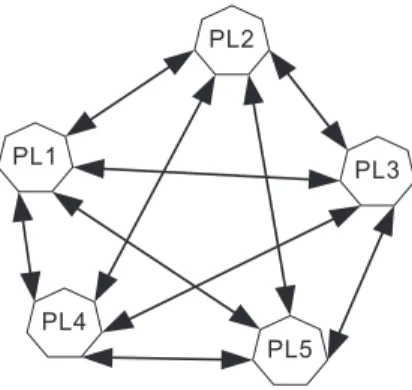
As was mentioned earlier, there is a problem about the number of mappings among different process modeling languages. If we want full interoperability among all the process descrip-tion languages, there aren(n;1)mappings9]
in fully connected graphFigure 1], where the
nodes PLx represent process language, the arcs
represent two-way mappings and the n is the number of nodes.
If the languages are XML-based, the mapping among them becomes easier, because of the pos-sibility of the XSLT transformations usage, but their number stays the same. The problems arise if the process description languages are not di-rectly comparable, for example, if they cover different process modeling aspects. Therefore, some conditions need to be satisfied when trans-forming the process description from(PL1)to
(PL2):
Between the PL1 and the PL2 there must
be a ‘path’, or sequence of defined mapping rules.
Process concept from every process
descrip-tion language on this path must be covered in its predecessor.
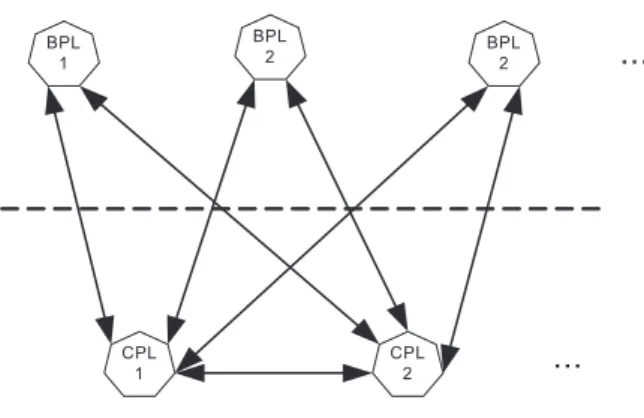
Fortunately, that is the worst-case scenario. Ideally, only one common(‘core’)process
mod-eling language should exist, encompassing all of the possible process modeling concepts of all languages. In this ideal situation, the num-ber of mappings is only 2 n, wherenrepresents the number of process languages. All map-pings among process description languages are indirect; to transform the process description from language (PL1)to (PL2), the
intermedi-ate transformation to the ‘core’ language(CPL)
is needed.
Fig. 2.Graph of mappings(one common process
description language).
To realize this idea, the following conditions should be satisfied:
A core language for the process descriptions
should exist, with strong mathematical foun-dations and
Two-way mappings to convert to and from
the core process language should be defined.
In reality, some mainstream process modeling languages are evolving. The graph of map-pings is also neither fully connected, nor bi-directional, which means that only a small set of mappings exists today. For example:
BPMN (Business Process Modeling
Nota-tion)!BPML/BPEL13],14],
XRL (eXtensible Routing Language) !
PNML(Petri Net Markup Language).
Those process description languages, ‘conver-gence points’ or, de-facto standards, reduce the number of mappings needed. The number of mappings here is between the positive and the negative scenarios.
Fig. 3.Leveled graph of mappings among process modeling languages.
Such topology is ‘right’ only if the core process description languages are compatible with one another, i. e. if they are derived from common low-level process language.
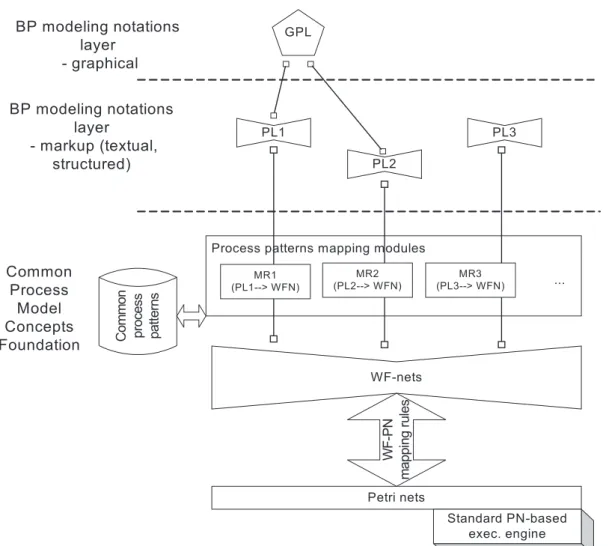
Relying on the current state of the development results in this field, majority of the parts of the proposed architecture and the stack of mappings
Figure 4]already exist. What is still missing,
are the model, mappings and relations, which connect high-level and low-level process de-scription languages and formally define map-ping rules.
The proposed architecture contains the follow-ing tiers:
The top-level tier, which consists of current
Fig. 4.Proposed mapping architecture.
Common Process Model Concepts
Founda-tion layer, which consists of WF-net and Petri net layers. On top of the WF-net layer is the most important part, the mapping layer, which converts variety of process descrip-tion languages to WF-nets.
For the core process description language, the Petri nets were chosen, because their advantages for a workflow modeling were proven many times.
WF-nets were chosen, because an extensive analysis showed they are appropriate for process and workflow representation3]. Main reasons
are:
WF-nets are high-level Petri nets, and they
can be converted to basic Petri nets,
WF-nets are more appropriate for a
work-flow modeling than basic Petri nets, because
they overcome their limitations (advanced
routing and triggering constructs),
WF-nets are Turing-complete, similar as other
high-level Petri-nets, which means that any algorithm can be expressed and,
WF-nets are very appropriate for formal
no-tation of workflow patterns.
The core of the process pattern-mapping mod-ules Figure 4] is the WF-pattern with several
mapping rules defined.
6. Structure of the Pattern-Mapping Modules
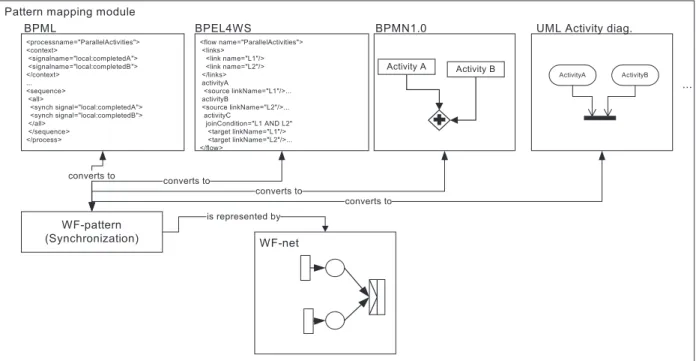
The kernel of the pattern-mapping module
Fig-ure 5]is the WF-pattern. Every WF-pattern can
Fig. 5.Example of mapping rule for Synchronization pattern.
transformed into Petri net. The mapping mod-ule contains mapping rmod-ules for conversion to the specific process description languages.
The pattern-mapping module is extensible with additional mapping rules. An example of such pattern-mapping module is presented in
Fig-ure 5]. The example pattern mapping
mod-ule describes how the pattern synchronization
is presented in several process description lan-guages: graphical (BPMN and UML Activity
diagrams)and one markup language(BPML).
The synchronization pattern represents a point in the process where multiple parallel branches converge into one single thread of control. Examples of the mappings from synchroniza-tion to BPML and other WF-patterns are de-scribed in detail in4]. Other mappings are
de-scribed in5](BPEL),6](XPDL), as a result of
the pattern-based analysis of the web services composition languages.
WF-nets describe only static structure of the pattern-mapping module. For the definition of the WF-net semantics, different approaches are studied, for example, the PSL11].
WF-nets and Petri nets do not have a mecha-nism to describe information objects which are very important in a process modeling. There-fore, the usage of RDF (Resource Definition
Framework) for a detailed token description is
studied9].
Because of the importance of WF-patterns in our approach, the following paragraph briefly describes them.
7. WF-Patterns
The pattern is the abstraction from a concrete form which keeps recurring in specific nonarbi-trary contexts2]. WF-pattern(Workflow
pat-tern)is a combination of interconnected process
modeling concepts, which formulate routing constructs, different synchronization or com-munication mechanism.
In the paper 3], the following groups of
WF-patterns are identified:
1. Basic control flow patterns, which are the basic constructs present in most workflow and process description languages. They are used for sequential, parallel and conditional routing (Sequence, Parallel Split,
Synchro-nization, Exclusive Choice, Simple Merge).
2. Advanced branching and synchronization patternsdescribe advanced types of splitting and joining behavior (Multi-choice,
Syn-chronizing Merge, Multi-merge, Discrimi-nator).
graphical languages, block structures are often considered to be too restrictive. There-fore, the patterns were identified that allow a less rigid structure(Arbitrary Cycles,
Im-plicit Termination).
4. Patterns involving multiple instances des-cribe parts of the process which need to be instantiated several times (Multiple
In-stances Without Synchronization, Multiple Instances With a Priori Design Time Knowl-edge, Multiple Instances With a Priori Run-time Knowledge, Multiple Instances With-out a Priori Runtime Knowledge).
5. State-based patternsdescribe state-based be-havior of the process or workflow(Deferred
Choice, Interleaved Parallel Routing, Mile-stone).
6. Cancellation patternsdescribe, how the pro-cess is canceled, based on incoming events and what are the steps following cancellation
(Cancel Activity, Cancel Case).
WF-patterns are conceptual constructs and they are not well covered in majority of process defi-nition languages. This could lead to mapping problems and the specific process information can be lost. The following paragraph discusses possible work-around solutions.
8. The Specific Process Model Enhancements Problem
Unfortunately, some process constructs are lguage specific and cannot be mapped to an-other process description language. On the other hand, some workflow patterns do not have direct representation in currently avail-able process description languages. Sometimes, workaround solutions can be used. For exam-ple 4], BPML does not support Multichoice,
DiscriminatororSynchronization mergepattern directly, although this pattern can be expressed using combination of simpler concepts.
If we want to accomplish true process descrip-tions interoperability, all vendor specific pro-cess information should be preserved. This in-formation should be hidden and marked ‘inactive’ if the process model is mapped to the language which does not support it.
Similar approach is used in some HTML code-generation tools. They create generic code and
additional specific information, which are hid-den in comments and ignored by web browsers. Another example of information hiding is <head> part of HTML code. The <head> part is not rendered by the web browser(except for the
<title></title> element), although it contains
essential information for different use cases
(web spiders and search engines).
9. Possible Applications
Practical usage of presented approach could be a web-based service of a process model reposi-tory and a translator. A user wishing to trans-form his process model would ‘feed’ the service with the process model and desired destination format. The service would check the model, transform it and return it to the user.
10. Discussion
Benefits of such architecture are: the process definition (model) could be independent, not
only from runtime(or, simulation environment),
but also from the process language.
The main result of this approach is: (a) it will
not matter any more in which process language the process is described and (b) the process
models could be analyzed using proven Petri net or graph algorithms.
The idea is partly borrowed from the program-ming language evolution: first, there were hard-ware specific programming languages, then ope-rating system specific languages and lastly, they developed into the problem area specific lan-guages. Last ones can run on different plat-forms, because the source code is not compiled directly into a hardware and OS specific binary code, but into an intermediate level byte code, which is interpreted by virtual machine. Main programming language vendors have adopted this approach: Sun with Java and Microsoft with C#.
It was recognized1]that the closer the syntax,
11. Conclusion
We do not claim the proposed approach is exhaustive or optimal. It is a hybrid of mul-tiple existing efforts trying to create universal process description and interchange language. It tries to take the advantages out of them. At the moment, the proposed approach is still at a draft stage.
Our future work will concentrate on further de-velopment of the suggested approach: the map-ping modules will be defined in detail, refined and tested on practical, real-world examples.
References
1] Evolution of High-Level Languages,
http://www.encyclopedia.com/html/ section/progrlan EvolutionofHigh-LevelLanguages.asp10/20/2003].
2] E. GAMMA, R. HELM, R. JOHNSON, AND J. VLIS
-SIDES, Design Patterns: Elements of Reusable
Object-Oriented Software. Professional Computing Series, Addison Wesley, Reading, MA, USA, 1995.
3] WILM. P.VAN DERAALST ET AL, Workflow
Pat-terns: On the Expressive Power of(Petri-net-based)
Workflow Languages,http://tmitwww.tm.tue. nl/research/patterns/download/
invited talk cpn 2002.pdf01/10/2004].
4] WIL M. P. VAN DERAALST ET AL, Pattern-Based
Analysis of BPML(and WSCI),http://
tmitwww.tm.tue.nl/research/patterns/ download/qut bpml rep.pdf01/10/2004].
5] WIL M. P. VAN DERAALST ET AL, Pattern-Based
Analysis of BPEL4WS, http://tmitwww.tm. tue.nl/research/patterns/download/ qut bpel rep.pdf01/10/2004].
6] WIL M. P.VAN DER AALST, Patterns and XPDL:
A Critical Evaluation of the XML Process Definition Language,http://tmitwww.tm.tue. nl/research/patterns/download/
ce-xpdl.pdf01/10/2004].
7] BPM&BIM,http://www.cbop.gr.jp/dl/semi
/bosc/2001/011102bosc 05.pdf03/01/2004].
8] JOHN F. SOWA, The WonderWeb Foundational
Ontology Library and the DOLCE Ontology,
http://suo.ieee.org/email/msg08943.html
13/01/2004].
9] JOSHUALUBELL, XML Representation of Process
Descriptions, http://ats.nist.gov/psl/xml/ process-descriptions.html3/12/2003].
10] SHARON BOYES-SCHILLER, Putting Workflow
and BPM Standards into Context, e-Science Workflow Services, Edinburgh, 03/12/2003],
http:www.nesc.ac.uk/talks/303/ EdinburghPresentation2122003.pdf
02/02/2004].
11] PSL home page, http://www.mel.nist.gov/
psl/index.html02/02/2004].
12] ISO TC184/SC4, Setting the Standards for
Industrial Data Homepage,
http://www.tc184-sc4.org/02/02/2004].
13] BPMI.org, Business Process Modeling
Nota-tion, Working Draft (0.9), November 13, 2002,
http://www.bpmi.org/bpmn-spec.esp
20/12/2002].
14] BPMI.org, Business Process Modeling Notation, (1.0),http://www.bpmi.org/bpmn-spec.esp 25/09/2003].
15] ASSAFARKIN, Intalio, Business Process Modeling
Language, http://www.bpmi.org/bpml-spec. esp22/07/2002].
Received:June, 2004 Accepted:June, 2004
Contact address: Tomislav Rozman Romana Vajde Horvat Gregor Polanciˇcˇ
Institute of Informatics Faculty of Electrical Engineering and Computer Science University of Maribor Smetanova 17 SI-2000, Maribor Slovenia Phone:+386 2 235 51 07
Fax:+386 2 235 51 34
e-mail:
ftomi.rozman|romana.vajde|[email protected]
TOMISLAVROZMANis a PhD student, teaching assistant and research engineer at the Faculty of Electrical Engineering and Computer Science, University of Maribor. His work and research interests are dedicated to software standards, process and workflow modeling and analysis and web application development.
ROMANAVAJDEHORVAT, PhD, is an assistant professor at the Faculty of Electrical Engineering and Computer Science, University of Maribor. She teaches and works in the field of software process improvement, software quality improvement, project management, information soci-ety and computer-mediated communication. She is also head of the Centre of Information Technology, Maribor.