INTRODUCTION
Biochemical markers play an important role in accurate diagnosis and also for assessing risk and adopting therapy that improves clinical out-come.1 Creatinine is a breakdown product of
cre-atine phosphate in the muscles. Creatinine is trans-ported through the bloodstream to the kidneys.2
Serum creatinine is the most commonly used test to assess renal function.3 The National Kidney
Disease Education Program recommends calculating glomerular filtration rate (GFR) from serum creatinine concentration.4 The
diag-nosis of renal failure is usually suspected when serum creatinine is greater than the upper limit of normal. In chronic renal failure, an even-tual reduction occurs in the excretion of crea-tinine by both the glomeruli and the tubules.
Creatinine values may alter as its generation may not be simply a product of muscle mass but influenced by muscle function, composition, activity, diet and health status.5 The increased
tubular secretion of creatinine in some patients with kidney dysfunction could give false negative value.6
The impaired renal functions are mainly reflected by the laboratory detection of serum creatinine, which is not sensitive enough to detect early change of renal function, when active management is important.7 Creatinine reflects
renal filtering capacity, which is not sensitive to acute or chronic kidney injury until it is substantial enough to compromise the filtering ability.8
Recently it has been postulated that a substan-tial number of patients have evidence of tubular
ORIGINAL ARTICLE
CORRELATION OF BETA 2 MICROGLOBULIN WITH
SERUM CREATININE AND CREATININE CLEARANCE
IN PATIENTS WITH DIFFERENT LEVELS OF
RENAL FUNCTION
Shahjahan, Riffat Yasmin, Muhammad Amin Jan Mahsud, Mahnoor Khan, Jawaid Subzwari, Javaid Hussain
Department of Biochemistry & Pathology, Gomal Medical College, D.I.Khan, and Department of Biochemistry & Chemical Pathology, Shaikh Zayed Hospital, Lahore, Pakistan
ABSTRACT
Background: Chronic kidney disease is a major health problem in Pakistan. Serum creatinine is the most common test used to assess renal function. This study was aimed to evaluate the levels of β2 Microglobulin
and creatinine in individuals with different levels of renal function and to see the correlation between these biomarkers.
Material & Methods: Total subjects included in the study were 88; 50 males and 38 females, of 30-60 years age, selected randomly from Sheikh Zayed Hospital Lahore. Creatinine clearance was calculated from serum creatinine and 24 hours urinary volume and urinary creatinine for all study subjects and they were divided into 4 groups on the basis of creatinine clearance.
Results: Serum and urinary β2 Microglobulin levels were found to be raised in both male and female patients
of all groups, while serum creatinine levels were in normal range in patients with creatinine clearance above 60 ml/min. Both β2 Microglobulin and serum creatinine levels were increased in parallel with the severity of renal disease. It was found that serum and urinary β2 Microglobulin had a positive correlation with
serum creatinine in all groups. β2 Microglobulin showed negative correlation with creatinine clearance in all
groups.
Conclusion: β2 Microglobulin correlates more closely with different levels of renal functions. It shows
posi-tive correlation with serum creatinine and negaposi-tive correlation with creatinine clearance.
injury without significant changes in their serum creatinine.9
Creatinine clearance (Cr.Cl) is the volume of plasma cleared of creatinine per unit time and is a useful measure for approximating the GFR. How-ever, the creatinine clearance systematically over-estimates the GFR due to secretion of creatinine by the renal tubules.10 By measuring the amount
of creatinine excreted in the urine over 24 hours and serum creatinine, the creatinine clearance may be calculated by the formula.
Cr.Cl = (uCr x uV) / (sCr x 1440).11
Cr.Cl is Creatinine clearance in ml/min, uCr is Urine Creatinine in mg/dl, sCr is Serum creatinine in mg/ dl, uV is 24 hour urine volume in ml and 1440 rep-resents number of minutes in 24 hours.
β2 Microglobulin is a non-glycosylated
pro-tein. In the system, it possesses the negative charge.12 β
2 Microglobulin is a component of MHC
class 1 molecules, which are present on almost all cells of the body except red blood cells. β2
Microglobulin is generally required for the trans-port of MHC class I heavy chains from the endo-plasmic reticulum to the cell surface.13.14 β
2
Microglobulin is filtered by the glomerulus, ab-sorbed and catabolised by the proximal tubules. Clinically the appearance of significant amount of this protein in urine is one of the earliest sign of almost all renal diseases.15 Serum creatinine is
af-fected by factors other than GFR, in particular muscle mass and meat intake. β2 Microglobulin is
released at constant rate in normal subjects, readily filters through the glomerular capillary wall, over 99.9% being reabsorbed and catabolised in proxi-mal tubules with virtually no return of the filtered protein to the circulation. β2 Microglobulin is
there-fore theoretically a highly suitable biomarker of renal dysfunction.16
The current study was designed to determine the values of these biomarkers in patients with dif-ferent levels of renal functions and find out the cor-relation between serum and urinary β2
Microglo-bulin, serum and urinary creatinine, blood urea nitrogen and creatinine clearance in patients with different levels of renal function.
MATERIAL AND METHODS
It was a cross-sectional study. Both male and female (88 in number), subjects between the ages of 30 to 60 years; suffering from different levels of renal dysfunction were selected from the Sheikh Zayed Hospital, Lahore. Diagnosed cases of end stage renal disease (ESRD), patients on
mainte-nance hemodialysis and renal transplant were ex-cluded from the study. Pregnant females and indi-viduals with any other systemic disease like ma-lignancy, leukemia, lymphoma and multiple my-eloma were also excluded from the study. On the basis of creatinine clearance, the patients were divided into 4 groups. All patients participated willingly. A written research participant consent form was filled by each study participant to un-dergo tests. History, demographic information and biochemical results of the patients were recorded. A 6-8 ml blood sample was collected in dispos-able syringes from peripheral vein which was al-lowed to clot for 25 to 30 minutes at room tem-perature (37°C), then centrifuged at 3000 RPM for 3 minutes and clear serum obtained was poured in tubes and kept frozen at -20°C for estimation of serum β2 Microglobulin, serum creatinine and blood
urea nitrogen. Twenty-four hour urine samples were collected in plastic containers. Urine was centri-fuged to obtain clear supernatant that was stored at -20°C for estimation of β2 Microglobulin and
crea-tinine. Creatinine and blood urea nitrogen were determined on chemistry auto analyzer, while Se-rum and urinary β2 Microglobulin was determined
by Enzyme Linked Immunosorbent Assay (ELISA). All data were entered and analyzed through SPSS version 15. Results of serum and urinary Beta 2-Microglobulin, Serum and Urinary Creatinine and Blood Urea Nitrogen were expressed as Mean+SEM for each group. ANOVA technique was used for the comparison of serum and urinary β2 Microglobulin, Serum Creatinine, and Blood Urea Nitrogen of all the groups. PosthocTukey’s test was used for group comparison. Pearson correla-tion coefficient was utilized to see the correlacorrela-tion between different markers. A ‘p’ value of less than 0.05 was considered statistically significant.
RESULTS
The results are given below in tables 1 to 6.
Table 1: Gender distribution of patients in different groups.
Group Male Female Total
patients patients
1 10 6 16
2 4 6 10
3 10 12 22
4 26 14 40
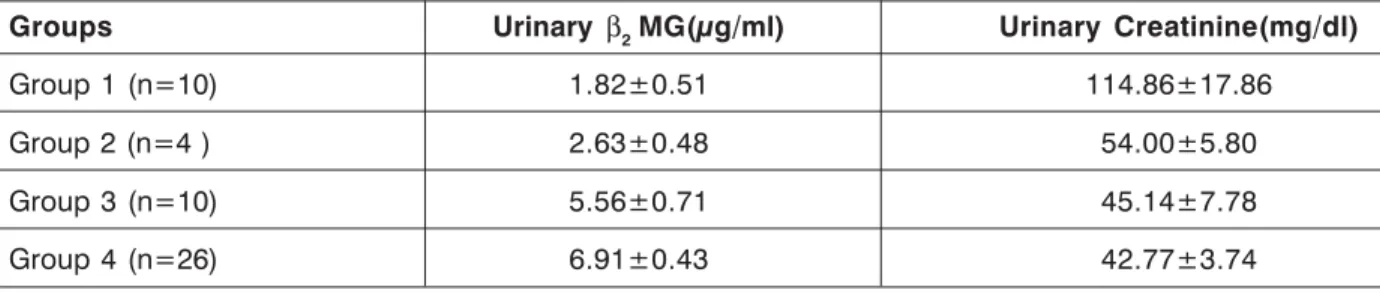
Table 4: Comparison of urinary βββββ22222Microglobulin and urinary creatinine in male patients of different groups.
Groups Urinary β2 MG(µg/ml) Urinary Creatinine(mg/dl)
Group 1 (n=10) 1.82±0.51 114.86±17.86 Group 2 (n=4 ) 2.63±0.48 54.00±5.80 Group 3 (n=10) 5.56±0.71 45.14±7.78 Group 4 (n=26) 6.91±0.43 42.77±3.74 Values are Mean± SEM
Table 5: Comparison of urinary βββββ2 Microglobulin and urinary creatinine in female patients of different groups.
Groups Urinary βββββ2 Microglobulin(µg/ml) Urinary Creatinine((mg/dl)
Group 1 (n=6) 1.05±0.07 83.62±10.68 Group 2 (n=6) 2.58±0.27 86.88±14.78 Group 3 (n=12) 3.03±0.15 47.36±8.04 Group 4 (n=14) 4.91±0.46 31.74±3.25 Values are Mean± SEM.
Table 3: Comparison of serum creatinine, β2 Microglobulin, blood urea nitrogen and creatinine
clearance in female patients of different groups.
Groups Serum Serum Blood urea Creatinine
creatinine βββββ2 Microglobulin nitrogen clearance
(mg/dl) (µg/ml) (mg/dl) (ml/min)
Group 1 (n=6) 0.90±0.13 5.08±0.76 13.00±1.91 124.38±4.35 Group 2 (n=6) 0.98±0.07 5.84±0.20 14.00±1.53 71.12±2.61 Group 3 (n=12) 1.01±0.07 5.88±0.12 14.25±1.07 48.22±1.77 Group 4 (n=14 ) 2.12±0.25 6.19±0.45 41.07±4.73 18.04±1.76 Values are Mean± SEM.
Table 2: Comparison of serum creatinine, β2 Microglobulin (MG) blood urea nitrogen (BUN) and creatinine clearance in male patients of different groups.
Groups Serum Serum BUN Creatinine
creatinine βββββ2MG (mg/dl) clearance
(mg/dl) (µg/ml) (ml/min)
DISCUSSION
Various studies have been conducted to find out the biochemical markers which could play an important role in diagnosis of different renal dis-eases, assessment of the associated risk and adopting therapy. From these studies, it has been speculated that the appearance of significant amount of proteins in urine is one of the earliest sign of almost all renal diseases. The current study is unique that it was conducted on 88 individuals (50 males and 38 females) between the ages of 30 to 60 years with different levels of renal function and suffering from different renal problems. It may be interpreted from these results that serum crea-tinine is a poor marker in assessing early renal damage as it is influenced by muscle mass, gen-der, age, race and medications and is often not elevated until the injury is well established. More-over, serum creatinine level reflects renal filtering capacity, which has a lot of reservation and is there-fore not sensitive to acute or chronic kidney injury until it is substantially enough to compromise the filtering ability. Serum creatinine also does not re-flect any renal damage in early stage of diabetes when kidneys are hyper functional due to initial hyperglycemia, leading to increase in the kidney size and higher glomerular filtration rate. Mean serum creatinine in both male and female patients showed inverse correlation to creatinine clearance in all groups. In group 3 and 4, serum creatinine was above the normal, showing renal injury. From these results, it is obvious that serum creatinine is a late marker of renal injury. It does not show early renal damage. In contrast to creatinine, both se-rum and urinary β2 Microglobulin values were above
the normal in both male and female patients of group 1 and 2. These results indicate that β2
Microglobulin is more sensitive and accurate biomarker for the assessment of renal functions as compared to serum creatinine. The most
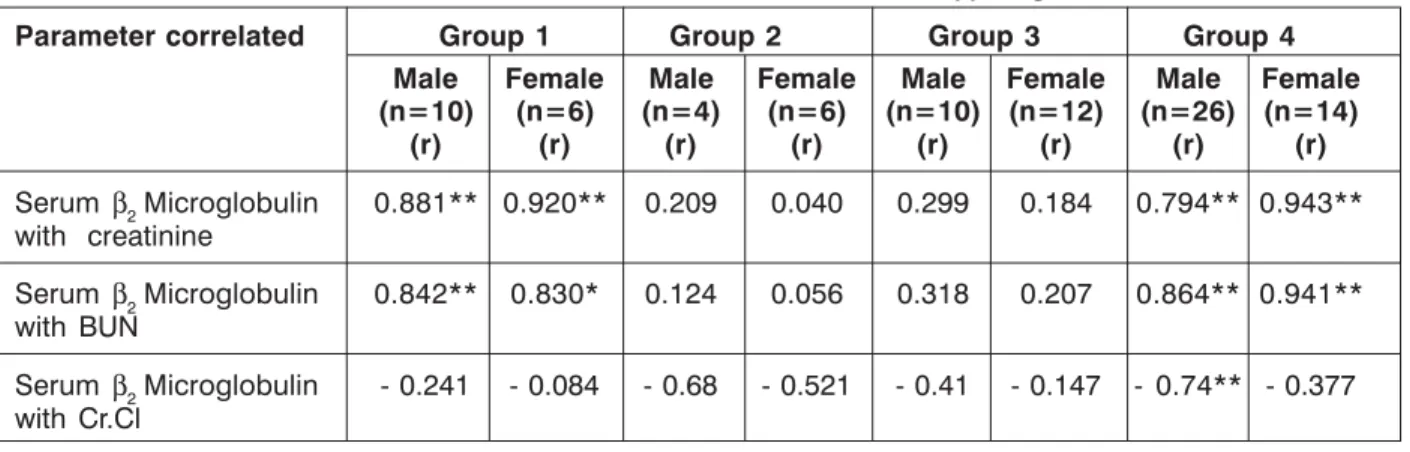
prob-Table 6: Correlation of serum β2 Microglobulin with serum creatinine, blood urea nitrogen and creatinine clearance. Coefficient of correlation (r) is given.
Parameter correlated Group 1 Group 2 Group 3 Group 4
Male Female Male Female Male Female Male Female (n=10) (n=6) (n=4) (n=6) (n=10) (n=12) (n=26) (n=14)
(r) (r) (r) (r) (r) (r) (r) (r)
Serum β2 Microglobulin 0.881** 0.920** 0.209 0.040 0.299 0.184 0.794** 0.943** with creatinine
Serum β2 Microglobulin 0.842** 0.830* 0.124 0.056 0.318 0.207 0.864** 0.941**
with BUN
Serum β2 Microglobulin - 0.241 - 0.084 - 0.68 - 0.521 - 0.41 - 0.147 - 0.74** - 0.377 with Cr.Cl
*p<0.05, **p<0.01
able reason for this could be that South Asians have different diet and muscle mass as compared to Caucasians and creatinine is influenced by these factors. Tazeen et al16 reported similar results. High
values of β2 Microglobulin in group 1 patients could
also be due to any subclinical acute phase dis-ease, as β2 Microglobulin is released in high amount
in acute inflammatory conditions. It was depicted that β2 Microglobulin correlates more closely to
glomerular filtration rate in all different levels of renal functions in different groups of patients as compared to creatinine. β2 Microglobulin showed positive correlation with creatinine and blood urea nitrogen in all groups of patients while both
β2 Microglobulin and creatinine showed inverse
correlation to creatinine clearance in both male and female patients of all four different groups. The consistent negative correlation be-tween β2 Microglobulin and creatinine clearance,
indicates the importance of β2 Microglobulin in di-agnosing renal damage at any level. Measuring β2
Micro-globulin concentrations is a simple and ac-curate method of detecting minor degrees of re-nal damage and monitoring the effects of treat-ment.
CONCLUSIONS
Serum and urinary β2 Microglobulin has highly
significant positive correlation with both serum creatinine and blood urea nitrogen in all groups of patients. A negative correlation exists between serum and urinary β2 Microglobulin and creatinine
clearance in both male and female patients in all groups.
It is suggested to plan a population based study with larger numbers of individuals having specified race, gender, body mass index and nu-tritional parameters, so that β2 Microglobulin can
REFERENCES
1. Ramachandran SV. Biomarkers of Cardiovas-cular Disease MoleCardiovas-cular Basis and Practical Considerations. Circulation 2006;113:2335-62. 2. Yuegang Z, Chengjun. Simultaneous Determi-nation of Creatinine and Uric Acid in Human Urine by High Performance Liquid Chromatog-raphy. Anal Sci 2008;24:1589-92.
3. Corbett JV. Laboratory tests and diagnostic pro-cedures with nursing diagnoses. 7th Ed. 2008;
90-107.
4. Miller W, Myers G, Ashwood. Creatinine mea-surement: state of the art in accuracy and interlaboratory harmonization. Arch Pathol Lab Med 2005;129:297-304.
5. Banfi G, Del F. Serum creatinine values in elite athletes competing in 8 different sports: com-parison with sedentary people. Clinical Chem-istry 2006;52:330–1.
6. Trof RJ, DiMaggio F, Leemreis J, Groeneveld AB. Biomarkers of acute renal injury and renal fail-ure. Shock. 2006;26:245-53.
7. Amanda J. W. Gerald V. and Jack. serumcreatinine is poor marker of GFR. Nephrol Dial Transplant 2005;20: 707-11.
8. Wu I, Parikh C. Screening for kidney disease: older measures versus novel biomarkers. Clin J Am Soc Nephrol 2008;3:1895- 901.
9. Gwinner W, Hinzmann K, Erdbrueggar U, Scheffner I, Broecher V, Vaske B. Acute tubular injury in protocol biopsies of renal grafts :Preva-lence, associated factors and effect on long term function. Am J Transplant 2008;8:1684–93. 10. Tietz NW. ed., Fundamentals of Clinical
Chem-istry, 3rd Edn, W.B. Saunders, Philadelphia, PA
(1987).
11. National Kidney Foundation. K/DOQI clinical practice guidelines for chronic kidney disease: evaluation, classification, and stratification. Am. J. Kidney Dis 2002;39:S1-266.
12. Aksun S Appakan, Ozmen D, Ozmen B. Beta2-Microglobulin and cystatin C in type 2 diabetes: assessment of diabetic nephropathy. Experi-mental and Clinical Endocrinology and Diabe-tes: official journal, German society of Endocri-nology and Diabetes association 2004; 112:195-200.
13. Xinhua Chen, Zhipeng Wu, Suhang Yu. Beta2 -Microglobulin is involved in the immune re-sponse of large yellow croaker to aeromon-ashydrophila: a proteomic based study. Fish and shellfish immunology 2010;28:151-8.
14. Bjorkman P.J., Saper M.A., Samraoui B. Struc-ture of the human class I histocompatibility antigen. Nephrol. Dial. Transplant. 1992;7: 1106-10.
15. Sandeep G, Alok Kumar G, Anurag R. Evalua-tion of Random Urine Sample Protein-Cretinine Ratio as an Index of Quantitative Proteinuria. JK science 2004;6:134-7.
16. Jafar TH, Schmid CH, Levey AS, Serum creati-nine as marker of kidney functions in South Asians. J Am Soc Nephrol 2005;16:1413-9.
Corresponding author:
Dr. Shahjahan
Assistant Professor & Head Department of Biochemistry Gomal Medical College D.I.Khan, Pakistan