Communication and Network, 2010, 2, 38-43
doi:10.4236/cn.2010.21005 Published Online January 2010 (http://www.scirp.org/journal/cn)
Joint Power Control and Spectrum Allocation for
Cognitive Radio with QoS Constraint
Zhijin Zhao1, Zhen Peng1, Zhidong Zhao1, Shilian Zheng2 1
Telecommunication School, Hangzhou Dianzi University, Hangzhou, China
2
State Key Lab. of Information Controlling Technology in Communications System of No. 36Research Institute, China Electronic Technology Corporation, Jiaxing, China
E-mail: {Zhaozj03, Zhaozd}@hdu.edu.cn, [email protected], [email protected] Received October 11, 2009; accepted November 11, 2009
Abstract: Spectrum sharing with quality of service (QoS) requirement and power constraint on cognitive us-ers is studied. The objective is to maximize the system throughput. This problem is modeled as a mixed inte-ger nonlinear programming problem and then transformed to a continuous nonlinear programming problem through eliminating integer variables. We propose the joint power control and spectrum allocation algorithm based on particle swarm optimization to obtain the global optimal solution. Simulation results show that the proposed method can achieve higher system throughput and spectrum utilization under the constraints of transmit power and QoS requirement.
Keywords: spectrum sharing, power constraint, QoS, particle swarm optimization
1. Introduction
The spectrum of the wireless networks is generally regu-lated by governments via a fixed spectrum assignment policy. However, in recent years, the demand for wireless spectrum use has been growing dramatically with the rapid development of the telecommunication industry, which has caused scarcity in the available spectrum bands. Furthermore, the underutilization of the licensed spectrum bands makes the situation even worse [1]. Cognitive radio [2], with the ability to sense unused bands and adjust transmission parameters accordingly, is an excellent can-didate for improving spectrum utilization. In cognitive radio networks, the cognitive (unlicensed) user needs to detect the presence of the primary (licensed) users as quickly as possible and dynamically changes the system parameters, such as transmit power level, so as to best utilize the valuable spectrum [3].
There are two kinds of spectrum sharing method: spec- trum overlay and spectrum underlay. The researches of underlay spectrum limit the transmit power of the cogni-tive users and make sure that the interference temperature does not exceed certain threshold [4]. The related works on spectrum sharing schemes under interference tem-perature mainly include [5–7]. [5] regards the capacity of one cognitive link as an optimization problem with con-straints in interference temperature and studies the opti-mal power allocation strategies. [6] studies the problem of channel selection in multi-hop cognitive mesh networks, but power allocation is not considered. With the
assump-tion that the primary users will always occupy the spec-trum, these approaches can sufficiently increase the spectrum efficiency. [7] studies the joint of power control and random access under interference temperature, the optimization problem is transformed to a convex optimi-zation problem. However, each cognitive user should be aware of the interference with the primary users and re-quires some kind of communications between the cogni-tive users and the primary users.
Previous works (such as [7]) on conventional OFDM systems are based on an implicit assumption that all the OFDM sub-carriers are fixed and always available. But in practice, the under-utilized spectrum which can be util-ized by the secondary users varies over time, this is be-cause the primary users can access to their spectrum un-restricted.
and minimum QoS requirement on individual cognitive user. The QoS constraint is characterized by the minimum transmission rate requirement. To balance the power and QoS constraints, and further to efficiently and fairly util-ize spectrum, transmit power and spectrum allocation must be determined by coordination among cognitive users.
The rest of this paper is organized as follows. The problem formulation and transformation are presented in Section 2. In Section 3, we propose the power and spec-trum allocation algorithm based on particle swarm opti-mization. Section 4 includes simulation results and analysis. Conclusions are drawn in Section 5.
2. Mathmatics Model
In this paper, we consider a cognitive base station to multi cognitive users in wireless networks with rapid changes of spectrum opportunities. When the spectrum opportunities vary quickly, the cognitive users should frequently update the spectrum availably to avoid interference with the primary user. The cognitive base station balances the cognitive users’ transmit power and spectrum to effi-ciently and fairly utilize spectrum.
Consider OFDM based CR system with a total band-width of BHz and M primary users, each primary user with a bandwidth Bm B M/ (m1, 2,...,M ), assume that Bm is less than the coherent bandwidth of the wire-less channel, so that the channel response on each is flat. At the same time, there are N cognitive users in this sys-tem. At different location and time t, cognitive users have different available spectrum resource information because of the primary users’ transmission activities. Define this available spectrum resource information as Ln m, ( )t ,
where Ln m, ( )t {0,1}.Ln m, ( )t 1 means the mth primary user use its own channel and the nth cognitive user can not use this channel, otherwise Ln m, ( )t 0. Let Gn m, ( )t denote the channel gain of the nth cognitive user on the
mth channel and pn m, ( )t be the transmit power of the nth
cognitive user on the mth channel at time t, pnmax is the maximum peak transmit power constraint of user n. We assume that the time variation of the wireless channel is stationary and slow enough, so that the cognitive users are able to perfectly estimate their local channels state in-formation (CSI) on each channel and the cognitive base station knows all the CSI. Based on this CSI, cognitive base station balances the power and spectrum allocation to maximize the system throughput. Let xn m, ( )t {0,1} indicate whether the spectrum is allocated to the cognitive user at time t. If xn m, ( )t 1, the mth channel is assigned to
the nth cognitive user, otherwise xn m, ( )t 0. Each
chan-nel can be used by one cognitive user at any given time t,
that is interpreted as , 1
( ) 1 N
n m n
x t
.We assume that the network is under additive white Gaussian noise. We use M-ary quadrature amplitude modulation (MQAM) and then the maximum transmit rate of cognitive user n in channel m is given by:
, ,
, 2 2
1.5 ( ) ( )
( ) log (1 )
log(5 ) ( )
n m n m
n m m
req
p t G t
r t B
BER t
(1)
where BERreq is an SNR gap parameter which indicates how far the system is operating from capacity, 2( )t is the interference power.
The objective is to maximize the cognitive system throughput
, ,
1 1
( ) ( ) N M
n m n m n m
x t r t
(2)since power per user is finite in this system, every cogni-tive user has its own peak power constraint
, , max
1
( ) ( ) M
n m n m n
m
x t p t P
(3)In practice, cognitive user transmission rate require-ment is required no less than a certain thresholdrn0. It is defined as the QoS constraint of each cognitive user and expressed as
, 0
1 ( ) M
n m n
m
r t r
(4)Note that if the available spectrum information
, ( ) 0 n m
L t or the mth channel has not been allocated to the nth cognitive user xn m, ( )t 0, the transmit power must be zero. The base station should optimize the spec-trum allocation matrix X and power matrix P. In this problem, xn m, ( )t is an element of X and xn m, ( )t {0,1},
, ( ) n m
p t is an element of P and pn m, ( )t (0,pnmax). Due to the discrete nature of channel and continuous nature of power, this optimization problem is a mixed integer nonlinear programming problem (MINLP). The difficulties in solving this MINLP problem come from the conflicting constraint sets, and coupled control variables. In [7] and many other works, they relax the binary valued constraint on the integer variable and replace it by a con-tinuous variable. While this method causes inaccuracy of the algorithms and it can not find the optimal solution. In this paper, we first transform the MINLP problem to a continuous nonlinear programming (NLP) problem by introducing variable transformation, then we solve this problem by particle swarm optimization algorithm.
Z. J. ZHAO ET AL. 40
'
, ( ) , ( ) , ( )
n m n m n m
p t x t p t (5) so the variable rn m, ( )t is transformed to
'
, ( ) , ( ) , ( )
n m n m n m
r t x t r t (6) Then the optimization problem is transformed as the following problem P1:
P1.
Max ',
1 1 ( ) N M
n m n m
r t
(7) s.t.'
, ,
'
, 2 2
1.5 ( ) ( )
( ) log (1 )
log(5 ) ( ) n m n m
n m m
req
p t G t r t B
BER t
(
n
N
)(8)
'
, 0
1 ( ) M
n m n
m
r t r
( n N) (9)'
, max
1 ( ) M
n m n
m
p t P
( n N) (10)' '
, ( ) ( , ) 0 N
n m i m
i n
p t p
, ', ( ) 0 n m
p t
( n N m, M i, N ) (11) In P1, one continuous variable '
, ( ) n m
p t replaces the integer variable and the continuous variable, this substi-tution reduces the solution space dramatically. In addition, the new model is suitable for heuristic and search algo-rithms.
3. Power and Spectrum Allocation
Algorithm Based on PSO
The particle swarm algorithm (PSO) is a swarm intelli-gence optimization algorithm modeled on the flight characteristics of birds [9,10]. In PSO, each solution is a ‘bird’ in the flock and is referred to as a ‘particle’, each particle has a position vector and velocity vector. The location of particles is the solution of optimization prob-lem, the performance of each particle depends on the value of optimization objective’s fitness function. Veloc-ity vector used to determine particle velocVeloc-ity.
The following notation is needed in PSO. The number of particles in the population is denoted asQ . Let
1 2
[ , ,..., ]
k k k k
i i i iD
y y y y be the position of particle i
(1 i Q) at iteration k, where D is the number of di-mensions to represent a particle and yidk is the dth (1 d D) dimension of the position of particle i. Note that yik is treated as a potential solution of the optimi-zation problem. The velocity of particle i at iteration k is
denoted as [ 1, 2,..., ]
k k k k
i i i iD
v v v v , k [ max, max] id
v V V . Each particle in the swarm is assigned a fitness value indicating the merit of this particle such that the swarm evolution is navigated by best solutions. Let sik
1 2 [ k, k,..., k ]
i i iD
s s s be the best solution that particle i has
obtained until iteration k, and [ 1, 2,..., ]
k k k k
b b b bD
s s s s be the global best solution obtained from the population at iteration k.
The evoluationary process of the PSO is as follows:
1
1 1( ) 2 2( )
k k k k k k
id id id id bd id
v v c u s y c u s y (12)
1 1
k k k
id id id
y y v (13) where c1 and c2 are two positive constants named learning factors or acceleration coefficients, u1 and u2 are uniform random numbers distributed in the range [0, 1], and is an inertia weight employed to control the impact of the previous history of velocities on the current velocity. Note that Equation 12) specifies that the veloc-ity of a particle at iteration k is determined by the previ-ous velocity of the particle, the cognition part, and the social part.
In the PSO-based spectrum and power allocation algo-rithm, each particle's position vector specifies a possible spectrum and power allocation scheme. The penalty function is used to solve the constrained optimization problem. Ordinary penalty function only calculates the total violation of individuals, but does not make full use of the violation information of the infeasible solutions. We use the penalty function which is not only depends on the number of constraint violations but also on the degree of constraint violations. The performance of this method is better than that using the ordinary penalty function [11]. As a result of the different scales in con-straints, it is possible that some certain constraints play a dominant role in the total constraints and other con-straints may not reflect their degree of constraint tions. In addition, the objective function and the viola-tions of constraint funcviola-tions may be in different scales, so we normalize the objective function and constraint functions to solve this problem.
We use the following fitness function to evaluate the particle:
' '
, ,
1 1 1 1
( ) ( ) m in( ( ))
N M N M
n m n m
n m n m
F t r t r t
0.5 0 0 0 0 0.3
0 0 0 0 0.4 0
' 0 0.5 0 0 0 0
0 0 0 0 0 0
0 0 0 0 0 0
p 1 0 1 0 0 1
0 0 0 1 1 0 0 1 0 0 0 1 0 0 0 1 0 0 1 0 0 0 0 0
L
[0.5,0,0.3,0,0.4,0.5,0,0,0]
ki
[image:4.595.149.470.83.188.2]y
Figure 1. Coding scheme of particle
one.
1 1
( ') ( ')
_
max( ( ')) max( ( '))
N N
n n
n n n n
i i
J H
sum viol
J H
p
pp p (15)
( ') max(0, ( '))
n n
J p j p (16) ( ') max(0, ( '))
n n
H p h p (17) '
0 ,
1
( ') ( )
M
n n n m
m
j r r t
p (18)
'
, max 1
( ') M
n n m n
m
h p P
p (19)
where '
,
1 1
( )
N M
n m
n m
r t
is the system throughput of the particle p' in time slot t. p' is an N by M matrix rep-resenting the power and channel allocation, if ', 0
n m
p , the channel m is assigned to the cognitive user n, other-wise p'n m, 0.
In the proposed PSO-based power and spectrum allo-cation algorithm, a particle specifies a possible power and spectrum allocation assignment. As p'n m, 0when
, ( ) 0 n m
L t , if we use one bit to encode every element in '
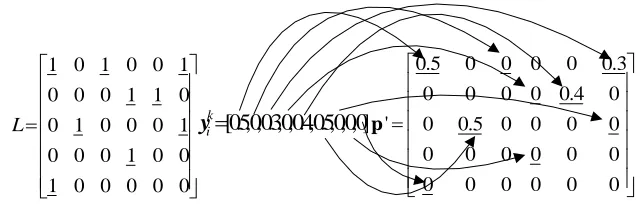
p , there will be a lot of redundancy in the particle. We encode only those elements which may take the value 1, i.e., '
, n m
p where ( , )n m satisfies Ln m, ( )t 1. As a consequence, the length of the coding string is equal to the number of elements equal to 1 in L. Figure 1 illus-trates the structure of an example particle, where N5,
6
M . Note that encoding all the elements needs 30 bits, while encoding only the elements with underline only needs 9 bits. In order to evaluate the fitness of the parti-cle, we need to map the particle to the assignment matrix
'
p , as the arrows show in Figure 1.
The value of every bit in the particle is randomly gen-erated at the initial population and this coding scheme reduces the searching space of the optimization problem efficiently.
The proposed PSO-based power and spectrum
as-signment algorithm proceeds as follows:
Step 1: cognitive user gets the available spectrum re-source information matrix L and channel information matrixGn m, , then transmits these information to the cog-nitive base station.
Step 2: set k0, and randomly generate yidk and k
id
v , where vidt [ Vmax,Vmax],1 d D, thus ob-taining k [ k1, k2,..., k ]
i i i iD
y y y y ,1 i Q. Step 3: map k
id
y (1 i Q) to ' , n m
p , where ( , )n m
is the dth element with Ln m, ( )t 1.
Step 4: compute the fitness value of each particle in the population according to Equation 14), set
1 2
[ , ,... ]
k k k k
i i i iD
s y y y and sbk [ybk1,ybk2,...,ybDk ], where
b is the index of the particle which has the highest fitness value.
Step 5: set k k 1, and update k id
v according to Equation 12). If vidk Vmax , then set vidk Vmax; if
max
k id
v V , set vidk Vmax. Step 6: update k
id
y according to Equation 13) and map k
id
y to ' , n m
p .
Step 7: compute the fitness value of each particle in the population. For particle i, if it’s fitness value is greater than the fitness value of k 1
i
s , then set
1 2
[ , ,... ]
k k k k
i i i iD
s y y y . If particle i’s fitness value is greater than the fitness value of k 1
b
s , then set sbk [yik1,yik2,...,.
] k iD
y .
Step 8: if k equals to the predefined maximum itera-tion, then the algorithm is terminated, map sbk
1 2
[sbk,sbk ,...,sbDk ] to p'; else, go to Step 5.
4. Simulation Result and Analysis
Z. J. ZHAO ET AL. 42
0 500 1000 1500 2000 2500 3000
5.5 6 6.5 7 7.5 8 8.5 9
9.5x 10
6
iteration n
th
ro
ughput
(b
ps
)
[image:5.595.59.281.68.274.2]r0=500 r0=1500 r0=2500 r0=3500
Figure 2. Convergence of proposed algorithm under differ-ent QoS constraints(Pnmax1.5)
0 500 1000 1500 2000 2500 3000
5 6 7 8 9 10 11 12 13x 10
6
iteration n
th
ro
u
ghp
ut
(b
ps
)
[image:5.595.311.535.77.280.2]r0=500 r0=1500 r0=2500 r0=3500
Figure 3. Convergence of proposed algorithm under differ-ent QoS constraints(Pnmax2.5)
censed to M 12 primary users, every primary user’s transmission uses one channel and the available spectrum resource information matrix L is generated randomly. The number of cognitive users is N10. The required bit error rate of each transmission is supposed to be
6 10 req
BER . For simplicity, each cognitive link’s av-erage channel gain is chosen randomly within (0, 0.01) and the interference power is 0.5 mW.
The parameters for the PSO are Q20, c1 c2 2, and Vmax4, and PSO would be terminated after 3000 iterations.
Figure 2 and Figure 3 illustrate the convergence proc-
0 500 1000 1500 2000 2500 3000
4 6 8 10 12 14x 10
6
iteration n
th
rough
put
(b
ps
)
Pnmax=2 Pnmax=2.5
[image:5.595.62.283.316.522.2]Pnmax=3
Figure 4. Convergence of proposed algorithm under differ-ent transmit power constraints
0 10 20 30 40 50
0.95 1 1.05 1.1 1.15
1.2x 10
7
time t
th
o
roug
hpu
t
(
bp
s
)
Figure 5. System throughput at different time
ess of the proposed PSO-based power and spectrum al-location algorithm with different transmission rate re-quirements rn0 r0 under the peak transmit power con-straint. The peak transmit power constraints are Pnmax
1.5
[image:5.595.313.533.320.514.2]0 5000 10000 15000 0
2 4 6 8 10x 10
6
iteration n
th
ro
u
ghput
(
bps
)
Lagrange PSO
Figure 6. Convergence of proposed algorithm and lagrange algorithm
taking more channels, but the more channels they take, the more power will be consumed. Then other users with weaker channel gains and more available power can take the rest channels to transmit and further increase the sys-tem throughput.
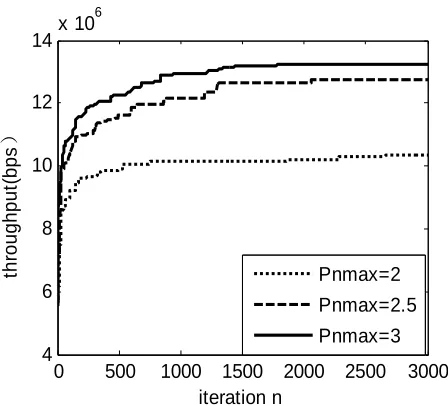
Figure 4 shows the convergence process of the pro-posed algorithm with same transmission rate requirements
0 2000
r bps under different peak transmit power con-straints Pnmax. The peak transmit power is set to 2W, 2.5W and 3W respectively. We can clearly see that the system throughput is increasing as the peak transmits power increases.
Figure 5 shows that the system throughput is fluctuat-ing at different time. The peak transmits power con-straints arePnmax2 and QoS requirement of each user is set to 2500bps. At different time t, the CR system has different available spectrum information and channel state information because of the activities of primary users. Sometimes the primary users are not active, so the cognitive users have more available spectrum resource and the channel gains are better. As a result, the system through is higher than some situations which primary users are active.
Figure 6 shows the convergence processes of the pro-posed algorithm’s performance and the Lagrange algo-rithm in [7]. The peak transmits power constraints are
max 2 n
P and QoS requirement of each user is set to 2500bps. We can see that the proposed algorithm has higher system throughput and faster convergence speed
than the lagrange algorithm.
5. Conclusions
We model the power control and spectrum allocation problem as a mixed integer nonlinear optimization prob-lem. This MINLP problem is difficult to find the optimal solution, so we transform the MINLP problem to an NLP problem. Then we use a coding scheme and PSO-based power control and spectrum allocation algorithm to solve the NLP problem. Simulations show that the proposed model provides the fairness of the assignment and the proposed algorithm performs better than the Lagrange algorithm.
REFERENCES
[1] J. Mitola, “The software radio architecture,” IEEE Com-munications Magazine, 1995.
[2] J. Mitola and G. Q. Maguire, “Cognitive radio: making software radios more personal,” IEEE Pers. Commn, Vol. 6, pp. 13–18, 1999.
[3] J. Mitola, “Cognitive raido: an integrated agent architec-ture for softoware defined radio,” Doctor of Technology, Royal Institute Technology Stockholm, Sweden 2000.
[4] Federal Communications Commission, Spectrum policy task force, Report ET Docket, 2002.
[5] A. Ghasemi and E. S. Sousa, “Fundamental limits of spectrum sharing in fading environments,” IEEE Trans Wirel. Commun, Vol. 6, pp. 649–658, 2007.
[6] M. Sharma, A. Sahoo, and K. Nayak, “Channel selection under interference temperature model in multi-hop cogni-tive mesh networks,” Proceeding of IEEE DySPAN, 2007.
[7] B. Yang, Y. Y. Shen, and G. Feng, “Disttibuted power control and random access for spectrum sharing with QoS constraint,” Computer Communications, Vol. 31, pp. 4089–4097, 2008.
[8] M. Wylie-Green, “Dynamic spectrum sensing by multi-band OFDM radio for interference mitigation,” Proceed-ing of IEEE DySPAN, pp. 619–625, November 2005. [9] J. Kennedy and R. Eberhart, “Particle swarm
optimiza-tion [A],” Proceeding of IEEE Internaoptimiza-tional Conference on Neural Networks, 1942–1948, 1995.
[10] Y. Shi and R. Eberhart, “A modified particle swarm opti-mizer,” Proceeding of the IEEE International Conference on Evolutionary Computation, pp. 69–73, 1998.