Original
Article
The Effect of the Posture of the “Hermit Doing
Body Contortion” on Relief of Shoulder and
Scapular Pain Caused by Chronic Myofascial
Pain Syndrome
:
A Randomized, Parallel Group,
Controlled Trial
Peamruetai Butdapan, B.ATTM.*, Khuannara Narajeenarone, B.ATTM.*, Angkana Apichartvorakit, B.ATTM.*, Sukree Kade, B.ATTM.*, Suton Jansomsarit, B.ATTM.*, Premsuda Jamjuntra, B.ATTM.*, Kunlatorn Debmongkon, M.D.**, Pradit Pratepavanit, M.D.***, Tawee Laohapand M.D.*, Pravit Akarasereenont M.D., Ph.D.*
*Center of Applied Thai Traditional Medicine, **Routine to Research Project, ***Department of Rehabilitation Medicine, Faculty of Medicine Siriraj Hospital, Mahidol University, Bangkok 10700, Thailand.
Correspondence to: Angkana Apichartvorakit E-mail: [email protected] Received 5 July 2016 Revised 28 August 2016 Accepted 19 September 2016
ABSTRACT
Objective: To explore the ability of the posture of the “Hermit Doing Body Contortion” (HDBC) to relieve
shoulder and scapular pain in patients with chronic myofascial pain syndrome (MPS).
Methods: One hundred and thirty-six out-patients with chronic MPS were randomly assigned to one of two
groups. The experimental group was advised to perform a posture of the HDBC named “posture for relieving abdominal pain, pain of the scapular blade” (PRASP) every day for two months. Both groups received Thai traditional massage treatment and hot herbal compresses once a week for four weeks. Using a numeric rating scale and dolorimeter, outcomes were assessed prior to commencing the intervention (M0), and one and two months
after commencing the intervention (M1 and M2).
Results: The mean change in pain intensity between M1 and M2 differed significantly between the groups
(1.32±1.45 in the experimental group and 0.47±2.26 in the control group; p = 0.039). Similarly, the mean change in pressure pain threshold between M0 and M2 also differed significantly between the groups (1.39±1.76 in the
experimental group and 0.53±1.90 in the control group; p =0.027). In both cases, the experimental group achieved greater pain relief.
Conclusion: In patients with chronic MPS, the posture of the HDBC combined with standard Thai traditional
medicine treatments provided better ongoing relief of shoulder and scapular pain than did standard Thai traditional medicine treatments alone.
Clinical trial registration no.: TCTR20151230002
Keywords: Hermit doing body contortion; court-type Thai traditional massage; myofascial pain syndrome;
scapular; shoulder
Siriraj Med J 2016;68:350-357
T
INTRODUCTIONhai Traditional Medicine is becoming established as a recognized health care profession in Thailand.1 The most famous
treatment procedure in Thai traditional medicine is Thai traditional massage which is used to relieve pain of chronic muscle pain. MPS is a frequently occurring and important cause of chronic pain in middle-aged subjects.2 It means that MPS is one
of the most important causes of pain.3,4,5
Assess-ment of patients attending the Ayurved Clinic of Applied Thai Traditional Medicine because of shoulder pain often results in diagnoses of MPS. Treatment with court-type Thai traditional massage and hot herbal compresses generally reduces such shoulder pain for a short period, although the pain usually recurs.The standard treat-ments for MPS in Western medicine are trigger point eradication, botulinum toxin injection, and drugs. Trigger point eradication involves multiple modalities; namely, stretching, massage, physical therapy, acupuncture, dry needling, and trigger point injection.6,7
Since 1836, a son of King Rama V ordered royal sculptors to build the 80 statues of the HDBC postures and had poets compose poems to describe the benefit of each posture.8 In ancient
times, performing these postures was known to prevent and relieve both muscle strain and pain. In the authors’ experience, performing the posture of the HDBC is an effective means of managing the symptoms of patients with MPS. One of these ancient wisdom postures is called the “PRASP”. This posture stretches the pectoralis and biceps muscles and is likely to strengthen the trapezius, rhomboid, supraspinatus, and infraspinatus muscles.9 Because the efficacy of this posture has
not yet been assessed scientifically, the authors designed a study to do so.
The aim of this study was to explore the ability of the “PRASP” to reduce shoulder and scapular pain in patients with chronic MPS when combined with standard treatment comprising court-type Thai traditional massage and hot herbal compresses compared with a control group recei-ving standard treatment alone. The primary outcome was pain intensity according to a numeric rating
scale and the secondary outcome was pressure pain threshold.
MATERIALS AND METHODS
Subjects
One hundred and thirty-six out-patients attending the Ayurved Clinic of Applied Thai Traditional Medicine Siriraj Hospital were recruited for research. Nine out-patients were excluded because they were not convenient to follow up. The study was approved by the Siriraj Institutional Review Board, Faculty of Medicine Siriraj Hospital, Mahidol University on 5 January 2010 (Si.583/2552) and the study ran from March 2010 to July 2011.
Inclusion criteria were as follows: age 18-50 years, chronic shoulder and/or scapular muscle pain for more than 3 months, never treated or treated for less than one month, and were diagnosed of MPS by physician at the Ayurved Clinic of Applied Thai Traditional Medicine. Exclusion criteria comprised comorbidities of psoriasis or osteoporosis, temperature more than 37.5°C, pregnancy, history of trauma or surgery involving the bones of the neck, shoulder and/or back, and arthralgia.10
Study design
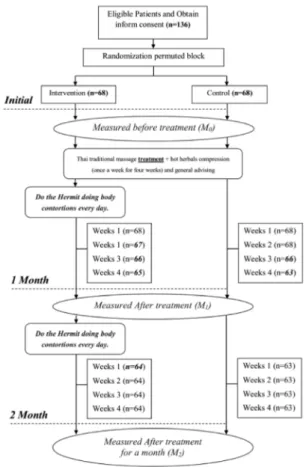
After the subjects had provided written informed consent, they were allocated to one of two groups by randomization. The control group (68 subjects) was treated by court-type Thai tradi-tional massage and hot herbal compresses and given general advice, whereas the 68 subjects in the experimental group were also asked to perform the posture of the HDBC named “PRASP” every day. By the end of study, 127 subjects remained, 64 in the experimental group and 63 in the control group. Nine subjects (four in the experimental and three in the control group) dropped out of the study because there were too busy to comply with the recommended treatment regimen (Fig 1).
Assessment
Assessment was performed on three occasions: on entry into the study (M0) and one
The intensity of shoulder and scapular pain was self-assessed on a numerica rating scale from 0 to 10 (0 meaning no pain and 10 extreme pain).11
Clinically significant improvement was defined as reduction in pain intensity by two or more levels. The pressure pain threshold was assessed with a dolorimeter12 (Dolorimeter Force Dial
FDK; US Neurologicals, Washington, DC, USA) (FDK 20, 9 kgf × 0.11 kgf 10 kgf × 0.1kgf) by an applied Thai traditional medical practitioner (ATTM).
Intervention
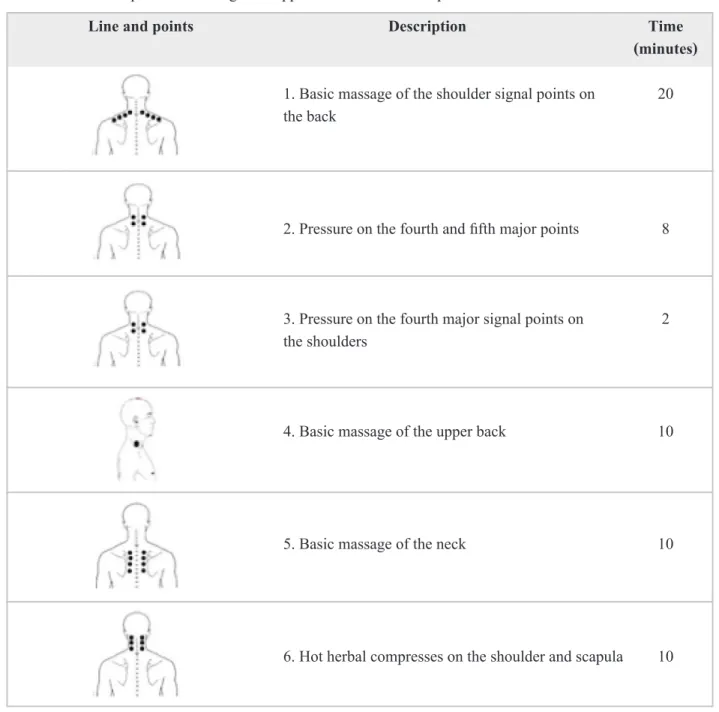
All subjects received court-type Thai tradi-tional massage and hot herbal compresses once a week for four weeks from a licensed ATTM. This standard treatment included the following: (i) basic massage of the shoulder; (ii) pressure on the fourth and fifth major signal points on back; (iii) pressure on the fourth major signal points on the shoulder; (iv) basic massage of the upper back; (v) basic massage of the neck; and (iv) hot herbal compresses on the shoulder and scapula. The lines and points of massage are shown in Table 1.
All subjects also received general advice, which included a recommendation to avoid posi-tions or behaviors that exacerbated their pain and to refrain from using any other treatment. Specific treatments they were asked to avoid included the following: injection at trigger points, acupuncture, use of topical cold or heat, analgesics including non-steroidal anti-inflammatory drugs, other types of exercise, and other forms of massage therapy.1
Additionally, subjects in the experimental group were instructed in and asked to perform the pos-ture of the HDBC known as “PRASP”five times, twice a day (morning and evening) for two months (Fig 2). These subjects were asked to record their compliance with these instructions in a diary; the diary and posture were checked by an ATTM at each assessment.
Statistical analysis
Descriptive statistical methods were used to calculate the percentage, mean and standard deviation. The effect of treatment was compared with the Chi-square test. P-values less than 0.05 were considered statistically significant. The pain numeric rating scale and pressure pain threshold were compared within and between groups using repeated measure ANOVA.
RESULTS
At the end of the study, results were availa-ble for 127 of the original 136 subjects, 64 in the experimental group (standard treatment plus the
Fig 1. Study flow
Fig 2. The posture of the “Hermit Doing Body
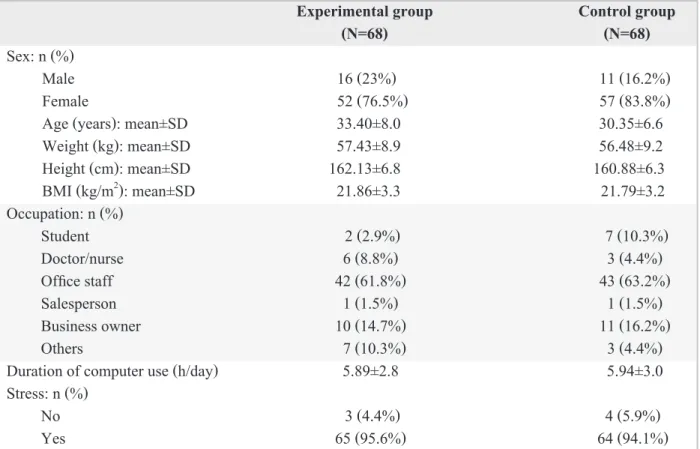
specified posture of the HDBC) and 63 in the control group (standard treatment only). As shown in Table 2, there were no significant differences in general characteristics such as age, weight, height, body-mass index, occupation and duration of computer use.
As to numeric rating scale scores, at the two month (M2) endpoint, 79.7% of subjects in the experimental and 61.9% in the control group reported reduction in pain by two or more levels, and this difference was statistically significant (p = 0.03). However, at one month (M1), 53.1% of subjects in the experimental and 58.7% in the control group reported reduction in pain by two or
Table 1. Lines and points of massage and application of herbal compresses.
Line and points Description Time
(minutes)
1. Basic massage of the shoulder signal points on 20 the back
2. Pressure on the fourth and fifth major points 8
3. Pressure on the fourth major signal points on 2 the shoulders
4. Basic massage of the upper back 10
5. Basic massage of the neck 10
6. Hot herbal compresses on the shoulder and scapula 10
Fig 3. Percentage of subjects for whom pain intensity
decreased by two or more levels between M1 and M2
according to grouop
Experimental group Control group
(N=68) (N=68)
Sex: n (%)
Male 16 (23%) 11 (16.2%)
Female 52 (76.5%) 57 (83.8%)
Age (years): mean±SD 33.40±8.0 30.35±6.6
Weight (kg): mean±SD 57.43±8.9 56.48±9.2
Height (cm): mean±SD 162.13±6.8 160.88±6.3
BMI (kg/m2): mean±SD 21.86±3.3 21.79±3.2
Occupation: n (%)
Student 2 (2.9%) 7 (10.3%)
Doctor/nurse 6 (8.8%) 3 (4.4%)
Office staff 42 (61.8%) 43 (63.2%)
Salesperson 1 (1.5%) 1 (1.5%)
Business owner 10 (14.7%) 11 (16.2%)
Others 7 (10.3%) 3 (4.4%)
Duration of computer use (h/day) 5.89±2.8 5.94±3.0
Stress: n (%)
No 3 (4.4%) 4 (5.9%)
Yes 65 (95.6%) 64 (94.1%)
TABLE 2. Relevant baseline characteristics of study subjects.
The mean pain intensity scores on the numeric rating scale on entry to the study (M0)
and one month (M1) and two months (M2) after entry were 4.62, 2.94, and 1.62, respectively, in
Fig 4. Pain intensity according to numeric rating scale
scores according to group
# Compared with Mo within group significant
dif-ferrence at p < 0.001
* Compared with M1 within group significant
dif-ferrence at p < 0.001
P = compate between group significant differrence at p < 0.001
the experimental group and 5.24, 3.34, and 2.87, respectively, in the control group (Fig 4). The differences between the groups were at M0 (p = 0.02), M1 (p = 0.17) and M2 (p = 0.001).
The mean changes in pain intensity over the three assessed periods (M0 to M1, M0 to M2, and M1 to M2) were compared within each of the
groups. Expressed as mean difference ± SD, these values were 1.59±1.64, 2.91±1.72, and 1.32±1.45, respectively, in the experimental group and 1.87±1.93, 2.33±2.25, and 0.47±2.26, respec-tively, in the control group. All of these changes were statistically significant (p<0.001) except for between M1 and M2 in the control group (p = 0.315), as shown in Fig 4.
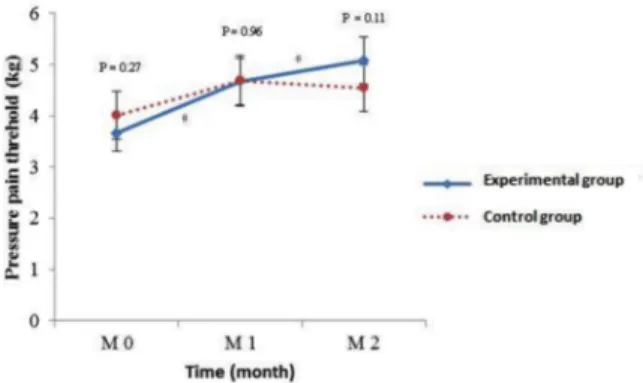
The mean changes in pressure pain threshold were compared within groups over three time periods: M1 to M0, M2 to M0, and M2 to M1. These
values, expressed as mean ± SD were 0.98±2.01, 1.39±1.76, and 0.41±2.18, respectively, in the experimental group. The changes between M1 and M0 and M2 and M0 were statistically
signi-ficant (p˂0.001 for both). In the control group
they were 0.66±1.89, 0.53±1.90, and -0.13±1.76, respectively, the change between M1 and M0 being statistically significant (p = 0.023), as shown in Fig 5.
In terms of satisfaction, 87.5 % of subjects in the experimental group were satisfied with the results of the specified exercise and 92.2% planned to use the posture when they experienced pain.
DISCUSSION
As shown in the patient flow diagram (Fig 1), we enrolled 68 subjects into each arm of the study (M0). Three participants in the experimental and five in the control group did not attend for their one month appointment because of work pressures. Therefore, at M1 65 subjects remained in the
experimental and 63 in the control group. One more subject in the experimental group failed to attend the two month appointment (M2) for private reasons; thus, we had complete results for 64/68
participants in the experimental and 63/68 in the control group. The M0 from the two groups were different in pain intensity, so the feelings of the participants were then divided into groups by RCT. The result was beyond the expectation of the researchers. The pressure pain threshold and results for the two groups were not significantly different. In addition, the study was conducted to measure change in pain intensity at different times which is shown in Fig 4 to illustrate the effectiveness of the posture of the HDBC.
At the end of the first month, there was no significant difference in pain intensity between the study groups; both had received standard treat-ment with court-type Thai traditional massage and hot herbal compresses. However, the superior efficacy of the experimental regimen, which included performing the posture of the HDBC, was detectable at M2, when the experimental
group had significantly milder pain intensity and higher pressure pain threshold than the control group (Figs 4 and 5).
Our findings clearly show that doing the posture of the HDBC known as “PRASP” in addition to receiving standard treatment reduced shoulder and scapular pain after two months (M2) more effectively than standard treatment alone. As shown in Fig 3, a significantly greater proportion of subjects in the experimental than in the control group experienced reduction in pain intensity by two or more levels (p = 0.03). Additionally, as shown in Figs 4 and 5, the reduced pain intensity was accompanied by increased pressure pain threshold.
We have here presented the findings of pre-liminary research into the efficacy of the posture of the HDBC known as “PRASP” combined with court-type Thai massage and hot herbal compres-sion in a randomized controlled trial. Originally, the ancients developed this and many other pos-tures by practicing various pospos-tures to find out experientially how they caused muscles to tense up, shrink, or relax and wrote and interpreted poetry that documented their findings. They developed and recorded a whole body of know-ledge about such postures in this way. There are still 80 poems and 24 statuesin existence that explain the posture of the HDBC; these could be
Fig 5. Pressure pain threshold according to dolorimeter
according to group
# Compared with M0 within group significant
dif-ferrence at p < 0.001
* Compared with M1 within group significant
dif-ferrence at p < 0.001
the basis of further research for improving and maintaining the knowledge developed in ancient times. There is a research article on comparing yoga, which is a familiar exercise with HDBC, with stretching-strengthening exercises. The research has shown that yoga practice is just as effective as stretching-strengthening exercises in improving functional fitness, in terms of balance, strength, flexibility, and mobility.13 The posture
of HBDC named PRASP can stretch many parts of the muscle. For example, when sitting with crossed-leg position, quadriceps femoris, ham-strings, and tibialis anterior are stretched. Further-more, when you perform the posture, it will stretch trapezius, rhomboids, deltoid, biceps brachii and triceps brachii muscle which can relieve shoulder and scapular pain9.
Assessment of the pain of patients with MPS using a dolorimeter14 is useful for assessing
specific treatments during rehabilitation15,
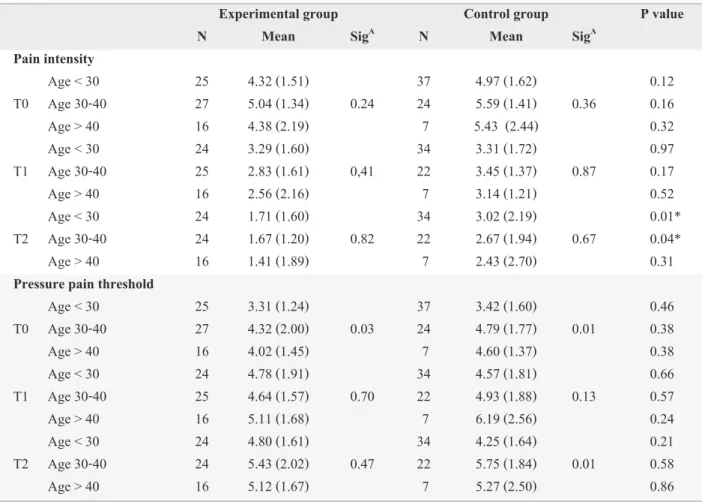
although it is not very practical in clinical settings. Nonetheless, the dolorimeter is a reproducible way of measuring pain. Assessment of pain symptom using the numeric rating scale is useful, although, it is a subjective form of assessment. Thus, the combination of numeric rating scale scores and dolorimeter readings used in this study was optimal for effectively and accurately assessing the subjects’ shoulder and scapular pain. The subjects were split into age and additional testing was conducted to see whether age affected pain intensity and pressure pain threshold with one way ANOVA for analyzing the relationship between age and time. Furthermore, Independent paired T-test was used for comparing between groups in each age and time. As shown in Table 3, there was no statistically significant difference in pain intensity.
One limitation of this study was that we did not incorporate a suitable placebo posture of
Experimental group Control group P value
N Mean SigA N Mean SigA
Pain intensity
Age < 30 25 4.32 (1.51) 37 4.97 (1.62) 0.12 T0 Age 30-40 27 5.04 (1.34) 0.24 24 5.59 (1.41) 0.36 0.16 Age > 40 16 4.38 (2.19) 7 5.43 (2.44) 0.32 Age < 30 24 3.29 (1.60) 34 3.31 (1.72) 0.97 T1 Age 30-40 25 2.83 (1.61) 0,41 22 3.45 (1.37) 0.87 0.17 Age > 40 16 2.56 (2.16) 7 3.14 (1.21) 0.52 Age < 30 24 1.71 (1.60) 34 3.02 (2.19) 0.01* T2 Age 30-40 24 1.67 (1.20) 0.82 22 2.67 (1.94) 0.67 0.04* Age > 40 16 1.41 (1.89) 7 2.43 (2.70) 0.31
Pressure pain threshold
Age < 30 25 3.31 (1.24) 37 3.42 (1.60) 0.46 T0 Age 30-40 27 4.32 (2.00) 0.03 24 4.79 (1.77) 0.01 0.38 Age > 40 16 4.02 (1.45) 7 4.60 (1.37) 0.38 Age < 30 24 4.78 (1.91) 34 4.57 (1.81) 0.66 T1 Age 30-40 25 4.64 (1.57) 0.70 22 4.93 (1.88) 0.13 0.57 Age > 40 16 5.11 (1.68) 7 6.19 (2.56) 0.24 Age < 30 24 4.80 (1.61) 34 4.25 (1.64) 0.21 T2 Age 30-40 24 5.43 (2.02) 0.47 22 5.75 (1.84) 0.01 0.58 Age > 40 16 5.12 (1.67) 7 5.27 (2.50) 0.86
TABLE 3. Relation of age with pain intensity and pressure pain threshold.
the HDBC for the control group. Also, it was of relatively short duration, so we suggest that future studies should be longer to better ascertain the effects of the posture of the HDBC.
CONCLUSION
Performing the posture of the HDBC known as “PRASP” repeatedly over many days combined with massage and hot compresses reduces the pain of subjects with MPS. The participants were highly satisfied with this practice and reported no complications.
ACKNOWLEDGMENTS
This study was supported by the Siriraj Routine to Research Management fund, Mahidol University, Bangkok, Thailand. The authors wish to thank Associate Professor Chulalak Komoltri and Pimrapas Tengtrakul for statistical advice, Miss Narichart Chuensakun and Miss Manmas Vannabhum for editing and translating this article. Furthermore, thanks to Miss Kridtiya Noojarearn and Miss Kritsana Panpumfor their help during data collection. Finally, the originator of this research, Mr. Chatchaparm Jantabutr, wishes to thanks all participants for their cooperation.
REFERENCES
1. Laohapand T, Jaturatamrong U, Jantabut C, Tonglue T, Kamkaew P, Punpeng P, et al. Thai Traditional Medicine in the Faculty of Medicine Siriraj Hospital. Bangkok: Supa- vanich Press; 2009.
2. Phongtarakulpanit A, Chaiumnuay P, Asavatanabodee P, Kongkiatngam U. Myofascial pain syndrome in Thai com- munity. Rheumatism Booklet 1995;4:2-9.
3. Fishbain DA, Goldberg M, Meagher BR, Steele R, Roso- moff H. Male and female chronic pain patient categorized by DMS-III psychiatric diagnosis criteria. Pain 1986;26: 181-97.
4. Rosomoff HL, Fishbain DA, Goldberg M, Santana R, Rosomoff RS. Physical findings in patients with chronic intractable benign pain of the neck and/or back. Pain 1989; 37:279-87.
5. Simons DG. Myofascial pain syndrome due to trigger points. In: Goodgold J, ed. Rehabilitation Medicine. St. Louis: Mosby; 1988.p.6863723
6. Srbely JZ. New trends in the treatment and management of myofascial pain syndrome. Curr Pain Headache Rep 2010;14:346-52.
7. Prateepavanich P. Myofascial pain syndrome a common problem in clinical practice. Bangkok: Amarin Printing and Publishing Public Company; 1999.
8. Fine Arts Department. Hermit Doing Body Contortions Poetry Collection. Amarin Printing And Publishing; 2008. 9. Thippayachareontam R, Iam-am A. The posture of the
“Hermit Doing Body Contortion” on relief of shoulder and scapular pain. In: Laohapand T, Jaturatamrong U, eds. Hermit Doing Body Exercises Volume I. Bangkok, Supawanich Printing; 2011.p.33-36.
10. Kasitanont N. Evaluation of patients with joint pain. In: Asavatanabodee P, ed. Rheumatology for nurse practi- tioners and allied health professionals. Bangkok: City Print Company; 2013.p.12-29.
11. Farrar JT, Young JP Jr, La Moreaux L, Werth JL, Poole RM. Clinical importance of changes in chronic pain intensity measured on an 11-point numerical pain rating scale. Pain 2001;94:149-58.
12. Maquet D, Croisier JL, Demoulin C, Crielaard JM. Pressure pain thresholds of tender point sites in patients with fibro- myalgia and in healthy controls. Europ J Pain 2004;8: 111-7.
13. Neha PG, Edward M. Yoga is as good as streching-stren- gthening exercises in improving functional fitness out- comes: results from a randomized controlled trial. J Gorontol A Biol Sci Med Sci 2016;71:406-11.
14. Assumpção A, Sauer JF, Mango PC, Pascual MA. Physical function interfering with pain and symptoms in fibromyal- gia patients. Clin Exp Rheumatol 2010;28(6 Suppl 63): S57-63.