ЕЛЕКТРИЧНИЙ
ТРАНСПОРТ
UDC 629.423.2:621.313.333
H. K. HETMAN
1, S. L. MARIKUTSA
2*1Dep. «Electric Rolling Stock of Railways», Dnipropetrovsk National University of Railway Transport named after Academician V. Lazaryan,Lazaryan St., 2, Dnipro, Ukraine, 49010, tel. +38 (056) 373 15 31, e-mail [email protected],
ORCID 0000-0002-3471-6096
2*Dep. «Electric Rolling Stock of Railways», Dnipropetrovsk National University of Railway Transport named after Academician V. Lazaryan, Lazaryan St., 2, Dnipro, Ukraine, 49010, tel. +38 (056) 373 15 31, e-mail
[email protected], ORCID 0000-0002-0429-6633
SELECTION OF RATIONAL PARAMETERS OF THE NOMINAL MODE
ELECTRIC TRAINS WITH ASYNCHRONOUS TRACTION DRIVE
Purpose. Parameters of the nominal mode are related to the most important performance indicators of traction means, therefore, the problems of choosing their optimal values always inevitably arise when forming technical re-quirements for a new rolling stock. The paper describes the features of solving the above-mentioned problems for electric trains with an asynchronous traction drive in the case of two-zone and three-zone frequency control of pow-er. Methodology. Power of nominal mode of the rolling stock should be chosen in such a way that it would be pos-sible to realize a predetermined travel time along in the section or the movement speed. On that basis, and also tak-ing into account the fact that the important operational characteristics of electric trains include the acceleration value during the start-up and acceleration at the design speed, we will formulate the problem of determining the nominal power. In the task for a given range of traction, it is necessary to find such a value of the nominal mode power and the corresponding force value to ensure the ability to carry out transportations with the given level of average speed with minimal energy consumption for traction. At the same time, it is necessary to fulfill the following conditions: a) the speed of the electric train on the section does not exceed the established limits; b) it is possible to realize the given values of accelerations. A more detailed consideration of the problem shows that in real conditions, when the starting acceleration and the mass of the train are given, the problem of determining electric train power is practically reduced to determining the optimal value of the nominal mode speed.
Findings. The task of choosing the optimal values of the nominal mode speed is solved by determining the electric power consumption with the variation of the possible values of starting speed. Therefore, only those values that ensure the implementation of the given starting and residual accelerations should be taken into account. The work shows that the traction force value increases with the design speed increase and other equal conditions, if the starting speed is increased. Originality. Authors developed the methodology for determining the optimal values of the nom-inal mode parameters of electric trains with an asynchronous traction drive, with two-zone and three-zone frequency power regulation. Practical value. The above mentioned methodology can be the basis when forming technical requirements for new rolling stock for Ukraine’s railways.
Keywords: electric train; starting and residual acceleration; starting speed; motion equation; traction characteristic; power regulation zone; specific force
Introduction
Parameters of the nominal mode are related to the most important performance indicators of the electric rolling stock. Therefore, the problems of
of acute shortage of funds, when it is especially important to avoid the acquisition of inefficient equipment.
Determining the parameters of the nominal mode (traction force, speed of movement and pow-er) of traction means is the main objective of the so-called traction supply problems. Review of the papers on this topic is given in [1, 5, 6]. There one can find the ways of solving such problems with regard to freight and passenger electric locomo-tives, mainly with a collector traction drive.
Purpose
In the case of electric trains, the tasks of deter-mining the parameters of nominal mode were con-sidered in a smaller volume and only with refer-ence to the collector traction drive [3, 4, 9]. In this article, the features of these traction supply prob-lems for electric trains with an asynchronous trac-tion drive are described.
Methodology
The nominal mode power should be selected in such a way that it would be possible to realize the predetermined travel time along the section (or movement speed). With such a «blurred» statement of the problem, its solution contains many variants, and when determining the rules for selecting the best ones the work [6] proposes to apply the fol-lowing indicators for a comparative evaluation of the variants:
– specific power consumption for train traction; – excess capacity of the required locomotive fleet;
– the mean value of the traction multiplicity re-quired for transportations.
Last two indicators make sense for freight and passenger traffic, as the weight (composition) of trains varies widely.
In the case of electric trains only the first of the above-mentioned indicators is used: electricity consumption, since in the general case, when the specific power is distributed along the length of the train, i.e. which accounts for 1 ton of train weight, it does not depend on train composition. For elec-tric trains, where the traction motors are located in the end cars, the maximum train weight should be taken into account.
Based on the above and taking into account that the acceleration value during starting period (ac-celeration) аs and acceleration at the design speed
аr (residual acceleration) refers to the important operational characteristics, the problem of deter-mining the nominal power of the electric train is formulated as follows: for the given traction poly-gon, it is necessary to find such a value of the nom-inal mode power and corresponding traction value, so that it would be possible to carry out transporta-tions with a given level of average speed with min-imum electricity consumption for traction and the following conditions would be met:
– the speed of the train movement in the section does not have to exceed the established limits;
– it is possible to realize the given values of ac-celeration at start (аs) and the residual one (аr).
A more detailed consideration of the problem shows that in real conditions, when the starting acceleration and the train weight are given, the task of traction supply of electric trains practically re-duces to determining the optimal value of the nom-inal mode speed.
To be convinced of the validity of the forego-ing, let us determine the factors defining the nomi-nal mode power.
The traction force in N, required to realize the given acceleration а, is determined on the basis of the equation of the train motion used for traction calculations [2, 12] as
( ) ( ) 1000 (1 ) , N
k k
F v W v m a , (1)
where F vk( ) – tangential traction force (on the rim of the driving wheels) of the motor cars, N; W vk( ) – total movement resistance, N; m – train weight, t; 1 – inertia coefficient of the rotating masses of the train; a – acceleration, m/s2.
Given that the train movement resistance
( ) 9,81W vk mw vk( ), (2)
where w vk( ) – specific total resistance to train movement, N/kN.
Taking into account (2), we transform (1) to the form
( ) 9,81 ( ) 102(1 ) .
k k
F v m w v a (3)
(km/h) the nominal mode power is defined as
3
0,2778 10 , kW,
n kn n
N F v (4)
where Fkn – tangential traction force related to one traction motor, N; the index «n» – means the value of the parameter corresponding to the nominal mode.
Substitution of (3) into (4) gives
3
2,725 10 ( ) 102(1 ) .
n k n s n
N m w v a v
(5)
Expression (5) shows that the power of nominal mode at the given values ,m as, (1) and
( )
k n
w v dependencies is definitely determined by the value of the optimal mode speed, and thus the problem of choosing the optimal parameters of nominal mode of electric trains reduces to the choice of the movement speed in the nominal pow-er mode from the condition of minimizing the elec-tricity consumption for traction of trains.
To solve the problem, one can use the method proposed in [6]. Its implementation is carried out by successively solving the following tasks:
– determination of control parameters of the train movement equation;
– optimization of train traffic control for mini-mal electric power consumption;
– determination of the nominal mode speed, corresponding to the minimum power consumption when implementing the given travel time.
To solve the last two of the problems posed above, it is possible to apply the approaches used in solving similar problems for passenger electric locomotives [1, 5, 11]. Therefore, we will dwell only on the problem of determining the control parameters of the motion equation.
Traction calculations are based on the integra-tion of the mointegra-tion equaintegra-tion (6).
o( ) ( ) ,
vdv
u w i s
ds (6)
where − is dimensional coefficient, the value of which depends on the accepted units of measure-ment of physical quantities; u − control parameter;
( )
о
w v – basic specific net train resistance; і − the value of the longitudinal path gradient, which is a
function of the path ( )і s .
The value w vо( ) is determined as
( ) in traction mode; ( )
( ) in the run-out (idling) mode.
о о
ox w v w v
w v
(7)
The dependences ' ( )w vо and w voх( ) are de-termined by the corresponding dependences ob-tained on the basis of the experimental data [7, 8, 10].
The control parameter depends on the operation mode of the electric train: u0 corresponds to the traction mode; u0 – to the braking mode;
0
u to the run-out mode.
Let us consider the traction drive with a smooth control of the traction power. Then, in the power calculation the control parameters that satisfy the following conditions are adopted:
– traction mode 0 u f vk( ); – breaking mode ( )b vt u 0,
where f vk( ) и ( )b vt − limiting traction and brak-ing characteristics respectively, referred to 1 kN of the train weight.
Let us consider the problem of calculating de-pendencies f vk( ) for the two most frequently en-countered methods of 3-zone (Fig. 1, a) and 2-zone (Fig. 1, b) frequency control of the asynchronous traction drive power for electric trains.
In the case of 3-zone regulation, there is a pos-sibility:
– in the zone 1 (0 v vs) – acceleration with the given starting traction force;
− in zone 2 (vs v v) – the realization of the constant traction power;
− in zone 3 (v v vc) – the traction power control is inversely proportional to the movement speed.
In the acceleration zone (0 v vs), the start-ing traction force of thrust in specific units (3)
( ) ( ) 102(1 ) .
ks k s s
Fig. 1. The limiting traction characteristics of the electric trains, HRCS2 series: a – the Hyundai-Rotem Company and b – EJ675 of SKODA Vagonka . In zone 2 (vs v v)
.
s
s ab v v
N N
Since Ns F vks s and Nab Fk ab( )v then
( ) s.
k ab ks
v
F F
v
(9)
Taking into account (8)
( )( ) ( ) 102(1 ) s.
k ab k s s
v
f v w v a
v
(10)
In the 3rd regulation zone ( )
c
v v v the ul-timate traction power
.
bc v
N N
v
Since
( )
bc k bc
N F v or Fk bc( ) N v2.
v
(11)
But since N F vk , where Fk – is the val-ue Fk ab( ) at v v , then
2 ( ) 2 .
k bc k
v
F F
v
(12)
From the (9) we have the following
,
s
k ks
v
F F
v
that is why
( ) 2 .
s
k bc ks
v v
F F
v
(13)
We designate ,
c v k
v
then v v kc and
( ) 2 .
s c
k bc ks
v v k
F F
v
(14)
where vc – constructional speed of the train, km/h. Taking into account the specific quantities, we obtain
( )( ) ( ) 102(1 ) 2 .
s c
k bc k s s
v v k
f v w v a
v
(15)
Let us introduce the designations
; ,
ks s
f N
kn n
F N
k k
F N
(16)
where Ns – is the maximal traction force, at
s v v .
The limiting traction characteristic for the ac-celeration section is determined by the expression (8), and fk ab( )( )v – according to the formula (10).
Nominal traction force
.
ks kn
f F F
k
(17)
The value of the nominal mode speed is
ob-tained on the basis of the relation s ks s
n kn n
N F v
N F v ,
taking into account the expressions (16).
.
f
n s
N k
v v
k
(18)
Findings
The task of choosing the optimal values of the nominal mode speed vn is solved by determining the electric power consumption with the variation of the possible values of the starting speed vs, therefore one should take into account only those its values that ensure the implementation of the
given starting as and residualar accelerations at the selected control method.
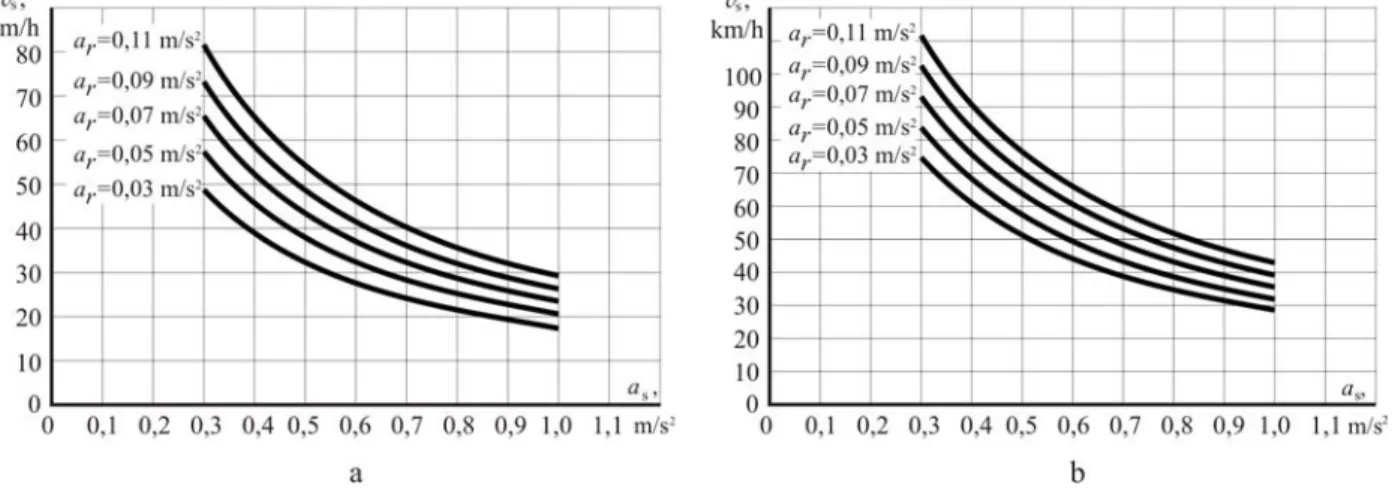
As it can be seen from the Fig. 1a and Fig. 1b, the value of traction force at the design speed, oth-er things being equal, increases with increasing starting speed. Therefore, in order to exclude vari-ants that do not match the conditions of the prob-lem solution, it is necessary to determine the min-imal values vs corresponding to the given starting and residual accelerations.
Since the traction force at the design speed: – from the one side
( ) ( ) 102(1 ) s ;
k c k s s
c v k
f v w v a
v
– and from the other side
( ) ( ) 102(1 ) .
k c k c r
f v w v a
Neglecting the dependence of wkon vs, we ob-tain
min ( ) 102(1 ) .
( ) 102(1 )
k c r
c s
k s s
w v a
v v
k w v a
(19)
For the case of two zone regulation in the pre-sented expression it should be taken
1, ( c).
k v v
In the calculations one should take only the values min
s s
v v . Dependencies min( )
s s
v a for dif-ferent values ar are shown in the Fig. 2.
The value of the starting acceleration at the given train weight determines the tractive effort, and hence the use of the «wheel-rail» contact capabilities to realize the traction creepage. In order to exclude from consideration, the variants, when the traction force cannot be reliably realized according to the adhesion conditions, it is expedient to set the maximum permissible values of the starting acceleration according to the adhesion conditions, i.e. corresponding to the spec-ified design coefficient of adhesion.
Estimated adhesive force
3
( ) 9,81 10 ( ), N
ad pс k
F v m v (20)
where mpс– adhesive weight (weight of power cars), t; k( )v – estimated coefficient of adhesion.
Specific value of the adhesion force
3 N
( ) 10 ( ),
kN
pс
ad k
m
f v v
m
(21)
The necessary acceleration value is obtained from the well-known law of locomotive traction [2], according to which for the reliable operation of
a wheel-rail vehicle, it is necessary to fulfill the condition
( ) ( ).
k ad
f v f v
Based on the expression (8) and (21) we obtain
3
10 ( ) ( )
102(1 )
pc
k k
s
m
v w v
m a
. (22)
where w vk( )w vо( ) upon the condition that the electric train moves at the section, i.e. i0 ‰.
Obviously, only values as as. can be taken into account.
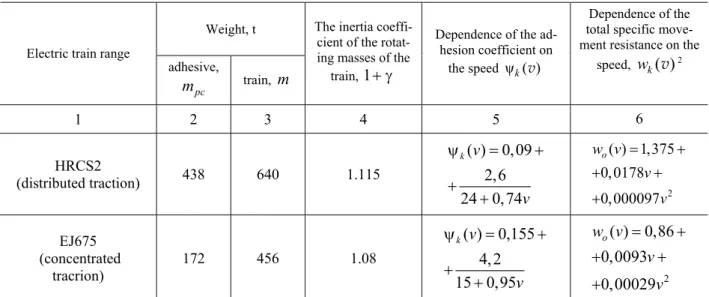
The dependences as( )v for the variants of the concentrated and distributed traction are shown in the Fig. 3. They are considered for these electric trains of HRCS2 series by Hyundai-Rotem Com-pany«and EJ675 of «SKODA Vagonka». The cal-culations were performed with the initial data giv-en in the Table 1.
Table 1
Initial data for calculating the dependencies of the minimum permissible starting acceleration using the con-ditions of adhesion on the speed of motionas( )v .
Weight, t Electric train range
adhesive, pc
m train, m
The inertia coeffi-cient of the rotat-ing masses of the
train, 1
Dependence of the ad-hesion coefficient on
the speed ψk( )v
Dependence of the total specific move-ment resistance on the
speed, wk( )v 2
1 2 3 4 5 6
HRCS2
(distributed traction) 438 640 1.115
( ) 0,09 2,6 24 0,74 k v v 2
( ) 1,375 0,0178 0,000097 o w v v v EJ675 (concentrated
tracrion) 172 456 1.08
( ) 0,155 4,2 15 0,95 k v v 2
( ) 0,86 0,0093 0,00029 o w v v v
Fig. 3. Dependencies as( )v for the variants of the distributed (curve 1) and concentrated (curve 2) traction
Originality and Practical Value
Originality consists in developing a methodol-ogy for determining the optimum values for the parameters of the nominal mode of electric trains with asynchronous traction drive, with two-zone and three-zone frequency regulation of power.
The resulted methodology can serve as a basis at formation of technical requirements for a new rolling stock for railways of Ukraine.
Conclusions
The materials presented in the article provide for the implementation of traction calculations (in terms of plotting the motion curves), in solving problems, selecting parameters for the nominal mode of electric trains with asynchronous traction drive.
LIST OF REFERENCE LINKS
1. Арпуль, С. В. Выбор рациональных параметров тягового электроподвижного состава / С. В. Арпуль // Электрификация транспорта. – 2014. – № 8. – С. 66–72.
2. Бабичков, А. М. Тяга поездов и тяговые расчеты : учеб. для вузов ж.-д. трансп. / А. М. Бабичков, П. А. Гурский, А. П. Новиков. – Москва : Транспорт, 1971. – 280 с.
3. Бещева, Н. И. Пригородное движение на электрифицированных линиях / Н. И. Бещева // Тр. ВНИИЖТа. – Москва, 1961. – Вып. 223. – 372 с.
4. Бещева, Н. И. Сравнение отдельных видов тяги в пригородном пассажирском движении / Н. И. Бещева // Труды ЦНИИ МПС. – Москва, 1968. – Вып. 358. – 363 с.
5. Гетьман, Г. К. Вибір раціональних параметрів номінального режиму електровозів / Г. К. Гетьман, С. Л. Марікуца // Наука та прогрес транспорту. – 2017. – № 1 (67). – С. 96–105. doi: 10.15802/stp2017/92615. 6. Гетьман, Г. К. Научные основы определения рационального мощностного ряда тяговых средств
железно-дорожного транспорта : монография / Г. К. Гетьман. – Дніпропетровськ : Вид-во Дніпропетр. нац. ун-ту залізн. трансп. ім. акад. В. Лазаряна, 2008. – 444 с.
7. Гетьман, Г. К. Теорія електричної тяги : підручник : у 2 т. / Г. К. Гетьман. – Дніпропетровськ : Вид-во Дніпропетр. нац. ун-ту залізн. трансп. ім. акад. В. Лазаряна, 2014. – Т. 1. – 578 с.
8. Правила тяговых расчетов для поездной работы. – Москва : Транспорт, 1985. – 287 с.
9. Розенфельд, В. Е. Электрическая тяга поездов / В. Е. Розенфельд, Ю. Е. Равкин, И. А. Лакштовский. – Мо-сква : Гос. трансп. ж.-д. изд-во, 1940. – 799 с.
10. Fischer, Sz: Traction Energy Consumption of Electric Locomotives and Electric Multiple Units at Speed Restric-tions / Sz: Fischer // Acta Technica Jauriensis. – 2015. – Vol. 8, No. 3. – Р. 240–256. doi: 10.14513/actatechjaur.v8.n3.384.
11. Optimization of Train Operation in Multiple Interstations with Multi-Population Genetic Algorithm / Y. Huang, X. Ma, S. Su, T. Tang //Energies. – 2015. – Vol. 8 (12). – Р. 14311–14329. doi: 10.3390/en81212433.
Г
.
К
.
ГЕТЬМАН
1,
С
.
Л
.
МАРІКУЦА
2*1Каф. «Електрорухомийскладзалізниць», Дніпропетровськийнаціональнийуніверситетзалізничноготранспорту іменіакадемікаВ. Лазаряна, вул. Лазаряна, 2, Дніпро, Україна, 49010, тел. +38 (056) 373 15 31,
ел. пошта [email protected], ORCID 0000-0002-3471-6096
2*Каф. «Електрорухомийскладзалізниць», Дніпропетровськийнаціональнийуніверситетзалізничноготранспорту іменіакадемікаВ. Лазаряна, вул. Лазаряна, 2, Дніпро, Україна, 49010, тел. +38 (056) 373 15 31,
ел. пошта [email protected], ORCID 0000-0002-0429-6633
ВИБІР
РАЦІОНАЛЬНИХ
ПАРАМЕТРІВ
НОМІНАЛЬНОГО
РЕЖИМУ
ЕЛЕКТРОПОЇЗДІВ
ІЗ
АСИНХРОННИМ
ТЯГОВИМ
ПРИВОДОМ
Мета. Параметри номінального режиму відносяться до найважливіших експлуатаційних показників тягових засобів, тому задачі вибору їх оптимальних значень завжди неминуче виникають при формуванні тех-нічних вимог на новий рухомий склад. У роботі необхідно викласти особливості рішення зазначених задач для електропоїздів із асинхронним тяговим приводом при двозонному та тризонному частотному регулюванні потужності. Методика. Потужність номінального режиму електрорухомого складу повинна бути обрана таким чином, щоб забезпечувалася можливість реалізації заданого часу ходу по ділянці або швидкості руху. Виходячи із цього, а також враховуючи, що до важливих експлуатаційних характеристик електропоїздів відноситься величина прискорення в період пуску й прискорення при конструкційній швидкості, сформулює-мо задачу визначення номінальної потужності. В задачі для заданого полігона тяги необхідно знайти таке зна-чення потужності номінального режиму й відповідне їй значення сили тяги, щоб забезпечувалася можливість здійснювати перевезення із заданим рівнем середньої швидкості руху при мінімальній витраті електроенергії на тягу. При цьому необхідно, щоб виконувалися умови: а) швидкість руху електропоїзда на ділянці не перевищує встановлених обмежень; б) забезпечується можливість реалізації заданих значень прискорень. Більш детальний розгляд питання показує, що в реальних умовах, коли задані пускове прискорення й маса поїзда, задача визначення потужності електропоїзда практично зводиться до визначення оптимального значення швидкості номінального режиму.
Результати.Задача вибору оптимальних значень швидкості номінального режиму вирішується шляхом
визна-чення витрати електроенергії при варіації можливих значень пускової швидкості, тому в розрахунки слід при-ймати тільки ті її значення, які забезпечують реалізацію заданих пускового й залишкового прискорень. У роботі показано, що величина сили тяги при збільшенні конструкційної швидкості й інших рівних умовах зростає, якщо збільшувати пускову швидкість. Наукова новизна. Авторами розроблена методика для визначення оптимальних значень параметрів номінального режиму електропоїздів із асинхронним тяговим приводом, при двозонному та тризонному частотному регулюванні потужності.
Практичназначимість. Наведена методика може бути основою при формуванні технічних вимог на новий
рухомий склад для залізниць України.
Ключові слова: електропоїзд; пускове й залишкове прискорення; пускова швидкість; рівняння руху; тягова характеристика; зона регулювання потужності; питома сила
Г
.
К
.
ГЕТЬМАН
1,
С
.
Л
.
МАРИКУЦА
2*1Каф. «Электроподвижнойсоставжелезныхдорог», Днепропетровскийнациональныйуниверситетжелезнодорожного транспортаимениакадемикаВ. Лазаряна, ул. Лазаряна, 2, Днипро, Украина, 49010, тел. +38 (056) 373 15 31,
эл. почта [email protected], ORCID 0000-0002-3471-6096
2*Каф. «Электроподвижнойсоставжелезныхдорог», Днепропетровскийнациональныйуниверситетжелезнодорожного транспортаимениакадемикаВ. Лазаряна, ул. Лазаряна, 2, Днипро, Украина, 49010, тел. +38 (056) 373 15 31,
эл. почта [email protected], ORCID 0000-0002-0429-6633
ВЫБОР
РАЦИОНАЛЬНЫХ
ПАРАМЕТРОВ
НОМИНАЛЬНОГО
РЕЖИМА
ЭЛЕКТРОПОЕЗДОВ
С
АСИНХРОННЫМ
ТЯГОВЫМ
Цель. Параметры номинального режима относятся к важнейшим эксплуатационным показателям тяговых средств, поэтому задачи выбора их оптимальных значений всегда неизбежно возникают при формировании технических требований на новый подвижной состав. В работе необходимо изложить особенно-сти решения указанных задач для электропоездов с асинхронным тяговым приводом при двухзонном и трехзонном частотном регулировании мощности. Методика. Мощность номинального режима электропод-вижного состава должна быть выбрана таким образом, чтобы обеспечивалась возможность реализации заданного времени хода по участку или скорости движения. Исходя из этого, а также учитывая, что к важным эксплуатаци-онным характеристикам электропоездов относится величина ускорения в период пуска и ускорения при конст-рукционной скорости, сформулируем задачу определения номинальной мощности. В задаче для заданного поли-гона тяги необходимо найти такое значение мощности номинального режима и соответствующее ей значение силы тяги, чтобы обеспечивалась возможность осуществлять перевозки с заданным уровнем средней скорости движения при минимальных затратах электроэнергии на тягу. При этом необходимо чтобы выполнялись условия: а) скорость движения электропоезда на участке не превышает установ-ленных ограничений; б) обеспечивается возможность реализации заданных значений ускорений. Более детальное рассмотрение вопроса показывает, что в реальных условиях, когда задано пусковое ускорение и масса поезда, задача определения мощности электропоезда практически сводится к определению оптимального значения скорости номинального режима. Результаты. Задача выбора оптимальных значений скорости номинального режима решается путем определения расхода электроэнергии при вариации возможных значений пусковой скорости, поэтому в расчет следует принимать только те ее значения, которые обеспечивают реализацию заданных пускового и остаточного ускорений. В работе показано, что величина силы тяги при уве-личении конструкционной скорости и прочих равных условиях возрастает, если увеличивать пусковую скорость.
Научнаяновизна. Авторами разработана методика для определения оптимальных значений параметров
номи-нального режима электропоездов с асинхронным тяговым приводом, при двухзонном и трехзонном частотном регулировании мощности. Практическаязначимость. Приведенная методика может служить основой при фор-мировании технических требований на новый подвижной состав для железных дорог Украины.
Ключевые слова: электропоезд; пусковое и остаточное ускорение; пусковая скорость; уравнение движения; тяговая характеристика; зона регулирования мощности; удельная сила
REFERENCES
1. Arpul, S. V. (2014). The choice of rational parameters of the traction electric rolling stock. Electrification of Transport, 8, 66-72.
2. Babichkov, A. M., Gurskiy, P. A., & Novikov, A. P. (1971). Tyaga poezdov i tyagovyye raschety. Moscow: Transport.
3. Beshcheva, N. I. (1961). Prigorodnoye dvizheniye na elektrifitsirovannykh liniyakh. Moscow: Railway re-search institution of railway transport.
4. Beshcheva, N. I. (1968). Sravneniye otdelnykh vidov tyagi v prigorodnom passazhirskom dvizhenii. Moscow: Transport.
5. Hetman, H. K., & Marikutsa, S. L. (2017). Selection of rational parameters of the nominal mode of electric locomotives. Science and Transport Progress, 1(67), 96-105. doi: 10.15802/stp2017/92615
6. Hetman, H. K. (2008). Nauchnyye osnovy opredeleniya ratsionalnogo moshchnostnogo ryada tyagovykh sredstv zheleznodorozhnogo transporta [Monograph]. Dnipropetrovsk: Dnipropetrovsk National University of Railway Transport named after Academician V. Lazaryan.
7. Hetman, H. K. (2014). Teoriia elektrychnoi tiahy (Vol. 1). Dnipropetrovsk: Dnipropetrovsk National Univer-sity of Railway Transport named after Academician V. Lazaryan.
8. Pravila tyagovykh raschetov dlya poyezdnoy raboty. (1985). Moscow: Transport.
9. Rozenfeld, V. Y., Ravkin, Y. Y., & Lakshtovskiy, I. A. (1940). Elektricheskaya tyaga poyezdov. Moscow: Transzheldorizdat.
10. Fischer, S. (2015). Traction Energy Consumption of Electric Locomotives and Electric Multiple Units at Speed Restrictions. Acta Technica Jauriensis, 8(3), 240-256. doi: 10.14513/actatechjaur.v8.n3.384
12. Sarsembayev, B., Suleimenov, T., & Arpabekov, M. (2015). Analyze of Impact of Track Alignment on the Energy Consumption Level. International Journal of Traffic and Transportation Engineering, 4(2), 45-59. doi: 10.5923/j.ijtte.20150402.02
Prof. A. M. Afanasov, D. Sc. (Tech.), (Ukraine); Prof. O. O. Beihul, D. Sc. (Tech.), (Ukraine) recommended this article to be published