Variation in Care of In
fl
ammatory Bowel Diseases Patients in
Crohn
’
s and Colitis Foundation of America Partners: Role of
Gastroenterologist Practice Setting in Disease Outcomes and
Quality Process Measures
Kimberly N. Weaver, MD,* Michael D. Kappelman, MD, MPH,
†,‡Robert S. Sandler, MD, MPH,
‡,§Christopher F. Martin, MSPH,
‡,§Wenli Chen, MS,
‡,§Kristen Anton, MS,
§,kand Millie D. Long, MD, MPH
‡,§Background:As variation in care has previously been linked to quality, we aimed to describe variations in inflammatory bowel diseases care by
gastroenterology (GI) practice setting.
Methods:We performed a cross-sectional study within the Crohn’s and Colitis Foundation of America Partners and used bivariate analyses to compare
patient characteristics by GI practice setting (GI-academic [GIA], GI-private, or GI-other). Regression models were used to describe the effects of provider type on steroid use, disease activity, and the quality of life.
Results:The study included 12,083 patients with inflammatory bowel diseases (7576 with Crohn’s disease [CD] and 4507 with ulcerative colitis [UC]).
Nearly 95% reported visiting a GI provider annually. Also, CD patients seen by GIA were younger, better educated, used less 5-aminosalicylate agents, and had higher biologic and immunomodulator use (P,0.001 for all). On multivariate analysis of CD patients, GIA used less steroids when compared with GI-private (odds ratio, 0.84; 95% confidence interval, 0.67–1.06) or GI-other (odds ratio, 0.66; 95% confidence interval, 0.49–0.89). GIA patients were more likely to be in remission, haveflu vaccine, and have better quality of life. UC patients seen by GIA were younger, had more hospitalizations, and previous surgery (P,0.001 for all). No differences existed for steroid use, remission,flu vaccine, or quality of life for UC care on bivariate or multivariate analyses.
Conclusions:Significant variations in care patterns and quality measures exist for CD across GI provider types, without similar variation in UC care.
Interventions to reduce variations in care could improve the quality of care in CD.
(Inflamm Bowel Dis 2016;22:2672–2677)
T
he art of medicine allows for some expected variation in practice; however, extreme variations in care have been used as markers of poor quality of care whether secondary to insuffi -cient evidence, lack of knowledge, misuse of health care resources,or multiple equally effective approaches.1,2Such variation is
evi-dent in the care of both ulcerative colitis (UC) and Crohn’s dis-ease (CD) patients, although more prominent in the latter due to its heterogeneous nature.
Spiegel et al2showed that a wide variation in the everyday
management of UC exists between community and expert gas-troenterologists when presented with clinical vignettes. Simi-larly, significant variations in CD management were seen between community and expert gastroenterologists when pro-vided with sample case vignettes,3 especially with regards to
the use of 5-aminosalicylate (5-ASA) medications. However, the response of a physician to a vignette may differ greatly from their management of actual patients.
Due to the variation in care evidenced in individuals with inflammatory bowel diseases (IBD), the American Gastroentero-logical Association developed an IBD performance measurement set with the intent of improving health outcomes through increased patient safety with an emphasis on preventive care and noncorticosteroid-based treatment options.4The Crohn’s and
Colitis Foundation of America (CCFA) also sponsored the pub-lication of a set of quality indicators (QIs) in IBD management, including treatment, surveillance, and preventive care.1 Use of Received for publication April 25, 2016; Accepted August 15, 2016.
From the *Department of Medicine, University of North Carolina at Chapel Hill, Chapel Hill, North Carolina;†Division of Pediatric Gastroenterology and Hepatol-ogy, University of North Carolina at Chapel Hill, Chapel Hill, North Carolina; ‡Center for Gastrointestinal Biology and Disease; §
Division of Gastroenterology and Hepatology, University of North Carolina at Chapel Hill, Chapel Hill, North Carolina; andkGeisel School of Medicine at Dartmouth.
Supported by the Crohn’s and Colitis Foundation of America, the Patient Centered Outcomes Research Institute, NIH P30 DK34987 (R. S. Sandler), and NIH 1K08DK088957-01 (M. D. Kappelman).
M. D. Long has previously served as consultant to Abbvie, Salix, Pfizer, Theravance, and NPS Pharmaceuticals. M. D. Kappelman has previously served as a consultant to Abbvie, Janssen, GlasoSmithKline, and Cubist. The other authors have no conflict of interest to disclose.
Address correspondence to: Millie D. Long, MD, MPH, University of North Carolina at Chapel Hill, Campus Box 7080, Chapel Hill, NC 27599-7080 (e-mail: [email protected]).
such QIs establishes measurable benchmarks that can assess base-line quality of care and provide measurable standards for subse-quent improvement in care.5,6
A focus on quality improvement and the development of evidence-based treatment guidelines has led to improved out-comes including decreased morbidity and mortality in other chronic diseases, such as cysticfibrosis.7Prior studies that have
examined the differences in practice patterns of IBD care com-paring community and expert gastroenterologists have been small in size and based on clinical vignettes. In our study, we aimed to use CCFA Partners to describe variations in medication use, remission rates, and quality of life measurements in individuals with UC and CD by gastroenterology (GI) practice setting.
METHODS
Crohn
’
s and Colitis Foundation of
America Partners
We used an Internet-based cohort, CCFA Partners, to describe variations in medication use, remission rates, and quality of life measurements by GI practice setting for individuals with self-reported IBD. CCFA Partners follows individuals with IBD who were recruited from CCFA e-mail lists and other social media outlets. Participants complete baseline and semiannual follow-up surveys regarding demographic, disease location and activity, medication use, prevention activities including vaccina-tion and screenings, and quality of life measurements. Baseline characteristics of the population and further details of the cohort have been described elsewhere.8
Data Collection and Management
Data were collected in a Web-based format, and the interface performed range and consistency checks to improve data quality. The data management system has been previously described.8Special software was not required, and the Web forms
were accessible from any computer running a modern Internet browser with an active Internet connection. Data on demograph-ics, GI practice setting, disease type, IBD medications, remission, vaccination status, and quality of life were extracted from CCFA Partners core data. GI practice settings included GI-academic (GIA), GI-private (GIP), or GI-other (GIO; managed care or vet-eran’s administration).
Study Design
We performed a cross-sectional study within CCFA Partners’ Internet-based cohort including all individuals who completed a baseline survey, preventive health survey, and quality of life survey. We collected demographic data including age, gender, and education level. Factors associated with disease course, such as prior bowel surgery, hospitalization, and medica-tion use, were also recorded. We assessed disease activity through validated self-report instruments including the short Crohn’s dis-ease activity index9for CD and the simple clinical colitis activity
index10for UC. We used previously validated cutoffs for
remis-sion of,150 for short Crohn’s disease activity index9and#2 for
simple clinical colitis activity index.11We obtained data on
qual-ity of life through the short IBD questionnaire (SIBDQ).12 We
questioned participants about influenza vaccination, a QI endorsed by the American Gastroenterological Association.13
We also collected data on smoking status, which is known to be associated with the course of both CD and UC.14Screening
for smoking and recommendation for cessation intervention is a physician quality reporting system measure for IBD.
Statistical Analysis
Bivariate analyses were used to compare demographics, disease activity, and SIBDQ by GI practice setting. We used logistic and linear regression models controlling for factors associated with complicated disease course, including history of surgery, hospitalization, smoking, and disease duration, to deter-mine the independent effects of provider type on outcomes such as steroid use, disease activity, and quality of life. We accounted for potential clustering using a robust variance estimator in the models. STATA 14.0 (College Station, TX) was used for all analyses.P
values less than 0.05 were considered statistically significant. The Institutional Review Board at the University of North Carolina at Chapel Hill approved the study protocol.
RESULTS
Study Population
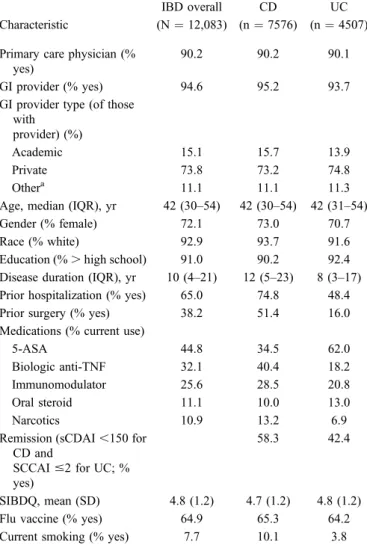
The study included 12,083 individuals with IBD who completed baseline demographic and preventive health surveys within CCFA Partners. Of those, 7576 reported having CD and 4507 reported having UC. Seventy-two percent of the study participants were women. The mean age of the study population was 42 years, and the mean time from diagnosis to study participation was 10 years. Nearly 95% reported visiting a GI provider at least annually. Of those consulting a GI provider, 73.8% saw GIP, 15.1% saw GIA, and 11.1% saw GIO. Additional demographic information is provided in Table 1.
Characteristics and Outcomes of CD Patients
by Provider Type
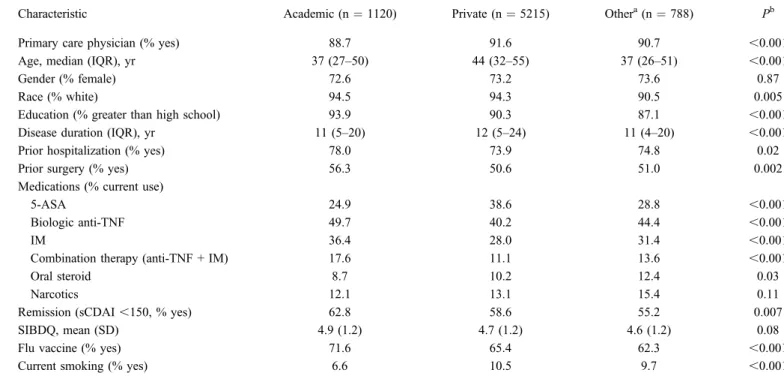
CD patients seen by GIA were younger (P,0.001), better educated (P,0.001), used less 5-ASA agents (P,0.001), and had higher use of anti–tumor necrosis factor (TNF) agents (P,
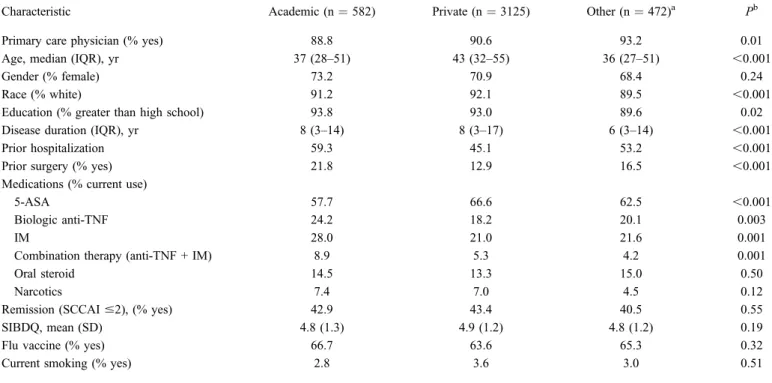
surgery (P,0.001). UC patients treated at academic sites did use less 5-ASA (P , 0.001), more anti-TNF agents (P ¼ 0.003), immunomodulators (P ¼0.001), and combination therapy with anti-TNF and immunomodulator (P ¼ 0.001). However, there were no differences in the use of steroids, remission rates, flu vaccine, or SIBDQ for UC care on bivariate (Table 4) or multi-variate (Table 3) analyses.
DISCUSSION
An inverse relationship exists between variation in care and quality of care delivered to an individual.3In recent years,
health care improvement efforts have focused on reducing unin-tended variation in care in an effort to improve patient outcomes and decrease costs and resource utilization. This is one of the
first studies to describe variation in adult IBD care by GI practice setting. We found that significant variations in care patterns and quality measures exist for CD across GI provider types, without similar variation in UC care. We recognize that severity of dis-ease is likely associated with important outcomes, such as ste-roid use or clinical remission; thus, we did control for factors associated with a prior complicated disease course. In our study, patients seen by GIA had increased risk of prior surgery, which may represent a more severe IBD phenotype. Despite this, a greater percentage of these complicated CD patients treated by GIA were in remission on biologic and immunomodulator therapy with less dependence on corticosteroids. GIA had a high-er rate of influenza vaccination and also had fewer individuals who were current smokers within the CD population. It is pos-sible that this provider group may place a greater emphasis on health care maintenance and preventive care. Important preven-tive health maintenance counseling in individuals with IBD in-cludes yearly discussions about the importance of tobacco cessation and education about appropriate vaccinations for those with IBD. For example, yearly influenza vaccine is recommen-ded in all patients with IBD, with avoidance of live virus vac-cines in those on immunosuppression.1
Interestingly, there was less variation in care between GI practice settings within the UC population. There were minor differences in mediation utilization among UC provider types; however, overall rates of anti-TNF and immunomodulator use were much lower for each provider group in UC when compared with CD. Rates of steroid use and important outcomes, such as clinical remission and quality of life and preventive health measures (flu vaccine), did not differ among provider types for UC patients. Ananthakrishnan et al15recently described similar findings in a study population of IBD patients treated at 7 aca-demic centers. The heterogeneous nature of CD as compared with UC may account for some of these variations in manage-ment. Management recommendations for CD patients differ sub-stantially based on CD phenotype and location and other known risk factors for severe disease, such as young age at onset and smoking status. There is also more consensus in UC manage-ment, including greater expert agreement on a step-up medical
TABLE 1.
Characteristics of the Population of Patients
with CD and UC in CCFA Partners
Characteristic
IBD overall (N¼12,083)
CD (n¼7576)
UC (n¼4507) Primary care physician (%
yes)
90.2 90.2 90.1 GI provider (% yes) 94.6 95.2 93.7 GI provider type (of those
with provider) (%)
Academic 15.1 15.7 13.9 Private 73.8 73.2 74.8 Othera 11.1 11.1 11.3 Age, median (IQR), yr 42 (30–54) 42 (30–54) 42 (31–54) Gender (% female) 72.1 73.0 70.7 Race (% white) 92.9 93.7 91.6 Education (%.high school) 91.0 90.2 92.4 Disease duration (IQR), yr 10 (4–21) 12 (5–23) 8 (3–17) Prior hospitalization (% yes) 65.0 74.8 48.4 Prior surgery (% yes) 38.2 51.4 16.0 Medications (% current use)
5-ASA 44.8 34.5 62.0 Biologic anti-TNF 32.1 40.4 18.2 Immunomodulator 25.6 28.5 20.8 Oral steroid 11.1 10.0 13.0 Narcotics 10.9 13.2 6.9 Remission (sCDAI,150 for
CD and
SCCAI#2 for UC; % yes)
58.3 42.4
SIBDQ, mean (SD) 4.8 (1.2) 4.7 (1.2) 4.8 (1.2) Flu vaccine (% yes) 64.9 65.3 64.2 Current smoking (% yes) 7.7 10.1 3.8 a
Other includes veteran’s affairs, managed care, and other provider types.
IQR, interquartile range; SCCAI, simple clinical colitis activity index; sCDAI, short
Crohn’s disease activity index; SIBDQ, short inflammatory bowel diseases questionnaire.
(oddsratio[OR],0.84;95%confidenceinterval[CI],0.67–1.06) orGIO(OR,0.66;95%CI,0.49–0.89).ThepatientsseenbyGIA werealsomorelikelytobeinremission(OR,1.18;95%CI,1.02– 1.37 for GIA versus GIP and OR, 1.37; 95% CI, 1.11–1.68
respectivelyforGIAversusGIO),morelikelytohavefluvaccine (OR,1.33;95%CI,1.15–1.53forGIAversusGIPandOR,1.53; 95%CI,1.26–1.87forGIAversusGIO),andmorelikelytohave higherSIBDQscores(betacoefficient,0.17and0.25respectively;
P,0.001forboth).AdditionaldataarepresentinTable3.
Characteristics
and
Outcomes
of
UC
Patients
by
Provider
Type
UCpatients who were seen by GIA were younger (P,
approach, the efficacy of medications such as 5-ASA, and the opportunity for a potentially curative surgery in the setting of severe disease.
The literature has previously shown differences in the care received in academic referral practices versus private practices. Reddy et al16recently examined care that IBD patients received
before referral to a tertiary center and showed various deficits in care including underdosing of medications, prolonged use of corticosteroids, and failure to perform routine health care
maintenance.17Similar improved outcomes at academic medical
centers are seen in the literature of various other medical sub-specialties. For example, Veenstra et al18described the delivery
of higher valued care at academic centers leading to longer over-all survival for those with stage IV colon cancer. In the cardiac literature, Patel et al19detailed greater adherence to established
acute coronary syndrome guidelines in academic hospitals com-pared with nonacademic hospitals. A recent study also describes greater use of evidence-based acute and discharge therapies and
TABLE 2.
Characteristics of Patients with CD Who Reported a GI Provider; by Type of Provider in CCFA Partners
Characteristic Academic (n¼1120) Private (n¼5215) Othera(n¼788) Pb
Primary care physician (% yes) 88.7 91.6 90.7 ,0.001 Age, median (IQR), yr 37 (27–50) 44 (32–55) 37 (26–51) ,0.001
Gender (% female) 72.6 73.2 73.6 0.87
Race (% white) 94.5 94.3 90.5 0.005
Education (% greater than high school) 93.9 90.3 87.1 ,0.001 Disease duration (IQR), yr 11 (5–20) 12 (5–24) 11 (4–20) ,0.001 Prior hospitalization (% yes) 78.0 73.9 74.8 0.02 Prior surgery (% yes) 56.3 50.6 51.0 0.002 Medications (% current use)
5-ASA 24.9 38.6 28.8 ,0.001
Biologic anti-TNF 49.7 40.2 44.4 ,0.001
IM 36.4 28.0 31.4 ,0.001
Combination therapy (anti-TNF + IM) 17.6 11.1 13.6 ,0.001
Oral steroid 8.7 10.2 12.4 0.03
Narcotics 12.1 13.1 15.4 0.11
Remission (sCDAI,150, % yes) 62.8 58.6 55.2 0.007 SIBDQ, mean (SD) 4.9 (1.2) 4.7 (1.2) 4.6 (1.2) 0.08 Flu vaccine (% yes) 71.6 65.4 62.3 ,0.001 Current smoking (% yes) 6.6 10.5 9.7 ,0.001 a
Other includes veteran’s affairs, managed care, and other provider types.
b
OverallPby 1-way analysis of variance, Kruskal–Wallis, Pearson’s chi-square as appropriate.
IQR, interquartile range; sCDAI, short Crohn’s disease activity index; SIBDQ, short inflammatory bowel diseases questionnaire; IM, immunomodulator.
TABLE 3.
Comparisons of Adjusted
aOutcomes by GI Provider Setting Among Patients with CD and UC
Steroid use Remission Flu Vaccine SIBDQb
Adjusted OR (95% CI) Adjusted OR (95% CI) Adjusted OR (95% CI) Beta Coefficient (95% CI),P
CD
Academic versus private 0.84 (0.67–1.06) 1.18 (1.02–1.37) 1.33 (1.15–1.53) 0.17 (0.09 to 0.25);P,0.001 Academic versus other 0.66 (0.49–0.89) 1.37 (1.11–1.68) 1.53 (1.26–1.87) 0.25 (0.14 to 0.36);P,0.001 UC
Academic versus private 1.07 (0.82–1.38) 1.02 (0.83–1.26) 1.14 (0.94–1.38) 20.01 (20.12 to 0.10);P¼0.83 Academic versus other 0.96 (0.68–1.37) 1.11 (0.84–1.47) 1.07 (0.82–1.39) 20.03 (20.19 to 0.12);P¼0.68 a
Adjusted for surgery, hospitalization, smoking status, and disease duration.
b
characteristics or preferences or both. Because CCFA Partners data are self-reported, there is also a potential for misclassification of disease status or type. However, the validity of self-reported IBD in CCFA Partners has been previously demonstrated.21
Addi-tionally, there may be an element of recall bias especially with regards to the rate of influenza vaccination. Prior studies have demonstrated that self-report likely overestimates true vaccination status.22We would argue that any misclassification in the case of
vaccination is likely nondifferential because we do not expect an individual to fail to report receiving an influenza vaccination based on their provider type. Identification of provider type was also by patient report. Although misclassification is possible, this is also most likely to be nondifferential. Because this was a cross-sectional study design of baseline data, we do not have access to disease activity instruments preceding the outcome measures. However, we did control for disease duration, prior surgery, and prior hospitalization, all prior markers of a more complicated disease course.
As we continue to witness the expansion in treatment options available for both CD and UC, we must take action to reduce unintended variation in care. There has been great success in decreasing variation, improving care delivery, and thus out-comes in chronic diseases such as cystic fibrosis and pediatric IBD.7,23,24In both scenarios, quality improvement efforts aimed at
better using previously available therapies and the function of the
TABLE 4.
Characteristics of Patients With UC Who Reported a GI Provider; by Type of Provider in CCFA Partners
Characteristic Academic (n¼582) Private (n¼3125) Other (n¼472)a Pb
Primary care physician (% yes) 88.8 90.6 93.2 0.01 Age, median (IQR), yr 37 (28–51) 43 (32–55) 36 (27–51) ,0.001
Gender (% female) 73.2 70.9 68.4 0.24
Race (% white) 91.2 92.1 89.5 ,0.001
Education (% greater than high school) 93.8 93.0 89.6 0.02 Disease duration (IQR), yr 8 (3–14) 8 (3–17) 6 (3–14) ,0.001 Prior hospitalization 59.3 45.1 53.2 ,0.001 Prior surgery (% yes) 21.8 12.9 16.5 ,0.001 Medications (% current use)
5-ASA 57.7 66.6 62.5 ,0.001
Biologic anti-TNF 24.2 18.2 20.1 0.003
IM 28.0 21.0 21.6 0.001
Combination therapy (anti-TNF + IM) 8.9 5.3 4.2 0.001
Oral steroid 14.5 13.3 15.0 0.50
Narcotics 7.4 7.0 4.5 0.12
Remission (SCCAI#2), (% yes) 42.9 43.4 40.5 0.55 SIBDQ, mean (SD) 4.8 (1.3) 4.9 (1.2) 4.8 (1.2) 0.19
Flu vaccine (% yes) 66.7 63.6 65.3 0.32
Current smoking (% yes) 2.8 3.6 3.0 0.51
a
Other includes veteran’s affairs, managed care, and other provider types.
b
OverallPby 1-way analysis of variance, Kruskal–Wallis, Pearson’s chi-square as appropriate.
IQR, interquartile range; SCCAI, simple clinical colitis activity index; SIBDQ, short inflammatory bowel diseases questionnaire; IM, immunomodulator.
improved 30-day outcomes forthose individuals presenting to anacademicmedicalcenterwithanon–ST-elevationmyocardial infarctioncomparedwith anonacademicmedical center.20
Therearenumerousstrengthstoourstudyonvariationin careinpatientswithIBDbyGIpracticesetting.CCFAPartners includesalargeandgeographicallydiversepopulation.Thereis also diversity in provider type, whereas other studies have focusedlargelyonacademic centers.Inaddition, wemeasured actual care delivery and outcomes directly through patient report, an advantage over prior studies that used clinical vignettestoassesstheoretical carepatterns.Weinclude impor-tant patient-reported outcomes such as SIBDQ that have not previouslybeenmeasuredinstudiesofvariationincareinIBD. Priorstudieshavelargelyfocusedontreatmentvariationsrather thanonpatient-reportedoutcomes.
Wedoacknowledgeseverallimitationstoourstudy.CCFA Partners is a volunteer sample of patients, thus may not be representative ofgeneral U.S. IBD population.Individuals with lowersocioeconomicstatus,educationlevel,andminorityethnic statusmaybeunderrepresentedinthispopulationduetothelack ofInternetaccessandinsufficientliteracytocompletetheonline questionnaires. Unfortunately, this is a known limitation of Internet-basedresearch.21It isalsodifficulttoascertainif
health care delivery system resulted in significant outcome im-provements for these individuals, with reduced variation in care. Although this is certainly promising, it may be more difficult to implement similar efforts in the adult population. For example, much of pediatric IBD care is centered at large academic centers compared with community practices, whereas adult IBD care is focused in the community.
CCFA is dedicated to quality improvement through the development of care pathway algorithms, QIs, and a more systematic and multidisciplinary approach to IBD care to ensure that all individuals with IBD are receiving optimal care regardless of GI provider type.25Our data show the existence of significant
gaps in IBD care. Initial quality improvement efforts aimed at disseminating the available evidenced-based guidelines may result in improved patient care, a healthier IBD population, reduced health care costs, and less disconnect between the differ-ent GI provider types.3,13 Collaboration between different
pro-vider types and redesigning elements of the chronic care delivery system will certainly be necessary to optimize the care of IBD patients.
REFERENCES
1. Melmed GY, Siegel CA, Spiegel BM, et al. Quality indicators for infl am-matory bowel disease: development of process and outcome measures.
Inflamm Bowel Dis.2013;19:662–668.
2. Spiegel BM, Ho W, Esrailian E, et al. Controversies in ulcerative colitis: a survey comparing decision making of experts versus community gastro-enterologists.Clin Gastroenterol Hepatol.2009;7:168–174, 174.e1. 3. Esrailian E, Spiegel BMR, Targownik LE, et al. Differences in the
man-agement of Crohn’s disease among experts and community providers, based on a national survey of sample case vignettes.Aliment Pharmacol Ther.2007;26:1005–1018.
4. AGA.Adult Inflammatory Bowel Disease Physician Performance Meas-ures Set. 2011.
5. Ahmed S, Siegel CA, Melmed GY. Implementing quality measures for inflammatory bowel disease.Curr Gastroenterol Rep.2015;17:14. 6. Melmed GY, Siegel CA. Quality improvement in inflammatory bowel
disease.Gastroenterol Hepatol (N Y).2013;9:286–292.
7. Schechter MS, Gutierrez HH. Improving the quality of care for patients with cysticfibrosis.Curr Opin Pediatr.2010;22:296–301.
8. Long MD, Kappelman MD, Martin CF, et al. Development of an internet-based cohort of patients with inflammatory bowel diseases (CCFA Partners): methodology and initial results.Inflamm Bowel Dis.
2012;18:2099–2106.
9. Thia K, Faubion WA Jr, Loftus EV Jr, et al. Short CDAI: development and validation of a shortened and simplified Crohn’s disease activity index.Inflamm Bowel Dis.2011;17:105–111.
10. Walmsley RS, Ayres RC, Pounder RE, et al. A simple clinical colitis activity index.Gut. 1998;43:29–32.
11. Jowett SL, Seal CJ, Phillips E, et al. Defining relapse of ulcerative colitis using a symptom-based activity index.Scand J Gastroenterol.2003;38: 164–171.
12. Irvine EJ, Zhou Q, Thompson AK. The Short Inflammatory Bowel Disease Questionnaire: a quality of life instrument for community physi-cians managing inflammatory bowel disease. CCRPT Investigators. Canadian Crohn’s Relapse Prevention Trial. Am J Gastroenterol.
1996;91:1571–1578.
13. Siegel CA, Allen JI, Melmed GY. Translating improved quality of care into an improved quality of life for patients with inflammatory bowel disease.Clin Gastroenterol Hepatol.2013;11:908–912.
14. Lunney PC, Kariyawasam VC, Wang RR, et al. Smoking prevalence and its influence on disease course and surgery in Crohn’s disease and ulcer-ative colitis.Aliment Pharmacol Ther.2015;42:61–70.
15. Ananthakrishnan AN, Kwon J, Raffals L, et al. Variation in treatment of patients with inflammatory bowel diseases at major referral centers in the United States.Clin Gastroenterol Hepatol.2015;13:1197–1200. 16. Reddy SI, Friedman S, Telford JJ, et al. Are patients with inflammatory
bowel disease receiving optimal care? Am J Gastroenterol.2005;100: 1357–1361.
17. Weizman AV, Nguyen GC. Quality of care delivered to hospitalized inflammatory bowel disease patients.World J Gastroenterol. 2013;19: 6360–6366.
18. Veenstra CM, Epstein AJ, Liao K, et al. The effect of care setting in the delivery of high-value colon cancer care.Cancer. 2014;120:3237–3244. 19. Patel MR, Chen AY, Roe MT, et al. A comparison of acute coronary syndrome care at academic and nonacademic hospitals.Am J Med.2007; 120:40–46.
20. O’Brien E, Subherwal S, Roe MT, et al. Do patients treated at academic hospitals have better longitudinal outcomes after admission for non-ST-elevation myocardial infarction?Am Heart J.2014;167:762–769. 21. Randell RL, Long MD, Cook SF, et al. Validation of an internet-based
cohort of inflammatory bowel disease (CCFA partners).Inflamm Bowel Dis.2014;20:541–544.
22. Jimenez-Garcia R, Hernandez-Barrera V, Rodriguez-Rieiro C, et al. Com-parison of self-report influenza vaccination coverage with data from a pop-ulation based computerized vaccination registry and factors associated with discordance.Vaccine. 2014;32:4386–4392.
23. Crandall W, Kappelman MD, Colletti RB, et al. ImproveCareNow: the development of a pediatric inflammatory bowel disease improvement net-work.Inflamm Bowel Dis.2011;17:450–457.
24. Crandall WV, Margolis PA, Kappelman MD, et al. Improved outcomes in a quality improvement collaborative for pediatric inflammatory bowel disease.Pediatrics. 2012;129:e1030–e1041.