N.Vinoth, Dr.Knirmala IJSRE Volume 4 Issue 12 December 2016 Page 6113
Volume||4||Issue||12||December-2016||Pages-6113-6118||ISSN(e):2321-7545 Website: http://ijsae.in
DOI: http://dx.doi.org/10.18535/ijsre/v4i12.07
A Study on Deaf and Dumb Students E-Learning System Using Sign Language
Authors
N.Vinoth1, Dr.KNirmala2 1
Research Scholar, Computer Science Dept, Vels University, Chennai, India
2
Research Supervisor, Computer Science Dept, Quaid-e-millath collegefor women, Chennai, India Email- [email protected], [email protected]
ABSTRACT
E-learn is useful method that has contributed in facilitating education for deaf people. Deaf people are able to get benefit from this technology by increasing their knowledge and improving their skills. They can utilize the mobility feature to learn anywhere and at any time. Most of the deaf students easily learn and develop skill and knowledge in e-learning method. Now a day’s e-learning tools are mostly used in learning method...learning includes computer and electronically supported learning and teaching methods. E-learning used in Web-based E-learning, computer-based E-learning, virtual based E-learning and digital technology. It is a computer and network-enabled transfer of knowledge. It is the combination of learning and knowledge management. In this paper we study about how deaf and dumb students used e-learning system using sign language
Keywords— E-learning, deaf learning, sign language.
INTRODUCTION
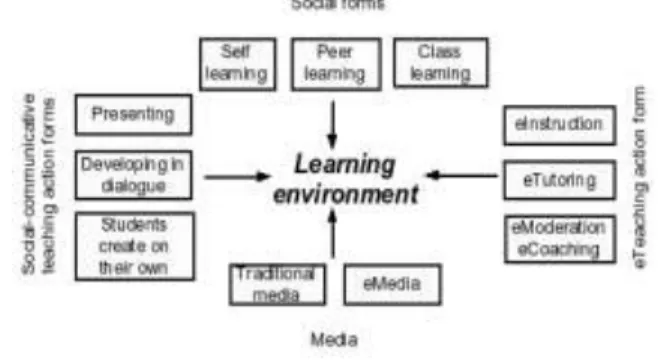
E-learning represents a wide range of methods for the electronic delivery of information in order to provide education or online training. There are many terms used to describe learning that is delivered online, via the internet, ranging from Distance Education, to computerized electronic learning, online learning, internet learning and many others. We define eLearning as courses that are specifically delivered via the internet. World Health Organization reports says (2015), 360 million people all over the world are Deaf or have hearing difficulties According to the tamilnadu census data 27273 peoples are hearing impaired in Chennai. World Federation of the Deaf, 80% of Deaf people are illiterate or semi-literate. So we must take more efforts to the Deaf equal opportunities in education and in working with others. E-learning is the excellent ways to increase the percentage of educated Deaf people by optimizing new technology. Today, many new systems were designed to assist Deaf people access the web for learning and training. E-learning is commonly referred to the intentional use of networked information and communications technology for teaching and learning. Fig- 1 shows about e-learning system. It has learning and knowledge management process.
N.Vinoth, Dr.Knirmala IJSRE Volume 4 Issue 12 December 2016 Page 6114
Deaf peoples are communicating through sign language. Today it is one of the most growing research fields. Many new technologies have been developed recently in these fields. In this situation we have to assist deaf people with their study material translated into the Sign Language based on e-learning technology. The user-friendly of multimedia, telecommunication and internet information services are used as a standard electronic platform to support procedures of distance, lifelong and continuing training for the Deaf and dumb people.
In India only low amount of institutions implement e-learn method for deaf peoples, because of lack of telecommunication devices, multimedia software’s and high implementation cost. So that we can implement e-learn method to achieve the great result in deaf people’s learning skills. Here we present effectiveness of e-learn for deaf peoples using sign language in various way. Fig –1 & 2 shows the deaf peoples hand sign language samples.
Fig – 2 – two hand sign language
Fig – 3 – single hand sign language
LITERATURE REVIEW AND RELATED WORK
N.Vinoth, Dr.Knirmala IJSRE Volume 4 Issue 12 December 2016 Page 6115
Hearing impaired(HI) students need to be involved in practicing more and more using their modes of visual communication like sign language to cover their audio disability. Teaching methodology of HI students recommends demonstration and repeating with slow presentations of instructional material. A teacher displays his lesson directly face to face without visual noise. More reinforcement and encouragement to HI students, fun & enjoyment should be strongly included in the e-lessons as well as continuous interaction between teacher and HI students.[5]
MobileASL is a video compression project that uses American Sign Language (ASL) as its medium of communication on a mobile device. The project was developed to enable Deaf users who use low to midrange commercially available mobile devices to send sign language video over a mobile network[6]. Here we plan to prepare these mobileISL for indian sign language users. E-learning is convenient as it can be done anywhere, at any time. The E-learning advancement approaches has become more improvised with the continuous developments of technologies; thus Academic Staffs should always be efficiently consistent and steadily up-to-date, incorporating these rapid developments into the web-based environment.[7]. Using these review papers we are using sign language for implement e-learn in deaf students institutions.
All segments of society can benefit from e-learning and m-learning facilities, including disabled people. If they do not become familiar with new technology, it can negatively affect their life [8].Deafness is a hearing disability in which a person is incapable of receiving auditory information. Most people who are deaf are also speech-impaired and they use sign language (SL) as the main way of communication [9]. Sign language uses hand signs, facial expressions, lip patterns and body language instead of sound patterns. As on spoken languages, sign languages vary amongst countries and have their own vocabulary and grammar. They also vary within the same country and there is no standard sign language [10]. E-learning standards are documented agreements containing common rules and guidelines that are used throughout the design and the implementation of any learning course. Standardization is essential in essential in system design and implementation to ensure reusability, portability, flexibility and interoperability. Furthermore, management of learning content becomes easier when standards are applied. Moreover, this will reduce the time and effort the learner needs to learn new courses.[11] Cloud computing deliver services autonomously based on demand and provides sufficient network access and effectual flexibility. Cloud computing is growing rapidly, with applications in almost any area, including education.[12]
IMPORTANCE OF SIGN LANGUAGE
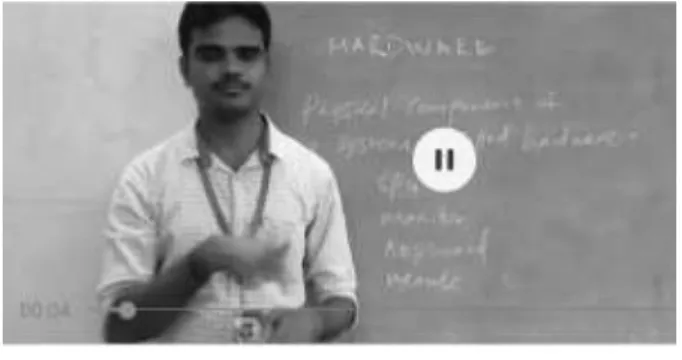
Deaf people communicating, learning only in lip reading, sign language, gesture and facial expression. In their class room also the teacher must use sign language for teaching. In india we follow Indian sign language(ISL). It has more signs. The ISL videos available in internet. The following fig(3) are the samples for sign language teaching in class rooms.
Fig 3 – Sign language video
N.Vinoth, Dr.Knirmala IJSRE Volume 4 Issue 12 December 2016 Page 6116
including schools, colleges, hospitals, police stations, court, hotels, restaurants, etc. in one of the T.V news channel provide sign language news especially for deaf and dumb peoples.
3.1 Single Hand Sign Language Video
3.2 Double Hand Sign Language Video
E-LEARNING SYSTEMS FOR THE DEAF:
E-learn system is important to deaf people for gather knowledge. To implement e-learn we need the following
Virtual classroom with all devices Text and video materials
Sign language dictionary.
Computer and communication devices Sign language interpreter
Hand sign images
Sign language educational content video Sign language learning video
METHODS
Here we use two types of sign languages, single hand sign language(with voice and without voice) and double hand sign language(with voice and without voice) to deaf students in e-learning.
FINDINGS
We take sign language 20 videos( both single hand and double hand) for programming in C language, and analyze it. To show the C language videos to deaf peoples and classify it for which type of sign language method is most useful one.
The C programming sign language videos contains introduction of c, application of c, constant, variable, data types, operators, If statement, for loop, while loop, switch case, functions, array, structure, union, pointer and files. These topics are covered in sign language (single and double hand, with voice and without voice) videos .
It should be shown to 50 deaf and dumb peoples and classify it. SHWV - Singe Hand With Voice
N.Vinoth, Dr.Knirmala IJSRE Volume 4 Issue 12 December 2016 Page 6117
DHWV - Double Hand With Voice DHWOV - Double Hand Without Voice
SHWV SHWOV DHWV DHWOV
constant 4 7 27 12
variable 5 5 30 10
if 8 3 28 11
for 5 5 30 10
array 2 4 26 18
function 4 3 28 15
pointer 8 5 27 10
CHART
CONCLUSION
In this paper we study about deaf and dumb students how use e-learning system using sign languages in different way. We analyse 50 deaf and dumb students that how they understand e-learning using sign language content videos. Here out of 50 students most of the peoples like and understnd DHWV-double hand with voice method of teaching and learning. These datas are implement in 3 algorithms namely ID3, Decision tree and Apriori. Finally we conclude that Decision tree algorithm is best for this analyzing of sign language videos. The author strongly recommend that DHWV method is suitable for e-learning especially for deaf and dumb students. Finally all these videos and text materials are stored in cloud, so deaf and students can access c programming sign language videos anywhere at anytime.
PROPOSED SYSTEM
To implement e-learn with cloud computing and big data in all deaf education institutions To upload new educational sign language video, controlling video speed
To implement good computer and communication system with advance software. User tracking Chatting( text chat and video chat)
File sharing and all educational updated materials. Implement ICT.
Acknowledgment
I really thankful to my heart of deaf students in presidency college, Chennai. As well as I thank my parents and full support of my research supervisor and my grandmother to doing this research work successfully.
REFERENCES
N.Vinoth, Dr.Knirmala IJSRE Volume 4 Issue 12 December 2016 Page 6118
2. Hisyamuddin HASHIM, “67 E-LEARNING ENVIRONMENT FOR HEARING IMPAIRED STUDENTS” TOJET: The Turkish Online Journal of Educational Technology – October 2013, volume 12 issue 4
3. Joyeeta Singha Dept. of Electronics and Communication Engineering, “Indian Sign Language Recognition Using Eigen Value Weighted Euclidean Distance Based Classification Technique “,
(IJACSA) International Journal of Advanced Computer Science and Applications, Vol. 4, No. 2, 2013
Assam Don Bosco University Guwahati, India
4. Norazah Nordin1 , “Evaluation of E-Learning Web-Portal (e-HearMe) Designed for Hearing-Impaired Learners - Mediterranean Journal of Social Sciences, MCSER Publishing, Rome-Italy 1Faculty of Education, Universiti Kebangsaan Malaysia (UKM), Malaysia
5. Dr. Karim Q Hussein, “AUTHORING SYSTEM OF DRILL & PRACTICE ELEARNING MODULES FOR HEARING IMPAIRED STUDENTS ” , International Journal of Computer Science & Information Technology (IJCSIT) Vol 7, No 1, February 2015, Mustansiriyah University /Baghdad , Iraq
6. George G. Ng’ethe1, Edwin H. Blake1 , “ SignSupport: A Mobile Aid for Deaf People Learning Computer Literacy Skills” , Department of Computer Science, University of Cape Town, Private Bag X3, Rondebosch, 7701, South Africa
7. Hadi Salehi1, Mohammad Shojaee1 & Susan Sattar , “Using E-Learning and ICT Courses in Educational Environment: A Review”, 1 1 Faculty of Humanities, Najafabad Branch, Islamic Azad University, Najafabad, Isfahan, Iran, ISSN 1916-4742 E-ISSN 1916-4750, Published by Canadian Center of Science and Education.
8. M. Nasr, “an enhanced e-learning environement for deaf/hoh pupils,” in computer technology and development (icctd), 2010 2nd international conference on, 2010, pp.724
9. M. R. C. Venkatasubramaniam, k. Duraisamy, d. Subramaniam, and m. Chelladurai, “embedding sign representation in mobile phones to assist disabled.” Computer technology & application, vo. 2, [42-47, 01//2011].
10.p. Prinetto, u. Shoaib, and g. Tiotto, “the italian sign language sign bank: using wordnet for sign language corpus creation,” in communications and information technology (iccit), 2011 international conference on, 2011, pp. 134-137.
11.adina, “ e-learning standards”, informatica economica, vol 1 , 2007.
12.utpal jyoti bora, mijdul ahmed, “ e-learning using cloud computing”, international journal of science and modern engineering, vol-1, 2013
Author Profile
Author Name : N.Vinoth
Qualification : Msc(IT), M.C.A, M.Phil(computer science . now doing Ph.D( computer science)