Breaking Up is Hard to Do: Security and Functionality in a
Commodity Hypervisor
Patrick Colp
†, Mihir Nanavati
†, Jun Zhu
‡, William Aiello
†,
George Coker
∗, Tim Deegan
‡, Peter Loscocco
∗, and Andrew Warfield
† †Department of Computer Science, University of British Columbia‡Citrix Systems R&D,∗National Security Agency
ABSTRACT
Cloud computing uses virtualization to lease small slices of large-scale datacenter facilities to individual paying customers. These multi-tenant environments, on which numerous large and popular web-based applications run today, are founded on the belief that the virtualization platform is sufficiently secure to prevent breaches of isolation between different users who are co-located on the same host. Hypervisors are believed to be trustworthy in this role because of their small size and narrow interfaces.
We observe that despite the modest footprint of the hypervisor it-self, these platforms have a large aggregate trusted computing base (TCB) that includes a monolithic control VM with numerous inter-faces exposed to VMs. We present Xoar, a modified version of Xen that retrofits the modularity and isolation principles used in micro-kernels onto a mature virtualization platform. Xoar breaks the con-trol VM into single-purpose components called service VMs. We show that this componentized abstraction brings a number of ben-efits: sharing of service components by guests is configurable and auditable, making exposure to risk explicit, and access to the hyper-visor is restricted to the least privilege required for each component. Microrebooting components at configurable frequencies reduces the temporal attack surface of individual components. Our approach in-curs little performance overhead, and does not require functionality to be sacrificed or components to be rewritten from scratch.
1.
INTRODUCTION
Datacenter computing has shifted the criteria for evaluating systems design from one that prioritizes peak capacity and offered load, to one that emphasizes the efficiency with which computing is de-livered [2, 5, 47, 45]. This is particularly true for cloud hosting providers, who are motivated to reduce costs and therefore to mul-tiplex and over-subscribe their resources as much as possible while still meeting customer service level objectives (SLOs).
While the efficiency of virtualization platforms remains a primary factor in their commercial success, their administrative features and benefits have been equally important. For example, hardware fail-ures are a fact of life for large hosting environments; such
envi-Permission to make digital or hard copies of all or part of this work for personal or classroom use is granted without fee provided that copies are not made or distributed for profit or commercial advantage and that copies bear this notice and the full citation on the first page. To copy otherwise, to republish, to post on servers or to redistribute to lists, requires prior specific permission and/or a fee.
SOSP ’11, October 23-26, 2011, Cascais, Portugal. Copyrightc2011 ACM 978-1-4503-0977-6/11/10 ... $10.00.
User A’s VM
Hypervisor
Control VM
aka Domain 0
User B’s VM
Monolithic Trust Domain
Administrative Tools Live Migration Device Drivers Device Emulation
Trap/Hypercall API Individual “Service” APIs Administrative Network
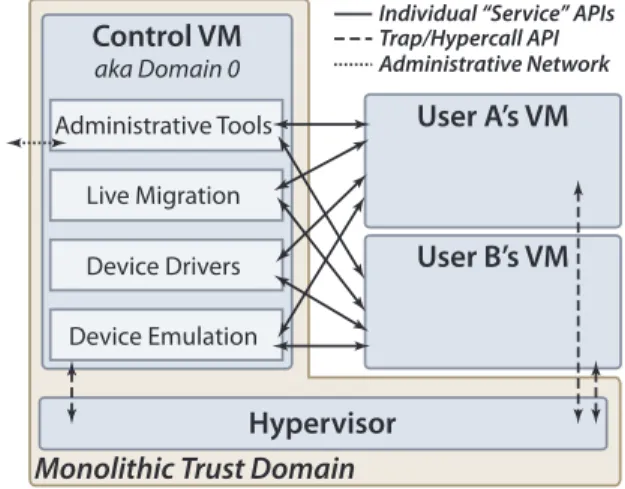
Figure 1: The control VM is often a full operating system in-stall, has privilege similar to the hypervisor, and offers multiple services over numerous interfaces to guest VMs.
ronments rely on functionality such as live VM migration [13] for planned hardware replacements as well as unexpected failures [8, 15]. Hardware diversity is also inevitable in a large hosting facility; the use of hardware emulation and unified virtual devices means that a single VM image can be hosted on hardware throughout the facility without the need for device driver upgrades within customer VMs. Administrative benefits aside, the largest reason for the suc-cess of virtualization may be that it requires little or no change to existing applications. These three factors (resource utilization, ad-ministrative features, and the support of existing software) have al-lowed the emergence of large-scale hosting platforms, such as those offered by Amazon and Rackspace, that customers can trust to se-curely isolate their hosted virtual machines from those of other ten-ants despite physical co-location on the same physical hardware. Are hypervisors worthy of this degree of trust? Proponents of vir-tualization claim that the small trusted computing base (TCB) and narrow interfaces afforded by a hypervisor provide strong isolation between the software components that share a host. In fact, the TCB of a mature virtualization platform is larger than that of a conven-tional server operating system. Even Type-1 hypervisors, such as Xen [4] and Hyper-V [22], rely on a privileged OS to provide addi-tional shared services, such as drivers for physical devices, device emulation, and administrative tools. While the external interfaces to these services broaden the attack surface exposed to customer VMs, the internal interfaces between components within that OS are not as narrow or as carefully protected as those between components of
the hypervisor itself. This large control VM is the “elephant in the room”, often ignored in discussing the security of these systems. While TCB size may not be a direct representation of risk, the shared control VM is a real liability for these systems. In Xen, for instance, this control VM houses a smorgasbord of functionality: device em-ulation and multiplexing, system boot, administrative toolstack, etc. Each of these services is presented to multiple customer VMs over different, service-specific interfaces (see Figure 1). As these ser-vices are all part of a single monolithic TCB, a compromise of any of them places the entire platform in danger.
The history of OS development shows us how to address the prob-lem of a large TCB: break it into smaller pieces, isolate those pieces from each other, and reduce each one to the least privilege consistent with its task [43]. However, the history of OS deployment demon-strates that “secure by design” OSes often generate larger commu-nities of readers than developers or users. In this vein, from-scratch hypervisors [38, 40, 42] have shown that particular security proper-ties can be achieved by rearchitecting the platform, but they do not provide the rich set of features necessary for deployment in com-mercial hosting environments.
The work described in this paper avoids this compromise: we ad-dress the monolithic TCB presented by the control VM without re-ducing functionality. Instead, we hold the features of a mature, de-ployed hypervisor as a baseline and harden the underlying TCB. Our approach is to incorporate stronger isolation for the existing components in the TCB, increasing our ability to control and reason about exposure to risk. While full functionality is necessary, it is not sufficient for commercial deployment. Our approach adds only a small amount of performance overhead compared to our starting point full-featured virtualization platform.
1.1
Contributions
The primary contribution of this paper is to perform a component-based disaggregation of a mature, broadly deployed virtualization platform in a manner that is practical to incorporate and maintain. Our work takes advantage of a number of well-established mecha-nisms that have been used to build secure and reliable systems: the componentization of microkernels, freshening of component state using microreboots [10], and the use of recovery boxes [3] to al-low a small set of explicitly designated state to survive reboots. The insight in this work is that these techniques can be applied to an ex-isting system along the boundaries that already exist between pro-cesses and interfaces in the control VM.
We describe the challenges of decomposing Xen’s control VM into a set of nine classes of service VMs while maintaining functional, performance, and administrative parity. The resulting system, which we have named Xoar, demonstrates a number of interesting new capabilities that are not possible without disaggregation:
• Disposable Bootstrap. Booting the physical computer in-volves a great deal of complex, privileged code. Xoar iso-lates this functionality in special purpose service VMs and destroys these VMs before the system begins to serve users. Other Xoar components are microrebooted to known-good snapshots, allowing developers to reason about a specific soft-ware state that is ready to handle a service request.
• Auditable Configurations. As the dependencies between customer VMs and service VMs are explicit, Xoar is able to record a secure audit log of all configurations that the system has been placed in as configuration changes are made. We
show that this log can be treated as a temporal database, en-abling providers to issue forensic queries, such as asking for a list of VMs that depended on a known-vulnerable component. • Hardening of Critical Components. While a core goal of our work has been to minimize the changes to source in order to make these techniques adoptable and maintainable, some critical components are worthy of additional attention. We identify XenStore, Xen’s service for managing configuration state and inter-VM communication, as a sensitive and long-running component that is central to the security of the sys-tem. We show how isolation and microreboots allow Xen-Store to be rearchitected in a manner whereby an attacker must be capable of performing a stepping-stone attack across two isolated components in order to compromise the service. We believe that Xoar represents a real improvement to the security of these important systems, in a manner that is practical to incor-porate today. After briefly describing our architecture, we present a detailed design and implementation. We end by discussing the se-curity of the system and evaluate the associated performance costs.
2.
TCBS, TRUST, AND THREATS
This section describes the TCB of an enterprise virtualization plat-form and articulates our threat model. It concludes with a classifi-cation of relevant existing published vulnerabilities as an indiclassifi-cation of threats that have been reported in these environments.
TCBs: Trust and Exposure. The TCB is classically defined as “the totality of protection mechanisms within a computer system — including hardware, firmware, and software — the combination of which is responsible for enforcing a security policy” [1]. In line with existing work on TCB reduction, we define the TCB of a subsystem Sas “the set of components thatStrusts not to violate the security ofS” [21, 33].
Enterprise virtualization platforms, such as Xen, VMware ESX, and Hyper-V, are responsible for the isolation, scheduling, and memory management of guest VMs. Since the hypervisor runs at the high-est privilege level, it forms, along with the hardware, part of the system’s TCB.
Architecturally, these platforms rely on additional components. De-vice drivers and deDe-vice emulation components manage and multi-plex access to I/O hardware. Management toolstacks are required to actuate VMs running on the system. Further components provide virtual consoles, configuration state management, inter-VM com-munication, and so on. Commodity virtualization platforms, such as the ones mentioned above, provide all of these components in a monolithic domain of trust, either directly within the hypervisor or within a single privileged virtual machine running on it. Figure 1 illustrates an example of this organization as implemented in Xen. A compromise of any component in the TCB affords the attacker two benefits. First, they gain the privileges of that component, such as access to arbitrary regions of memory or control of hardware. Second, they can access its interfaces to other elements of the TCB which allows them to attempt to inject malicious requests or re-sponses over those interfaces.
Example Attack Vectors. We analyzed the CERT vulnerability database and VMware’s list of security advisories, identifying a to-tal of 44 reported vulnerabilities in Type-1 hypervisors.1 Of the
reported Xen vulnerabilities, 23 originated from within guest VMs,
1
hy-11 of which were buffer overflows allowing arbitrary code execu-tion with elevated privileges, while the other eight were denial-of-service attacks. Classifying by attack vector showed 14 vulnerabili-ties in the device emulation layer, with another two in the virtualized device layer. The remainder included five in management compo-nents and only two hypervisor exploits. 21 of the 23 attacks outlined above are against service components in the control VM.
Threat Model. We assume a well-managed and professionally ad-ministered virtualization platform that restricts access to both phys-ical resources and privileged administrative interfaces. That is, we are not concerned with the violation of guest VM security by an administrator of the virtualization service. There are business im-peratives that provide incentives for good behavior on the part of hosting administrators.
There is no alignment of incentives, however, for the guests of a hosting service to trust each other, and this forms the basis of our threat model. In a multi-tenancy environment, since guests may be less than well administered and exposed to the Internet, it is pru-dent to assume that they may be malicious. Thus, the attacker in our model is a guest VM aiming to violate the security of another guest with whom it is sharing the underlying platform. This includes violating the data integrity or confidentiality of the target guest or exploiting the code of the guest.
While we assume that the hypervisor of the virtualization platform is trusted, we also assume that the code instantiating the function-ality of the control VM will contain bugs that are a potential source of compromise. Note that in the case of a privileged monolithic control VM, a successful attack on any one of its many interfaces can lead to innumerable exploits against guest VMs. Rather than exploring techniques that might allow for the construction of a bug-free platform, our more pragmatic goal is to provide an architecture that isolates functional components in space and time so that an ex-ploit of one component is not sufficient to mount a successful attack against another guest or the underlying platform.
3.
ARCHITECTURE OVERVIEW
Before explaining the design goals behind Xoar, it is worth provid-ing a very high-level overview of the components, in order to help clarify the complexities of the control plane in a modern hypervi-sor and to establish some of the Xen-specific terminology that is used throughout the remainder of the paper. While our implemen-tation is based on Xen, other commercial Type-1 hypervisors, such as those offered by VMware and Microsoft, have sufficiently simi-lar structures that we believe the approach presented in this paper is applicable to them as well.
3.1
The Xen Platform
The Xen hypervisor relies on its control VM, Dom0, to provide a virtualized I/O path and host a system-wide registry and manage-ment toolstack.
Device Drivers. Xen delegates the control of PCI-based periph-erals, such as network and disk controllers, to Dom0, which is re-sponsible for exposing a set of abstract devices to guest VMs. These devices may either be virtualized, passed through, or emulated. Virtualized devices are exposed to other VMs using a “split driver” model [17]. A backend driver, having direct control of the hardware, pervisors, most of which assume the attacker has access to the host OS and compromises known OS vulnerabilities — for instance, us-ing Windows exploits to compromise VMware Workstation. These attacks are not representative of our threat model and are excluded.
exposes virtualized devices to frontend drivers in the guest VMs. Frontend and backend drivers communicate over a shared memory ring, with the backend multiplexing requests from several frontends onto the underlying hardware. Xen is only involved in enforcing access control for the shared memory and passing synchronization signals. ACLs are stored in the form of grant tables, with permis-sions set by the owner of the memory.
Alternatively, Xen uses direct device assignment to allow VMs other than Dom0 to directly interface with passed-through hardware de-vices. Dom0 provides a virtual PCI bus, using a split driver, to proxy PCI configuration and interrupt assignment requests from the guest VM to the PCI bus controller. Device-specific operations are han-dled directly by the guest. Direct assignment can be used to move physical device drivers out of Dom0, in particular for PCI hardware that supports hardware-based IO virtualization (SR-IOV) [28]. Unmodified commodity OSes, on the other hand, expect to run on a standard platform. This is provided by a device emulation layer, which, in Xen, is a per-guest Qemu [6] instance, running either as a Dom0 process or in its own VM [44]. It has privileges to map any page of the guest’s memory in order to emulate DMA operations. XenStore. XenStore is a hierarchical key-value store that acts as a system-wide registry and naming service. It also provides a “watch” mechanism which notifies registered listeners of any modifications to particular keys in the store. Device drivers and the toolstack make use of this for inter-VM synchronization and device setup. XenStore runs as a Dom0 process and communicates with other VMs via shared memory rings. Since it is required in the creation and boot-up of a VM, it relies on Dom0 privileges to access shared memory directly, rather than using grant tables.
Despite the simplicity of its interface with VMs, the complex, shared nature of XenStore makes it vulnerable to DoS attacks if a VM mo-nopolizes its resources [14]. Because it is the central repository for configuration state in the system and virtually all components in the system depend on it, it is a critical component from a security per-spective. Exploiting XenStore allows an attacker to deny service to the system as a whole and to perform most administrative oper-ations, including starting and stopping VMs, and possibly abusing interfaces to gain access to guest memory or other guest VMs. Other systems (including previous versions of Xen) have used a completely message-oriented approach, either as a point-to-point implementation or as a message bus. Having implemented all of these at various points in the past (and some of them more than once), our experience is that they are largely isomorphic with regard to complexity and decomposability.
Toolstack. The toolstack provides administrative functions for the management of VMs. It is responsible for creating, destroying, and managing the associated resources and privileges of VMs. Creating a VM requires Dom0 privileges to map guest memory, in order to load a kernel or virtual BIOS and to set up initial communication channels with XenStore and the virtual console. In addition, the toolstack registers newly created guests with XenStore.
System Boot. In a traditional Xen system, the boot process is sim-ple: the hypervisor creates Dom0 during boot-up, which proceeds to initialize hardware and bring up devices and their associated back-end drivers. XenStore is started before any guest VM is created.
Xoar: Architecture
Xen
Bootstrapper:
Coordinate booting of the rest of the system.
Builder:
Instantiate other VMs.
Toolstack:
Handles management requests.
PCIBack:
Virtualizes access to PCI Bus config.
Self-Destructing VMs
Components of TCB that are destroyed after initialization.
Restartable VMs
Components where freshness is imposed using periodic restarts.
Active Runtime Dependencies
Restarted on each request
Restarted on a timer
NetBack:
Physical network driver exported to guest VMs.
BlkBack:
Physical storage driver exported to guest VMs.
Long-lived VM XenStore-State:
In-memory contents of XenStore.
XenStore-Logic:
Processes requests for inter-VM comms and config state.
Q
em
u
Q
em
u
Guest VM:
HVM Linux
Guest VM:
HVM Windows
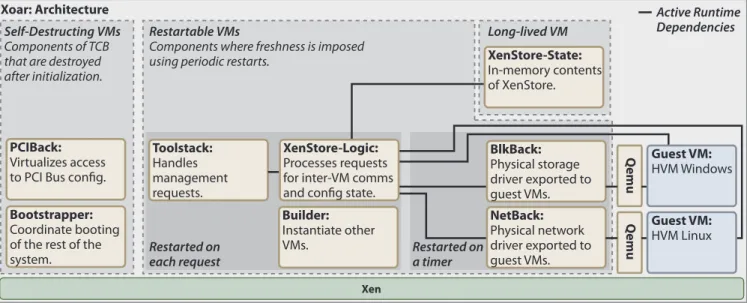
Figure 2: Architecture of Xoar. The figure above shows all the classes of service VMs along with the dependencies between them. For clarity, ephemeral dependencies (e.g., between the Builder and the VMs that it builds) are not shown. As suggested in the figure, a Qemu service VM is instantiated for the lifetime of each guest.
3.2
Xoar
Figure 2 shows the architecture of Xoar, and will be referred to throughout the remainder of this paper. In Xoar, the functionality of Xen’s control VM has been disaggregated into nine classes of service VMs, each of which contains a single-purpose piece of con-trol logic that has been removed from the original monolithic concon-trol VM. As is the case with the monolithic TCB, some components may have multiple instances, each serving different client VMs. That these individual components may be instantiated more than once is important, as it allows them to be used as flexible building blocks in the deployment of a Xoar-based system. Figure 2 shows a single instance of each component other than the QemuVM. Later in the paper we will describe how multiple instances of these com-ponents, with differing resource and privilege assignments, can par-tition and otherwise harden the system as a whole.
From left to right, we begin with two start-of-day components that are closely tied to booting the hypervisor itself, Bootstrapper and PCIBack. These components bring up the physical platform and interrogate and configure hardware. In most cases this functionality is only required when booting the system and so these components are destroyed before any customer VMs are started. This is a useful property in that platform drivers and PCI discovery represent a large volume of complex code that can be removed prior to the system entering a state where it may be exposed to attacks.
While PCIBack is logically a start-of-day component, it is actually created after XenStore and Builder. XenStore is required to virtu-alize the PCI bus and the Builder is the only component capable of creating new VMs on the running system. PCIBack uses these com-ponents to create device driver VMs during PCI device enumeration by usingudev[27] rules.
Three components are responsible for presenting platform hardware that is not directly virtualized by Xen. BlkBack and NetBack expose virtualized disk and network interfaces and control the specific PCI devices that have been assigned to them. For every guest VM run-ning an unmodified OS, there is an associated QemuVM responsible for device emulation.
Once the platform is initialized, higher-level control facilities like the Toolstacks are created. The Toolstacks request the Builder to create guest VMs. As a control interface to the system, toolstacks are generally accessed over a private enterprise network, isolated from customer VM traffic.
As in Xen, a VM is described using a configuration file that is pro-vided to the toolstack. This configuration provides runtime param-eters such as memory and CPU allocations, and also device config-urations to be provided to the VM. When a new VM is to be cre-ated, the toolstack parses this configuration file and writes the asso-ciated information into XenStore. Other components, such as driver VMs, have watches registered which are triggered by the build pro-cess, and configure connectivity between themselves and the new VM in response. While Xoar decomposes these components into isolated virtual machines, it leaves the interfaces between them un-changed; XenStore continues to be used to coordinate VM setup and tear down. The major difference is that privileges, both in terms of access to configuration state within XenStore and access to admin-istrative operations in the hypervisor, are restricted to the specific service VMs that need them.
4.
DESIGN
In developing Xoar, we set out to maintain functional parity with the original system and complete transparency with existing man-agement and VM interfaces, including legacy support, without in-curring noticeable overhead. This section discusses the approach that Xoar takes, and the properties that were considered in selecting the granularity and boundaries of isolation.
Our design is motivated by these three goals:
1. Reduce privilege Each component of the system should only have the privileges essential to its purpose; interfaces exposed by a component, both to dependent VMs and to the rest of the system, should be the minimal set necessary. This confines any successful attack to the limited capabilities and interfaces of the exploited component.
assign_pci_device (PCI_domain, bus, slot) permit_hypercall (hypercall_id)
allow_delegation (guest_id)
Figure 3: Privilege Assignment API
2. Reduce sharing Sharing of components should be avoided wherever it is reasonable; whenever a component is shared be-tween multiple dependent VMs, this sharing should be made explicit. This enables reasoning and policy enforcement re-garding the exposure to risk introduced by depending on a shared component. It also allows administrators to securely log and audit system configurations and to understand expo-sure after a compromise has been detected.
3. Reduce staleness A component should only run for as long as it needs to perform its task; it should be restored to a known good state as frequently as practicable. This confines any suc-cessful attack to the limited execution time of the exploited component and reduces the execution state space that must be tested and evaluated for correctness.
To achieve these goals, we introduce an augmented version of the virtual machine abstraction: the service VM. Service VMs are the units of isolation which host the service components of the control VM. They differ from conventional virtual machines in that only service VMs can receive any extra privilege from the hypervisor or provide services to other VMs. They are also the only components which can be shared in the system, aside from the hypervisor itself. Service VMs are entire virtual machines, capable of hosting full OSes and application stacks. Individual components of the control VM, which are generally either driver or application code, can be moved in their entirety out of the monolithic TCB and into a service VM. The hypervisor naturally assigns privilege at the granularity of the tasks these components perform. As such, there is little benefit, and considerable complexity, involved in finer-grained partitioning. Components receiving heightened privilege and providing shared services are targets identified by the threat model discussed in Sec-tion 2. By explicitly binding their capabilities to a VM, Xoar is able to directly harden the riskiest portions of the system and provide service-specific enhancements for security. The remainder of this section discusses the design of Xoar with regard to each of these three goals.
4.1
Privilege: Fracture the Monolithic TCB
A service VM is designated as such using aserviceVMblock in a VM config file. This block indicates that the VM should be treated as an isolated component and contains parameters that describe its capabilities. Figure 3 shows the API for the assignment of the three privilege-related properties that can be configured: direct hardware assignment, privileged hypercalls, and the ability to delegate privi-leges to other VMs on creation.
Direct hardware assignment is already supported by many x86 hy-pervisors, including Xen. Given a PCI domain, bus, and slot num-ber, the hypervisor validates that the device is available to be as-signed and is not already committed to another VM, then allows the VM to control the device directly.
Hypercall permissions allow a service VM access to some of the privileged functionality provided by the hypervisor. The explicit white-listing of hypercalls beyond the default set available to guest
resource = [ provider, parameters,
constraint_group=tag ]
Figure 4: Constraint Tagging API
SELECT e1, e2 FROM log e1, log e2 WHERE e1.name = e2.name AND
e1.action = ’create’ AND e2.action = ’destroy’ AND
e1.dependency = ’NameOfCompromisedNetBack’ AND overlaps(period_intersect(e1.time, e2.time),
compromise_period);
SELECT e1.name FROM log e1 WHERE e1.dependency = ’NetBack’ AND
e1.dependency_version = vulnerable_version;
Figure 5: Temporal queries which search for guest VMs that depended on a service VM that was compromised (top) or vul-nerable (bottom).
VMs allows for least-privilege configuration of individual service VMs. These permissions are translated directly into a Flask [41] policy, which is installed into the hypervisor.
Access to resources is restricted by delegating service VMs to only those Toolstacks allowed to utilize those resources to support newly created VMs. Attempts to use undelegated service VMs are blocked by the hypervisor, enabling coarse-grained partitioning of resources. In the private cloud example presented at the end of this section, each user is assigned a private Toolstack, with delegated service VMs, and has exclusive access to the underlying hardware.
4.2
Sharing: Manage Exposure
Isolating the collection of shared services in service VMs confines and restricts attacks and allows an explicit description of the rela-tionships between components in the system. This provides a clear statement of configuration constraints to avoid exposure to risk and enables mechanisms to reason about the severity and consequences of compromises after they occur.
Configuration Constraints. A guest can provide constraints on the service VMs that it is willing to use. At present, a single constraint is allowed, as shown in Figure 4. Theconstraint_group param-eter provides an optional user-specified tag and may be appended to any line specifying a shared service in the VM’s configuration. Xoar ensures that no two VMs specifying different constraint groups ever share the same service VM.
Effectively, this constraint is a user-specified coloring that prevents sharing. By specifying a tag on all of the devices of their hosted VMs, users can insist that they be placed in configurations where they only share service VMs with guest VMs that they control. Secure Audit. Xoar borrows techniques from past forensics sys-tems such as Taser [18]. The coarse-grained isolation and explicit dependencies provided by service VMs makes these auditing ap-proaches easier to apply. Whenever the platform performs a guest-related configuration change (e.g., the creation, deletion, pausing, or unpausing of a VM), Xoar logs the resulting dependencies to an off-host, append-only database over a secure channel. Currently, we use the temporal extension for Postgres.
Calls from within the service VM: vm_snapshot ()
recoverybox_balloc (size) VM configuration for restart policy:
restart_policy ([(timer|event), parameters]) Figure 6: Microreboot API
boot and initialization
request processing
rollback (triggered by restart policy)
vm_snapshot() Newly
Created VM
Snapshot Image
Copy-on-write
recovery box recovery box
requests and
responses rollback
activated Figure 7: Rolling back to a known-good snapshot allows effi-cient microreboots of components.
top query in Figure 5 determines which customers could be affected by the compromise of a service VM by enumerating VMs that relied on that particular service VM at any point during the compromise. Second, providers frequently roll out new versions of OS kernels and in the event that a vulnerability is discovered in a specific release of a service VM after the fact, the audit log can be used to identify all guest VMs that were serviced by it.
4.3
Staleness: Protect VMs in Time
The final feature of service VMs is a facility to defend the temporal attack surface, preserving the freshness of execution state through the use of periodic restarts. This approach takes advantage of the ob-servation from work on microreboots and “crash-only software” [10] that it is generally easier to reason about a program’s correctness at the start of execution rather than over long periods of time. Microreboots. Virtual machines naturally support a notion of re-booting that can be used to reset them to a known-good state. Fur-ther, many of the existing interfaces to control VM-based services already contain logic to reestablish connections, used when migrat-ing a runnmigrat-ing VM from one physical host to another. There are two major challenges associated with microreboots. First, full system restarts are slow and significantly reduce performance, especially of components on a data path such as device drivers. Second, not all state associated with a service can be discarded since useful side-effects that have occurred during that execution will also be lost. Snapshot and Rollback. Instead of fully restarting a component, it is snapshotted just after it has booted and been initialized, but before it has communicated with any other service or guest VM. The service VM is modified to explicitly snapshot itself at the time that it is ready to service requests (typically at the start of an event loop) using the API shown in Figure 6. Figure 7 illustrates the snap-shot/rollback cycle. By snapshotting before any requests are served over offered interfaces, we ensure that the image is fresh. A comple-mentary extension would be to measure and attest snapshot-based images, possibly even preparing them as part of a distribution and avoiding the boot process entirely.
We enable lightweight snapshots by using a hypervisor-based copy-on-write mechanism to trap and preserve any pages that are about to be modified. When rolling back, only these pages and the
vir-tual CPU state need be restored, resulting in very fast restart times — in our implementation, between 4 and 25 ms, depending on the workload.
Restart Policy. While it is obvious when to take the snapshot of a component, it is less clear when that component should be rolled back. Intuitively, it should be as frequently as possible. However, even though rollbacks are quick, the more frequently a component is restarted, the less time it has available to offer a useful service. Xoar specifies rollback policy in the service VM’s configuration file and we currently offer two policies: notification-based and timer-based. Restart policy is associated with the VM when it is instantiated and is tracked and enforced by the hypervisor.
In our notification-based policy, the hypervisor interposes on mes-sage notifications leaving the service VM as an indication that a request transaction has completed, triggering a restart. For low-frequency, synchronous communication channels (e.g., those that access XenStore), this method isolates individual transactions and resets the service to a fresh state at the end of every processed re-quest. In other words, every single request is processed by a fresh version of the service VM.2
The overhead of imposing a restart on every request would be too high for higher-throughput, concurrent channels, such as NetBack and BlkBack. For these service VMs, the hypervisor provides a pe-riodic restart timer that triggers restarts at a configurable frequency. Maintaining State. Frequent restarts suffer from the exact symp-tom that they seek to avoid: the establishment of long-lived state. In rolling back a service VM, any state that it introduces is lost. This makes it particularly hard to build services that depend on keeping in-memory state, such as configuration registries, and services that need to track open connections.
We address this issue by providing service VMs with the ability to allocate a “recovery box” [3]. Originally proposed as a technique for high availability, this is a block of memory that persists across restarts. Service VM code is modified to store any long-lived state in one of these allocations and to check and restore from it immedi-ately after a snapshot call. Memory allocated using this technique is exempted from copy-on-write.
Maintaining state across restarts presents an obvious attack vector — a malicious user can attempt to corrupt the state that is reloaded after every rollback to repeatedly trigger the exploit and compromise the system. To address this, the service treats the recovery box as an untrusted input and audits its contents after the rollback. Xen also tracks the memory pages in the allocation and forcibly marks all virtual addresses associated with them as non-executable. Driver VMs, like NetBack and BlkBack, automatically renegotiate both device state and frontend connections in cases of failures or restarts, allowing them to discard all state at every restart. In these performance-critical components, however, any downtime signifi-cantly affects the throughput of guests. This downtime can be re-duced by caching a very small amount of device and frontend state in a recovery box. The desired balance between security and perfor-mance can be chosen, as discussed in Section 7.2.
Components like XenStore, on the other hand, maintain a large amount of long-lived state for other components in the system. In
2
This mechanism leaves open the possibility that an exploited ser-vice VM might not send the event that triggers the rollback. To cover this attack vector, the hypervisor maintains a watchdog timer for each notification-based service VM. If a timer goes off, the VM is rolled back; if the restart is triggered normally, the timer is reset.
User A’s VM
(HVM)
User B’s VM
(PV) QemuXenStore
Xen
Interfaces Delegated-to
XenStore-Logic User A’s
Toolstack
XenStore-State Builder
NetBack (eth 0) BlkBack
(sda)
User B’s Toolstack
NetBack (eth 1) BlkBack
(sdb)
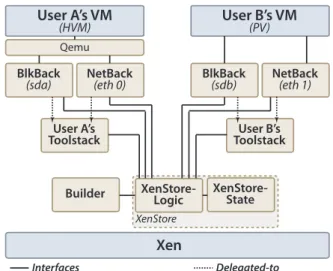
Figure 8: Partitioned configuration: In the configuration above, users A and B use isolated hardware and toolstacks and share interfaces only with XenStore and Xen itself.
such cases, this state can be removed from the service VM alto-gether and placed in a separate “state” VM that is accessible through a special-purpose interface. In Xoar, only XenStore, because of its central role in the correctness and security of the system, is refac-tored in this way (see Section 5.2). Only the processing and logic remain in the original service VM, making it amenable to rollbacks. Per-request rollbacks force the attacker to inject exploit code into the state and have it triggered by another VM’s interaction with XenStore. However, in the absence of further exploits, access con-trol and guest ID authentication prevent the injection of such exploit code into sections of the state not owned by the attacking guest (see Section 5.2). Thus, an attack originating from a guest VM through XenStore requires an exploit of more than one service VM.
4.4
Deployment Scenarios
Public clouds, like Amazon Web Services, tightly pack many VMs on a single physical machine, controlled by a single toolstack. Par-titioning the platform into service VMs, which can be judiciously restarted, limits the risks of sharing resources among potentially vulnerable and exposed VMs. Furthermore, dynamically restarting service VMs allows for in-place upgrades, reducing the window of exposure in the face of a newly discovered vulnerability. Finally, in the case of compromise, secure audit facilities allow administrators to reason, after the fact, about exposures that may have taken place. Our design supports greater degrees of resource partitioning than this. Figure 8 shows a more conservative configuration, in which each user is assigned separate, dedicated hardware resources within the physical host and a personal collection of service VMs to man-age them. Users manman-age their own service VMs and the device drivers using a private Toolstack with resource service VMs dele-gated solely to it.
5.
IMPLEMENTATION
This section explains how the design described in Section 4 was im-plemented on the Xen platform. It begins with a brief discussion of how component boundaries were selected in fracturing the control VM and then describes implementation details and challenges faced during the development of Xoar.
5.1
Xoar Components
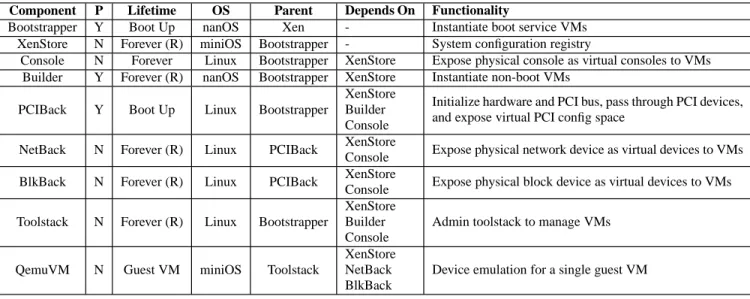
The division of service VMs in Xoar conforms to the design goals of Section 4; we reduce components into minimal, loosely coupled units of functionality, while obeying the principle of least privilege. As self-contained units, they have a low degree of sharing and inter-VM communication (IVC), and can be restarted independently. Ex-isting software and interfaces are reused to aid development and ease future maintenance. Table 1 augments Figure 2 by describing the classes of service VMs in our decomposition of Dom0. While it is not the only possible decomposition, it satisfies our design goals without requiring an extensive re-engineering of Xen.
Virtualized devices mimic physical resources in an attempt to of-fer a familiar abstraction to guest VMs, making them ideal service VMs. Despite the lack of toolstack support, Xen has architectural support for driver VMs, reducing the development effort signifi-cantly. PCIBack virtualizes the physical PCI bus, while NetBack and BlkBack are driver VMs, exposing the required device backends for guest VMs. Further division, like separating device setup from the data path, yields no isolation benefits, since both components need to be shared simultaneously. This would also add a signifi-cant amount of IVC, conflicting with our design goals, and would require extensive modifications. Similarly, the serial controller is represented by a service VM that virtualizes the console for other VMs. Further details about virtualizing these hardware devices are discussed in Section 5.3 and Section 5.4.
Different aspects of the VM creation process require differing sets of privileges; placing them in the same service VM violates our goal of reducing privilege. These operations can largely be divided into two groups — those that need access to the guest’s memory to set up the kernel, etc., and those that require access to XenStore to write en-tries necessary for the guest. Breaking this functionality apart along the lines of least privilege yields the Builder, a privileged service VM responsible for the hypervisor and guest memory operations, and the Toolstack, a service VM containing the management tool-stack. While the Builder could be further divided into components for sub-operations, like loading the kernel image, setting up the page tables, etc., these would all need to run at the same privilege level and would incur high synchronization costs. The Builder responds to build requests issued by the Toolstack via XenStore. Once build-ing is complete, the Toolstack communicates with XenStore to per-form the rest of the configuration and setup process.
5.2
XenStore
Our refactoring of XenStore is the most significant implementation change that was applied to any of the existing components in Xen (and took the largest amount of effort). We began by breaking Xen-Store into two independent service VMs: XenXen-Store-Logic, which contains the transactional logic and connection management code, and XenStore-State, which contains the actual contents of the store. This division allows restarts to be applied to request-handling code on a per-request basis, ensuring that exploits are constrained in du-ration to a single request. XenStore-State is a simple key-value store and is the only long-lived VM in Xoar.
Unfortunately, partitioning and per-request restarts are insufficient to ensure the security of XenStore. As XenStore-Logic is respon-sible for enforcing access control based on permissions in the store itself, a compromise of that VM may allow for arbitrary accesses to the contents of the store. We addressed this problem with two tech-niques. First, access control checks are moved into a small monitor module in XenStore-State; a compromise of XenStore-Logic is now limited to valid changes according to existing permissions in the
Component P Lifetime OS Parent Depends On Functionality
Bootstrapper Y Boot Up nanOS Xen - Instantiate boot service VMs XenStore N Forever (R) miniOS Bootstrapper - System configuration registry
Console N Forever Linux Bootstrapper XenStore Expose physical console as virtual consoles to VMs Builder Y Forever (R) nanOS Bootstrapper XenStore Instantiate non-boot VMs
PCIBack Y Boot Up Linux Bootstrapper
XenStore Builder Console
Initialize hardware and PCI bus, pass through PCI devices, and expose virtual PCI config space
NetBack N Forever (R) Linux PCIBack XenStore
Console Expose physical network device as virtual devices to VMs BlkBack N Forever (R) Linux PCIBack XenStore
Console Expose physical block device as virtual devices to VMs Toolstack N Forever (R) Linux Bootstrapper
XenStore Builder Console
Admin toolstack to manage VMs
QemuVM N Guest VM miniOS Toolstack
XenStore NetBack BlkBack
Device emulation for a single guest VM
Table 1: Components of Xoar. The “P” column indicates if the component is privileged. An “(R)” in the lifetime column indicates that the component can be restarted. Console is only mentioned for the sake of completeness. Since enterprise deployments typically disable console access, it is not part of the overall architecture.
store. Second, we establish the authenticity of accesses made by XenStore-Logic by having it declare the identity of the VM that it is about to service before reading the actual request. This approach effectively drops privilege to that of a single VM before exposing XenStore-Logic to any potentially malicious request, and makes the identity of the request made to XenStore-State unforgeable. The monitor refuses any request to change the current VM until the re-quest has been completed, and an attempt to do so results in a restart of XenStore-Logic.
The monitor code could potentially be further disaggregated from XenStore-State and also restarted on a per-request basis. Our current implementation requires an attacker to compromise both XenStore-Logic and the monitor code in XenStore-State in succession, within the context of a single request, in order to make an unauthorized access to the store. Decoupling the monitor from XenStore-State would add limited extra benefit, for instance possibly easing static analysis of the two components, and still allow a successful attacker to make arbitrary changes in the event of the two successive com-promises; therefore we have left the system is it stands.
5.3
PCI: A Shared Bus
PCIBack controls the PCI bus and manages interrupt routing for pe-ripheral devices. Although driver VMs have direct access to the peripherals themselves, the shared nature of the PCI configuration space requires a single component to multiplex all accesses to it. This space is used during device initialization, after which there is no further communication with PCIBack. We remove PCIBack from the TCB entirely after boot by destroying it, reducing the num-ber of shared components in the system.
Hardware virtualization techniques like SR-IOV [28] allow the cre-ation of virtualized devices, where the multiplexing is performed in hardware, obviating the need for driver VMs. However, provi-sioning new virtual devices on the fly requires a persistent service VM to assign interrupts and multiplex accesses to the PCI configu-ration space. Ironically, although appearing to reduce the amount of sharing in the system, such techniques may increase the number of shared, trusted components.
5.4
Driver VMs: NetBack and BlkBack
Driver VMs, like NetBack and BlkBack, use direct device assign-ment to directly access PCI peripherals like NICs and disk con-trollers, and rely on existing driver support in Linux to interface with the hardware. Each NetBack or BlkBack virtualizes exactly one network or block controller, hosting the relevant device driver and virtualized backend driver. The Toolstack links a driver VM delegated to it to a guest VM by writing the appropriate frontend and backend XenStore entries during the creation of the guest, af-ter which the guest and backend communicate directly using shared memory rings, without any further participation by XenStore. Separating BlkBack from the Toolstack caused some problems as the existing management tools mount disk-based VM images as loopback devices withblktap, for use by the backend driver. Af-ter splitting BlkBack from the Toolstack, the disk images need to be created and mounted in BlkBack. Therefore, in Xoar, BlkBack runs a lightweight daemon that proxies requests from the Toolstack.
5.5
Efficient Microreboots
As described in Section 4.3, our snapshot mechanism copies mem-ory pages which are dirtied as a service VM executes and restores the original contents of these pages during rollback, requiring a page allocation and deallocation and two copy operations for every dirt-ied page. Since many of the pages being modifdirt-ied are the same across several iterations, rather than deallocating the master copies of these pages after rollback, we retain them across runs, obviating the need for allocation, deallocation, and one copy operation when the same page is dirtied. However, this introduces a new problem: if a page is dirtied just once, its copy will reside in memory forever. This could result in memory being wasted storing copies of pages which are not actively required.
To address this concern, we introduced a “decay” value to the pages stored in the snapshot image. When a page is first dirtied after a rollback, its decay value is incremented by two, towards a maximum value. On rollback, each page’s decay value is decremented. When this count reaches zero, the page is released.
5.6
Deprivileging Administrative Tools
XenStore and the Console require Dom0-like privileges to forcibly map shared memory, since they are required before the guest VM can set up its grant table mappings. To avoid this, Xoar’s Builder creates grant table entries for this shared memory in each new VM, allowing these tools to use grant tables and function without any special privileges.
The Builder assigns VM management privileges to each Toolstack for the VMs that it requests to be built. A Toolstack can only man-age these VMs, and an attempt to manman-age any others is blocked by the hypervisor. Similarly, it can only use service VMs that have been delegated to it. An attempt to use an undelegated service VM, for example a NetBack, for a new guest VM will fail. Restricting privileges this way allows for the creation of several Toolstack in-stances that run simultaneously. Different users, each with a private Toolstack, are able to partition their physical resources and manage their own VMs, while still guaranteeing strong isolation from VMs belonging to other users.
5.7
Developing with Minimal OSes
Bootstrapper and Builder are built on top of nanOS, a small, single-threaded, lightweight kernel explicitly designed to have the min-imum functionality needed for VM creation. The small size and simplicity of these components leave them well within the realm of static analysis techniques, which could be used to verify their correctness. XenStore, on the other hand, demands more from its operating environment, and so is built on top of miniOS, a richer OS distributed with Xen.
Determining the correct size of OS to use is hard, with a fundamen-tal tension between functionality and ease of use. Keeping nanOS so rigidly simple introduces a set of development challenges, es-pecially in cases involving IVC. However, since these components have such high privilege, we felt that the improved security gained from reduced complexity is a worthwhile trade-off.
5.8
Implicit Assumptions about Dom0
The design of Xen does not mandate that all service components live in Dom0, however several components, including the hypervi-sor, implicitly hard-code the assumption that they do. A panoply of access control checks compare the values of domain IDs to the in-teger literal ’0’, the ID for Dom0. Many tools assume that they are running co-located with the driver backends and various paths in XenStore are hard-coded to be under Dom0’s tree The toolstack ex-pects to be able to manipulate the files that contain VM disk images, which is solved by proxying requests, as discussed in Section 5.4. The hypervisor assumes Dom0 has control of the hardware and con-figures signal delivery and MMIO and I/O-port privileges for access to the console and peripherals to Dom0. In Xoar, these need to be mapped to the correct VMs, with Console requiring the signals and I/O-port access for the console and PCIBack requiring the MMIO and remaining I/O-port privileges, along with access to the PCI bus.
6.
SECURITY EVALUATION
Systems security is notoriously challenging to evaluate, and Xoar’s proves no different. In an attempt to demonstrate the improvement to the state of security for commodity hypervisors, this section will consider a number of factors. First, we will evaluate the reduction in the size of the trusted computing base; this is an approach that we do not feel is particularly indicative of the security of a system, but has been used by a considerable amount of previous work and does provide some insight into the complexity of the system as a whole.
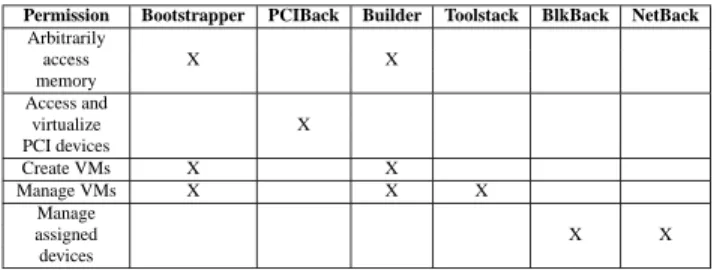
Permission Bootstrapper PCIBack Builder Toolstack BlkBack NetBack
Arbitrarily
X X
access memory Access and
X virtualize
PCI devices
Create VMs X X
Manage VMs X X X
Manage
X X
assigned devices
Table 2: Functionality available to the service VMs in Xoar. Components with access to no privileged hypercalls are not shown. In Xen, Dom0 possesses all of these functionalities.
Component Shared Interfaces
XenStore-Logic
XenStore-State, Console, Builder, PCIBack, NetBack, BlkBack, Guest XenStore-State XenStore-Logic
Console XenStore-Logic
Builder XenStore-Logic
PCIBack XenStore-Logic, NetBack, BlkBack NetBack XenStore-Logic, PCIBack, Guest BlkBack XenStore-Logic, PCIBack, Guest
Toolstack XenStore-Logic
Guest VM XenStore-Logic, NetBack, BlkBack
Table 3: Interfaces shared between service VMs
Second, we consider how the attack surface presented by the control VM changes in terms of isolation, sharing, and per-component priv-ilege in an effort to evaluate the exposure to risk in Xoar compared to other systems. Finally, we consider how well Xoar handles the existing published vulnerabilities first described in Section 2. Much of this evaluation is necessarily qualitative: while we have taken efforts to evaluate against published vulnerabilities, virtual-ization on modern servers is still a sufficiently new technology with few disclosed vulnerabilities. Our sense is that these vulnerabilities may not be representative of the full range of potential attacks. In evaluating Xoar’s security, we attempt to characterize it from an attacker’s perspective. One notable feature of Xoar is that in order for an adversary to violate our security claim, more than one service VM must have a vulnerability, and a successful exploit must be able to perform a stepping-stone attack. We will discuss why this is true, and characterize the nature of attacks that are still possible.
6.1
Reduced TCB
The Bootstrapper, PCIBack, and Builder service VMs are the most privileged components, with the ability to arbitrarily modify guest memory and control and assign the underlying hardware. These privileges necessarily make them part of the TCB, as a compromise of any one of these components would render the entire system vul-nerable. Both Bootstrapper and PCIBack are destroyed after system initialization is complete, effectively leaving Builder as the only ser-vice VM in the TCB. As a result, the TCB is reduced from Linux’s 7.6 million lines of code to Builder’s 13,500 lines of code, both on top of the hypervisor’s 280,000 lines of code.3
6.2
Attack Surface
Monolithic virtualization platforms like Xen execute service com-ponents in a single trust domain, with every component running at
3All lines of code were measured using David Wheeler’s
Component Arbitrary Code Execution DoS File System Access
Hypervisor 0 / 1 0 / 1 0 / 0
Device Emulation 8 / 8 3 / 3 3 / 3
Virtualized Drivers 1 / 1 1 / 1 0 / 0
XenStore 0 / 0 1 / 1 0 / 0
Toolstack 1 / 1 2 / 2 1 / 1
Table 4: Vulnerabilities mitigated in Xoar. The numbers repre-sent total mitigated over total identified.
the highest privilege level. As a result, the security of the entire sys-tem is defined by that of the weakest component, and a compromise of any component gives an attacker full control of the system. Disaggregating service components into their own VMs not only provides strong isolation boundaries, it also allows privileges to be assigned on a per-component basis, reducing the effect a compro-mised service VM has on the entire system. Table 2 shows the priv-ileges granted to each service VM, which corresponds to the amount of access that an attacker would have on successfully exploiting it. Attacks originating from guest VMs can exploit vulnerabilities in the interfaces to NetBack, BlkBack, or XenStore (see Table 3). An attacker breaking into a driver VM gains access only to the degree that other VMs trust that device. Exploiting NetBack might allow for intercepting another VM’s network traffic, but not access to ar-bitrary regions of its memory. On hosts with enough hardware, re-sources can be partitioned so that no two guests share a driver VM. Where components reuse the same code, a single vulnerability could be sufficient to compromise them all. Service VMs like NetBack, BlkBack, Console, and Toolstack run the same core Linux kernel, with specific driver modules loaded only in the relevant component. As a result, vulnerabilities in the exposed interfaces are local to the associated service VM, but vulnerabilities in the underlying frame-work and libraries may be present in multiple components. For bet-ter code diversity, service VMs could use a combination of Linux, FreeBSD, OpenSolaris, and other suitable OSes.
Highly privileged components like the Builder have very narrow interfaces and cannot be compromised without exploiting vulner-abilities in multiple components, at least one of which is XenStore. Along with the central role it plays in state maintenance and syn-chronization, this access to Builder makes XenStore an attractive target. Compromising XenStore-Logic may allow an attacking guest to store exploit code in XenStore-State, which, when restoring state after a restart, re-compromises XenStore-Logic. The monitoring code described in Section 5.2, however, prevents this malicious state from being restored when serving requests from any other guest VM, ensuring that they interact with a clean copy of XenStore.
6.3
Vulnerability Mitigation
With a majority of the disclosed vulnerabilities against Xen involv-ing privilege escalation against components in Dom0, Xoar proves to be successful in containing all but two of them. Table 4 taxono-mizes the vulnerabilities discussed in Section 2 based on the vulner-able component and the type of vulnerability, along with the number that are successfully mitigated in Xoar.
The 14 device emulation attacks are completely mitigated, as the device emulation service VM has no rights over any VM except the one the attacker came from. The two attacks on the virtualized device layer and the three attacks against the toolstack would only affect those VMs that shared the same BlkBack, NetBack, and Tool-stack components. The vulnerability present in XenStore did not exist in our custom version. Since Xoar does not modify the
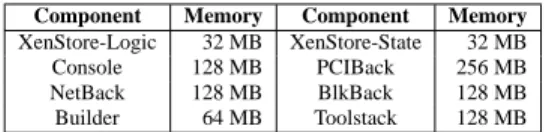
hyper-Component Memory Component Memory
XenStore-Logic 32 MB XenStore-State 32 MB
Console 128 MB PCIBack 256 MB
NetBack 128 MB BlkBack 128 MB
Builder 64 MB Toolstack 128 MB
Table 5: Memory requirements of individual components
visor, the two hypervisor vulnerabilities remain equally exploitable. One of the vulnerabilities in the virtualized drivers is against the block device interface and causes an infinite loop which results in a denial of service. Periodically restarting BlkBack forces the at-tacker to continuously recompromise the system. Since requests from different guests are serviced on every restart, the device would continue functioning with low bandwidth, until a patch could be ap-plied to prevent further compromises.
7.
PERFORMANCE EVALUATION
The performance of Xoar is evaluated against a stock Xen Dom0 in terms of memory overhead, I/O throughput, and overall system performance. Each service VM in Xoar runs with a single virtual CPU; in stock Xen Dom0 runs with 2 virtual CPUs, the configura-tion used in the commercial XenServer [12] platform. All figures are the average of three runs, with 95% confidence intervals shown where appropriate.
Our test system was a Dell Precision T3500 server, with a quad-core 2.67 GHz Intel Xeon W3520 processor, 4 GB of RAM, a Tigon 3 Gigabit Ethernet card, and an Intel 82801JIR SATA controller with a Western Digital WD3200AAKS-75L9A0 320 GB 7200 RPM disk. VMX, EPT, and IOMMU virtualization are enabled. We use Xen 4.1.0 and Linux 2.6.314pvops kernels for the tests. Identical guests running an Ubuntu 10.04 system, configured with two VCPUs, 1 GB of RAM and a 15 GB virtual disk are used on both systems. For network tests, the system is connected directly to another system with an Intel 82567LF-2 Gigabit network controller.
7.1
Memory Overhead
Table 5 shows the memory requirements of each of the compo-nents in Xoar. Systems with multiple network or disk controllers can have several instances of NetBack and BlkBack. Also, since users can select the service VMs to run, there is no single figure for total memory consumption. In commercial hosting solutions, console access is largely absent rendering the Console redundant. Similarly, PCIBack can be destroyed after boot. As a result, the memory requirements range from 512 MB to 896 MB, assuming a single network and block controller, representing a saving of 30% to an overhead of 20% on the default 750 MB Dom0 configuration used by XenServer. All performance tests compare a complete con-figuration of Xoar with a standard Dom0 Xen concon-figuration.
7.2
I/O performance
Disk performance is tested using Postmark, with VMs’ virtual disks backed by files on a local disk. Figure 9 shows the results of these tests with different configuration parameters.
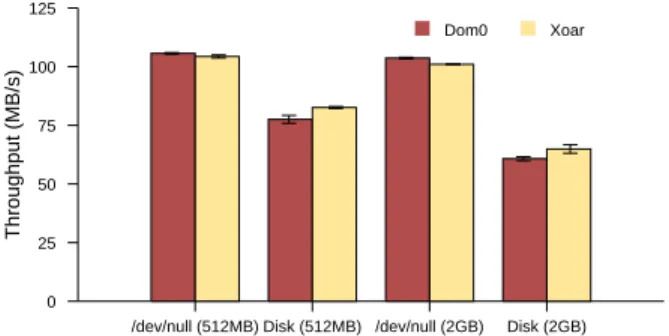
Network performance is tested by fetching a 512 MB and a 2 GB file across a gigabit LAN usingwget, and writing it either to disk, or to/dev/null(to eliminate performance artifacts due to disk performance). Figure 10 shows these results.
4Hardware issues forced us to use a 2.6.32 kernel for some of the
1Kx50K 20Kx50K 20Kx100K 20Kx100Kx100
Operations / Second
0 5000 10000 15000
Dom0 Xoar
Figure 9: Disk performance using Postmark (higher is better). The x-axis denotes (files x transactions x subdirectories).
/dev/null (512MB) Disk (512MB) /dev/null (2GB) Disk (2GB)
Throughput (MB/s)
0 25 50 75 100 125
Dom0 Xoar
Figure 10: Network performance withwget(higher is better)
Overall, disk throughput is more or less unchanged, and network throughput is down by 1–2.5%. The combined throughput of data coming from the network onto the disk increases by 6.5%; we be-lieve this is caused by the performance isolation of running the disk and network drivers in separate VMs.
Restart Interval (s)
1 2 3 4 5 6 7 8 9 10
Throughput (MB/s)
20 30 40 50 60 70 80 90 100
baseline slow (260ms) fast (140ms)
Figure 11:wgetthroughput while restarting NetBack at differ-ent time intervals
To measure the effect of microrebooting driver VMs, we ran the 2 GBwgetto/dev/nullwhile restarting NetBack at intervals between 1 and 10 seconds. Two different optimizations for fast mi-croreboots are shown.
In the first (marked as “slow” in Figure 11), the device hardware state is left untouched during reboots; in the second (“fast”), some configuration data that would normally be renegotiated via
Xen-Seconds
0 50 100 150 200 250 300 350 400 450 500
Dom0 (local) Xoar (local) Dom0 (nfs) Xoar (nfs) Restarts (10s) Restarts (5s)
Figure 12: Linux kernel build run on Dom0 and Xoar, locally, over NFS and over NFS with NetBack restarts.
Store is persisted. In “slow” restarts the device downtime is around 260 ms, measuring from when the device is suspended to when it re-sponds to network traffic again. The optimizations used in the “fast” restart reduce this downtime to around 140 ms.
Resetting every 10 seconds causes an 8% drop in throughput, as wget’s TCP connections respond to the breaks in connectivity. Re-ducing the interval to one second gives a 58% drop. Increasing it beyond 10 seconds makes very little difference to throughput. The faster recovery gives a noticeable benefit for very frequent reboots but is worth less than 1% for 10-second reboots.
7.3
Real-world Benchmarks
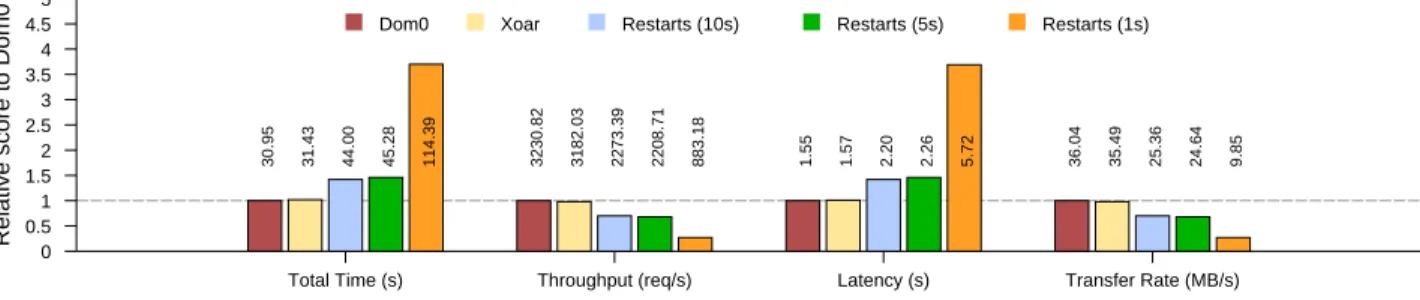
Figure 12 compares the time taken to build a Linux kernel, both in stock Xen and Xoar, off a local ext3 volume as well as an NFS mount. The overhead added by Xoar is much less than 1%. The Apache Benchmark is used to gauge the performance of an Apache web server serving a 10 KB static webpage 100,000 times to five simultaneous clients. Figure 13 shows the results of this test against Dom0, Xoar, and Xoar with network driver restarts at 10, 5, and 1 second intervals. Performance decreases non-uniformly with the frequency of the restarts: an increase in restart interval from 5 to 10 seconds yields barely any performance improvements, while changing the interval from 5 seconds to 1 second introduces a sig-nificant performance loss.
Dropped packets and network timeouts cause a small number of re-quests to experience very long completion times — for example, for Dom0 and Xoar, the longest packet took only 8–9 ms, but with restarts, the values range from 3000 ms (at 5 and 10 seconds) to 7000 ms (at 1 second). As a result, the longest request interval is not shown in the figure.
Overall, the overhead of disaggregation is quite low. This is largely because driver VMs do not lengthen the data path between guests and the hardware: the guest VM communicates with NetBack or BlkBack, which drives the hardware. While the overhead of driver restarts is noticeable, as intermittent outages lead to TCP backoff, it can be tuned by the administrator to best match the desired combi-nation of security and performance.
8.
RELATED WORK
With the widespread use of VMs, the security of hypervisors has been studied extensively and several attempts have been made to address the problem of securing the TCB. This section looks at some of these techniques in the context of our functional requirements. Build a Smaller Hypervisor. SecVisor [38] and BitVisor [40] are examples of tiny hypervisors, built with TCB size as a primary
con-Total Time (s) Throughput (req/s) Latency (s) Transfer Rate (MB/s) Relative score to Dom0 0.50
1 1.5 2 2.5 3 3.5 4 4.5 5
30.95 31.43 44.00 45.28 114.39 3230.82 3182.03 2273.39 2208.71 883.18 1.55 1.57 2.20 2.26 5.72 36.04 35.49 25.36 24.64 9.85 Dom0 Xoar Restarts (10s) Restarts (5s) Restarts (1s)
Figure 13: Apache Benchmark run on Dom0, Xoar, and Xoar with network driver restarts at 10s, 5s, and 1s.
cern, that use the interposition capabilities of hypervisors to retrofit security features for commodity OSes. While significantly reducing the TCB of the system, they do not share the multi-tenancy goals of commodity hypervisors and are unsuitable for such environments. Microkernel-based architectures like KeyKOS [20] and EROS [39], its x86-based successor, are motivated similarly to Xoar and allow mutually untrusting users to securely share a system. Our Builder closely resembles the factory in KeyKOS. While multiple, isolated, independently administered UNIX instances, rather like VMs, can be hosted on EROS, this requires modifications to the environment and arbitrary OSes cannot be hosted. More recently, NOVA [42] uses a similar architecture and explicitly partitions the TCB into several user-level processes within the hypervisor. Although capa-ble of running multiple unmodified OSes concurrently, the removal of the control VM and requirement for NOVA-specific drivers sac-rifice hardware support for TCB size. Also, it is far from complete: it cannot run Windows guests and has limited toolstack support. NoHype [23] advocates removing the hypervisor altogether, using static partitioning of CPUs, memory, and peripherals among VMs. This would allow a host to be shared by multiple operating systems, but with none of the other benefits of virtualization. In particular, the virtualization layer could no longer be used for interposition, which is necessary for live migration [13], memory sharing and compres-sion [19, 32], and security enhancements [11, 30, 46, 16].
Harden the Components of the TCB. The security of individ-ual components of the TCB can be improved using a combination of improved code quality and access control checks to restrict the privileges of these components. Xen’s XAPI toolstack is written in OCaml and benefits from the robustness that a statically typed, functional language provides [37]. Xen and Linux both have mech-anisms to enforce fine-grained security policies [31, 36]. While use-ful, these techniques do not address the underlying concern about the size of the TCB.
Split Up the TCB, Reduce the Privilege of Each Part. Murray et al. [33] removed Dom0 userspace from the TCB by moving the VM builder into a separate privileged VM. While a step in the right direction, it does not provide functional parity with Xen or remove the Dom0 kernel from the TCB, leaving the system vulnerable to attacks on exposed interfaces, such as network drivers.
Driver domains [17] allow device drivers to be hosted in dedicated VMs rather than Dom0, resulting in better driver isolation. Qubes-OS [35] uses driver domains in a single-user environment, but does not otherwise break up Dom0. Stub domains [44] isolate the Qemu device model for improved performance and isolation. Xoar builds on these ideas and extends them to cover the entire control VM.
9.
DISCUSSION AND FUTURE WORK
This idea of partitioning a TCB is hardly new, with software parti-tioning having been explored in a variety of contexts before. Micro-kernels remain largely in the domain of embedded devices with rel-atively small and focused development teams (e.g., [26]), and while attempts at application-level partitioning have demonstrated bene-fits in terms of securing sensitive data, they have also demonstrated challenges in implementation and concerns about maintenance [7, 9, 24, 34], primarily due to the mutability of application interfaces. While fracturing the largely independent, shared services that run in the control VM above the hypervisor, we observe that these con-cerns do not apply to nearly the same degree; typically the com-ponents are drivers or application code exposing their dominant in-terfaces either to hardware or to dependent guests. Isolating such services into their own VMs was a surprisingly natural fit.
While it is tempting to attribute this to a general property of vir-tualization, we also think that it was particularly applicable to the architecture of Xen. Although implemented as a monolithic TCB, several of the components were designed to support further com-partmentalization, with clear, narrow communication interfaces. We believe the same is applicable to Hyper-V, which has a simi-lar architecture to Xen. In contrast, KVM [25] converts the Linux kernel itself into a hypervisor, with the entire toolstack hosted in a Qemu process. Due to the tight coupling, we believe that disaggre-gating KVM this aggressively would be extremely hard, more akin to converting Linux into a microkernel.
9.1
Lessons
In the early design of the system our overall rule was to take a prac-tical approach to hardening the hypervisor. As usual, with the hind-sight of having built the system, some more specific guidelines are clear. We present them here as “lessons” and hope that they may be applied earlier in the design process of future systems.
Don’t break functionality. From the outset, the work described in this paper has been intended to be applied upstream to the open source Xen project. We believe that for VM security improvements to be deployed broadly, they must not sacrifice the set of functional-ity that has made these systems successful, and would not expect a warm reception for our work from the maintainers of the system if we were to propose that facilities such as CPU overcommit simply didn’t make sense in our design.
This constraint places enormous limitations on what we are able to do in terms of hardening the system, but it also reduces the major argument against accepting new security enhancements.