Spring 2012
Volume 25 Number 1
The O
HIO
Journal
of
T
eacher
Edu
cati
The Ohio Journal of Teacher Education
Spring 2012
Volume 25, Number 1
Published by the Ohio Association of Teacher Educators
Virginia McCormack, Ed.D.
Sarah Cecire, Ph.D.
Savilla Banister, Ph.D. Bowling Green State University
Michele Beery, Ph.D. Wilmington College
Cynthia Bertelsen, Ph.D. Bowling Green State University
Kami Darling, Ph.D. Ohio Dominican University
Beth Clark-Thomas, Ph.D. Malone College
Joy Cowdery, Ph.D. Muskingum University
Charlotte M. Harris, Ed. D. Wright State University
Martha Hendricks, Ed. D. Wilmington College
Lisa Huelskamp, Ph.D. Ohio State University Westerville City Schools
Doris Johnson, Ed. D. Wright State University
Lynn Kline, Ph. D. University of Akron
Tim Micek, D.A. Ohio Dominican University
Terry Miller, Ed. D. Wilmington College
Carol Ramsay, Ed. D. Lake Erie College
Linda Ingling Rogness, Ph.D. Muskingum University
Marlissa Stauffer, Ph.D. Ohio Dominican University
Megan Wereley, Ed.D. College of Wooster
Editorial Board
Contents
Message from the Editors ...4
Articles
Looking to Learn: Improving Observations in the Classroom ...5
Teresa Young, Ed.D.
Delane Bender-Slack, Ed. D
.Addressing the Needs of Young Children with Asperger’s
Disorder in the Inclusive Classroom ...12
Evonn Welton
Shernavaz Vakil
Rachel Boit
Lynn Kline, Ph. D.
Using a Structured Peer Assessment Model to Facilitate
Pre-service Teachers’ WebQuest Development ...19
Lan Li, Ph..D.
Preparing Culturally Responsive Teachers: An
Assets-Based Service -Learning Approach ...24
Winston Vaughan, Ph. D.
The Event Component as a Phenomenological Trigger
in the Pathway of Professional Reflection ...31
Rachel Wlodarsky, Ph.D.
Howard Walters, Ed. D.
Book Review
From brain to mind: Using neuroscience
to guide change in education by James E. Zull ...40
Dora, Ph.D.
Ohio Association of Teacher Education Membership Invitation ...43
A Message from the Editors...
The Spring 2012 issue of The Ohio Journal of Teacher Education has an open theme. The articles cover a range of topics of interest to teacher educators such as observation skills and tools, service for individuals with Asperger’s Disorder, WebQuest peer assessment activities, assets-based service learning in cultural diversity classes, and the phenomenological event as the motivational stimulus for reflection.
The first article by Young and Bender-Slack examined how Teacher educators are responsible for scaffolding preservice teachers in the use of the appropriate and effective observational skills and tools. This three-year study describes how preservice teachers engaged in field experience
observations to improve learning about teaching. The implications for teacher preparation are discussed.
The second article by Welton, Vakil ,Boit, Kline explored the challenges faced by pre-service early childhood teachers working with families and children with Asperger’s Disorder in inclusive early childhood programs. Recently, Asperger’s Disorder has become increasingly identified and recognized as a constellation of academic and social differences requiring both understanding and unique, coordinated intervention strategies in order to facilitate optimum success in the educational setting. This article is designed for pre-service teachers to understand and support the improvement of services for individuals with Asperger’s Disorder in inclusive educational setting.
The next article by Li presented a study that integrated peer assessment activities to facilitate pre-service teachers’ WebQuest development. Pre-service teachers created their initial WebQuest versions, and then served as assessors and assessees to rate and comment upon each others’ projects. Afterwards, they revised their own WebQuests based on peer comments. Findings of the single group pre- and post study suggested that the quality of WebQuest projects was significantly improved after pre-service teachers participated in peer assessment activities.
The fourth article by Vaughan details the effects of integrating assets-based service-learning as a component of a cultural diversity class to help preservice teachers to be more culturally responsive. Prior to beginning the service, students were asked to select a marginalized cultural group that they would like to work with, write a two- page paper reflecting on their own identities and experiences with diversity, as well as the various prejudices and misconceptions they may have about the group. A pretest 18 item Likert-type scale consisting of two categories was completed prior to the experience, and a posttest 27 item Likert-type scale consisting of 3 categories with additional 9 items at the conclusion. A second paper was also written reflecting on their experiences and the contents of the first paper. Quantitative and qualitative data indicated overall positive beliefs and attitudes toward service experiences.
The final article by Wlodarsky and Walters explains the importance of an authentic,
phenomenological event as the motivational stimulus for reflection leading to change in professional practice cannot be overstated. This is the conceptual bedrock that allows a discussion of learning in or through practice, as opposed to learning about practice in a depersonalized manner. Certainly the more complex view of the precipitating event suggests that later considerations—the disposition of the individual, the socio-cultural and political environment, and the personal life of the individual—are ever more complex and more deeply connected to the outcomes than our model and the models of others suggest.
We hope you enjoy this issue of the journal, and we hope you find these articles and book review to be informative and helpful in your various roles preparing teacher educators.
Sarah Cecire
Virginia McCormack Spring, 2012
Looking to Learn: Improving Observations in the Classroom
Teresa Young, Ed.D.
Delane Bender-Slack, Ed.D.
Field experiences are typically required in most teacher education programs. In fact,
throughout their teacher preparation, preservice teachers spend a large number of hours in observation, gaining experience and learning to teach. “Although Dewey argued that first-hand experience in schools is critical to the education of teachers, he also argued that not all experience is necessarily beneficial” (Gallego, 2001, p. 312). Moreover, the time preservice teachers spend with practicing teachers in the field has increased dramatically, and preservice teachers believe that time in the field equates to learning (Bullough, 2008). Preservice teachers are typically placed with mentor teachers in authentic K-12 classrooms with the goal of observing teaching. In recent methods courses, however, preservice teachers indicated that after engaging in hours of classroom observations “nothing happened.” This was problematic because preservice teachers were placed in authentic classrooms so that they would have the opportunity to observe classroom teachers modeling effective teaching. Observing teaching and learning in classrooms is essential to the professional development of preservice teachers at all grade levels and disciplines. In fact, the K-12 field experiences can provide rich opportunities to learn about teaching not available in the college classroom.
Readers interested in improving their preservice teachers’ field experiences will find practical application of an observational process that includes scaffolding and the use of unguided and guided tools.First, we situate the process and tools within a theoretical context that describes scaffolding of observation and types of
observations. Second, is a brief description of the data. Next, we explicate the three essential
components of the observational process. Last, we provide insights for improving the effectiveness of preservice teachers’ field observations.
Theoretical Context: Scaffolding Observation Learning occurs via multiple pathways, but for the sake of this research, the focus was solely on observation.Preservice teachers hope to observe effective teaching, and simplify it into basic rules of effective teaching so that they can produce similarly successful results. “Relevant features can be extracted by repeated exposure to specific exemplars which share the common property. Exposure alone, however, does not ensure that the relevant features will be noticed [our emphasis]” (Bandura, 1986, p. 100). In fact, without guidance, preservice teachers find it challenging to recognize what matters in teaching and to expand on what they see (Berliner, 2001; Santagata & Angelici, 2010; Santagata, Zannoni, & Stigler, 2007; Star & Strickland, 2008; van Es & Sherin, 2002). Engaging in classroom observations is critical to teacher education because most human behavior is learned by observation through
modeling (Bandura, 1986). Consequently, observation plays a key role in learning to teach. An important goal of field experiences is that preservice teachers acquire knowledge of teaching by observing classroom teachers.
Placing preservice teachers in
engage in effective lifelong learning demands more than showing and telling. In fact, Hammnerness et al., (2005) identified three major principles of learning: to develop competence in an area of inquiry, to identify preconceptions that inform what they learn, and to adapt a “metacognitive” approach to instruction that can help teachers learn to take control of their own learning.
A review of the literature revealed that
observation experiences can, in fact, enrich and refine the thinking and conceptual understanding of
preservice teachers with regard to teaching and learning (Cherubini, 2009; Chiang, 2008; Loyens & Gibels, 2008; Parkison, 2009). Moreover, the quality of the time spent in observations as well as the skills, expertise, and feedback of the professionals in the field help to determine the value of the experience (O'Brian, Stoner, Appel, & House, 2007; Shantz & Ward, 2000; Tang & Chow, 2007; Whitney, Golez, Nagel, & Nieto, 2002). However, preservice teachers are often “armed with extensive personal observations of teaching with little or no access to teachers’
rationales for acting as they did,” resulting in a common and simplistic view of teaching as telling (Martin & Russell, 2009, p. 320).
There are two distinct methods of observing teaching by preservice teachers: guided and unguided (Anderson, Barksdale, & Hite, 2005). In conducting unguided observations, preservice teachers are given only a general area of foci, such as focusing on a literacy event, language arts instruction, or the use of language in the classroom. According to Bell, Barrett, & Allison (1985), unguided observation requires observers to organize their thoughts to individually-devised frameworks rather than a given and possibly limiting structure. Moreover, preservice teachers who engage in unguided observations view the classroom through multiple lenses, acquiring a greater
understanding of teaching in an authentic classroom (Anderson, et al., 2005).
In contrast, guided observations allow preservice teachers to recognize and concentrate on one component of teaching or learning. For example, pre-identified types of teacher and student behaviors such as gender of student response or types of texts used are provided before the observation, so that preservice teachers have a clear focus. The benefits and limitations of both the unguided and guided approach are explained as follows:
Guided observations allow preservice teachers to identify and focus on a single aspect of teaching or learning. Yet, in viewing classrooms through a single lens, preservice teachers Preservice teachers in unguided observation settings see the classroom through many lenses and get valid understandings of the complexities and realities of teaching. Yet the views from multiple lenses may not provide solid data that could result in improved teaching practices (Anderson, et al., 2005, p. 101).
There appears to be a void in the literature blending guided and unguided methods of observation, and therefore our study addressed this gap.
Data: Focus on the Tools
This three-year study is the synthesis of educational research and practice, with a clear goal of informing our teacher education program. Therefore, data were collected from 79 preservice teachers in semester-long Language Arts methods courses, in early childhood and middle childhood. Throughout weekly field experiences, preservice teachers took observational field notes during one-hour of unguided observation in classroom language arts instruction. Using the notes as a foundation, preservice teachers then chose one significant event to further explore on a theory-to-practice tool (see Appendix). This tool directed preservice teachers to choose their own experiences interacting and teaching, observations of students interacting with each other, or teaching episodes facilitated by the classroom teacher. Moreover, the tool required preservice teachers to provide a narrative description, explain their role, make a connection to course texts, reflect, and recommend.
The data underwent content analysis, which is studying “a set of objects (i.e., cultural artifacts) or events systematically by counting them or interpreting the themes contained in them (Reinharz, 1992, p. 146). The cultural artifacts of interest in this study were the preservice teachers’ artifacts, specifically their field notes and theory-to-practice tools, which were triangulated with the course syllabus/calendar as well as researcher journals.
analytic induction, a process in which initial coding categories are identified from patterns within the transcripts (Bogdan & Biklen, 2003). In this case, qualitative grounded theory coding meant creating the codes as the data were studied (Charmaz, 2004). Data were coded into literacy events such as instructional strategies (mini lessons, writing workshop, etc.) and classroom organization, further categorized into classroom management, transitions, and physical environment. Due to our interest in the language arts, in years two and three, data from the observation notes and theory-to-practice tools were also deductively analyzed using the modes of language. Deductive analysis is a process in which initial coding categories were identified from an established framework
(Bogdan & Biklen, 2003).
The Observational Process: The Trifecta Concept Our interest was how to improve the
observation component in preservice teachers’ field experience. As previously stated, preservice teachers remarked that they did not always know what to observe and record or what was important about their observation when in the classrooms. Consequently, our purpose was twofold: scaffolding our preservice teachers in recording observational field notes, and implementing a two-step process of observation we term a blended approach. The focus was to assist the preservice teachers in using observation to help them make sense of the classroom experience and to use this knowledge to learn about and impact their teaching.
Scaffolding Observation Skills
During year one, preservice teachers practiced using unguided observations by visiting a public space (student union, coffee shop, dormitory, etc.) or a K-3 classroom and practiced taking field notes. In doing so, preservice teachers had to engage in preparing the mind by learning how to focus because observation involves enormous energy and concentration (Patton, 2002). Preservice teachers’ practice observations were followed with a discussion of the challenges and benefits when observing in a complex space as well as the purpose of developing the skills to be a keen observer. Both early and middle childhood preservice teachers shared their challenges such as maintaining extended concentration and viewing multiple people and events, making it difficult to capture all that was occurring. The discussion also provided an
opportunity for preservice teachers to reflect on their
own observations as well as listen to comments from other preservice teachers.
In the second and third year of the study, prior to beginning their field placement, the early and middle childhood preservice teachers were presented with information together about using observation in the classroom and implementing the two-step
observational process, utilizing the unguided and guided approaches. They completed two simulated observational experiences. The preservice teachers watched video clips of two separate classrooms. In the first example, they watched a kindergarten student writing a short story. Preservice teachers were asked to write down what they observed; however, we quickly noticed that they were not writing, and therefore, prompted them to write while they were observing the video clip. The preservice teachers then discussed their observational notes with each other and compared their findings. Preservice teachers commented on how difficult it was to capture the entire event and how similar and different their notes were although they were watching the same scenario. The preservice teachers then recorded their
observations while watching another video clip. This clip focused on a teacher engaged in a writing workshop minilesson on revision. They compared their field notes again, noting how difficult capturing the experience was and how their observational notes were similar and different. To assist the preservice teachers in writing observational field notes, we discussed the importance of recording just the descriptive details while observing rather than
including their interpretations. The preservice teachers asked questions. For example, they were confused about the differences between objective observation and interpretation because they naturally interpreted during their note taking. We provided the example of a little boy putting his head down on his desk. They assumed the boy was bored. We then brainstormed other reasons for his behavior such as illness, vision problems, or lack of supplies. They were scaffolded in their understanding of recording their observations separately from their interpretations. We discussed the importance of observing for detail, looking
The Blended Process
Essential to scaffolding was what we termed a blended process for the observational requirements during the preservice teachers' field experiences (Author & Author, 2010). By the blended process we meant that preservice teachers would be scaffolded to use tools that supported first unguided and then guided observations in order to reap the benefits and mitigate the limitations of both approaches. For example, only after using unguided observations did we require pre-service teachers to use a guided tool, called a theory-to -practice tool, to mediate these observations. This tool would direct preservice teachers to choose their expe-rience interacting and teaching, observations of stu-dents interacting with each other, or teaching episodes facilitated by the classroom teacher. Moreover, the tool, which has evolved over the three years of the study, required preservice teachers to provide a narra-tive description, reflect/interpret the event, make a connection to theory, provide recommendations, con-sider how this would impact their teaching, and state the reason for their area of focus.
Preservice teachers of all grade levels and dis-ciplines can learn to become more engaged in the ob-servation process and reap the benefits of their time spent in contemporary classrooms, however, observa-tion is not an innate skill. “The fact that a person is equipped with functioning senses does not make that person a skilled observer” (Patton, 2002, p. 260). Teacher educators must spend time scaffolding pre-service teachers to engage in effective observation, analysis, and reflection. The blended approach was effective in helping preservice teachers make the con-nection between observation and learning to teach. With proper education and practice, preservice teach-ers can use tools common to ethnographteach-ers in the field and improve their observation skills, making them more accurate, authentic, and meaningful.
Through our two-step observationalblended process of unguided observations with the guided the-ory-to-practice tool mediating the observations, pre-service teachers' benefited from their field experiences and extended their learning about teaching practices. Field experiences hold great potential for observa-tion,s and we wanted to maximize this opportunity. Rather than simply recording and accepting what they observed, they were encouraged to find and test mean-ing and “to think – about the ill-defined problems of teaching in ways that enable productive problem solu-tion” (Bullough, 2008, p. 6). Due to utilizing the
two-step blended observational process, preservice teach-ers were able to focus on teaching practices as well as reflect on the effectiveness of those practices.
The Use of the Tools
In order to educate preservice teachers about the relationship between observation and learning to teach, we first scaffolded observational skills, taught the blended process, and then provided them with ap-propriate tools to utilize within the environment of the classroom. The tools to which we are referring are the classroom field notes and the theory-to-practice tool. During their teacher education program, preservice teachers can learn to be more effective in using obser-vational tools in the field experience. In fact, Patton (2002) lists the following essentials for observers:
learning to pay attention, see what there is to see, and hear what there is to hear
practice in writing descriptively
acquiring discipline in recording field notes
knowing how to separate detail from trivia to achieve the former without being overwhelmed by the latter
using rigorous methods to validate and triangulate observations
reporting the strengths and limitations of one’s own perspective, which requires both self-knowledge and self-disclosure (pp. 260-261) The process of using both tools can meet the needs for preparing observers. Although we believe that devel-oping preservice teachers’ observational skills is cru-cial to learning to teach, those skills are invaluable once in the field. Being a keen observer helps them make sense of their present classroom experience, which is a goal of teacher education programs.intellectually stimulating as they produce learning about teaching, schools, ourselves, and others.
When you see your primary role as a teacher as closely observing children and communicating what you see, you find yourself surrounded by learning encounters. Becoming a keen observer is a way to learn child development, to find curriculum ideas, and meet re-quirements for assessing out-comes” (Curtis & Carter, 2000, pp. xvi-xvii).
We believe there is a need for scaffolding preservice teachers in the use of the available observational tools, specifically observational field notes and the subse-quent theory-to-practice tool, as a foundation for ef-fective teaching. We want to emphasize that all three components -scaffolding of observational skills, the understanding of the blended process, and using the tools - are essential to improving observations. We caution against implementing only a portion of the recommended observational process. For example, isolating the theory-to practice tool as the only way to mediate observation will not have the desired out-come. It is using all three components in tandem that reap the benefits of improving observation.
Preservice teachers hope to view effective teaching, and simplify it into basic rules of effective teaching so that they can produce similarly successful results. That requires a process that involves observa-tion, interpretaobserva-tion, and reflection. Teacher educators are responsible for scaffolding preservice teachers in the use of the appropriate and effective observational skills and tools. Honing effective observational skills is critical to impacting teaching because preservice teachers spend an inordinate amount of time observing teaching and learning in classrooms. We began the three-year study knowing that exposure to the contem-porary classrooms was not enough. Consequently, we blended the observational approaches so that preserv-ice teachers would use both guided and unguided so that they could better understand the complexities of the classroom and impact their future teaching. There-fore, by first scaffolding their observational skills, providing an understanding of the blended process, and directing the use of specific tools, preservice teachers were able to focus on improving their obser-vations. We plan to continue to refine the three com-ponents of the observational process to promote
growth and reflection in preservice teachers’ field ex-periences in order to improve their observations. Teresa Young is an assistant professor in the Depart-ment of Childhood Education and Literacy at Xavier University in Cincinnati, Ohio. She teaches courses in language arts and children’s literature. Her research interests include early childhood literacy, teacher de-velopment, and children’s literature.
Delane Bender-Slack is an assistant professor in the Department of Childhood Education and Literacy at Xavier University in Cincinnati, Ohio. She teaches courses in reading theory, content area literacy and adolescent literature. Her research interests include adolescent literacy, teacher induction, and teaching for social justice.
References
Anderson, N., Barksdale, M., & Hite, C. (2005). Pre-service teachers' observations of cooperating teachers and peers while participating in and early field experience. Teacher Education Quarterly, 97-117.
Bandura, A. (1986). Social foundations of thought and action: A social cognitive theory.Englewood Cliffs, NJ: Prentice Hall.
Bell, R., Barrett, K. R., & Allison, P. C. (1985). What preservice physical educationteachers see in an unguided, early field experience. Journal of Teach-ing in Physical Education, 4, 81-90.
Author & Author (2010). Improving Preservice Teach-er ObsTeach-ervations: A Blended Process. The Reading Professor, 32 (1).
Berliner, D. (2001). Learning about and learning from expert teachers. International Journal of Educa-tional Research, 35, 463-482.
Bogdan, R. C., & Biklen, S. K. (2003). Qualitative research for education (4th ed.).Boston: Pearson. Bullough, R. (2008). Teaching and reconsidering the
social foundations of education: A self-
study. Studying Teacher Education, 4(1), 5-15. Charmaz, K. (2004). Grounded theory. In S.
Cherubini, L. (2009). Exploring prospective teachers' critical thinking: Case-based pedagogy and the standards of professional practice. Teaching & Teacher Education, 25, 228-234.
Chiang, M. H. (2008). Effects of fieldwork experience on empowering prospective foreign language teachers. Teaching & Teacher Education, 2, 1270-1287.
Curtis, D., & Carter, M. (2000). The Art of Awareness. St. Paul, MN: Redleaf Press.
Dewey, J. (Ed.). (1974). The relation of theory to practice in education (Vol. University of Chicago Press). Chicago.
Gallego, M. (2001). Is experience the best teacher? Journal of Teacher Education, 52(4), 312-325. Hammerness, K., Darling-Hammond, L., Bransford,
J., Berliner, D., Cochran-Smith, M., MCDonald, M., et al. (2005). How teachers develop and learn. In L. Darling-Hammond & J. Bransford (Eds.), Preparing Teachers for a Changing World (pp. 358-389). San Francisco: Jossey-Bass.
Loyens, S., & Gibels, D. (2008). Understanding the effects of constructivist learning learning environ-ments: Introducing a multi-directional approach. Instructional Science, 36(5/6), 351-357.
Martin, A., & Russell, T. (2009). Seeing teaching as a discipline in the context of preservice teacher edu-cation: Insights, confounding issues, and funda-mental questions. Teachers and Teaching: Theory and Practice, 15(2), 319-331.
O'Brian, M., Stoner, J., Appel, K., & House, J. (2007). The first field experience: Perspectives of preserv-ice and cooperating teachers. Teacher Education and Special Education, 30(4), 264-275.
Parkison, P. T. (2009). Field-based preservice teacher research: Facilitating reflective professional prac-tice. Teaching and Teacher Education, 25, 798-804.
Patton, M. (2002). Qualitative research & evaluation methods. Thousand Oaks: Sage Publications. Reinharz, S. (1992). Feminist methods in social
re-search. New York: Oxford University Press. Santagata, R., & Angelici, G. (2010). Studying the
impact of the lesson analysis framework on pre-service teaches' abilities to reflect on videos of classroom teaching. Journal of Teacher Education, 61(4), 339-349.
Santagata, R., Zannoni, C., & Stigler, J. (2007). The
role of lesson analysis in preservice teacher educa-tion: An empirical investigation of teacher learn-ing from a virtual video-based field experience. Journal of Mathematics Teacher Education, 10, 123-140.
Shantz, D., & Ward, T. (2000). Feedback, conversa-tion and power in the field experience of preserv-ice teachers. Journal of Instructional Psychology, 27(4), 288-294.
Star, J. R., & Strickland, S. K. (2008). Learning to ob-serve: Using video to improve pre-service mathe-matics teachers' ability to notice. Journal of Math-ematics Teacher Education, 11, 107-125.
Tang, S. Y. F., & Chow, A. W. K. (2007). Communi-cation feedback in teaching practice supervision in a learning-oriented field experience assessment framework. Teaching & Teacher Education, 7 (23), 1066-1085.
van Es, E. A., & Sherin, M. G. (2002). Learning to notice: Scaffolding new teachers' interpretations of classroom interactions. Journal of Technolog and Teacher Education, 10, 571-596.
Appendix
Theory-to-Practice Tool
The theory-to-practice log entry will serve as a tool for you to record and reflect on your observations. Your entries may pertain to (1) your own experiences interacting and teaching, (2) observations of students interact-ing with each other or (3) teachinteract-ing episodes facilitated by the classroom teacher. Be sure to include an APA style works cited.
Date ___________ Name _______________________________ Role_________________
Narrative Description:
Reflection/Interpretation:
Connection to Theory:
Recommendation (s):
How will this observation impact your teaching?
Why did you select this area of focus?
Addressing the Needs of Young Children with Asperger’s Disorder in the Inclusive
Classroom
Evonn Welton, Ph.D.
Rachel Boit , Ed.D
Shernavaz Vakil , Ed.D.
Lynn Kline, Ph.D.
Understanding Asperger’s Disorder and Educa-tional Implications
The legal mandate IDEA (2004) has held that all children must be educated in the least re-strictive environment (LRE). Interpretation of LRE has changed over the past 25 years, with the regu-lar educational setting being the norm rather than the exception for children with disabilities and spe-cial education needs. In addition, parents have be-come increasingly more aware of their rights and have emerged as strong advocates for their chil-dren. These conditions contributed to an increase in the ability of all children to access the general edu-cation curriculum (Bauer & Shea, 2003) and re-ceive services among their typically developing peers in inclusive educational settings.
While access to the regular education cur-riculum has received a lot of attention, the individ-ual’s unique academic needs, team communication and process becomes challenging when determin-ing the most appropriate course of action for social and behavioral concerns. The process is further challenged when the individual with disabilities presents with a great deal of scatter within his or her own ability profile. In other words, some skills may be within or above average range while others are significantly below what is expected. It is pos-sible that this discrepancy in performance levels is due to a lack of skill with an understanding of the characteristics of the disorder and difficulty with completion of functional behavioral assessments; resulting in an increased subjective analysis of be-havioral problems and individual interpretation (Kaufman, 1997). It is also possible that team
inter-action is at risk due to the increased stress levels that result from behavioral or social challenges. Stress can often be found in families and educators and also impact the children /youth themselves (Lecavalier, Leone, & Wiltz, 2006). Brooks (1991), states that professionals often respond with blaming and anger when they should be communi-cating nurturing and caring. The tendency toward blame may be the result of the frustrations felt by team members who are committed to improve-ment, but are unaware of the methods necessary to achieve their goals.
Cooperation is sometimes hard to come by when team challenges arise. Epstein (1995) stated that most parents care about the students, want them to succeed and want to work with schools and communities as partners in their children’s educa-tion. In addition, it is stated that while most teach-ers and administrators want to collaborate and in-clude students, they may not know how to build positive relationships. Epstein identifies a “rhetoric rut” in which educators talk about partnerships but never actually put those statements into action. The development of productive and cooperative rela-tionships between all stakeholders would serve to ease the tensions of both parents and educators thereby resulting in better services for children with Asperger’s Disorder.
collaboration between family and educators. The man-ner in which teams perceive and communicate their concerns is essential for effective problem solving and alleviation of stress. While progress has been made and strategies have been developed to increase empa-thy and sensitivity (Fish, 1990; Margolin & Branni-gan, 1990), parents continue to report significantly negative and difficult experiences in the educational process.
Helping the Team through the Understanding of Asperger’s Disorder Qualitative Language Impairments
Among the characteristics associated with As-perger’s Disorder are qualitative impairments in lan-guage and restricted, repetitive or stereotyped patterns of behavior or interests (Smith, 2010). It must be not-ed that while there are qualitative differences in lan-guage most of these are in the form of expressive and receptive pragmatic skills. McDevitt & Ormrod (2007) define receptive language as the ability to understand what one hears and reads; and expressive language as the ability to communicate effectively either orally or in writing. They further define pragmatic skills to in-clude verbal and non-verbal strategies for communi-cating effectively with others including strategies for initiating conversations, changing the subject, telling stories and arguing persuasively. Language develop-ment does not appear to be impacted (Smith, 2010); therefore, the individual develops expressive and re-ceptive language skills such as vocabulary within an expected range. Areas of weakness are demonstrated in those language skills which are necessary for effec-tive social skills, conversation and the more abstract qualities of language such as humor.
Because there is no delay with vocabulary skills, it is sometimes difficult for educators to under-stand the difficulties individuals with Asperger’s Dis-order encounter in their day to day social and educa-tional environments. Receptively, the individual may lack the ability to understand and therefore, predict outcomes and consequences of certain behaviors (Griffin, Griffin, Fitch, Albera,& Gingras, 2006) . For example, the person may make impulsive and socially inappropriate comments due to a lack of recognition that these comments may be offensive. In addition, due to their relatively restrictive interests, the individ-ual may lack conversational topics that would be age appropriate or perseverate on topics not of interest to others. It is possible that this then becomes a self
sus-taining cycle. Consequently, the characteristics of As-perger’s Disorder result in social isolation which then diminishes opportunities to learn more socially appro-priate behaviors and skills. Prosody is also frequently evident in the speech of individuals demonstrating As-perger’s Disorder. Specifically, speech quality may be relatively flat and lack modulation, which tends to make it difficult for individuals with Asperger’s Dis-order to interact socially with peers (Rao, Beidel, & Murray, 2008).
Language is often mistakenly considered to only imply the use of word knowledge. From an ob-jective standpoint, children must master the four basic components of the language. According to McDevitt & Ormond (2007), they must master phonology which requires that they know how words sound and are able to produce them. They must master semantics; which is concerned with the meaning of words. Children must have a good command of syntax, which requires that children know how words can be combined to form understandable phrases and sentences and they must master the pragmatics of language, which refers to the ability to use social conventions and linguistic strategies that enable effective communication with others. While this may also be an area of difficulty for children with Asperger’s Disorder the more abstract and nonverbal aspects of language reasoning are more often impaired. Therefore, understanding and using appropriate body language can also be impacted. While it is reasonable that a speech and language ther-apist develop goals and objectives for pragmatics in collaboration with teachers, parents and other profes-sionals, all need to understand the role and function pragmatics play in communication, and therefore should embed these goals in interactions throughout the day.
Qualitative Social Impairments
dif-ferent behavior characteristics and most children have been observed to be increasingly interactive and coop-erative in play activities Social skills and behavior are both areas of significant concern and misunderstand-ing for children with disabilities and especially chil-dren with Asperger’s Disorder (Smith, 2010). Teach-ers sometimes believe that they must focus only on academics. They must recognize that teaching occurs at all times in the school setting and that some chil-dren acquire social skills through incidental learning, children with Asperger’s Disorder rely on intentional instruction for the acquisition and development of so-cial skills. This has been further reinforced by the per-ception of mandates expressed by No Child Left Be-hind (NCLB, 2000). In drafting the law, social skills were not considered an appropriate part of the IEP nor within the teacher’s role and function. Appropriate consideration was no given to understanding the diffi-culty individuals would have with incidental learning and social modeling that is characteristic of children with Asperger’s. The law reflects an expectation that the physical placement of the child in a regular educa-tion classroom, where the child could observe appro-priate behavior would, by itself, lead to social and be-havioral improvements.
Qualitative differences in receptive and expres-sive language are characteristic of individuals with Asperger’s Disorder. It is imperative that teachers un-derstand how receptive or expressive language impair-ments might impact social behavior. Specifically, ver-bal lectures, verver-bal redirection or admonishment (Smith, 2010) may have little or no impact on misbe-havior since children with Asperger’s do not respond well to direct verbal interactions. Teachers often are under the misconception that these children will pro-cess and remember admonitions and that verbal lec-tures will lead to behavioral improvement. They may also believe that the child’s difficulty with remember-ing auditory/verbal directions is volitional noncompli-ance and a choice that is made by the child with this disorder. Because of this difficulty, those verbal inter-actions involved in classroom or school disciplinary procedures may be especially difficult, ineffective and even counterproductive.
There is current evidence that some individu-al’s with Asperger’s Disorder go on to engage in crim-inal behavior. Specifically, they may offend because of their obsessive interests such as stealing trains or electronics, because they are angry at others for treat-ing them badly or because they are coerced or
victim-ized by others. In addition, their unusual affect may result in those charged with assisting them or evaluat-ing the criminal behavior havevaluat-ing significant difficulty (London,2009) .While this reference refers to adult behavior the implications for early childhood settings is clear.
Most children with Asperger’s Disorder tend to have difficulty interacting with peers. Misunder-standing, the unusual skill patterns in children with Asperger’s Disorder are often an area of difficulty in team meetings and can result in behavior problems. The structure of rules and the predictability of routines is very appealing to individuals with Asperger’s Dis-order (Smith, 2010). Nonetheless, social behaviors and interactions rely upon inferential and abstraction skills. Effective teachers are aware of the immense difficulty with abstract reasoning and intolerance of ambiguity characteristic of children with Asperger’s Disorder.
Socially, the individual with Asperger’s Disor-der often focuses upon a specific area of interest, ac-cumulates a great deal of knowledge about that area and then wants to share this information with others without recognizing that the listener may not have the same level of interest in the topic. According to Myles, Hilgenfield, Barnhill, Grisworld, Hagiwara & Simpson, (2002), this can be used to an advantage for some individuals who then proceed on to a career in their field of interest. However, in the early childhood years, it can limit the child’s positive experiences when peer social interactions are so critical to learning and social-emotional development.
Strategies to Enhance Social and Language Pragmatics in Inclusive Environments
and puppets. This allows for the natural environment of the classroom to be the key environment for social learning activities to occur throughout the day (Allen, 2009; Welton, Vakil & Carasea, 2002).
Bandura (1977) identified social modeling as one method of learning social expectations. It is im-plicit, that social modeling involves vicarious learn-ing. In other words, the child would observe an indi-vidual being rewarded or punished for a behavior and then incorporate that learning into his or her repertoire of skills. Social modeling and vicarious learning needs to be adapted for individuals with autism. Specifically, the models should be trained and direct instruction of the specific social skill should be utilized. (Fulk & King, 2001; Owen-DeSchryver, Carr, Cale & Blakeley -Smith, 2008.) Specific goals may emphasize the need for the child to participate in play situations and group activities, asking the teacher or peers for help, sequencing events and taking on the listener’s per-spective when retelling stories or experiences (Welton, Vakil & Carasea, 2002).
Individuals with Asperger’s Disorder may not benefit from vicarious learning/social modeling alone and require direct instruction. Though this is consid-ered the most intrusive form of instruction, its effec-tiveness as an intervention strategy in teaching social skills to children with Asperger’s Disorder requires emphasis. Direct instruction should focus on task analysis. In this instance, social skills should be task analyzed into various successive steps and taught in-crementally. Direct instruction should also provide opportunities for the child to generalize the skills learned to a variety of different settings (Simpson, Myles, Sasso & Kamps, 1997).
The utilization of social stories (Gray & Gar-and, 1993) has also received support when designed to facilitate appropriate behavior. Social stories are picto-rial representations of events that communicate ex-pected behaviors. When designed for the unique needs of the individual with Asperger’s, this activity can serve to enhance the pragmatic/ social skills expected and reduce behavioral problems. Social stories may facilitate understanding events from the viewpoint of others (Hagiwara & Myles, 1999).
Children with Asperger’s Disorder have few interests, on which they tend to perseverate. It may be helpful to utilize these areas or facilitate an increase in desired areas of interest for the child with Asperger’s Disorder. This can be a very challenging task; howev-er, embedding expanded concepts into already
estab-lished areas of interest may help academically and concurrently enhance social skills needed for inclu-sion. For example, if a child with this disorder persev-erates on trains, it may be helpful to utilize this inter-est to expand the child’s knowledge of social studies or science/engineering/math concepts. This may also serve to facilitate learning in these content areas.
Valuing the IEP to Enhance Inclusion The IEP is a positive and functional document used to identify specific areas of need and articulates plans for improvement. In addition to academic needs, well written IEP’s include behavioral and social goals and objectives which enhance the learning of all young children in the inclusive classroom. All team members play a critical role in the development and implementation of the IEP. Therefore, administrators, the regular education teacher, other professionals and parents also must take an active role in the develop-ment of goals and objectives so that the student is able to remain in the least restrictive environment and participate in inclusive settings to the maximum extent possible. In addition, the IEP process emphasizes accountability and collaboration so that all participants are members of an ongoing team of professionals dedicated to the support and enhancement of the individual child’s skills across all areas of need.
Well intentioned though that may be, this philosophy may have disastrous consequences. Not reading docu-mentation can lead to application of ineffective or counterproductive strategies and may lead to inaccu-rate interpretation of observations, motivations of be-haviors and analysis of data. The results are delays in appropriate intervention and a lack of skill acquisition. An IEP that is read, results in appropriately challeng-ing children with Asperger’s Disorder and accesschalleng-ing the general education curriculum with appropriate ac-commodations and modifications already in place.
Improve Relationships between Families and Educators to Enhance Inclusion Collaboration and team effort are terms that have become commonplace in early childhood educa-tion teacher preparaeduca-tion programs. Collaboraeduca-tion is an organizational and interorganizational structure where resources, power and authority are shared and where people are brought together to achieve common goals that could not be accomplished by a single individual or organization (Kagan, Kauerz, Tarrant , 2008). Col-laboration between individuals working with and on behalf of the child has therefore been the linchpin in the learning process of young children with special needs. Parents/guardians are recognized as the “child’s first teacher” (Wright, Stegelin & Hartle, 2007;
Grant& Ray 2010), and are therefore expected to play a pivotal role in the lives of their children at home, with professionals in the schools and in the larger community. A working collaboration cannot be at-tained without the commitment of families in all areas of learning and development of their children. Grant and Ray (2010) suggest that the reciprocal benefits of family involvement are numerous; all constituents; including children, families, educators, and the school community, reap the positive rewards of increased family involvement.
Collaboration among all team members is criti-cal for successful inclusion of young children in the classroom. Increased knowledge and awareness about Asperger’s Disorder among all collaborators is sug-gested as a primary strategy to enhance learning expe-rience for the inclusion of children with Asperger’s Disorder in the classroom. An understanding of the disorder, its complexities, and its implication for creat-ing a learncreat-ing environment that supports the child’s academic and social-emotional success should be con-sidered when planning interventions.
Increased communication and collaboration between the home and school reduces the frustrations
many families feel with the education process. Rather than forcing families into defensive or angry behaviors when advocating for their children with Asperger’s, school personnel, should recognize families as a valu-able source of information and integral members of the intervention team. It is a dynamic learning process for the collaborative team, finding successful interven-tion strategies for inclusive classrooms also improves team communication and morale (Friend, 2008).
Barnhill (2004) suggests parents and teachers can support social skill development in the following ways:
1. Guard the child from bullies. The child with As-perger’s Disorder is a likely target for teasing and is often painfully aware of rejection. Caregivers should structure play activities where the child can be taught how to respond to social cues, make friends and deal with frustration. Focus on inten-tional instruction that is designed for success and self confidence building by using The New Social Story Book: Illustrated Edition (Gray,2000) or Comic Strip Conversations (Gray,1994). 2. Keep explanations simple. Often too much
lan-guage creates confusion and anxiety. Use concrete and simple terms. Be aware of the tone of your voice. Because of their difficulty with understand-ing the social elements of language, they may mis-interpret inflection and believe you are angry when you are not. ,Provide direct instruction on multiple meaning of words and idioms and how to begin, maintain and end conversations. I
3. Allow the child time to think about explanations and requests. Do not expect immediate answers or responses. The child may need to be in a quiet en-vironment for a time to relax and process infor-mation.
4. Provide picture schedules and predictable routines. Often, the world is a confusing place for the young child with Asperger’s. Providing as much structure and predictability as possible may serve to de-crease behavioral problems. Teach anger-control skills; cause and effect concept and use humor to diffuse tension. Teach students to engage in such appropriate waiting behavior as counting slowly to 10 rather than screaming to gain attention.
Consult with the parents/caregivers. They can often provide significant insights and ideas.
Summary
Individuals with Asperger’s Disorder comprise a very diverse population of students in the school set-ting. Often, students with Asperger’s are included in regular early childhood and primary classrooms for much of their educational experience. If the parents are inexperienced or unaware of typical developmen-tal milestone, the early childhood teacher may be the first professional to identify atypical behaviors includ-ing those associated with Asperger’s Disorder. As such, pre-service teachers must be prepared to support the learning and development of all children, It is the responsibility of early childhood licensure programs to provide opportunities for candidates to study and in-teract with special needs children and families. For inclusion to be successful, it is critical that children’s needs are identified and all early childhood profes-sionals are able draw from a repertoire of appropriate strategies to support their learning. Consistent and ear-ly implementing of appropriate strategies for individu-als with Asperger’s can greatly improve their opportu-nities for success as they progress through the school. Evonn Welton, Ph.D. is a Professor and Associate Dean in the College of Education at the University of Akron. As faculty, Dr. Welton taught courses in the special education department. She holds a Ph.D. in School Psychology. Her research interests include children with developmental disabilities and emotion-al disturbance.
Shernavaz Vakil, Ed.D. is a professor at the Universi-ty of Akron received her doctorate at the UniversiUniversi-ty of Memphis in 1994. Her research focuses on early childhood and and autism as well as changing percep-tions of educators towards inclusion by linking experi-ences and voices of individuals with cognitive disabili-ties to the academic, ethical and social contexts that exist in the classroom.
Rachel Boit, Ed.D. is an Assistant Professor in the De-partment of Curricular and Instructional Studies at the University of Akron, Ohio. She teaches courses in Early Childhood Education. Her research focus in-cludes Early Literacy, Child Development and Home, School, Community Partnerships.
Lynn Kline, Ph.D. is an associate professor at the University of Akron in the Department of Curricular and Instructional Studies. She teaches school based courses in the early childhood program with research interests in teacher performance assessment, early childhood learning and development and urban edu-cation.
References
Allen, K. (2009). The Exceptional Child: Inclusion in Early Childhood Education. (6th ed.). Albany, NY: Delmar.
Aronsohn, L.,Rosenstock, R.,Prady,B.,Ferrari, M. (2009). In Mark Cendrowski, Big Bang Theo-ry: The Gothowitz Deviation Episode 3.03. Available from http://the-big-bang-theory.com/ episodeguide/episode/303/
Bandura, A. (1977). Social Learning Theory. New York, NY: General Learning Press.
Barnhill, G. P. (2004) Asperger Syndrome: A guide for parents and educators .Helping children at home and school II: Handouts for families and educators. Retrieved from http://
www.nasponline.org/resources/principals/ nasp_asperger.pdf
Bashe, P. & Kirby, B. (2001). The OASIS Guide to Asperger Syndrome. New York, NY: Crown Publishers.
Bauer, A.M., & Shea, T.M. (2003). Parents and schools: Creating a successful partnership for students with special needs. Columbus, OH: Merrill Prentice Hall.
Britt, E & Genee, M. (2009). Autism Research: A Call for Collaboration. New Zealand Journal of Teachers’ Work, 6(2), 129-135.
Brooks, R.B. (1991). The self-esteem teacher. Circle Pines, MN: Treehouse Communications Inc. Council for Exceptional Children: Today. (2002,
Sep-tember/October). Copy Editor, 9, 1 and 7-8. Epstein, J.L. (1995). School/family/community
part-nerships: Caring for the children we share. Phi Delta Kappan, 76 (2) 701-712
Fish, M.C. (1990). Family school conflict: Implica-tions for the family. Journal of Reading, Writ-ing and LearnWrit-ing Disabilities International, 6 (1) 71-79.
MA: Ally & Bacon
Fulk, B. & King, K. (2001). Classwide peer tutoring at work. Teaching exceptional children, 34(2), 48 -54.
Grant, K.B. & Ray, J.A. (2010). Home, school, and community collaboration: Culturally respon-sive family involvement. Los Angeles: Sage. Gray, C. (1995). Teaching children with autism to
“read” social situations. In K.A. Quill (Ed.) Teaching children with autism: Strategies to enhance communication and socialization (pp.219-241). New York: Delmar.
Gray, C. (1994). Comic strip conversations. Arlington, TX: Future Horizons
Gray, C. (2000). The new social story book: Illustrat-ed Illustrat-edition. Arlington, TX: Future Horizons Kagan, S. L. Kauerz K. & Tarrant, K. (2008). The
ear-ly care and education teaching workforce at the fulcrum:An agenda for reform. New York: Teachers College Press.
Griffin, H. C, Griffin, L. W, Fitch, C. W. Albera, V., & Gingras, H. (2006). Educational interven-tions for individuals with Asperger syndrome. Intervention in School and Clinic. 41, 150-155. Individuals with Disabilities Education Act of 2004 .
PL NO.108-446
Hagiwara, T. & Myles, B. (1999). A multimedia social story intervention: Teaching skills to children with autism. Focus on autism and other devel-opmental disabilities 14(2), 82-95.
Kauffman, J. (1997). Conclusion: A little of every-thing, a lot of nothing is an agenda for failure. Journal of Emotional and Behavioral Disor-ders, 5(2), 76-81.
Language development http://autism.emedtv.com/ autism/language-development-in-autistic-children-p2.html
Lecavalier, L., Leone, S., & Wiltz, J. (2006). The im-pact of behaviour problems on caregiver stress in young people with autism spectrum disor-ders. Journal of Intellectual Disability Re-search, 50(3), 172-83.
London, S. (2009, April). Asperger’s diagnosis is ten-uous after a crime. Clinical Psychiatry News. Retrieved from http://findarticles.com/p/ articles/mi_hb4345/is_4_37/ai_n31616395/ Margolis, H., & Brannigan, G.C. (1990). Strategies for
resolving parent school conflict. Journal of
Reading, Writing and Learning Disabilities International, 6(1) 1-23.
McDevitt, M. T. & Ormrod, E. J. (2007). Child De-velopment and Education. Upper Saddle River, NJ: Pearson Education, Inc.,
Myles, B. S., Hilgenfeld, T. D., Barnhill. G. P., Gris-wold, D. E.. Hagiwara. T. & Simpson, R. L. (2002). Analysis of reading skills in individu-als with Asperger syndrome. Focus on Autism and Other Developmental Disabilities, 7(1), 44 -47.
McDonnell, McLaughlin, M., & Morrison, P. (Eds.). (1997). National Research Council, Committee on Goals 2000 and the Inclusion of Students with Disabilities Board on Testing and Assess-ment Commission on Behavioral and Social Sciences and Education. Educating one and all: Students with disabilities and standards-based reform. Washington, DC: National Academy Press.
Rao , P.A., Beidel, D.C., & Murray, M.J. (2008). So-cial Skills Interventions for Children with As-perger’s Syndrome or High-Functioning Au-tism: A Review and Recommendations, Jour-nal of Autism and Developmental Disorders, 38 (2), 353-361.
Owen-DeSchryver, J.S., Carr, E.G., Cale, S.I., Blake-ley-Smith, A. & (2008). Promoting social In-teractions between students with Autism spec-trum disorders and their peers in inclusive school. Focus on Autism and Other Dev Disa-bilities, 33, 15-28.
Simpson, R., Myles, B., Sasso, G. and Kamps, D. (1997). Social skills for students with autism 2nd ed. ERIC Document Reproduction Ser-vices Item No. ED 414 697
Smith, D. (2010). Introduction to special education: Teaching in an age of opportunity. Boston, MA: Allyn & Bacon.
Thomas, C.C., Correa, V.I., & Morsink, C.V. (2005). Interactive teaming: Enhancing programs for students with special needs. Columbus, OH: Merrill Prentice Hall.
Welton, E., Vakil, S. & Carasea, C. (2004). Strategies for increasing positive social interactions in children with autism: A case study. Teaching Exceptional Children., 37(1), 40-46.
Using a Structured Peer Assessment Model to Facilitate Pre-service Teachers’
WebQuest Development
Lan Li, Ph.D
Background
The WebQuest is an Internet-based lesson model that integrates meaningful web resources to engage students in higher-order thinking skills such as analysis, evaluation and synthesis (Dodge, 1995). The WebQuest model usually involves stu-dents in an inquiry type, problem-solving task, and then provides steps, valid web resources, and in-structional scaffolding to guide student teams in investigations to solve the problem. Since WebQuest’s development in 1995, it has been gaining popularity in education and has been “widely used by teachers to integrate technology, especially computers and Internet, into learning and teaching” (Frazee, 2004, as cited in Wang & Hannafin, 2008).
At Bowling Green State University, the classroom technology classes have introduced the WebQuest to pre-service teachers as a training framework to help them effectively and efficiently design the Internet-integrated teaching resources in ways that engage students and promote students’ constructive learning. Pre-service teachers have embraced this innovative technology integration model and have perceived the WebQuest as an teresting, informative, and practical means of in-corporating the World Wide Web into curriculum and pedagogy. However, lacking teaching experi-ence often makes it difficult for pre-service teach-ers to foresee and assess the feasibility and func-tionality of their WebQuests in a classroom envi-ronment. A significant amount of their WebQuests failed to present effective and meaningful ap-proaches to learning in their designated discipline areas. The major issues identified on WebQuest
projects developed by pre-service teachers include the following three areas:
1. Providing scaffolding in WebQuest activities. Pre-service teachers generally lack the under-standing and application of scaffolding practic-es (Karen Paciotti , Margaret Bolick , 2009; Verenikina & Chinnappan, 2006). Despite clear enthusiasm about using scaffolding tactics and strategies to support student learning, a discon-nection between conceptual knowledge and a lack of experience in the role of teacher, seems to confuse pre-service teachers about what scaffolding guidance should be provided and how it should be provided on their WebQuests. 2. Engaging students in activities that promote
higher-order thinking skills. Inadequate under-standing of Technological Pedagogical Content Knowledge (TPCK) and knowledge in problem solving inhibit pre-service teachers’ ability to integrate higher-order thinking in lesson plan-ning (Shen, 2010). Quality WebQuests often engage students in inquiry type activities that challenge students beyond direct and rote com-prehension. Many beginning developers tend to design WebQuests involving students in mere memorization and regurgitation of already ex-isting facts on the Web.
WebQuests. Class instructors identified technology integration in some WebQuests developed by pre-service teachers as impractical and unrealistic.
To assist pre-service teachers in understanding what a quality WebQuest is and to further help them develop well-structured WebQuests, the course in-structor (also the researcher) had spent a significant amount of time in each class session providing feed-back on individual projects and aiding students in re-visions. While these instructor-student interactions often resulted in satisfactory outcomes and better qual-ity WebQuests, the one-to-one communication method was very time consuming and often impeded the start-ing and progress of other class projects. In order to carry on the course as planned while ensuring the quality of instruction and student projects, the re-searcher designed and implemented a formative peer assessment model in the classroom technology classes to facilitate pre-service teachers’ WebQuest develop-ment.
Peer Assessment
Peer assessment is a process in which students of similar status evaluate each other’s work (Topping, Smith, Swanson, & Elliot, 2000). Peer assessment usually engages students in two roles: assessors and assessees. As assessors, students review and comment upon peers’ work. As assessees, students receive peer feedback and improve their own projects (Li, Liu & Steckelberg, 2009). Peer assessment can be either formative or summative. Formative peer assessment aims to empower students and promote student learn-ing, while in summative peer assessment, students rate each other’s projects and provide summative grading.
Value of peer assessment has been widely studied and well documented. Patri (2000) views it as an activity that has “significant pedagogic value.” Pope (2001) suggests that peer assessment motivates and engages students in meaningful and deeper learn-ing. Freeman (1995) argues that peer assessment pro-motes students’ autonomy. Topping (1998), after an extensive literature review of 109 peer assessment ar-ticles, summarizes that peer assessment may benefit both assessors and assesses in multiple ways such as increased time on task, cognitive development, under-standing of critical elements of quality work, and a greater sense of accountability and responsibility.
The purpose of this paper was to examine the effects of a structured peer assessment process on the quality of pre-service teachers’ WebQuest projects. Specifically, the researcher asked two research
ques-tions.
1) Is there a statistically significant difference in qual-ity of pre-service teachers’ WebQuest projects be-fore and after peer assessment?
2) What percentage of major issues (scaffolding, high-er-order thinking skills, and technology integra-tion) identified in the initial version of WebQuest projects are addressed after peer assessment activi-ties?
Methodology Participants
A group of pre-service teachers students (n = 43) enrolled in two sections of a classroom technology class were invited to participate in this study. Pre-service teachers ranged from freshman to senior stand-ing with various concentrations such as math, scienc-es, language arts, and social studies. Most participants were female (n=35), Caucasian (n=37) with an aver-age aver-age of 21.3.
Peer Assessment Procedure/Model
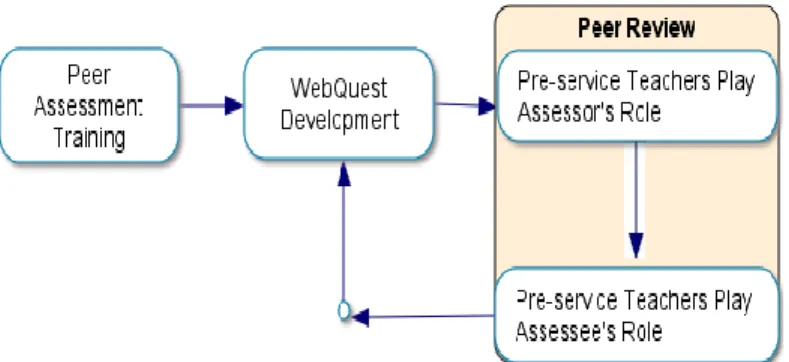
As Figure 1 shows, the peer assessment model di-rected students through the process of peer assessment training, initial WebQuest development, peer review process, and WebQuest final revision. Since
most pre-service teachers had never had any previous peer assessment experience, training was provided to introduce peer assessment to them. Pre-service teach-ers were encouraged to ask questions and voice their concerns. A clear message was delivered to
service teachers that peer assessment would be used only as a formative approach to help them improve their WebQuest projects. Therefore, their final project grades would not be influenced by peer ratings. After-wards, pre-service teachers studied and discussed the marking criteria of the WebQuest projects. They were then presented two example WebQuest projects and practiced on rating and commenting upon these pro-jects based on the marking criteria.
WebQuest projects created by pre-service teachers were uploaded to the Discussion Board forum in Blackboard for peer assessment. Blackboard is a course management system that provides an integrated set of web-based tools. Embedded in Blackboard, Dis-cussion Board is a communication tool that enables users to post messages asynchronously online. Each pre-service teacher was randomly assigned two peers’ WebQuests to review (assessor role). As a result, each pre-service teacher received two peer reviews for his own WebQuest (assessee role). During the review/ assessment process, pre-service teachers were explicit-ly instructed that they should not onexplicit-ly rate their peers’ performance, but also identify issues and provide con-structive feedback on how peers should further im-prove their WebQuests. After viewing grades and feedback provided to their own projects by peers, pre-service teachers were instructed to go back to view and improve their own WeQuest projects. At that point, all participants were informed that peers’ rating and feedback may vary in quality. Therefore, they should judge the quality of feedback and decide which suggestions to adopt or not adopt. After WebQuest revisions, pre-service teachers submitted their updated WebQuest projects to the instructor (researcher). Data Collection and Analysis
Data collected in this study include both ver-sions (prior to and post peer assessment) of pre-service teachers’ WebQuest projects. Once collected from the students, both versions of WebQuest projects were graded and analyzed by the instructor and an in-dependent rater to identify issues in the three areas previously discussed (scaffolding, higher-order think-ing skills, and technology integration).
To ensure that the scoring process of pre-service teachers’ WebQuest projects was consistent, the re-searcher and one trained independent rater blindly graded all WebQuest projects based on the same ru-bric used in peer assessment. The inter-rater reliability of the researcher’s scoring and the independent rater’ scoring was satisfactory at 0.89. The researcher and
the grader also examined both versions of all
WebQuests (pre- and post peer assessment) and identi-fied issues in the three major areas presented in those projects. The researcher and the grader reached 100% agreement on issue identification after discussion. Results
SPSS (Statistical Package for the Social Sci-ences) version 18.0 was utilized for data analysis. The assumption that data came from a normal distribution was tested using the Shapiro-Wilks test. Results indi-cated that the Sahpiro-Wilks Test was not significant at the normal 5% level in both groups. Therefore, a normal distribution of the scores of WebQuest projects was assumed. Differences in quality of WebQuest pro-jects before and after peer assessment were compared by Paired Sample T-Test, which indicated that scores of the final version of WebQuest projects were signifi-cantly higher (M = 31.30, SD = 4.95) than scores of the initial version (M = 26.95, SD = 5.52), t (42) = 8.8737, p < 0.0001, Cohen’s d = 0.83.
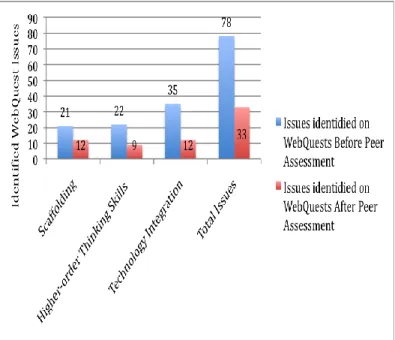
Examination of the initial version of WebQuest projects (prior to peer assessment) identified 78 issues in the three areas (21 issues on scaffolding, 22 issues on higher-order thinking skills, and 35 issues on tech-nology integration), as some projects had more than one issue recognized. Comparison of the issues found on the initial and final versions of WebQuests suggest-ed a considerable improvement by rsuggest-educing issues from 78 to 33 (see Figure 2). In other words, a little