Enforcing Wildfire Prevention Regulations:
Evaluating Enforcement Agencies in the County of
San Luis Obispo
Carly A. Hudak
California State Polytechnic University San Luis Obispo, California
This project aims to evaluate the enforcement of wildfire prevention policies in the County of San Luis Obispo. In the past few years, a series of highly destructive wildfires have ravaged the state of California, leading to scrutiny of wildfire prevention and its enforcement. This study focused on the County of San Luis Obispo to analyze the agencies responsible for enforcing wildfire prevention. In the County of San Luis Obispo, the County Planning and Building Department, County Fire Department, and Cal Fire State Department cooperate to enforce wildfire prevention measures across the County. Personnel from these agencies were interviewed to provide a basis for understanding each agency’s modus operandi. These agencies cooperate to enforce a plethora of preventative regulations, as well as self-perform preventative measures across the County. Enforcement agencies face a multitude of difficulties in enforcing wildfire prevention regulations, including lack of funding, insufficient manpower, and critical media attention. Despite these difficulties, the County of San Luis Obispo operates at a reasonable level considering their resources; however, greater measures could be taken should changes occur. Some of these changes could include greater values for fines, stricter treatment of code violators, and distribution of some County responsibilities to city agencies.
Key Words: Wildfire Prevention, Fire Code, Cal Fire, County of San Luis Obispo, Enforcement
Introduction
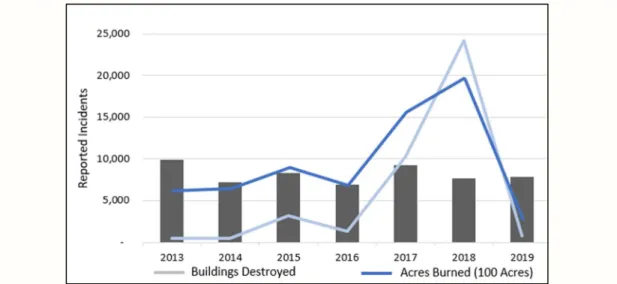
In just the last five years, 40,006 fires have been reported in California, with 5,321,800 acres burned and 39,671 buildings destroyed (Incidents Overview). To put this into perspective, California wildfires have burned an area only slightly smaller than the state of New Jersey in only five years. In the last 5 years, there have been some extremely publicized wildfires, such as the Camp Fire which became the most destructive wildfire in California history (“Incidents Overview”, n.d.)
Both federal and state legislatures have passed various legislative pieces to improve wildfire prevention. These measures include amendments to the California Building Code, Wildland Urban Interface Regulations, and the mandatory writing of Local Hazard Mitigation Plans. However, it is not clear how effective these measures have been in preventing such destructive wildfires. In this study, I will evaluate the County of San Luis Obispo (SLO) and its enforcement of wildfire prevention measures to see if these policies really seem to be making a difference.
Wildfire Risk
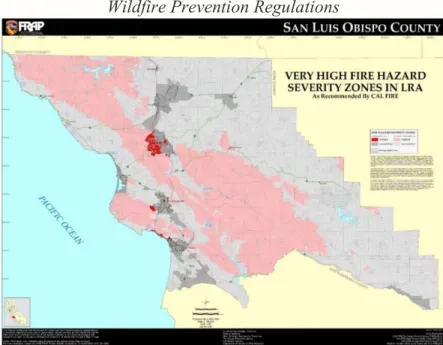
Wildfires are a bit of a misnomer in that they do not necessarily always occur in forests or wildlands. Many wildfires occur in areas designated by the federal government as wildland urban interfaces. There is no definitive boundary for these areas but are typically rural and involve some sort of civil infrastructure (Fire Management Board, 2019). As such, the public is not always aware of the wildfire risk in their area. Accordingly, Cal Fire publishes maps to indicate fire hazard severity zones in counties across the state. These maps are utilized to inform agencies on where to focus preventative measures. The maps are divided into two categories: State Responsibility Areas (SRA) and Local Responsibility Areas (LRA). State Responsibility Areas are areas protected by the state-level Cal Fire Agency, while Local Responsibility Areas are monitored by city and county agencies. The LRA Hazard Severity Map presented in Figure 2 provides the clearest picture of the wildfire risk to cities. From this map, you can see that the City of Atascadero has the highest risk in the county, with almost half of the city at very high risk. Additionally, San Luis Obispo, Avila Beach, and Pismo Beach also have some zones of very high risk. Additionally, much of the state’s wildlands fall under very high risk, but these areas are managed by the state.
These zones are labeled very high risk for a combination of factors, such as historical tendencies, burn pattern probability, presence of potential fuels, and exposure due to new construction. These maps are created through predictive modeling to best inform agencies on where to focus resources for wildfire prevention to minimize the chances of a wildfire. This provides some challenges in how to allocate
resources to enforce wildfire prevention across the county, as different areas may need to be more strictly managed than others.
Wildfire Prevention Regulations
Numerous regulations impact wildfire prevention programs throughout San Luis Obispo County. These regulations include local ordinances, state regulations, and federal laws. While, federal and state regulations must be observed across the county, more specific protection measures may vary from city to city.
Starting at the federal level, wildfire policy switched from suppression to prevention starting in the early 2000s. As such, multiple federal mandates were passed, specifically the Wildfire Prevention Act of 2017 and Executive Order 13728 in 2016. The Wildfire Prevention Act amended previous
legislation, expanding the role of the federal government in providing hazard mitigation assistance regardless of whether a major disaster is declared (U.S. House, 2017). This opened federal funding for prevention measures and policy implementation. As such, much of the federal focus in wildfire prevention is in fuel reductions and controlled burns to reduce ignitable materials in wildland areas (Busenberg, 2004). Executive Order 13728, also known as the Wildland Urban Interface Risk Management Program (WUI), created supplemental code requirements to the National Fire Protection Association’s Codes (“Wildfire Protection”, n.d.). The WUI Code acts in accordance with the NFPA codes to minimize the wildfire threat and prevent the spreading of wildfires (“Wildland Urban Interface Toolkit: Codes and Standards”, n.d.). Some of these measures include defensible space minimums, restricted building materials, and removal of fuels and hazards.
At the state level, California has adopted a series of stricter codes and regulations due to the dry climate and long fire seasons experienced in the last few decades (Schoennagel, 2017). According to Cal Fire, major legislation pertaining to wildfire prevention can be found in Chapter 7a of the
California Building Code, State Building Construction Regulations, and publications from the Office of the State Fire Marshall (County Fire Department, n.d.).
Lastly, preventative measures at the local level follow most of the guidelines set forth by the state and federal mandates. However, cities and counties can control how policies are implemented and which practice receive the most focus. In 2000, Congress pass ed the Disaster Mitigation Act requiring local governments to create Local Hazard Mitigation Plans (City of Atascadero Hazard Mitigation Planning Team, 2014). These plans are used to improve local government preparedness for natural disasters, such as wildfires, and provide training and educational outreach to the public (City of Atascadero Hazard Mitigation Planning Team, 2014).
Enforcement Organizations
Just as there are multiple levels of wildfire prevention law, there are multiple organizations responsible for implementing preventative measures and enforcing regulations. There are many federal departments that work in coordination with state governments to enforce their regulations. Some of these departments include the Forest Service, Department of the Interior, Bureau of Land Management, and many others (Gorte, 2011). These agencies typically provide support through financial assistance to states, 95% of which goes to protecting federal lands (Gorte, 2011). In short, states are typically performing enforcement as a proxy of federal agencies in return for funding for their programs.
At the state level, the main organization actively involved in wildfire prevention and policy enforcement is the Department of Forestry and Fire Protection, or Cal Fire. In contrast with federal agencies, Cal Fire operates extremely closely with local governments, imbuing them with authority and allocating resources based on diverse needs (Smith, 2011). Through strong relationships with local governments, Cal Fire can focus on statewide issues and preventative measures, while localities manage However, this also means the enforcement of state programs is ultimately up to local governments to implement (Smith, 2011).
Local governments, in turn, are responsible for managing wildfire prevention for the public at a county level. In the County of SLO, wildfire prevention regulations are enforced by multiple agencies. The County of SLO Cal Fire agency involves 23 fire stations arranged into six battalions. The
battalions handle emergency services, as well as investigations for citations, permits, and construction projects (County Fire Department, n.d.). Additionally, the County of SLO assists these efforts through the Planning and Building Department, by checking construction plans for adherence to wildfire prevention regulations (Planning and Building Department, n.d.). Lastly, the County of SLO Parks and Recreation Department manages parks, forests, and campsites for wildfires (Parks and Recreation Department, n.d.). These agencies must work together to enforce the numerous wildfire prevention regulations approved by the state and federal government. Inevitably, there are challenges in collaborating between various departments, which we will evaluate in this study.
Methodology
for enforcement is managed through various agencies. The interviewed parties were also able to provide insight on where challenges and inefficiencies may lie in enforcement of regulations.
The parties interviewed over the course of this project include:
Garret Veyna, Fire Marshall for the County of SLO Cal Fire Department
Elizabeth Szwabowski, Lead Plan Examiner for the County of SLO Planning and Building Department
Scott Witt, Deputy Chief of Fire Planning and Prevention for Cal Fire
The objectives of this report are as follows:
Identify the responsibilities of local agencies in preventing wildfires
Evaluate the enforcement process of regulations at the County level
Identify any challenges to the enforcement of wildfire prevention measures
Propose improvements to enforcement systems to rectify any inefficiencies discovered
Results
Agency Responsibilities
As part of enforcement, it is important to understand how responsibility for wildfire prevention is shared between the different agencies in San Luis Obispo. The three primary agencies coordinating for wildfire prevention in San Luis Obispo are the County of SLO Planning and Building Department, County of SLO Cal Fire Department, and the Cal Fire State Department. A member of each agency was interviewed and defined their department responsibilities as well as when they coordinated with other agencies.
According to Elizabeth Szwabowksi at the County Planning and Building Dept, the main
responsibilities of her department are to evaluate new plans for adherence to Chapter 7a of the fire code, insure submitted plans adhere to WUI requirements, and identify additional parties that need to review the plans. The Planning and Building Department focuses on 4 main criteria before a permit is issued, which directly relate to regulations under WUI. These include regulations on the type of roofing material, siding materials, window schedules, and a new regulation on eaves in WUI designated areas. However, this only covers a few of the regulations under the Fire Code and WUI. Regulations pertaining to landscaping, underground infrastructure, and grading are not reviewed by the County Planning and Building Department. The County will typically issue a permit if plans meet the criteria listed above then transfer the plans to the County Fire Department, who will review the plans in greater detail for further inspections. As such, the Planning and Building Department’s responsibilities for wildfire prevention are limited, compared to the County and State Fire Departments.
The County Fire Department has an extensive list of responsibilities in wildfire prevention. Garret Veyna, Fire Marshall for the County of SLO, states that the County Fire Department performs inspections annually for all buildings within the County, reviews new building plans and structures under construction, revises local ordinances pertaining to the fire code, distributes burning permits, and performs weed abatement in County owned lands. Similar to the County Planning and Building Department, the County Fire Department reviews new building plans; however, they focus on
to the Fire Code that must be submitted to the County of SLO for implementation into the local building code. One of the largest responsibilities of the County Fire Department is the annual inspection of all buildings within the County, both private and public, for adherence to wildfire prevention measures. This typically focuses on violations pertaining to overgrown grass, defensible space minimums, and material storage. Lastly, the County Fire Department must enforce regulations and investigate any complaints generated by the public. In emergencies, the County Fire Department may be required to send personnel and equipment to assist other regions.
Lastly, the Cal Fire State Department acts as an overseer for local Cal Fire Departments, such as in the County of San Luis Obispo. According to Scott Witt, Deputy Chief of Fire Planning and Prevention, Cal Fire provides guidance to local departments regarding new regulations, performs public outreach and education, and investigates all wildfires within the state of California. While the State Department also focuses on prevention, typically through inspections and fuel burnings, much of their focus is on investigating wildfires and determining their causes. Additionally, the state
department places a large emphasis on public outreach and education, which Scott believes has helped limit the occurrences of wildfires in communities.
The Enforcement Process
The enforcement of wildfire prevention measures can be a daunting task for agencies, considering the sheer volume of elements to inspect in the County of San Luis Obispo alone. Therefore, multiple agencies and groups are utilized to achieve a comprehensive and widespread system of enforcement. At the permitting level, enforcement is straightforward as there is little variability in how regulations can be enforced. From that point on, roles become a bit more complicated. Inspections can be performed for a few reasons: a citizen compliant, part of an annual inspection, or a fire recently occurred. Typically, complaints regarding minor offences like overgrown grass or fuel storage are submitted directly to the County Fire Department but may also be passed along by County Code Enforcement or the County Police Department. Calls regarding fires in progress are typically handled by a dispatcher and can be sent out to multiple agencies at once to respond. Additionally, inspections may not always be performed by members of the County Fire Department. For example, Garret Veyna stated that many of the annual inspections for wildfire prevention are performed by hired agencies of defensible space inspectors rather than county fire officials. This practice is also commonly done with fuel crews for controlled burnings and foresters for large wildland projects.
must be paid. It is rare that a fine is distributed from the fire inspectors; this will typically only occur if the violator has had multiple warnings or a punitive measure is warranted.
The Cal Fire State Department typically leaves enforcement efforts to local fire departments unless a wildfire has occurred in the region. In that case, Cal Fire will call on other Cal Fire County agencies to respond and offer assistance for wildfires. Then the state will send out an investigator to determine the cause of the fire and any extenuating circumstances. Then they will typically hand down a recommendation and perform public outreach to prevent a recurrence. For example, Scott Witt described a situation in which a small wildfire occurred near a freeway caused by how lake boats were being towed. Therefore, Cal Fire responded by creating billboards to inform the public of the risk and holding public outreach. In cases where criminal intent may be suspected, enforcement is usually handed off to the local police department for further investigation. At the state level, enforcement is usually performed through public education and outreach, rather than fines or abatement notices.
Challenges to Enforcement
While the enforcement process may seem very straightforward, there are plenty of challenges to successfully completing these tasks. Additionally, not every agency has the same challenges.
Elizabeth Szwabowski from the County Planning and Building Department is very satisfied with their enforcement process and able to easily coordinate with the County Fire Department. Considering their responsibilities, this seems appropriate.
However, it is a different story for the County Fire Department and State Fire Department. The most pressing challenge for the County Fire Department is manpower. Many tasks, like inspections require repeated in-person visits of thousands of buildings. Even with additional agencies hired to assist, it is difficult to maintain as vigilant a presence as needed. While fire officials at the County department are responsible for completing these inspections, they must also perform their other duties. Additionally, the County Fire Department would like to improve wildfire prevention by creating new ordinances, like weed abatement laws, but lacks the manpower to manage such a measure. Unfortunately, the solution for this is not as straightforward as hiring more inspectors. The other issue the County Fire Department faces is funding. While the County has sufficient funding for their current services, it does not have the ability to expand or implement new programs. Much of the funding for the fire department comes from the County of SLO General Fund based on a yearly budget, which can be subject to cuts based on the Board of Supervisor’s discretion. The General Fund is not only for paying salaries and purchasing equipment, but also for paying for fire prevention work. So, in cases where the fire department may need to pay for abatement that a property owner has not rectified, it comes out of the department budget and is not always immediately recouped. The other issue with funding is that fires tend to be seasonal, causing periods of low and high spending that can be unpredictable. As such, many of the cuts to the fire department’s budget are targeted at reducing staffing outside of the fire season, even though the amount of work that needs to be completed is still significant.
wildfire has not occurred for years, public awareness can turn to complacency as they underestimate the risk. Accompanying this, enforcement can also become complacent as focus is turned to other high-risk areas and funding decreases. Unfortunately, the main challenge in public outreach is dealing with fear. Media coverage of large wildfires tend to exacerbate fear of wildfires in other communities, which then lead to a large public outcry as to whether their communities are being properly protected. As such, the Cal Fire State Department must manage informing the public and maintaining their support through the calm and the chaos of fire seasons.
Conclusion
Successful prevention results in fewer wildfires. However, severely destructive wildfires still occur every year. There are concerns that local agencies may not be doing enough to enforce wildfire prevention measures, leading to record-breaking fire seasons in 2017 and 2018. The focus of this study was to evaluate how well enforcement agencies in the County of SLO have enacted wildfire prevention measures through analysis of their methods and resources. From interviews with employees of the County of SLO, County Fire Department, and Cal Fire State Department and in-depth understanding of agency responsibilities and their enforcement processes was created. From this, we can conclude that the wildfire prevention is being closely enforced and is a main target of interest for fire prevention agencies. However, lack of funding, limited manpower, and varied media attention generate challenges to enforcement of wildfire prevention regulations. So, while
enforcement agencies are not failing in their own efforts to enforce regulations, they are not able to practice enforcement to the degree they would choose. This report concludes that there are areas for improvement for enforcement and proposes some preliminary solutions that would improve these agencies enforcement abilities.
Potential Improvements
Despite these challenges, enforcement agencies are not failing in their prevention of wildfires. Scott Witt stated that prevention activities save roughly ten times what is spent on preventative measures, but you do not generate savings on fires that do not start. There is no simple solution to the variety of challenges enforcement agencies face in San Luis Obispo. While a blanket increase in funding may be helpful to solving manpower and logistical issues, sourcing that funding could be difficult.
Additionally, a series of severe wildfires like what occurred in 2017 and 2018 could wipe out any reserve funding. One approach to this issue is to deliver punitive fines more consistently to property owners that violate wildfire prevention regulations. This solution would solve two major problems for the County of SLO by establishing a source of new funding and bringing wildfire prevention
References
Busenberg, G. (2004). Wildfire Management in the United States: The Evolution of a Policy Failure.
Review of Policy Research,21(2), 145-156. doi:10.1111/j.1541-1338.2004.00066.x
City of Atascadero Hazard Mitigation Planning Team. (2014). LOCAL HAZARD MITIGATION PLAN. Atascadero, California.
County Fire Department. (n.d.). County of San Luis Obispo.
https://www.slocounty.ca.gov/Departments/County-Fire-Department.aspx
Fire Hazard Severity Zones Maps. (2009). California Department of Forestry and Fire Protection. https://osfm.fire.ca.gov/divisions/wildfire-planning-engineering/wildland-hazards-building-codes/fire-hazard-severity-zones-maps/
Fire Management Board. (2019). Federal Wildland Fire Policy Terms and Definitions (19-004).
Gorte, R. W. (2011). Federal Funding for Wildfire Control and Management (Rep.). Congressional Research Service.
Incidents Overview. (n.d.). California Department of Forestry and Fire Protection. https://www.fire.ca.gov/incidents/
Parks and Recreation Department. (n.d.). County of San Luis Obispo. https://www.slocounty.ca.gov/Departments/Parks-Recreation.aspx
Planning and Building Department. (n.d.). County of San Luis Obispo. https://www.slocounty.ca.gov/Departments/Planning-Building.aspx
Schoennagel, T., Balch, J. K., Brenkert-Smith, H., Dennison, P. E., Harvey, B. J., Krawchuk, M. A., . . . Whitlock, C. (2017). Adapt to more wildfire in western North American forests as climate changes. Proceedings of the National Academy of Sciences,114(18), 4582-4590.
doi:10.1073/pnas.1617464114
Smith, R. C., & Gilless, J. K. (2011). Institutional Obstacles to Success in Implementing a Statewide Community-Based Fire Planning Mandate. California Journal of Politics and Policy,3(1), 1-9. doi:10.5070/p23g62
U.S. House - Transportation and Infrastructure. (2017). Wildfire Prevention Act of 2017 (R. Ruiz, Sponsor) [H.R. 1183 from 115th Cong., 1st sess.]. Library of Congress.
Wildland Urban Interface toolkit: Codes and standards. (n.d.). https://www.usfa.fema.gov/wui_toolkit/wui_codes.html
Wildfire Protection. (2020). California Department of Forestry and Fire Protection.