ALE CONFERENCE PROPOSAL
1. Tony Andenoro
Senior Employee Development Specialist Human Resources Department
Texas A&M University
1111 Research Parkway, Suite 126, 1255 TAMU
College Station, TX, 77843-1255Email – [email protected] Office – 979.458.9703
Fax – 979.845.4188
2. Competencies of Leadership Professionals: A National Study of Premier Leadership Degree Programs
3. Research
4. This study examined leadership programs and their ability to prepare students for leadership positions. Data outlined the necessary leadership competencies and examined the curriculum of premier leadership degree programs. The study provided recommendations for leadership degree programs to better facilitate the learning of those interested in pursuing leadership positions.
5. Tony currently serves as the Senior Employee Development Specialist for the Employee Development area of the Human Resource Department at Texas A&M University. A native of Cleveland, Ohio, Tony earned his Bachelor of Science degree in Communication from the University of Toledo, his Master of Science in Educational Administration from Texas A&M University, and his PhD in
Leadership Development from Texas A&M University. He holds certifications in Professional College Teaching, Instructional Leadership Development, Diversity Education, and Administrative Leadership. His research interests include the link between emotional intelligence and critical thinking, student development and
empowerment, the globalization of leadership curricula, and empowering leadership creativity and intelligence.
COMPETENCIES OF LEADERSHIP PROFESSIONALS: A NATIONAL STUDY OF PREMIER LEADERSHIP DEGREE PROGRAMS
Anthony C. Andenoro, PhD Senior Employee Development Specialist
Human Resources Department Texas A&M University
1111 Research Parkway, Suite 126.27 College Station, Texas 77843-1255
979.845.9703 (phone) 979.845.4188 (fax) [email protected]
COMPETENCIES OF LEADERSHIP PROFESSIONALS: A NATIONAL STUDY OF PREMIER LEADERSHIP DEGREE PROGRAMS
INTRODUCTION
CONTEXT AND BACKGROUND OF THE STUDY
Leadership education has been a focal point of many higher education programs and curricula for many years. However, who should teach leadership and leadership development and how it should be taught has been a constant topic of discussion for educators across the curriculum. Due to this discussion, leadership education has become decentralized and administered in a variety of different formal leadership degree
programs within the academic arena. These programs include, but are not limited to public leadership, government service, holistic citizenship, master of business administration, and agricultural education programs.
As educators, our hope is that we are preparing leaders to be successful stewards of prosperity and productivity in the future. However with little cross curricular
communication among formal leadership degree programs, educators across universities are providing similar instruction to their students adding unnecessary redundancy to the student degree plan. Furthermore, these educators may not be teaching critical material to their students that could prove to be valued additions to the current curricula. This situation is a potential problem as students may not be receiving the holistic education that they hope to attain in a leadership degree program. This dilemma calls for an assessment of leadership education including what is being taught, who is being taught, how it is being taught, and who is teaching it at the premier higher education institutions advancing leadership education through their formal academic programs in the United
States. With regards to the literature, an assessment could bring cross-curricular collaboration enhancing the education of our students and future leaders of society.
STATEMENT OF THE PROBLEM
Current organizational mega-trends point to the emergence of a value shift that governs our global society (Barrett, 2004). This value shift includes a renewed focus on social responsibility, stewardship, service, and member fulfillment. This shift calls for a new type of leadership which incorporates the ability to comprehend and facilitate opportunities and successes for members through creative means while balancing the interests of the organization, members, and society as a whole. Barrett further explains that competitive organizations will make nurturing innovation and productivity their top priority by transforming their corporate culture (2004).
Due to this trend, leadership and leadership education will become increasingly complex for the future. Educators within formal leadership degree programs will be forced to assess their curriculum and how they are preparing leaders. This search will be incredibly difficult considering the vast number of educators across academia attempting to prepare leaders and the variety of competencies needed to be an effective leader.
Thus, it is important to examine a cross-curricular sample of highly ranked institutions and programs in their individual fields. It is also imperative to evaluate and determine how well the programs’ curriculum is equipped with the competencies necessary to address the new generation of leaders, organizational mega-trends, and an ever-changing society.
PURPOSE OF THE STUDY
The purpose of this study was to examine formal leadership degree programs and their ability to prepare professionals for leadership positions. This study provided data outlining the necessary competencies for leadership positions and examined the current activities and formal curricula included in three diverse premier formal leadership degree programs. This study also provided recommendations for the enhancement of current curriculum and methods in formal leadership degree programs to better facilitate the learning and empowerment of student populations interested in pursuing leadership positions.
RESEARCH OBJECTIVES
The following research objectives have been satisfied through examination of data collected in this study. However for the purpose of this paper we will focus on
Objectives 6, 7, and 8:
1. Describe the leadership programs based on contextual ideologies and curricula. 2. Illustrate the gatekeepers’ perceptions of the leadership competencies taught and
facilitated within his or her formal leadership degree program.
3. Discover and explain how the leadership programs developed these competencies. 4. Illustrate the graduates’ perspectives of the program faculty and the leadership
curricula’s impact on development of competencies providing for success in leadership positions.
5. Illustrate the respondents’ perceptions of the leadership competencies associated with their professional leadership positions.
6. Identify the necessary leadership competencies for leadership professionals based on the perceptions of the respondents.
7. Develop perspectives of global leadership priorities and accompanying competencies based on the respondents’ perceptions.
8. Evaluate and recommend revisions for formal leadership degree programs. REVIEW OF THE LITERATURE
The theoretical framework included three areas that assisted in the foundational understanding of leadership education, the “who,” “what,” and “how”. However, it is also critically important to examine global leadership. A global perspective will provide leaders with a foundation for a productive future within dynamic societies. As
perspectives become increasingly complex and more inclusive of people from diverse backgrounds, graduates will need a global perspective to manage diversity within teams to ensure for successful facilitation of activities, interactions, and organizations.
The “who” refers to the students within formal leadership degree programs and educators’ theoretical understanding of those students’ development. Understanding student development theory was broken into three areas. Linked to Erikson, psychosocial theory examines the individuals’ personal and interpersonal lives (Evans, 1996). The second area is cognitive-structural theory. This area illuminates changes in the way that people think, but not what they think (Evans, 1996). These were derived from Piaget’s work stressing the importance of heredity and environment in the intellectual
development and reveal the various ways that individuals develop cognitively (1952). The third area of student development theory is typology theory which examines the individual differences in how people relate to the world (Evans, 1996). These are based
on Jung’s work addressing the individual differences which occur in mental processing. Understanding the generational differences of students is also critical for leadership educators as the student population’s generational diversity increases within higher education. Hence it was important to consider this through the review of the literature to create a foundation for assessing leadership education as it relates to its student
population.
The “what” was broken into two areas concerning the contents of the formal leadership degree programs and past competency-based learning assessments within higher education. When addressing leadership education it is also of fundamental importance to critically examine leadership education theory and previously developed leadership competencies. This examination provided a theoretical foundation for the justification of curricula development and usage in formal leadership degree programs. Leadership is broadly defined as a process involving influence occurring within a group context involving goal attainment (Northouse, 2001). The foundational elements of how to lead and what leadership entails emerge from this definition.
Considering the leadership competencies and the curricula currently taught is also critically important to the “what” as it provides educators with a deeper understanding of cross-curricular perspectives of leadership and hopefully will lead to better teaching and more holistic curricula. However educational systems have been criticized through out the years for their inability to develop leaders (Gardner, 1993). This perspective means that it is paramount for educators to carefully consider the curricula they develop in an attempt to teach learners the competencies that will allow for them to be successful leaders. This content hinges on several considerations, including the student’s comfort
with the concept of leadership, identification of the elements of leadership, acceptance that leadership is a process, a heightened awareness of the practice of leadership, establishment of the purpose of leadership, identification of individual strengths and weaknesses on the way to developing a personal leadership approach, enhancement of analytical skills, and sharing of new and emerging leadership theories (Wren, 1994; Lewis, 1995; Watt, 1995).
The third piece, the “how,” includes research examining the learning preferences of students and the delivery strategies used in transferring skills to students which can be applied to “real world” settings. Hence, understanding learning preferences and
approaches becomes critical to the understanding of leadership competencies and leadership education. The world of leadership education is changing. The meaning of knowing has shifted from being able to remember and repeat information to being able to find and use it (Simon, 1996). This understanding is highly applicable to leadership settings as leaders attempt to disseminate information and develop solutions to problems which have yet to have been addressed. Thus as leadership educators, it is important to understand not only the student, but how to most effectively deliver the knowledge so they can use it in an effective manner.
The final piece of this area of the theoretical foundation examines the emerging priority of global or international focus within leadership education. The influence of globalization and technology requires new paradigms and new leadership competencies (Bueno & Tubbs, 2004). These paradigms are critical to the development of effective global leadership. Thus leadership education must address the perspectives which
leadership education, there is an emerging priority to discuss the importance of global perspectives, but there has only been a superficial examination of how educators can teach and empower global leadership within learners. DiStefano and Maznevski assert that global managers are expected to master an ever-expanding range of knowledge and skills, and educators are faced with the daunting task of preparing these managers to be as effective as possible (2003). Leadership education and global leadership are analogous and as such, leadership educators will be forced to address global paradigms and develop competencies which can be enhanced within our students to promote effective leadership for the future of ever dynamic societies.
METHODOLOGY
This study utilized the qualitative research paradigm in order to study the
interrelationships holistically. The data collected in this study provided insight into what leadership competencies were valued and taught by highly ranked diverse undergraduate and graduate academic programs. The programs were selected based on their excellent national reputation, faculty, scholarship, national service, graduate success, and overall program experience. The respondent perspectives obtained through assessments of these programs were then examined from a constant comparative perspective (Erlandson, Harris, Skipper, & Allen, 1993). The gatekeepers and graduates of these highly motivated academic programs identified the necessary competencies for success after graduation in the leadership work force. This examination allowed for holistic impressions to be made about curriculum revision and enhancement that added to the foundation and future of leadership education.
A purposive sample was used to maximize the range of specific information that could be attained from and about the context. The purposive sample allowed me to purposely seek typical and divergent data and insights to capture the essence of the situation.
My respondents included the program coordinators from three premier formal leadership degree programs. The program coordinators or gatekeepers provided me with perspective of what leadership competencies were prioritized at highly ranked programs and what curricula was currently being addressed to aid in the preparation of leaders through competency development. My respondents also included graduates of these highly ranked programs who were currently serving in a leadership capacity. They provided perspectives of their academic programs, including their perceptions of the program’s effectiveness in preparing the graduates for leadership positions, and if they saw any gaps in the curricula relating to what they felt were the necessary leadership competencies for success as a leader.
My methods of data collection consisted of telephone and face to face interviews with the purposive sample listed above and document analysis of curricula summaries and common degree plans. I completed a triangulation process addressing the program coordinators’ perspectives, graduates’ perspectives, and document analysis of curriculum.
It is paramount to establish trustworthiness for this study. Hence, credibility, transferability, dependability, and confirmability were essential (Erlandson, et al. 1993). Credibility was met through persistent observation, triangulation, referential adequacy materials, peer debriefing, and member checks. I used persistent observation by constantly interpreting within the context in different ways. Triangulation assisted in
establishing trustworthiness by collecting data from varying perspectives, specifically by addressing the program coordinators’ perspectives, learners or graduates’ perspectives, and document analysis of curriculum. Referential adequacy materials further provided my study with credibility as I was able to reference my materials through recorded interviews and field notes. Peer debriefing also established credibility as I discussed my research and findings with my committee members to provide for other perspectives within the context. Member checks with the respondents permitted me to verify data before including it in my final report. I used thick description by expressing my data with sufficient detail so others could tell if data is applicable to their own studies and data. I included a dependability audit so an external reviewer could check the sources of data using an audit trail, which provided interview notes and logistical details for data.
Data were analyzed using the constant comparative method (Glasser & Struass, 1967). This method starts to generate theoretical properties of the category which provide an understanding of the data and how it relates to and affects other categories. It is incredibly useful because it provided grounding for the study, adding to trustworthiness of the research. I communicated these results through case study reporting, as it allowed the reporting of multiple realities and interactions with the site to promote transferability to other sites.
RESEARCH FINDINGS, CONCLUSIONS, & RECOMMENDATIONS Cross-case analysis brings together the most critical pieces of multiple case study research (Yin, 2003). Thus, this form of analysis is critical to this study as it allows for impressions to be formed of the necessary components of multidisciplinary formal leadership degree programs. The cross-case analysis examined the triangulated data of
the three contexts, the findings of this research suggests conclusions about leadership education, the critical competencies necessary for student development and success within formal leadership degree programs, and recommendations for the future of leadership development. Due to the nature of this research, the significant findings are presented along with the researcher’s conclusions and recommendations for each of the three research objectives noted for this paper.
Research Objective Six
Identify the necessary leadership competencies for leadership professionals based on the perceptions of the respondents
Based on the perceptions of the gatekeepers and graduates, and confirmed by the summary of the literature, the following are noted as leadership competencies necessary for development within formal leadership degree programs to aid in the development of future successful leaders. These competencies have been characterized based on a two faceted approach recommended for holistic leadership development: personal
development, organizational development, and civic development. Eticcompetencies refer to those competencies relating to features or items targeted for development which can be considered outside of their role within a leadership system. Emic competencies refer to those competencies relating to features or items targeted for development with respect to their role within a leadership system.
Etic Competencies
• Understanding for Self, Values, & Strengths • Communication Skills (Written & Verbal)
• Ability to Address Situations & People with Respect to Individualism & Diversity
• Dynamic Viewpoint of Complex Political Issues
• Ability to Use Reflection as a Means of Understanding & Sharing Knowledge Emic Competencies
• Foundation of Leadership Theory
• Understanding for & Ability to Manage Change • Understanding of International Perspectives
• Understanding for, Ability to Work with, & Establish Relationships with Diverse Populations
• Ability to Vision, Strategize & Define Organizational Goals • Understanding of Organizational Behavior Theory
• A Philosophy of Power, Empowerment, and Social Dynamics
• Fluency for Public Discourse & the Ability to Solve Problems within Groups • Understanding of Social Entrepreneurism as it Relates to Contemporary
Societal Issues
• Understanding of Engaged Citizenship
• Understanding for the Historical Leadership Issues
Development of etic competencies aid in the critical personal development of the individual, while emic competencies assist students in developing competencies which will provide a successful foundation for organizational leadership and involvement.
However, foundationally, it is important to note the third context’s contention of a moral framework from which to design courses from. It is the recommendation that courses build from a foundation rooted in the idea of ethical decision making and bound by the moral fiber of good practice. Dewey (1938) wrote that education must begin with
purpose with an end in mind. “Moral purpose is about both ends and means” (Fullan, 2001, p. 13). Thus, I would advocate that leadership education must do the same, and if our end is civically engaged successful leaders, then our purpose is found in a moral foundation.
Research Objective Seven
Develop perspectives of global leadership priorities and accompanying competencies based on the respondents’ perceptions
Based on the respondents’ perceptions and the summary of the literature, it is essential for leadership educators to develop global perspectives and skills to be successful in leadership positions. Respondents from all three contexts noted the important of global perspective in leadership situations. It was determined that with the ever increasing technological advances, the world’s view is changing and becoming much smaller. Through the use of technology, information is readily accessible and communication can be facilitated asynchronously. This perspective lessens idea of local decision making and perspective. The program coordinator from context two identified that society is approaching a new age where local and state decisions will have global impact. These decisions will have social, economic, civic, and environmental conditions (Jacoby, 1996).
With the influence of globalization and technology requiring new paradigms and new leadership competencies (Bueno & Tubbs, 2004) and the expectation that global managers master an ever-expanding range of knowledge and skills (DiStefano &
Maznevski, 2003), educators will have a difficult time empowering true global leadership development. The challenge existing to design and execute educational curricula to
develop global leaders was noted within the first context as the program coordinator explained that globalization of curriculum and student perspectives is an ever growing priority. It was also noted by those within Context II that global perspectives are inseparable from leadership curricula as educators attempt to create holistic leaders for the future. The respondents of Context III advocated that globalization is a major
concern and activities such as immersion exercises, along with multiple methods as noted will aid in the development of global leaders. This perspective was validated by
DiStefano and Maznevski (2003).
Leadership education and global leadership are analogous and as such, leadership educators will be forced to address global paradigms and develop competencies which can be enhanced within our students to promote effective leadership for the future of ever dynamic societies. Along with idea Bueno and Tubbs’ (2004) list six competencies for success in global leadership communication skills, motivation to learn, flexibility, open-mindedness, respect for others, and sensitivity, competencies can be extrapolated from the responses provided and emerging themes . If leaders are continually challenged to use global perspectives, then it is imperative that leadership educators provide learners with the tools to effectively develop these competencies in an increasingly global society. The following is an interpretation of the shared global competencies listed by Bueno and Tubbs (2004) and the respondents from the three contexts for success in global
Figure 1. Identified Global Leadership Competencies as Noted for Global Leadership Success as Perceived by the Respondents and Bueno & Tubbs (2004).
Due to the emerging priority of global leadership, I would advocate that leadership education adopt a synergistic balance of leadership competencies and international perspectives built to develop global leaders for the future. I would also advocate that this balance be built from a foundation of moral purpose and developed through a series of immersion exercises and service-learning opportunities. Leadership educators are asked to provide a delicate balance of challenge and support as students embark upon an experiential adventure into learning. This delicate balance of challenge
and support was first identified by Sanford (1962). Knefelkamp (1974), further defined this idea stating that an educator must challenge, however if the challenge becomes too great the student will retreat, but if the support provided is too great, it will impede the challenge and the student will stagnate.
Research Objective Eight
Evaluate and recommend revisions for formal leadership degree programs
Based on the literature and respondent perspectives four recommendations can be made for the revision of leadership education. These revisions are expansion of current curricula, renewed focus and attention to global perspective, enhanced faculty
development opportunities, and grounding in moral and ethical purpose. Expansion of Current Curricula
It was noted by respondents within all three contexts that curricula must be expanded to include certain key ingredients for the development of leadership
competencies. Within the first context it was noted that the inclusion of contemporary leadership theory, such as Servant-Leadership, could enhance the current curriculum. Courses which attempt to develop critical and creative thinking skills were also identified for curricula enhancement. More defined communication courses were also identified as potential means for leadership skill development within the curricula. Within the second context it was suggested that the courses be developed including, group dynamics, political psychology, human resource management, conflict resolution, and collective bargaining. Noting that the context offers a great conflict resolution program, graduates addressed the possibility of collaborative courses which allow for the solution focused application of theory. It was also identified that a better understanding for group
dynamics would add to their small group interactions which the encounter daily in their leadership positions.
Renewed Focus & Attention to Global Perspective
This area was a foundational consideration for all three contexts and noted as a critical priority for the future of leadership education. This idea was validated by the research defining that the influence of globalization and technology requires new paradigms and new leadership competencies (Bueno & Tubbs, 2004). Leadership education must address the perspectives which encompass the dynamic ideologies and perceptions of our world’s societies and, as such, educators must teach and empower global leadership within learners. I would advocate that the competencies listed by Bueno and Tubbs (2004), communication skills, motivation to learn, flexibility, open-mindedness, respect for others, and sensitivity, be developed within leadership education to ensure for successful future international interactions. Immersion and service-learning opportunities should also be considered here for development of individuals both
personally and professionally. These experiences can have a tremendous impact and change student perspectives, providing them with more holistic foundations of thought.
Faculty Development
With the insurgence of a need for global perspective and the dynamic student populations, educators will need to become more adept with technology, student development theory, and active learning practices. I would advocate that faculty be charged with addressing not only what to teach but how to teach it. This charge is critical with regards to our student’s development and engagement.
It is also recommended that faculty develop an understanding for mentorship and the delicate balance of challenge and support as outlined by Sanford (1962). This understanding can then be developed into ability which will provide a solid foundation for student learning.
Finally, educators must collaborate. Collaboration is essential as there is no singular pot from which to distribute leadership education. Leadership education has grown with the growth of society and, as such the charge must be divided equally amongst the academic arena. Departments of Public Policy, Communication,
Agriculture, Business, Sociology, Psychology, Education, and Political Science must combine forces to effectively manage the breath of leadership education.
Grounding in Moral and Ethical Purpose
Somewhere along the way the altruistic nature of leadership was lost on the idiosyncratic perspective of management. As noted by Bennis and Nanus (1985), managers do things right, but leaders do the right things. This statement is critical to consider for leadership education. Leaders need a moral foundation from which to make decisions. Thus, it is critical for leadership educators to ensure that leadership education is immersed in a pool of moral purpose. I would advocate that all courses examine practice from the question of “why do leaders act in the capacity that they do”. The examination can provide for moral and philosophical debate leading to better practice and application of leadership theory, ultimately resulting greater organizational and follower development.
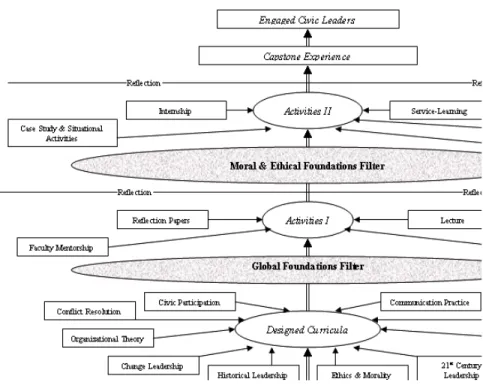
The Foundational Approach to Leadership Development Model
Based on these four recommendations for development, I have created a model to demonstrate the practical application of leadership education and enhance the
development of leadership competencies with students enrolled in formal leadership degree programs. The model is a vertically progressive example of how leadership development can be administered. The bottom level of this model is the leadership educators. Without a foundational, a building will fall. This is the idea behind placing the leadership educators at the base of the model, as they provide the structure and support for leadership development. Without leadership educators, leadership development does not take place.
The next level expresses the need for constant and intensive faculty development and collaboration to assist as a foundational element for success in leadership
development. Faculty members are asked to assess, evaluate, and revise practice based on the newest and most innovative means of teaching and communicating, and with regards to student development theory. As noted by the literature (Fritz & Brown, 1998) and the respondents from all three contexts, it is absolutely critical for faculty to create cross curricular bonds which will enhance collaborative opportunities. Through development and collaboration, faculty will establish the most effective means for leadership development.
The next level demonstrates the designed curriculum that was identified by the respondents as critical to the development of leadership competencies within students. These courses then pass through the global foundations filter. This filter is a reminder that due to the importance of global leadership perspectives and priorities, educators must
globalize or incorporate perspectives of global situations and international perspective within their curriculum.
Activities I refers to the activities which engage students in a comfortable low-risk environment. These curricular-activities provide students with challenges, but balance support to assist in the foundational development of students and their ability to lead. Following these, a line of reflection is drawn to account for real learning. Jacoby (1996) noted that learning and development do not necessarily occur as a result of experience itself but as a result of a reflective component specifically designed to foster learning and development. Thus, it is absolutely critical for leadership learning and development to encompass a component of reflection.
Next the progression moves through another filter titled, the moral and ethical foundations filter. This filter was chosen as a necessary part for leadership development because moral and ethical decision making is critical to the leadership process. Without this foundational filter educational materials can be delivered within a context left open for interpretation by the students and ungrounded in the moral fiber of ethical decision making.
The next set of activities, Activities II, calls for application of the information, knowledge, and skills garnered earlier in the progression of the model. These activities are characterized by a developing level of challenge exhibited by more professional, higher risk activities. These activities, although higher risk, are still highly supportive and coordinated by faculty members. This stage of activities is also followed by a line of reflection. Reflection is necessary, because regardless of the activity and risk level, it is essential to reflect to ensure for a well nurtured learning experience.
The Capstone Experience, as it alludes to, is a culminating experience where a student is forced to apply all the given knowledge and skills achieved within the leadership development progression. I would advocate that this experience should encompass creation of a civically minded research service learning project within their community, state, nation, or abroad. This experience should be a “real grassroots”
experience, providing students with an understanding of how to empower change through assessment, creation, implementation, and evaluation of a program. The faculty
member’s challenge becomes more central to the experience, as students are forced to seek out solutions and information on their own. This experience can be frustrating for students as they expect information and resources to be provided for them. However, if administered properly, the experience will provide them with the experience and
confidence to succeed as engaged civic leaders within society, the final level of the progression.
The following has been termed the Foundational Approach to Leadership Development. The word choice for this model was intentional in its origins.
“Foundational Approach” implies active engagement of students through dynamic means and “Development” was used as it implies the inescapable connection between student development and leadership education.
REFERENCES
Barrett, R. (2004). Mega trends for the future of work: building a successful corporate climate. Retrieved September 8, 2004 from
http://richardbarrett.net/download/future_of_work.pdf
Bennis, W. G., & Nanus, B. (1985). Leaders: The strategies for taking charge. New York, NY: Harper & Row.
Bueno, C. M., & Tubbs, S. L. (September, 2004). Identifying global leadership competencies: an exploratory study. TheJournal of American Academy of Business, Cambridge, 5, 1/2. 80-88.
Dewey, J. (1938). Experience and education. New York, NY: Simon & Schuster. DiStefano, J. J. & Maznevski, M. L. (2003). Developing global managers:
integrating theory, behavior, data, and performance. Advances in Global Leadership, 3, 341-371.
Erlandson, D. A., Harris, E. L., Skipper, B. L., & Allen, S. D. (1993). Doing naturalistic inquiry: A guide to methods. Newbury Park, CA: Sage Publications, Inc.
Evans, N. J. (1996). Theories of student development. In S.R. Komives, D.B. Woodward Jr., & Associates, Student services: a handbook for the profession (3rd ed., pp. 164-187). San Francisco, CA: Jossey-Bass
Fritz, S. M. & Brown, F. W. (1998). Leadership education courses and programs in departments of agricultural education. Journal of Agricultural Education, 59, (3). 57-62.
Fullan, M. (2001). Leading in a culture of change. San Francisco, CA: Jossey-Bass. Gardner, J. W. (1993). On leadership. New York, NY: Free Press.
Glasser, B. G., & Strauss, A. L. (1967). The discovery of grounded theory. Hawthorne, NY: Aldine.
Jacoby, B., & Associates, (1996). Service-learning in higher education: Concepts and practices. San Francisco, CA: Jossey-Bass.
Knefelkamp, L. L. (1974). Development instruction: Fostering intellectual and personal growth in college students. Unpublished doctoral dissertation, University of Minnesota, Minneapolis.
Lewis, C. T. (1995). The grammar of leadership education. The Journal of Leadership Education, 2(1), 3-12.
Northhouse, P. G. (2001). Leadership: theory and practice. Thousand Oaks, CA: Sage Publications, Inc.
Piaget, J. (1952). The origins of intelligence in children. New York, NY: University International Press.
Sanford, N. (1967). Where colleges fail: A study of the student as a person. San Franscisco, CA: Jossey-Bass.
Simon, H. A. (1996). Observations on the sciences of science learning. Paper prepared for the Committee on Developments in the Science of Learning for the Sciences of Science Learning: An Interdisciplinary Discussion. Department of
Psychology, Carnegie Mellon University.
Watt, W. M. (1995). Teaching essential behaviors of leadership: a rationale and syllabus. The Journal of Leadership Studies. 2(1), 149-161.
Wren, J. T. (1994). Teaching leadership: the art of the possible. The Journal of Leadership Studies. 1(2), 71