ISSN: 2252-8938 97
Type2 Fuzzy Soft Computing Technique for Image
Enhancement
U. Sesadri1, B. Siva Sankar2, C. Nagaraju3
1
Department of Computer Science and Engineering, Vaagdevi Institute of Technology and Science, Proddatur.
2
Vaagdevi Institute of Technology and Science, Proddatur.
3
Department of Computer Science and Engineering, YSRCE of YVU, Proddatur.
Article Info ABSTRACT
Article history: Received May 24, 2015 Revised July 14, 2015 Accepted August 3, 2015
The mainpurpose of Image enhancement is to process an image so that outcome is more appropriate than original image for definite application. The fuzzy logic isone of the soft computing techniques to enhance the images by eliminating uncertainty.In this paper efficient type2 fuzzy logic technique is used to get betterquality image. This method consists of two steps. In the First step fisher criterion function is useful to generate type1 fuzzy membership value. In the second step based on type1 membership value fuzzy rules are derived to enhance the image. The type2 fuzzy method is compared with type1 fuzzy. The table values and graphs provethat the proposed method gives better results compared with fuzzy type1 method. Keyword:
Fisher criterion Fuzzy type1 Fuzzy type2
Membership function
Soft computing Copyright © 2015 Institute of Advanced Engineering and Science.
All rights reserved.
Corresponding Author: U. Sesadri
Department of Computer Science and Engineering, Vaagdevi Institute of Technology and Science, Proddatur, Kadapa District, Andhra Pradesh, India. Email: [email protected]
1. INTRODUCTION
Image enhancement is fundamentally improving theinterpretability or perception of information in images for humanviewers and providing better input for other automated imageprocessing methods. The primary objective of imageenhancement is to modify attributes of an image to make it moresuitable for a given task and anexact observer. Throughout thisprocess, one or more attribute values of the image are customized. Theselection of attribute values and the technique they are modified are specific toa knownjob. Furthermore, the observer-specificfactor values, such as thehuman beingillustration system and the observer's understanding, will bring inanimmense deal of subjectivity into the choice of image enhancementmethods. But no existing technique that can enhance a digitalimage without spoiling features. In [1], proposed algorithm based on contrast measure within the discrete cosine transform domain for image enhancement.The proposed algorithm is shown better result for low contrasted images. However it fails to retain significantcharacteristics. In [2], the author mainly focused on spatial domain methods which are histogram processing and point processing methods. It is not given any details regarding the computational cost of enhancement algorithms which play an important role for to choose an algorithm for real applications. In [3], the Mehter method with High-Pass Filtering, Histogram Equalization and Block Filtering used for enhancing the finger print image and the new Mehtre technique gives better performance compare to existing Mehtre method. In [4], by using aura alteration, the enhancement is applied on ultra sound images to predict the diseases of human body. It is not applicable to other medical images. In [5], used an erosion enhancement technique by using quality parameters like peak signal to noise ratio (PSNR) and mean square error (MSE) to enhance the gas burner images. This paper gives better results when PSNR is high and MSE with low value.
In [6], fuzzy logic and Artificial Bee Colonyoptimization method improve the quality of the images.This approach provides better performance than Ant Colony Optimization method. In [7], filtering and Histogram Equalization, gray scale manipulation and fast Fourier transforms used for enhancing the thermal images. In [8], genetic algorithm is used for enhancing and segmenting the image. In [9], the fingerprint images, color images and medical images are enhanced by using fuzzy logic approach. This method fails to enhance the video type images. In [10], fuzzy gray scale enhancement method used for enhancing the imageand is good for preserving and smoothing the edges. In [11], by using Dominant Brightness and Adaptive Intensity Transformation, the image enhancement is performed for low contrasted satellite images. The proposed technique is useful to avoid the over enhancement compare to existing techniques. In [12], adaptive thresholding and contrast stretching for enhancing the MRI knee images, which is used for medical applications.In preprocessing an image is processed for removing noise, automatic edge detection, edge or boundary enhancement, automatic contrast adjustment and segmentationand is not applicable for enhancing the damaged images when multiple noises are applied to an image. In [13], an Adaptive Contrast Enhancement Based on modified Sigmoid Function (ACEBSF) algorithm is used in various applications where images suffer from various contrast inconveniences and it giveshigh speed, good performance and lessCPU time for processing the natural images. In [14], the author presents fuzzy association rule mining for enhancing the mammogram image. This method has proven better for enhancing and it uses less processing time to enhance the image. In [15], based on novel algorithm with statistical operations and with neighbourhood computation, the image enhancement has been performed.This algorithm is good for preventing from side effects and it preserves the consistency and brightness of the image. In [16], Contrast Limited Adaptive Histogram Equalization (CLAHE) method for image enhancement and class 3 fuzzy C means clustering method for image segmenting. The proposed method issuperior for improving the threshold value at lesser CPU processing costand is not used for different objective functions like FCM (Fuzzy C-Mean) and C-mean. In [17], artificial intelligence used for image enhancement andprovides better results compare to spatial and frequency domain methods. It is not applicable for optimized enhancement and is not suitablefor computationaltime and faster response.In [18], the image enhancement performed based on fuzzy logic with histogram modifications for all color images and gray scale images. In [19], based on fuzzy type2 and morphological gradient method, the image edge detection is performed. But this method only used heights and approximations for defuzzification.
2. FUZZY TYPE 1
In a gray scale image the morphological gradient is defined as the difference between intensity values of two neighboring pixels. It belongs to structural element.
Is a gradient operator and is a vector.is
taken asy
j
x
i
(1)and
g
c
x
,
y
is a continuous space image is defined by
j
y
y
x
g
i
x
y
x
g
y
x
g
c cc
,
(
,
)
(
,
)
(2)Where,i and j are the unit vectors along x and y directions respectively. Its magnitude at point (x0,y0) is
x
0,
y
0
g
c
, measures the maximum rate of change in the intensity. The local maxima is2 2
)
,
(
)
,
(
)
,
(
y
y
x
c
g
x
y
x
c
g
y
x
g
c (3)In this paper we use Ei instead of
g
c
x
,
y
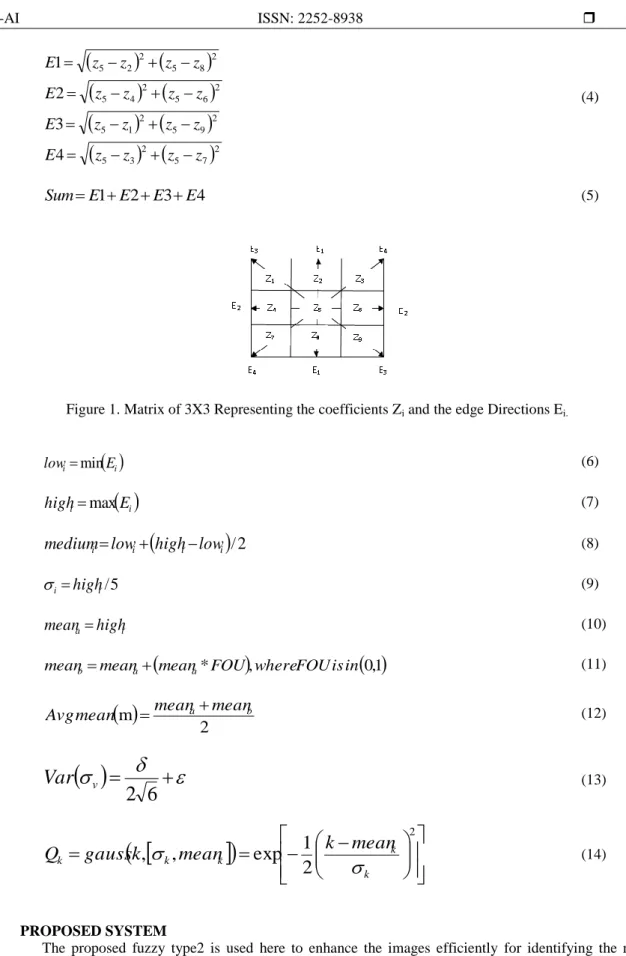
, apply 3X3 matrix in Figure 1, and calculate the coefficients of Zi with (4) and the directions of the edge mentioned in figure (2)
27 5 2 3 5 2 9 5 2 1 5 2 6 5 2 4 5 2 8 5 2 2 5
4
3
2
1
z
z
z
z
E
z
z
z
z
E
z
z
z
z
E
z
z
z
z
E
(4)4
3
2
1
E
E
E
E
Sum
(5)Figure 1. Matrix of 3X3 Representing the coefficients Zi and the edge Directions Ei.
ii E
lowmin (6)
ii
E
high
max
(7)
i i
/
2
i
i
low
high
low
medium
(8)5
/
i i
high
(9)i
a
high
mean
(10)
mean
*
FOU
,
where
FOU
is
in
0
,
1
mean
mean
b
a
a (11)
2
m
mean
amean
bmean
Avg
(12)
6
2
v
Var
(13)
22
1
exp
,
,
k k k k kmean
k
mean
k
gauss
Q
(14)3. PROPOSED SYSTEM
The proposed fuzzy type2 is used here to enhance the images efficiently for identifying the real objects for the processing of data. Two coordinates of the 2-D histogram expressed as L(i) and X(j) respectively, the mean and variance of the 2-D histogram of Fisher criterion can be given by the following equations
,
,
0
,
1
ki kjk
k
2,
2
,
0
,
1
2
k
kj ki
k
(16)Where mean is calculated as follows
s i i di i L i L i 0 0 ) ( ) ( *
(17)
t j j dj j X j X j 0 0 ) ( ) ( *
(18)
L s i idi
i
L
i
L
i
1 1)
(
)
(
*
(19)
L t j j dj j X j X j 1 1 ) ( ) ( *
(20)and the variance is considered as follows
s i ioi
i
L
i
di
0 2 0 2
)
(
*
(21)
t j joj j X j dj
0 2 0
2 ( ) * ( )
(22)
i
LidiL s i i i
1 2 1 21
* ()
(23)
j
X jdjL t j j j
1 2 1 21
* ( )
(24)
1 0 1 0 ) , ( ) ( L j L i j i N i L (25)
1 0 1 0 ) , ( ) ( L i L j j i N j X (26)Thus 2-D fisher criterion function is defined as below
2 2 1 1 0 0 j i j iD
(27)
21 2 1 2 2
*
,
j i oj oi T FD
D
t
s
J
(28)In fuzzy systems for modelling the process, we consider the three rules that depict the previous relationships between the image gradients that fuzzy rules are
1. If (E1 is H) or (E2 is H) or (E3 is H) or (E4 is H) then S is EDGE, where H is HIGH 2. If (E1 is M) or (E2 is M) or (E3 is M) or ( E4 is M) then S is EDGE, where M is MEDIUM 3. If (E1 is L) and (E2 is L) and (E3 is L) and (E4 is L) then S is No EDGE, where L is LOW
4. QUALITY PARAMETERS 4.1. Mean
Mean is used to find the average gray levels of the image. It is considered as:
Rx S
y
y
x
f
RS
mean
1 1
,
1
Where R and S are width and height of the image and f(x, y) is gray value. 4.2. Standard deviation
The standard deviation of gray level image is calculated as follows
Rx S
y
y
x
f
RS
st
1
2
1
,
1
Where R, S are the width and height of the image, is mean of the image, f(x, y) is gray level value of the image, is standard deviation.
4.3. Jaccard Index
Jaccard index is a statistic used for comparing the similarity and diversity of sample sets. It is calculated as:
Q P
Q P Q P Jac
,
Where P and Q are both empty, we define jac (P, Q) =1 and
0
jac
(
P
,
Q
)
1
.5. EXPERIMENTAL RESULTS
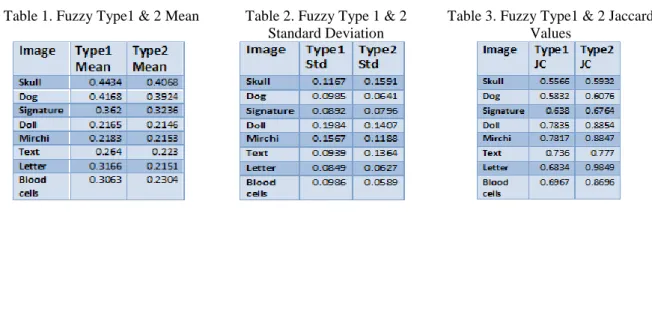
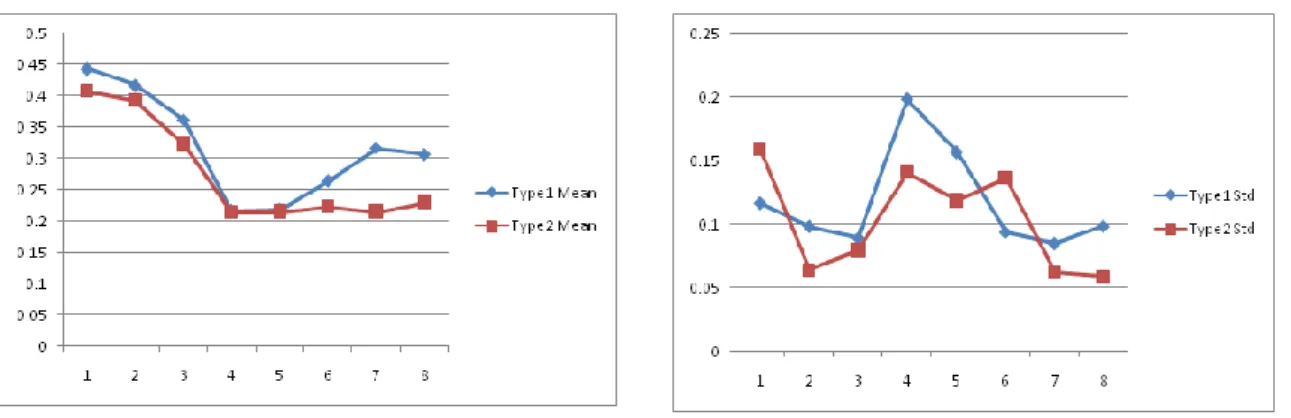
In this paper, the fuzzy type2 method is used for image enhancement. The quality parameters mean, standard deviation and jaccard formulae, are used for finding the performance of the fuzzy type1 and type2 on skull, dog, signature, doll, mirchi, text, letter and blood cells images. The tables of values are shown in table1 to table3. The figure 2 shows the output comparisons of fuzzy type1 and type2. Figure are shown in Figure 3a to Figure 4b which demonstrate the results of Type1 and Type2 fuzzy techniques and proved that the type2 is better than type1and Figure 4 is the combination of all Type 1 and Type 2 fuzzy values. According to the graphs for mean, standard deviation and jaccard formula optimal threshold is generated to enhance the images.
Table 1. Fuzzy Type1 & 2 Mean Table 2. Fuzzy Type 1 & 2 Standard Deviation
Table 3. Fuzzy Type1 & 2 Jaccard Values
Figure 2. Comparisons of Fuzzy Type 1 and Type 2
Figure 3a. Fuzzy Type 1 & Type 2 mean Figure 3b. Fuzzy Type 1 & Type 2 mean
6. CONCLUSION
In this paper we performed theimage enhancement techniques by using fuzzy type2. The fuzzy type2 is compared with type1 ondifferent kinds of images and quality parameters are evaluated. In most of the test cases the proposed method is giving better resultthan traditional type1. However it is not practically suitable for document type images because the characters of documents are very small so important characters may be lost.
REFERENCES
[1] Jinshan Tang, Scott Acton. Image Enhancement Using a Contrast Measurein the Compressed Domain. IEEE signal processing letters, 2003; 10(10): 289-292.
[2] Raman Maini, Himanshu Aggarwal. A Comprehensive Review of Image Enhancement Techniques. Journal of computing, 2010; 2(3): 8-13.
[3] Mustafa Salah Khalefa, Zaid Amin Abduljabarand Huda Ameer Zeki. Fingerprint image enhancement by develop mehtre technique. Advanced Computing: An International Journal, 2011; 2(6): 171-182.
[4] Sandeep Arya, Saleem Khan, Dhrub Kumar, Maitreyee Dutta. Image enhancement technique on Ultrasound Images using Aura Transformation. International Journal in Foundations of Computer Science & Technology, 2012; 2(3): 1-10.
[5] Pooja Kaushik, Yuvraj Sharma. Comparison of Different Image Enhancement Techniques Based Upon Psnr & Mse.
International Journal of Applied Engineering Research, 2012; 7(11).
[6] Adlin Sharo T, Kumudha Raimond. Enhancing Degraded Color Images Using Fuzzy Logic and Artificial Bee Colony. International Journal of Computational Engineering Research, 2013; 3(3): 356-361.
[7] Shweta Tyagi, Hemant Amhia. Image Enhancement and Analysis of Thermal Images Using Various Techniques of Image Processing. International Journal of Engineering Research and Applications, 2013; 3(2): 579-584.
[8] Komal R Hole, Vijay S Gulhane, Nitin D Shellokar. Application of Genetic Algorithm for Image Enhancement and Segmentation. International Journal of Advanced Research in Computer Engineering & Technology, 2013; 2(4): 1342-1346.
[9] Preethi SJ, K Rajeswari. Membership Function modification for Image Enhancement using fuzzy logic.
International Journal of Emerging Trends & Technology in Computer Science, 2013; 2(2): 114-118.
[10]Jaspreet Singh Rajal. Enhancement of Low Contrast Images using Fuzzy Inference System. International Journal of Science and Research, 2013; 2(5): 138-143.
[11]G Veena, V Uma, Ch Ganapathy Reddy. Contrast Enhancement for Remote Sensing Images with Discrete Wavelet Transform. International Journal of Recent Technology and Engineering, 2013; 2(3): 114-120.
[12]U Pavan Kumar, P Padmaja. A Hybrid Method for Enhancement of MRIKnee Images. International Journal of Engineering Trends and Technology, 2013; 4(10): 4348-4351.
[13]Shyam Lal, Mahesh Chandra. Efficien-+t Algorithm for Contrast Enhancement of Natural Images. The International Arab Journal of Information Technology, 2014; 11(1): 95-102.
[14]K Meenakshi Sundaram, P Aarthi Rani, D Sasikala. An Enhanced Mammogram Image Classification Using Fuzzy Association Rule Mining. International Journal of Innovative Research in Science, Engineering and Technology, 2014 3(3): 10315-10321.
[15]Nungsanginla Longkumer, Mukesh Kumar, AK Jaiswal, RohiniSaxena. Contrast enhancement using various statistical operations and neighborhood processing. Signal & Image Processing: An International Journal, 2014; 5(2): 51-61.
[16]Shivendra Singh, Manish Soni, Ravi Shankar Mishra. Segmentation of Underwater Objects using CLAHE Enhancement and Thresholding with 3-class Fuzzy C-Means Clustering. International Journal of Emerging Technology and Advanced Engineering, 2014; 4(4): 798-805.
[17]Gurpreet kaur, Rajdavinder Singh. Image Enhancement and Its Techniques- AReview. International Journal of Computer Trends and Technology. 2014; 12(3): 148-151.
[18]Shazia Siddiqui, Praveen Kumar, BPS. Senger. Fuzzy based Image Enhancement using Attribute Preserving and Filtering Techniques. International Journal of Computer Applications, 2014; 101(9)10-14.
[19]Patricia Melin, Claudia I Gonzalez, Juan R Castro, Olivia Mendoza. Edge-Detection Method for Image Processing Based on Generalized Type-2 Fuzzy Logic. IEEE transactions on fuzzy systems, 2014; 22(6): 1515-1525.
BIOGRAPHIES OF AUTHORS
U. Sesadri is currently working as Assistant. Professor and HOD in the Department of CSE in Vaagdevi Institute of Technology & science, Proddatur, Kadapa District, Andhra Pradesh, India. He received his M.Sc. in Mathematics from SV University, Tirupati, M.E in Computer Science and Engineering from Sathyabama University, Chennai and pursing PhD in Digital Image Processing from V.T. University, Belgaum. He has got 7 years of teaching experience. He has attended five National Level workshops and two international level conferences. He has organized 10 National level workshops and two National level paper presentations.
Bodicherla Siva Sankar is doing his M. tech in Vaagdevi Institute of Technology, Proddatur, Kadapa, A.P, and India. He received his B.Tech degree in Information Technology from J.N.T. University Anantapur and he has attended two workshops on “cloud computing & Big Data” and “Research challenges in Digital Image Processing”. And he attended two week faculty development program on “Network Security and Cyber Forensics”.
Dr. C. Naga Raju is currently working as Associate Professor and Head of the Department of Computer Science and Engineering at YSR Engineering College of Yogi vemana University, Proddatur, Kadapa District, and Andhra Pradesh, India. He received his B.TechDegree in Computer Science and Engineering from J.N.T.University, Anantapur, and M.Tech Degree in Computer Science from J.N.T.University Hyderabad and PhD in digital Image processing from J.N.T.University Hyderabad. He has got 18 years of teaching experience. He received research excellence award, teaching excellence award and Rayalaseema vidhyaratna award for his credit. He wrote text book on C & Data structures and Pattern Recognition. He has six PhD scholars. He has published fifty six research papers in various National and International Journals and about thirty research papers in various National and International Conferences. He has attended twenty seminars and workshops. He delivered 10 keynote addresses. He is member of various professional societies like IEEE, ISTE and CSI.